

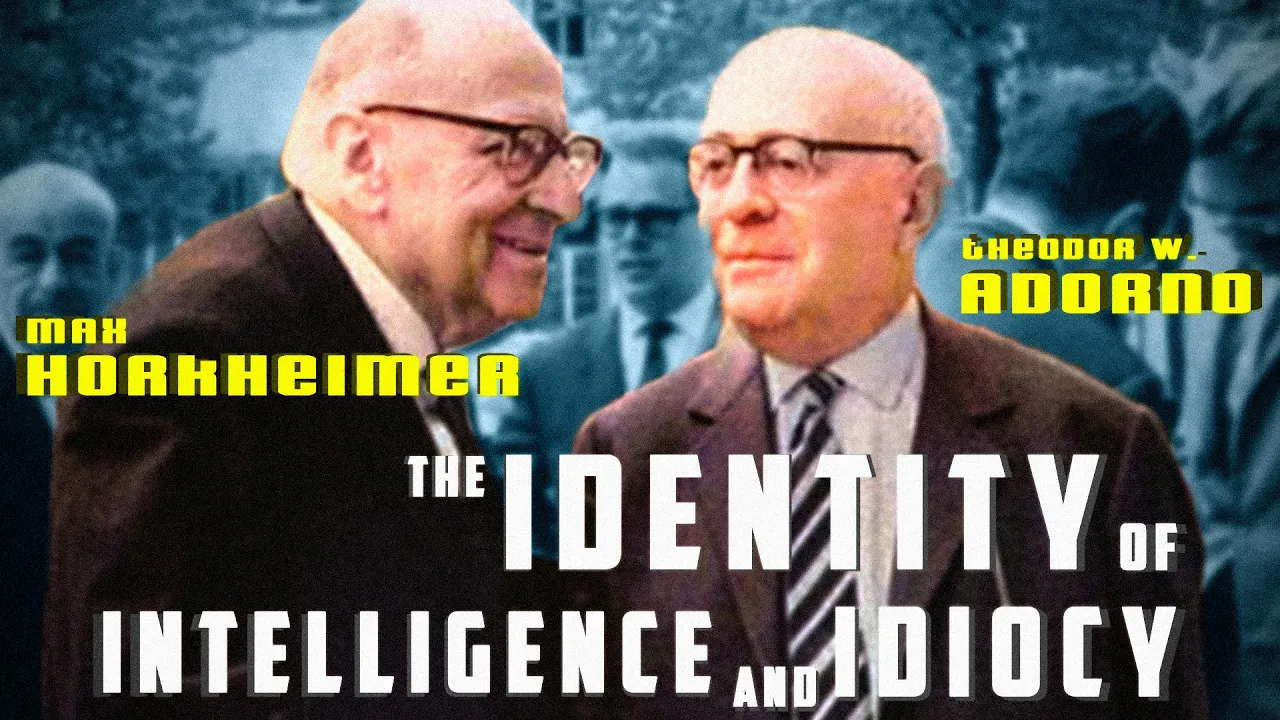





Adorno and Horkheimer argue that Enlightenment's promise of human emancipation through reason paradoxically enables domination by diffusing power from nature and sovereigns onto the collective body of humanity, which then imposes that power upon nature and others; this occurs because Enlightenment's emphasis on quantification, calculation, and rational control eliminates zones of mimesis and becoming, reducing everything to conformity and repetition, thereby creating conditions ripe for totalitarianism and self-immolation.
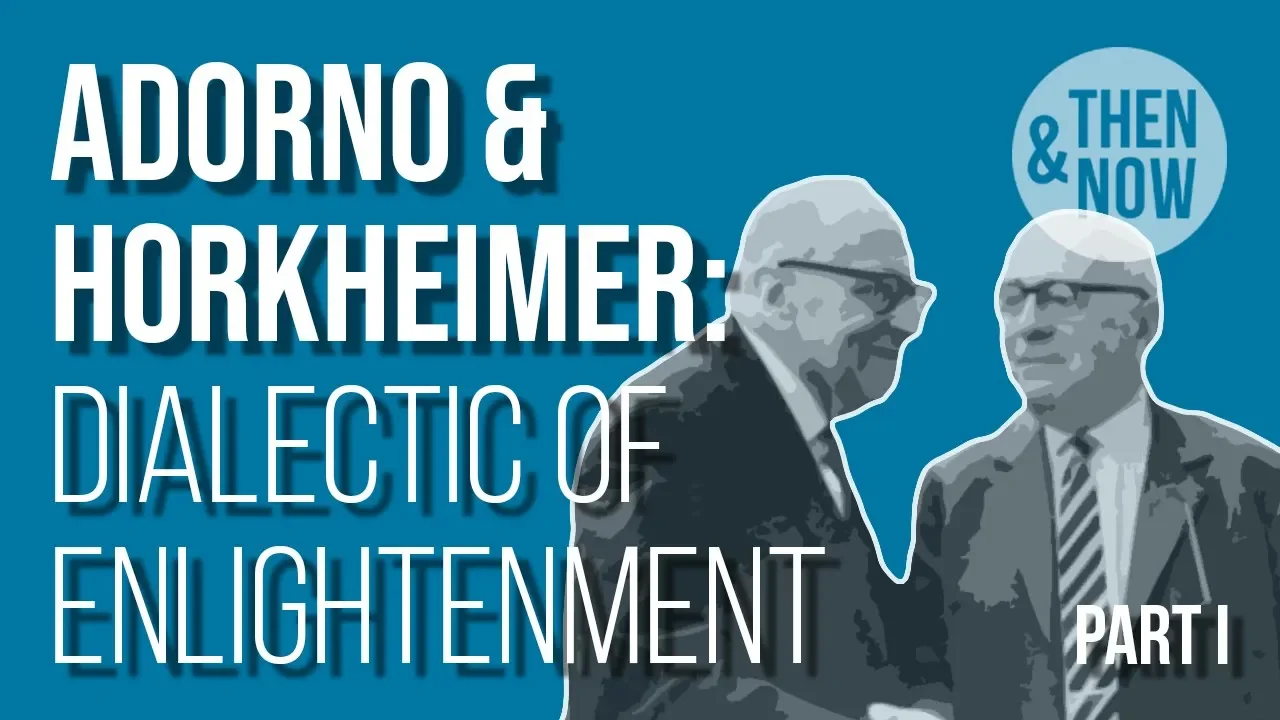
Adorno & Horkheimer: Dialectic of Enlightenment, Part 1 Explained
Added:The historical context and core values of the Age of Enlightenment, particularly the philosophical emphasis on reason, scientific progress, and emancipation from superstition.
Fundamental concepts of Marxist theory, specifically how capitalism shapes social consciousness, alienation, and the relationship between base and superstructure.
An introductory understanding of the Frankfurt School of Critical Theory and its goal of analyzing social structures and power dynamics.
The philosophical distinction between myth (mythos) and rational explanation (logos) in classical and Western philosophy.
Adorno and Horkheimer's specific critique of 'The Culture Industry,' which analyzes how mass media and consumer culture enforce social conformity.
Max Horkheimer's 'Eclipse of Reason,' focusing on the deep-dive transition from objective reason to subjective, instrumental rationality.
Jürgen Habermas's defense of the Enlightenment and his theory of 'Communicative Action' as a constructive response to the pessimism of early Critical Theory.
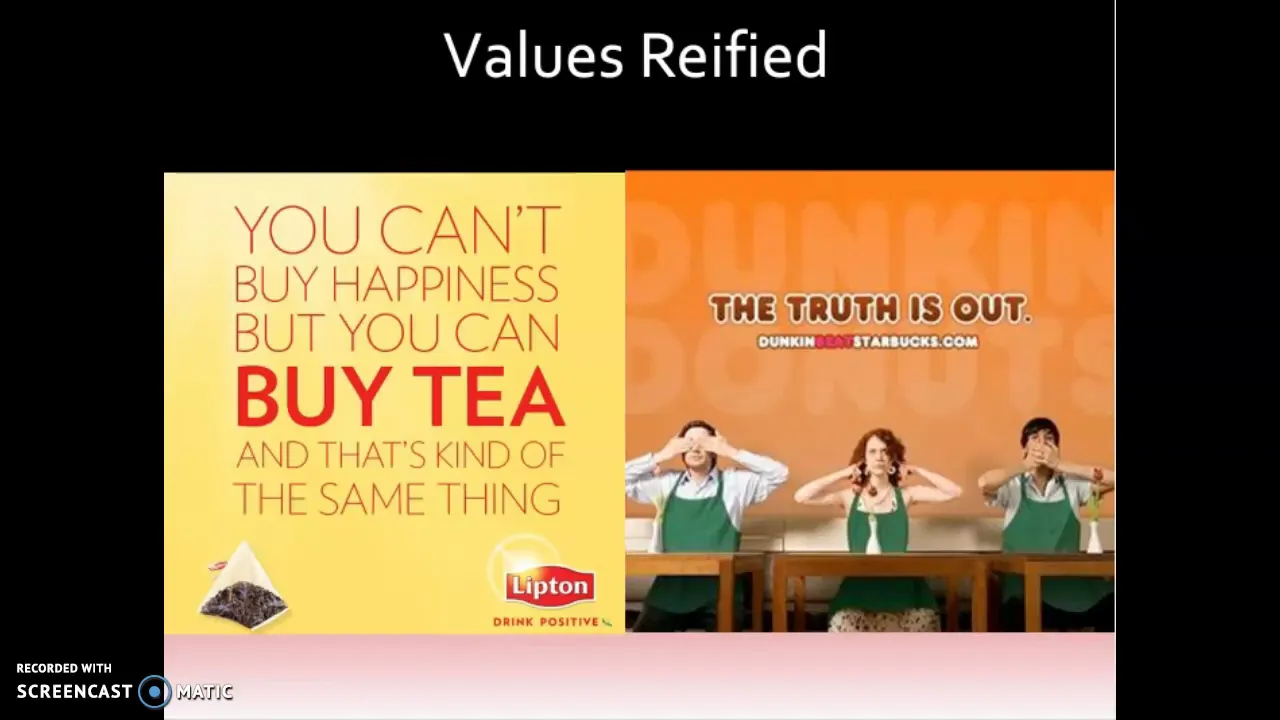
Applying the critique of technological rationality to contemporary societal issues, such as algorithmic bias, data surveillance, and digital economy structures.
17K views486likes49:28Original Release: 2021-06-05
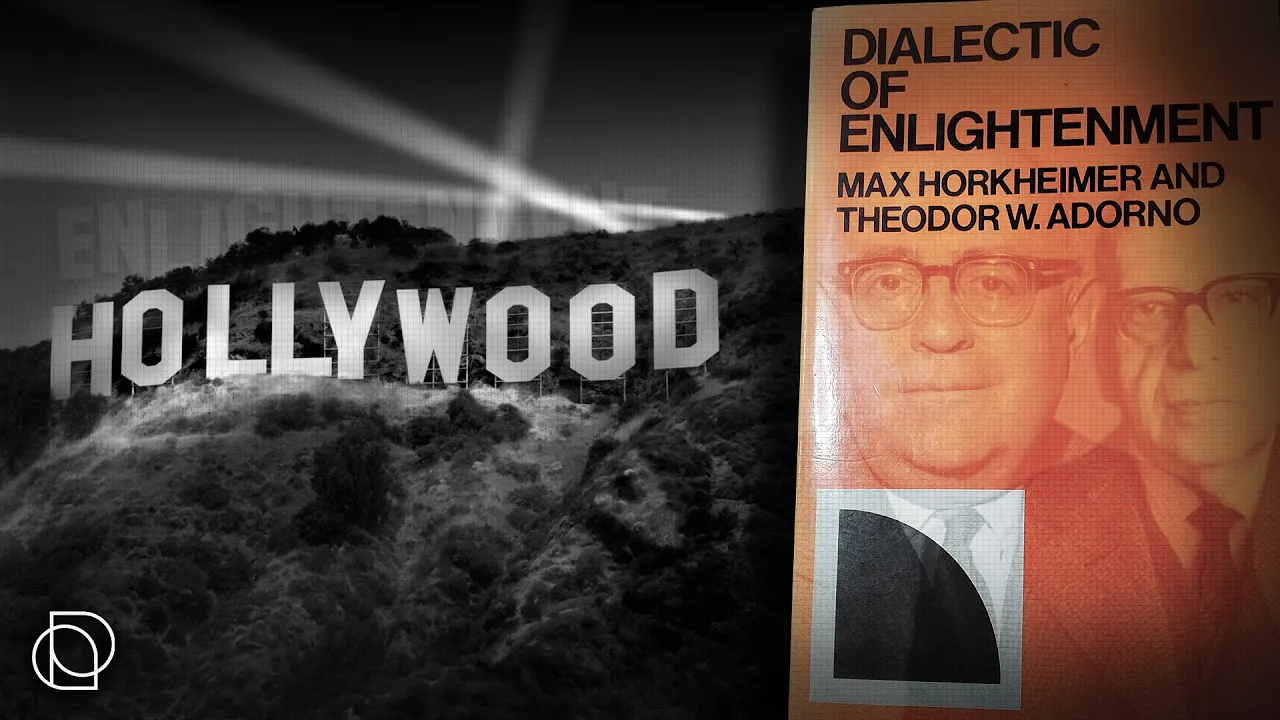
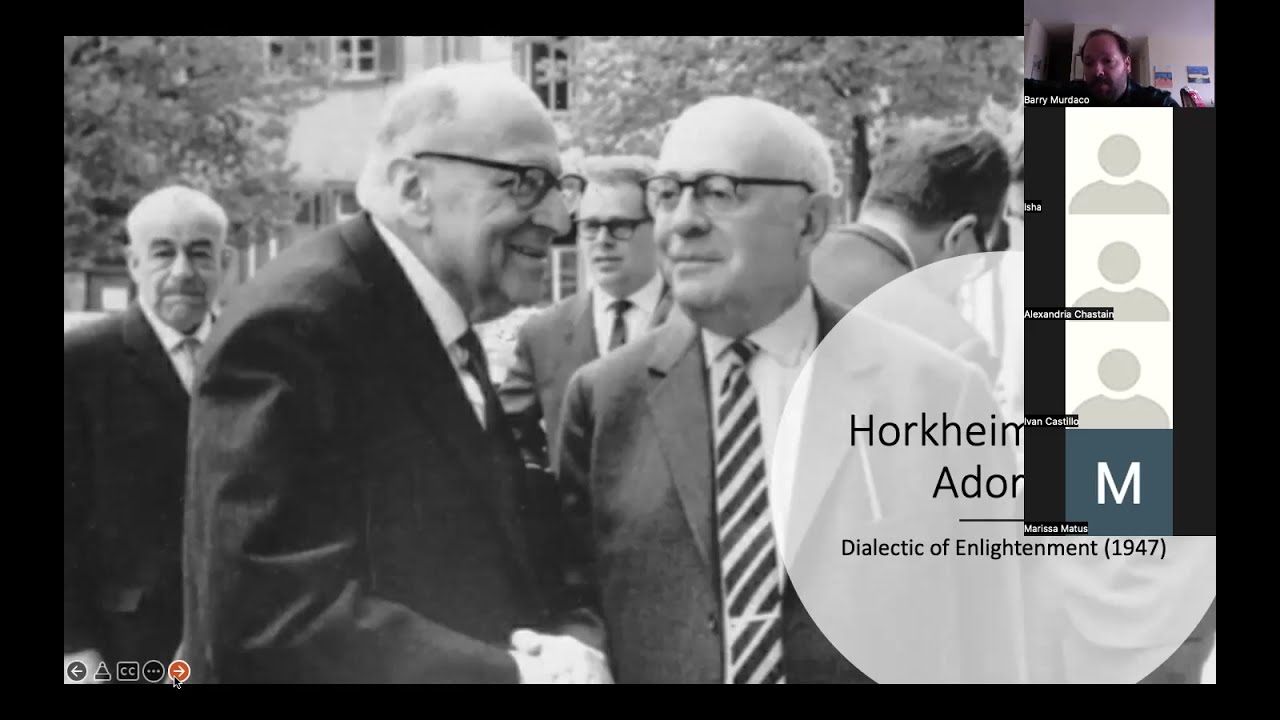
[Music] hey everyone back again today i'm going to take on adorno and horkheimer's dialectic of enlightenment now i'm going to do this in two parts covering the first three chapters here and the last two in the next episode but before jumping into it if you want to follow me anywhere other than here you can find me on instagram theory underscore and underscore philosophy or on twitter at david quino if you're new here welcome hi i'm david i try to explain philosophical texts and ideas in a way that makes them accessible to you so if you haven't already like share subscribe comment i'd love to hear from you and speaking of you know i read everybody's comments but i don't have the time to respond to all of them likewise with people leaving reviews on apple podcasts and any comments there i see them all i just don't have the time to respond to all of them but liking sharing subscribing helps me out a lot because i release videos every week and you know you wanna you wanna stay in the loop and if you wanna help me out monetarily you can do that via patreon or paypal and finally if you found this on youtube you'll be able to find it in podcast form anywhere where you get podcasts where there shouldn't be any ads or if you found me on some podcast platform you're going to be able to find me on youtube or sometimes i release videos so you know find me everywhere yeah so don't want to waste any more of your time with that stuff let's jump into theodore dorno and max horkheimer's the dialectic of enlightenment starting with chapter one the concept of enlightenment so the project of enlightenment was or came with it the promise of emancipating humans from superstition emancipating humans from tutelage or self self-imposed tutelage emancipating humans from nature and the tools that would come with it would be the products of reason not wealth or power so reason and rationalism rationality i'll just call it will come to reign in this moment in time but it hardly marked the end of what was known as domination or control in fact it simply transposed that formula onto others so what we see and they evoke the words of bacon or the ideas of bacon who suggests that the enlightenment project is one that displaces or i guess transfers power from nature from the sovereign onto the collective body of humanity who can then impose that power upon nature upon others upon lesser than them or who is viewed as being lesser than them so rather than marking an end to power enlightenment more or less corresponds to a moment in which power has been diffused throughout the general public to some extent now we're going to proclamatize that a bit and go through this in in how they give it to us but for now let's let's put that as our kind of guiding thesis here and i would like to add as a way to illustrate enlightenment specifically the dialectic of enlightenment the way that i like to understand it is with the emergence of technology with the kinds of technology that we come to know now for the most part they well i will just kind of maybe vulgarly say for the most part they make our lives easier but of course this comes with various caveats so the introduction of the personal cell phone was in many cases a way by which we could better communicate with our friends and families in a more efficient way but with that also came the dissipation of the nine to five working day where suddenly you're availa you have to be available all hours of the day because you can easily be text and by virtue of that you are expected to then give an immediate response so with this possibility with the relative ease afforded by these new communication technologies comes as well the very inhibition of the possibility it was meant to open up because with more free time apparently we could do more things that we liked because our lives got easier when in fact it meant the opposite likewise i like to think about the dialectic of enlightenment that is the tension between enlightenment and anti-enlightenment found within this idea of enlightenment in the emergence of nuclear weapons where nuclear weapons are a demonstration of intellectual technological scientific prowess which is a sign of progression you know if we were to put it quite simply but at the same time it is a sign of ultimate evil that is meant only to promise death rather than to actually make anyone's lives better so for adorno and horkheimer the enlightenment is something that is always held in contention it always brings with it the possibility of its undoing in the form of anti-enlightenment or what they call barbarism so with these organizing principles that come about with the enlightenment we see as well the very propensity to control to dominate not to liberate as the promise of reason once conveyed to us so by and large any kind of newness that we see or saw with the emergence of the enlightenment is more a cosmetic change than anything else because we still see domination occur we still see people going hungry even though we have the resources to supply for everyone on earth or at least to supply for people on earth much more than we are now even though we have these capacities we do not do these things we would rather have car lots filled with unsold vehicles that no one is going to be able to drive because someone isn't going to make a profit off of them so with the rationality or rationalism that is often associated with enlightenment comes as well a very prominent irrationalism one that doesn't seem to abide by any logic yet is baked into the system to such an extent that it you know has become naturalized and one of the great ways that we come to demonstrate this rationalism is an emphasis upon numbers upon graphs upon charts statistics quantification so anything that falls out of the purview of quantification something that can't be readily quantified is looked at with suspicion as something that is a relic of a time long gone of a time of superstition of a time of mythology of a time of magic and so we must exercise we must must purge the world of those moments of those zones so that they do not pose a challenge to the dominating logic of quantification but enlightenment is particularly effective at doing what it does and it is particularly pernicious because any challenge to it works to more or less reaffirm it because a challenge to it must assume the stance that is opposed to the naturalized domain of quantification of ordering of scientization anything like that and so because it has to stand outside of that sphere that has been naturalized that is we associate nature with a kind of quantification we impose upon nature a kind of ordering that doesn't exist in nature but we do that to it in order to better control it because something in order to challenge the system has to stand outside of it it is only the sign of a time-long past that has to then be further purged further exercise that has to be taken out of the system and what that does is it reaffirms the system's domination the system's ability to deliver the goods the system's righteousness over anything that might oppose it now they equate this potential that is the rooting out of any challenge to the system as totalitarian that is one of the ways that they characterize totalitarianism as a sniffing out as a kind of destruction of anything that opposes it but in the meantime before that thing is totally rooted out it has affirmed and strengthened the very system that feels itself under threat now where did enlightenment begin when did these logics begin to emerge that would come to crystallize into what we now know as enlightenment or to use another one of adorno's kind of popular terms when did this constellation of effects come into action to put together this constellation of the enlightenment or to exist among other various logics that would form a constellation they don't give us a very clear answer to this question when did it emerge because and if they're very clear about this that which we often position against enlightenment specifically things like superstition religion mythology have embedded within them the very same principles and logics that we see today or at the time that they're writing this in the mid-40s i guess the same kind of things that we see then so in the case of the bible for those that haven't read it i believe the third book is genesis uh genesis exodus leviticus numbers the fourth book numbers is a demonstration of this to a great extent in that it's it very much as the title suggests it's accounting of the uh the kind of armies that are present and then jump ahead a couple of books to joshua and that is just the total domination of the world by joshua and his people in the name of god and so with this we can obviously see the roots of this enlightenment logic this desire to command to control and to dominate so instead what they do is they contrast enlightenment with the world of magic where they say that mimesis so mimesis is like mimicry so to copy something where mimesis and substitution reigned by reigned i mean uh held dominion or was the kind of guiding principle so that's a point in which mimesis and substitution reigned not distance and control because with distance and control there isn't the possibility for mimesis because you are just subordinating that which is not yourself you're subordinating that which you do not understand you do not put yourself in a position to become that thing now as a kind of an aside i don't think they totally appreciate how complicated the idea is that they're putting forward and i don't know what their knowledge of the various anthropological stuff that was kind of emerging at that time and would come to emerge 30 40 years after them obviously i didn't know that but anyways because this is a very complicated idea this notion of becoming animal becoming other which we hear echoed in the word in the work of delusion gutari of course but it is a very fascinating one and it's one that i just as an aside i'm very very fascinated with now so we have this new distinction not between enlightenment and superstition or between enlightenment and religion but now we have a distinction between enlightenment and the world of magic likewise because they position myth and religion as being the roots or setting the roots for this thing called the enlightenment they say that the enlightenment is marked by a turn from the world of magic into myth then into enlightenment now i'm simplifying this greatly but i think that it gets the point across and in myth one of the ways that we see this logic of the enlightenment begin to emerge beyond the ways that i've already mentioned is that in myth all problems are effectively resolved any issue that is raised is resolved in a very familiar easy way likewise with the enlightenment so one of the ways that this plays out is by the homogenization of the possibility of of becoming so to speak in myth so in many myths humans are at least in the western kind of canon of myths humans are very much they or they they transpose themselves or they project themselves onto god so gods take on a human form and we see the same thing with the bible or at least from the move from the old to the new testament and so what we have is a general degree of conformity that would come to characterize the enlightenment specifically enlightenment under the culture industry that we'll get into in the next episode now whereas in the world of magic there was this possibility of mimesis there was then the possibility to undo who you are it was a moment of giving up yourself to become something else whereas in the age of an of conformity that we see the roots of in myth and religion what we see here is not giving up oneself but rather projecting oneself onto others and as an aside and i promise i won't do many more of these this is place itself out in the distinction that body yard raises between provocation and seduction where provocation is a moment in which you expect others to be like you and so you you put forward a what i will just now call a challenge for someone to become like you so that you can beat them because you are yourself and you are therefore the best at being yourself in the age of seduction if i can call it an age but with seduction like with mimesis you are actually making yourself the weak one to become someone else or something else so in this logic or in this world of enlightenment many zones are reduced to this operation of conformity that just regresses to a kind of repetition which can certainly be applied to art as well but art for them is interesting because it still houses some degree of potential to embody the spirit or the specter of mimesis against the system at large now while art houses this potential at the same time any possibility that it risks transgressing the system it's going to be exercise conjured away or purged because it is on the track or is on track to just meet enlightenment with its very logic which they charge hegel with having done as well so in hegel's phenomenology of spirit for those that aren't familiar and i've covered that that book in its entirety here but just to put it very briefly the progression of the dialectic or the phenomenology of spirit i should say goes through many of these dialectical sequences where hegel is acting like an explorer almost he's like a cave diver and he's looking at all these places for this thing called spirit more or less and he looks at plants he looks at people's engagements with rocks with others so on and so forth but at the very end he winds up with this thing called absolute spirit or absolute religion and for them that is for adorno and horkheimer they see this as a reduction of the possibility of the dialectic to a very specific point which they are not satisfied with because they would obviously interrogate this point as being indicative of or being complicit with the logic of enlightenment that is reducing things to a kind of statistical or kind of perfection in the form of a sovereign point but i want to stress it's it's a lot more complicated than that so that's just what we have here but in any case they reduce this whole sequence to a kind of number of conspirators and they put forward their own conspiracy theory to some extent saying that the masses that exist under enlightenment or within the domain of enlightenment that they'll come to call the culture industry they are beholden to the powers which manipulate the collective as an agent of violence and this is something that's going to come up again and again and again in that adorno and horkheimer are very quick to say that there are these people that hold the reins of this society you know it's the capitalists it's the policymakers and fill in the blanks if you will but they ascribe to them a great deal of power and in relation to that power everyone has been reduced to a kind of statistical uniformity they've been homogenized and this isn't to say that anyone just like i guess transcends the system and floats above everybody else and can pull the strings of the system like that would be totally wrong because they themselves are are submit to this very logic and with this homogenization comes a relative degree of myopia that is a narrow sightedness where we only look upon the present really we don't actually think far ahead we think about immediate profits we think about immediate self-preservation not about the preservation of anyone around us we don't care about children being hungry in parts of the world we don't care about people who suffer through domestic or workplace based harassment or violence we don't care about any of that because it doesn't immediately affect us but to better illustrate this kind of distinction between the bourgeois you know the capitalist policymaker whatever versus the workers that is the masses they use a story from odysseus or from the odyssey sorry in which uh the siren story for those that are familiar for those that aren't familiar the siren story is a story within the odyssey where the lead character odysseus with his crew on this ship are trying to sail through this one part of the ocean where there are these what are called sirens which are these uh these women upon this rock or this island that sing this song that essentially seduces people to crash their ship into the rock which would then you know they would meet their demise because of it now in order to defend themselves against the sirens odysseus has his men tie him to the mast of the ship and they don't cover his ears or anything so he can still hear the song of the sirens but they just time so that he can't move meanwhile all the crew are expected to fill in their ears with wax i believe so that they cannot hear the people singing or the sirens singing and they use this to illustrate the distinction between what the leaders and the masses are allowed to know and hear and experience in the world so odysseus hears the siren songs whereas the workers are they have their ears closed up they have their senses turned off so that they can't even hear odysseus when odysseus is like you know we've passed them we we you don't need the things in your ears anymore you can let me go so they can't even hear the um the captain the bourgeois in this case calling out for help and so they use this example to draw once again from hegel specifically hegel's description of the distinction between the lord and the bondsman now to give you kind of brief explanation of what hegel says about that hegel says that when he employs a number of different bondsmen because of the bondsman's indebtedness to the lord what happens is that the bondsman is opened up to a certain potential to certain possibilities to an engagement with the world because they're physically working on the world to pay off their debt that the lord is not open to and because of that the lord risks undoing themselves because they enter a degree of stagnation where they see themselves as being the center of the universe so therefore they don't need to adapt they don't need to change or anything like that and that forecloses their own possibilities which ultimately marks their demise whereas the bondsman the person who from the outside looking in might be in a worse predicament is actually opened up to certain potential and so here we see this um play with odysseus shooting himself in the foot so to speak by tying himself to the mass by being the kind of center stage of it all which marks his undoing but of course he doesn't actually come to an end with that but they use that story to bring up hegel once more now this illustrates the basic dialectic of enlightenment where they say that the curse of irresistible progress is irresistible regression so as i was alluding to earlier with progress with scientific rational technological progress comes the very elements of its undoing and so when odysseus i guess uses his senses or to still um that is to still hear the siren songs he comes to in a sense hate them because he's hearing their songs and he's developing this irresistible urge that he can't fulfill to go to the sirens and in that moment he finds himself repudiating his senses treating them only as a tool to affirm his dominion to affirm his control over the crew who cannot be trusted to hear the songs so while odysseus is suffering he's doing it in such a way as to demonstrate his superior position over others and with this comes also kind of mirrors a certain dualism that appreciates the mind over the body where odysseus can suffer physically through his senses but as long as he retains that superior position then it doesn't matter how much he physically suffers or how much his body suffers and likewise today the masses you know the working populations are associated with a kind of bodiness you know they work with their bodies they work with their hands while those people in upper positions are those that can cultivate their own minds they can spend time thinking about things not wearing their bodies down which is only meant to maintain some kind of hierarchical distribution among the population of those more righteous against those less righteous more those more inclined to their base instincts not the higher orders of being and with this emphasis upon the mind and upon thinking comes very unsurprisingly a desire to control and to dominate and we're going to get into this more in the third chapter with with their turn to kant but for now they suggest that thought is predisposed to domination and so for that reason we see a few people having a great deal of authority over many people and that propels us here into the next chapter in which we're going to develop or build on the odysseus myth in a lot more detail and this is excuses 1 odysseus or myth and enlightenment so beyond just the siren myth that i just talked about all of homer's works so homer the pre-socratic greek all of homer's work speaks to this i guess emergence of the enlightenment or the intertwinement of myth and rational labor so homer through myth brought about the end of myth and the birth of another ordering logic which might seem totally ironic but that's what they give us but specifically the way that myth kind of gave over more i guess more directly to this logic of enlightenment that is this logic of this ordering logic kind of is in its turn to the epic that shares with myth a proclivity for power and exploitation in how the stories in it unfold so in the case of odysseus the entire story is about odysseus going into all the corners of the world experiencing so many different things encountering so many different people but all in the i guess all in the service of him becoming himself not changing into anything now i just want to put a pin in that because there are moments in which he kind of changes that we're going to talk about as well but the big point they're trying to say is that in uh the odyssey what we see is the demonstration of a kind of self-preservation an emphasis on individuality that we will come to see play out in the enlightenment and that will motivate some of the greatest horrors ever to grace the earth now throughout the course of the odyssey odysseus dupes the gods through many fake sacrifices like he promises to give something he doesn't give it he he says he's going to receive something he doesn't receive it or he does receive it but he knows he's going to get more for it than the gods would allow and this stirs some or this kind of ruffles some of the gods feathers because they don't obviously don't like to be duped they don't like to be played with so he also offers fraudulent sacrifices and so on and they use this to think about sacrifice more broadly where the i guess the goal of sacrifice is to protection the gods which is to say that it is a way to feed the gods to give to the gods who will then give back to humanity in the form of good weather or you know bountiful crops or whatever plentiful crops whatever whatever but to do so implies a sort of deification of the sacrificial victim because if they were just an average joe there would be nothing special about sacrificing them so the person needs to be exalted and by exalted it just means to be put on a pedestal which is kind of blasphemous when you think about it because it elevates a human beyond the domain of humans almost into the domain of the divine which is obviously not a great thing to do and it's totally ironic it reverses the whole effort being made by sacrifice but in yeah not to mention the fact that it implies that if there were actually gods that they would care at all about what humans are doing and the kinds of sacrifices that humans offer up and so with this offering up or this construction of a victim that can enter the domain of the divine that can protection the gods what we see is a departure from the magic power of representation so this idea about the magic world or the world of magic coming back again because in the way that sacrifice is played out it presupposes that the thing being satisfied or satiated through the sacrifice has some kind of indelible affinity to humanity which in a sense is to create a very strong alliance between the two so that a sacrifice can actually mean anything now the problem with that is that it reduces something that is supposed to be outside of the world to the world which is indicative of this logic of ordering of conformity instead of a world of mimesis of changing of becoming so on and you might say well okay if sacrifice is indicative of this this ordering logic that we would come to see play out in the enlightenment then why why don't we see it anymore well we do in many cases we do people are very much sacrificed to you you name it science religion whatever but they are very clear that i guess the only reason that sacrifice may have disappeared in a cosmetic kind of superficial way was simply because it outlasted its rational necessity and so we can't forget that the newest ideologies are a mere reprise of the oldest and so they continue and this really applies to odysseus's duping the gods but they say that barking one's way out of sacrifice by means of self-preserving or self-preservation is a form of exchange no less than was sacrifice itself so while in many ways we still retain the spirit of sacrifice we try to forget that and we put sweep it under the rug and we say oh no we've moved beyond that we're more righteous now we are more enlightened now we're more civil now we don't do that kind of stuff because that's a relic of the past but the new state that we found ourselves in the kind of apotheosis the climax of the climax of this logic of sacrifice marks an end to the possibility of social progress that was at least there was still a kernel of that allowed in the domain or in the age of sacrifice and so with this end of social progress comes the very end of the individual that odysseus stands in for that was trying to maintain his self-preservation or trying to preserve himself in his own individuality and with people losing their attachment to individuality and we can see this play out as well in the very logics of capitalism that say you know people should work for their own needs they should they should seek to satisfy their own needs and if we let people work for their own needs exist in a free market in which they will i guess work by their own desires do things for their best interest and everyone is doing that then the market will just regulate itself then people will be free to do whatever they want in the most equal possible way but of course the irony with this is that this system is exactly what leads to an end of individuality because we see only the a basic level of conformity occurring where it's all about repetition submission to a rule to a code that you do not have any kind of possibility of escape from now this is a system that is particularly ripe for totalitarianism and self immolation because people see themselves as not even really being individuals when they submit to masses when they submit to collectives in the face of or by the or through the orders of a despot and so they are ripe for self-immolation they are willing to give themselves over for this greater thing this god-like figure that they have to sacrifice to in the form of a tyrant in the form of a dictator a fascist they feel the need to give themselves over to that person and they see other people as being expendable as being less than human so to illustrate this further to return to the siren story when odysseus satisfies this kind of unwritten contract that he is going to listen to the siren song but he's going to do it while being chained or tied to the mast of the boat he is undoing the contract or i should say he's satisfying the contract but he's added his own little sneaky caveat to best the sirens to beat the sirens and so adorno and horkheimer take this moment to demonstrate odysseus is setting the stage for what will come to be known as homo economicus so the huma economic person the person who's going to be well fit for bourgeois reason for early capitalist logic of cunning of exploitation of trickery and so from the standpoint of the exchange society odysseus depicts the risks which line the path to success and how many times have we heard this you know if you're on youtube you get those ads for you know how to make money quick or like entrepreneurship and it's like well you gotta spend money to make money you gotta make risks to arrive at the point this this uh kind of divine mythical point you have to go through all this process and they are very interestingly i think seeing the roots of this in odysseus however and i said that there would be a point in which odysseus seems to undo his own individuality his own personhood and that is when he comes into contact with the cyclops so the one-eyed creature of course to which he doesn't give his real name he doesn't supply his real name he just says that he's nobody and there is an impossible issue with translation here where the name for nobody actually kind of sounds like odysseus it's like udius or something like that uh which is kind of similar to odysseus so this might be attributable to the cyclops just not properly understanding odysseus when odysseus actually said his name and therefore it you know it wasn't odysseus saying his name is nobody it was just a misunderstanding but if we assume that odysseus is trying to uh trying to thwart the cyclops or trying to trick the cyclops then we see this as being the demonstration of a cunning person essentially taking advantage of the feeble-minded and the cyclops is constructed and illustrated as being someone who isn't very intelligent now all of this essentially culminates into odysseus just trying to make the better position for himself so he wagers his identity he gives up his identity in order to better his own stance in the world in order you know to i guess satisfy his own hubris his own his own vanity and so his non-identity his assuming a pseudonym was only a tactic for his real identity one wagered to best to beat the cyclops and it's only when he's about to escape when uh i think there were other cyclops throwing rocks at him and he's you know he's narrowly dodging death that he yells out his real name to essentially solidify his dominance by saying i am the person that beat you when i didn't even have a name so in the case of the cyclops there is a kind of state of nature that is associated with the cyclops that isn't embraced so there's no mimesis here odysseus does not become nature he does not become anything he just becomes a kind of free-floating bourgeois agent in the world now they contrast this to some extent to the story of cersei who's uh i probably didn't pronounce that right but cersei who seduces men on this island and then turns them into animals by getting them to drink this potion and so there's almost a real turning back to nature here but in the case of odysseus and when they arrive on the island there are all these these majestic animals there like lions and and everything us and we come to assume then that these were once people that have been transformed into animals in the case of odysseus some of his men take this potion and they only they become pigs and they are associated with a kind of baseness even within nature so they don't become the elegant lion they become this animal that is often assumed or associated with a kind of baseness in the animal kingdom when in fact pigs are obviously extremely intelligent but that's that's neither here nor there so even the possibility of mimesis here is undone even when the act occurs it is undone by framing it as being a negative event but of course odysseus doesn't fall for this he tricks cersei who then is so enamored by him having tricked her that he she's willing to sleep with him of course he he agrees and he says the only way i will do this of course is if you agree that i'm not going to be punished you're not going to go tell the gods that i did this thing that i slept with you and then and then they would get the retribution you have to not allow that to happen and this just demonstrates adorno and horkheimer an example an early example of men's control over women and the possibilities that they have and so we have here one of the first kind of images in the western civilization of women's powerlessness in relation to men and we see this play out again when he first enters the underworld and he sees all these powerless women who are essentially beholden to hades including his mother who don't have any say in that world now they conclude their look at homer at odysseus by remarking upon the kind of cold optimism that is found within it this kind of cold way that they just talk about violence and destruction without actually having any kind of emotional um having emotional impact because of it and this would set the stage for what would come to be the novel or the fairy tale that always has to end nicely no matter what horrors have gone through it where in their words that they say that over the raveled skin of prehistory barbarism and culture homer passes the soothing hand of remembrance bringing the solace of once upon a time only as the novel is the epic transmuted into fairy tale or only as the novel is the epic transmuted into fairy tale and that propels us here into chapter 3 excursus 2 juliet or enlightenment enlightened mint enlightenment and morality now this is where it gets a little bit complicated it's been complicated the whole way but it gets complicated here in that they turn to kant who is by no means an easy thinker now they're going to talk primarily about kant's first and second critiques and those are the critique of pure reason and the critique of practical reason in the critique of pure reason to put it extremely simply kant says if we just try to sit in a chair and think about the truths of the world or try to find about truths about the world we are going to be led astray because we are going to pretend that we can learn anything about god about immortality about the afterlife even though our brains don't have that capacity all our brains seem to be able to do to some extent is develop the capacity for thought in relation to our experiences and again i want to stress i'm being very simple about this so he proposes what he calls transcendental idealism which is just coming into recognition that the world doesn't necessarily exist per se the world does not exist in the way that we see it so when we look at the world we are not seeing things in the world we are seeing the imprint of our mind's capacity for ordering the world for understanding the world we are seeing that unfold out in the world which in the way that we see it then comes back to us through our senses that we are able to then make sense of so nothing that doesn't comply to what he would call our categories or our cognitive faculties can properly be understood so the whole world then is organized according to our process of or what is called the kind of i think it's called the synthetic unity but the processes in our brain that make sense of the world now in the second critique in the critique of practical reason kant says well now that now that you know we know that there's this world here we don't have so much of an attachment with it as we do with ourselves engaging with that world what do we then do about action that is what do we do about morals and it's a very difficult question and it pretty much amounts to him saying that it is a mysterious thing that we have the capacity as humans even though we aren't we can't think about god you know we are just ex pretty much just grounded with an experience he says that there must be some kind of attachment to something beyond this world that is just a part of us because we only see it in accordance with our cognitive faculties with the operations that go on in our mind there must be some way that we are attached to something beyond that because then we wouldn't be able to say whether or not there's good or evil at all so we have this propensity for morality that imparts a kind of judgment upon the world and i'm drawing from the third critique a little bit but that's not as important but because of that we then can say that there might be some attachment to dare i say a god or something beyond this physical world this world of experience that we live okay so that just kind of sets the stage for how the or what we have to know from kant and i'm gonna build more from it i'm gonna add more to it as we go but i think it'll be a fair base for you so they say drawing from kant that enlightenment is a point at which people are not dependent on others for knowledge and this comes out of const text what is enlightenment in which he says that enlightenment is essentially people's emancipation from doctors from teachers from uh preachers you know priests who tell them what they have to know about the world enlightenment is a moment in which people begin to think for themselves so in the age of enlightenment humans are guided by nothing other than their own reason that in their words contributes nothing but the idea of system systematic unity the formal elements of fixed conceptual relationships so what they mean here is that when we have given over to this kind of enlightenment logic and we can trust ourselves to develop knowledge about the world then we are seeing the unity of the world unfold as it is related to our capacity to see that very unity and impose that unity upon the world so for kant reason forms to some extent a holistic relationship with the world through understanding that renders intelligible it renders it known that which corresponds to a concept this is the system for kant that must be kept in harmony with nature but for adorno and horkheimer there's prejudice here there are issues with what kant gives us because the subject is always given a sort of precedence here and it just comes down in the way that i was framing it earlier to an individual's relationship to the world as this unity that is given to them through their mind that their mind imposes upon this world so it's always this individual phenomenon and so this this kind of free thinker is a perfect fit for the free market and even kant's moral philosophy for adorno and horkheimer that essentially bridges reason and morality is a welcome mat for control that is the control of the righteous over the unrighteous indirectly like like in through the market now kant's moral philosophy essentially amounts to this that because everyone is engaging in this world and in many cases the world is within everyone you cannot with any real uh with any real justification claim that someone is lesser than you and therefore use them for your own end so you cannot use anyone for an end or for as a means to an end that is not an end in itself all people are ends in themselves for kant because as reason tells us all humans have the same relationship to the world and are all equal on that plane so it would be great for adorno and horkheimer if people followed that like if that was actually what was taken up that'd be that'd be great obviously but they problematized it by saying that from the standpoint of scientific reason moral forces are neutral drives and forms of behavior so it essentially amounts to them saying kant is removed from context he's forgetting the ways that this is mobilized for power and this also speaks to a distinction that they draw between the first and second critique where in the first critique when kant is laying out how people form this relationship to the world because it is in in their minds to some extent which they then impart upon the world and that sets the stage for or for people to really easily justify domination over others because they you know can do whatever they want because they the world is their oyster it's almost literally theirs they contrast that with the second critique that is putting forward now this idea that humans are not to be treated as means to an end but we are still seeing within enlightenment within enlightenment the very crystallization of these non-moral things like fascism in which people are treated as means to an end not as ends in themselves which isn't totally surprising drawing from the kantian maxims from kanti and philosophy because he says you know you have to submit to reason which is just a kind of tacit way to say to forget about emotion forget about feeling in favor of reason now whether or not personally i buy their reading of kant is up for debate but nevertheless that's what we get now here they draw upon the work of marquis de sade specifically dork juliet to kind of illustrate this modern kantianism so the story to be quite brief follows the life of juliet who lives a life of at least in how it's depicted a life of depravity and encounters the number of very violent people who uh do horrible things in the world and juliet is this figure for uh adorno and horkheimer who engages in this kind of kantian framework of just you know existing for oneself because you are an end in yourself and you can exert yourself in any way as a result you know you don't have any real obligation to anyone else as long as you know you're doing your own thing and of course this just regresses into violence she kills family members like this is horrible now they also use the story of juliet because what occurs in it as well is uh the justification of juliet's subordination or her being controlled by religious figures and so on so they use that as well to illustrate the way that women women's bodies are controlled by these sites of power but they kind of gloss over that even though i know some feminist thinkers have taken up this adorno and horkheimer's reading of juliet as being quite progressive at the time and i'm sure it was but they don't spend a whole lot of time talking about it but it's there nevertheless really in my mind their focus is on the way that juliet engages in these kinds of acts that you know she does with a kind of calm coolness it's almost as though she's submitted entirely to her reason and not to emotion or anything like that and they equate this with what would then come out in nietzsche specifically this exaltation of the bird of prey where nietzsche celebrates the bird of prey because they're just the ones who says yes to themselves they're the one who can do what they want and they shouldn't feel ashamed for it because they are greater than the other they can eat what they want because they can because that's just the way things are and so with this logic adorno and horkheimer say that kindness and good deeds become a sin and domination and suppression a virtue and so nietzsche's overman you know that this person that stands above everyone else is this great person and moral philosophy essentially both drink from the same stream of despotism and set the stage for it but whereas kant was naively optimistic about the future of enlightenment and people being good in the end nietzsche correctly understood that people are going to take advantage of any opportunity they can to dominate others and so they give credit to nietzsche here for very correctly identifying what would occur even if they want to see value adorno and horkheimer that is see value in helping others caring for others and yeah that that more or less covers the first half of the book here and next time i'll cover the last two chapters and uh yeah if there's anything that i excluded i'd love to hear about it anything i got wrong i'd love to hear about it this is an incredibly difficult text and i'd love to hear anyone's any anyone else's interpretations maybe there's something that i'm got totally wrong maybe it could have happened uh but yeah if you like what i did like share subscribe and i'll catch you next time take care
Up Next

34:18
Adorno & Horkheimer on the Culture Industry & Mass Deception
@IITRoorkeeJuly
11.3K views•2019-03-01

164:01
John of Damascus on Holy Images: A Theological Defense
@BannedBooks
139 views•2026-04-25

68:32
Should We Destroy the Machines? Big Tech Surveillance Critique
@TheStoriesWeTell303
167.9K views•2025-11-30
4:57
The Myth of Sisyphus: A Greek Legend of Eternal Punishment
@TEDEd
8.6M views•2018-11-13
Related Study Plans & Knowledge Roadmaps
Structured learning paths in Philosophy
philosophy
Frankfurt School: Critical Theory & Culture
01Foundations of the Frankfurt School and Critical Theory
02Horkheimer & Adorno: The Critique of Instrumental Reason
03The Culture Industry and Mass Deception
+ 2 more learning modules
12h5 modules
Explore Roadmap
philosophy
Philosophy of Language: From Frege to Austin
01The Linguistic Turn: An Introduction to Language in Philosophy
02Gottlob Frege: Sense and Reference
03Early Wittgenstein: The Picture Theory of Meaning
+ 3 more learning modules
15h6 modules
Explore Roadmap
philosophy
Feminist Epistemology: Standpoint & Injustice
01Introduction to Epistemology and Feminist Critiques
02Sandra Harding and Standpoint Theory
03Donna Haraway and Situated Knowledges
+ 2 more learning modules
12h5 modules
Explore Roadmap
philosophy
Environmental Philosophy: Ethics & Deep Ecology
01Foundations of Environmental Ethics & Anthropocentrism
02Biocentric Individualism and Animal Liberation
03Ecocentric Holism and Deep Ecology
+ 1 more learning modules
10h4 modules
Explore Roadmap