




























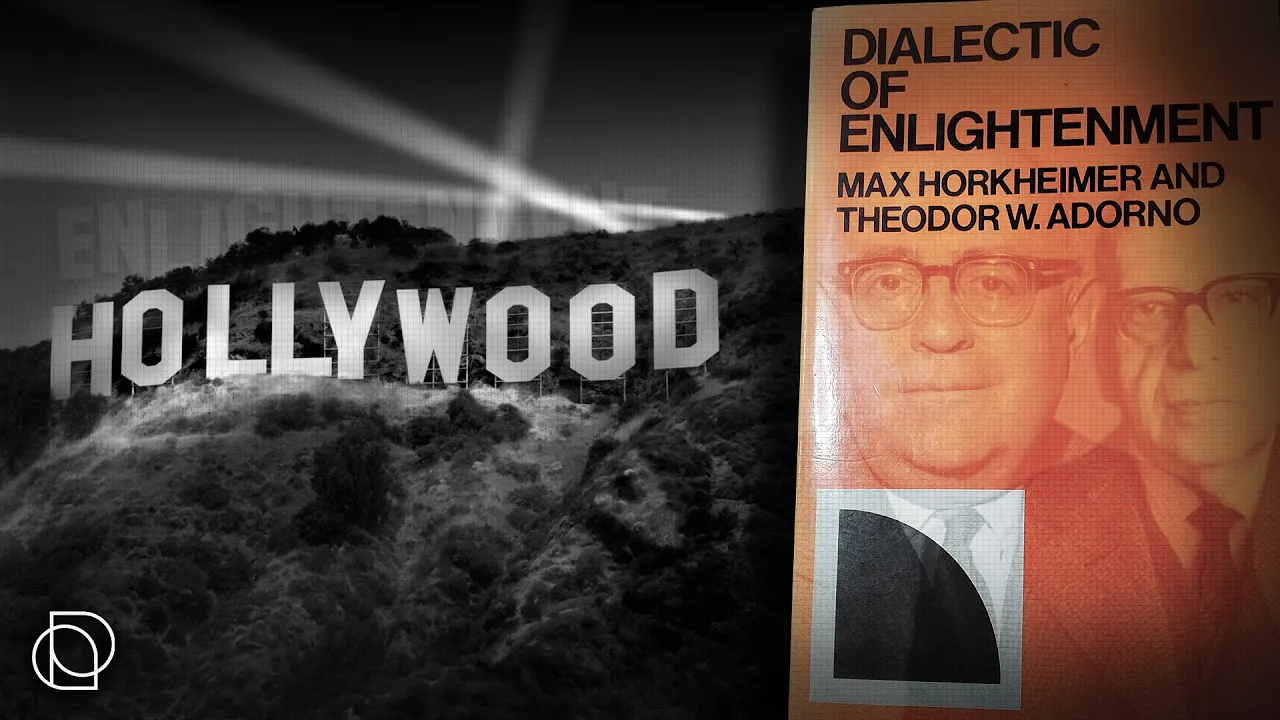


Adorno and Horkheimer, prominent Frankfurt School theorists who fled Nazi Germany to the USA, developed the concept of the 'culture industry' to critique how capitalist forces transform culture into a mechanism of social control and mass deception; they argued that under monopoly capitalism, culture becomes standardized, formulaic, and industrially produced to generate false needs among consumers, thereby replacing genuine art's emancipatory potential with passive entertainment that maintains the status quo and prevents critical consciousness.
Adorno & Horkheimer on the Culture Industry & Mass Deception
Added:Basic Marxist Theory: Understanding foundational concepts such as capitalism, commodification, alienation, and the relationship between the economic base and cultural superstructure.
The Frankfurt School: A basic awareness of this group of German-Jewish intellectuals and their development of Critical Theory in response to the rise of fascism and mass consumerism.
The Concept of Ideology: Understanding how dominant ideas, beliefs, and values are propagated within a society to maintain existing power structures and social order.
Walter Benjamin and Democratic Art: Exploring Benjamin's contrasting, more optimistic view on mass-reproduced art in his seminal essay 'The Work of Art in the Age of Mechanical Reproduction'.
Antonio Gramsci's Cultural Hegemony: Analyzing how ruling classes maintain control through cultural institutions and popular consent, rather than just direct coercion.
Modern Media and Algorithms: Applying Adorno and Horkheimer's critique to contemporary digital culture, including social media platforms, streaming algorithms, and 'surveillance capitalism'.
Postmodernism and Hyperreality: Studying Jean Baudrillard's theories on simulacra and simulation to see how consumer culture has evolved beyond mere commodification into a completely simulated reality.
11.3K views256likes34:18Original Release: 2019-03-01
[Music] [Music] [Applause] dear participants welcome to the second module of the sixth week in the previous module we had discussed certain critical considerations about the formation of ideology in this current module and in the next one we would take these discussions further and look at the works of Adorno and Horkheimer about the formation of identity the work of Adorno and Horkheimer in association with other critics of the Frankfurt School had created various intellectual waves in the realms of theory media political science and philosophy in the works of Adorno and Horkheimer we find that there is a deep anxiety in an in the uneasiness with the nature of modern capitalist society they were initially inspired by the Marxist analysis and they viewed capitalism as being fundamentally unfair to people and also exploitative to the interest of the common people they were Jews who had to flee the Nazi Germany during the preceding era of the Second World War and they had sought shelter in the USA where they had seen the exploitative nature of contemporary capitalist forces also so having witnessed the rise of fascism the failure of socialism in the era preceding the Second World War Germany and the dominance of monopoly capitalism we find that their work touches these contemporary trends in such a way that even in today's world their significance can be realized Adorno felt that we have to move beyond the Marxist analysis and the marxist emphasis on the means and modes of production alone and felt that it was no longer able to account for various contemporary developments he had been associated with the Frankfurt School these were the critical theorists of society who wanted to propagate further the Marxist ideals it was established in Germany in the year of 1923 but by the time it was 1933 they had to move this Frankfurt School from Germany to the USA they had been critical and they means people who had been associated with the Frankfurt School were critical of industrial and capitalist societies but he still they had to seek shelter in a capitalist society for survival they had focused on the interconnections between culture economy psychology media and other factors which they consider to be vital for the functioning of capital is the state Adorno particularly is known for his influential book dialectic of enlightenment which was written and also published in 1944 but it was published in a reworked edition in 1947 Adorno and Horkheimer had developed the notion of culture industry in this book to describe how culture and consequently the minds of the people are also produced industrially Adorno and Horkheimer viewed mass culture or the popular culture as a means of social control and mass deception they had given the title culture industry because they felt that it has been influenced by the contemporary developments of industrial forces they also saw the culture industry as a tool of mass deception and they viewed culture primarily not as an evocative response of human beings but as an industry which is being managed in the same way as any other contemporary industry say in steel or in any other production house in the later philosophical writings of Adorno a particularly bleak aspect towards human nature can be seen in fact he had suggested in his works that culture in society are dominated by systems of power in control and therefore they stifle the inquisitiveness and curiosity of human beings and produced what has been termed as one-dimensional men by Herbert Marcuse another person associated with the Frankfurt School according to Adorno and Horkheimer the repressive regimes of capitalist economy and culture result in a uni-dimensional individuality and even the conscience of men is being produced in the same way in which industry produces any other commodity so his critique of commodification of individual sensitivity ultimately has resulted in his writing of culture as an industry in which he laments the loss of human spontaneity and human elements in governance also Adorno's understanding of culture industry has been discussed in a particular chapter of his book dialectic of enlightenment and the title of this chapter is culture industry enlightenment is mass deception we find that he viewed culture as a product of late capitalism and he refers to the process of the industrialization of mass-produced culture particularly he refers to those cultural products which were being circulated in the contemporary USA in the forms of films the music particularly the music of films the magazines and later on the TV serials and his thesis is based on an analysis of the cultural products for mass consumption he has deliberately used the world culture industry highlighting the word industry instead of using any other term for example mass culture cause in his view culture emanates from the masses whereas culture industry is being collectively produced for the masses so culture industry has been producing cultural products for the consumption of masses and the creativity of the masses is not at all involved in the production of this culture industry on the other hand Adorno had viewed that the culture industry of his contemporary world viewed people as consumers and therefore entertainment industry has become a producer of certain goods which is being desired by the consumers he has used the metaphor of industry to explain his idea of culture industry in a better manner and he has drawn comparisons with the assembly line model of production in which the individuality of goods the individuality of the people who are producing a particular good is lost and there is an emphasis on a sequential production the continuity of the production ensuring that a similar nature of goods are being produced ultimately with the help of the assembly line so in the same manner Adorno and Horkheimer feel that entertainment and laser has ultimately been taken over by a capitalist method of production in fact a particular critic Dorland has suggested that in the views of Adorno and Horkheimer laser has the same rhythms the same pace the same simplification and illusions that of work and therefore we find that in adonis criticism easy pleasures have been rendering passivity and docility in his opinion the entertainment which is being passed on to the individuals by the culture industry does not appeal to their intellect it also does not emit any curiosity in their mind on the other hand it makes them passive viewers at the same time he suggests that the false needs are also being generated among the viewers by the culture industry so that they can be satisfied by parallel productions of the capitalist world mass culture according to Adorno and Horkheimer is a detriment to real art which requires a better intellect and also an inquisitiveness to produce and also to view and enjoy an understand if we look at the idea of enlightenment as mass deception in historical context we find that Adorno and Horkheimer had responded to the failure of the notion of enlightenment when they were talking about the culture industry in their ideas we find that they have presented a significant criticism not only of the un-- industrial society but also of the contemporary bureaucracy and of the contemporary forces which were basically anti-democracy in his critique of industrial society Adorno says that the production and development is not there anymore for the general welfare rather it has such sustaining itself on the manipulation of working life and the idea of production and development is linked with the maximization of profit instead of ensuring a general welfare of the masses and therefore it leads to in exploitation only in his critique of bureaucracy he says that there is an undue emphasis on formal procedures of death of decision making which ultimately results into dehumanizing practices a situation in which human beings are not treated as human beings rather they become numbers in an increasing manner at the same time in his works we find a very severe criticism of anti-democratic forces and he appeals to the reclusive emotionality of the people Adorno and Horkheimer in their work view contemporary developments in the new forms of mass media as being highly significant and important they also suggest that these contemporary developments particularly the commercial marketing of cult of culture have been driven by the market economy and therefore their preference is not on the production of those art and those aspects of culture which may be related with the innate curiosity of human beings or for any ennobling purpose rather we find that there has been an intensive commodification of culture under monopoly criticism adorned and Horkheimer were particularly critical of the idea of this status quo and according to them the idea of the Enlightenment was not to retain the status quo on the other hand he feels that the contemporary forces result in the cementing of this status quo which makes people satisfactory with their life and does not probe them into questioning the situations and therefore he says that the culture industry has been used to stunt the responses of the audience because the basic appeal through the culture industry is not to the intellect of the people but to those senses which makes them dull and receptive and therefore he says that it is a means of social control through deception and the culture industry through this reception ultimately aims at the proliferation of capitalist ethos and values which are nothing but a form of exploitation of the have nots by the helps so according to Adorno and Horkheimer the culture industry transforms culture into an ideological medium of domination but at the same time they are aware that culture has not always been limited to this particular aim also culture has not always been a medium of ideological control only in fact over the passage of time in different historical periods we find that the meaning the nature the scope and the functions of art have changed according to the needs of the contemporary society so they contrast the products of culture industry with the emancipatory power of what they call genuine or authentic art so in the works of a dollar and Horkheimer we find that there is a clear contrast between a product of the culture industry and what they perceive to be as a genuine or authentic art so in their criticism or Comeau of the commodification of art which is being perpetuated by the culture industry a Donen Horkheimer are critical of its impact on human society and ultimately its impact on the human consciousness in order to support their idea they have presented different arguments a major argument which has been presented by them is about how the culture industry takes on the appearance of artwork through its different products in fact the idea of the culture industry is to earn only profit because it is a market driven industry like any other industry so it has to thrive on earning profits on the other hand authentic art does not have this particular aim only it fosters human growth by suggestions and by possibilities and therefore according to Adorno and Horkheimer the genuine art or the authentic art has an ennobling mission and it can be helpful for the people and therefore he has contrasted it with the products of the culture industry which only have the profit motive behind them another criticism or which he presents in the context of the culture industry is that even the genuine art become commodified in this contemporary culture not only the product the production of genuine and authentic art has been stunted but at the same time whatever art had already existed it has been commodified by the culture industry and he analyzes how the works of Beethoven or Mozart or Wagner may be used in fragmentary forms and may be included either in advertisements or in different other types of media to serve a particular purpose which has been dissociated by the context of the original art so d contextualization of the art results into commodification in the curve in the contemporary culture in the industry so commodification of culture is ultimately the commodification of consciousness as in the given world audience are not participating in the production of the art they are only receiving they have been turned into passive receptacles and therefore the amusement and the distractions of entertainment industry replicate the ideology of capitalism and which has already been corrupted by commerce Adorno and Horkheimer feel that genuine art has been replaced by the culture industry and therefore it would have a corrupting influence not only on the way people spend their time but also it would have a negative impact on their consciousness they also say that it also produces submissive and obedient creatures out of consumers because the distractions which are being provided by the culture industry hide the real conditions under monopoly capitalism and the real conditions under monopoly capitalism remain to be exploitative in nature so culture industry works as a prism through which reality is filtered and the true reality is also being obscured they also feel that Mews mint under the culture industry has become an extension of labor and it does not provide any true entertainment it aims at the cultivation of certain desires which may not be the genuine ones but which may be absolutely artificial and created but these needs and desires are created to promote the cells of sales of certain products and fulfillment of these desires also brings no real happiness as desire has been imposed upon the people through advertisements for example the desire for a bigger car may ultimately not provide a lasting happiness to people as it has been imposed upon the audience through advertisements so they repeatedly supply formulaic products that are very similar to each other and the difference in these products occurs only in minor ways and fundamentally all these products remain the same they remain more or less identical with certain cosmetic differences with it so the idea is that the culture industry aims to get a response with minimum maintenance intellectual efforts and therefore ultimately in the long run it also makes us fearful of innovative and genuine things so it produces a climate in which the audience are receptive of commodified art and become fearful of the challenges of genuine art and the city stunts the growth of human beings and produces submissive and obedient creatures out of the consumers of the culture industry Adorno and Horkheimer have also written in detail about autonomous art which they have contrasted over the culture industry a central argument in Adorno's writing is the idea that under certain social conditions art can provide an alternative vision of reality autonomous art or the Jane art has the potential to highlight the inequalities and irrational it is in our societies by challenging the status quo it can create an ideal version of humanity it can also provide our vision which is emancipatory for the people but they also feel that the radical character of autonomous art should emerge not through the content only but also from the form which it takes in the expression of individual creativity so according to Adorno artists autonomous an emancipatory only when it is not a subject of any specific demands only when it is not being governed by any motive of profit seeking only on the other hand he says that the products of art under culture industry are functionless they do not have any emancipate revision they also do not perform any socially useful function and they are produced for their own sake so that the capitalist idea of profit-making can be completed they have also written in detail about how and why culture can be transformed into a tool of domination according to Adorno and Horkheimer free proliferation of cultural products had come to an end under monopoly capitalism because of new techniques of production and distribution and therefore they represented victory of instrumental reason over the role of culture so according to them the commodification of art is a natural corollary to the contemporary world in which the industry was progressing and it has ultimately dealing art from its ideological role so there has been a loss of autonomy there has been a loss of the critical edge which an autonomous art used to possess there also has been a loss of freedom and individuality under the growing influence of contemporary capitalists and anti-democracy forces in the sword nation of art to the logic of monopoly capitalism has turned culture into a tool of domination which is being produced to create a particular type of mindset among the people and to promote consumerism so that the basic aim of capitalist forces can be completed in the society the characteristics of culture industry products have also been listed by a doughnut Horkheimer there is a certain standardization there is this idea of formula based production in which things are same and the repetition of a particular action of assembling them also gives a quick pace to the production and therefore the production is quick and it is also is standardized because it is being produced at the level of a bulk and therefore there because of the sameness and repetition and the standardization and mass production we find that there is a homogeneous Asian sometimes it may seem that there is a claim to individuality of these products also but I do not Horkheimer feel that it is only a pseudo individuality because basically these products are the same so they lack diversity and the illusion of choice is also deliberately created basically according to them these products are the same with minor differences there is a sense of interchangeability also if this product is not very good it may be easily replaceable with a similar type of a product so the choice does not become a genuine choice in fact the consumers all the people are only given this illusion that they are capable of choosing something so the artificiality of culture industry products ultimately leads to a particular type of psyche which also adopts the appreciation of the creative and intellectual challenges of genuine art the differences between culture industry and autonomous are can be easily explained with the help of this table and we find that culture industry is inauthentic or artificial whereas autonomous artists authentic and original where is the culture industries formulaic identical there is an elusive illusion of individuality etc we find that the autonomous art is just the opposite to it so in these details we can find out why the responses towards the culture industry and the responses to words autonomous art are basically different and how the appreciation of these two different productions related with art would also result in a particular type of different human psyche an approach towards things in general Adorno and Horkheimer also feel that the rise of culture interest rate results in standardization and rationalization of cultural products because it weakens the ability of individual to think critically and independently the producers of entertainment industry achieve standardization of tastes and expectations to increase profitability and they flood the market with those products which cater to the needs of one and all so a specialization goes hand-in-hand with standardization and range of hierarchical goods and products men is meant to align with consumers expectations so the idea of standardization is basically linked with the mass production of the products of this entertainment industry as well as the culture industry and because of the sameness of things we find that the critical ability of the individual is not allowed to flourish further adorned and Horkheimer have been particularly critical of the Hollywood entertainment industry which was almost established during the time of their writings and they suggest that the Hollywood and industry is an exemplar of the phenomenon they have covered under their idea of culture industry according to them this entertainment industry produces tons of films and cattles through different types of viewers its basic motivation is profit and money it does not have any other motivation at all so the motivation towards the creation of art in the context of a genuine and autonomous art which we had earlier has been missing in this industry altogether they have also said that the continuity of technological developments in the medium of films particularly when there was a transition from the silent movies to the sound films so according to them it represents a Genet of standardization because with the production of sound movies they feel that films are able to approximate reality but at the same time they blur the divide between the reality and illusion because these sound movies and the other related technological developments have enabled the filmmakers to create a particular product to produce a particular film in which the audience can be drawn immediately into this spectacle and that the audience also consumes the films without any critical view of them the pace the dialogues the music which creates a particular movie draws the audience into it so that the audience has to be attentive to make a sense out of out of the movie but at the same time it does not require any criticality on their part so it becomes a passive yet an engrossed viewer shape which ultimately results into a passive consumerism in this particular quote from Adorno we find that this particular idea has been presented in detail and I quote life is becoming indistinguishable from the movies the sound film leaves no room for imagination or reflection on the part of the audience who is unable to respond within the structure of the film yet deviate from its precise detail without losing the thread of this story has the film forces it victims to equate it directly with reality so the idea which I don't who wants to present over here highlights the way a film has to be viewed by an audience the audience is unable to respond within the structure of the film yet the pace of the movie forces him to keep on viewing it continually and therefore the basic nature of the culture industry is in juxtaposition with the basic nature of true art forms it also can be compared with the idea of the willing suspension of disbelief which has been presented by Coleridge for the appreciation of any literary work in the ideas of Coleridge we find that even though a sense of acceptance of fantasy and fancy is there but at the same time the critical Faculty of the audience or the readers are fully involved in the process of reading and appreciating on the other hand we find that in the products of culture industry this critical involvement of the audience has been removed absolutely and it results into a passivity on the part of the audience and it is this passivity on the part of their viewer on the part of the viewers which leads to isten ting of the powers of imagination and spontaneity it results into a particular climate which is not an effect of any psychological mechanism but it is an effect of the nature of the product itself so we find that the audience become passive not because they are suffering from any psychological factors but because it is effect of the nature of the product itself they are so designed and I quote that quickness power of observation and experience are undeniably needed to apprehend them at all yet sustained thought is out of the question if the spectator is not to miss the relentless rush of facts so we find that the nature of the product itself ultimately stands the power of imagination spontaneity and the criticality in the audience according to Adorno and Horkheimer the system generates consumers as far as the context of culture industry is concerned these are the workers and employees the farmers and the lower middle class and the cultural production by this industry which ultimately is a capitalist production has confined them all together body and soul that they have become absolutely victimized by them and I quote from their article as naturally as the ruled always took the morality imposed upon them more seriously then did the rulers themselves the deceived bosses are today captivated by the myth of success even more than the successful are a movie Billy they insist on the very ideology which enslaves them so we find that Adorno and Horkheimer want to suggest that the culture industry is a product of a particular ideology it enslaves the people but people somehow have been goaded into thinking that it is not their enslavement but it is their independent choice in their further discussions on the film industry and music as well as advertisement we find that Adorno and Horkheimer have continued with the same ideas these ideas will be discussed in the next module thank you [Music] [Applause] [Music]
Up Next
39:32
Walter Benjamin: The Work of Art in the Age of Mechanical Reproduction
@rebeccalongtin3943
7.6K views•2021-02-21

164:01
John of Damascus on Holy Images: A Theological Defense
@BannedBooks
139 views•2026-04-25

68:32
Should We Destroy the Machines? Big Tech Surveillance Critique
@TheStoriesWeTell303
167.9K views•2025-11-30
4:57
The Myth of Sisyphus: A Greek Legend of Eternal Punishment
@TEDEd
8.6M views•2018-11-13
Related Study Plans & Knowledge Roadmaps
Structured learning paths in Philosophy
philosophy
Frankfurt School: Critical Theory & Culture
01Foundations of the Frankfurt School and Critical Theory
02Horkheimer & Adorno: The Critique of Instrumental Reason
03The Culture Industry and Mass Deception
+ 2 more learning modules
12h5 modules
Explore Roadmap
philosophy
Philosophy of Language: From Frege to Austin
01The Linguistic Turn: An Introduction to Language in Philosophy
02Gottlob Frege: Sense and Reference
03Early Wittgenstein: The Picture Theory of Meaning
+ 3 more learning modules
15h6 modules
Explore Roadmap
philosophy
Feminist Epistemology: Standpoint & Injustice
01Introduction to Epistemology and Feminist Critiques
02Sandra Harding and Standpoint Theory
03Donna Haraway and Situated Knowledges
+ 2 more learning modules
12h5 modules
Explore Roadmap
philosophy
Environmental Philosophy: Ethics & Deep Ecology
01Foundations of Environmental Ethics & Anthropocentrism
02Biocentric Individualism and Animal Liberation
03Ecocentric Holism and Deep Ecology
+ 1 more learning modules
10h4 modules
Explore Roadmap