










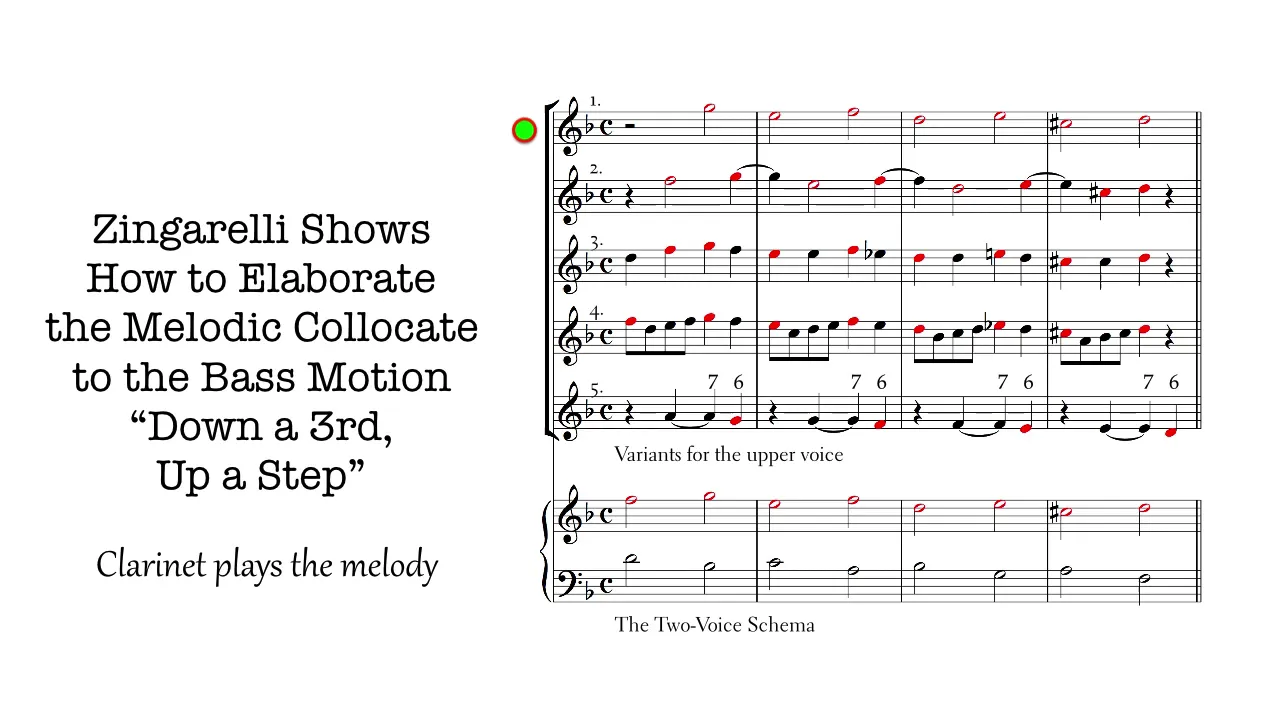



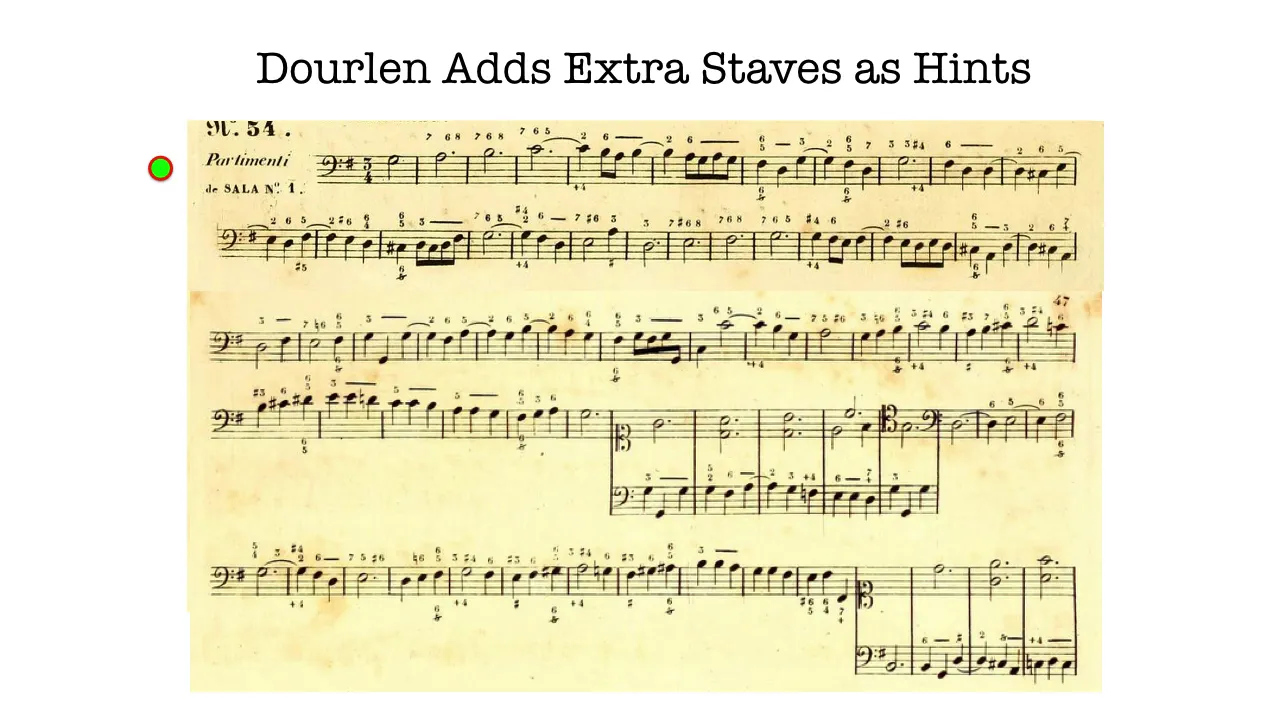


Partimento is a 17th-century Italian keyboard improvisation training system that originated in Rome and peaked in Neapolitan conservatories, where students learn to harmonize a bass line using the Rule of the Octave as a foundational algorithm, progressing through levels of recognizing harmony, realizing chords, and stylizing into various musical forms like preludes or overtures.
What Is Partimento? Historic Improvisation Explained
Added:Basic music theory including major and minor scales, intervals, and triad construction.
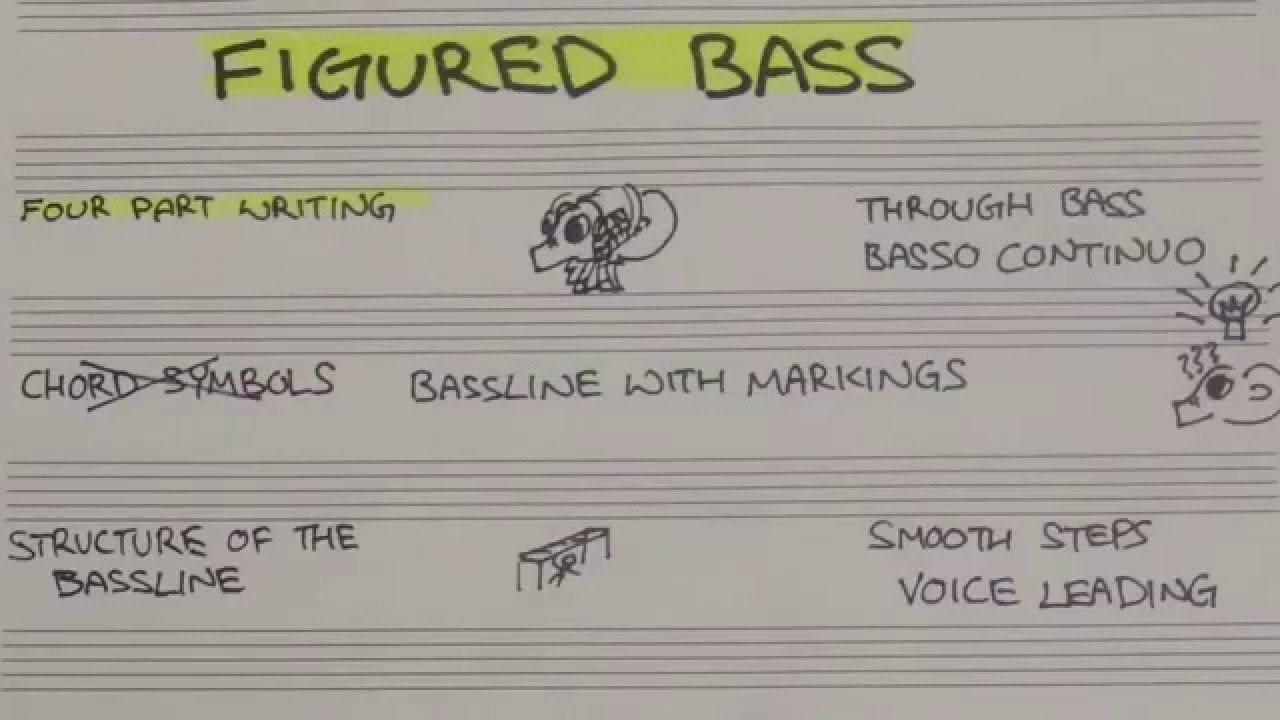
The fundamentals of figured bass (basso continuo) notation and how to read intervals relative to a bass line.
Standard classical voice-leading rules, particularly the avoidance of parallel fifths and octaves.
Elementary keyboard proficiency to play simple chords and voice-leading exercises.
Study of the Galant style schemata (e.g., Monte, Fonte, Ponte) popularized by music theorists like Robert Gjerdingen.
Realization of historical partimenti manuscripts by masters such as Fenaroli, Durante, and Leo.
The art of diminution, learning how to decorate and ornament simple bass realizations into complex keyboard textures.
Improvisation of complete classical forms, such as preludes, partimento-fugues, and sonatas.
Analyzing the historical debate between the Italian partimento school and the French fundamental bass theory.
17.7K views0likes15:03Original Release: 2020-03-20
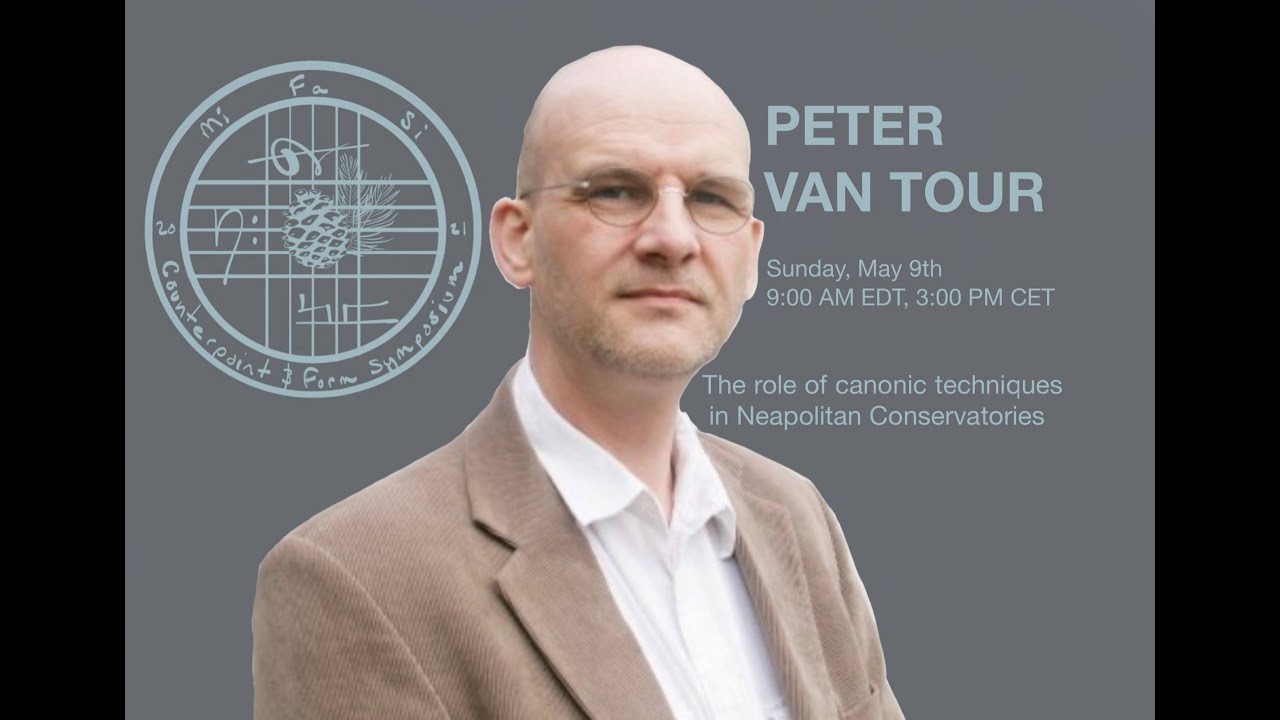
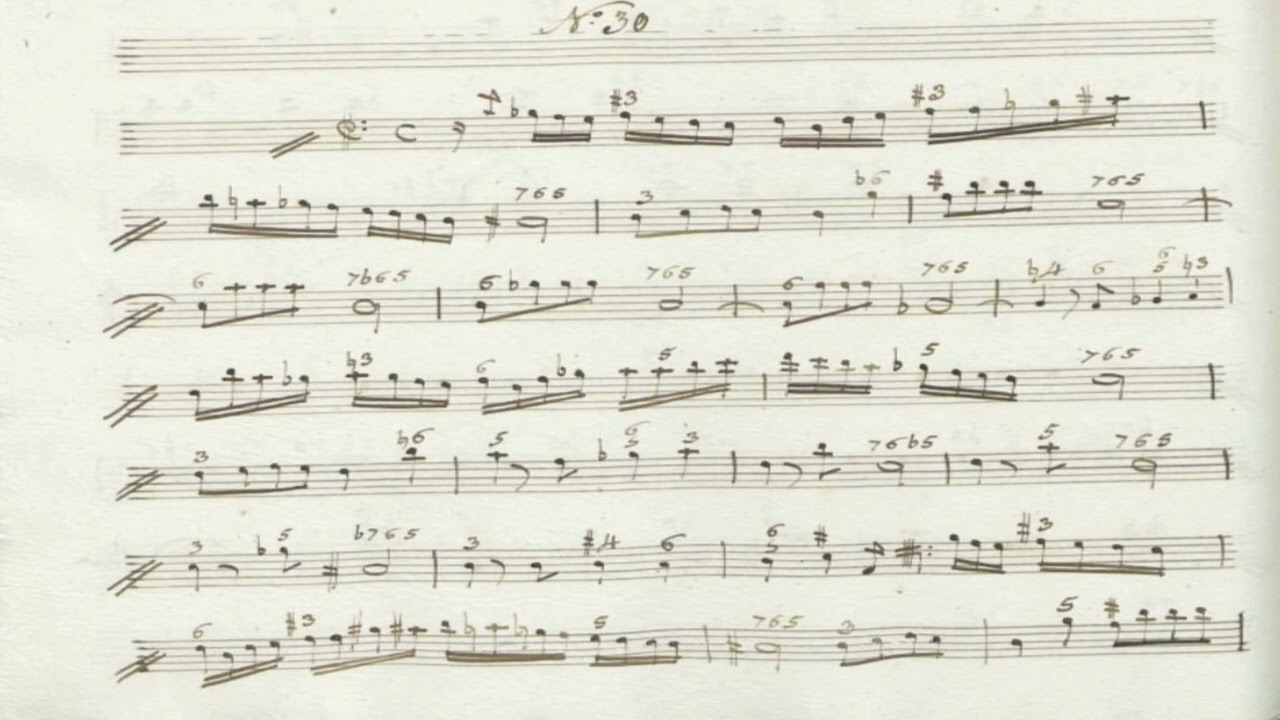
hi and welcome to piano pandemic tivities today and I thought we might follow up on this idea of part amento we've already had a few comments with people asking more about it and you you may have heard about it buzzing around in circles musical circles or they discuss music theory or improvisation and anyway that's so it's today I'll just explain what it is and how you can go learn more about it first of all I want to make disclosure and that is that as part of the resources that I will be naming one of them is my own project which has a subscription fee so I hate bait-and-switch things where someone promises one thing and then later it turns out they're trying to sell me something so I feel very obligated to let you know that one of the resources I will suggest has a small subscription fee so if you hate that kind of stuff see you later anyhow what is part of mental part amento is a training system that was begun in Italy in the 17th century probably in Rome it really reached its peak in Naples na Polly in the conservatories there and that's where a lot of the manuscripts of parlamento that are now being studied come from and many of the best teachers the people that we study what it is it looks like a baseline it's just a baseline something you know they get more complicated sometimes they have other clefts and other things happen but at the beginning level it's just a baseline what are you supposed to do with this baseline it's really quite amazing how powerful the training system is when you first look at it you don't think it could be all that much and then later you start to understand its full power so before you can play a part amento before you can go and look at this baseline you have to learn a few things and the first thing you have to learn is called rule of the octave and rule of the octave is a default system of harmonizing notes in the bass so if you don't know what else to do if you don't have something else special going on you just default to rule of the octave it's like the musical small talk of the 18th century if you don't really have anything particular to talk about you sort of chitchat well it's gray out today boy that was quite a rainstorm last night how about that sports team you know just the kind of standard language that fills in all the empty gaps I sometimes compare a rule of the octave to that so here on the screen I'm gonna put rule of the octave there it is superimposed over me and the way to explain it the easiest way to explain it is that in the in the scale one and five in the bass take what we would call root position triads but what they called chords of the fifth every other pitch takes something else often based on a sixth with other intervals in between also they change rising and falling certain scale degrees are different depending on whether they're going up or going down so for it changes going up and down it takes different harmonies also in minor we use the melodic minor form of the scale so six and seven actually change chromatically going up and down and then there are a few other exceptions that you have to learn so to learn rule of the octave we play the bass alone in the left hand and we play these harmonies in the right hand we don't mix the harmonies between the hands it's it's better to just leave the bass note in the left hand because then you can really think about what scale degree that is and first the first thing you learn is you learn to go up and down in major and in minor and then we learn to start from different positions and a position is what is in the soprano so if I start on one in the base and the soprano also has scale degree one that's known as the first position when the soprano takes the third that second position and when it takes the fifth that's third position now obviously as these chords go on because we don't play in all parallel motion the position changes so when we say play rule of the octave in first position I only means start on the chord that's first position all right what are the rules of playing rule the octave first of all no parallel fifths or octaves between the outer voices they must not do that okay the inner voices we really don't worry about because parallels are not audible on keyboard instruments between inner voices and it just really won't be a problem so the first thing that we do when we learn rule the octave is we learn it up and down and then we learn what are called the four six exceptions which is where four and six in the bass have yet another harmony they take under certain conditions okay and then we practice them starting in every position avoiding parallel fifths and octaves rising and falling major and minor up to three or four sharps and flats in both directions major and minor so this is a lot of keys you know this is half or more than half of the keys when I have taught parlamento class in the past I have given the students this assignment that during the summer they are to learn major and minor ascending and descending in every key up to four sharps and flats at metronome equals eighty one chord per click no mistakes on video starting in every position no parallels and they have to send me that video before class can start so as you can imagine learning rule of the octave is a big job and it often will take weeks or months depending on how many keys you want to learn when people are just beginning and especially when they're not professionals or conservatory students really just learn it in G first G major and then do G minor and then move one accidental in each direction just get yourself a few keys to get started it's fine there's there's really no hurry so that's the first task then once you go to the first part amento the the easiest ones and I'll tell you about those in a minute you will be able to figure out what harmony are to be applied to every bass note because the easiest part Amenti only used row of the octave okay they only need that one algorithm to solve everything and and they will unlock okay so we play them as simple chord patterns that's the simplest level level of realization with correct eighteenth-century harmony and that's known as realizing apartamento okay now as part Amenti go on we begin learning more and more musical devices that are going to be contained in them the next thing is usually how Cadence's work there are three types of Cadence's in part amento so we learn all three of those and then we learn how to recognize them just by looking at how the bass moves then after that we learn about how modulations happen in parlamento how to recognize them in a part amento only by seeing the base with no figures and no chord symbols and no other clues you still can figure out where it's going harmonically so those are the first levels of parlamento then it starts getting interesting we learn about special moves special patterns of the base called base motions or move Amenti departamento or moves of the parlamento and these are patterns that we recognize that take harmonies that are different from rule of the octave and there are many of these it takes a long time to learn them all they're very interesting they're very rich harmonically and they're embedded within these part Amenti so as we go on you know the part of meant to get more and more complex so think for a moment about what we're actually doing when we play a part of mento we are getting our hands on the keyboard and playing using correct eighteenth-century harmony not because we're reading all the notes and being dictated to but because we are applying understanding of the musical language we're solving a problem rather than reciting information okay you can recite difficult scores all day long without knowing what's going on in them but you can't play parlamento even the simplest ones without knowing exactly the inner workings of the musical language so number one we're rehearsing how the musical language is actually put together we're learning to speak the language like a native second we're getting habits of voice leading in our hands so that the hand just naturally finds the right places the right harmonies to go to without really thinking too much third we're kind of composing and we're kind of improvising all at the same time so by undertaking this one activity we're working on ear we're working on reading we're working on keyboard skills we're working on how the musical language works and harmony and voice leading and everything else all in one single activity okay so my contention we're where I am right now is I think that the best and fastest and most powerful pathway to improvisation is by learning parlamento and so that's how I teach my students to do it I we work through ten levels of giovani floor nose part Amenti as the foundation for improvisation okay so here's a couple pictures of some part Amenti from the world of old uh-huh and some of them would have figures to help along a beginner student and the more advanced ones do not in the case of for know even his beginning part Amenti don't have figures you have to recognize only from the movement of the bass what's going on and then after we work for a while at the simple chord realization then we do a level called stylization in stylization we're turning it from just a bunch of chords into an interesting type of piece Prelude or a French overture or an allemande or a G or whatever you want you could even turn it into a choral piece or an orchestral piece or a string quartet you could do anything with it so that's the top level stylisation the the first level is to recognize where we look at it and we say AHA given how this bass is moving I know what the harmony should be at step1 step2 to realize since these should be the harmonies I will now play them in my right hand as simple chords and get the correct sound that's to realize to stylize as then to transform it into a different piece so resources let's talk about resources because there's there's a lot more that you need to learn I told you I was going to do a commercial so the commercial is for Improv planet which is an online school of historic improvisation I run it I believe I can honestly say it is the largest collection of video tutorials for historic keyboard improvisation in the world I think that's probably true and it does have a amateur level and a pro level and all this stuff gets explained and there's tutorials and videos hours and hours and hours and hours and hours of stuff so that's linked here you can check that out whether you're interested in that or not there's a lot of other things I can recommend I recommend some books one is the art of parlamento by Giorgio sanguinetti Giorgio is a scholar in Italy and our best to you Italian friends and Giorgio for good health and safety the this book really is is the the the sweeping picture of how all this worked historically why they did this what happened to it what happened in the 19th century it's really indispensable is it's great another book that touches largely on par Demento is music in the Galant style by robert yard again wonderful book he has a new one called child composers in the old conservatories i've ordered it it's actually across the lake in the library i'm going to get it today and it's about how these kids study parlamento and and other techniques and became brilliant composers at young ages so those are some of the biggies my own book which is coming out very soon The Pianist guide to historic improvisation does not begin with par Demento it begins with actually easier things and works its way and has a chapter on portamento but again it's for people normal keyboard playing people who have never improvised before who want to learn to do that in historic styles and then there are some websites that I will link that have a lot of great material there's even a Facebook group you have to ask to be a member it's called the art of parlamento and there's some good discussions there if I think of anything else I'll put it all in the description so you can have all those links so I've been working on part of Mentos I'm actually working on a book on it now guys like Giorgio sanguinetti and Bob yard again and I should mention Peter vantur wonderful scholar from Oslo these people are out there digging up manuscripts and reconstructing the historic side of this that is just so valuable and wonderful we just love what they do where I try to come in and do some work is translating that for the average typical contemporary player who may be an amateur or maybe a conservatory student or professional but who is never improvised so how do you connect all this historic stuff with typical piano players today that's really my area there and so I'm working through Fenner Olli right now I've got his huge collection of part of antique and I'm about a third of the way through I'm playing all of them and just getting to know what's in here so some of my pandemic tivities today other than that I'll leave the rest in the in the link down below and provide you with some good activities while you have some downtime so check out parlamento and see where it may lead you I hope they'll be interesting in front for you ciao
Up Next

10:20
Mozart's Musical Dice Game Explained: History, Rules, & Fun
@webpianoacademy
5K views•2023-03-13
16:05
Double Counterpoint Schemata in Partimento Practice
@en-blanc-et-noir
11.8K views•2020-08-16

47:36
Understanding Diatonic 7th Chords in Major Keys | Music Theory Tutorial
@GracieTerzian
54.7K views•2022-03-02
10:49
Understanding John Coltrane's Giant Steps: A Music Theory Analysis
@Vox
10.4M views•2018-11-12
Related Study Plans & Knowledge Roadmaps
Structured learning paths in Music Theory
music-theory
Composing Galant Music: Partimento & Schemata
01Foundations of Figured Bass and Keyboard Harmony
02The Rule of the Octave (Regola dell'Ottava)
03Galant Schemata: The Building Blocks of Form
+ 2 more learning modules
30h5 modules
Explore Roadmap
music-theory
Decoding Overtone Series: Tuning & Drone Music
01Acoustic Foundations: The Physics of the Overtone Series
02Tuning Systems: Equal Temperament vs. Just Intonation
03Microtonality and Spectralism: Beyond Standard Pitches
+ 2 more learning modules
24h5 modules
Explore Roadmap
music-theory
Impressionist Harmony: Scales, Planing & RPGs
01Foundational Music Theory: Keys, Intervals, and Seventh Chords
02Impressionist Color: Chord Planing and Parallel Harmony
03Whimsical Textures: Pentatonic Cascades and Whole-Tone Scales
+ 1 more learning modules
14h4 modules
Explore Roadmap
music-theory
Negative Harmony: Axis Reflection in Indie Pop
01Music Theory Foundations: Scales, Intervals, and Triads
02Functional Harmony and the Circle of Fifths
03Demystifying the Negative Harmony Axis Reflection
+ 2 more learning modules
16h5 modules
Explore Roadmap