











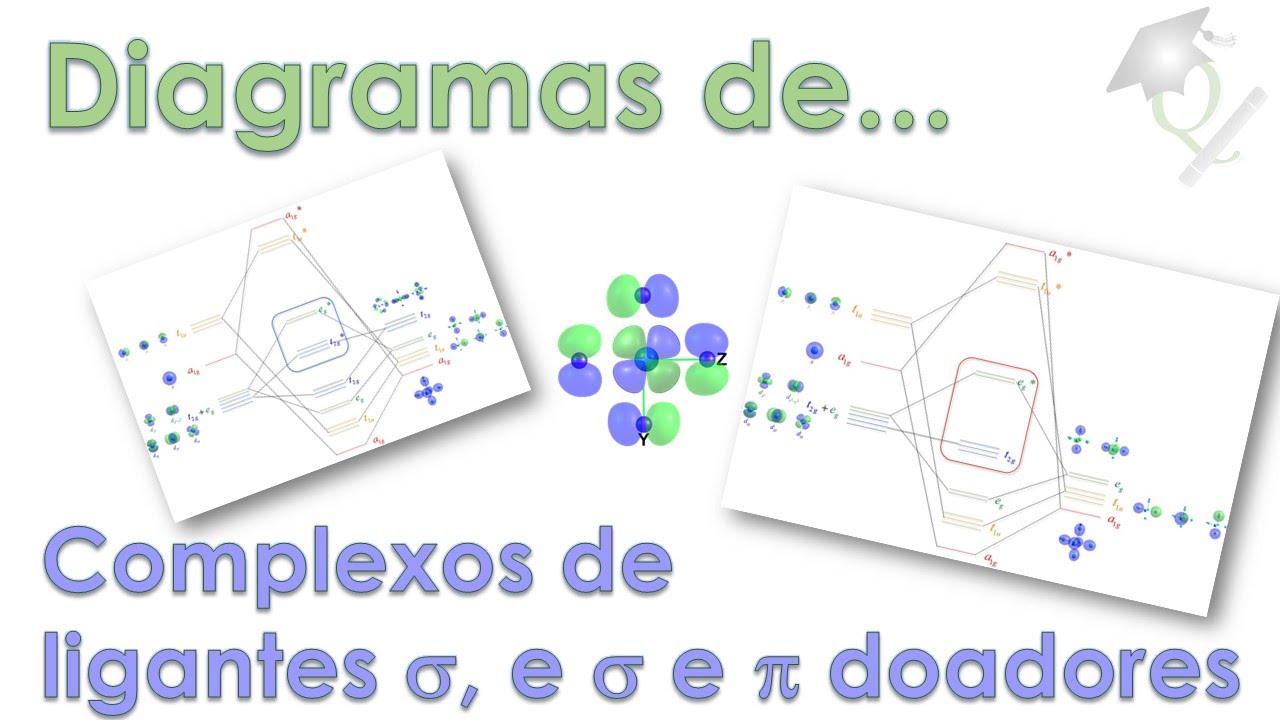
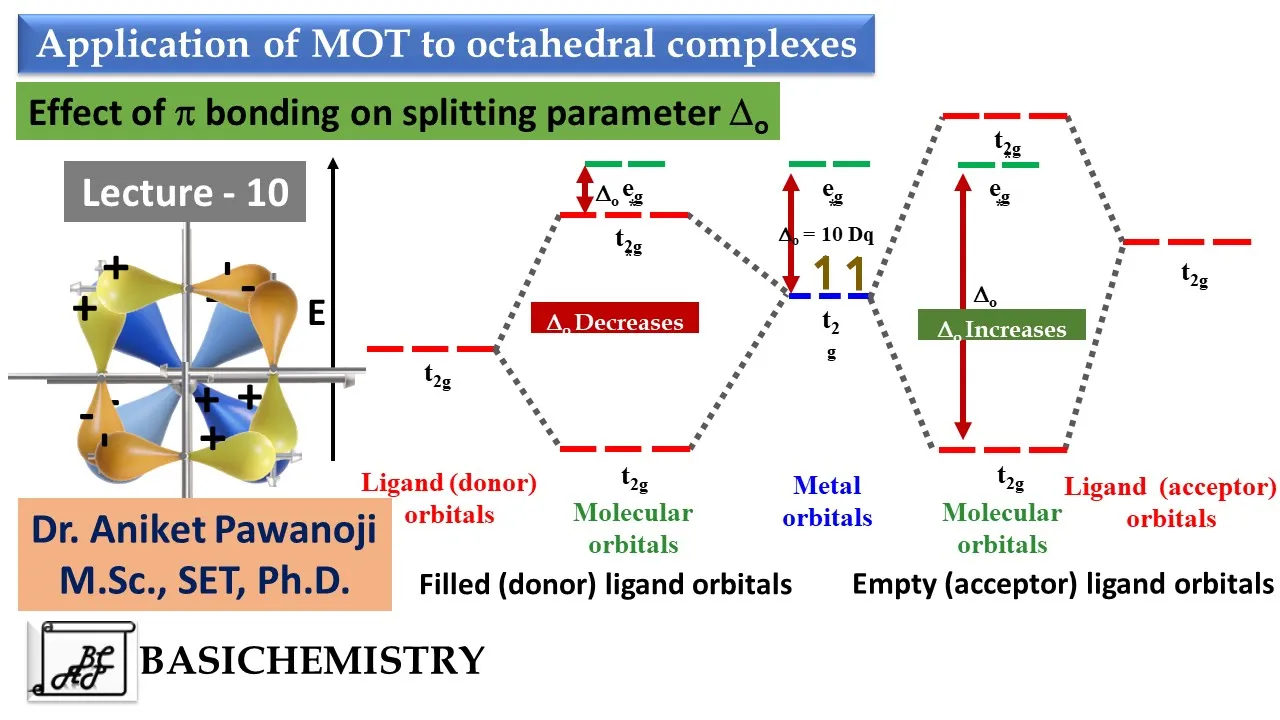










In metal-ligand bonding, π interactions significantly affect the crystal field splitting energy (Δo): π donation by ligands with filled π orbitals (like halides F⁻, Cl⁻, Br⁻, I⁻) decreases Δo, leading to high-spin complexes; conversely, π acceptance by ligands with empty π orbitals (like CN⁻, CO, PR₃) increases Δo, resulting in low-spin complexes. This explains the spectrochemical series, where ligands are ordered by their ability to split d-orbitals, with π donor ligands occupying the lower end and π acceptor ligands at the higher end.
Effect of Pi Bonding on Delta O Splitting Energy
Added:Basic Crystal Field Theory (CFT), specifically how d-orbitals split into t2g and eg subsets in an octahedral coordination environment.
The fundamental differences between sigma (σ) and pi (π) chemical bonding in terms of orbital overlap.
An introductory understanding of Molecular Orbital (MO) Theory, including bonding, antibonding, and non-bonding orbital concepts.
Familiarity with the empirical Spectrochemical Series and the concept of crystal field splitting energy (Δo).
Constructing complete Ligand Field Theory (LFT) molecular orbital diagrams for octahedral complexes with pi-interactions.
Explaining the concept of synergistic pi-backbonding and its physical consequences in organometallic complexes (e.g., metal carbonyls).
Interpreting electronic absorption spectra (UV-Vis) and calculating Racah parameters using Tanabe-Sugano diagrams.
Predicting the thermodynamic stability and kinetic lability of complexes based on their pi-donor or pi-acceptor character.
440 views10likes40:04Original Release: 2023-10-27
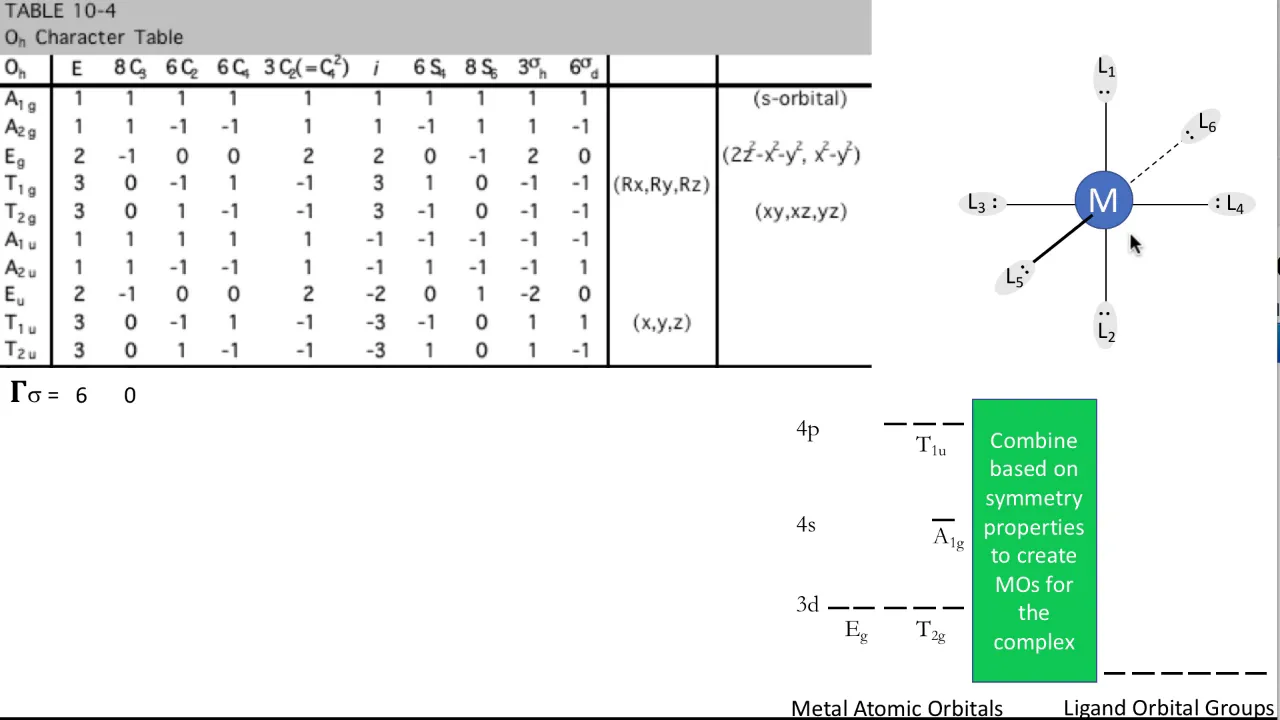
[Music] welcome friends after a between the previous lecture and this one there should be a big gap and the gap as you know is due to the esc and some examination bought pg and ug last semester we are engaged with those examination uh assignment y was an mcq quiz and etc and due to that unable to post a new lecture in the continuity and therefore uh let me brief you about the previous lecture so that the link can be established and we can have a fair discussion on this lecture as well well we are have been discussing metal ligand bonding um in metal again bonding we discussed different theories to establish how metal and we can have different type of interaction in which we have discussed little bit about crystal field theory vb approach uh and then now we need to discuss the molecular orbital theory or we can say ligand field theory so that it clarify the limitation which we have gone through for crystal field theory and in vb approach or vscpr theory so to remove that uh limitations we studied three different geometry in metal ligand interactions first is octahedral geometry second is tetrahedral geometry third is square planar geometry in octahedral geometry we studied three different type of interaction one is sigma interaction between metal and ligand the other one is sigma donation by donation interaction and the third one is sigma donation by donation and pi acceptance acceptance interaction between metal and vegan then after we discuss tetrahedral geometry in tetrahedral geometry we have two interactions only one is a sigma donation uh between the metal and ligand and the other one is sigma donation and by donation interaction tetrahedral geometry should not have phi acceptance interaction so there is the limitation in the tetrahedral geometry and the third geometry we have studied that is square planar geometry in square planar geometry all these interactions are possible because when you compare the square planet geometry with octahedral geometry you found that the actual ligand which is oriented on z axis elegans five and six are missing so we have one two three four in a planar arrangement that is a square planar geometry so that is the difference between the octahedral geometry and square planet geometry as far as geometrical differences is concerned but in square blender geometry we studied sigma donation interaction sigma donation and by donation interaction and sigma donation by donation and pi acceptance interaction so these are the three different geometries and different metal ligand interactions we have studied there well the temptation of learning this metal ligand interaction then after i have clarified by putting some notes of the limitation of cft how we can rule out the limitation of cft and what different information can be obtained see if you have information of symmetry and this improved ligand fill theory or we can say molecular orbital theory of a complex compound you can easily study the spectroscopy so these are the base of learning the spectroscopy that is the temptation behind learning these theories once you learn these theories uh in the more semesters when you study spectroscopy it would be easy little bit to understand the spectroscopy pi 2 pi star sigma 2 pi star sigma 2 sigma star interactions in the spectroscopy this can be easily easily you can learn by having this basic information of metal or vital theories so three different geometries we have studied and now we need to discuss the effect of pi bonding on the value of delta o that is a splitting energy so why there is a limitation in cft we just learn what are the limitations but why those limitations are there and how we clarify those limitation can be explored by these theories so these are the common theory of all the three different uh geometrical shape you have studied for complex compound so today we will going to discuss this uh effect of pi bonding on the value of delta o that is splitting energy by considering the example of octahedral geometry and that can be that can be implemented to tetrahedral geometry up to some extent and it can be implemented to square planet geometry completely so this is the effect of pi bonding of delta o that is a splitting energy in the complex compound i am dr devan pandya i'm from the department of chemistry san javis college autonomous mdhaba well let's start the effect of pi bonding on the value of delta o that is the splitting energy in order to discuss the effect of pi bonding on the value of delta o we shall consider two type of molecular energy level diagrams of octahedral complex here when i say two type of uh diagrams energy diagrams for octahedral complexes molecular energy level diagram that is moed we have used the term moed for that two type means once in which we have focus for sigma interaction only and the other sigma and phi interaction now sigma and pi interaction there are two kind of pi interaction that you need to keep in mind one is by donation interaction and the other one is pi acceptable interaction so basically there are three different parts but here we will classify the moed for only two considerations one is sigma interaction the other is pi interaction in pi interaction there is some two part that is pi donation interaction and pi acceptance interaction that you are much familiar now with that so these two diagrams we're going to see in the next slide as figure 1 and 2 and we're going to discuss what is there in the only sigma interaction for the value of delta o and how it get changed when there is two type of pi interaction taken place between metal and ligand so that is the discussion of today's lecture that we need to take into account i am going to show you the figure one and the figure one has certain limitation the limitation is that that this figure is not a complete ammo it only shows the energy level diagram showing the effect of pi bonding on the moed of a metal complex and hence the non-bonding ligand or pi orbital of t1g t1 u and t2 u symmetry have not been shown over here you can see here this is the splitting energy this is t2g nonbonding in a sigma interaction so this is a energy gap between sigma t2g non-bonding as well as eg sigma star abmos and that difference is known as delta o and the energy gap between t to g star pi abmo and sigma star uh eg star sigma abmos that energy gap is mentioned here by delta dash o and you can see here this splitting between delta o and delta dash o delta o is greater than delta dashboard so that the things that you need to keep in mind for this figure 1 and these are the ligand group orbitals lgo uh sigma as well as pi and this is the uh metal uh orbital in the metal ion d orbitals so sigma and pi orbital of lg and metal have interaction and the splitting will taken place in this form and what effect of this pi interaction is there what is the effect of sigma interaction is there on the splitting energy that is the point of discussion today for this figure one uh how figure one before with figure two that we're going to discuss as well this is figure two and figure two also indicate the effect of the pi bonding on the mod of a complex and here also the non-bonding pi orbital of t 1 g t 1 u and t 2 u symmetry have not been shown uh here you can see the splitting energy is like this one this is t 2 g metal ion orbitals and energy gap is between t2g metal or orbitals and eg star sigma abmos that is indicated by delta o and this one is five bonding uh with sigma star ag abmo and that energy gap is indicated by delta dash o so in figure 2 delta s o is greater than delta o and that is how the difference is there in the splitting value of energy when the pi interaction we introduced in the metal ligand interaction and that is what missing in safety crystal field theory crystal field theory is unable to explain the difference in the splitting of the orbital of central metal ion if the ligand change into spectrochemical series and here we are able to explain the difference ah by indicating this different type of interaction sigma interaction sigma interaction and pi interaction sigma interaction pi donation interaction and pi acceptor interactions so that is what the difference is there in these two figures and that will going to elaborate these two figures as well in this later presentation well in this both diagrams what we need to point out three points would be there the first point indicate that we have depicted the formation of two eg sigma bmos and two is star sigma abmos three t two g pi bmos and 3t t2g star pi abm so here there is the interaction of sigma donation and pi donation and this kind of molecular orbitals are involved in this plating and that will going to give you the idea of either the better splitting or less pleating in the complex compound in the second point we need to focus on the 2d generate easy sigma bmos and 2d eg star sigma abmos are generated by overlap between two ligand sigma orbital of eg symmetry with metal orbital of the same easy symmetry and the easy symmetry is d z square and d x square minus y square of the metal ion d orbital so this interaction is the sigma donation interaction clearly it mentioned that sigma bmos and sigma star abmos they are generated by the overlapping of two ligand sigma orbital of eg symmetry with metal ion having the same eg symmetric that is the z square and dx square minus y square now eg sigma bmos have lower energy always you know that bmos have lower energy compared to abmos so that is there in the second point this type of overlap between the orbitals is called sigma overlap and that interaction is known as sigma interaction and in short we are branding it as sigma donation interaction only it should be noted that 3d orbital of t2g symmetry which include 3d xy 3d yz and 3d zx orbitals do not participate in sigma overlap and hence these orbital remain non-bonding molecular orbital and therefore their energy will not get changed and the energy is quite equal with the 3d orbital of free metal ion so the energy of t2g symmetry in mo diagram remains similar with the 3d orbital of free metal ion and therefore it considered as nbmo non-bonding molecular orbital and the third point the three degenerate t2g pi bmos and three degeneracy to the star pi abmos are produced by the overlap between three ligand pi orbital of t2g symmetry and the metal line t2g orbital that is the xyz and zx always we know that the planar orbital uh when there is actual interaction in octahedral geometry or either in a square plane planar geometry actual orbital resulting to sigma interaction this planar orbital and participate into pi interaction so there should be a pi interaction between t2g symmetry of the metal ion with d2g symmetry of the ligand and that overlap result into this three d hundred pi bmos and 300 pi star abmos now this t2g pi bmos have lower energy always we know that the bmos have lower energy compared to abmos so that is there the overlap between orbitals leading to the formation of t2g pi bmos and p2g star pi abmos is called pi overlap or pi interaction now this pi interaction is of two kind as already we have studied in our previous lectures one is sigma donation interaction where the ligand act is five base and the other one is supply acceptance interaction where the pi orbital of ligand act as pi scb ligands that we will going to see in the later presentation in this pi interaction three ligand pi orbital may be filled orbitals when there is filled orbitals the example would be mostly halogens fluoride chloride bromide iodide or other certain element or ions which have filled pi orbitals or in certain other case the pi interaction will result if the ligand have empty pi orbitals when empty pi orbitals are there the example is always would be cyanide carbon monoxide nitrosyl oxide uh triphenyl phosphine thy alkyl phosphine hydride ions etc so these two type of interactions is there as far as pi interaction is concerned uh one is through field orbitals and the other one is through empty orbital field orbitals always result into five base and empty orbital always resulting to five acidic orbitals that we are going to see later if the ligand pi orbitals are filled and the metal the orbitals are empty then pi interaction is represented as ligand to metal pi interaction in which the fill ligand orbitals pi orbitals act as donors and they can be branded as lavish base in mcq these are the terms which will be more useful so you need to pay attention here students and similarly when we discuss the ligand pi orbitals which are empty and the metal d orbital which are filled then whatever pi interaction is taken place is represented as metal to ligand pi interaction in which empty ligand pi orbital actors acceptor and they has been they are branded as levees acid so that you need to keep it into mind and the fourth point the delta o that is of splitting energy represents the energy gap between eg stars sigma abmos and non-bonding metal ion orbital t2g symmetry that is 3d xy yz and zx when only metal ligand sigma bonding is considered so this energy gap represent only sigma donation interaction and that energy gap is between easy star sigma abmos and non-bonding molecular orbital that is nbmo t2g symmetry of the central metal ion that is three d x y y z and z x so that represents the splitting energy delta o in a sigma bonding interaction now let's recall the figure one once again this is our figure one and in this figure one uh the ligand pi orbital used for the formation of three t2g pi that is there in the blue circle three t two g pi b m o and three t two g star five abmos that is in the blue circle over here as well and these are filled and when it is filled the example will be fluoride bromide chloride iodide etc and have lower energy than the metal t2g orbitals so this has lower energy than the metal t2g non-bonding orbitals hence delta dash o is the energy gap between eg star sigma abmos and pi star t2g star pi abmos when boss sigma and pi bonding are considered sigma donation and by donation considered our energy gap is only this much sigma donation by donation only sigma donation energy gap is this much that is represented by delta o delta dash o that is sigma donation as well as pi donation so that way the mo diagram is shown over here this is not a complete ammo this is overlapping ammo of sigma as well as pi donation sigma donation and pi donation interaction so that we can understand what is the effect of pi on splitting it may be noted that the value of delta dash o decreases relatively to the value of delta o where metal ligand pi bonding is absent non-pi bonding case delta o is higher delta dash o will get decrease in other words pi bonding leads to decrease in the value of delta when pi bonding takes place delta o which is this much bigger energy gap reduced to delta dashboard that means the value of delta dash o is less than that of the pairing energy dash o is less than that of the pairing energy and as a result what happen when pairing energy reduce we'll going to get the high spin complex the ligand such as fluoride chloride bromide iodide or other ligand which have filled pi orbital which contain a field p pi orbital exert weak ligand feel they are not able to split the orbital more effectively and hence generally form high spin complex so when the pairing energy is greater than that of the splitting energy you will always get high spin complex this interaction is found in oxide and fluoride complexes with filled low energy 2p orbitals filled energy then we'll get this kind of things and you will get high spin complex these ligand can act as spy donors from free ligand orbital to vacant or partially filled metal pie orbitals the oxide and fluoride have all their 2p orbital that is filled when we talk about oxygen the electronic configuration is 2h2 2p4 and when we discuss regarding oxide 2 minus ion then its electronic configuration is 2h2 to p6 similarly when we discuss about fluoride as an atom the electronic configuration is 2s22p5 but f minus that is fluoride ion then the outermost orbital would be 2h2 to p6 and in both the case of oxide and fluoride you can see completely filled p pi orbital would be there and as a result its delta dash o that is splitting energy is always lower than that of pairing energy hence this complex of oxide and chloride is always high spin complex and the splitting energy is always lower than that of the sigma donation interaction one such field orbital is used in sigma bonding with the metal ion with while the other two field orbitals are used in pi bonding okay so sig out of this sum of used for sigma bonding while metal ion uh with the metal ion sorry and the other to fill our vitals used for the pi bonding out of this this type of interaction is found in magnesium hexachloride uh four minus iron complex this is octahedral geometry and the chloride ion act as sigma donation phi donation and it result into high spin complex well let's discuss the figure two on the other hand we have in figure two the ligand pi orbital used for the formation of three t2g pi bmos and three t to g star phi abmos are blackened that is empty eg pi star abmos in the cyanide ion case either carbon monoxide nitrosyl oxide or dry alkyl phosphine triphenylphosphine this type of ligand which have this m and antibonding pi abmo which is vacant and have higher energy than metal due to t2g of vitals so the delta dash o that is the energy gap between eg star sigma abmos and t2g pi bmos when what sigma and pi bonding are considered is going to be more compared to sigma delta oh only splitting when only sigma interaction is there it may be seen that the value of delta dash o increases relatively to the value of only delta that is when i say only delta o that is only sigma donation interaction between metal and negan when i say a delta dash o that is pi interaction between metal and degree so in pi donation we studied that dash o is less compared to delta o now in pi acceptance delta dash o increases relatively to the value of delta o where metal ligand pi bonding is absent non-pi bonding case is there in other words pi bonding leads to an increase in the value of delta o that can be seen over here you can see that delta dash o is greater compared to this so this is only sigma donation interaction and here pi acceptance interaction so this delta dash o is greater than that of delta o as a result what happens as a result the value of delta dash o is more than the value of pairing energy so delta o is higher than that of pairing energy so energy gap is high when ligand approach to central metal ion splitting get increased and as a result uh we're going to get low spin complex the ligand like cyanide carbon monoxide no tri-alkyl phosphine triphenylphosphine hydride this kind of ligands contains vacant p pi orbital excerpt strong ligand failed generally from low spin complexes in which delta dash o is greater than that of bearing energy which we can found in this mo diagram which this information can be obtained in mo diagram which is missing in cft so we have explored the limitation of cft by representing the effect of pi bonding on the value of splitting energy it cannot be clarified into cft it indicates the splitting but cannot explain why the splitting is indifferent into different complex compound when the ligand get changed with the same metal ion the orbital splitting get different that cannot be explored in cfd can be rectified into this mo diagram this type of pi interaction is found in the complex of phosphine areas air signs etc such ligand can act as pi acceptors from metal orbitals to vacant ligand phi orbitals by acidic as well we can say pi acidic now let's compare the value of delta dash o for halide ions used for filled pie ligands so after learning the impact of pi bonding on splitting orbital how high spin low spin complex is formed uh we can put even the one more diagram which can indicate or the difference between only sigma interaction sigma donation by donation interaction and sigma donation by acceptance interaction as well that we're going to put somewhere else or will going to have it in a live chat as well so here we are going to discuss the comparison between the value of delta dash o for halide ions we have different series in the halide group fluorine chlorine bromine iodine so in this form what should be the order of the value of delta or splitting in this filled pi orbital the mo energy level diagram that is moed in which halide ions are there what are the halide ions fluoride chloride bromide and iodide which are used as filled by a ligand that we can see in the figure three in the next slide this figure shows that the value of uh for f minus that is fluoride to compare the value of delta dash o for hallowed ions used as field pi orbital which we will going to see what are the difference in the value of delta dash o from uh we can say fluoride to iodide here the things is missing little bit fluoride to iron iodide and we're going to compare the value of delta dash over this halide in this field orbital the figure shows that the value of delta dash 4 that is splitting energy for fluoride chloride bromide and iodide ligands decreases in this order fluoride is having more we can say delta o delta dash o value then the chloride is having little less delta that is splitting of the orbital done by fluoride more effectively which is done by less effectively by chlorine which is even done by less effectively by bromide and because the size of iodide is more it has very less so because the energy of this pi orbital of the halide ligand increases as uh we can say the order would be fluoride to chloride energy of pi orbital of halide ligand increases chloride to bromide from i2 iodide the decrease order of the value of delta dash o explain the decreasing order of ligand fill strength of these halide ligands now why halides have different splitting energy with the same metal line we cannot explore into safety we can explore it here using the moed diagram a low value of delta dash o correspond to weak ligand fill strength and that is how study of this will going to give us the spectrochemical series why one ligand is more effective to split the orbital why the other ligand is less effective to split the orbital that can be explored using this moed diagram and the study of this splitting energy well here you can see the t2g to eg star abmo that is the delta oh in a sigma interaction but as far as this pi interaction is concerned you can see that fluoride have little higher delta dash oh but not that much of similar to this you can see fluoride iodide is there very less splitting big splitting high spin most high spin complex bromide is even better having more delta dash over value fluoride is even more delta dash for value and fluoride you can see is quite similar but not that much as sigma interaction this is sigma interaction and this is a comparison between sigma interaction and pi interaction you can clearly see the pi bonding effect on the splitting energy value or energy gap and the complex compound cannot be explored in cft can be explored here in uh mod molecular orbital energy level diagram so that is how this can be explored in this different ligand and you can give the ordering of the splitting energy gap here in halogen series now relation between pi bonding ability of ligands and their position in spectrochemical series so this will going to give us the positioning of spectrochemical series now positioning in spectrochemical series cannot be explored by cft can be explored by moed diagram mo theory so that is also how we can clarify the limitation of cfd we have shown that the ligands like fluoride chloride bromide iodide etc donate electrons present in their p pi orbital to the empty metal d orbitals and from and form strong ligand to metal pi bond such ligands are called pi donor ligand and cause small splitting of b orbital compared to sigma interaction small splitting of d orbital these ligand occupy position at the lower energy side of the spectrochemical series so in spectrochemical series they will occupy low side on the other hand the ligand like cyanide carbon monoxide triphenylphosphine etc except electron from the filled metal orbital in the vacant anti-bonding orbital of the ligand and form strong metal to ligand pi bond such ligands are called pi acceptor ligand and cause large splitting of d orbitals these ligands occupy position at higher energy side of the spectrochemical series and we have high end low end now you can understand what should be on in the moderate place moderate place is sigma donation interaction no space in a spectrochemical series occupied by sigma donation and pi donation ligand and high place in the spectrochemical series you can now understand is occupied by cyanide carbon monoxide triphenylphosphine so this ordering of spectrochemical series can be explained by mo approach or improved ligand field theory can not be explored by cfd now relation between pi bonding ability of ligands and their position in spectrochemical series in which we now going to put some uh data some values which clearly mention the positioning of ligand into spectrochemical series uh jorgenson in 1962 jorgensen has calculated the value of field factor that is f value f for each of the ligand given in the spectrochemical series we're going to show it over here for calculating this value of f for s2 or is considered as an ideal ligand and its value has been taken as 1.00 so now it is a relative value water ligand that is 1.00 now other ligand if they are having more value than 1.0 they can be placed in higher energy order and if it has less than one point zero it will be placed the lower than the water molecule in the splitting spectrochemical series so let's see the values of uh this f that is fill factor value this is ligand uh iodine bromine thiocyanide chlorine nitrite fluoride hydroxide carbonate acid or we can say acetate etc and the f value for iodine it is 0.70 low speeding bromine has 0.72 little higher splitting in the uh delta o value third cyanide that is 0.73 chloride 7.78 you can see the value get increase of the value uh the splitting energy is higher and in that order uh the ligand has been placed into spectrochemical series similarly ligand which have a higher value than water water is having uh f value that is 1.0 uh this ligand is having one point zero two nitride carbide that is one point one five period in one point twenty three a minus one point twenty five and so as you can see cyanide one point seven zero carbon monoxide is quite equal 1.70 and they are high-end uh ligands in the spectrochemical series so it may be seen that the value f value increases from point seven zero to 1.70 the power of the ligand to split the orbital also increases thank you for paying attention to this lecture and because i would like to present this lecture on teacher's day i am little late that is it teachers are not common people and common people are not teachers please don't choose to become a teacher until you are worth it this is the wording of the lady over here says the president of germany and teachers in germany have the highest salary in the country and when judges doctors and genius ask the chancellor of germany angela markel for the same salary she told them how can i compare you to those who taught you so let's keep the dignity of teacher recall your favorite teacher call them today or either you can say hi or in a month or a year please remember them there are too much please to you thank you very much this is the things which we have discussed today that is a common for the theory we are going to learn more in upcoming lectures till then and goodbye from my side
Up Next

84:27
Nobel Prize 2022 Ceremony Highlights | Stockholm Full Event
@NobelPrize
256.5K views•2022-12-10
83:56
Biocatalysis and Catalysis in Islatravir Synthesis | Merck Webinar
@SCIwheresciencemeetsbusiness
675 views•2020-10-08
10:06
1H NMR: Determining Number of Peaks from Structure
@MSJChem
59.2K views•2017-04-06

17:31
Edible Water Bottles: A DIY Guide to Sodium Alginate Spherification
@ryan
10.5M views•2019-06-21
Related Study Plans & Knowledge Roadmaps
Structured learning paths in Chemistry
chemistry
Nuclear Chemistry: Decay, Meds & Fuel Cycle
01Introduction to Nuclear Structure and Radioactivity
02Decay Dynamics and Kinetics
03Radiation Interaction and Detection
+ 2 more learning modules
24h5 modules
Explore Roadmap
chemistry
Supramolecular Chemistry: Forces & Machines
01Foundations of Chemical Bonding and Intermolecular Forces
02Introduction to Host-Guest Chemistry
03Thermodynamics and Dynamics of Self-Assembly
+ 2 more learning modules
16h5 modules
Explore Roadmap
chemistry
Photochemistry: Excited States & Reactions
01Foundations of Light-Matter Interactions
02Molecular Orbitals and Electronic States
03Photophysical Processes and Jablonski Diagrams
+ 2 more learning modules
18h5 modules
Explore Roadmap
chemistry
Coordination Chemistry: Bonding & Properties
01Introduction to Transition Metals and Ligands
02Crystal Field Theory (CFT) and Geometry
03Magnetic Behavior and Spin States
+ 2 more learning modules
14h5 modules
Explore Roadmap