



![[s4 | 2026] Математический анализ, К. П. Кохась, лекция 7](https://i.ytimg.com/vi/9QsxBuaVH6k/maxresdefault.jpg)

![[UT#70] La transformation d'Abel (Introduction)](https://i.ytimg.com/vi/5QaSTn3lD-8/maxresdefault.jpg)







![[난제] 리만가설 / [Eng sub] Riemann hypothesis](https://i.ytimg.com/vi/Xslgz1nNcTQ/hqdefault.jpg)










The Riemann Zeta function ζ(z) can be analytically continued to all complex numbers with positive real part using the formula ζ(z) = 1/(z-1) + 1 + z × ∫₁^∞ [floor(t) - t] × t^(-z-1) dt, where the integral converges absolutely for Re(z) > 0 due to the bound |floor(t) - t| ≤ 1 and the estimation |∫₁^∞ [floor(t) - t] × t^(-z-1) dt| ≤ ∫₁^∞ t^(-Re(z)-1) dt = 1/Re(z).
Analytic Continuation of the Riemann Zeta Function | Number Theory
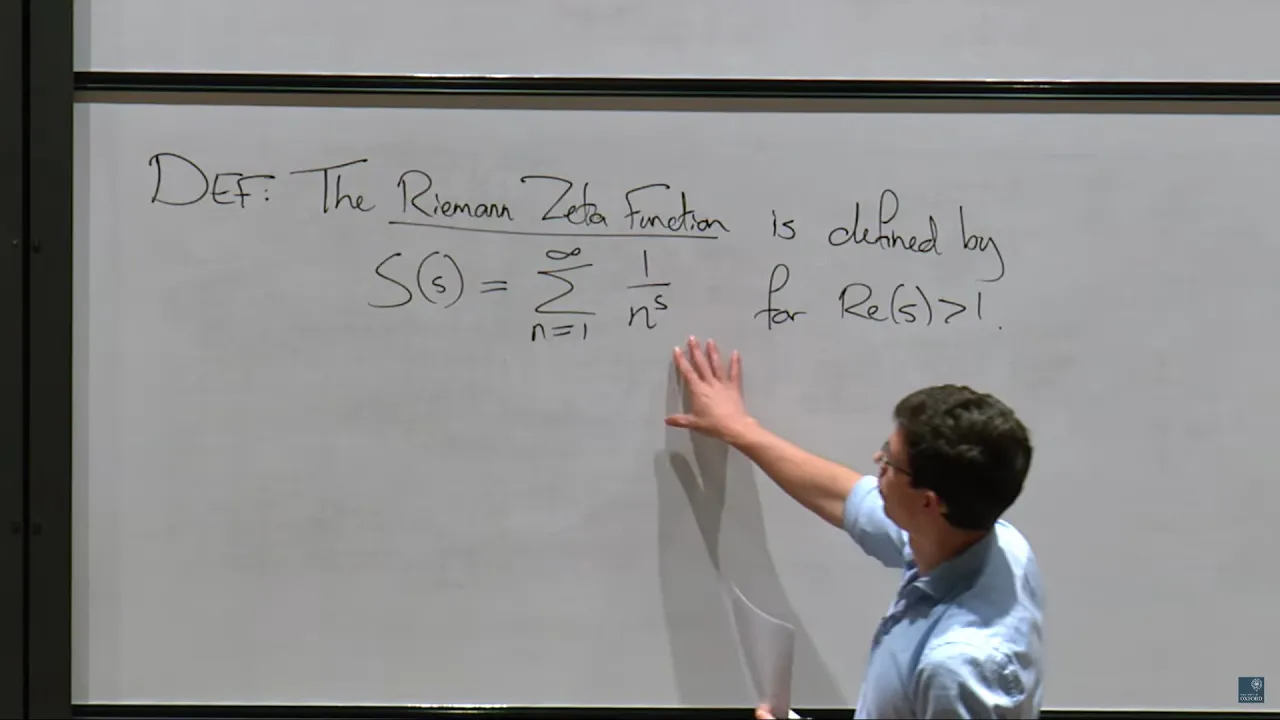
Added:The classical definition of the Riemann Zeta Function as a Dirichlet series and its convergence properties for Re(s) > 1.
Fundamental concepts of Complex Analysis, specifically holomorphicity, analytic functions, and the uniqueness of analytic continuation.
Abel's Summation Formula (summation by parts), which is crucial for transforming discrete series into continuous integrals.
The behavior of complex exponents and improper integrals involving complex variables, such as the integral of x^(-s).
Analytic continuation of the Riemann Zeta Function to the entire complex plane (except for a simple pole at s=1) using the Gamma function.
The Functional Equation of the Riemann Zeta Function, which establishes a reflection formula relating zeta(s) to zeta(1-s).
The distribution of the zeros of the Riemann Zeta Function, distinguishing between trivial zeros and non-trivial zeros located within the critical strip (0 < Re(s) < 1).
The Riemann Hypothesis, which posits that all non-trivial zeros of the zeta function lie on the critical line Re(s) = 1/2.
The Prime Number Theorem, exploring how the analytic properties and non-vanishing of the zeta function on the line Re(s) = 1 dictate the distribution of prime numbers.
7.3K views106likes15:36Original Release: 2017-11-09
in this video I'll be constructing an analytic continuation of the zeta function to all the real number of to all the complex numbers with real parts positive okay so now to start off what we do is we analyze the sum a very specific sum that's a partial sum as worth evaluating it's going to be the sum from N equals 1 to K minus 1 of n times 1 over n plus 1 to the Z minus 1 over N to the Z ok now why would we want to analyze this well there's a formula called summation by parts is very much like integration by parts except with sums you can look that up try to drive this yourself well what you end up getting it's gonna be 1 over K to the Z minus 1 minus 1 minus the sum from N equals 1 to K minus 1 of 1 over m plus 1 to the Zeke ok now why would we do this well because I could then rearrange this by adding those two negatives over and subtracting the other one over ok so then I get that 1 plus the sum from N equals 1 to K minus 1 a 1 over n plus 1 to the Z which you may notice is really just a partial sum of the Riemann zeta-function because one substitutes in for N equals 0 translate it up then you have the partial sum of the Riemann zeta-function so that's really just gonna be the sum from N equals 1 to K of 1 over N to the Z is going to be equal to okay that's why we're analyzing this is going to be equal to this sum subtracted over so one over K to the Z minus one minus the sum from N equals one to K minus one of n times one over n plus one to the Z and you get the idea okay I'll just put dot dot dot what I'm gonna do is I'm gonna replace what's in here okay because that right there sure looks like an integral doesn't it Emily it's gonna be the integral negative Z to the N negative Z times n the integral from n to n plus 1 of 1 over T or just T to now use e minus 1 DT because if I evaluate this that's gonna be negative Z times N and then times T to the negative Z over Z that Z cancels out with that one evaluate the T from n to n plus 1 and then look at that you get that right that right there anything I'm multiplying it by n cool but what's the point of doing this well there's a function called the floor function of T which will help us here it'll allow us to move that n inside of the integral without leaving in ascend okay and what it does is it rounds down so the floor function of 3.1415 so on is 3 in the floor function of one point seven 7 eight 8 nine 9 is going to be equal to 1 it rounds down it's the greatest integer that is less than it in this function is completely constant on this interval it's constant on that interval so I can move it inside that integral without wearing because it's constant on that interval and it's constantly equal to end okay so that's gonna be negative Z times the integral from n to n plus one of the floor function of T times T to the negative Z minus 1 DT okay let's plug this in okay so I'm gonna have a negative Z there but I have a negative out there so let's just make that a plus Z times the integral from n to n plus 1 of the floor function of T T to the negative Z minus 1 DT now here I'm gonna have the integral from 1 to 2 plus the integral from 2 to 3 plus the integral from 3 to 4 right that's what this is and you can imagine the stuff inside the integrals plus the integral from K minus 1 to K but 1 to 2 2 to 3 I can combine those into 1 2 3 1 1 2 3 3 2 4 I can combine those who can combine all of them because these are just the partial sums right if this is my curve and I had this area and I just divided it up into all these little areas and I just added all these little areas together it's still gonna be the entire area that's the point I'm trying to make is that that sum right there it's really just going to be equal to 1 over K to the Z minus 1 plus Z times the integral from 1 to K of this and so well we now define very what we now find is that we can see that these ADA of Z right the Riemann zeta function of Z is really just going to be equal to one over that goes to for the real part of Z bigger than one right that minus one goes makes it a positive and then that goes to zero so that goes to 0 as K goes to infinity here so we're letting K go to infinity so this right here is the riemann zeta function right that goes to zero for a real part of Z greater than one and this one goes to z times the integral from 1 to infinity of the integral of the floor function of T T to the negative Z minus 1 DT right now I claim is that I can continual I can make this into something even better ok namely by subtracting by subtracting 1 over Z minus 1 ok what would that do well because Z times the integral of T times T to the negative Z minus 1 DT right right here of course can be equal to Z times we're gonna have T to the negative Z you can evaluate that all out it's can be Z over Z minus 1 which is going to be 1 plus 1 over Z minus 1 right because that be T to the negative Z evaluated it all out you get that this is from one to infinity and so that by subtracting this over right so if I subtract that on both sides I get Zeta of Z minus one over Z minus one it's going to be equal to one plus Z times the integral from one to infinity of this T to the Z minus one DT but I also need to account for the fact that I added this on to it so I need to subtract off of that Z times the integral from 1 to infinity of T times T to the negative Z minus one DT I combine those two integrals to get the floor function of t minus T T to the Z minus one negative Z minus one DT I claim that this integral right here extends to real part of Z bigger than zero okay because the absolute value I'm gonna say it's absolutely converging the absolute value from one to K of the floor function of t minus T T to the negative Z minus 1 UT thank the absolute value of that this right here is a constant that is less than zero so when you take the um I'm gonna say less than or equal to the integral of the absolute value there right because the absolute value of the integral is less than the integral of the absolute value okay I'm gonna move this up here so I have the absolute value of the integral from 1 to infinity of 4 function t minus t e to the minus Z minus 1 DT it's going to be less than or equal to the integral of the absolute value right I'll leave this up to you to prove and then that's gonna be less than or equal to this thing inside the brackets is going to be less than or equal to the individual multiplications right and times the so right there I have the absolute value of the for function and then times the absolute value of T to the minus C minus 1 DT all right which is less than or equal to this right here is a constant that is less than 0 right because every one was greater than 0 that wouldn't be the lowest value okay so that's gonna be less than 0 so I can get rid of it and still keep that less than or equal to now I have this what I claim is that this is less than or equal to the integral from 1 to infinity of T to the negative real part of Z plus 1 DT because the absolute value of T to the Z is less than or equal to T to the real part of Z why is this because all right there is gonna be T to the real part of Z times T to I times the imaginary part of Z all right I just separate it out into its components T to I times the imaginary part of Z has absolute value 1 ok because that just be e to the natural log times at that give you absolute value one so this is absolute value one this is gonna be less than or equal to you have to value this and then times the absolute value of that which is one so that goes away this is positive right there that's where this comes from and so we now have the integral from one to infinity of this which is also going to be less than or equal to this is also going to be less than or equal to the integral from one to infinity of the individual real part so negative real part of Z and minus one DT right I just separated it out into its components which you can evaluate to be one over the real part of Z for real part of Z greater than zero ok so after all of this what have we proven that it's absolute value is bounded the absolute value here is bounded so therefore this converges so therefore this is an analytic continuation and so what we've basically done here is shown that in actuality that we may define the zeta function of Z as Zeta of Z equals one over Z minus one plus one plus Z times the integral from one to infinity of the floor function of t minus T T to negative Z minus 1 DT for the real part of Z Bayer than zero Oh
Up Next
12:38
The Riemann Hypothesis and L-Functions Explained
@numberphile
1.4M views•2016-05-10

4:43
Elliptic Curve Cryptography Explained: ECC, ECDSA, ECDH
@PracticalNetworking
28.5K views•2024-10-21
10:44
Fourier Series Introduction: The Big Idea Explained
@DrTrefor
387K views•2021-05-03

6:00
The Mathematical Impossibility of Accurate World Maps
@Vox
23.3M views•2016-12-02
Related Study Plans & Knowledge Roadmaps
Structured learning paths in Mathematics
mathematics
Tensor Calculus: Vectors to Riemann Curvature
01Mathematical Foundations: Linear Algebra & Calculus
02Covectors, Dual Spaces, and Tensor Basics
03The Metric Tensor and Index Gymnastics
+ 2 more learning modules
40h5 modules
Explore Roadmap
mathematics
Gödel's Incompleteness: Logic, Proofs & Limits
01Introduction to Formal Systems & Hilbert's Dream
02Set Theory, Cardinality, and Cantor's Diagonal Argument
03Arithmetization and Gödel Numbering
+ 2 more learning modules
14h5 modules
Explore Roadmap
mathematics
Galois Theory: Fields, Groups & Solvability
01Foundations of Abstract Algebra: Groups & Fields
02Polynomials & Field Extensions
03Splitting Fields & Symmetries
+ 2 more learning modules
24h5 modules
Explore Roadmap
mathematics
Non-Euclidean Geometry: Models & Geodesics
01Euclid's Fifth Postulate and the Birth of New Geometries
02Hyperbolic Space and the Poincaré Disk Model
03Geodesics: Defining Straight Lines in Curved Spaces
+ 2 more learning modules
15h5 modules
Explore Roadmap