











Research on 79 countries reveals that the conventional theory—that clientelism perpetuates economic inequality—is challenged by evidence showing that in poorer countries with low state capacity, clientelism may actually reduce inequality by providing targeted benefits to the poor, who have limited alternatives and shorter time horizons; however, this counterintuitive relationship depends on competitive electoral environments and weak state capacity, suggesting that the impact of clientelism on inequality is context-dependent rather than universally negative.
Clientelism & Inequality in Electoral Democracies
Added:Understanding the definition and mechanisms of political clientelism, including patron-client networks, patronage, and vote-buying.
Familiarity with the concepts of socio-economic inequality and how it is typically measured, such as the Gini coefficient.
The distinction between programmatic political representation (based on policy platforms) and non-programmatic representation (based on selective incentives).
The standard academic consensus and theoretical assumptions regarding how clientelism historically undermines democratic quality and exacerbates economic disparity.
Analyzing the methodologies and global databases used to measure clientelism empirically, such as the Democratic Accountability Linkages Project (DALP).
Evaluating the comparative politics of distributive policy, specifically how informal clientelistic distribution interacts with formal welfare state institutions.
Studying the conditions and causal mechanisms that drive a political system's transition from clientelistic to programmatic party competition.
Deepening research into modern case studies where clientelism serves as an unintended, albeit inefficient, mechanism for wealth redistribution in developing democracies.
181 views1likes55:41Original Release: 2024-11-14
this is the project I'm supposed to working be working on and have been working on but this is actually the first time I ever talked to anyone about it and I know this topic is also a bit out of the ordinary of um this cluster so I have a some particular challenges to introduce you to the general theoretical area in which this works and I will start with just some general considerations of democratic theory and how it uh differs from a conventional considerations of democratic theory and ultimately I want to get to uh the data I have been collecting over the last two and a half years uh but in order to motivate this I will have to give you bit more crisp theoretical uh uh predictions uh that then will lead me to uh giving you sort of a first flavor of some empirical results that uh one can generate with this uh still incomplete data set you see there's an end of 79 countries we are just finishing the last 11 we will have 90 uh by probably by the end of July and there will be a panel at the American science association with a variety of papers that will go over the regional data but the data analysis hasn't really begun so um I'm also looking for some input in uh how to devise the analysis you can help me uh prepare a um an analysis plan so uh let me start off with just some very roundabout considerations the first something that we might do in an undergraduate class how do we think of democratic accountability and responsiveness so I'm following here something that aren liart proposed many years ago you start with living conditions and have political preferences somehow they bleed to activists that coordinate around political parties they select leaders that Appeal on the basis of certain ideas programs that affects voters and their preferences they identify with parties ultimately this leads to elections government formation uh policy making and uh implementation and policy impact that's the cycle of democratic account ideally um I have highlighted here three elements that will become important for my uh considerations that there are programmatic appeals whatever that means we get to that uh that governments can Implement these can formulate and Implement these policies and that this will have an impact on economic distribution so that's sort of the traditional way of thinking about it uh and um in the standard model uh let me make a link now to inequality and how how the standard model thinks about inequality um I'm not giving you here various extensions of the standard model the standard model typically operates with a spatial competition Theory people vote for a politicians who Pol programs are ideally close to their own preference schedules and you can adapt this in various ways that would be a separate talk there's a lot of literature about this but there are four ways to think about the link between that and inequality the traditional one I call this the pluralistic one is it goes to the Mela Richards argument uh depending on how much inequality you have the median voter will be more inclined to demand redistribution ution and so Democratic politics Will uh update that and then uh correct the income distribution uh you can uh read further development that is in Carlos Bosch and Asam mler and Robinson's work um a second one which is I think more uh interesting in recent decades is is that uh you have inequality about politicians who want to preserve it can invent other dimensions of politics on which voters are mobilized and divert their attention from inequality so um that's a mechanism to preserve inequality a third one which I call here the lopsided pluralistic account this was developed in the 1960s and 70s especially around what then was called instrumentalist Marxist uh uh arguments you have big business that essentially can override politicians and tell elected politicians and non-elected politicians what really to do and how to preserve the existing income distribution um and those of you who were here a few weeks ago uh I have the suspicion that bakaro at all essentially are a continuation of this approach it was at the time does anyone remember the notion stoc cup State Monopoly Capital this was of the theory of the of the gdr about um State Monopoly capitalism and the fourth one is the structural account of last far politicians even though they are in anticipation of having to win elections cannot touch certain property rights and cannot touch the capacity of capitalists to invest they have to anticipate the negative consequences that will have for them through the mechanism for example of economic voting with respective econom so that's a traditional way of thinking about it um uh this this standard model has some obvious limitations the most obvious one is is that uh most most people don't vote programmatically they don't really know what's going on in politics if you look at political psychology uh you know that this is the case and um then in the model you saw there are a number of assumptions that are are problematic in many instances State capacity do governments have the capacity to implement what they promise uh is there an organized civil society that demands certain things is this crystallized around institutionalized parties or is it really more personal cies that govern politics what do you do under conditions of extremely high inequality if you follow Bosch and as MoGo and Robinson you should never have democracy then the only way you can have democracy is is that in those instances the rich can can threaten exit which keeps Democratic politicians from redistributing uh but I will uh submit to you that there is another way and that will you will see has to do with clientalism uh although I will uh amend that and um finally I something that's also a puzzle for this we normally assume that the more educated and wealthier turn out more and we find that in U developing democracies just the reverse is the case and um people have shown that this may actually have something to do with uh uh clientalism so so what are political linkages if it doesn't work to program what are other political L linkages that matter for Democratic politics what motivates people to vote in particular ways and so I give you here now a um sort of a a map of additional elements that everyone who studies electoral politics is familiar with and has come across and I will just focus on one of them then um it can be instrumental material benefits or it can be symbolic effective appeals that matter that resonate with voters if you go beyond just support out of habit my colleague John Aldridge wrote a paper not too long ago that voter turnout and how you vote is mostly a road activity most people is unthinking you just do it and you don't give it a second thought uh what's relevant for politicians is really only that Minority of people who can be reached with signals and who respond to signals and so that's where all these other things come into play um These instrumental and symbolic benefits can be not non-targeted in the sense that they're issued by politicians but they can affect any voter and so uh they are if you the opposite then is if you have targeted ones that are directed to particular individuals or small groups that's where we we come to clientalism but let me first give you uh sort of the uh menu of all the other things that affect voting uh local Services sometimes referred to as constituency service um if it affects groups and territorial units units pork uh then if it's larger groups uh uh large clubs and uh a polity as a whole that's where we get to programmatic politics that's where we get to what is usually in the conventionally called policy and uh that is not the only thing then we get to social identif there's a lot of talk about identity politics I usually ask when I when you are in a conversation with me about identity politics I will ask you what what does identity mean most of the time I really don't get much of a response Um this can mean identification with an individual charismatic leader personality matters it can be based on kinship and nepotism it can be based on some ethnic or partisan identification and it can be a national identification where's clientalism well we haven't come to that yet a clientalism involves uh directed benefits and threats I should add uh to individuals or to small groups and uh let me be uh so these are the S the the big categories I think that we are dealing with in Democratic accountability mechanisms uh at this time and I will say a bit more now about clientalism um it targets individuals and small groups it involves very short causal chains you give someone let me give an an advanced Western uh example Austria anyone visit the K marks in vien Vienna so in the 1920s you had a lot of building of public housing the social Democrats did that and that went to their members so public housing would be an example in many places patronage that is public sector jobs or nonprofit sector jobs they go to individuals to support the party um in many countries Municipal jobs essentially are filled with people who have a dual function they work for the municipal government but at the same time also for the mayor and their party and um there is then some conditionality and opportunism um if you get this job you better do something for the party and the question is and there's a big literature on this I'm not going to address this whether that then involves uh monitoring um or if not monitoring what sort of alternative channels are dealing with this cond conditionality and the implicit opportunism you get something but then you don't deliver either if you are the recipient of a benefit or threat or the issue um so there are whole varieties of uh clientalism it can be single shot or relational the most extreme form is of you say you are in Nicaragua and you get building materials for your house you get sort of some panel for your roof and you're expected to vote for the I could show you a picture in Mexico uh a couple of decades ago where there's a a candidate of the pre and behind him sit about 200 washing machines and they're given to the borders on a very very crude one you give someone the left the the lower part of a pressure cooker before the election and the top after the election so this very very extreme so actually in D one we had an open question where we are asked our experts to tell us how clientalism is implemented and this can be hilarious so I mean we could we could talk of for an hour just about all these technology and politicians are really inventive when it comes to these things uh so I already mentioned it's not just these vote buying benefits single short and shortterm you have these benefits that are longer term unemployment benefits housing municip jobs um this ability um I think the build during the Euro crisis featured a a a a um an island of Greece where most of the citizens were registered as being blind and uh so you can spell this out in terms of clientalism there were politicians who actually uh made sure that they got these votes by enabling citizens to get this disc discretionary benefit uh public sector employment regulatory easements and business procurement contracts if you were in Japan in the 1960s 7s 80s or in Russia in that brief window where you had a bit of electoral competition this would be run through contracts to large firms you would in a way subcontract the capacity of mobilizing Voters to the managers who get uh procurement contracts for their firm um so these are dimensions of differences and we captured this in the DP survey um these uh benefits can be delivered by individual politicians or party machines so we have a whole module that talks about that um it can be remunerative or coercive you can also threaten to withdraw something uh that is just as uh critical as uh benefiting extending a benefit it can be Supply or demand initiated um often we think of clientalism and these benefits and direct individual exchange as something that is unethical and this is how all intellectuals think in all countries but if you ask people that may be very different I remember some years ago I was on a on a panel and the um the chair of the panel was a former president of Colombia and so we were talking about clientalism and at some point he just exploded and said oh you are talking about clientalism as if this was something illegitimate have you ever gone to a Colombian Village and try to uh make an appeal to voters there they expect that you deliver these things and that you hand out these things there's nothing ethically uh uh objectional to this and so there recently has been also in anthropology a bit more of a literature about that this can be demand uh re it may involve a monopoly or competitive relations where does clientalism come from as a concept well it's not from political science it comes from anthropology and from political economy and it concerns the relationship between essentially uh small holders and uh tenants and the large land owners and it's typically a relationship in which the land owner the large landowner extracts resources but on a variable schedule such that if there's a failure of the Harvest he may come to the aid of his uh dependent clients or if you go back to the Middle Ages uh if they are Invaders to protect them they can withdraw to the manner of instead of being exposed to violence and so James Scott famous book written 1976 is one of the most influential uh people analyzing this from a political science perspective and that then came into political science uh but um once you have electoral relations it's no longer necessarily uh monopolistic and again there's a big debate about this in political science um what I've said so far mostly uh involves material economic relations but it could also have symbolic and informational and effective relations if you were in Peru how do you organized clientalism there well you have a big Fest and the alcohol flows people come and that's what you are expected to do you you you organize a big festivity what do you as a politician expect to get out of this attention you're buying attention here and uh the the an Avenue for persuasion uh and you find this in many countries actually that there's sort of this social effective side of uh clientalism all the way to Japan where uh candidates of the ldp took their voters on weekend outings on tours imagine you went a CDU candidate in constant said okay you I pay for you for a tour to go to whatever uh Lindo with me for the day and I wine and D you uh something like this uh so uh I already indicated the all these varieties and I just want mention some misunderstandings um clientalism is not the the same as vot buying vot buying may be one form of many um the relationship between clientalism and Corruption is very complicated again I'm not going to say anything about that now whether it's exploitative or asymmetrical that's an open question that depends on the competition again there's lots of debate in the field about this whether there's an imperative of monitoring or not big debate lots of field research we have some questions about this in the survey I haven't analyzed yet um whether particular institutions here uh open open vote so no secrecy of the vote and certainly no Australian ballot whether that's a precondition of having clientalism big question uh whether and I will show you some data on this but there's a clear tradeoff between clientalism and programma ISM that's a big question anyone here being being an expert for VM the varieties of democracy project in gothenberg they have one of their questions in the survey is to say whether a political party is more clientelistic or more programmatic so essentially assuming that there is a simple trade-off between the two and I will show you something on that in a moment um and um it could be the reverse that really we are dealing with a multi-dimensional vectors of linkages I mean something I'm not going to get to but if you can go back to this complicated scheme uh one moment this complicated scheme uh you could also Imagine of what politicians are doing is really choosing a vector of linkage strategies over the whole range and so they have to pick how much they put on personality on constituency service and and and yes Australian ballot is if you do not have just a a public a secret ballot but also one where the government or some electoral institution prints the ballot in many countries you have secret ballots but the parties are printing actually the ballots so uh that's so that it was first introduced in Australia I think in 1906 or something like that uh so theorizing clientalism and linkage profiles um so I already talked about this we want to know we want to characterize linkages and how they hang together in linkage profile else then there may be some corelates of this I don't even want to think about in which direction the causal errors run um but things that may be uh complementary to the choice of linkages so the kind of party organization the kind of electoral arrangements and also the interaction between the two and the embeddedness into associational networks and the competitiv of partic systm so we have data on this eventually we can analyze this not now um then we want to know where this is so the Upstream where does it come from so we have a lot of theories about this economic development is probably the most uh prominent ones poorer countries tend to be more clientelistic than richer countries you will see something on that in a moment and a state capacity which is quite closely linked and it's difficult to dissociate this that's something uh I will come to in the future the Democratic regime experience for example you have the famous argument by a world Bank Economist Philip keer clientalism is something you have in New democracies when politicians did not have the chance to invest in developing brands of political vehicles um embeddedness in associational networks yeah so oh no I'm here um Democratic institutions so we get to the question whether some institutions are more uh conducive to this or not uh here we are mostly dealing also with religious predictors and then the question whether in ethnol culturally divided societies is more likely to re rely on clientalism because it's more easily policed and targeted benefits and and finally a political economy so then we get to inequality um and you see inequality being here on the upscreen side does inequality affect linkage choice but it's also on the downstream side uh is it affected by linkages uh I will today only give you something about correlations and not about cation which is obviously hard part uh but um so if you look at Downstream uh does the choice of linkage mechanisms affect uh economic and social development life chances uh social economic ific there we really get to what I'm talking about today political domination political regime satisfaction and so on these are all things we can uh analyze um some of which has been most of it has not um so the I'm not going to go through the details here I give you conventional wisdom about all of these things um so for example I have here clientalism is thought of as out of one cluse and mostly vot by or um that it involves an asymmetrical Patron client relationship or that it happens in new policy polies the conventional wisdom that is almost based on no grounding that I want to challenge is actually here this last Point more income and wealth inequality is present in clientalism uh the rich by off the vote of the poor with minor targeted SS uh so let me um uh elaborate on that let me get to the empirics um so I will not go through the entire agenda of counter claims uh he are the ones that are of Interest my counter clim will be at the margin less inequality even controlling for sealing effects in countries with high uh clientalism so there maybe an argument that may be counterintuitive on the face of it that if you have more clientalism you may have less inequality and uh that should apply mostly in poorer countries so there I'm making concession to the developmental perspective with low State capacity so uh that is sort of what I want to elaborate now a little bit more so the Orthodox perspective um still in some ways is against the backdrop that I already gave you the melzer Richard theorem that if um you have Democratic polit competition and you have policies that spells bad news from to rich people because then you have to supply large Club goods and Collective Goods to the me including the median vo and that will lead to less pre inequality or equal more equal pre redist predistribution and promote fiscal redistribution so how might rich people want to avoid that well that's where clientalism comes in they buy off individuals and small groups they buy their acquiescence to inequality by targeted benefits that's cheaper than introducing say a pension system or Universal Health Care or whatnot and so uh you have these targeted localized discretionary benefits uh that keeps them AC quied and this works most easily if you have monopolistic Supply you have one party That's The Only Name Game in Town they are not really alternative suppliers with some credibility and um you target these of course to the to the poor bers because they're the cheapest and um so uh that reduces the cost of a Target and also the poor are kept dependent in this we also know from economics that poor people have a short time Horizon they're under pressure they need to um satisfy immediate subsistence needs and so clientalism is it's ideal for doing this and um by implication then so as countries become wealthier clientalism should grow rly Sub sub subside so you also see the link here to develop um as already indicated the causality in this theorizing and also in sort of my amendments runs both ways inequality is a condition but it's also a consequence and may reinforce each other or work against each other so the heterodox argument is that um you have to think about the conditions under which these relations apply and the first one is what if clientalism operates in a competitive context so you have different potential suppliers of clientalism uh you have to theorize that um you could have a demand side that goes shopping among different political uh candidates if not parties for benefits how will this affect the operation and the impact of clientalism uh on inequality and this may go along with that there is no normative sanctioning ostracizing of clientalism that clientalism is just thought of as okay and as the way to go if you want to have Democratic accountability um and that in fact political parties May institutionalize this in machines so my uh collaborator my partner in crime in this project k y deim for example studied this with the AKP in Turkey you go into the poor suburbs of Istanbul and you see that in operation um the second thing is what if you have low State capacity that means as a politician you cannot credibly commit to the delivery of large Club Goods of collective Goods um under these conditions uh what can politicians promise and what borders are not stupid um so you may then think that uh uh voters realize this and what they what they uh think of as clientalism is here with the uh English language uh uh saying better a bird in the hand than two in the bush um what politicians may tell you in terms of uh Collective goods and Club Goods this is cheap talk uh they cannot realize that anyway I rather take what I can get and that is in fact uh clientelistic benefits and um I could link this to a broader literature in the political economy of development that's sometimes called embedded liberalism many developing countries don't have encompassing welfare states but they use essentially uh the public sector as a trough to compensate against socioeconomic inequalities um a range of Voters and they typically tend to be Affiliated also with uh with political parties so here we get to these things already mentioned um so the potential for clientalism as poverty and inequality alleviating maybe greatest in poorest and some middle income countes especially those that have low State capacity these things are actually quite diff as you will see in a moment you look at correlations difficult to dissociate from one another so that's one of the problems here so we get to the hypothesis um conventional wisdom strong clientalism should correlate with more inequality and the counter hypothesis is um there's no correlation between the two and maybe at the margin it's the reverse at least in less developed countries with low State capacity and competitive democracy all right so this is the setup um measures I don't I see I'm already 30 minutes into this so I can only give you the uh sketch of the measures here um so this project Democratic accountability Democratic accountability and linkage project two that follows number one they had a survey on this in 20089 you can download that that data is available and has been used quite a bit in the profession um there are four different ways to study problems of electoral competition uh one is through surveys I would love to do a survey on clientalism but give me a few million let's say 15 million then I couldn't do it probably and so this has hardly been that just a handful of question if you you look at afrobarometer and Latino barometer they're usually deplorable I myself once got questions into the India election study of 2009 I never got access to the data because they don't let you have the data and that charge for each multiple regressions you run 500 bucks if you're a Wester so and then you don't know what they're really doing so that's another reason why I just would not want to go there the second is politician surveys I've done some of those myself uh and actually the results are surprisingly similar to this third one you do this with attentive observers that we get to experts I could give you an entire talk on about the methodological problems of this um typically associated with four baskets how expert are how much expertise do the experts really have on these difficult questions some of you completed them is there bias uh is that differential item functioning that means you give the same stimulus in one place but it's interpreted and perceived in different ways elsewhere and finally aggregation well we can ask them about the unit of analysis is political parties it's not countries although you will see I aggregate a lot of the results here as sort of a first approximation to to countries um this these are all very problematic we discussed this quite a bit with with them people a future one maybe David yes this text based analysis but as we discussed um there may be too little out there on these questions for an AI program really to give us maybe in a few years uh so so we have the the subjective Pro the unit of analysis I already indicate National parties and legislative elections the countries included are those that have more than 2 million inhabitants although in order to keep continuity we kept even some shrinking ones so Estonia and latva are now below um and um they should have at least a liberal democracy score of VM of greater three or lower than four and the Freedom House Index just to assume a modicom of competition so a few countries we had in 2009 fell out of the spectrum Egypt we couldn't do Egypt anymore um Russia Venezuela Nicaragua Mali and uh one other ner too bad uh you just can't run it anymore um so I already gave you that so survey content also did this so there's a lot of continuity and I will show you a little bit of between 20089 and now but in the runup to implementing this one around here we sent a draft Kum and I sent a draft to 50 plus of our buddies around the world to study clientalism and they gave us over 500 suggestions how to change the survey and so but that was quite a handful to work through it led to the in inclusion of an additional module though uh module a is essentially pretty much from the Del one party organization Civil Society although we have something in there about party funding which is creating a lot of headache um module B this is essentially on which I now will draw but module C is entirely new and that uh deals more with the Implement organization of clientalism and what in the business is called brokerage and Brokers so we have a a battery of questions on that module D that is sort of a garden variety programmatic party appeals but in a more fine grained way than you find in VM and also in chest the Chapel Hill uh expert surveys and then some roundabout summary ones where so where we we have essentially at least one indicators on each of these many different kinds of linkages you saw in an early uh slide here uh so our indicators for clientalism itself so it's party scores which can be aggregated to National scores weighted by the Electoral performance of parties so that's what I'm actually doing now so a party say if you are in Mexico the um uh ruling Modena party will be score will be weighted stronger than say the pre or the pun and then you have minor Splinter parties that are scored but they are not really weighted much here um we don't have subnational scores so if you are you know political scientists fall into um lumpers and Splitters I'm more on the lumper side here so depending on how much you are Desiring splitting I cannot satisfy you and so there is obviously subnational variance so if you are in the Anatolian Countryside or in Istanbul makes a difference and I cannot deliver that um so we have an summary index that's based on five variables that itemize these Services you earlier saw like having a patronage job and so on in the new Doby actually added some that weren't in the old one but for the sake of continuity and comparability I keep the same indicators here we also have one on clientelistic Effectiveness that's actually very interesting so one you ask politician or experts how much politicians make an effort with clientalism but then you can ask the experts also do you think that it makes an electoral difference and that's not necessarily the same thing in fact I have one paper which analyzes for d one how to account for the difference in some instances you have differences in others you don't again something I can't talk about here um I will briefly this programmatic effort is a very complicated matter so I will also not explain it I will just use a little bit from one indicator um and so let me give you some brief results so first this summary index B15 uh n nationally weighted uh for 2009 never mind now the the scale here from0 to 20 or actually effectively from 4 to 20 and in 2023 uh amazingly if you aggregate this it comes to almost the same thing and there only some countries so if you are above the line that means that in 2023 you have less than in 20 20 uh 2009 so there are some countries um where that makes sense so Ireland um the Mediterranean countries you see a decline Taiwan would also be here Bulgaria Argentina a little bit so you have some declines of clientalism over time but overall we were surprised how consistent it is um you have a few cases where clientalism has increased a clientalism how do clientalism and programma ISM relate to one another so I gave you earlier the conventional idea well it's a it's a it's a it's a a tradeoff I'll give you actually here the skram on the party level so you don't really it's not weighted by the the size of parties but these are sort of the uh whatever 400 odd parties we have so far we eventually will have about 550 and what you see is well there's some regression here and there are some quite a few parties where you can say yeah they have a lot of programmatic appeal and relatively little clientelistic appeal and the reverse you have clientelistic parties that are not very programmatic but and not really much discussed in the literature you have a lot of parties uh I have a paper on that as well that is are diversifies linkage parties that combine clientelistic appeals with programmatic appeals again think of Austria the Austrian socialists there were a clientelistic party starting uh from the time that captured the Vienna mayoral but they were of course also programmatic parties they delivered Collective goods and Club goods and um so that's an interesting question why do some parties and in some places why are they able to combine this um you don't have very many in the uh category that they don't do any of this uh these are typically small and new parties I only can tell this from 2009 I haven't looked at the current data set yet in that regard uh so now let's get to inequality that's really that's why I'm here so let's let's get to this 45 minutes into my but I'm almost done uh I'm only using a sing measure at at this point and because it's something we only really did in the last several weeks the standardized World inequality a data said taking off from the Luxembourg which is sort of the I think best uh source of um data uh so we take this we take in the Disposable the genie for disposable income there but you can of course think of a whole range of other measures that we will look at in the future uh you can look at petti World in inequality data with a top 11 10 and bottom 50% you can look at redistribution because you have market and disposable income and SED you can look at wealth rather than uh income uh you can look at poverty and there are always different mechanisms and strategies involved in each of these uh you can look at the security income of income and assets burles man has an index has very little available really on knowing how comprehensive the welfare state is beyond Advanced Western democracies and Burman provides at least a it's a cumbersome and crude instrument but it's the only one uh I have found so far that would allow us to extend this to most of the countries we have in our Set uh another thing I think that might be interesting is to bring in the world happiness Service uh does clientalism affect is affected by happiness does affect happiness we know that there the for corruption and and governance but um that is one public goods provision education healthc care and performance I have actually a paper based on 20089 that looks at um students uh um math and verbal scores in developing countries uh and relates it to clientalism um and so you can also more broadly look at human development indicators so clientalism in in course just the hypothesis one would be to say there's a positive relationship that is the conventional one the alternative one says oh that depends that may depend on some other contingencies maybe it's different depending on where you are in the development trajectory maybe it's different on your capacities so let me well that looks like the conventional one right so you have here the genie and here you have the clientalism index so the more clientalism uh the more inequality I declare defeat not quite uh well first of all how does visual inspection so completely unscientific um is maybe not we usually we usually our our modeling strategy typically a linear one we just the the functional form of relations that we assume is linear but that may not necessarily be the case and um that's the first clue but um then there's of course the problem how development inequality and uh clientalism relate to each other we get to the question of especially if we do this over the entire data set the problem is is when you include Advanced Western countries in many Global comparisons this is like the new nuclear bomb of exp explanations that blows out everything else and that's also the case if you look at this here so Genie and calistic effort uh so that that explains about 35 37% of the variance um but then you bring in Economic Development that's of course also very strongly related and extraordinarily related to clientalism going on it could be that Economic Development uh uh determines genies and clientalism let me just show you the relationship between clientalism and economic development to challenge the idea that the functional form of statistical estimation should be one of linear linearity um this is the relationship so here you have the uh log GDP and GDP is always GDP per capita at purchasing power parity 2022 and here you have the clientalism index and you have in different colors the uh different regions of the world you have many of the African countries here here you have Latin America is highly differentiate look where Uruguay is Uruguay is way out there uh Costa Rica Argentina Chile and then you have every everything else more up here Mexico Ecuador and so on uh then you have um Asia and the the Middle East of course we have very few Middle East countries we have Tunisia in there people scoring retrospectively uh what clientalism was in 2020 um and then you have in blue of course the advanced Western democracies and they essentially Drive the correlation here I mean if you take them out if if you say you cut it off at about $40,000 per capita GDP there is very little relationship and if anything um in fact we can show this with regression it's a curv linear one that there's somewhere a peak and then beyond this clientalism doesn't contribute anything to uh inequal to to I have I have to be careful I'm not yet at inequality clientalism and um development are no longer positively related um and in um so that is something you can see here so based on that let me now show you the relationship between clientalism and income inequality once we use uh the uh residual so we control for GDP per capita at purchasing power parity and what you see then is is that the relationship disappears and if anything uh if you stick with a linear format uh actually um you can argue the more clientalism um uh the the Disposable G GD or the the residual disposable Genie residual is related in the opposite way the theory would predict and uh we can do this also we have 79 here 78 cases because we don't have a GDP per capita data in the standardized format for Taiwan um and you see in fact that there is a a cur linear relationship if you predict uh a clientalism uh that uh that uh is in a curve linear Cur linearly related uh to uh GDP and to gen so that is just a beginning here um so the uh the theoretical argument would be uh the relationship between these variables between clientalism inequality depends on contingencies and GDP per capita and yet not included here uh capacity State capacity uh are the relevant uh uh conditions there may be discontinuities maybe even threshold effects um so you have essentially uh the uh two uh scenarios in very poor countries and countries with little state capacity the poor may actually benefit from targeted Provisions because nothing else is available in intermediate income countries um particular with well I'm going here into things I have not explained strong State economic organization State L because they are the state makes available a lot of economic resources to political discretion um they are um you may have um actually the reverse you may have a situation where these resources are diverted in clientalism industrial complexes or not so that's something that requires um much more detailed invest investigation uh so that as a as a shortcut is there something like a a kets curve if you think of the old kets argument that with development things first become worse and then better um so there's more inequality and then less inequality so you have sort of a reverse KET argument that clientalism in very poor countries uh is not as um negative on inequality than in intermediate income countries with more uh State capacity uh prospects well none of this includes appropriate controls test for mechanisms direction of causality um we have not exploited any leverage of intertemporal change so we have now two data points which is still really rough 20089 and 2022 to 24 we also have in each of these surveys a recall question so in 2008 it reads like well if you think of 10 years earlier was clientalism in sort of the experts country more or less pronounced interesting actually for 20089 we see that clientalism has not gone down over time in the recall and also not gone down with development and that brings to mind that even in some really rich countries you had very strong clientalism until um you had certain momentous uh socioeconomic um uh crisis think of Japan until the bubble burst in 1991 the crisis of the public sector Industries in Austria and in Italy in the uh late 1980s there were sort of critical events in which clientalism became unviable um and in Latin America you can think of the uh uh decade of the 1980s as something that undermined clientalism in many instances for example in Mexico that triggered both democratization as well as democracy in part because the pre the incumbent party could not sustain a paying off its consistencies in the traditional way um yeah so uh these recall this this has to be uh used and uh mechanisms so we have this very rough link between or I hope between more clientalism and less Genie disposable income what could be mechanisms that link those two things together um one would be you have more party competition that gives the voters more leverage over what politicians Supply um and that of course directly is related to that the it's actually the voters who demand these benefits and they insist on these benefits um and that this is voters who are really poor who are the beneficiaries of this so we have questions in the survey about targeting which groups in society are being targeted and um we can also look at what capabilities the party machines have that are involved in clientalism and finally um this should Prevail especially if State capacity is very weak and there's no option for uh politicians to use another Avenue for 20089 do I have sort of a paper that shows that there is a tradeoff between providing more Social Security as measured with bti and having less clientalism at least in countries with intermediate uh State capacity so uh let me close on this instead of a conclusion I hope I uh sort of made uh plausible that dealing with clientalism at least if you go beyond Western democracy an important subject um a second thing I usually emphasize is that it's important to think of electoral politics in relation to political economy uh something that's often not done you look at much of comparative politics and people sit at Separate Tables some deal with institutions and voting others deal with political economy and usually have only the the vaguest idea of uh uh electoral politics well that leads back to our previous um meeting and um the final one uh it's going to be very difficult to convert an analysis of correlations into causation because we have so few data points and we have these macro relations many of the things that you uh think of as um important and uh imperative to draw a causal inferences cannot be implemented here but um the terrible thing is of course these are big questions and when you look at the literature that has been done on a lot of client especially graduate students have gone into studying clientalism in individual countries or not even countries in in localized cases um how you would really reaggregate from there uh to anything that gives you a more meaningful um B picture we probably need both kinds of studies and uh rather than going to one of the extremes okay that's it
Up Next
106:15
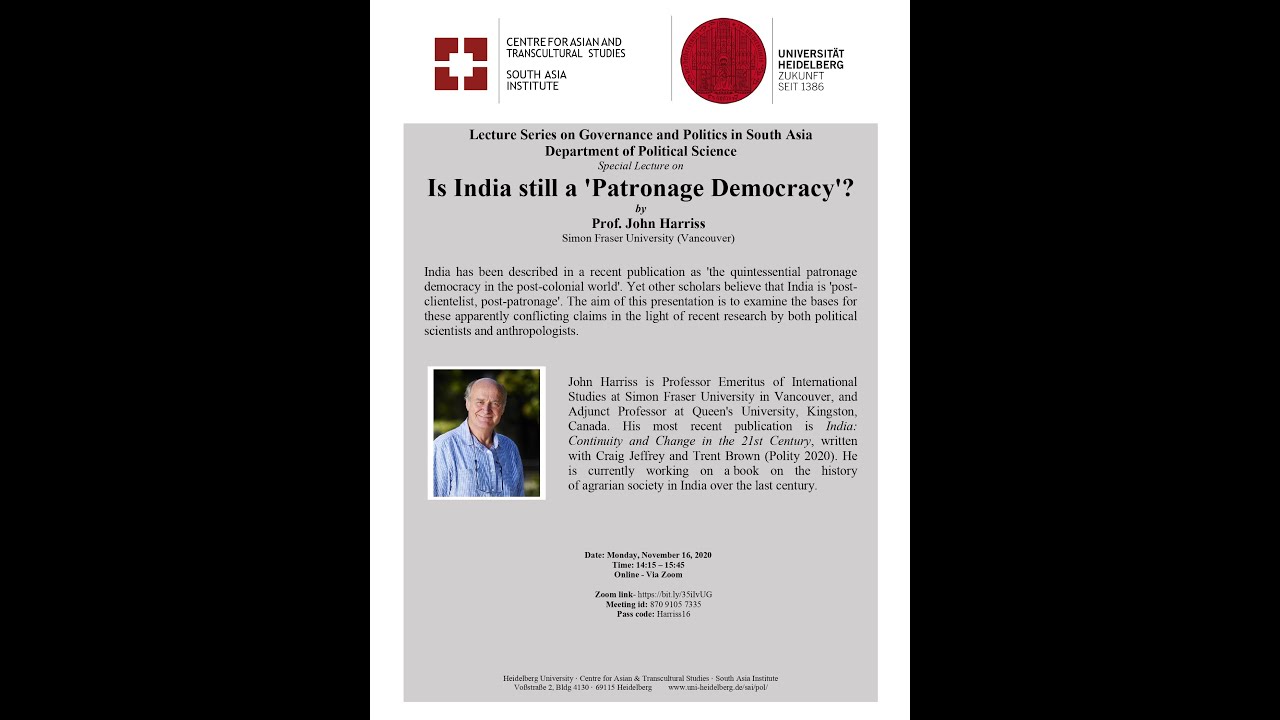
Is India Still a Patronage Democracy? A Political Analysis
@departmentofpoliticalscien8039
213 views•2020-11-27
88:38
Patronage and Political Machines in Southeast Asian Elections
@NewYorkSoutheastAsiaNetwork
511 views•2023-04-05
7:33
Government Surveillance Methods: 10 Ways You May Be Watched
@BeAmazed
1.6M views•2017-04-09
10:19
Explaining the Saudi-Iranian Proxy Conflict in the Middle East
@Vox
18.2M views•2017-07-17
Related Study Plans & Knowledge Roadmaps
Structured learning paths in Political Science
political-science
Analyzing Clientelism: Patronage & Vote-Buying
01Foundational Concepts of Clientelism
02Mechanics of Patronage and Resource Allocation
03Vote-Buying, Turnout Buying, and Ballot Secrecy
+ 2 more learning modules
12h5 modules
Explore Roadmap
political-science
Economic Statecraft: Sanctions & Chokepoints
01Foundations of Geoeconomics and Economic Statecraft
02The Mechanics of Weaponized Interdependence
03International Sanctions: Types, Implementation, and Efficacy
+ 2 more learning modules
12h5 modules
Explore Roadmap
political-science
Central Bank Independence: Politics & Policy
01Foundations of Central Banking and Monetary Policy
02The Time Inconsistency Problem & Inflation Bias
03The Delegation Model and Designing Independence
+ 2 more learning modules
12h5 modules
Explore Roadmap
political-science
Consociationalism: Power-Sharing & Stability
01Democratic Dilemmas in Divided Societies
02Introduction to Consociational Democracy
03The Four Pillars of Consociational Design
+ 2 more learning modules
12h5 modules
Explore Roadmap