















Languages vary dramatically in their morphological complexity, ranging from isolating languages (like Vietnamese and Hawaiian) with no morphology to polysynthetic languages (like Navajo and Greenlandic) where single words can express entire sentences; this variation affects word order freedom, as morphologically complex languages can use morphology rather than word order to mark grammatical relationships, allowing more flexible sentence structures.
Linguistics Lecture 12: Morphology Productivity & Variation
Added:Basic morphological concepts, including the definition of morphemes, roots, affixes, and the distinction between free and bound morphemes.
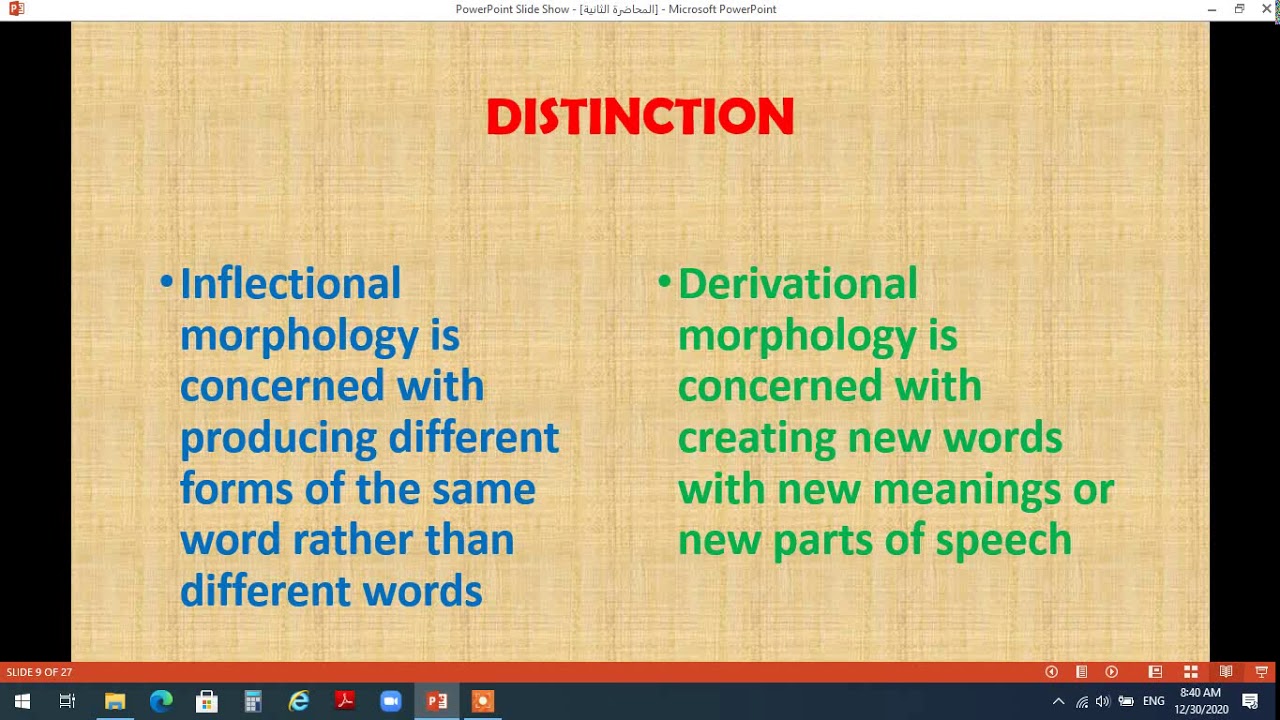
The fundamental difference between derivational morphology (which creates new lexemes) and inflectional morphology (which expresses grammatical relationships).
An understanding of basic syntactic structure and standard word order patterns (such as Subject-Verb-Object).
Familiarity with syntactic functions and grammatical relations, specifically how languages mark subjects, direct objects, and grammatical cases.
The morphosyntax interface, exploring how syntactic operations and morphological features interact (e.g., head movement and clitic doubling).
In-depth typological analysis of complex morphological systems, focusing on the structures of specific polysynthetic languages (such as Na-Dene or Eskimo-Aleut families).
Diachronic linguistics and morphological change, studying how languages transition over time between isolating, agglutinating, and fusional states.
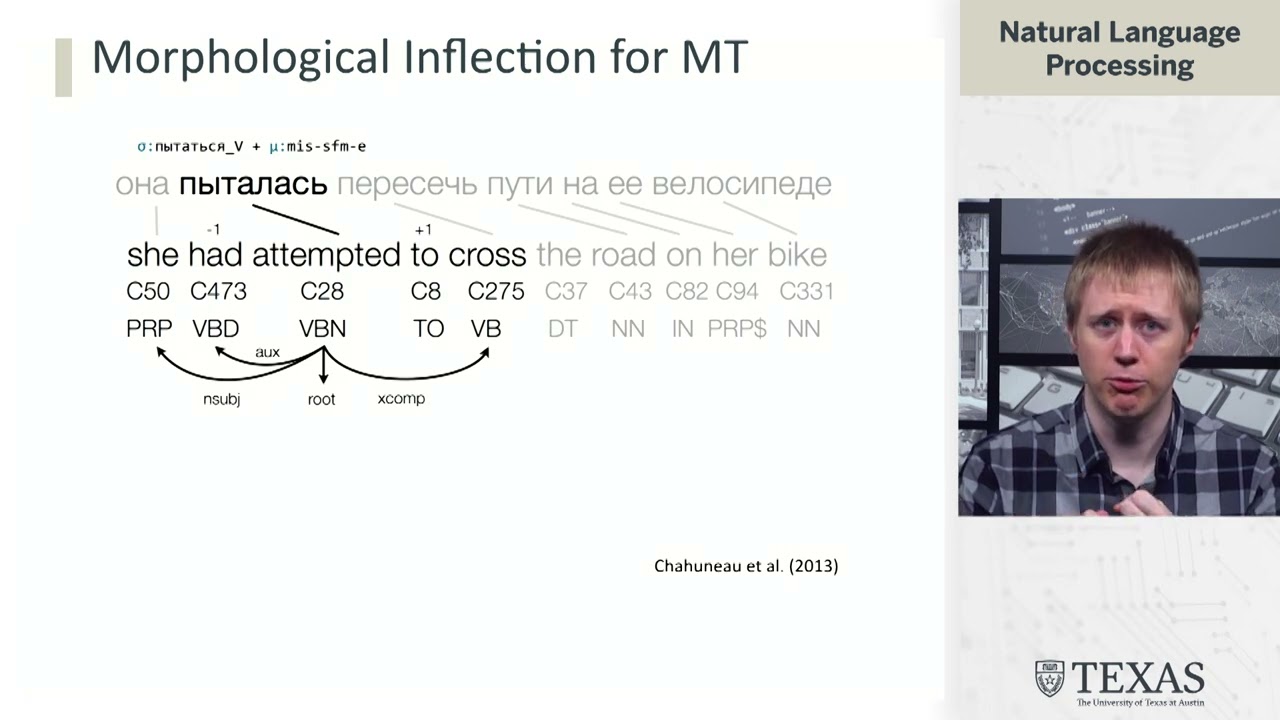
Computational morphology, examining how natural language processing models parse and generate words in highly inflected and morphologically rich languages.
23.1K views460likes36:15Original Release: 2021-07-13
hello welcome back today we're going to be wrapping up morphology the first thing i'd like to do is review what we covered last time the different kinds of morphological processes and in particular the functions of those morphological processes what are the aspects of meaning which are expressed using morphology across the world's languages these are going to be things like changing the lexical category of a word conveying gradations of meaning and marking grammatical properties like number tense and aspect and person and in languages other than english you'll have morphology marking things like gender possession and case remember case is like the meaning of a preposition in english so morphology that marks these grammatical properties is called inflectional morphology i'd like to zoom in on the very last thing we talked about last time and go into a little bit more detail here this is this very important notion of productivity whether a morphological process is productive or whether it's unproductive so morphological processes can be either productive or unproductive a productive process is one that can apply freely to any root within a lexical category an unproductive process is one that only applies to certain roots within a category so there's a fixed finite set of roots within the lexical category that can take certain suffixes that can undergo certain morphological processes in that case it's unproductive if the process applies to everything without restriction then it's productive for example the suffix ness in english is productive it applies to an adjective and it turns that adjective into a noun so you can take angry and add ness and get angriness you can take cool and add ness and get coolness turning the adjective into a noun you can do this for just about any adjective in fact you can do it for any adjective at all in english you can even do it for a made-up adjective if i make up an adjective like gruish i can add nest to it and i would expect then that you would understand that gruishness refers to the state of being gruish and i could even take something like pine scented a sort of complex adjective which is actually a compound pine scented and add nest to it and get pine scentedness and i would expect that another english speaker would understand perfectly clearly what i mean when i say pine scentedness now here's another example of a suffix which is unproductive in english this is the suffix the spelled th which also functions to turn an adjective into a noun so you can take warm and add thu at the end and get warmth but you couldn't take a word like tall and add the at the end and get a word like tulth if i say the word talfth no one has any idea what i mean whereas if i say tallness then you do know what i mean so this suffix the is not productive it cannot be added to an arbitrary adjective to form a noun it can only apply to a certain fixed set of adjectives including warm so though only attaches to a finite set of roots the suffix the is unproductive in english now productivity is best thought of as a sort of spectrum some morphological processes are more productive means that they apply more freely to more different roots some are less productive meaning they apply to smaller and smaller sets of roots so something like the is on the really really unproductive side in english something like ness is on the super productive side something like itty is somewhere in the middle so you can take ferocious and that idiot and get ferocity but that doesn't apply everywhere but it does apply more than so productivity is sort of like a spectrum things can be more or less productive so now let's say you have some morphological process in a language and you want to know whether that process is productive the strongest test that you can apply to figure out if a process is productive is what's called the non-word test that means you ask can you apply this morphological process to a nonce word anons non-sword is a made-up word which still follows the phonotactics of a language so for example in english we don't have words wug or blick or gruish but they sound like they could be possible words right like you wouldn't be too surprised if maybe there's some obscure word wug or blick or gruish so these are non-swords in fact we made them up and we use these to test for productivity so for example let's say we want to know is the process of forming a past tense by adding the suffix de productive is this a productive process in english well we test that by making up a verb so let's say that wug is a verb let's say that wug is the verb that means to jump up and down twice so i wug means i jump up and down twice then what do you expect the past tense to be if you say i wug in the present tense then in the past tense you would probably say i wugged right by adding the d and that shows that the process of adding the suffix da to indicate the past tense is productive how about the process of forming a past tense by changing is that productive well let's make up a nonce word that has the vowel in it so let's say we have the verb plick and that means to jump up and down three times maybe if you say the present tense is i plick would you expect the past tense to be i plaque or would you expect it to be i plicked you would probably expect plicked right so that shows that this process of changing the vowel to indicate the past tense in english is not productive because it does not apply to nonce words similarly the process of forming an adjective by adding the suffix like to a noun let's say that wug now is a noun it refers to a little blue creature that jumps around a wug then it seems like i would for free get that i could describe something as wug like right so if i have a noun wug then i can describe anything as wug like that's a productive process how about the process of forming an adjective by adding ich to a noun so i have wug would i then describe something as a wugic well maybe this is kind of in the middle of the productivity spectrum but probably not so we'd say that ich is not productive the process of forming an adjective from a noun by adding the suffix ick is not productive in english good so that's productivity now what i want to talk about is the variety of morphology that we see across languages so i like to wrap up the phenology and the morphology sections by talking about the huge diversity and variety of different forms of phenology and morphology that we see across languages so this is pretty fun it turns out that languages differ in how much morphology they have they differ in what's called their morphological complexity morphological complexity is how many morphological processes the average word in a language undergoes so you've probably noticed that in your problem sets some of these languages have really elaborate morphology to get a word you put the roots through a lot of elaborate morphological processes whereas in other languages you sort of don't have those kinds of morphological processes right so if the language only uses affixation then this is equivalent to asking just how many morphemes are there per word but stating it in terms of morphological processes is a bit more general you should think of this again as a spectrum languages vary from the least morphologically complex to the more morphologically complex and this is a way in which languages really differ from each other a lot so if you're learning say a really really morphologically complex language and your first language is a morphologically simple language it's going to be really hard for you in fact this is one of the hardest thing for things for people learning second languages is morphology so on the simple end of the spectrum the languages that have the least morphological complexity we have what are called analytic languages analytic languages are languages that don't have a lot of morphology the other end of the spectrum is what's called synthetic languages so what do these words mean so remember analytic means breaking things apart the verb analyze means to break things apart so an analytic language is a language in which the meaning is broken apart into many different independent words and those words are free-standing units they don't have a lot of morphology a synthetic language well synthesis is the opposite of analysis synthesis means putting things together to synthesize is the greek verb to put together so synthetic languages are things that put things together so a word in a synthetic language consists of very many different morphemes that have all been put together that's why an analytic language is morphologically simple and a synthetic language is morphologically complex this is the difference between languages that split things apart into words versus things that agglomerate things together into big words as we're going to see so we're going to look at analytic languages first we're going to look at the simple end of the spectrum first and the first language we can look at in this direction is actually english analytic languages being languages with relatively little morphology english is one of those so for example here's a sentence in english english is an interesting language and let's think about how many morphological processes are involved in this sentence how much morphological stuff is going on in this sentence well we see that there was this suffix ing that we added to interest to get interesting and we see that the verb there is in the form is which is expressing the third person singular present tense form of the verb to be by a subpletion process and we have the suffix in so we have a subpletion process applying to the verb to be and we have a suffixing process applying to a verb to turn it into an adjective so we see that there are two morphological processes that applied in this language this is the sense in which english is an analytic language there's not a lot of morphological processes going on in a sentence so there's just two here that's not a lot trust me we're going to see languages with a lot more morphological processes per sentence and per word so that's just a simple affixation process in english only two morphological processes in that sentence now as our next example we're going to move more towards the analytic end of the spectrum more towards morphologically simple and a language which is more morphologically simple than english is mandarin chinese so let's look at some examples from mandarin chinese this is a senate's woman tancinla which means we played piano i've given it here in a phonetic transcription for those of you who don't read mandarin which is most of you and let's look at what are the morphological processes involved in the sentence well we see that the word wall the first thing in the sentence there expresses the first person pronoun then it has a suffix man which indicates the plural so we have an affixation process and that's actually it there's no more morphology in the sentence so the past tense nature of this sentence is actually expressed by a separate word la at the end of the sentence so the distinction between present and past tense and mandarin is not expressed using morphology it's expressed by adding a separate word look whereas in english in the english equivalent we played piano we see that we have a first person plural subject pronoun which is formed by a separation process and we have a past tense verb expressed using a suffix so there's two morphological processes in the english sentence only one in the chinese sentence now mandarin chinese also differs from english in that it doesn't have case marking on the pronouns so remember i introduced case marking as something that you don't really have in english but really english does have case marking on pronouns it just doesn't have case marking on regular nouns whereas in mandarin you don't have case marking anywhere not even on pronouns so for example here is a sentence which means he sees me takanwu in mandarin and you can see the parts ta means third person singular khan means means first person each word here is expressing a little bit of meaning there's no morphology going on no morphological processes it's all quite analytic if you say sort of the opposite sentence i see him where now you've switched who's doing the seeing you get walcanta in mandarin so we've just flipped the order of the pronouns but if you look at the english translation equivalent compared to the one above you see that a lot more changes when you compare the two english sentences as compared to when you compare the two mandarin sentences so in english the pronoun he is expressing that it's a subject pronoun so when the pronoun is indicating the doer of an action it's in a form like he or she and when it's indicating the object of an action it's in a form like him or her so here we have he when it's the subject and him when it's the object similarly we have me when it's the object and i when it's the subject we see that the form of the word is changing depending on whether it's the subject or the object that's case marking indicated by a supplement process in english we also change the form of the verb with a suffix process so we add a third person singular present suffix on the verb so we see there's actually quite a bit of morphology going on here in the english example which serves the function of indicating who is doing what to whom whereas if we look at the mandarin examples the forms of the words don't change depending on what's the subject and what's the opposite so the first person the i is always wall whether it's the subject i or the object me so chinese is an example of a language which is more analytic than english we would situate the two languages on our spectrum of morphological complexity somewhat like this so english is in the analytical direction mandarin chinese is even more in the analytical direction and now i want to ask can we go further and in particular how far can we go can we go is there an end to this scale in terms of morphological simplicity is there is there a sort of minimum of morphological complexity well there is these are what are called isolating languages isolating languages are the extreme analytic languages where there is no morphology at all there are no morphological processes so every single bit of meaning is expressed as an independent word and the forms of the words never change that's like zero morphological complexity that's an isolating language isolating languages or languages with no morphological processes or almost no morphological processes it's actually really hard to find a completely isolating language in the world it's more likely that you'll find a language that has like one morphological process that applies in one time in one tenth of all the sentences or something like that so in these languages every word is always in the same form and every word only consists of one free morpheme remember the distinction between free and bound morphemes examples of these languages include vietnamese and hawaiian the hawaiian language the native language spoken on the hawaiian islands these are two isolating languages or as close to isolating as you can realistically get so here's actually a map of the world where the different languages are indicated in colors which indicate their morphological complexity so in this case white means isolating it means there is no morphological complexity there is no morphology the languages marked in white here are the isolating languages and you see that they're not really super common it's sort of a rare language type and interestingly they're sort of concentrated around the southern pacific so why that's the case is a mystery of linguistics we don't really know it's very interesting but the point is that these isolating languages are relatively rare most languages have some morphology so now we've explored the lower end of morphological complexity what i want to do now is start to explore the upper end of morphological complexity so we're going to now move in the direction of the synthetic languages towards the more complex languages isolating languages being the sort of end of the scale on the side of simplicity now synthetic languages are languages with relatively many morphological processes and they divide into three kinds based on how those morphological processes work and how many of them there are there are the agglutinative languages the fusional languages and the polysynthetic languages we're going to take these in turn so first we're going to talk about the agglutinative languages agglutinative languages are languages where words convey meaning built out of very many affixes and where each affix is conveying one aspect of meaning these are languages where the language sort of gives you a lot of little lego blocks and you assemble a word by putting together a lot of the lego blocks typically through affixation so for example we saw this example of an english of a hungarian word hasembon which means in my house this has the root haz which means house and then a suffix um which means my and then bun which means in that's the case marker we have a root a possessive and a case marker they're all jammed together end to end we see that each morpheme here sort of is expressing an independent part of the meaning and we string them together that's an example of agglutination an even more extreme example of agglutination comes from the turkish language so take a look at this example in turkish there is a word avrupa which means europe we can add a suffix li at the end the i without a dot there that indicates the high central vowel li is a case it is a morpheme which has the function of turning a noun into an adjective so avro pali means european or of europe or something like that then we can add lash to that and that turns it into a verb meaning become so avrapalilash means become european then we can add a suffixtur to that which means to cause so apropalila means to cause to become european or to europeanize someone then we can add the suffix ama to that which means to be unable we end up with avro pali last rama which means to be unable to europeanize or uneuropeanizable that would be a way to put that in one word in english then we can add the suffix duk to the end of that which means someone it turns a verb into a noun so the avr pali lash means someone who is unable to be uneuropea unable to be europeanized an uneuropea an uneuropeanizable person then we can add the suffix large to that which is the productive plural marker in turkish we get avurpali declare which means those who are unable to be europeanized then we can add the two suffixes actually um and is which indicate the first person possessive and the plural so you end up with a first-person plural possessive which means those of us who are unable to be europeanized or our uneuropeanizable ones then we can add the suffix don the case marker which makes this which adds the meaning of so avrah palilash drama declare means of ours who are unable to be europeanized can we go further well we can add another suffix mish which means to reportedly be so this is transforming the the noun phrase the case marks noun phrase here into a verb you end up with avrupali last rama di mazdan mish which means to be reportedly among ours who are unable to be europeanized all in one word so this is what an agglutinative language looks like you see that at the very end we have what looks like a very complex word but it's actually built out of these tiny pieces these are like lego blocks that you just put together you string them along and you end up building a nice big complex word whose meaning is clear so a turkish speaker would have no trouble at all understanding the word at the bottom and that's because it's built out of these tiny pieces each of which contributes one aspect of the meaning here's another example of an agglutinative language here is an example from swahili so i'd like you to look at this swahili data and just try to figure out what's the part that indicates person so that's i versus you versus he she and what's the part that indicates tense so that's the present tense versus the past tense so take a look can you figure it out so we have notice that when it's i am reading or i was reading it always starts with me and when it's am reading it's always not as the second morpheme and when it was reading it's always li and when it's will be reading it's always ta so we see this kind of structure in swahili so the first thing here indicates the person i versus you versus he she the second thing indicates the tense and then you have the verb root so what we have here is an agglutinating language which is using prefixes so you take the verb root soma and you add these prefixes in front of it and you end up with a conjugated swahili verb swahili is another example of an agglutinative language so that's agglutinative languages now i'd like to talk about fusional languages the second major type of synthetic languages so fusional languages are languages where words are built using only a few affixes or only a few morphological processes and each of those affixes conveys several different aspects of meaning simultaneously so for example spanish and in general the romance languages are fusional languages so for example in a word like hablo which means i speak or a word like abla which means he or she speaks or we're like which means i spoke we see that we have a root morphing abl the verb to speak and then you're going to add a single suffix to it you add o and that single morpheme simultaneously indicates that it's the first person that it's singular and that it's present tense those three features are all expressed in this one more theme called the fuse the morpheme the ah ending indicates that it's the third person singular present and the a ending indicates that it's the first person singular past tense so it's important to contrast fusional and agglutinative languages in fusional languages like spanish or like latin or like most european languages in fact each affix conveys several aspects of meaning simultaneously and in these languages there's typically a lot of irregular forms like if you've taken a class in a european language there's probably a point in the class where you have to memorize a big list of irregular verbs right well that's an aspect of fusional languages fusional languages have a lot of irregular verbs can you guess how many irregular verbs exist in agglutinative languages many of them have none many agglutinative languages actually have zero irregular verbs everything is perfectly regular but fusional languages have a lot of irregular verbs and they tend to have fewer morphemes per word compared to agglutinative languages in agglutinative languages on the other hand every s every affix conveys a single aspect of meaning instead of one morpheme having a lot of different aspects of meaning crammed into it you just have a one-to-one correspondence between morphemes and individual features of the meaning things like person tense number there's typically few to no irregular forms and you have a lot more morphemes per word so remember that turkish example it had a lot of morphemes in that word and they were all combined together very regularly and each of them expressed a very specific aspect of meaning that's agglutinative whereas in a fusional language a single morpheme expresses lots of aspects of meaning simultaneously so how would we situate these languages on our gradient of morphological complexity well diffusional languages are typically a little less complex so things like spanish or even more complex than that things like latin are going to be situated about here and the agglutinative languages are typically more complex they typically involve more morphemes per word now i want to think about how far can we go in the direction of complexity we saw that when we were going the direction of simplicity towards the isolating languages there is a floor to the simplicity right you can hit zero morphological processes so there's a limit to how simple you can get is there a limit to how complex you can get so how far out can you go out to the right here can you get something which is extremely extremely morphologically complex is there an upper bound the languages that have the most morphological complexity by far are the languages that are called polysynthetic languages polysynthetic remember synthetic means putting things together poly is a prefix which means many so this tells you something about how these languages work polysynthetic means they put a lot of things together so let's look at an example so polysynthetic languages are languages where words consist of very many bound morphemes such that a single sentence an entire sentence is often expressed in a single word which consists of many parts so for example in the green landic language which is the main native language spoken in greenland you can end up with a word like this which expresses an entire clause so i'll break it into parts here these are the morphemes in the word it's if we break that into parts the first part is the root entertainment then salsu is a suffix which means provide and then we have a whole lot of morphemes strung together with quite a few more phonological processes applying until we end up with this word which expresses the entire meaning however they see he is a great entertainer but dot dot so this entire clause is expressed in a single word in green lane consisting of very many more themes that have been combined together this is an example of a polysynthetic language another example of a polysynthetic language is the navajo language which is still spoken by a few hundred thousand people in the u.s here is how a verb works in navajo so at the very end you have the root or the stem and before that you have as many as ten prefixes and each of those prefixes is expressing one of these sort of fine gradations of the meaning or telling you something about the nature of the subject or the object of the verb so you can end up with verbs like this one adispas which means i'm starting to drive some kind of wheeled vehicle along so there's some part of this word that indicates that the object has wheels there's some part of this word that indicates that the the action is starting and that it's going to continue and also that the object is a vehicle all of that is expressed by cramming together very many of these morphemes to form a verb according to this template so the polysynthetic languages like greenlandic and navajo occupy the sort of maximal area of syntheticness on this spectrum so let's look a bit at the distribution of morphological complexity across the world so what this figure shows is the morphological complexity in terms of the number of morphemes per word on average across languages and so remember the dots that are in the americas here these represent the indigenous languages of the americas so we see that blue blue indicates the languages that are simple so even as so far as being isolating and then as you go into white and then darker and darker red that indicates the more and more morphologically complex languages so a few things to note so english is as we noted on the analytic side we also note that a lot of the morphologically complex languages are in fact the indigenous languages of the americas this is an interesting fact especially the indigenous languages of north america are extremely morphologically complex think of that navajo example so this is one reason why it's especially important to preserve these languages beyond the enormous cultural and social value of these languages they have scientific value because these languages show us what a language looks like when it has sort of extremely high morphological complexity these are fascinatingly intricate languages if you read a grammar a description of these languages it's just mind-blowing how complex these languages can get in terms of their morphology we can also look at the distribution of kinds of affixes across the world so this is a plot of languages by whether they tend to mark things using prefixes versus suffixes prefixes are in red suffixes are in blue and white means the isolating languages this is the thing i showed you earlier so take a look does it look like most languages use prefixes or like most languages use suffixes well there's a lot more blue here right so most languages actually prefer to use suffixes rather than prefixes why is this the case we don't really know this is an unsolved question in linguistics this is an open scientific question why is there a suffixing preferences why do languages prefer to use suffixes rather than prefixes there's a lot of work on it there's a lot of theories but we don't know which theory is right yet so if you're interested in explaining something about human language this is something that remains to be explained now to conclude i'd like to talk a bit about how these morphological languages these morphologically complex languages use word order to express meaning it turns out that morphologically complex languages use morphology rather than word order in order to mark relationships between words in sentences and this is starting to take us a bit into syntax which will be our next unit but the key thing here is basically what do languages gain in return for having morphological complexity what they gain is the ability to mark relationships between words using morphology instead of using word order and that means the word order can become very free within a sentence so we'll see some examples so here's a hungarian sentence which means the cat sees the dog and i've marked here the words word by word they have given me morphine by morpheme translations into english so cat is matchka kuchat is dog and it has a case marker at the end the ot at the end which makes it the object of the sentence this indicates the kind of sentence where the cat is the subject the cat is doing the seeing and the dog is the object the dog is being seen the sort of opposite sentence would be something like a cucholato a much cat which means the dog sees the cat in that case the dog is the subject and the dog is seeing the cat who is the object and we see that the word order in hungarian is reflected in the word order in english except that in english the form of the word is the same whether it's the subject or the object so it's always the word dog or it's always the word cat whether it's the subject or object whereas in hungarian the form of the word actually changes because you add this at at the end if it is an object this means that in hungarian you now have the freedom to order the sentence like this so in hungarian you can say aku chatlachiko which means word by word it means the dog object sees the cat subject so i've actually used the word order where the dog is coming first but because the morphology marks what is the subject and what is the object it's still clear who is doing the seeing and who is being seen similarly i can say amatkat which means the cat object sees the dog subject the english equivalent would be the dog sees the cat so we see that in english we rely on the order of these two words to express what's the subject and what's the object whereas in hungarian it uses the form of the word to indicate what's the subject and what's the object and that means that in hungarian you're free to use whatever word order you want the thing that comes first doesn't have to be the subject it might be the object so morphologically complex languages often have what's called word order freedom that means the words can go in just about any order because the morphology is indicating the relationship between them so you don't have to rely on the order
Up Next

17:25
Finnish Vowel Harmony Explained: A Complete Guide
@FinnishWithAnna
33.5K views•2021-04-11
36:52
Constraint Interaction in Optimality Theory: Epenthesis & Deletion
@Vidyamitra
180 views•2018-08-20

8:59
Forensic Linguistics: How Language Solves Crimes | PBS
@pbsstoried
1M views•2024-01-25

21:32
Accent Expert Explains U.S. Regional Dialects | Part 1
@WIRED
9.3M views•2021-01-21
Related Study Plans & Knowledge Roadmaps
Structured learning paths in Linguistics
linguistics
Optimality Theory: Tableaux & Constraints
01Phonological Basics: Sounds, Syllables & Rules
02Foundations of Optimality Theory: GEN, CON, and EVAL
03The Constraint Inventory: Markedness vs. Faithfulness
+ 2 more learning modules
15h5 modules
Explore Roadmap
linguistics
Morphosyntactic Alignment: S, A & P Systems
01Foundations of Syntax: Transitivity and Arguments
02The Linguistic Variables: Mapping S, A, and P
03Nominative-Accusative Alignment
+ 3 more learning modules
12h6 modules
Explore Roadmap
linguistics
Analyzing Sign Language: Phonology & Syntax
01Foundations of Sign Language Linguistics
02Phonology: The Five Parameters of a Sign
03Morphology: Word Formation and Classifiers
+ 2 more learning modules
14h5 modules
Explore Roadmap
linguistics
Pragmatics: Speech Acts, Grice & Politeness
01Introduction to Pragmatics: Meaning in Context
02Grice’s Cooperative Principle & Implicature
03Speech Act Theory
+ 2 more learning modules
14h5 modules
Explore Roadmap