

















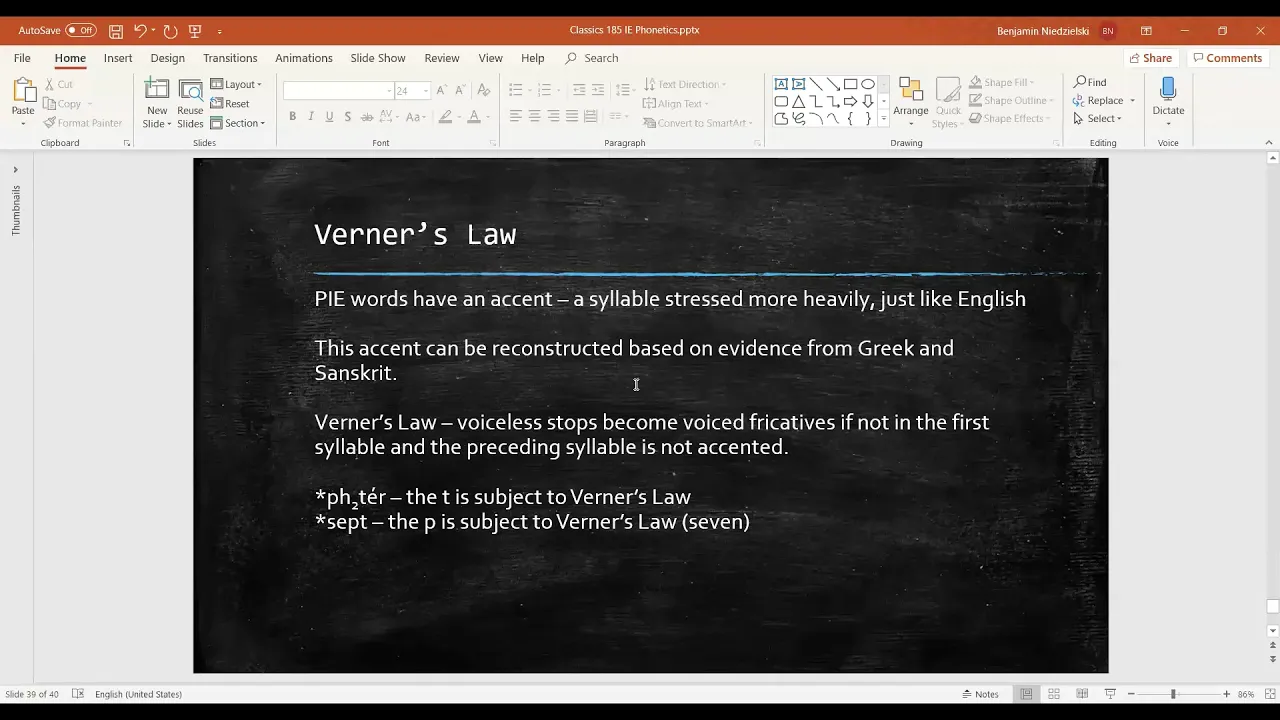
Verner's Law, formulated by Karl Verner in 1877, describes a historical sound change in Proto-Germanic where voiceless fricatives (*f, *þ, *s, *h, *hʷ) underwent voicing and became respectively *b, *d, *z, *g, *gʷ when immediately following an unstressed syllable in the same word; this law explains irregularities in Grimm's Law by showing that sound changes depend on accent position rather than being universally applicable, as Proto-Germanic accent consistently fell on the first syllable of the lexical root while Proto-Indo-European allowed free accent placement.
Verner’s Law: Germanic Sound Change & Accent Shift
Added:Familiarity with articulatory phonetics, specifically the distinction between voiced and voiceless sounds, and the definition of fricatives.
A thorough comprehension of Grimm's Law (the First Germanic Consonant Shift) and the specific phonetic shifts it describes.
An understanding of the Indo-European language family and the evolutionary relationship between Proto-Indo-European (PIE) and Proto-Germanic.
An introduction to prosody, specifically the concept of mobile pitch-accent in Proto-Indo-European compared to fixed stress in Germanic.
Exploration of 'Grammatischer Wechsel' (Grammatical Alternation) and how Verner's Law created morphological alternations in Germanic verb paradigms (e.g., 'was' versus 'were').
Study of the Germanic Stress Shift, where the mobile Indo-European accent transitioned to a fixed, word-initial stress, thereby obscuring the original conditioning environment of Verner's Law.
Analysis of later West and North Germanic sound changes, such as rhotacism (the phonetic transition of the voiced sibilant /z/ to /r/).
Investigation of the Neogrammarian hypothesis ('Ausnahmslosigkeit der Lautgesetze' or 'sound laws admit no exceptions') and how Verner's Law historically validated this theory of linguistic science.
339 views4likes11:20Original Release: 2020-11-09
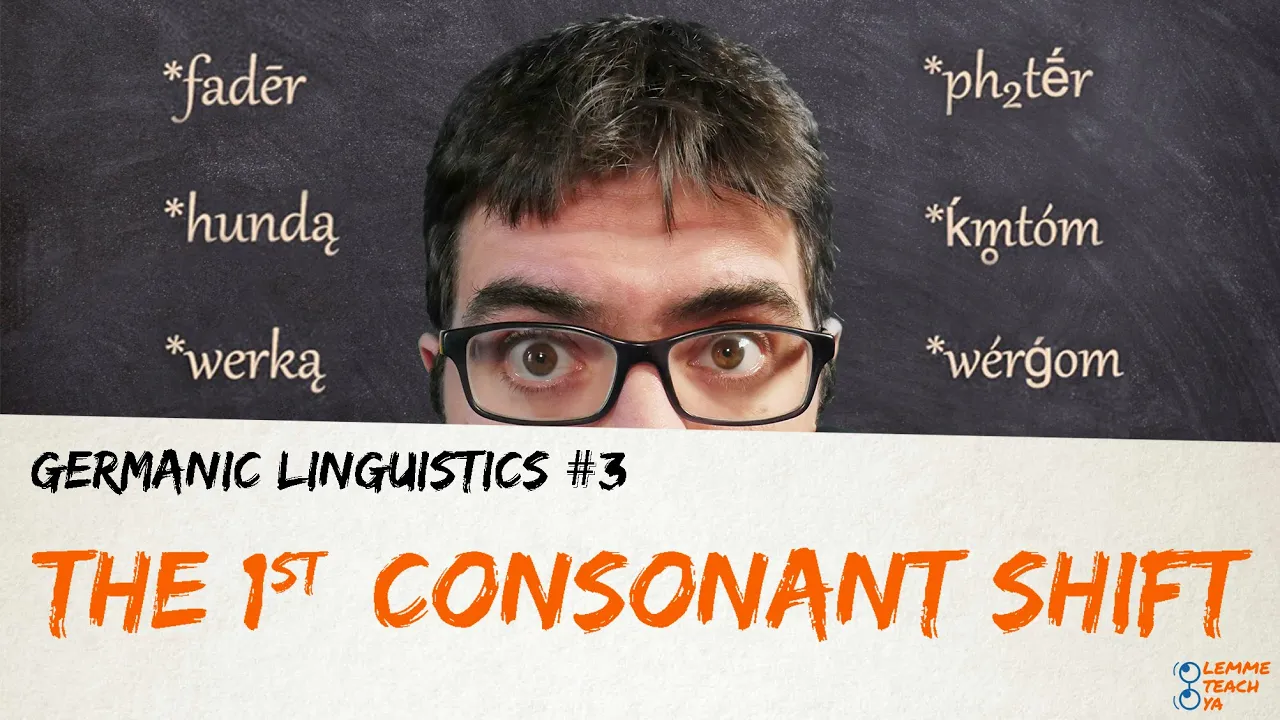
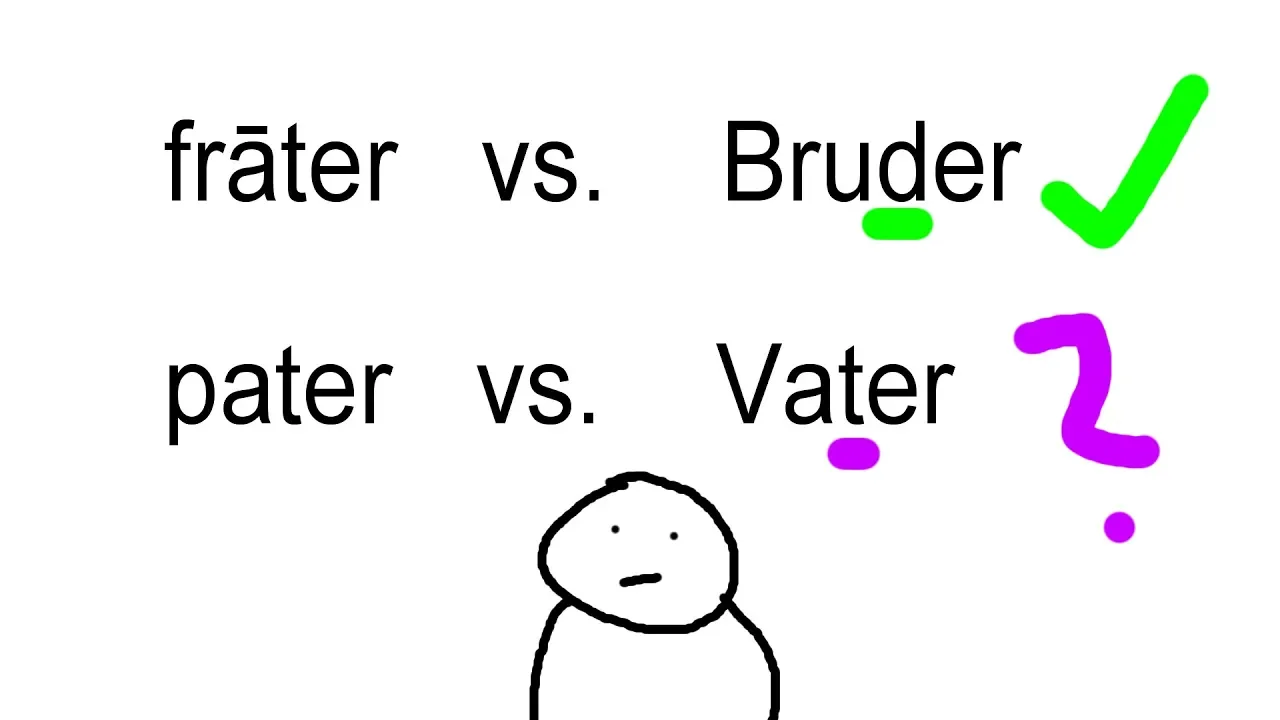
hello guys uh so we have come across uh grimslow in detail during the previous session and uh i hope that you have understood uh jacob grimm's uh you know the formulas and the theories which he gets formulated on the basis of his study and his findings on the consonant shift shift actually starting with the first consonant shift and the second consonant shift also so basically what jacob grimm uh has uh propounded is like you know the the uh on the aspirated voiced plosive like uh and girl uh it initially changed to the anger when it came uh to the modern english or to the germanic language in fact so like now uh brother uh is from brother in sanskrit or though uh is actually from uh is actually changed to do though uh in english or two in english in modern english too all right so um and it changed to the per the aspirated uh uh plosive aspirated voiced uh plosive per change to bull and uh per till and curve that is also another that's the second constant shift actually so the initial constitution from uh the voiced uh uh aspirated plosive moving to the voiced unaspirated plosive and from there to the voiceless per to and curve so and from there it further moved on to full so these three changes actually happened three sets of change changes happened uh in during the constant shift period as for jacob grim well uh so after a further study by carl werner in 1877 he propounded uh a law on the basis of his findings and what has uh left over by uh what has uh unfound or uncorroborated by uh jacob grimm so verna slow uh describes a historical sound change basically in the historical sound change basically in the proto germanic language whereby the uh you know the voiceless fricative the voiceless fricatives like you know [Music] when immediately followed by an unstressed syllable in the same word underwent voicing and became respectively the fricatives so what he's trying to say is that you know uh what jacob grimm was uh propagated is like you know uh his formula was actually based on the consonant shift for the shift of consonants during over the years which happened to the proto-indo-european languages but what carl warner is saying is that you know the change in which jacob grimm was uh formulated jackie grim formulated are nonetheless proven uh as not complete which is not uh perfect and those changes which carl werner have found are on the basis of strictly on the basis of accent shift it all it's all it all depends upon uh what you can call the migration of languages it started from one place to different parts of the world so basically what happened was that consonant the the people uh the migrants they took the constants or the uh language uh the script with them and when it reached a place a destination where they settle down and it's all because of the linguistic aspect it's all because of the phonetic environment it's because of the uh the influence of the new area what happened was that uh some of the uh consonants became uh changed or it reversed back or some deficiency or we can say a major shift happened in the sum of the consonants as the carbon so when grimslow was discovered a strange irregularity was observed in its operation so uh what uh carl warner is it saying that grimslow apparently fails so like you know uh like for example uh the latin term or the latin word kentum of like c e n t u m canton or some guys call it centum this kentum uh when officially it's it came to the english language it became 100 hundred but as for jacob grim the the proto-indo-european language latin from which a kentum came from the middle consonant the mid consonant till must have to change to third as per jacob because jacob in his uh you know the second third consonant shift he said till changes to third or third so that should uh be the place that should be the uh right kind of change uh as for jake but carl werner is pointing out that centum changed to 100 instead of 100 so as for jacob grim t should be full but what happened was that what happened actually was that kingdom changed to hundred so till became dirt instead of third that was kind of you know uh you know discrepancies or anomalies which happened during uh the grimm's low period which later because of the influence of carl werner he he tried to overcame some kind of errors which happened um in the formulas which have been properly proper propounded by uh jacob grimm carl werner was actually the first scholar to point out the factor governing these irregularities and this irregularities uh which is pointed out by carl warner is basically called the accent shift because uh of uh jacob grimm's theory of consonant shift karl warner explains the sound quality depending upon the position of the accent in the in the european uh word like you know after an unstressed vowel so basically what cardboard is saying is that in indo-european accent was free it was free it could occur on any syllable of the word in indo-european the proto-indo-european the parent european language it could occur on any syllable of the word no need for specification no need for uh you know specifically mentioning that this certificate particular uh syllable should be stressed but when it came to the germanic language accent fell on the first syllable of the lexical root accent fell on the first syllable of the lexical root and most probably the lexical root were actually uh the sanskrit cognate so after an unstressed wall after an unstressed wall the voiceless fricatives as i mentioned before the voiceless fricatives like you know her it became cool and uh voiced were voiced and became the earth and z sound z [Music] the latin painter painter changed to father father to change to the father all right so another uh important aspect as per car warner is uh you know after an unstressed world after an unstressed world uh like sir sir sounds sound in germanic languages becomes voiced z if it is sound it's not voiced but when it came to germanic language it became became voiced so those are some kinds of uh you know uh important information that have been uh you know propounded by carl warner uh especially his uh burners low all right so uh so basically uh for example i can say that uh now the brim was uh grim was grim slow was valid whenever the accent on the root syllable whenever the accent because the accent falls on the root syllable of the sanskrit cognate or the parent or the proto-indo-european cognates but when it came to germanic language as i mentioned before the accent for another syllable and it becomes a dill and girl all right so like no brother brother became brother as i mentioned before yeah all right uh thank you so much and thanks for attention uh have a nice day
Up Next

34:45
Ploughshare Etymology: Indo-European Roots & Cognates | Historical Linguistics
@michaelkensak
1.4K views•2018-02-02
36:52
Constraint Interaction in Optimality Theory: Epenthesis & Deletion
@Vidyamitra
180 views•2018-08-20

8:59
Forensic Linguistics: How Language Solves Crimes | PBS
@pbsstoried
1M views•2024-01-25

21:32
Accent Expert Explains U.S. Regional Dialects | Part 1
@WIRED
9.3M views•2021-01-21
Related Study Plans & Knowledge Roadmaps
Structured learning paths in Linguistics
linguistics
Optimality Theory: Tableaux & Constraints
01Phonological Basics: Sounds, Syllables & Rules
02Foundations of Optimality Theory: GEN, CON, and EVAL
03The Constraint Inventory: Markedness vs. Faithfulness
+ 2 more learning modules
15h5 modules
Explore Roadmap
linguistics
Morphosyntactic Alignment: S, A & P Systems
01Foundations of Syntax: Transitivity and Arguments
02The Linguistic Variables: Mapping S, A, and P
03Nominative-Accusative Alignment
+ 3 more learning modules
12h6 modules
Explore Roadmap
linguistics
Analyzing Sign Language: Phonology & Syntax
01Foundations of Sign Language Linguistics
02Phonology: The Five Parameters of a Sign
03Morphology: Word Formation and Classifiers
+ 2 more learning modules
14h5 modules
Explore Roadmap
linguistics
Pragmatics: Speech Acts, Grice & Politeness
01Introduction to Pragmatics: Meaning in Context
02Grice’s Cooperative Principle & Implicature
03Speech Act Theory
+ 2 more learning modules
14h5 modules
Explore Roadmap