






![Drumming with Polyrhythms [3:2 | 3:4 | 5:4] + musical examples](https://i.ytimg.com/vi_webp/73jEJ33YLq0/maxresdefault.webp)



![How to: Compose with Irrational Time Signatures [Sibelius & Finale]](https://i.ytimg.com/vi/00WLwAthM-s/sddefault.jpg)
![Irrational² [Q&A]](https://i.ytimg.com/vi/-x8fFPUysBI/hqdefault.jpg)
![[Incorrect, Old, Bad] Weird time signatures. Really weird time signatures.](https://i.ytimg.com/vi/y0-KOAWWkZ0/maxresdefault.jpg)


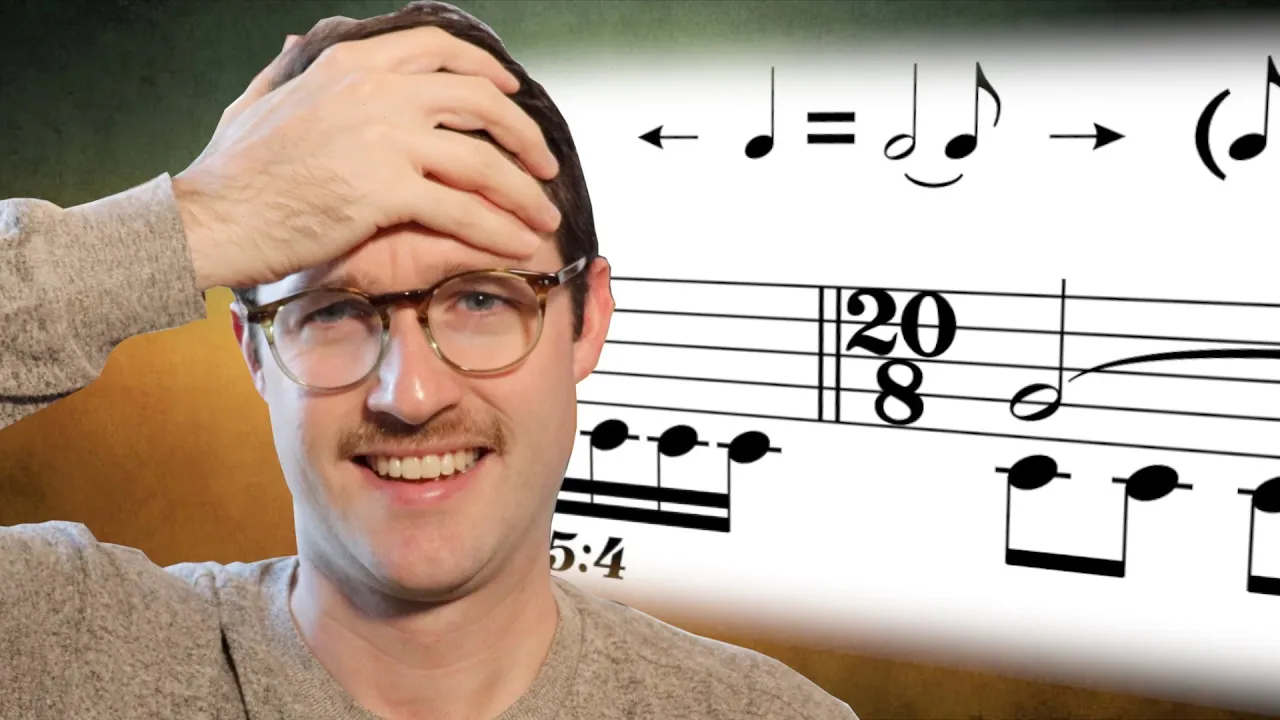








Metric modulation is the technique of changing the perceived beat at a given tempo through a mathematical ratio between two meters, typically using a pivot rhythm that functions in both meters; non-dyadic time signatures (those with bottom numbers not being powers of two like 3, 5, or 7) are primarily useful as relative time signatures during metric modulation rather than for entire compositions, as they create rhythmic ambiguity that can be confusing to read and interpret.
Metric Modulation and Non-Dyadic Time Signatures Explained
Added:Understanding of standard (dyadic) time signatures, including simple, compound, and odd meters (e.g., 4/4, 6/8, 7/8).
Familiarity with rhythmic subdivisions, standard note values, and tuplets (such as triplets and quintuplets).
Basic knowledge of tempo (BPM) and how note durations are mathematically related to a steady pulse.
A foundational grasp of polyrhythms (such as 3 against 2) and how multiple rhythmic patterns coexist.
Advanced application of irrational (non-dyadic) time signatures (e.g., 3/10 or 5/6) in music composition and notation software.
Analyzing the historical and theoretical development of metric modulation through the works of 20th-century composers like Elliott Carter.
Studying the implementation of adaptive and dynamic audio in video games, specifically how metric modulation facilitates seamless musical transitions.
Exploring complex rhythmic practices in modern genres such as math rock, progressive metal, and contemporary jazz fusion.
121.4K views8.1Klikes23:02Original Release: 2025-11-02
There can also technically be nonp power of two bottom numbers, but those are cringe and we're not going to talk about it.
All right, fine. We'll talk about it.
Before we talk about irrational time signatures, we should probably first address the related concept of metric modulation. And to understand metric modulation, we must first understand what modulation is in the context of key changes. Modulation simply refers to the process by which we change keys. If we're in the key of C major and we want to go to the key of D flat major, we have a few options. We can have a clean split between the part that is clearly in C major and the part that is in D flat. This is called a direct modulation.
[music] >> [music] >> Alternatively, we can have a kind of gradient between the two keys where a chord or series of chords has at least vague function in both keys leading to a smooth transition to our new key. This is called a pivot modulation.
>> [music] >> There's a few other types, but for our purposes, that's really all we need to think about. Metric modulation is exactly what it sounds like. Modulation, but for our meter instead of our key.
We're changing the way we feel an already established beat at a given tempo. Technically speaking, if anything [music] about the meter or groove changes, like the tempo, feel, or time signature, it's metric modulation because the meter modulates. But in common practice, things that are called metric modulation follow two rules. Rule one is that there must be some sort of mathematical relationship, a clean ratio between the two meters. Our ear has to hear the relationship between the two groups. Going from a 44 group at 97 BPM to 44 at 163 will just sound like we're getting faster indiscriminately and as such isn't commonly considered to be metric modulation. But going from 44 at 90 BPM to 44 at say 120 BPM could be considered metric modulation since there is a discernable 3:4 ratio between the two tempos. This ratio allows note values to have relationships and intermingle between the two meters. As such, rule number two is that almost always, at least our cleanest metric modulations will be a pivot modulation of sorts. There will be some rhythm within the groove that has clear function in both meters, but still takes up the same time duration.
[music] [music] Perhaps the simplest and kindest metric modulations are the types where the perceived beat changes, but the pivot rhythm remains the same note value. Take a listen to the title track from Metroid, especially what the drums are doing.
[music] [music] >> [music] >> The eighth note remains the same speed between the two meters. If I just tap our eighth notes between the two tempos and time signature changes, it sounds like nothing happens.
However, consider that in 44 we feel the beat as the quarter note. In 68, we actually typically feel the beat as the dotted quarter note, each measure composed of two beats containing three [music] eighth notes per. What this means is that even though the eighth note stays the same by nature of 68 having three eighth notes per beat instead of only two, it feels like the beat actually gets slower. Let's take a listen to the metric modulation again, but this time I'll add clicks for how we're perceiving the beat.
really elegant in how simple the metric modulation is, but it still kind of catches you off guard. Perhaps the name Metroid was always a subtle reference to metric mod.
We can hear another example of this exact same thing in Undertale's fallen down reprie.
>> [music] >> same thing. Our eighth note is the same speed in both groups, but the beat sounds like it's slowing down in the 68 section.
[music] In case you're wondering how I'm calculating these tempos, it's actually pretty simple. The first section is at 110 quarter notes per minute, which means it's at 220 eighth notes per minute. If the eighth note remains the same and the dotted quarter note contains three eighth notes, we divide 220 by 3, giving us 73.33 dotted quarter notes per minute, or a 3:2 ratio between our two tempos. You might also notice 34 and 68 do in fact take up the same amount of time. After all, each contains 6 eighth notes. But I would argue this is still metric modulation, albeit at its simplest. the perceived beat changes in a clean ratio. The meter dub be modulating. But there is a much more common style of metric modulation, the opposite of what we've just looked at.
In these examples, the pivot rhythm will look different in both meters, but the beat will look the same. We can go from something like 44 to 44, speeding up or slowing down with the pivot rhythm functioning as two different things between the two meters. A great example of this is in Bowen's I Still Miss You.
>> [music] [music] [music] [music] [music] >> The time signature does not change. We stay in 44 but speed up in a 3:4 ratio.
As such, what previously sounded like our eighth note now sounds like our quarter note triplet. We can see the pivot rhythm as the eighth notes in the I Still Miss You, which becomes the quarter note triplets in the bass. The vocal chop quarter notes, meanwhile, sound much faster than the quarter notes in the previous section.
Another example of this kind of thing can be heard in Pandora Paradox, a tune from the arcade rhythm game My My Finale.
[music] We go from 34 to 44 after the intro section, which doesn't matter much because the quarter note keeps the beat in both. But we metric mod in a 3:4 ratio. This beeping metronome instrument plays quadruplets, four even notes in the span of three quarter notes. One of those quadruplets becomes our new quarter note.
But we actually metrically modulate a second time only a few moments later.
This measure gives us eighth note triplets setting up our two to three metric mod into this new section.
We haven't really talked about it yet, but what's the point of metric modulation in the first place? It takes some math and you have to really finesse the rhythms to make it work. I would say in the earlier examples, it gives a nice division between the sections. Sure, they could have slowed down or sped up the tempo to whatever number they wanted, but that smooth metric mod is kind of interesting and adds a fun layer of rhythmic ambiguity when it happens.
On top of these reasons, the metric mod in this song has kind of a meta purpose.
This isn't a rhythm game, of course, and these weird perceived tempo changes add a level of difficulty that trips you up in a fun mathy kind of way that you can't achieve with just normal timest changes. Here's a fun one. A dark zone from Delta Rune Chapter 4.
>> [music] [music] >> Kind of a unique metric modulation happens Typically, the pivot rhythm is a subdivision of our beat. But here, the pivot is actually the dotted half note, which takes up the exact same duration as the whole note of the new tempo, giving us a 3 to four ratio.
It's definitely a bit harder to hear since the chords are rather long and also sense pulses faster than our pivot.
It kind of distracts. It does bring up an interesting point though, is this metric modulation. If the ratio isn't immediately apparent and if the pivot rhythm is longer than our beat, I would argue yes, but it's definitely a weaker example of metric mod. It's more akin to a direct modulation than a pivot modulation where we don't have an immediately clear pivot just modulating once we get to the new section, but it does still fulfill that 3 to four ratio with the tempos and you can kind of hear that. I am interested in why Gastra would make Cara make Tricky Tony do this. This is the battle theme of Jackenstein. During this fight, you slowly navigate a house and grab a key, after which he famously declares his iconic catchphrase, >> before chasing you, your movement speed also increasing. This sudden increase in speed mirrors exactly what happens in the song.
>> YOU CAN'T KEEP GETTING AWAY WITH IT.
>> Another metric modulation of dubious validity can be found in the Ravio shop theme from A Link Between Worlds.
[music] >> [music] >> We have this short little section where we go to a faster 64 using the eighth note triplets to pivot in a 2:3 ratio.
And then we use the quadruplets to snap back to our original meter in a 3:2 ratio. Kind of reversing the metric mod.
[music] >> [music] >> Since the 64 at this tempo takes up the exact same duration as a 44 measure in the old tempo, you could really just notate it like this, just funny triplets instead of metric mod. This makes a lot of sense, too, considering that we go right back to the original feel only a few measures later. the bassoon line even starting to pivot a measure before.
But I consider this to still be metric mod because there's just so much effort to make it feel like 64 with each quarter note divided into eighth notes versus just simple triplets. Perhaps it's more apt to think of it as metric tonicization. In terms of key changes, I best liken modulation versus tonicization to a swimming pool analogy.
We can think about two different key centers as a swimming pool and the dry land surrounding it. Modulation is when you jump into the pool, you fully commit to a key change, and if you want to go back to your original key, you have to make your way back with effort.
Tonicization, meanwhile, is simply dipping your legs into the pool. You tease a new key center and can fully modulate, but there's no expectation.
You can just as easily get out and walk away. Bringing this metaphor back to metric tonicization, here we tease this metric modulation, but it's neither at a strong sectional break, nor does it strongly commit to the new meter for long enough. We tonicize, so to speak, the 64 at 198 briefly, but quickly gradient back to our old feel. And it really keeps you on your toes. Perfect for this quirky shop theme for an equally quirky shopkeeper. This next tune has kind of a funny backstory. So, back at Berkeley, I was writing music for a game jam with my friend, and he was handling the general traversal theme. I remember metric mod being this big hilarious concept at Berkeley, so it was always some ridiculous contest to see how often you could insert it into tracks. Anyways, he wrote this track for the game. I don't think the lead developer appreciated the metric mod at all, [music] but it's hilarious and kind of a banger I still think about seven years later.
And more importantly, a really, really good example of textbook metric mod.
[music] [music] [music] >> [music] [music] >> So, this section sounds super wacky, but is conceptually rather straightforward.
We more or less play the melody verbatim four times in a row, but the drums and sometimes bass metrically modulate us into each repetition. It's very textbook. There's no ambiguity because we stay in 44 the entire time. The consistent melody helps ground us in the new feel and we always have a pivot rhythm before the modulation.
[music] Perhaps [music] there's a bit of an argument for metric tonicization, especially with it changing so quickly and frequently, but I would argue it's strong enough that it feels like it could settle into the new feel at any point. Hilarious tune, and thank you, Bujorn, for letting me use this. Which leaves us with the final tune I want to talk about in the metric modulation half of the video.
Previously, we've only talked about tunes with ratios of twos, threes, and fours. Mostly because our pivot rhythms were duplets, triplets, and quadruplets.
But what about a tune with a metric modulation ratio of 4 to 5? First, let's take a listen to the intro.
[music] >> [music] >> We're in a pretty believable four four, but every quarter note rather than being subdivided into four 16th notes or even three triplets is instead divided into five quintuplets [music] and the tune stays in this quintuplet grid for the majority of it. But if that wasn't enough, we also get a metric modulation later in that aforementioned 4:5 ratio. Let's take a listen.
>> [music] [music] [music] >> So crazy. So what we're doing is turning four of the five notes of the quintuplet into our new four 16th notes or alternatively one quarter note. Four fifths of a quarter note to our new quarter note.
What's even crazier though is that the other instruments are still adhering to the old grid. Sometimes since 54 at this new tempo is equivalent to the 44 at the old tempo, the bass and kick drum dividing the measure evenly into four hits sounds like four quarter notes in the old group. The result is this five against four poly rhythm going on but only in some measures. Two meters happening at the same time. [music] Crazy stuff. Okay, so that's all the metric mod tunes I've been meaning to talk about for years now. So let's finally address irrational time signatures and how they relate to metric mod. As a quick refresher for time six, the top number refers to how many of the bottom number we have per measure. So for instance, a song in 44 means we have four quarter notes per measure. 78 means we have 7 eighth notes. 3116 means we have 316th notes and so on and so forth.
Almost certainly every time signature you've ever seen in your entire life has a lower number of 1 2 4 8 16, maybe even 32 or 64. powers of two, which makes a lot of sense. The bottom number refers to how we're dividing the whole note. A time signature with a bottom number of one means we're counting whole notes.
Two means we're counting half notes, four for quarter notes, and etc. A so-called irrational time signature is a time signature with a lower number that isn't a power of two. Things like 3, 5, 7, or 10. I do want to mention how I think the term irrational time signature is a bit confusing at best and a misnomer at worst. Since the lower numbers are in fact rational in a mathematical sense, it also helps to distinguish these from true irrational time signatures. Time signatures with an irrational lower number like pi or e or something which you know about the 11 over oilers's constant time signature. I think it makes a lot of sense to refer to non-power of two lower number time signatures as non-diatic. Diatic referring to our usual power of two. So what would something like 4 three even look like? Lower number of three means we're dividing the whole note into triplets. upper number of four means we have four of those little guys per measure. But what is the point of this?
If I wrote an entire song in four or three, are we really going to hear the beat as four triplet divisions of the whole note? Almost certainly not. We're probably just going to hear it as 44 because we simply have no information that tells us that we're hearing four triplet divisions of the whole note. The much more obvious explanation that our ears will latch on to is that we're just hearing four quarter notes per measure.
It's important to consider that this kind of use case where the time signature is noniatic for the entire tune is both unclear for musicians to read and almost always unjustifiable as a transcription of something. There is really only one justifiable application of noniotic time signatures that I'm aware of and that is as a relative time signature. When we've already established a diatic time signature, we can use the relativity to that time signature to establish our non-diotic one, which of course is something we can do in tunes with metric modulation, where the two tempos are also in a kind ratio. Noniotic time signatures allow us to notate the ratio between the two grooves using the bottom number rather than with tempo. Though you can technically do this, there's still that problem of clarity. Unless you're some sick freak who'd rather read the rest of a tune as 46 instead of 44, it almost always makes more sense to just write the new tempo. And maybe to illustrate the metric mod, include the metric mod ratio next to it, as I've been doing.
But I think this clarity problem only exists for tunes where we fully modulate. What about metric tonicizations where we just have a few bars of a new meter or even smaller one measure metatonicizations in the middle of a groove? I'm not even sure you could call that metric tonicization. Maybe metric interchange or something. But either way, that would pretty much be the only justifiable instance of non-diatic time signatures in notation that I can think of. These instances where it would get really messy to notate a new tempo for just one or two bars just to go back to the old one, especially if that pattern repeats. You don't even really need to pivot into it so long as the math checks out with the division of the whole note. So, let's take a look at some examples of noniotic time signatures in video games.
>> Where is it?
>> Yeah, I couldn't find anything. But hold on a sec. Perhaps noniotic time signatures in the context of metric tonicization are simply too weird and counterintuitive to exist in your favorite mainstream Nintendo games. But what if it was common? I've mocked up some examples of your favorite video game soundtracks from a kinder, less diatic universe.
[music] Heat up >> [music] [music] >> here.
>> [music] >> One, two, three, four.
Heat. Heat.
[music] >> [music] [music] [music] >> pretty trippy. Like what I was saying about the metric modulation earlier, it really is this layer of rhythmic complexity that you can't achieve with something like mixed meter or even poly rhythms to some extent having this pulse that changes speeds. I think it's really really hard to have something that's palatable and accessible while also being a justifiable case of noniotic time sigs. So if you guys have any cool examples, video games or otherwise, please let me know in the comments. If you liked this video, smash that subscribe button, hit that bell, and consider supporting me on Patreon.
Before the video is over, I would be remiss to not at least give a passing mention to true irrational time signatures. Let's see if I can whip something up in Musecore.
>> For me, impossible.
Up Next
17:46
How to Write a Piece of Music: Foundations of Composition
@ThinkSpaceEducation
54.9K views•2024-11-22

10:20
Mozart's Musical Dice Game Explained: History, Rules, & Fun
@webpianoacademy
5K views•2023-03-13
32:15
Every Time Signature Explained Using Nintendo Music Theory
@CadenceHira
1.7M views•2024-01-05
10:49
Understanding John Coltrane's Giant Steps: A Music Theory Analysis
@Vox
10.4M views•2018-11-12
Related Study Plans & Knowledge Roadmaps
Structured learning paths in Music Theory
music-theory
Composing Galant Music: Partimento & Schemata
01Foundations of Figured Bass and Keyboard Harmony
02The Rule of the Octave (Regola dell'Ottava)
03Galant Schemata: The Building Blocks of Form
+ 2 more learning modules
30h5 modules
Explore Roadmap
music-theory
Decoding Overtone Series: Tuning & Drone Music
01Acoustic Foundations: The Physics of the Overtone Series
02Tuning Systems: Equal Temperament vs. Just Intonation
03Microtonality and Spectralism: Beyond Standard Pitches
+ 2 more learning modules
24h5 modules
Explore Roadmap
music-theory
Impressionist Harmony: Scales, Planing & RPGs
01Foundational Music Theory: Keys, Intervals, and Seventh Chords
02Impressionist Color: Chord Planing and Parallel Harmony
03Whimsical Textures: Pentatonic Cascades and Whole-Tone Scales
+ 1 more learning modules
14h4 modules
Explore Roadmap
music-theory
Negative Harmony: Axis Reflection in Indie Pop
01Music Theory Foundations: Scales, Intervals, and Triads
02Functional Harmony and the Circle of Fifths
03Demystifying the Negative Harmony Axis Reflection
+ 2 more learning modules
16h5 modules
Explore Roadmap