















![Bach - The Art of Fugue, BWV 1080 [complete on Organ]](https://i.ytimg.com/vi/Lrb0dHKJBR4/hqdefault.jpg)
Second species counterpoint uses a two-to-one ratio where two notes are written for every note of the cantus firmus, with the first note of each pair on the strong beat requiring consonance while the second note on the weak beat can be a dissonance resolved by step through passing tones or neighbor tones, while maintaining stepwise motion, avoiding parallel perfect intervals, and balancing consonant structural notes with carefully placed dissonances to create richer, more dynamic counterpoint.
Second Species Counterpoint Rules Tutorial | Music Composition
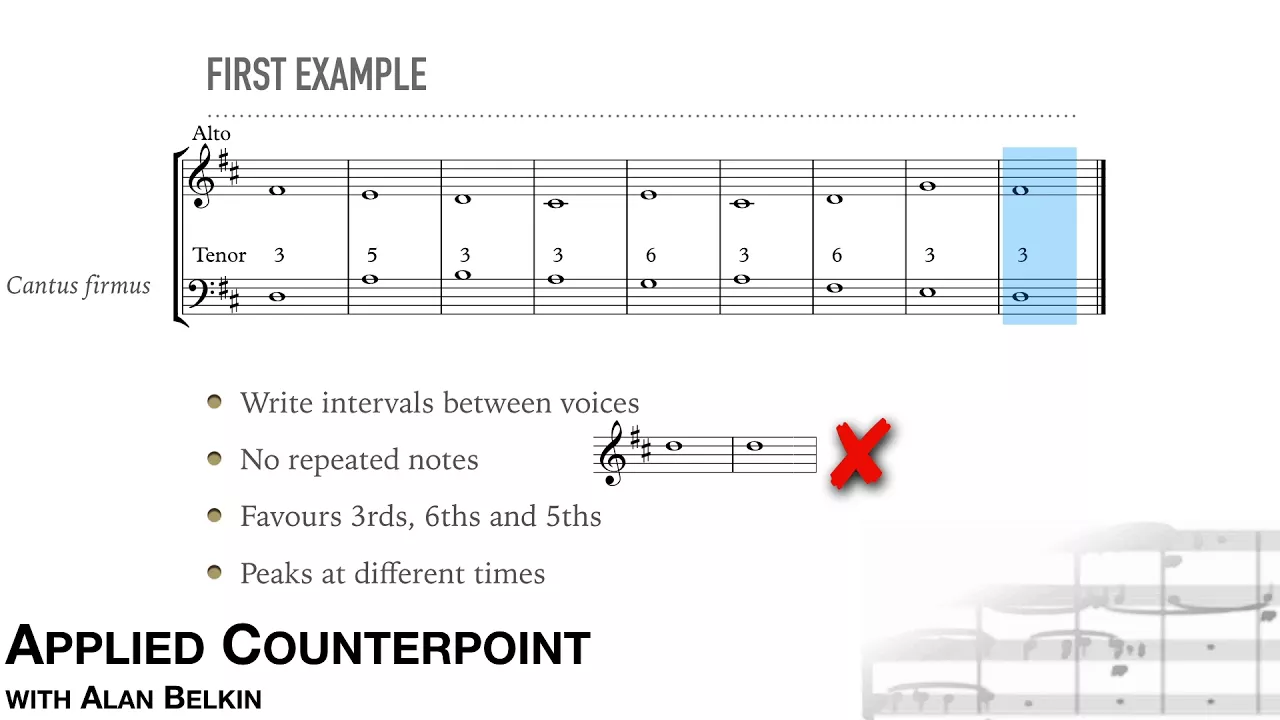
Added:First Species Counterpoint: Mastery of note-against-note (1:1) composition, including rules for harmonic intervals and motion types (contrary, parallel, oblique, and similar).
Consonant and Dissonant Intervals: A clear understanding of how to classify perfect consonances, imperfect consonances, and dissonances in diatonic music.
Cantus Firmus Construction: Familiarity with the structure, modal characteristics, and melodic contour of a traditional cantus firmus.
Basic Voice-Leading Guidelines: Knowledge of how to avoid forbidden motion, specifically parallel fifths and octaves, in two-part writing.
Third Species Counterpoint: Transitioning to four-to-one (4:1) melodic writing and learning how to incorporate neighbor tones, double passing tones, and the nota cambiata.
Fourth Species Counterpoint: Studying suspensions and syncopated rhythms, focusing on how to prepare, strike, and resolve dissonances on strong beats.
Fifth Species (Florid Counterpoint): Combining elements of all previous species to write a free-flowing, rhythmically diverse counter-melody.
Polyphonic Composition (3+ Voices): Expanding species counterpoint principles from two voices to three or four voices, managing more complex vertical harmonies.
Application to Canon and Fugue: Using counterpoint techniques to compose imitative polyphonic works in the style of Baroque masters like J.S. Bach.
338 views6likes8:45Original Release: 2024-10-25
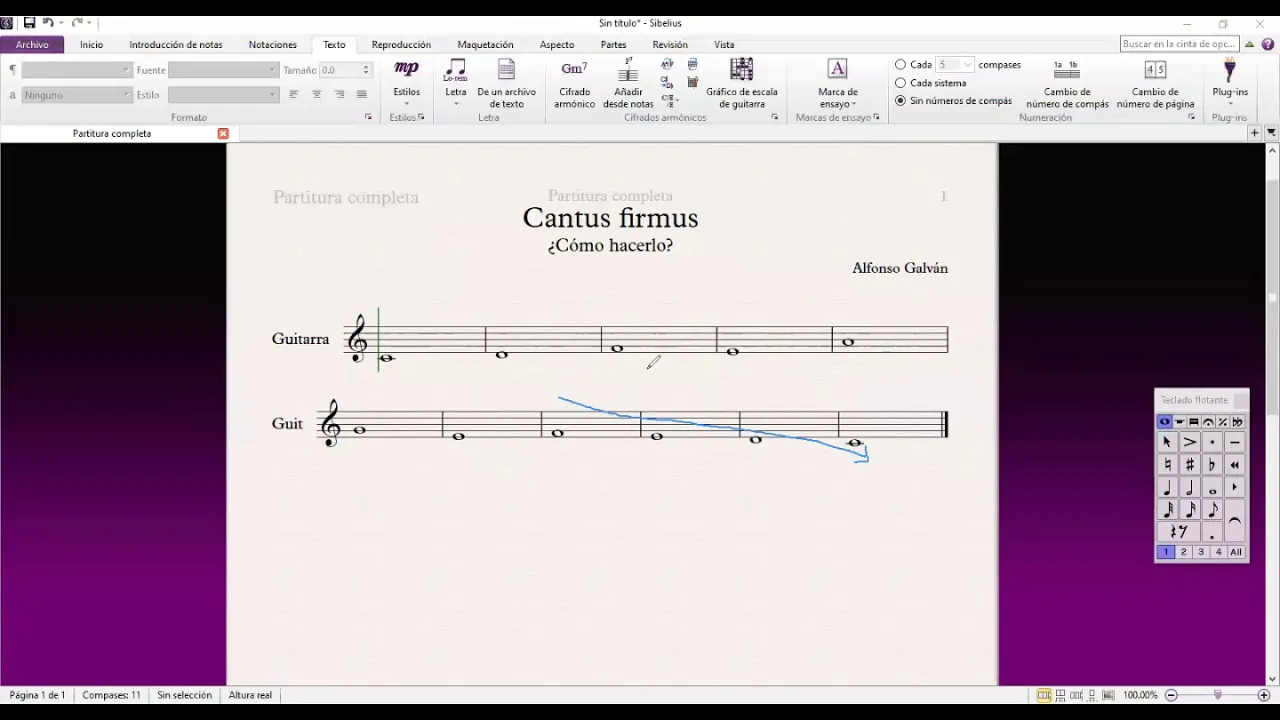
edit welcome back to our Counterpoint series my name is Professor Lindsay and in today's video we're exploring the exciting world of second species Counterpoint these next steps are going to build on the foundation of first species adding more Rhythm and allowing for control dissonances in second species you'll learn how to craft two notes for every note of arantis fmis while maintaining a balance of consonant and carefully placed passing tones by the end of this video you'll have the tools to create richer more Dynamic Counterpoint while following these Timeless rules let's Dive In before we jump into the details let's do a quick recap of first species Counterpoint as you might recall the first species we work one to one ratio meaning that for every note in the cantis fmus we write one note in our Counterpoint the focus here is on consonances only avoiding any dissonances while keeping motion smooth and avoiding parallel perfect intervals if you're not familiar with first species I recommend checking out my previous video where I covered this in details now let's move on to Second species Counterpoint where things start to get a little more interesting in species we write two notes for every one note in the CIS feris typically half notes of our Counterpoint for every whole note of the cermis the first note of each pair on the strong beat has to be constant with the cantis fmis just like in first species but on the second note on the weak beat this can be a distance as long as it's resolved by step so that means passing tones and neighbor tones this is how we start to introduce a sense of tension and resolution just remember to avoid parallel perfect intervals between strong beats as these can detract from a sense of melodic Independence between voices when writing second species here are some tips to keep in mind we're going to use stepwise motion as much as possible to create smooth lines when we introduce a leap we're going to resolve it by step in the opposite directions and we're going to keep an eye on our intervals consonances on strong beats and carefully placed passing tones are going to help our Counterpoint really sing let's see how this plays out in an example we've got our cantis fmis on the bottom in this top example again I'm going to first get a general sense of what do I think is the harmonic shape of this cantis fmis before I start composing my Counterpoint so I see kind of tonic with a consonant skip to the E A subdominant between like Ray and Fa I see a dominant to perhaps a tonic substitute like a deceptive Cadence back down to a 451 subdominant dominant tonic shape so if I begin with a perfect fifth I could kind of keep so in my uh Counterpoint line doing a voice Exchange in the second voice where I go from fa to Ray instead of Ray to far I'll come up to a sixth on my dominant that tonic substitute maybe I'll do a straight up subdominant chord here though I kind of don't like that and then I could go to a d to a r t do let's see where we've landed as far as intervals vertically uh I'm starting off with the fifth Then a3d followed by out of third 6 6 6 63 2 e one thing I have an issue with is I have a lot of sixths in a row so I don't love that how about we change this third sixth but instead make a contrary motion so that we don't have an overabundance of sixths in a row I'm going to change these last two so let's make this a l t do this still works now parallel thirds and then we'll expand to the octave here with t do to make an octave there at the very end so this makes a lot more sense and we're not overusing sixs so this is my consonant framework so it's very important that even though we can do two notes against the cermis I'm trying to maintain strong structural note against note rule on my strong beats and then I can decide to do consonant skips or dissonances on these weaker beats on these Off beats so if I'm hanging up here by G I'm just going to do a neighbor up above so I can come back down to the G before perhaps doing a constant skip afterwards on that tonic chord I realize I'm doing eighth notes even though those should be quarter notes those those should be quarter notes um so bear with me um you're going to fa and I want to go from fa down to Ray passing Motion makes a lot of sense I know that I originally thought there's going to be a dominant chord but instead this is like a 164 chord and then fa passing to so over to law on that 46 chord and then maybe we can change up because we have a leap down I'm going to be a little bit stuck going from far to T we could maybe change up my melody a bit have it go up to La do on that four chord and then t with a consonant skip t r do and step down again this is a similar motion at the very end but it's by step in The Sopranos so that's okay I suppose we could also go t do do and make that an anticipation you don't see anticipations as much in second species um mostly we're just singing passing and neighbor tones here's how it sounds [Music] and here's how it sounds if we did an anticipation at the end instead of that cordal skip from T to right [Music] do not bad how about you take a look at the bottom one and see if you want to do a similar thing I'm giving you the cantis fmis this time on the the top pause the video compose your own Counterpoint line and then we'll compare so this canis fmis sounds like this we're in c minor it's our first minor example so I see us being in c minor so that may so I think it being kind of like a tonic leap then down to do May so do all that's just tonic we'll treat that Ray as like a dominant passing motion May to fa treat that as tonic to subdominant Ray Ray both of those will treat as dominant and then will zve to Tonic at the end so let's see ways to harmonize this I'm thinking that we could perhaps treat this with uh you know thirds in the base I'm going to have this maybe be a descending Baseline so a third moving by step to a six then a third again in the soprano down to a sixth again we've got a number of sixths in this base again fa so Le is all this moving in six with my soprano on top let's see if we can find an alternative to all of these sixths there on the bottom what can I do instead on that fourth six what if I just raise this up to a third meaning kind of like a minor five so a 3 to 5 to 1 that's giving us again similar motion towards the final octave so that's acceptable and what if we did something a little bit more interesting what if we had this entering on a rest so it starts on a weak beak with that third and then we just kind of drive down that that Baseline this is going to give it a little bit more of a distinct rhythmic profile notice that we're still maintaining consonant notes only in this first bar using passing motion to connect between Le and Fa in the second bar and then what if we tried to connect something getting to that t I'm going to be a little bit screwed here by the fact of I don't want to do an anticipation to that tay I want to treat passing motion I might rewrite my Counterpoint line so now this goes down to fa we'll keep that extra sixth sorry and then this will prepare a motion towards that dominant by the end so though I don't like that we overused sixth a bit too much as a structural interval I don't think it's as prominent because now we have passing motion that's ornamenting this gesture in between give it a listen and see what you think so well done you've now explored the balance of consonants and passing tones in second species Counterpoint this stop add Rhythm and controll dissonance both essential tools as we move into more expressive species if you found this helpful or have any questions let me know I'd love to hear from you otherwise keep practicing and I'll see you in our next third species video
Up Next
4:54
Bach's Counterpoint Applied to Slayer's Raining Blood | Music Theory Analysis
@ShredmasterScott
1.1M views•2019-03-14

10:20
Mozart's Musical Dice Game Explained: History, Rules, & Fun
@webpianoacademy
5K views•2023-03-13

47:36
Understanding Diatonic 7th Chords in Major Keys | Music Theory Tutorial
@GracieTerzian
54.7K views•2022-03-02
10:49
Understanding John Coltrane's Giant Steps: A Music Theory Analysis
@Vox
10.4M views•2018-11-12
Related Study Plans & Knowledge Roadmaps
Structured learning paths in Music Theory
music-theory
Composing Galant Music: Partimento & Schemata
01Foundations of Figured Bass and Keyboard Harmony
02The Rule of the Octave (Regola dell'Ottava)
03Galant Schemata: The Building Blocks of Form
+ 2 more learning modules
30h5 modules
Explore Roadmap
music-theory
Decoding Overtone Series: Tuning & Drone Music
01Acoustic Foundations: The Physics of the Overtone Series
02Tuning Systems: Equal Temperament vs. Just Intonation
03Microtonality and Spectralism: Beyond Standard Pitches
+ 2 more learning modules
24h5 modules
Explore Roadmap
music-theory
Impressionist Harmony: Scales, Planing & RPGs
01Foundational Music Theory: Keys, Intervals, and Seventh Chords
02Impressionist Color: Chord Planing and Parallel Harmony
03Whimsical Textures: Pentatonic Cascades and Whole-Tone Scales
+ 1 more learning modules
14h4 modules
Explore Roadmap
music-theory
Negative Harmony: Axis Reflection in Indie Pop
01Music Theory Foundations: Scales, Intervals, and Triads
02Functional Harmony and the Circle of Fifths
03Demystifying the Negative Harmony Axis Reflection
+ 2 more learning modules
16h5 modules
Explore Roadmap