














This video teaches how to identify common organic functional groups in pharmaceutical molecules by examining eight 2019 prescription drugs, covering alcohols, amines, carboxylic acids, amides, phenols, ethers, alkyl groups (methyl, ethyl, isopropyl, butyl, tert-butyl), benzene rings, halides, and specialized groups like sulfoxides and tetrazoles; the key principle is recognizing that functional groups combine multiple structural elements (such as carbonyls adjacent to OH or NH groups) rather than identifying isolated pieces.
Identify Organic Functional Groups | Drug Molecule Practice
Added:Familiarity with reading skeletal (line-angle) molecular structures, as complex drug molecules are typically represented in this format.
Understanding basic covalent bonding, valence electrons, and the typical bonding patterns of carbon, nitrogen, oxygen, and hydrogen.
A foundational definition of what a functional group is and why they dictate the chemical behavior of organic molecules.
Recognition of basic heteroatoms (such as oxygen, nitrogen, sulfur, and halogens) and their electronegativity trends.
Predicting the physical properties of drugs, such as water solubility, melting points, and boiling points, based on their functional groups.
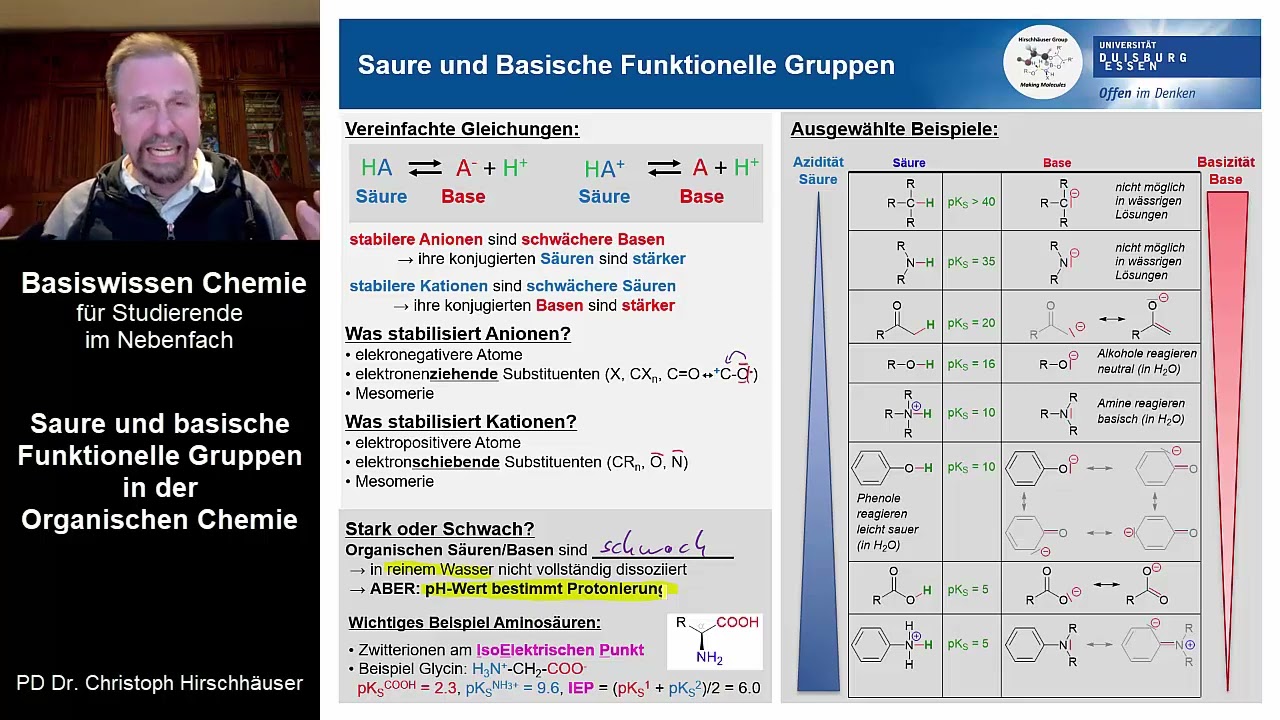
Evaluating the acid-base properties of drug molecules, specifically identifying acidic (e.g., carboxylic acids, phenols) and basic (e.g., amines) sites at physiological pH.
Studying basic organic reaction mechanisms that target these functional groups, such as ester hydrolysis or amide formation.
Exploring Structure-Activity Relationships (SAR) in medicinal chemistry to understand how altering a functional group changes a drug's biological activity.
67.1K views1.7Klikes14:33Original Release: 2020-10-06
Good day to you from Chem Help ASAP. In this video we'll identify different functional groups. In each of the eight problems in this video we'll look at one of the most commonly prescribed drugs from 2019.
We'll then pick out at least four functional groups in each of the drugs.
Go to the description of this video to find links to printable copies of these problems as well as printable solutions. This video also contains links to other videos that might help you with this material.
Before we jump into the problems, let's quickly look at four frequently confused pairs of functional groups.
So in the upper left we have this molecule here.
It contains an OH group, and so students will say, "OH! This is an alcohol." And that's correct. And the molecule just to the right, it also has an OH group, so it's easy to look at this structure on the right and say, "That is an alcohol." It's not because it has, right next door, a carbonyl. This collective functional group -- the carbonyl plus the OH -- has a special name. It is called a carboxylic acid. So don't just look at the pieces, but try to identify what the largest whole is that contains those different pieces. To the bottom left we have this functional group. This is two groups connected to an oxygen. This is an ether. But just to the right, we have the same kind of situation.
One of the groups next to the ether oxygen is now a carbonyl.
In that specific case, this is no longer just an ether.
It is an ester. So again we don't want to break it (a functional group) down into too small of a part because we will miss the larger story of all those parts together. So that's the ether versus the ester.
In the upper right, we have an alcohol. We've already seen this, and here's a case where the alcohol is attached to this six-membered ring, this benzene ring. This is also often called an alcohol, but some people and you have to go by the lead of your instructor here, they might call this by a slightly different name. They may call it a phenol, or a phenolic alcohol. And we give it a different name because that OH behaves a little bit differently. It reacts differently, and because it reacts differently, we give it a different name.
So there's an alcohol, and then phenolic alcohols or phenols. Now finally in the bottom right is a compound that has a nitrogen in it. Lots of nitrogen containing compounds -- that functional group is called an amine. But amines have the same thing as alcohols. If you have a carbonyl next to the amine, this is no longer an amine. It is called an amide.
At least that's what we call it in the United States. I think in a lot of countries, are calling amides. Again follow the lead of your instructor for the correct pronunciation that your instructor prefers. But it's a different functional group.
The carbonyl next door changes the behavior of this nitrogen group so we give it a different name. We call it an amide instead of an amine.
So those are some confusing functional groups. Now let's find some functional groups in molecules.
Here is problem number one. This is a compound, levothyroxine, used in a thyroid hormone replacement. It contains a bunch of functional groups, so let's look at them. Down here on the bottom, this is a halide, specifically an iodide. Here is an oxygen that has two nice R groups on it. This is an ether.
This alcohol to the left. This is... You could call it an alcohol. More specifically it's an alcohol off of a benzene ring, so we call that a phenol to be more specific. This... You know, I noted it's off a benzene ring, well there's our benzene ring.
And now let's work our way over to the right of the structure.
Here is a nice simple amine.
And this OH is part of a larger group, it's part of, next to a carbonyl, so this is a carboxylic acid. So one drug, lots of different aromatic or organic functional groups.
Our second drug is a compound lisinopril. This is a drug used to treat high blood pressure. So on the left, we have an OH with a carbonyl.
This is a carboxylic acid.
If you notice on the upper right, there is another carboxylic acid. So we have two carboxylic acids here. We have a benzene ring.
We have this NH2. This is an amine. (Kind of flatten out that "a".) That's an amine. This is also an amine -- simple nitrogen attached to carbon groups. And in the middle, here we have a nitrogen that is next to a carbonyl, so that is not an amine.
That is an amide. So lisinopril contains a whole collection of different organic functional groups.
The structure on the screen is called atorvastatin. This is a cholesterol drug.
And let's start in the upper left. We have benzene ring.
This nitrogen is next to a carbonyl. That makes it an amide. Here is a carbon chain dangling off the molecule. This is an alkyl group.
It's specifically... If you learn different alkyl groups, this is called an isopropyl group.
We have a halide down here in the corner. This is actually, specifically a fluoride.
Both of these groups here are simple OH groups.
They are alcohols. And then finally we have the OH next to a carbonyl and that is a carboxylic acid. So lots of functional groups in this molecule, and there are the names of most of them (not quite all but most of them).
Our fourth drug is called amlodipine. This is a high blood pressure medication. On the far left we have this single carbon dangling off. This is an alkyl group.
Specifically the one carbon group is called a methyl.
This carbonyl next to an oxygen... There's no OH.
That is called an ester.
This nitrogen down here, not the simplest example, but this is an amine.
We have a halide coming off the ring. This is specifically a chloride, or a chloro, group. Here is yet another ester, and here's another alkyl group.
This is a two carbon group. It's called an ethyl group. We have this oxygen. There are no carbonyls next to it. This would be an ether. And then finally, this nitrogen on the end -- this would be an amine functional group. So kind of a small molecule but lots of functionality in the molecule amlodipine.
This drug is called metaprolol. Metaprolol contains, the far left, this is an alkyl group.
A one carbon alkyl group is called a methyl group.
This is an oxygen attached to two carbon groups. That's an ether.
You know benzene rings are always easy to circle.
This would be another ether.
This OH is an alcohol.
Here is a nitrogen. It doesn't have a carbonyl next to it. This is an amine.
And then we saw this... in a previous drug... here's another alkyl group, and this is called an isopropyl group. So those are the main functional groups in metaprolol.
Problem number six! This is omeprazole. This is a drug taken for acid reflux. I think this is a more difficult question.
It's got plenty of functional groups -- just doesn't have that many different functional groups. But let's see what we can come up with.
So on the far left, this is a single carbon alkyl group. This is a methyl group. This oxygen this would represent an ether. It's attached to two carbon groups.
Now at that point the simple ones are kind of dried up. I mean we have these on the right. We have these two carbon groups, but those are both methyl groups.
Here's a methyl group on the end of this oxygen, which is also an ether. So I think we need to be a little more creative here. I'll tell you what. There's one more easy one. You can always circle the benzene ring.
Now the the one other functional group that I would point out as somewhat normal is this S=O double bond. This is called the sulfoxide. Sometimes sulfoxides are seen in solvents.
That is a functional group that you may encounter in organic chemistry. but these others are a little bit harder to identify. As you get into aromatic chemistry, you will learn that this six-membered ring kind of looks like a benzene ring. It has an... It has a nitrogen in it. This is called a pyridine ring, but i'd say most students won't identify pyridine until later in their first semester or maybe in their second semester of organic chemistry. We also have these other nitrogen groups. These aren't just simple amines because they're tied into these other benzene rings, so i would consider these to kind of be outside the realm of a first semester organic chemistry class. So this is a tougher problem because there are fewer different functional groups to choose from, but we can see alkyl groups and ethers and at least a benzene ring in addition to this sort of special group, the sulfoxide. If there's one positive note I'd take from this problem... By learning just a few functional groups, you will... these are the very common functional groups. The fact is organic chemistry is a big field, and there are a lot of other functional groups out there. So there's always more to learn even though you maybe learned a whole lot of functional groups.
Problem seven! This is a drug called losartan. Losartan is another high blood pressure drug. We'll start on the left.
This is a halide, specifically a chloride or a chloro group. Here's a nice OH.
This is an alcohol in the upper left. This long carbon chain. This is an alkyl group. This is specifically, has a four carbon chain.
It's a butyl. We have two benzene rings in this structure. Now this kind of interesting nitrogen-rich structure, this has a name. I don't think most students would see this in first semester organic chemistry maybe not even second, second semester, but this is called a tetrazole, and these appear in drugs from time to time.
So there are functional groups in losartan.
Last problem, number eight. This is albuterol, and in the upper left, we have this OH. This is a nice alcohol.
Now just below that is another OH group. But here we have the OH on a benzene ring. This is an alcohol. More specifically it is a phenol, phenolic alcohol. Here's a benzene ring Right above it... but there is another OH group. That's a regular alcohol. Here is a nitrogen. It's not next to a carbonyl. This is an amine, and this highly branched thing is an alkyl group. It is specifically a tert- butyl group. It's butyl because there are four carbons in it, and then the tert indicates how those carbons are connected to each other and branched off each other. And that tert is supposed to be italicized, so i've underlined it like you would a book or movie title. So those are the functional groups of albuterol.
I hope you found this video helpful. Please subscribe, like, or leave a comment or question. If there are different types of problems you would like to see in the future videos, please let me know.
Thank you for watching, and remember that links to printable copies of these problems and solutions are in the video description. Take care.
Up Next

5:57
The Chemistry of Fire: Oxidation, Combustion, and Fire Safety
@ScienceAroundCincy
1.1K views•2020-12-14
83:56
Biocatalysis and Catalysis in Islatravir Synthesis | Merck Webinar
@SCIwheresciencemeetsbusiness
675 views•2020-10-08
10:06
1H NMR: Determining Number of Peaks from Structure
@MSJChem
59.2K views•2017-04-06

17:31
Edible Water Bottles: A DIY Guide to Sodium Alginate Spherification
@ryan
10.5M views•2019-06-21
Related Study Plans & Knowledge Roadmaps
Structured learning paths in Chemistry
chemistry
Nuclear Chemistry: Decay, Meds & Fuel Cycle
01Introduction to Nuclear Structure and Radioactivity
02Decay Dynamics and Kinetics
03Radiation Interaction and Detection
+ 2 more learning modules
24h5 modules
Explore Roadmap
chemistry
Supramolecular Chemistry: Forces & Machines
01Foundations of Chemical Bonding and Intermolecular Forces
02Introduction to Host-Guest Chemistry
03Thermodynamics and Dynamics of Self-Assembly
+ 2 more learning modules
16h5 modules
Explore Roadmap
chemistry
Photochemistry: Excited States & Reactions
01Foundations of Light-Matter Interactions
02Molecular Orbitals and Electronic States
03Photophysical Processes and Jablonski Diagrams
+ 2 more learning modules
18h5 modules
Explore Roadmap
chemistry
Coordination Chemistry: Bonding & Properties
01Introduction to Transition Metals and Ligands
02Crystal Field Theory (CFT) and Geometry
03Magnetic Behavior and Spin States
+ 2 more learning modules
14h5 modules
Explore Roadmap