











![[인생의 해답은 고전에 있다] 인간관계, 돈, 행복, 삶과 죽음에 이르기까지 책읽어주는여자 오디오북 Korea Reading Books](https://i.ytimg.com/vi/TVvXtlaNDLo/maxresdefault.jpg)







![[롤스의 정의론] 정의의 두 원칙, 평등의 원칙, 차등의 원칙 #3](https://i.ytimg.com/vi_webp/Y8Ac3cKAdIQ/maxresdefault.webp)
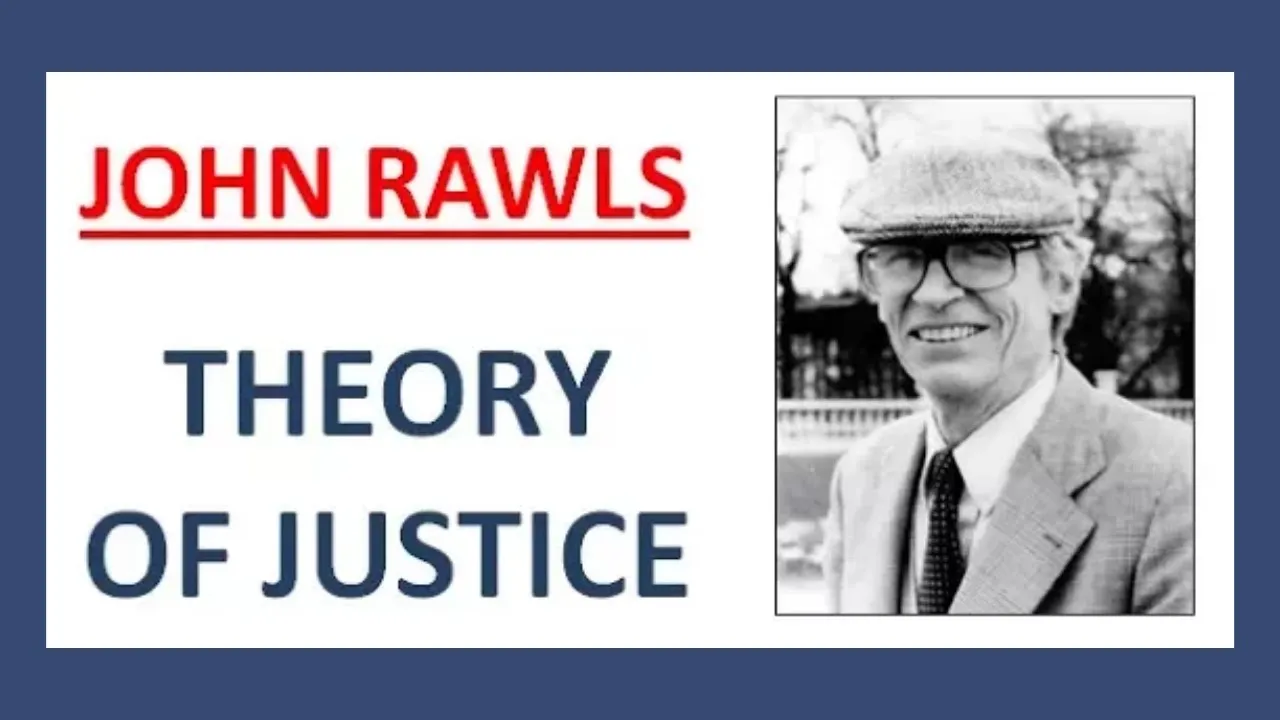
John Rawls' theory of justice proposes that principles of justice should be chosen from behind a 'veil of ignorance'—a hypothetical situation where individuals select social rules without knowing their future position in society (such as their wealth, race, gender, or abilities)—leading to two key principles: (1) each person has an equal right to the most extensive system of liberties compatible with a similar system for all, and (2) social and economic inequalities are permissible only if they benefit the least advantaged members of society; Rawls shifts political philosophy from utility-based approaches to 'resourcism,' focusing on concrete resources like liberties, opportunities, income, and wealth rather than subjective welfare or utility.
John Rawls' Theory of Justice: The Rawlsian Social Contract
Added:Prof: So welcome back everybody.
It probably will take a while to wrestle your brains back to what we were talking about before the break, but I'll do my best to help in that endeavor.
We're really finishing up the first two-thirds of the course by talking about John Rawls, a very interesting figure and phenomenon in modern political philosophy.
We're finishing up the first two-thirds of the course in the sense that this is the third Enlightenment tradition we're talking about, the first two having been utilitarianism and Marxism.
And after we finish with Rawls we're going to talk about the anti-Enlightenment tradition and then the democratic traditions.
So Rawls is an odd figure in some ways.
If I had been here, or if a predecessor from a prior generation had been here teaching a course like this in the 1950s or early 1960s, and somebody had speculated that maybe a very major figure would emerge in American political philosophy there would have been a lot of skepticism, and there would have been even more skepticism if somebody had said, "And they would have been a theorist of the social contract."
And I think there would have been two reasons for that skepticism.
One is that political philosophy was really not thought to be a particularly important area of philosophy, of academic philosophy in the 1950s and 1960s.
The people who were sort of seen as the cutting edge in philosophy were doing philosophy of language, logic, epistemology, metaphysics, and political philosophy was sort of way down on the totem pole.
It was a subdivision of ethics, and sort of ethics for many people, if you like.
And the notion that anybody in philosophy who did political philosophy would turn out to be a major figure would have attracted a lot of skepticism among academic philosophers.
And yet John Rawls, I think today, and if you polled, if you went around the most prestigious philosophy departments in the world, not just the English-speaking world, today, and said, "Who was the most important philosopher of the last third of the twentieth century, not political philosopher just philosopher," and you ask that question of people in major philosophy departments around the world, Rawls would be cited more than other person, without any doubt about it.
I don't have any doubt about it.
He'd be cited more than any other person.
So that's one reason people would have been skeptical that they just didn't think political philosophy was that important and the sort of serious heavyweights in philosophy did other things.
But then I think the second reason people would have been skeptical is that a theorist of the social contract, and everybody knew that the social contract, which as you all know, has been around in its modern form at least since the seventeenth century, everybody knew it had these two huge problems.
One was that it didn't have any grounding in natural law that people accepted, and the second was it never was a social contract.
We now know from 150 years of anthropology there never was a social contract.
Aristotle was closer to being accurate when he sort of treated human beings as inherently political.
There was never a pre-political condition.
And as you now know, because we've studied Robert Nozick, the revival of the social contract tradition answered both those questions first by replacing natural law with some version of Immanuel Kant's ethics.
So Kant becomes the placeholder for natural law, and on the other hand working with hypothetical contracts rather than actual contracts asking the question, "What would people agree to?"
not "What did people agree to under certain specified conditions?"
But neither of those ideas was central to Nozick, was invented by Nozick.
Rather both of those ideas were invented by Rawls, and Nozick was one of many people who reacted to Rawls.
I had pedagogical reasons for dealing with Nozick first, namely that his argument grows so directly out of Locke's, but if this was a course in the history of twentieth-century political philosophy of course we would have done Rawls first.
And it's really important to say this because Nozick's book would never have been written but for Rawls.
And I think the one measure of the importance of Rawls is that there are probably fifty books, and I don't know how many articles that would never have been written but for Rawls.
You can go and find Rawls's book in the library and you'll find it on the shelf next to the book just books listing the citations to Rawls's book.
And so that's a very interesting fact.
It's also an interesting fact because Rawls is not a great in the sense that we think of as Hobbes, Locke, or Mill, or Dewey, who we don't read in this course, as greats in the sense that most of those people had a view of the world that ranged right across all domains of knowledge.
So if you read Locke, he had a view of knowledge, a view of language, a view of theology, a view of politics; a view of everything.
Mill had a theory of science.
He had a mathematical theory.
He had theories of meaning.
He had an epistemology, and he had a theory of politics.
Dewey, same story, there's a whole worldview that's worked out in every what we today think of as disciplines, but for most of the tradition we're not divided up in the way we divide things up today.
But the people we tend to call greats had a view that ranges across the whole gamut of knowledge.
Rawls didn't do that.
He doesn't have a metaphysics.
He doesn't have epistemology, he doesn't have a theory of science, he doesn't have a theory of language.
He only wrote this book, basically.
He wrote some articles which lead up to the book and then some things that follow out of the book, but basically his book A Theory of Justice is it.
And so he's not a great in that sense of the greats of the tradition, but he certainly has more intellectual staying power than any contemporary, in the broad sense of the word, that you've read in this course or will read in this course.
People will still be reading Rawls long after people like me have been forgotten about.
So in that sense he's a really important figure, and he's a really important figure also in the sense that even if you don't like his arguments, even if you are completely un-persuaded by all of his arguments you have to come to grips with him.
I'm not in sympathy with any of his major arguments, but you cannot work in this field and not deal with John Rawls.
That's how important he is, and he's going to be for a long time.
So that's just by way of background and letting you know what you're dealing with.
One other thing I'd say about A Theory of Justice is, it is not a well-written book.
It's not badly written in the sense that it's unclear.
Any given paragraph is clear enough if you sit down and figure out the jargon means.
It's not hard in the sense that, say, the technical sides of Marx or Pareto are hard, but it's not captivating writing.
You need a chair with a hard back to read this book, and there's a reason for that.
The reason is that although the book was published in 1971, Rawls actually came up with the main ideas in the 1960s in a couple of articles, the most famous of which was called Justice as Fairness, and he circulated these articles in the profession, in the philosophy profession, and he kept getting criticisms.
And eventually he had book manuscript, and he circulated the book manuscript and he kept getting criticisms.
And every time somebody sent him a criticism he added three paragraphs to address the criticism.
This is not the way to write a book if you want it to be captivating.
So it's got this kind of--almost plodding quality that's sort of at variance with the hype I just gave you about his importance, but it's to do with the composition of the book, I mean, there's ten years of endlessly fiddling with this manuscript.
And I should also say that he eventually did a second edition of the book later in his life, which is a substantial rewrite of it from the first edition.
So he was somebody who couldn't stop fiddling, and it's not a trait to which I would commend to you, but in any event there it is.
And it's a long, and if not plodding, certainly ponderous book, and my goal in these lectures about Rawls is to try pull out the main ideas for you, and particularly the main enduring ideas.
Because Rawls, like everybody else we've read, as an architectonic theorist fails.
The pieces don't add up.
There are big logical holes in the big structure.
So if you want it to be the silver bullet or the final word it's not going to happen.
Nonetheless, there are very important enduring insights and questions Rawls put on the table which have not gone away and are not going to go away for anybody who wants to think about the fundamentals of political association.
So what are these ideas?
Well, they get, I think, mixed up to some extent, or hidden, or obscured, or made to seem more complicated than they should be partly because of the architecture of his theory, partly because of the way he does the exposition.
He has this story about the original position, which is his version of the hypothetical social contract.
And let me just give you the intuition, but I want to preface it by saying it's actually not important to his theory.
It's really an expository device because what he does is he structures a hypothetical choice, and then he gives you certain kinds of information to get you to choose a certain outcome.
So unless the outcome is itself independently desirable, the fact that this thought experiment leads to it is of no interest.
Let me give you an example before we get into Rawls, which is one that he himself gives.
I'm not sure if it's one of the excerpts you read or not, but this is an observation that has been around long before Rawls.
He says, "What is the fair way to cut a cake?"
Is this in what you read anybody, "What's the fair way to cut a cake?"
Probably not, I'm sure you spent your spring break reading through Rawls.
Yeah?
Student: > Prof: Correct.
So the person with the knife gets the last slice, and what will they do?
Student: >.
Prof: But how will they divide it?
Student: >.
Prof: There are two assumptions there, okay?
You say, "What's the fair way to cut a cake?"
The answer: "The fair way to cut a cake is the person with the knife gets the last slice."
What will they do?
They will divide it equally, right?
That's how the person with the knife gets the biggest possible slice, right?
Right, yeah?
Anyone think that's not the fair way to cut a cake intuitively?
Okay, well there are two assumptions there that are worth bringing to the fore just for purpose of what I'm going to say to you about Rawls in a minute.
One is that we think dividing the cake equally is the right, you know, we've devised a system where the cakes can get equally divided, right?
But do we think it should be equally divided?
What if I added other information like one of the people in the room was starving and hadn't eaten for three days, or one was a diabetic?
We could add other information which would make you wonder, do you want to get an equal division, right?
So the cake-cutting example doesn't show you that equality is a good thing.
It presumes that you've already decided equality's a good thing and you want to get the person to choose equality, right?
Then the other thing it assumes is that people are going to behave self-interestedly, right?
When we give the person the knife and say, "Divide it however you like.
You get the last slice," we're assuming that she or he will want to get the biggest possible slice.
So immediately we've got two assumptions built into there, one that equality's a good thing.
That's the result we actually do want to get, and secondly that people are going to behave in a self-interested way, right?
Which isn't to say they're bad assumptions, but it's to note that they are assumptions, okay?
Now, Rawls' original position has the same structure as the cake cutting for both of those reasons.
He has a distributive outcome that he wants to convince you is a good thing, and he's going to create a hypothetical choice situation that will lead you to it, right?
But that doesn't itself establish that it is a good thing.
You have to have some other argument to convince you that it is a good thing, and I'll tell you what that argument is, but it's completely independent of this expository device that's modeled on the cake cutting.
So the expository device that's modeled on the cake cutting goes like this.
It says imagine you had to design a social order, a society in the broadest sense of the word.
It will include an economic system, a political system and so on, and you didn't know whether you were going to turn out to be rich or poor, male or female, what race you were going to be, whether you were going to be an athlete or a nerd.
You didn't have any particular information about yourself, whether you're going to have a high IQ or a low IQ, musical, not musical, good athlete, a bad athlete, nothing.
You didn't have that kind of information about yourself, which doesn't mean that there could be people who didn't have those characteristics, right?
Just like say you had to design the rules of chess and you didn't know whether or not you're going to be good at using bishop, better at using a bishop than using a knight, but you had to agree on certain rules, okay?
So the rules for designing society you're going to choose while being ignorant of what he calls particular facts about your circumstances.
You're going to know only certain pretty general things like he says, "It's a world of moderate scarcity."
So it's not superabundance, which is a good thing, because we found out when we studied Marx that there's no coherent of superabundance.
Moderate scarcity, it's not a developing country, what we think of today as a third world or developing country.
It's basically principles for countries of the sort we live in, okay, so moderate scarcity.
And we're going to assume certain basic what he calls laws of psychology and economics, and I think that people largely behave self-interestedly is the most important of those.
But beyond that you're not going to have particular knowledge about yourself and your circumstances.
In particular, sorry to use particular in two conflicting ways, but in particular, you're not going to have the kind of knowledge that would allow you to bias things in your own direction.
So that if you knew you were going to turn out to be female you could say women should earn twice as much as men, but you're not going to know whether you're going to turn out to be female or male.
So the kind of knowledge you're going to be denied is the kind of knowledge that would let you bias things in your own favor, okay?
So that's the sense in which he's trying to be Kantian.
He calls his principles, "procedural expressions of the categorical imperative."
There's a mouthful for you on the first day back from spring break.
We know what the categorical imperative is, right?
It's the imperative to choose things that are universalizable, things that you would will regardless of the consequence, so things you would will from every conceivable standpoint.
And what Rawls is trying to do when he says there's a procedural expression of it, what he's trying to do is say, "Well, if you don't have knowledge of which kind of person you're going to turn out to be in terms of rich or poor, or male or female, or black or white, or Hispanic, or some other ethnic group, or religious of some sort, or atheist, you don't know any of those things.
You're going to have to think about, what are the best social rules for people regardless of who they turn out to be?
And that's the sense in which he wants to think of himself as a Kantian.
So whereas for Nozick it's sort of just a slogan, for Rawls it's really built into the structure of his argument, okay?
And the idea of the original position is to force us, even while recognizing we're self-interested, to force us to think about society as a whole, to think about what would be desirable regardless of who you turned out to be.
And so then the basic way the book, if you had time to read the whole book, the basic way the book proceeds is he starts out with this complete veil of ignorance and tries to get you to agree with him.
In this sense it's not even really a social contract.
He's not saying, "Would you agree with one another?"
What he wants to say is, "Will you, the reader, agree with me, John Rawls, that any rational person would choose the principles that I'm arguing for?"
In that sense he's actually--we can't do it in this course because we didn't read Hobbes, he's actually more like Hobbes than he is like Locke because for Hobbes the social contract isn't legitimate because anybody made it, but because it must be rational to make it.
Any rational person, says Hobbes, would agree to give up their freedom to an absolute sovereign because anything else leads to civil war and is just madness.
So it's a property of rationality for Hobbes that people will accept the authority of the sovereign.
It isn't really a contract.
Well, Rawls is more like Hobbes on that point.
He saying, "I, John Rawls, want to persuade you, the reader, that any rational person would choose my principles of justice over the going alternatives," because his style of thinking-- people go on and on about Rawls being abstract, and an ideal theorist, and head in the clouds, but actually his actual way of proceeding isn't that.
It's comparative.
Basically what he does is he says, "Well, what are the going alternatives?"
There's utilitarianism.
There are other ones you haven't read in this course.
There's perfectionism, which is what he thinks of in Aristotle.
There's Marxism.
"I want to show you that my principle does better than the going alternatives from the perspective of being behind this veil of ignorance.
If somebody else comes along with another principle and shows that it does even better than mine then I would give it up."
So his basic mode of reasoning is comparative, okay?
And so what he does is he has a general principle of justice which he wants to persuade you of first from behind this veil of ignorance, and then more specific applications of it.
He ends up coming up with two principles of justice that are the applications which are really three principles, so I'll go through them with you.
But as you went more and more into the book he keeps adding information and lets you design more specific institutions and so on, always with the caveat that as you get more information later you can't go back and undo choices that you made earlier, right?
So it's sort of like--I don't know if you've been around long enough to ever see Congress go through a base closing exercise for the military where they realize that there's going to be special pleading from every, you know, say they're going to get rid of thirty military bases.
Every congressional district that has a base in it is going to have good reasons why-- "Yes, we should get rid of 30 bases, but not the one in our district, right?
We don't want to stop making submarines in Groton," right?
Whatever it is.
And so what they do is they create a commission that agrees on the base closing nationwide, and they have to vote up or down on the entire package, and then they can't start undoing it later.
So this has a kind of structure of a base closing commission that as the veil of ignorance starts to be lifted, and then you discover well actually I turn out to be female rather than male I can't then say, "Oh, well women should get certain particular kind of advantage," right?
So that's the way the book proceeds.
Now I think one other reason I should tell you about-- or actually two reasons I should tell you about, concerning why this book had such a big impact, why this book has had the staying power that it's had.
One is it's really very much a book of the 1960s and '70s when there was, to some extent, a crisis of confidence about liberal democratic institutions born of the students' movement, and the Vietnam War, and everything that went with it.
That is to say there was a generation of people who thought we needed to have critical standards for evaluating government, and utilitarianism, which was the main alternative around, didn't seem to provide them.
And Rawls came up with this notion that we could come up with an independent standard for judging, actually existing political systems, and then use it to see how they measure up.
It wouldn't have to be rooted in natural law and all the problems that went with it.
It was going to be rooted in this universal Kantian ideal, and it would give us principles by which we could evaluate not only what our government does, but other governments.
So I think it was, to some extent, the kind of thirst for criteria that was characteristic of that era that gave Rawls his staying power.
But then I think the other reason, the other reason that Rawls had staying power was that he changed the subject that people who had been squabbling about utilitarianism for 150 years had been arguing about, because--and again, you know this now because of the first half of this semester, but utilitarianism had basically been struggling between two variants.
One, which we think of in the terminology of this course as classical utilitarianism, we might call objectivist where you make strong interpersonal judgments of utility, and the problem with that as we saw, and as Rawls says repeatedly in his book, it doesn't take seriously the differences among persons.
You could see this in the utility monster example.
You could see this in the problems that we have with the bag lady and Donald Trump.
You can see this in problems with the disabled.
That if you don't allow interpersonal-- I'm sorry, if you do allow interpersonal judgments of utility you can do Draconian things in the name of maximizing utility.
But if you say, "No we're not going to do that," and you make the neoclassical move, and you then say, "We cannot even allow that taking a nickel from Trump and giving it to the bag lady necessarily leads to an increase in social utility," then you seem to have the opposite problem.
So the objectivist problem is it allows people to be used in the name of maximizing utility.
The subjectivist version, the neoclassical version doesn't seem to allow any interpersonal judgments of utility.
Both are deeply morally unsatisfying, and the proponents of each one tend to make the case for their view mainly by pointing to the demerits of the other view, right?
And they're both right.
Both of these views have serious demerits.
And so part of what Rawls does is he changes the subject.
He changes the subject, and he changes it in an interesting way.
He says, "Look, the truth is we should be objectivist about some things and subjectivist about other things."
And what does he mean by this?
He says, "Look, people are substantially alike on some dimensions and unalike on other dimensions.
There's deep pluralism of values, yes, but we basically have the same needs, the same physiology.
We tend to need the same kinds of resources, so let's focus on resources rather than on utility.
Let's focus on some basic resources that everybody needs regardless of whether they're going to be intellectuals, or artists, or sportsmen, or sportswomen, or politicians.
There are certain things you're going to need more of rather than less of, other things being equal, sort of instrumental goods you could think of them as.
And let's focus on that."
And especially in political theory those are a good thing to focus on because after all, we're talking about what the state might or might not do.
And the state, as we all know, acts with blunt instruments.
This idea of the government sort of putting a utilitometer under people's tongues to find out what their utility is, apart from being technically problematic, nobody wants that.
It's morally undesirable.
So you have to think about the state as something that acts with blunt instruments and you can only really-- if you want a realistic political theory you should focus on some basic resources in the society that the state could have some impact on.
So instead of various competing definitions of utility or welfare Rawls says, "Let's change the subject to talking about resources that have the quality (a) that they're things that we could really imagine the state dealing with, and (b) that are instrumentally valuable to people no matter what they turn out to want in life."
So that's a second reason he's important.
Academics are not comfortable unless they create an -ism word, so the -ism word is resourcism.
Rawls actually is saying resourcism.
Stop talking about welfarism.
Stop talking about utility, or welfare, or the subjective experiences that people get, but rather the resources that they have at their disposal.
So that's a second reason, I think, his views have had a lot of staying power, and people who don't like his particular resourcist theory have nonetheless embraced other resourcist theories, again, sort of in the wake of Rawls, if you like.
Okay, so what is the basic idea?
What is the basic principle?
It's his general conception of justice, of which he says "All social values," by which he means resources as I've just said it to you now, and he's going to say that there are three-- well, he talks about liberties, opportunities, income and wealth, which he treats together.
So that's three, and then a fourth one, the social bases of self-respect, I'll come back to all of that in a minute-- "are to be distributed equally unless an unequal distribution of any or all of these values is to everyone's advantage."
That is the basic idea.
All social values, by which he means resources, should be distributed equally unless an unequal distribution benefits everyone.
That is the first and most general formulation of his principle.
So let me just backup a little bit.
I'll go through liberties, opportunities, income and wealth in more detail starting in a minute.
I'm just going to mention the social bases for self-respect briefly and then not talk about it anymore because of time limitations, and because Rawls himself never says anything much about them, and what he has to say I don't think is very coherent.
So we'll just forget about the social bases of self-respect for the moment, maybe come back to them later.
But so here's the thing, "...are to be distributed equally unless an unequal distribution works to everybody's advantage."
Now you might say, "Why?"
right?
And that's the first question, right?
It's the first question you ask.
And Rawls is not going to give you a straight answer.
There's not a "because" for the reason I said to you earlier.
His reasoning is comparative.
So he says, "Well, you could say this is one candidate principle.
You bring another candidate principle like say utilitarianism, and we'll look at both from behind the veil of ignorance and see which makes more sense to pick," okay?
So that's the sense in which he has a comparative-advantage argument, not a knockdown philosophical demonstration from first principles that this must follow.
So while I do want to say that he thinks it follows from the nature of reason that you would make this choice, it's only a comparative choice and somebody could come along with something else and convince you that it does better than his principle and then he'd have to accept that.
So what he does, and this is his resourcism in action, is he defines these primary goods.
Primary goods are these instrumental goods, these things you would, other things being equal, rather have more of than less of.
And the three we're going to focus on are liberties, opportunities, and income and wealth.
We'll probably only manage to deal with liberties today, but it'll give you a flavor of how his reasoning works.
So, what are liberties?
Well, they're pretty much the sort of thing in the Bill of Rights, in the American Bill of Rights: freedom of speech, freedom of religion, freedom of association, freedom, actually, to participate in democratic politics is one that he talks about.
And his principle for the distribution of liberties is, I just put it up there, he says, "Each person is to have an equal right to the most extensive system of total extensive"-- I told you he is ponderous, "...extensive total system of liberties compatible with a similar system of liberty for all."
Sounds like a lot of words not saying very much, so let me show you why it says more than it might appear to say at first sight.
Let's take the example of religious freedom.
So let's say, "Well, should we have an established religion?"
How can we reason about this from behind the veil of ignorance?
We don't know, once the veil of ignorance is lifted, whether we're going to be Christians, or Jews, or Muslims, or atheists, or agnostics, or something else, right?
We don't know that, right?
So how should we think about the question of whether there should be an established religion?
Well, and this is where one of his conceptual innovations comes in.
He says, "The way to think about it is from the standpoint of the most adversely affected person," because you don't know who you're going to be.
So for any principle if you could say, "Well, if I was the most adversely affected person by that principle, and I would still choose it, then it starts to look like a procedural expression of the categorical imperative," because if the person most disadvantaged by it would choose it over the going alternatives then presumably everybody else would, okay?
And so this is a misunderstanding of Rawls that people often get into.
He says at one point, "If the standpoint of justice is the standpoint of the least advantaged person," but this is not a kind of bleeding heart liberal point.
He's not saying the standpoint of justice is the standpoint of the least advantaged person because we should feel sorry for the least advantaged person.
That poor bag lady and that rich Trump, isn't that disgusting to contemplate?
That's not his point.
It's a self-interested point, a completely self-interested point.
He's saying, "You figure out what you would choose in this situation of turning out to be the most disadvantaged person.
That is the standpoint of justice, not because we feel badly for the most disadvantaged person, but because we want a universalizable principle," okay?
That's the point.
As I said, it's not a bleeding heart point.
It's a self-interest point.
It's self-interest in the service of universalizability.
It's to get people to pick a principle that they would affirm no matter what, and that's the sense in which Rawls thinks of himself as a Kantian.
Okay, now let's come back to religious freedom.
Well, if we had an established church and you turned out to be a member of the established religion you would be completely happy, but if we had an established church and you turned out to be a non-believer, or a believer in a different religion, you wouldn't be happy, right?
You'd be less happy, at least, than the person who turns out to belong to the established religion.
That part's straightforward, but that's not the interesting comparison, it's not the illuminating comparison.
So Rawls says, "Think about it like this.
The question is whether or not to have an established church, an established religion, right?
So think about the person who is not a member of the established religion in a world in which there is an established religion, right?
Versus the believer in a world in which there is no established religion."
Suppose you're an atheist, and you have no established religion, you're happy, but on the other hand the fundamentalist is unhappy, right?
But so for Rawls the relevant comparison is would you rather be a fundamentalist in a regime where there's no established religion or a non-believer in a regime where there is an established religion?
And his argument for disestablished religion is that the believer in the disestablishment regime has more religious freedom than the nonbeliever in the established regime, right?
To make this concrete, fundamentalists have more religious freedom in America than non-fundamentalists have in Saudi Arabia or Iran.
So the reason to prefer disestablishment of religion is that if you're trying to maximize the religious freedom of the least advantaged person you have to look at the least advantaged person in all of the possible regimes of governing religion, right?
And so the defense of the establishment clause of the U.S.--he doesn't talk about this example, it's my example, but it's his logic, right?
If you said the Rawlsian defense of the establishment clause of the U.S. Constitution that's what it would be.
Christian fundamentalists often criticize the establishment clause, particularly the way it's been interpreted by the courts.
They say it's presented as neutral among religions and it's not.
It's not neutral because it works, you know, people who think there shouldn't be an established religion, get exactly what they want, but we who think there should be, don't get exactly what we want, so it's not neutral.
Correct, they're correct, it's not neutral.
And Rawls actually contributes to confusion here because sometimes he talks about his theory as neutral.
It's not neutral.
And the requirement is not that it should be neutral, but rather that it should give the most extensive religious freedom to the person who's most disadvantaged in either system.
So as I said, the key point is that the believer has more religious freedom if you have something like the U.S.'s establishment clause than the nonbeliever has when you have a fundamentalist regime.
That's the claim.
And so you want to give the most extensive system of religious freedom compatible with a like system for all, right?
And the way you get to compatible with a like system for all is to look at it from the standpoint of the most adversely affected person, or the least advantaged person in any case.
So that's the basic way in which he reasons.
And that's why this sort of rather empty-sounding phrase here that is his first principle actually has more content than might appear to be at first sight to be the case, right?
So it's the standpoint of justice is the standpoint of the most disadvantaged person not because of being a bleeding heart, but because you want a universalizable principle.
And it's just the cake cutting.
You're giving the knife to the person who's getting the last slice.
You say, "Pick the system that will give you the most religious freedom when you later discover what your beliefs are, right?
And that is the principle you should affirm."
And that is why a religious fundamentalist should choose the establishment clause of the U.S.
Okay, now somebody might come along with some other principle and show that it does better and then we'd have to go through the process again.
But so that's the basic structure of Rawlsian reasoning, if you like, about principles of justice.
Okay, we'll pause there and pick up on Wednesday.
Up Next

Rawls' Theory of Justice Explained: A Philosophical Introduction
@ThenNow
392.4K views•2020-07-02

John of Damascus on Holy Images: A Theological Defense
@BannedBooks
139 views•2026-04-25
Sovereignty in Hobbes' Leviathan | Political Philosophy
@YaleCourses
96.7K views•2008-09-22
The Myth of Sisyphus: A Greek Legend of Eternal Punishment
@TEDEd
8.6M views•2018-11-13
Related Study Plans & Knowledge Roadmaps
Structured learning paths in Philosophy