
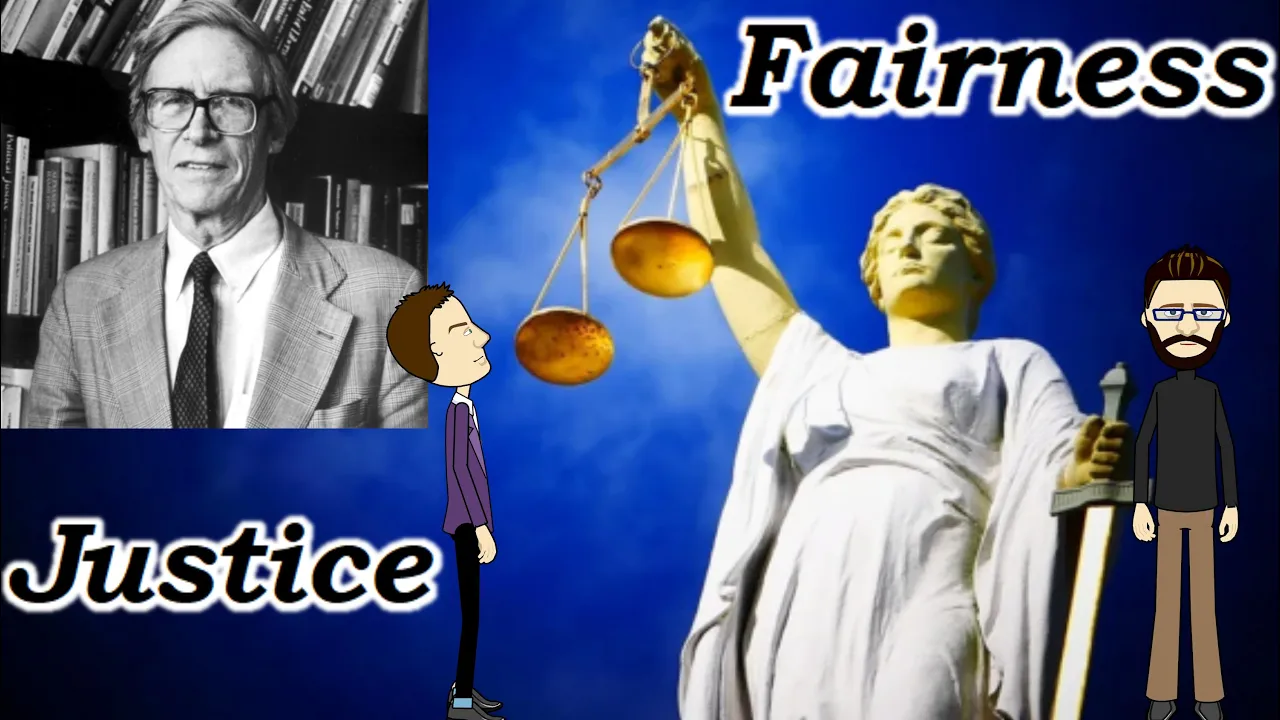
![Was ist eine gerechte Gesellschaft? - John Rawls: Eine Theorie der Gerechtigkeit [Philosophie]](https://i.ytimg.com/vi/ebpGLt_zITA/maxresdefault.jpg)

















This video presents a philosophical debate between John Rawls' theory of justice as fairness, which uses the veil of ignorance thought experiment to derive principles of equal liberty, fair opportunity, and benefits for the least advantaged, and Robert Nozick's libertarian perspective emphasizing individual rights, voluntary contracts, and minimal state intervention. The discussion applies these competing frameworks to healthcare policy, with Rawls supporting the NHS model based on collaborative risk-pooling and Nozick criticizing state redistribution as infringing on individual rights.
John Rawls vs Robert Nozick: Debating Theory of Justice | Medical Ethics Discussion
Added:The core tenets of John Rawls's 'A Theory of Justice', specifically the concepts of the 'Original Position', the 'Veil of Ignorance', and the 'Difference Principle'.
Robert Nozick's libertarian philosophy from 'Anarchy, State, and Utopia', including his 'Entitlement Theory' of holdings and emphasis on individual liberty.
The philosophical distinction between positive rights (e.g., a right to healthcare) and negative rights (e.g., freedom from government interference).
Basic introductory concepts of distributive justice—how a society should allocate its resources, rights, and burdens.
Analyzing Norman Daniels's 'Just Health' framework, which directly applies Rawlsian justice to health and healthcare allocation.
Evaluating real-world healthcare systems (e.g., the UK's NHS vs. the US market-driven system) using Rawlsian and Nozickian ethical lenses.
Exploring alternative philosophical perspectives on healthcare, such as Amartya Sen and Martha Nussbaum's 'Capabilities Approach'.
Applying these justice theories to specific bioethical crises, such as triage protocols during a pandemic or the ethics of global organ transplant distribution.
17.5K views115likes37:50Original Release: 2016-03-08
okay right um it's very important to say at the start uh that the um uh that the views to be expressed Now by um John rolls and Robert noik are not necessarily the views of John Spicer and D mbrook respectively however it will be a useful exercise I think for all of us uh in order to U bring uh our discussions to ahead uh this afternoon and perhaps a bit of fun too so um I will without further Ado um I will I will introduce uh John rolls uh author of the theory of justice and many other fine Works in political Theory uh you're you're going first John uh late lamented uh John rules passed away while I was doing my undergraduate degree and uh we are indebted to you for your presence here and over to you thank you very much CH you'll notice I'm sitting in the original position you are an an inj for phical philosophers yes my name is John R you may call me Jack everybody else does I'm 95 and I died 13 years ago that has had an influence on my cognitions my functioning so please excuse me if it slips a little during the course of our discussions I'm a scholar of Justice I was I didn't go far beyond Harvard really I did in my youth I saw some terrible things I saw two brothers die one of dixia another of pneumonia they caught it from me I saw terrible things in the Pacific Theater of World War II I think they probably inform my thinking I was a scholar in Oxford so I have a relationship with your country and I want to make some comments about that at the end I want to offer you a notion of justice as fairness and and that's better than any libertarian or utilitarian cooked up Theory you might hear in the next few minutes consider this thought experiment if you will imagine yourself as an intelligent person of sentience of your faculties but before your birth floating above the world with no idea where you may end up being born raised and live it could be as the child of a rich family in Hamstead I gather that's a a fine District of your country or a poor single parent in my land you have no idea where you might be in such a place you would want to set up a system of justice of fairness where your chances would would be the best you could possibly get where the schools and hospitals and housing and access to the law were arranged along those lines you'd want a fair system at least towards the advantage of those disadvantaged persons where you may end up and minimize the chances of you ending up it follows as one of the disadvantages I call this the ve notes so if you follow that logic a little bit further I ended up in my thinking with several principles of justice and I just want to briefly tell you about them now one that each person is to have an equal right to the most extensive basic Liberty with a similar Liberty for others they call that the people after me called it the Liberty principle secondly social inequalities should be arranged Ed so that offices and positions should be open to all under a fair equality of opportunity and my successors have called that the opportunity principle but most interestingly I think those social in inequalities should be arranged so that they are of the greatest benefit to the least advantaged as well because that's what happens if you were thinking about it from your position Veil veil of ignorance now those social goods that might be tune with those things I've said could be things like schools hospitals and other aspects of life and what I want to end up saying is that I think that these principles offer you something in your country to do with the organization of your Healthcare and I would argue that it follows that collaborative principles should implied when you're thinking about how you organize your healthare and I hear on the Great Vine but you do it rather well thank you well thank you John or should I say Jack um it's um it's delightful to to to talk to you um ously I I understand that you also were something of a theologian in your younger years do you recall I do you do recall I recall wanting to be a priest at one stage in fact but it was the Pacific Theater of War that yeah well your Works in theology have now come to light in the last few years in Princeton and we're uh we enjoy reading those too thank you very much Jack ruls so over to um Professor Robert mosic indeed who died strangely enough in the same year as as as John um one of those uh tricks of strange elements of History um so um no doubt You've Got U you entirely agree with uh with John John over it's great to see you uh Jack after what 13 years uh to be dug up for an occasion like this now I mean one thing you'll notice is is John here he he died at the age of 81 whereas uh I died at the age of 63 and isn't life just a now John you see is painting a very lovely picture for us he he takes he starts with a thought experiment you'll notice that he starts with a thought experiment uh and there's something about this this epistemological technique itself which I want to point out and in my excellent book which I hope you're going to go away and read by the way it's a Dar sight easier to read than his book um in my excellent book I I point out it's rather like taking one of these children's balloons and you sort of squeeze it here and you squeeze it there and you squeeze it there until it's sort of in the right shape that you want it but it's only going to stay in that shape moment so you better take a photo of it very quick before this Mirage disappears you see John has this wonderful thought experiment but it's a thought experiment can can you give me firstly the historical precedent for any society that has ordered its Affairs like this uh can you can you uh give me any reason why the particular values that you have retro engineered out of this thought experiment should be the values that we should Advocate you see John you're a great guy and I love you dearly as a Harvard colleague and we've spent many a good time uh talking together in the days when we were alive um the the the the problem is that this does not grapple with the real world the real world is unfair uh and you're a contract heran so you want to make a castle in the air whereas I actually am a moral realist and I I start with a number of key points one is uh the Canon point that humans are ends in themselves humans are not means to something each individual human is an end in himself and therefore uh there are issues of Rights and issues of justice so if we look at an original position well uh John Loch uh talked about original positions in his state of nature Theory uh and the St of nature before uh people impose any order upon it is as Hobs taught us uh nasty poor brutal and short um so the issue is what justification have I for for taking your goods if uh you happen to be more fortunate than me and I would say there is only a minimal justification yes we certainly have a common interest and the state therefore has a uh a natural right to exist to defend our rights to defend our rights against Force against theft against fraud and to en Force freely entered into contracts but if we go beyond that uh I have to ask John by what right do you m uh demand uh that I should work until about the middle of May every year uh that all the every penny I earn until the middle of May goes to the state in order to to benefit those who happen to be poorer than me now what by what moral right is that that actually is enforced labor so John you are saying I should be enslaved from January until the middle of May I'm not committed to any specific uh social order we we may have Charities we may have voluntary works we have many other things what I am committed to is saying that the state has no right uh to forcibly take my money and my labor uh and redistribute it by some arbitrary means because John your thought experiment is arbitrary uh your thought experiment is lovely because you're a nice guy um but your thought experiment is arbitrary it has no moral Foundation uh and therefore with regret it's uh one must that I must reject well thank you very much his opening statements uh John and Roberts I mean John was very nice about the NHS here the um uh the collaborative nature of the NHS historically at least I I suspect you take a different view Robert is that right would you say NHS is a um built on slave labor according to your arguments taxed funded by slave labor and essentially distorts the principle of moral responsibility self- responsibility also deprives people of their duly entitled inheritance of course by by inheritance tax which which are also GS at least in some form so I mean the whole of the NHS is built on slavery and theft the hold of the NHS is certainly U built on theft regrettably um but I I think to answer it though I'd like to offer you another couple of thought experiments on my own um because you see who can argue against the NS motherhood apple pie blah blah you know we the these these things uh produce many social goods but if you produce a social good by wrong means then can you justify that let me offer you a couple of thought experiments hey you're saying the state's such a wonderful thing why don't we go a little bit further uh we've got the SAS these days just hanging around there doing nothing let's send the SAS out to shoot criminals that that'll be brilliant that's a further extension of the state for a common good apart from the criminals obviously that would be one example uh or here we are sitting here we talked earlier about uh kidneys well why why doesn't everyone uh just uh have their their tissue type on uh the state uh database and when it is discovered that that that you Josh happen to be uh the right match for someone who needs a kidney the state Taps you on the shoulder and says Josh I'm going to take your kidney um now I think you would agree with me that in both those examples one could make a utilitarian argument as for it being for the common good but you using means that are totally unjustified and indeed wrong now my so I I just want to come back to my point that it is wrong to take away the fruits of uh a man's labor other than by a freely entered into contract so the job of the state should be to uphold freely entered into contract and birth of course is no sign of a contract right well this is why I pointed out that John lived till 81 and I died at 63 uh that's unfair what am I going to do retrospective come and shoot him at the age of 63 this is moral luck now I think John I'm right in saying that that you actually I'm bring John in at this point actually thank you very much you want to respon well thank you Professor noac I I take the point about the book on the chin and having written it I freely acknowledge that yours is a much easier to read having um I which Edition are you thinking of the first first um thought experiments I think we must we must engender thought experiments with the currency they deserve and mine is a particular kind of thought experiment which you could critique or not as you think fit but it was good enough for Hobs to imagine the state of nature it was good enough for any utilitarian to imagine a trolley exper a trolley argument so I I think I have a certain justification for that let me go back to my uh difference principle or or rather What flows from the veil of ignorance I would argue that the people sitting behind the veil of ignorance are acting as rationally self-interested persons this is not arbitrary rational self-interest permeates all of us and a rationally self- interested person would be interested among other things in knowing that he or she would end up in the most Advantage situation that he or she possibly could if you take that out then they could end up anywhere they could end up in the M End Road instead of in Hamstead and and What flows from that so I think there is an argument which is almost Canon uh which which goes along with with mine in that regard you also make the point about utilitarian arguments against a utilitarian could say well I'm behind the veil of ignorance I'll take my chances I could end up in an a grade place or in a z grade place the trouble is would you really want to take that chance would a UT utilitarian even live with the consequences of having pulled a bad card and I don't think he or she would okay now let's go back to to looking at this thought experiment then part of the problem is that it is an entirely hypothetical thought experiment now if uh the thought experiment what thought experiment actually I'll definitional move there thank you I'll I'll I'll I'll tell you one uh uh you just disillusioned me I always thought Philip ofoot actually was was at the side of that Railway trolley pulling believer so that was a thought experiment no okay anyway no but it's hypothetical in the sense that I believe that you have retro engineered it uh for the uh for the liberal ends that you desire so as I say you're you're a great guy and and that that's good um so you you you start with the notion I desire liberal ends and therefore you retro engineer this particular form of thought experiment as I say I've often you a couple of other thought experiments which you you know don't seem to critique that much um so so if that was a thought experiment that had real purchase in the real world uh as I would argue hobes does and as locks has then if that were the case one would expect to see uh certain real gravitations to towards not just the outcome which as I say I believe you've retro engineered but but towards uh uh the the some justification of the thought experiment itself in a in a more solid form of theory uh whereas I can offer you a very solid form of theory which is a a moral realist Theory and that is to do with Canan respect for persons and human rights now it seems to me that you're perfectly happy to tread right over human rights because you desire a certain liberal outcome uh whilst I have a certain um type of mild admiration for that liberal outcome uh I honestly don't think it justifies the negation of those rights because I don't think you will have a just Society if you ignore trample over people's rights in order to lead to it which is why I gave you those other thoughts what I want to do now or shortly is to ask uh uh the audience here to engage a bit to Robert and John but I think we need to get a bit more concrete about what your uh comments here mean for markets and Healthcare I mean um if we weren't where we were as it were now in in the UK what would you like to have seen instead are there particular failings or faults in the Rel healthare system which are are are more or less indebted to um to the um said rules in Vision or or or its predecessors and are there s of particular malign effects which you'd like to see overcome by perhaps the adoption of of your approach I'm glad you asked about mign effect effects now you'll note the title of my book anak State and Utopia because what is the Utopia well the Utopia is is the notion of far greater individual freedom to build the type of societ that we wish and frankly this will be different for different people and I suspect in Nokian Society I'll be in a different corner of it than than John although we'll still meet at Harvard and have our our lovely conversations uh or we would if we were still alive um so my point really is that we can see I mean John himself wrote uh about moral hazard if you simply keep on handing out welfare and support people uh and I do believe that that it will lead to gross irresponsibility is that your point uh it has the potential to do so I'm not saying it it does that universally but what I would say is that humans should be left uh to form their own types of preferred socities for example what how would Healthcare be arranged if it wasn't um universally accessible the point of view what's better than that I mean surely that's a very safe and and pleasant way to live to have that sense of it might be safe and pleasant but you're you're trampling over people's rights to get there is rather reminiscent I've had some dreams about living in certain Middle Eastern countries recently and uh it's very pleasant for uh uh white people living in certain middle eastern uh countries if if you just trample over the rights of Migrant workers uh and pay them low low wages so if you grab from one lot to to give to another lot yes it's certainly very pleasant for the winners I I I would agree with that but I no to come back to Anarchy States in Utopia I think the notion of Utopia is that different social groupings should be allowed to form their own ways of living and there will be some uh social groupings who I've no doubt will form very socialized ways of of living and there may be such as as John I've got to be honest with you Josh I don't really specifically Advocate one specific way uh I do think that that people should have far greater Freedom uh to decide how to spend their own resources and whether they wish to join private insurance systems or or a more socialized system or whatever I I think that they they have a right to make that choice and how about for you I mean you look at British Healthcare compared to your your home country United States of America um isn't just so much better in the US there's a great the freedom of choice you've got flourishing of individual Enterprise um all sorts of health insurance schemes of hospitals run by private Enterprise efficiently with lovely ethos and so on and here you just have the Dead Hand of the state inspired by the all kind of roles you um isn't this just TR all those PPS trained in Oxford read your books and come up and deliver to us an awful Bland healthare system isn't this isn't this your your inheritance you've left all of us well I would say that the marketized Health Care system that pertains to the US where I lived for many many years considerably more years than my colleague here as he's pointed out um has actually ended up in system with the worst Health outcomes possibly in the world it has the best health outcomes for a very small minority and it has the worst Health outcomes for very much more so I I think I have to say I agree with President Obama that the Health Care system of the US is in dire need of therapy and he's begun to engineer it to go back to the connection that you asked me to establish between my theoretical position and the British NHS let's push the analogy about the veil of ignorance offering the greatest Advantage either to everyone or to the least disadvantage and I would argue that that collaborative notion is actually pretty close to the risk pool that uh underlays the British NHS we don't know whether we're going to die at 63 or at 90 or whatever it might be but we do know that at no immedate to ourselves or you know rather in your country um that whatever happens you will actually be entitled to a level of health care which may not be the best that's available in America but is good enough for the whole well we're very grateful to you both for starting our conversation we're fortunate to have a wide range of expertise in the audience including I believe KL marks is present with with us this afternoon I don't know if you want to address any of the points made briefly I would actually first of all this reminds of 18th cury D verbal D between a rabbi and a mon or priest the of king ferin and queen isab aru after hours Dees she asked her tell me right and the says says is I don't know think's the problem inad whats toate two extremes is actually a debate between very good friends just in two different periods here Ro is the great ideologue of the capitalist welfare state he says and and if you analyze you do what I said said before if you analyze the presuppositions of what he said of his mind he starts from the that we have rich and poor okay we have already a class Society now let's see how we juggle it in a way how we play in a way that not make the poor too miserable and angry the notas onlye majority andain thank you Carl and on Robert thank you very much Carl so um who else would like to contribute to the conversation comments questions for either of these thinkers or indeed for uh KL marks thank you very much Dr ha do you feel human have Inon as a biological species what's the context of your question uh yes no an existential being yeah I'm not not a great existentialist but um uh I think question now I think uh of course we do we have a common interest in uh uh having our rights upheld we have a common interest in may may I finish my may I finish my brief answer ask if we have something in common how are you going to find out what it is okay uh I think the main things we have in common are that humans are ends not means and that humans have rights that pres the answer to the question I'm suting to you is how are you going to find out already know okay it by what means you find out what it is that human beings have in common with one another yes well I think uh all epistem all epistemology has a lot of meth methodological problems and in fact what you tend to do when you start down a particular epistemological track uh is exactly this problem of retro engineering ing that I I I'm talking about and this is why I started uh by discussing these squeezy balloons because you see I think what's different about My Philosophy is that the the problems with it are visible on the outside I think a lot of other uh philosophers take as their philosophical method they know where they want to end up and they they make this lovely appearance that is very smooth and photogenic um but but actually not Avid R yeah you have to yes okay way no I think what I'd like to come up with is is to OBS thank you very much Dr for making this point PR and know it we we need to have other other voices come in for a moment just please thank you no no you're first yes please uh no as as time went by I mean my my last book was published just around about the time of my death actually so I was writing because I had quite a prolonged battle with uh my stomach cancer regretably if any of you have come up with a cure in the meantime i' be interested to speak to you afterwards uh but to be honest the the the short answer was was no and in fact interestingly in my later life I was quite interested in questions of epistemology which is why I was little disappointed not to be able to answer that question uh but uh but the short answer is is no thank you we are indeed fortunate to have Martin Luther with us as well was representative of a Lutheran tradition uh spoke eloquently about love earlier what would you like to say at this point undermining your arguments come up with something um I think they were after my time uh so I can't speak with authority all things being equal um but I don't think necessarily what you're implying is a challenge to the difference principle per you'd like to describe more fully yes so that this this equality is allow only to extend that worst off so that this but but but people so if you don't take into account at the same time real differ of C would you say that it activates this this dynamics of Justice really is it really enough to think operate only this differences and redistribute Goods extent it's needed but well I think that this is a question about distributive justice as much as anything isn't it and um and I know that's a hot topic for you in your country at the moment in the distribution of scarce um medical resources which you you could argue as one of my primary goods and I think I made reference to it if I get your point correct L tell me if I haven't is that sufficient so are there additional um distributive mechanisms You may wish to apply beyond the the difference principle highlighting if you like the necessity to to work to the advantage of the least disadvantage I suppose the other position would be to work to the advantage of everybody and I'm specifically saying that there is a difference between those two things and that the difference says that one should it is in the it's actually benefit of all to work to the benefit of the least disadvantaged and I think that is what flows from the available have to bring in two two more voices and then and then finish so Roger please and then thank you ask thank you why why shouldn't doctoring become okay so that's a question I guess for Robert if he knows how to respond to that and then thank you your own Al UC Cal are Society yes I I I think uh there's some truth in that I'd have a couple of things to say about that um my colleague John uh stated a person does not morally deserve their talents well that's interesting because I mean obviously it's what Bernard Williams uh calls moral luck um now what are we going to do are we going to say the state owns your moral talents then are we going to say the state owns all of our our personal attributes and can distribute them in an arbitrary fashion uh as it wishes because when all is said and done uh John's difference principle is an arbitrary principle um because it doesn't have any force of uh of of um morality behind it um I I think it's really bad luck that I died at the age of 63 but I'm not going to complain to the state about it uh we we live in a world where there is a lot of difference to me two things matter a lot firstly that the initial uh position needs to be as Fair as possible and so if somebody has wronged me uh then it is right that that wrong should be rectified in some sense but secondly whatever uh that initial position is it is it is uh for for me to enter into open contracts willingly uh in order to improve my position and I didn't get a a a place as a professor at Harvard uh just because of accident of birth well John has got one point to make I think a respon and then I just wanted to remind you professor of the basketball player in indeed Will Chamberlain yesam is is a good example was a very lucky guy he was he was the best basketball player in the world at the time and you argue very powerfully but wrongly I think I was going to say thank you for offering me slam dunk actually but the the perspective that he should be automatically entitled to the fruits of his natural abilities well we're going to have to pause there and actually and stop there I think let let time runs runs away with us if you do have further questions for John Robert please do catch them before The Undertakers uh return um to to Reiner them we are grateful for your brief Rise um and we'll see what happens in the future I suppose um uh it's interesting that we've returned um to talk about um uh the deployment of talents which is where uh one well I finished my talk earlier on uh uh uh today the question of how um who what is it that follows from from from the having of talents a person does not morally deserve their talents this is mement how other talents to be used was the question I was posing earlier anyway um we're grateful to you both I hope that was enjoyable uh they shall now come out of um their their roles and um we're grateful to uh John Spicer and to David mistle Brook for um uh this uh conversation and I would underline that the views expressed are not necessarily those John or could I say that we could I say that we actually did this because we were asked to talk we asked to debate two ways the markets of healthc care and neither of us was prepared to take a particular position which one I'll leave for you to guess so we decided to do it in Persona but may we thank uh well let's say John and David for this thank [Applause] you
Up Next
40:35
Philosophy of Gamification: How Social Media Shapes Values
@TheRoyalInstituteofPhilosophy
32K views•2019-12-05

164:01
John of Damascus on Holy Images: A Theological Defense
@BannedBooks
139 views•2026-04-25

68:32
Should We Destroy the Machines? Big Tech Surveillance Critique
@TheStoriesWeTell303
167.9K views•2025-11-30
4:57
The Myth of Sisyphus: A Greek Legend of Eternal Punishment
@TEDEd
8.6M views•2018-11-13
Related Study Plans & Knowledge Roadmaps
Structured learning paths in Philosophy
philosophy
Frankfurt School: Critical Theory & Culture
01Foundations of the Frankfurt School and Critical Theory
02Horkheimer & Adorno: The Critique of Instrumental Reason
03The Culture Industry and Mass Deception
+ 2 more learning modules
12h5 modules
Explore Roadmap
philosophy
Philosophy of Language: From Frege to Austin
01The Linguistic Turn: An Introduction to Language in Philosophy
02Gottlob Frege: Sense and Reference
03Early Wittgenstein: The Picture Theory of Meaning
+ 3 more learning modules
15h6 modules
Explore Roadmap
philosophy
Feminist Epistemology: Standpoint & Injustice
01Introduction to Epistemology and Feminist Critiques
02Sandra Harding and Standpoint Theory
03Donna Haraway and Situated Knowledges
+ 2 more learning modules
12h5 modules
Explore Roadmap
philosophy
Environmental Philosophy: Ethics & Deep Ecology
01Foundations of Environmental Ethics & Anthropocentrism
02Biocentric Individualism and Animal Liberation
03Ecocentric Holism and Deep Ecology
+ 1 more learning modules
10h4 modules
Explore Roadmap