
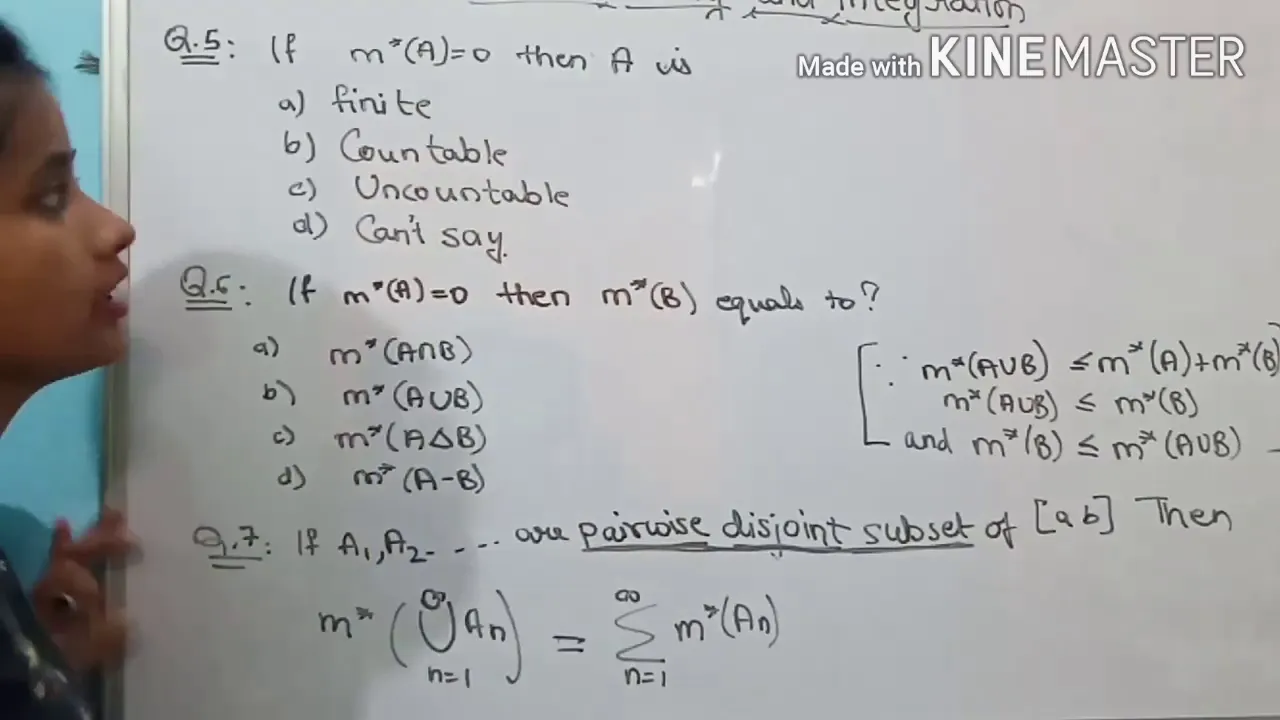

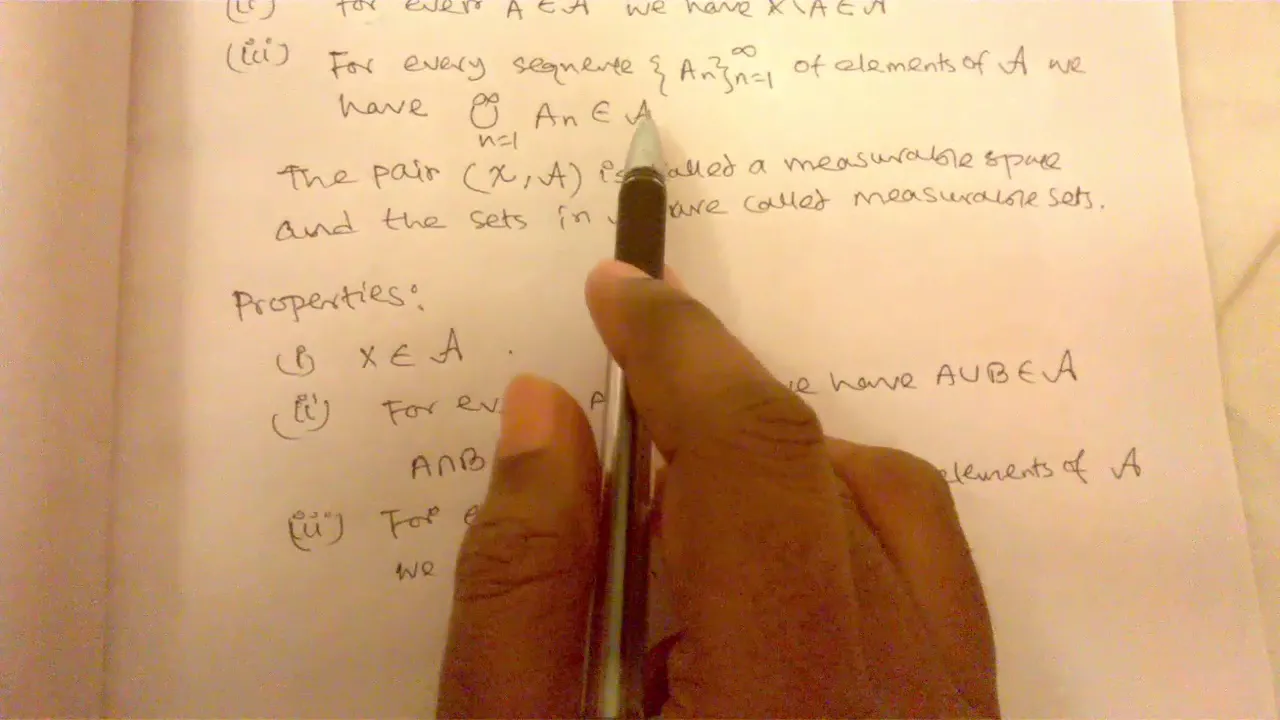




















A measure is a function μ defined on a σ-algebra A of subsets of a set X, mapping into the extended non-negative real numbers [0, ∞], that satisfies two key properties: (1) the empty set has measure zero, and (2) countable additivity, meaning the measure of a countable union of pairwise disjoint measurable sets equals the sum of their individual measures. Together with the set X and σ-algebra A, this forms a measure space (X, A, μ), which provides the foundational framework for integration and probability theory.
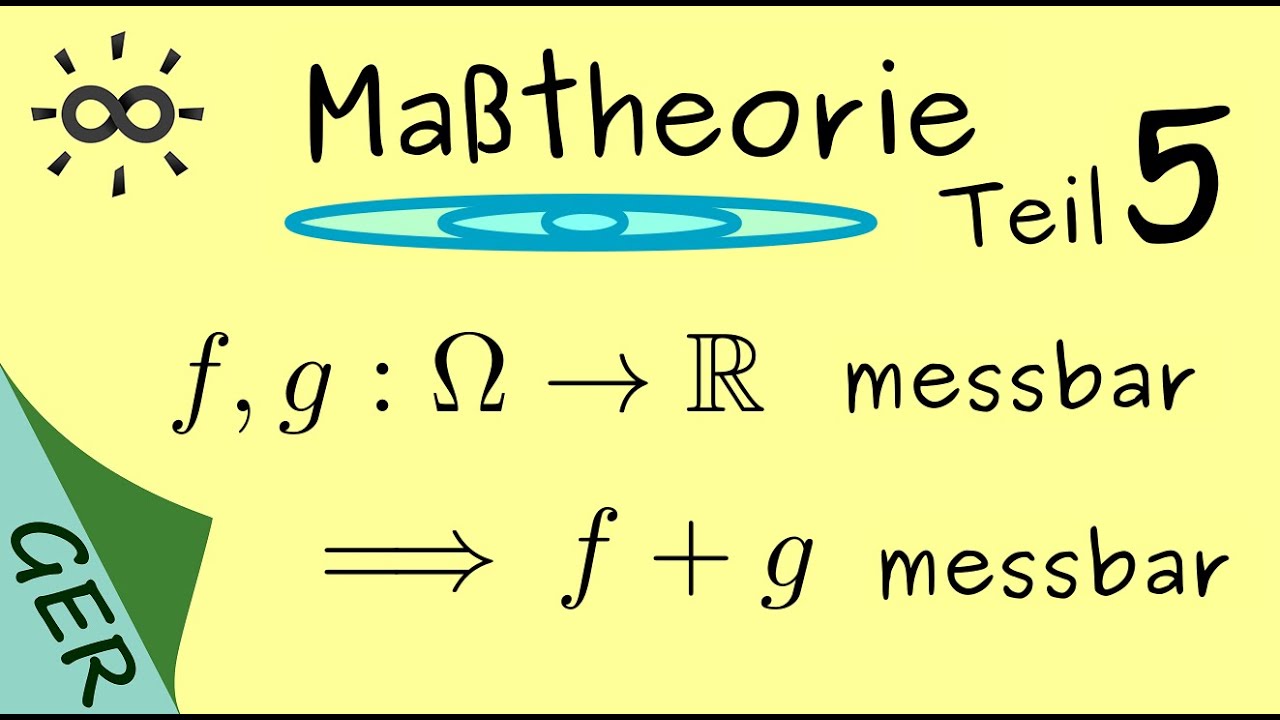
Measure Theory 3: What Is a Measure? | Definition & Examples
Added:Basic set theory, including countable versus uncountable sets, unions, and intersections.
The definition and properties of a sigma-algebra (measurable spaces).
The concept of functions mapping from a family of sets to the extended real number line [0, infinity].
Understanding of infinite series and limits, which are necessary for grasping countable additivity (sigma-additivity).
Fundamental properties of measures, such as monotonicity, subadditivity, and continuity of measures.
The construction and properties of the Lebesgue measure on the real numbers.
The concept of measurable functions and how they map between measurable spaces.
The definition and construction of the Lebesgue integral with respect to a general measure.
The formalization of probability spaces, where probability is defined as a measure with a total mass of one.
197.1K views3.7Klikes16:56Original Release: 2019-07-21
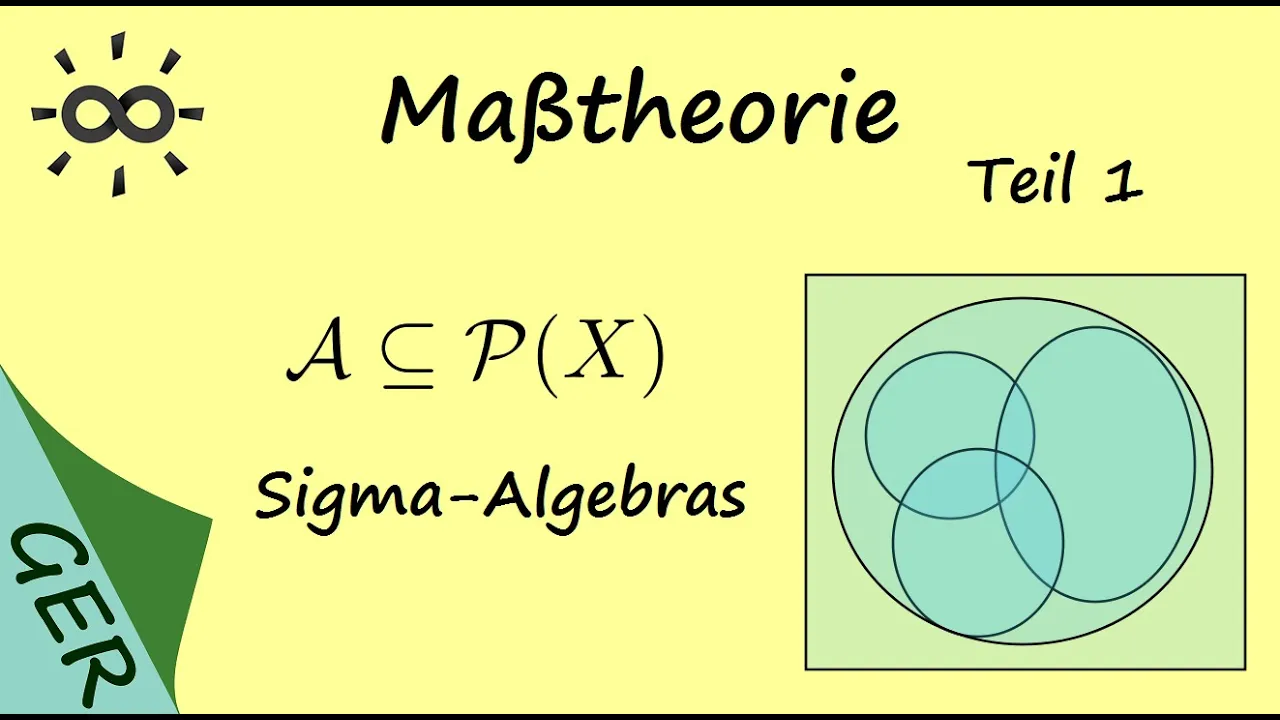
Hello and welcome back to measure theory. This is part 3 and today we will finally start talking about what measure is. I will start talking about the definition and then I explain you all the details. Afterwards then I can show you some examples for measures. To summarize in this video the question would be: what is a measure? To answer this question let's immediately start with the definition. What we need is a set X and a sigma-algebra on the set X and let's call this Sigma Algebra just A. And such a pair is then just called a measurable space. So nothing special, it just means you have a set X and you fixed one Sigma algebra on this set. And by now you know that a sigma algebra is a special collection of subsets of this set X. Now we will look at special maps that are defined on the Sigma algebra A. And such map I will always call by our lowercase mu.
So it's defined on the Sigma A and maps into the positive real numbers. However we include some small detail: on the one side we include 0, so 0 is allowed, and then we go to infinity, so this would be our normal interval: so we just look at a positive real line including 0. But here in the measure theory, we will change this a little bit we also include infinity. OK, this might look a little bit strange, and it is, because we just include one new symbol, so this means, we have our positive real line where we include the 0, so this is normal, but we also include a new symbol and we just call this symbol infinity. And to shorten this notation, we just write here also infinity is included in the interval. This means that it is just a short notation for saying that we have also a symbol infinity involved. How to calculate with this new symbol, I tell you later. First I want to tell you how such a map is now called. Maybe not so surprising such a map is now called a measure.
However only if the following two conditions are fulfilled. To see what these two rules should be, maybe recall what we want. We want to measure subsets of this set X, which means we want to give a volume to such a subset. So a generalized length or generalized volume. Therefore makes totally sense to restrict ourselves to the positive real numbers where we also include zero and the symbol infinity; which means we could also have a volume of zero and maybe also an infinite volume. But all other volumes should be positive numbers. From this, we immediately get our first property because we know that the empty set is a subset of X and in all Sigma algebras A involved.
Therefore we want to measure this empty set or we want to give it a volume. But the only sensible volume we can give the empty set would be zero. If there are no elements involved, the generalized volume should be zero. Okay for the start not so complicated so let's go to our second property, this property should fix the idea that we can add up volumes. Or in other words, if we have a subset given (so maybe just in this rectangle), then we could split it up into subsets (so maybe in this way maybe here line and here line). So I would call this A1, this is A2, this A3, A4, and A5. Now if we add up all these separate volumes, we should end at our original volume. And this is the condition I can write down. So adding up all the volumes where we start with i equals to 1 and we'll end with five, or we just write an N in this generality. So we're adding up the volumes, which means I add up mu of A_i. And we also know, we chose the sets to be disjoint, pairwise disjoint, because we want a decomposition of our original set. Pairwise disjoint means now that A_i intersected with A_j is the empty set if the indices do not coincide. So i is not equal to j.
Now you see something's missing in our condition but we can fix that immediately because we know this should be the original volume. So I can write this as the volume of the union of all these sets.
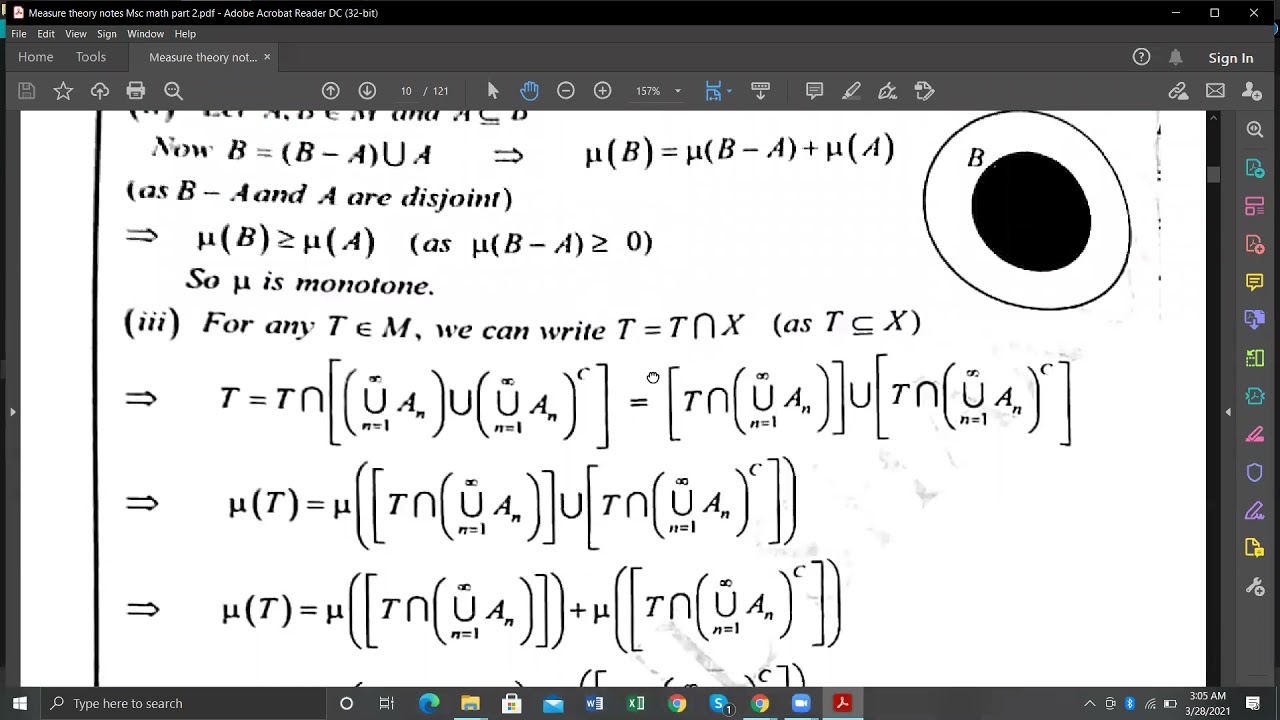
So I write here i equals to one going to N and here I have my A_i. This is the union that gives us indeed our original green set here. And this condition should be satisfied no matter which sets we chose. So I just write this should hold for all A_i out of our Sigma algebra. And this property is what one calls just additive. It tells you that if you have a finite union, you can split that up into a finite sum of the volumes. However I should tell you, this is not the full story. We also want to include the intuition that we can also approximate volumes. Maybe I explain it again in the picture. So if you want to calculate the volume of this rectangle, we can split it up again into subsets so this is my set A_1. Then I also choose an A_2 here and A_3 here and then I go on and on. So this would be my A_4 and A_5 and you see I get smaller and smaller. But you see I get again the decomposition of my original set into disjoint subsets. However, I have infinitely many subsets now. But they are countable, which means I have a sequence of subsets. Now you know, I can still form the union of all the subsets to get out my original set. Which means I put in here an infinity symbol to denote this union. And if I add up the infinitely many unions, I should also get out the original volume. So instead of a finite sum, I have now a series here; but it's the series of non-negative numbers. Therefore to denote this countable infinite additive rule, we usually call it sigma additive. And please recall we had the same idea in the definition of the Sigma algebra: we want this union, this countable infinity union, also be in the Sigma algebra. And therefore this is also well-defined because if we choose elements from the Sigma algebra, we know that this countable union is also in a sigma algebra. Therefore we can calculate mu of this one. And now we have it this is the definition of a measure. Maybe let's summarize that: a measure has to live on a Sigma algebra. It does not have to be the whole power set (it could be), but in general we will see we can't do it for the whole power set. This just means that we want to measure some meaningful subsets from our set X. Measuring subsets now means giving them a generalized volume, so it makes sense to give them a volume in the non-negative numbers where we also include a symbol infinity. And then the two properties generalize the ideas from a volume measure. The first thing tells you nothing should have a zero volume and the second tells you that you can calculate the volume by splitting it up into countable many subsets. Now let's assume you have a measure chosen, then we can also fix that in our informations here. You would write X with the Sigma algebra A and with our measure on the Sigma algebra A: mu. And this is what we call a measure space. This is of course a very important notion because the measure space is the space we work in. Very good. Now you learned what such a general measure space is. And now we can talk about some simple examples. Let us fix for all the examples, an arbitrary set X and also a Sigma algebra on the set X. And maybe we start with the best case scenario that we can choose the whole power set for the Sigma algebra. The first measure is very important and very easy, it's called the counting measure. No matter what set X is, you can always define this counting measure. Simply by setting that the measure of an arbitrary subset a is defined in the following way and I consider two cases here. The first case would be that A has only finitely many elements. In this case, I want the measure to be this number, so I can just write down the number of elements just by the number symbol. So this is a well-defined natural number or zero. So we don't have a problem, defining exactly this. Okay for the other case, I set it to infinity. Which means if A has not finitely many elements, I say it has infinitely many elements. There you see: it makes sense to use our symbol infinity. What you can now show is that this defines really a measure, so it fulfills these two rules. So that the empty set gets sent to zero is immediately clear because the empty set has finitely many elements and the number of elements is zero. So no problem there and also the Sigma additivity, you can easily show if you just deal with finite sets. If you deal with the infinite sets, it's also easy to show but then you need to know what are the calculations rules when I deal with this infinity symbol. And this is what I now want to show you. So just the basic calculation rules. The idea is of course thinking in the volumes. So if you have one volume x, and then you add up an infinite volume (so you add up infinity), you also should get out to infinity again. And this should hold for all x in our set. So also for the symbol infinity. Or other words infinity plus infinity is always infinity. In the same way we can do this for the multiplication: so x times infinity should be also defined as infinity. However now be careful, I want to exclude 0 now. So if I multiply a positive number with infinity, we get out to infinity again, but not for 0. For the special case 0 times infinity, there are different conventions. In general, you would just say this is undefined because it could mean anything. However in most cases in measure theory, it's also nice to have a definition for this combination of the symbols, and we set it to 0. However keep in mind, this is not always applicable and, outside of measure theory, it could be completely wrong. Often this occurs if we want to multiply two volumes. Then let's go to the next example and this one is called the Dirac measure. Maybe for this one visualize your set X here where we choose one fixed point, so we choose here maybe a point p inside X. And now we just want that the whole measure is concentrated in only this point. The usual notation one chooses for this measure is a delta where we have an index p to denote the point. Now for a given subset A, we also define it with two cases. It is either 1 or 0. The idea we could also sketch in our drawing here. So if this is our set A, we see that p is inside the set A. And if we want to volume to be concentrate at the point p, we now would say: okay this set has measure 1. So it doesn't matter how small the set is. As long as the special point p is inside, it has measure 1. But if P is not inside the set, then it has measure 0. A good visualization would be to think of this point as a point charge. The whole charge is in the point but if you look at the surrounding you would give also the surrounding exactly this charge. Okay so these were two measures that work on every set X, so in particular also for our special case R^n. Or in other words these measures don't measure the normal volume you, for example, have in R^3. They are indeed generalized measures. But we know we also want to have this normal volume measure in R^n. Therefore the exercise for measure theory is in particular to find a measure on X equal to R^n that has some nice properties. The first property would fix that it measures the normal volume. This means that if I put in the unit cube in the measure, which is a cube that has length 1 in all directions, then I want to get out the volume 1 as well. And the second property means it does not matter where we measure the volume in space.
In other words, the measure is invariant under translations. So I can write that as x plus our set A is equal to the volume of the set A. And this holds for all translation vectors x in R^n.
Also visualize always this property in a short picture. If you have your volume here so maybe this might be the set A. And now I translate all the points with a fixed vector x. Then I find the new set x plus A here. So this is my set x plus A. And of course this should have the same volume in our surrounding space. Of course this is not true for an abstract generalized measure from before.
But it should be true for our measure that we want to find that generalizes the normal volume measure in R^n. However keep in mind: we only know how to measure such cubes or cuboids and not how to measure such an arbitrary subset. And that's the idea that we want to extend this notion and still conserve these two properties. Later we will see that we can indeed define a measure with this two properties and that is what we then call the Lebesgue measure. And in the next video you will see that we can't choose the whole power set as a sigma-algebra. We have to choose a smaller one such that we can conserve these two properties. And there you will see that we can easily work in the Borel sigma-algebra. Well very good. That's all I wanted to tell you today and I hope that helped you a little bit. For the next videos, the real measure theory can start because now we have the notion what a measure and a measure space is. So thank you very much and see you next time!
Up Next
12:12
Measure Theory 1: Sigma Algebras Explained | Mathematics Lecture
@brightsideofmaths
560.1K views•2019-06-12

4:43
Elliptic Curve Cryptography Explained: ECC, ECDSA, ECDH
@PracticalNetworking
28.5K views•2024-10-21
8:22
Laurent Series Explained | Complex Analysis
@brightsideofmaths
52.4K views•2022-04-06

6:00
The Mathematical Impossibility of Accurate World Maps
@Vox
23.3M views•2016-12-02
Related Study Plans & Knowledge Roadmaps
Structured learning paths in Mathematics
mathematics
Tensor Calculus: Vectors to Riemann Curvature
01Mathematical Foundations: Linear Algebra & Calculus
02Covectors, Dual Spaces, and Tensor Basics
03The Metric Tensor and Index Gymnastics
+ 2 more learning modules
40h5 modules
Explore Roadmap
mathematics
Gödel's Incompleteness: Logic, Proofs & Limits
01Introduction to Formal Systems & Hilbert's Dream
02Set Theory, Cardinality, and Cantor's Diagonal Argument
03Arithmetization and Gödel Numbering
+ 2 more learning modules
14h5 modules
Explore Roadmap
mathematics
Galois Theory: Fields, Groups & Solvability
01Foundations of Abstract Algebra: Groups & Fields
02Polynomials & Field Extensions
03Splitting Fields & Symmetries
+ 2 more learning modules
24h5 modules
Explore Roadmap
mathematics
Non-Euclidean Geometry: Models & Geodesics
01Euclid's Fifth Postulate and the Birth of New Geometries
02Hyperbolic Space and the Poincaré Disk Model
03Geodesics: Defining Straight Lines in Curved Spaces
+ 2 more learning modules
15h5 modules
Explore Roadmap