


















![Measure Theory 2 | Borel Sigma Algebras [dark version]](https://i.ytimg.com/vi_webp/JWtzasf_Uy4/maxresdefault.webp)


![[L3] Théorie de la mesure: Fonctions mesurables, lim inf et lim sup.](https://i.ytimg.com/vi/du-gpZQCzsM/maxresdefault.jpg)





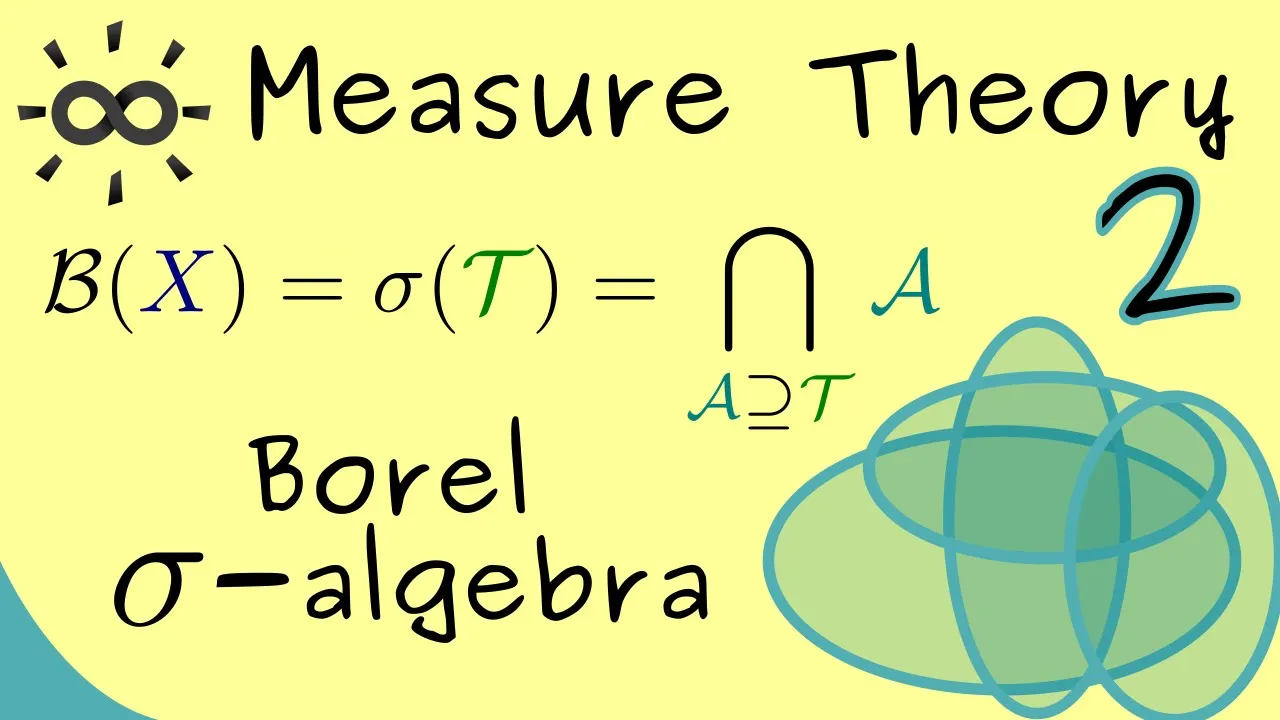
A sigma algebra (σ-algebra) is a collection of subsets of a set X that satisfies three key properties: it contains the empty set and the entire set X, it is closed under complementation (if a set is in the collection, its complement is too), and it is closed under countable unions (the union of countably many sets in the collection is also in the collection). These measurable sets form the foundation for defining measures and integrals in measure theory, as they provide a structured way to assign generalized volumes or lengths to subsets while maintaining mathematical consistency.
Measure Theory 1: Sigma Algebras Explained | Mathematics Lecture
Added:Naïve Set Theory: Mastery of set operations such as unions, intersections, complements, power sets, and De Morgan's laws.
Cardinality of Sets: A solid understanding of countable versus uncountable sets, which is fundamental to grasping the countable union property of sigma-algebras.
Basic Real Analysis: Familiarity with the topology of real numbers, specifically open and closed sets, bounds, and limits.
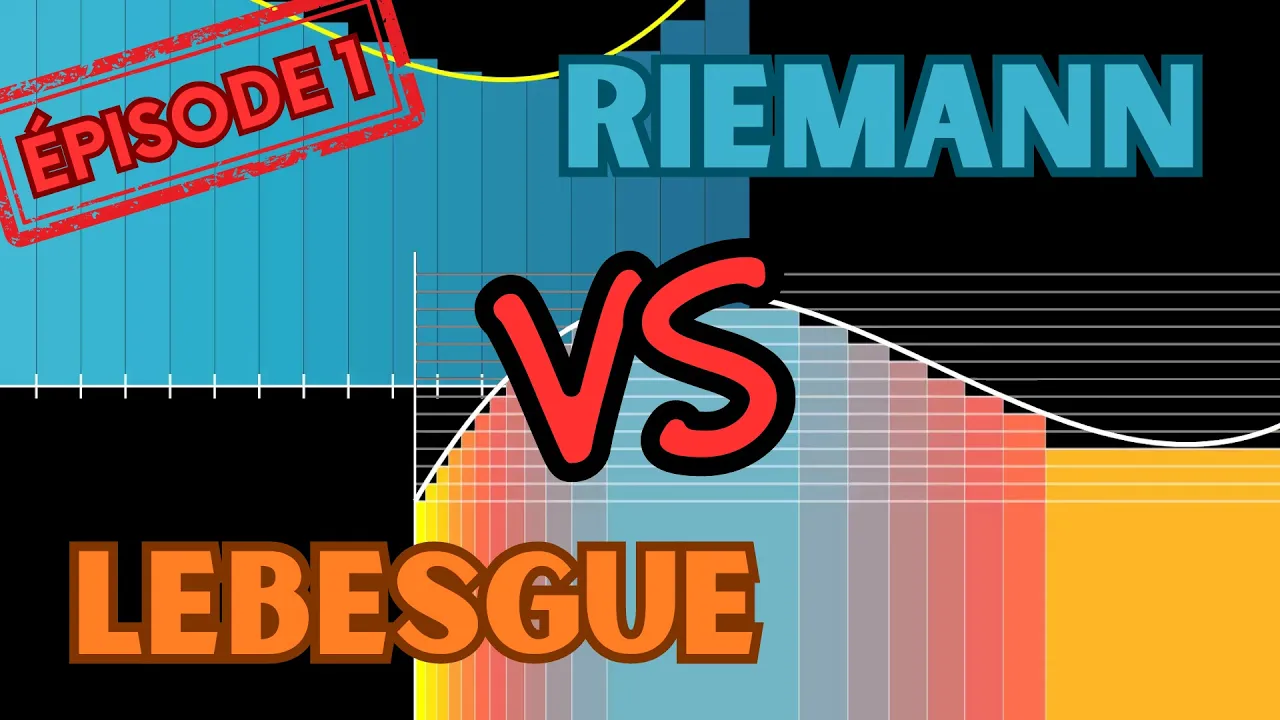
Limitations of Riemann Integration: Understanding why the Riemann integral fails for highly discontinuous functions (like the Dirichlet function), which motivates the need for measure theory.
Definition and Properties of Measures: Learning how to assign a 'size' or volume to elements of a sigma-algebra using measure functions with properties like countable additivity.
Borel Sigma-Algebras: Exploring the specific sigma-algebra generated by the open sets of a topological space, particularly on the real line.
Measurable Functions: Studying functions between measurable spaces where the preimages of measurable sets are also measurable, which are the functions we can integrate.
The Lebesgue Integral: Constructing the Lebesgue integral over measurable sets and exploring its superior convergence theorems (e.g., Monotone and Dominated Convergence Theorems).
Axiomatic Probability Theory: Understanding how probability spaces are formally defined as measure spaces where the total measure of the sample space is equal to one.
560.1K views9.5Klikes12:12Original Release: 2019-06-12
Welcome to measure theory! This is part 1 of a series where I want to give you an introduction into measures and integrals and where we will prove some interesting results, in the end, which are used very often in mathematical topics. The motivation is indeed the famous Lebesgue integral. And to define the Lebesgue integral, we need a meaningful notion of a measure. So let's start here with the real line. Now we can look at subsets on the real line and ask how to measure this subset. Or in other words what is the measure of this subset? And this is what Measure Theory is about: we want to give the subsets a meaningful measure or, in other words, a generalized volume.
Or, in this case of the real line, a generalized length. The notion of length is what you know from the real line if you look at intervals. If you have an interval in the real line from a to b, (you would write it as a to b, and the whole subset is this), then you would say this has a length of b minus a. The natural question is now: what do we do if the subset looks more complicated than such an easy interval? How can we then calculate the length? There immediately, the Measure Theory comes in.
And maybe we also want to deal with different notion of lengths. So we want to generalize this natural length. So maybe depending on the problem, we want to choose different lengths or different definitions of the length, so giving some weights at different parts to make our problem easier.
Here you immediately see, the real line gives us a lot of motivation why you want to measure subsets of the real line. But obviously, we don't want to stop there, we also want to measure areas, so in R^2, or even higher dimensional volumes, for example, normal volumes in three dimensions, and so on. So therefore it makes sense to immediately start an abstract measure theory, which now means we just look at an abstract set, and we call it just X. So X is just set. And for the set, we want to measure the volume, the generalized volume, of the subsets. So we will define a map which we will call later just a "measure". Of course, this map should fulfill some rules but I will talk about this later. First let us start on the set level. Because we want to measure the subsets of X, it's good to start with the power set of X. The power set is just the set of all subsets of X.
And to give you a short reminder, let's do an example. If we have the set with two elements (so let's call the elements just lowercase a and b), then we can write down the power set. The empty set is always a subset of the set so, we always have the empty set in the power set. And the set itself is also a trivial subset. So X is in the power set. Now we have only two elements in the set. So we can't form so many subsets, so the only possible way would be: okay choose one element, so a, and form a subset, and choose the other one. And in fact, these are all the subsets, so we now have defined the whole power set. So this is what you have to know. You have to know how to form subsets of a given set.
And now we can give the definition for measurable sets. When I say "measurable set", you may recognize immediately the idea that, maybe, we don't have to measure all the subsets we can form but only some.
If we have quite an amount of subsets we can and want to measure, maybe that's good enough for our theory. And therefore we call such sets "measurable". We will later see that we indeed have to do that because if we want to generalize even this easy measure, given by the length, to all the subsets, it's not possible. Yeah, it's only possible if we choose good sets as subsets. For these sets, we can generalize this length in a meaningful way. In the sense, we now look at a subset of the power set. So we look at a family of subsets that could be the whole power set (so there could be equality here) but, in general, we would have a smaller family of such subsets of X. So keep in mind this fancy A has as elements subsets of X. And such a collection is called a "Sigma algebra" if it fulfills the following rules. And these will be three rules. Please keep in mind that this notion of a Sigma algebra is indeed the important definition in the whole measure theory.
and therefore we start with this here. The elements in the Sigma algebra will be called the "measurable sets".
So these are the sets we can measure in the end. Therefore, we immediately have the first rule here because we want to measure the easiest sets, which will be the empty set (also here in the power set given) and the whole set itself. So we want these two sets as elements in our Sigma algebra because we want these sets to be measurable. In the same sense, we get out the next rule: So what happens if we know we can measure a set A? So A in this curly A. Then we want to be able to also measure the complement of the set. And I denote the complement by A^c, so A^c means X without A itself.
So this should also be a measurable set, so in the Sigma algebra A. To visualize this maybe a short sketch. So we have here an arbitrary set X and inside also some subset A. Measurable now means we know we can give a sensible generalized volume to the set A. If we know this generalized volume, we should also know the generalized volume outside. But this means, the complement so A^c should also be a measurable set. Therefore this rule (b) totally makes sense. This is what we naturally need.
In the same sense, the third tool comes in. One could say that this third rule comes in from a measure process point of view. And it also gives the "Sigma" in the Sigma algebra a meaning. However, maybe, I first tell you what the rule says and then we can discuss where it comes from. So we start here with countably many subsets, which means we have A_i where the index i goes through all natural numbers.
We could repeat the same set here, so then we only have finitely many subsets chosen, but the important thing is, if we have infinitely many, they are countable. Then we can look at the union of all the sets. So I can write the union symbol going from 1 to infinity. This defines us again a subset of X. And the claim is now: this is also in our Sigma algebra. This means that we can't leave the Sigma algebra by using the normal union, so union of two sets and even not if we use a countable union of infinitely many sets. Maybe we visualize that again in a short picture. This is again our set X and we have a subset A inside. Now assume we have measurable sets inside (so given as these squares or rectangles, so this would be A_1 and then we have here A_2 and so on). The idea would be now that we can form the set A out of a countable union of the smaller sets A_i. If the blue sets are measurable, which means they have generalized volume, then the generalized volume of A should be the limit of the sum of all these generalized volumes. Or speaking of areas: if you add up all the areas inside we can form, then you should get out the area of A. And in order to speak of an area or a generalized volume of A, we need that the set A is measurable. So it should be an element in a Sigma algebra. So this countable union should also be an element in a Sigma algebra. And these are all the rules. All systems of subsets with these three rules now are called Sigma algebras.
To close the definition I now write down what I told you the whole time: An element in the Sigma algebra is called a measurable set. So "Sigma algebra" and "measurable" are important notions in this Measure Theory, here. "Measurable" is given with respect to a given Sigma algebra, therefore sometimes also A is in the definition of "measurable" so it's called "A-measurable" if we should emphasize which Sigma algebra is used here. So now, of course, we need some examples.
We know that a Sigma algebra needs at least two elements, namely the empty set and set X itself.
And this is always smallest possible Sigma algebra. So A defined with these two elements is a Sigma algebra because (b) and (c) in the rules are trivially fulfilled. The complements are in and also all possible unions you can form with these two elements are also in. Hence, this is the smallest possible Sigma algebra. The question is now what is the largest one but this is also easy to see because the power set itself fulfills, also trivially, all these rules. Because by definition, all possible subsets are immediately in the powerset. So you can't leave it with the complements, and also not with the unions. No matter if they countable and uncountable. Therefore this would be the best case scenario that we can measure all possible subsets. However I already told you for important examples we can't fulfill this. And therefore our sigma-algebra will lie between these two extrema. Of course, it would be nice to have a lot of measurable sets therefore the rule would be to get as close as possible to the second case, to the power set. But this is what we will do in later videos here in this series. So maybe that's good enough for the introduction here.
Now you know what a sigma algebra is. And next time we will talk more about measures and define what a measure is. Therefore thank you very much for listening and see you next time.
Up Next

9:49
Measure Theory 1.2: Sigma-Algebras Defined | Probability Primer
@mathematicalmonk
176K views•2011-04-20

4:43
Elliptic Curve Cryptography Explained: ECC, ECDSA, ECDH
@PracticalNetworking
28.5K views•2024-10-21
8:22
Laurent Series Explained | Complex Analysis
@brightsideofmaths
52.4K views•2022-04-06

6:00
The Mathematical Impossibility of Accurate World Maps
@Vox
23.3M views•2016-12-02
Related Study Plans & Knowledge Roadmaps
Structured learning paths in Mathematics
mathematics
Tensor Calculus: Vectors to Riemann Curvature
01Mathematical Foundations: Linear Algebra & Calculus
02Covectors, Dual Spaces, and Tensor Basics
03The Metric Tensor and Index Gymnastics
+ 2 more learning modules
40h5 modules
Explore Roadmap
mathematics
Gödel's Incompleteness: Logic, Proofs & Limits
01Introduction to Formal Systems & Hilbert's Dream
02Set Theory, Cardinality, and Cantor's Diagonal Argument
03Arithmetization and Gödel Numbering
+ 2 more learning modules
14h5 modules
Explore Roadmap
mathematics
Galois Theory: Fields, Groups & Solvability
01Foundations of Abstract Algebra: Groups & Fields
02Polynomials & Field Extensions
03Splitting Fields & Symmetries
+ 2 more learning modules
24h5 modules
Explore Roadmap
mathematics
Non-Euclidean Geometry: Models & Geodesics
01Euclid's Fifth Postulate and the Birth of New Geometries
02Hyperbolic Space and the Poincaré Disk Model
03Geodesics: Defining Straight Lines in Curved Spaces
+ 2 more learning modules
15h5 modules
Explore Roadmap