






![[s3 | 2025] Математический анализ, Семенова О.Л., лекция 15](https://i.ytimg.com/vi/Qm7kwuTFV7w/maxresdefault.jpg)

![σ-algebras | [generated; partition; Borel]-sigma-algebras & much more](https://i.ytimg.com/vi/Co04Ah1rdwo/maxresdefault.jpg)



![[L3] Théorie de la mesure: Fonctions mesurables, lim inf et lim sup.](https://i.ytimg.com/vi/du-gpZQCzsM/maxresdefault.jpg)







A Borel sigma algebra is the sigma algebra generated by the open sets of a topological space, representing the smallest sigma algebra that contains all open sets; it serves as the foundational structure for measure theory on topological spaces like R^n, as it contains all measurable sets needed for meaningful measures while being more restrictive than the full power set.
Borel Sigma Algebras Explained | Measure Theory 2
Added:Basic Set Theory: Familiarity with set operations, including unions, intersections, complements, and the difference between countable and uncountable sets.
Definition of a Sigma-Algebra: Understanding the formal definition of a sigma-algebra, including its closure properties under complements and countable unions.
Basic Topology: Conceptual understanding of open and closed sets, particularly on the real line or within metric spaces.
Generated Sigma-Algebras: The mathematical concept of a sigma-algebra generated by a collection of arbitrary subsets.
Lebesgue Measure: Learning how to construct and define the standard Lebesgue measure on the Borel sigma-algebra of the real line.
Measurable Functions: Understanding how Borel sets are used to define measurable functions, where the preimage of any open set is measurable.
Lebesgue Integration: Exploring the theory of integration built upon measurable functions and measure spaces, generalizing the Riemann integral.
Borel vs. Lebesgue Sigma-Algebras: Investigating the completeness of measures and the existence of Lebesgue measurable sets that are not Borel sets.
Probability Theory Foundations: Applying Borel sigma-algebras to define random variables, event spaces, and cumulative distribution functions.
284.2K views4.6Klikes11:48Original Release: 2019-07-16
Welcome back to measure theory.
This is part 2 today and we still have to talk a little bit about sigma algebras.
Here you can see the definition from last time.
In short maybe a sigma algebra is just a family of subsets of a given set X, which fulfills these 3 rules.
Which means the empty set and the full set is always in the sigma algebra and for each set also the complement is in the sigma algebra and the third rule says that you can form arbitrarily countable unions inside the sigma algebra.
and all sets that are elements in the sigma algebra are just called measurable sets.
Ok, that is good enough for a short recap and now I can tell you, it's easy to show the following.
Imagine you have a lot of different sigma algebras on a given set X.
Let's call them A_i, where i comes from an arbitrary index set.
Here it does not matter if the index set is countable or not.
What we can do then is, look at all the intersections of the sigma algebras.
This is written in the following way. So this big cap, where we go over the index set and form the intersection.
Now, as I said this is easy to show and I advice you to try it, that this indeed gives you again a sigma algebra.
So it does not matter if you just look at the intersection of 2 sigma algebras or of the intersection of a lot of sigma algebras You still get the result, that you get a new, smaller sigma algebra from our set X.
This result is very helpful if you want to have a lot of properties that your measurable set should have.
Then you can just put the properties in different A_i's and then just form an *INTERSECTION* to get out a sigma algebra, where all your measurable sets, have all the properties.
In short this result helps you a lot, if you want to define a suitable sigma algebra for your problem and this gives rise to the next definition. For this let's fix a family of subsets.
So we have a subset of the power set of the given set.
In other words just the collection of some subsets, which means they don't have to form a sigma algebra yet.
However the result is now that we can form a sigma algebra out of this M and we can choose the smallest sigma algebra and smallest just means with respect to the set inclusion, that contains this set M.
The interesting thing is that we immediately know how to form such a small sigma algebra.
Yeah, we just look at the intersection again.
There we just put in sigma algebras A, where we know that our sigma algebra has to be bigger than our set M.
Still, keep in mind that we are working inside the power set. So we are working with sets of subsets.
That could be confusing, but it does not matter in our whole set construction here.
Yeah and keep in mind that our A has to be sigma algebras.
So we are putting in sigma algebras and use intersections so we know that something comes out and it is still a sigma algebra and because it's an intersection of the smallest sigma algebra with this property. So the smallest one that contains M.
However you see this is a long term to write down.
Therefore the common notation one uses is just a sigma of this set M as the definition of this intersection.
Another name for this sigma algebra is often the sigma algebra that is generated by M.
Keep in mind, it's no problem to find a sigma algebra that contains M. You can just use the power set if you want.
The real question is therefore to find the most efficient sigma algebra.
So where you have to add the least amount of sets to get to a sigma algebra and this is indeed the sigma M.
To get used to this definition, let's look at an easy example.
Let's look at a set with 4 elements. So let's call them a, b, c and d and then we define a set of subsets. So maybe I just choose singletons.
So this is just the subset that contains only a and this is just a subset that contains only b and I form the whole set. So this is my family of subsets.
First thing to note, this is not a sigma algebra yet.
So we can form now our sigma(M). Which should be the smallest sigma algebra that contains this family of subsets.
We immediately know 2 things. First of all we know that it's a sigma algebra.
So we know it contains the empty set and the whole set X.
This is the first property of the sigma algebra.
The next thing we know is that it's the sigma algebra that contains our set M.
So therefore also "a" as a set and b as a set, has to be inside sigma(M).
Now, if you thing about the other properties of the sigma algebra, we remember, that we know that all the countable unions are inside the sigma algebra.
Countable unions is of course, union of these two sets. So we know that also {a,b} has to be inside the sigma algebra.
All other unions we can form with these 4 sets don't change anything. We still get out our X, the empty set or {a} or {b}.
So these are all the unions we can form out of these 4 sets.
Then let's go to the one remaining property of a sigma algebra, namely that all the complements are also inside the sigma algebra.
Which means here, the complement of {a} is of course {b,c,d}.
There is also b inside the sigma algebra and the complement of b is of course {a,c,d} and then we also have to add the complement of {a,b}, which is {c,d}.
Every step with did up to this point, were things we needed to do to reach a sigma algebra.
So there was no other choice then adding all these elements here.
The question still remains. Was this sufficient? So did we get to a sigma algebra yet?
This is what we can now immediately check. So for example the first rule is fulfilled. Empty set are inside.
All complements are inside. So if we look at complements here and here, we still see that all are there.
Ok, then what about the unions? So we know the unions here and here fit together, but what about the unions here?
So just check all possible unions and then you see, all the sets are there, we need to be stable under the operations of union and complements.
So this means, what we have here is indeed a sigma algebra.
and by construction it was the smallest one possible to get from M to sigma algebra.
So this is indeed sigma(M).
So what you saw here was that it's not so hard to get to the sigma algebra, if we start with a finite set.
So if you have finitely many elements, we can do all the finitely many operations to end at our sigma algebra.
Obviously this has to be much harder if we start with an infinite set, because then we have to do infinitely many steps until we reach the sigma algebra and this leads us now to the most important sigma algebra and I will define it here.
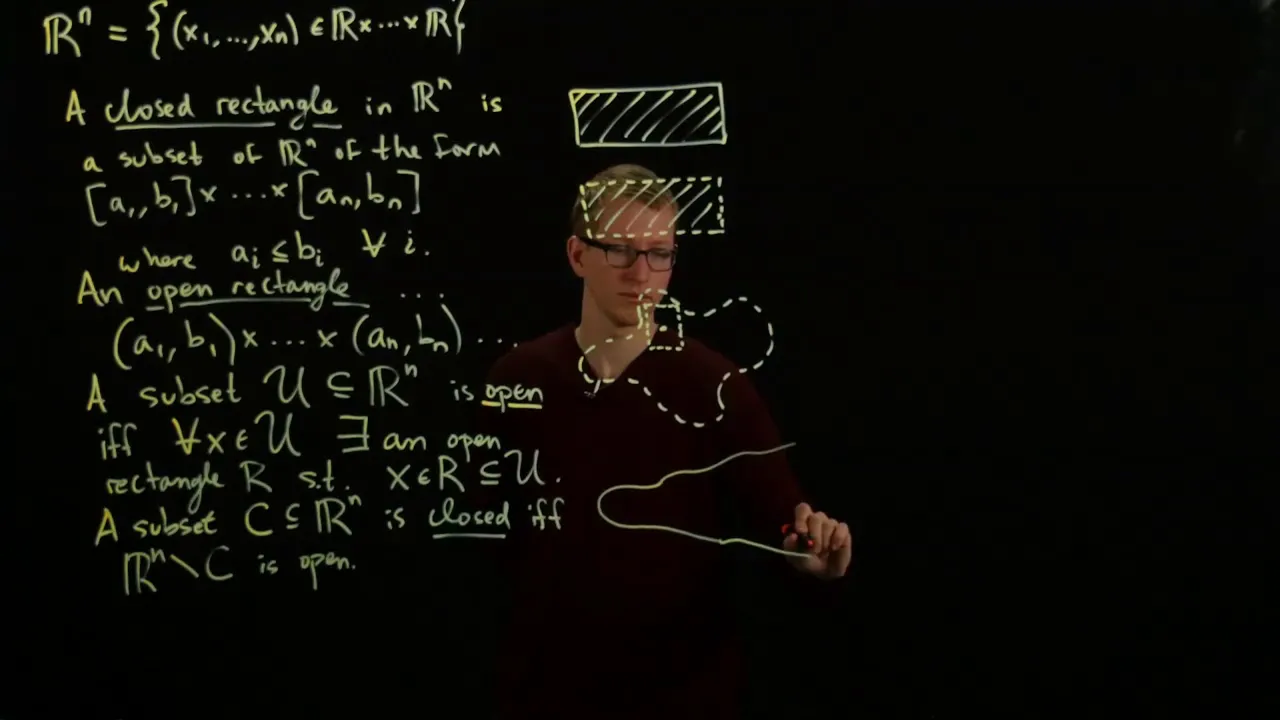
This works if our set X is a topological space.
If you don't know what a topological space is, you can work in the same way if your X is a metric space.
If you also don't know what a metric space is, then you can choose X more concretely as R or R^n if you want.
These things work all the same, because the only ingredient we need here is to know what open sets are.
Now you might already know what we want to do. We want to have all these open sets in our sigma algebra.
Which means we will look at a sigma algebra that the open sets generate and indeed, this is the Borel sigma algebra.
Denoted by B(X).
This is the sigma algebra generated by the open sets.
If you are working in a topological space, normally you would say, Ok, I have my set X together with a topology. So this could be my T and call this a topological space and the topology are just the open sets.
Which means by our definition from above, our Borel sigma algebra is nothing more than sigma of this topology.
And this is the Borel sigma algebra. Maybe to be more concrete, it's the Borel sigma algebra on X.
What you should note is that in our notation, the topology vanishes.
So there is no mention of this topology inside B(X), because most of the time the topology is clear.
It's also obvious which topology or metric we use.
For example, in R^n we use our standard topology, so we know what the open sets in R^n are and therefore we immediately know what the Borel sigma algebra of R^n is.
Therefore you really should keep in mind that by definition of the Borel sigma algebra, it includes the topological structure, so what open means, into a sigma algebra and in the case of R^n, this is indeed a really big sigma algebra, but not a power set.
So it's not the biggest possible sigma algebra, but it's the most suitable sigma algebra in our context, because it contains all the sets we want to measure and this is what we will do in the next video, where I want to define what a measure is and there you will see that in the case of R^n, we need this Borel sigma algebra and can't choose the power set, because our measure should fulfill some meaningfull rules.
And these rules can't be fulfilled on the whole power set, but on the Borel sigma algebra and the Borel sigma algebra is big enough. There are a lot of sets inside.
Indeed all the sets are inside, we want to measure in the end.
Then thank you very much and see you next time.
Up Next
16:56
Measure Theory 3: What Is a Measure? | Definition & Examples
@brightsideofmaths
197.1K views•2019-07-21
4:43
Elliptic Curve Cryptography Explained: ECC, ECDSA, ECDH
@PracticalNetworking
28.5K views•2024-10-21
8:22
Laurent Series Explained | Complex Analysis
@brightsideofmaths
52.4K views•2022-04-06

6:00
The Mathematical Impossibility of Accurate World Maps
@Vox
23.3M views•2016-12-02
Related Study Plans & Knowledge Roadmaps
Structured learning paths in Mathematics
mathematics
Tensor Calculus: Vectors to Riemann Curvature
01Mathematical Foundations: Linear Algebra & Calculus
02Covectors, Dual Spaces, and Tensor Basics
03The Metric Tensor and Index Gymnastics
+ 2 more learning modules
40h5 modules
Explore Roadmap
mathematics
Gödel's Incompleteness: Logic, Proofs & Limits
01Introduction to Formal Systems & Hilbert's Dream
02Set Theory, Cardinality, and Cantor's Diagonal Argument
03Arithmetization and Gödel Numbering
+ 2 more learning modules
14h5 modules
Explore Roadmap
mathematics
Galois Theory: Fields, Groups & Solvability
01Foundations of Abstract Algebra: Groups & Fields
02Polynomials & Field Extensions
03Splitting Fields & Symmetries
+ 2 more learning modules
24h5 modules
Explore Roadmap
mathematics
Non-Euclidean Geometry: Models & Geodesics
01Euclid's Fifth Postulate and the Birth of New Geometries
02Hyperbolic Space and the Poincaré Disk Model
03Geodesics: Defining Straight Lines in Curved Spaces
+ 2 more learning modules
15h5 modules
Explore Roadmap