










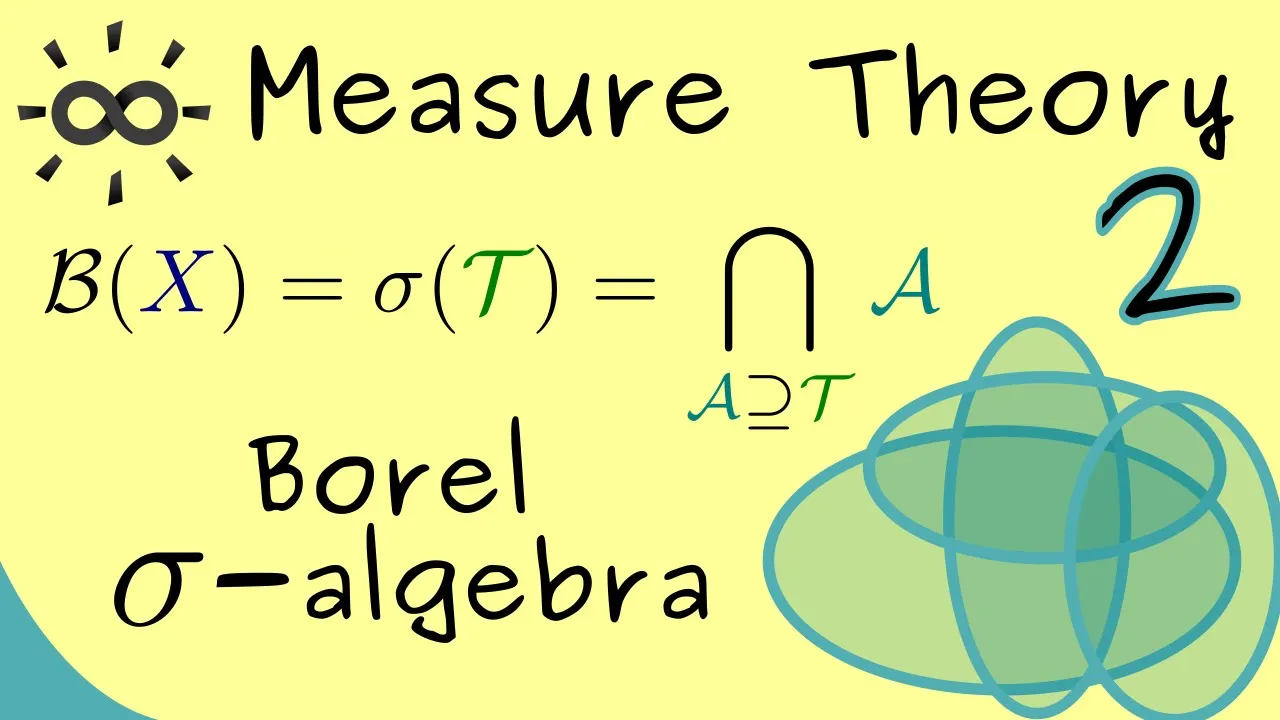

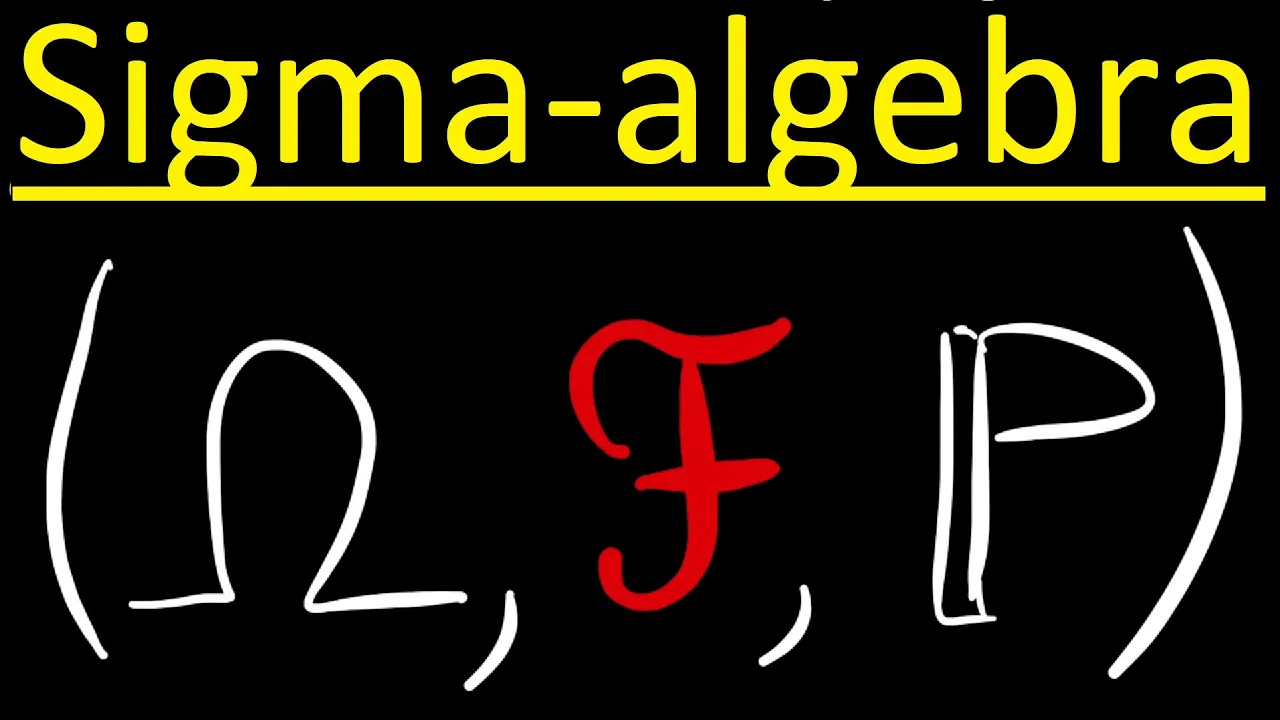









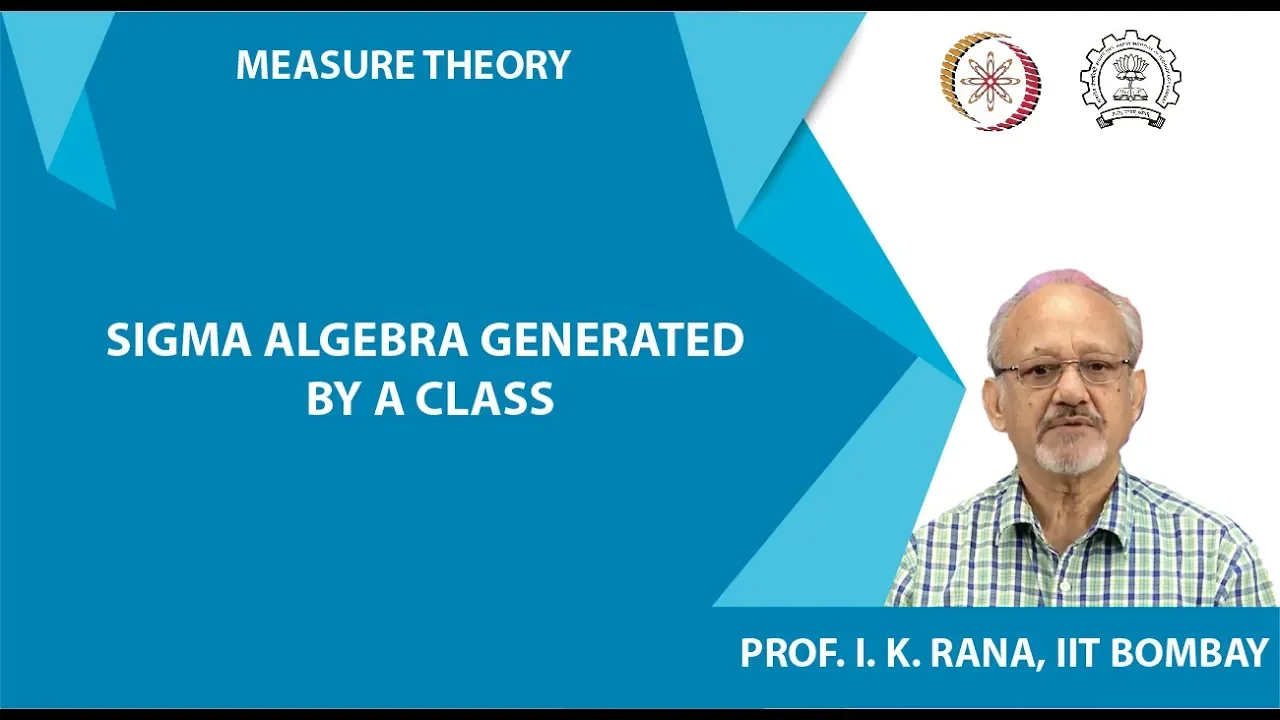
A sigma-algebra (σ-algebra) on a set Ω is a collection of subsets of Ω that satisfies three key properties: (1) it is non-empty, (2) it is closed under complements (if a set E is in the collection, then its complement Ω\E is also in the collection), and (3) it is closed under countable unions (if E₁, E₂, E₃,... are in the collection, then their union is also in the collection). As a consequence, any sigma-algebra automatically contains the entire set Ω and the empty set, and is also closed under countable intersections due to De Morgan's laws.
Measure Theory 1.2: Sigma-Algebras Defined | Probability Primer
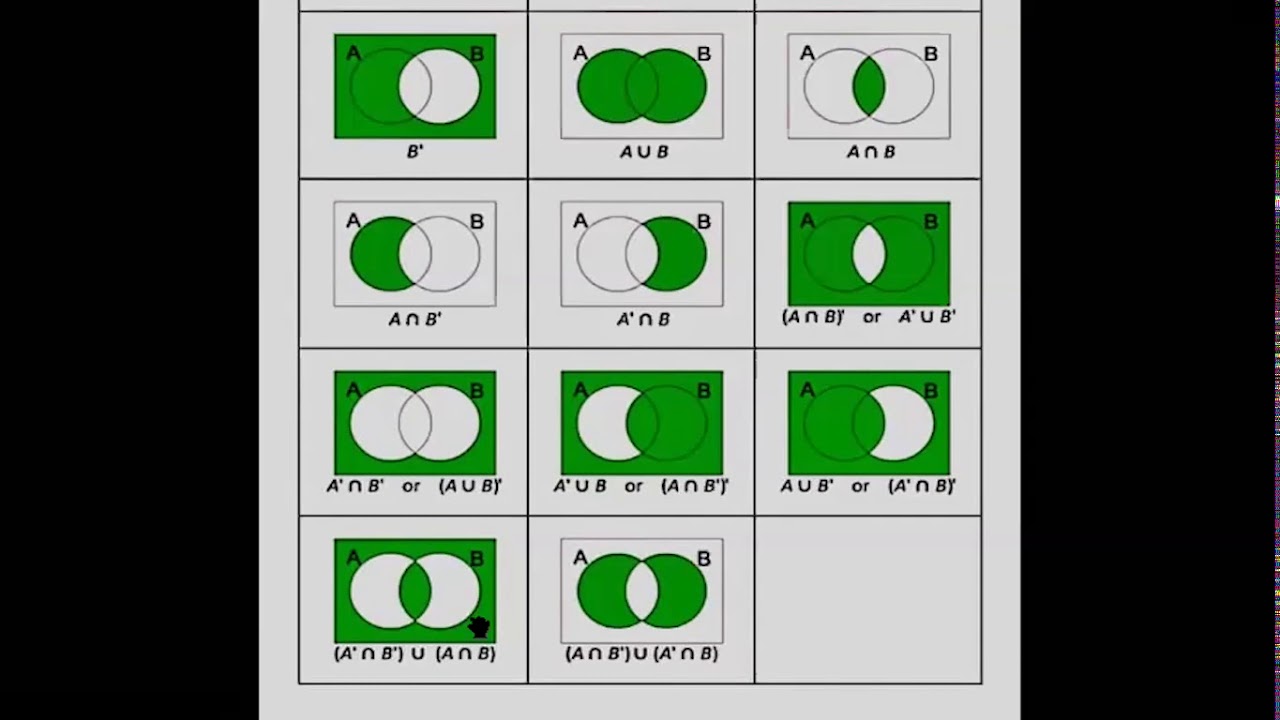
Added:Fundamental set theory, including operations like unions, intersections, complements, and power sets.
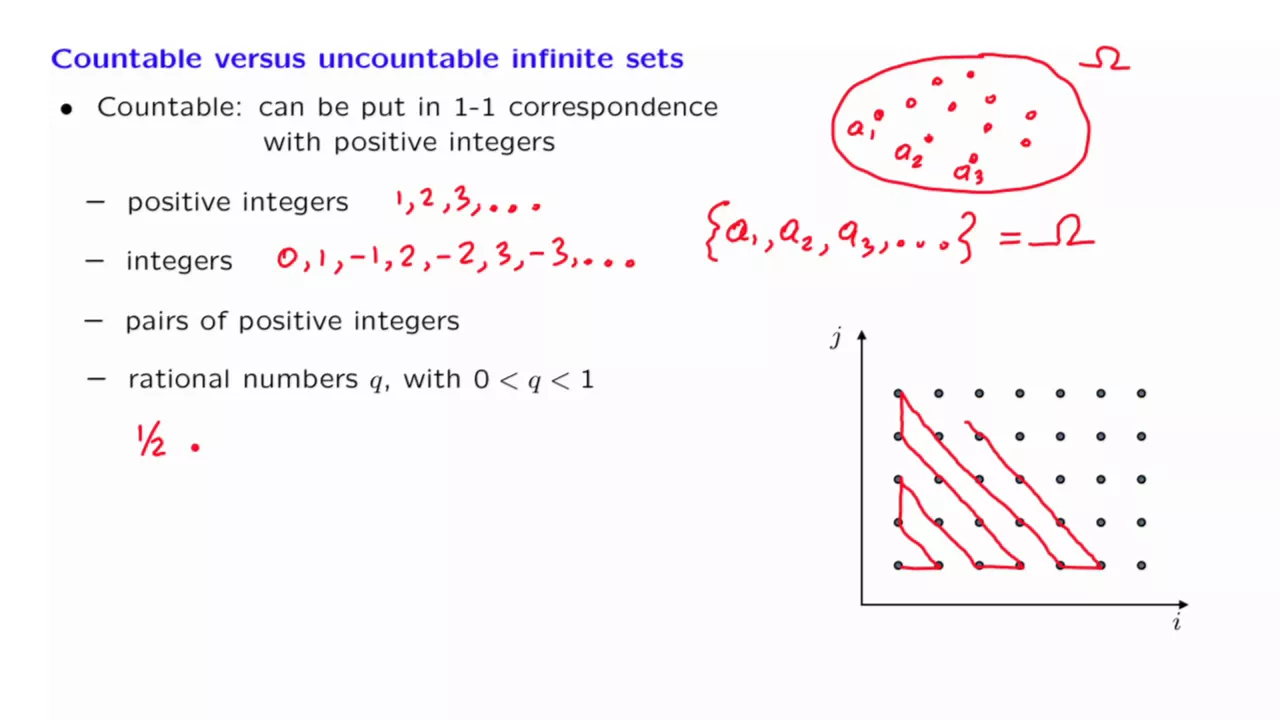
The concept of countability, specifically the mathematical distinction between finite, countably infinite, and uncountable sets.
Familiarity with the concept of a sample space (denoted as Omega) as used in elementary probability theory.
Basic mathematical notation and proof techniques, particularly how to show a collection of sets satisfies axiomatic properties.
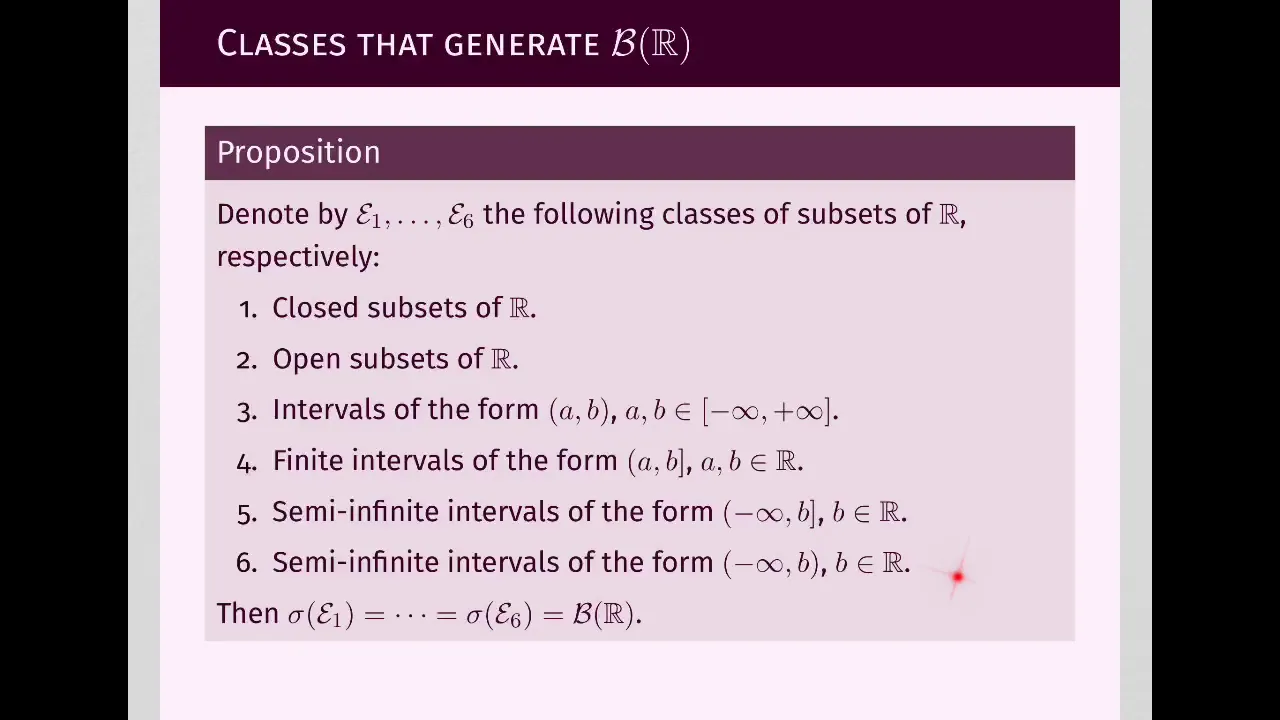
The definition and construction of the Borel sigma-algebra, particularly on the real numbers.
The formal definition of a measure and a measure space, which assigns sizes or volumes to the sets within a sigma-algebra.
The concept of measurable functions and how they serve as the foundation for defining random variables.
Kolmogorov's axioms of probability, which utilize sigma-algebras to rigorously define probability spaces.
The concept of generators of a sigma-algebra and how a smaller class of sets can uniquely determine a larger sigma-algebra.
176K views1.1Klikes9:49Original Release: 2011-04-20
we just looked at the Bak tarski Paradox as a motivation for measure Theory and measurable sets so let's dive into measure Theory what's it all about measure Theory the very first definition is what's called a sigma albra so for to define a sigma algebra let's say we're given some set Omega and it's just any set could be a finite set could be countably infinite set could be uncountable so that's just some arbitrary set so we're given Omega a sigma algebra on Omega is a collection which we'll denote by Script a that's a subset of the power set of Omega so let me just make a brief aside so there's going to be more but let me make a brief aside about what this is the power set if it's just a little bit of set theory notation so if Omega let's take a simple example say Omega is just no little finite set of zero and one then the power set is the collection of all subsets of Omega so it's a collection which is also a set containing the empty set the set with zero the set with one and the set with both zero and one so it's just the collection of all the subsets of Omega so back to the definition a sigma algebra on Omega is a collection of subsets of Omega such that a is not empty that's just a technical condition and two important conditions one it's closed a is closed under compliments and two it's closed under countable unions so what do I mean by this closed under compliments this is if there's some set e in a then that implies that the complement of e is also in a and the complement that's just all the stuff that's not in E all the stuff in Omega that's not e so the complement of the set zero would be the set one it's also closed under countable unions what do I mean by this that means if I have a countable collection E1 E2 some sequence of sets countably it's countable let's say it's countably infinite E1 E2 E3 up to even Infinity all members of a that implies that the union of all of them is also in a so it's closed under countable unions take that defin definition in for a second so let's make a couple remarks let's take a look at what is this saying remarks so here's here's a first remark the set Omega itself is always a member of any Sigma algebra on Omega so how do we know this well here's a little proof we know that the sigma algebra a is non empty so has some set e so let's say e is a member of this collection this Sigma algebra that implies that its complement is also in a by condition one and that implies that the Union of e and its complement is in a by condition two because we could even oh you know this is infinite here but we could always make it finite by taking say all of E1 I mean all of E2 E3 all of those will take to be e complement and we'll take E1 to be e itself so we can always this always implies this condition for finite unions and this Union is simply Omega itself because it's e and everything that wasn't in E everything else in Omega that wasn't in E so therefore Omega is an a next the empty set is also always in a sigma algebra and this we can see just immediately from one because one implies that Omega is na a and by condition one the complement is also in a and the complement of Omega is simply the empty set third remark this one's a little more interesting the previous two are sort of simple give you an idea for what a sigma algebra looks like a little bit but now for any Sigma algebra say we'll call it a it's closed under countable intersections now you remember condition two said that it was closed under countable unions this one's closed under countable intersections so it looks just the same except you replace this with an intersection so how do we prove this well let's look at the intersection let's take so I'll take some sequence of sets just like here so suppose we have some sets E1 E2 some sequence in a then the intersection this is the thing we want to show is in a we can write this as the intersection so any set is equal to the complement of its complement so we can rewrite this in this way and by De Morgan's laws if you know your set theory laws de Morgan's laws say the intersection of the complements equals the union I'm sorry equals the compl of the unions the intersection of the complement equals the compliment of the unions and this is in a because each of these is in a so their complements are in a the union is in a by condition two and the compl of that is in a by condition one and therefore this whole thing is in a so that proves that a is closed under countable intersections
Up Next

16:48
Measure Theory: Outer Measure Examples Explained | Part 2
@brightsideofmaths
30.2K views•2020-05-28
4:43
Elliptic Curve Cryptography Explained: ECC, ECDSA, ECDH
@PracticalNetworking
28.5K views•2024-10-21

14:52
Bayesian Inference Example: Univariate Gaussian with Gaussian Prior
@mathematicalmonk
130.6K views•2011-06-23

6:00
The Mathematical Impossibility of Accurate World Maps
@Vox
23.3M views•2016-12-02
Related Study Plans & Knowledge Roadmaps
Structured learning paths in Mathematics
mathematics
Tensor Calculus: Vectors to Riemann Curvature
01Mathematical Foundations: Linear Algebra & Calculus
02Covectors, Dual Spaces, and Tensor Basics
03The Metric Tensor and Index Gymnastics
+ 2 more learning modules
40h5 modules
Explore Roadmap
mathematics
Gödel's Incompleteness: Logic, Proofs & Limits
01Introduction to Formal Systems & Hilbert's Dream
02Set Theory, Cardinality, and Cantor's Diagonal Argument
03Arithmetization and Gödel Numbering
+ 2 more learning modules
14h5 modules
Explore Roadmap
mathematics
Galois Theory: Fields, Groups & Solvability
01Foundations of Abstract Algebra: Groups & Fields
02Polynomials & Field Extensions
03Splitting Fields & Symmetries
+ 2 more learning modules
24h5 modules
Explore Roadmap
mathematics
Non-Euclidean Geometry: Models & Geodesics
01Euclid's Fifth Postulate and the Birth of New Geometries
02Hyperbolic Space and the Poincaré Disk Model
03Geodesics: Defining Straight Lines in Curved Spaces
+ 2 more learning modules
15h5 modules
Explore Roadmap