















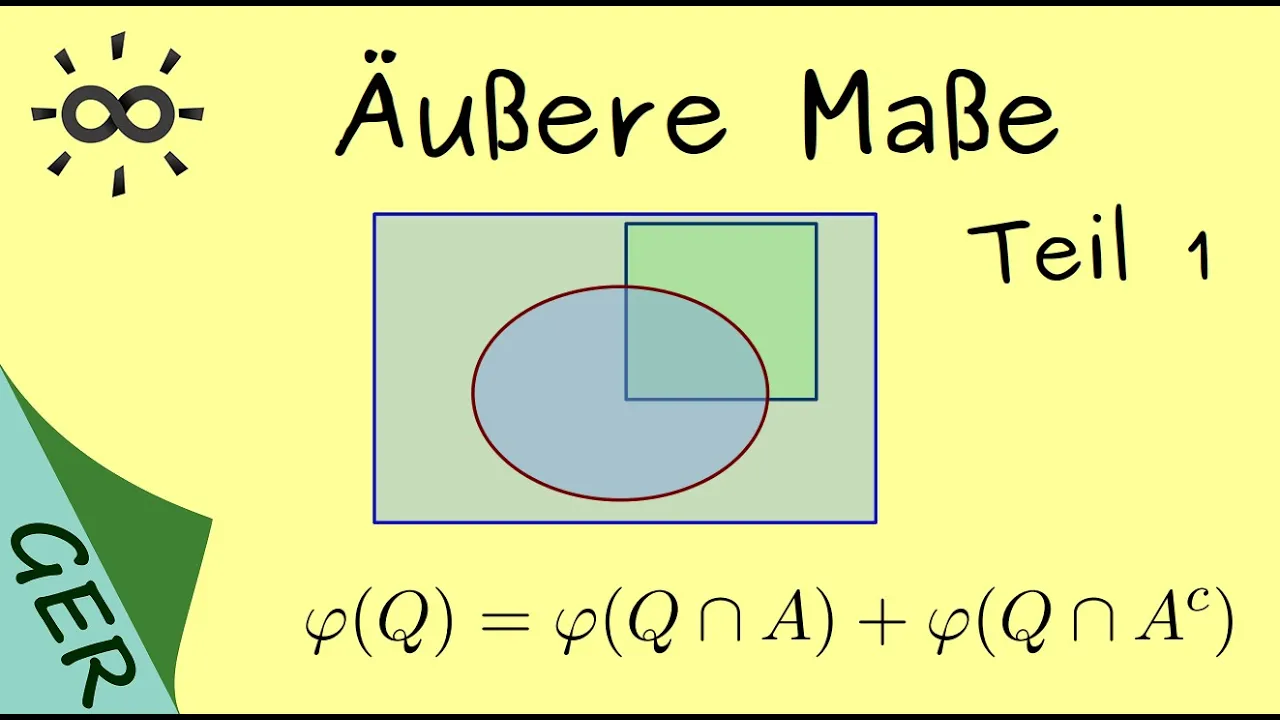

![[TMiC] 5. Konstrukcja Carathéodoryego. Czyli jak z miary zewnętrznej otrzymać miarę?](https://i.ytimg.com/vi/O4XHViqKoAE/maxresdefault.jpg)










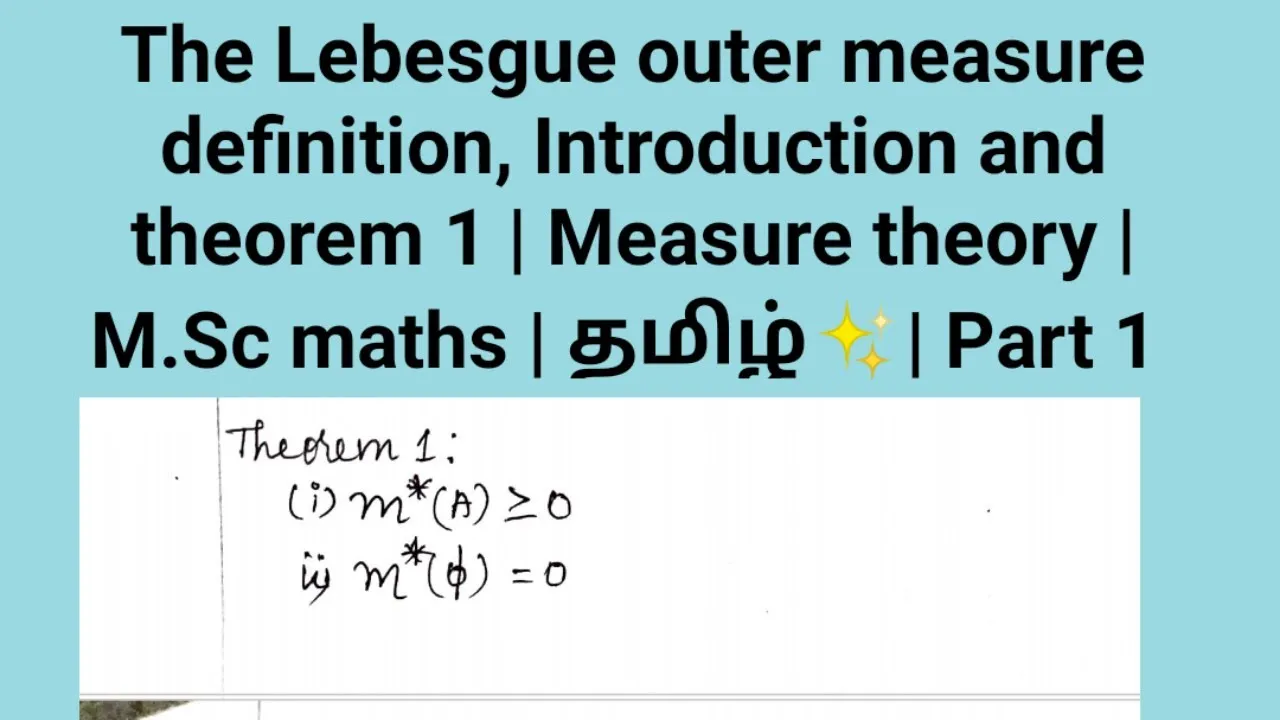
An outer measure is a function Φ defined on the power set of a set X, taking values in [0, ∞], that satisfies three properties: Φ(∅) = 0, monotonicity (if A ⊆ B then Φ(A) ≤ Φ(B)), and σ-subadditivity (Φ(∪A_n) ≤ ΣΦ(A_n)). Three examples are presented: (1) A constant outer measure on ℝ where Φ(A) = 1 for all non-empty A, which is not a measure because it lacks σ-additivity; (2) The counting measure where Φ(A) = |A| for finite A and ∞ otherwise, which is actually an ordinary measure; (3) The Lebesgue outer measure on ℝ, defined for any subset A as the infimum of the sum of lengths of countable intervals covering A, which is proven to satisfy all outer measure properties through detailed verification of null empty set, monotonicity, and σ-subadditivity using an ε-argument.
Measure Theory: Outer Measure Examples Explained | Part 2
Added:hello and welcome back to measure Theo II as always I want to thank all the nice supporters on steady today we continue with the other measures namely part 2 where I want to show you some examples maybe it's a good idea for a start to restate the properties of an outer measure we always call the map Phi and was defined on the power set of a given set X and the values were the non-negative numbers where we include the symbol infinity as always such a map fires then called an outer measure if it satisfies these three properties namely it sends the empty set to 0 it is monotonic and Sigma sub additive we discussed that last time so that we can immediately start with the examples I want to show you here three examples where the last one is the important one but let's start with two simple ones first a good starting point would be to choose the real numbers as our set X and then let's define an outer measure where we see the first property humility which means we define it as 0 if the set a is the empty set and in the case that a is not the empty set we set it as 1 this simple definition gives us immediately an outer measure you can see merely that the three properties are fulfilled the first one we already talked about monotonic is not a problem because you always get out one so if you have subsets you also get out one on both sides so the inequality is fulfilled and the same for the Sigma sub additive 'ti if you look at the left hand side you would have the 1 and on the right hand side the ones would add up so also the inequality is fulfilled you see this one is an simple example but a good one because we mainly get out an outer measure which is not an ordinary measure this one you also see immediately we don't have the Sigma additivity so without this up with the same reasoning as before on the right hand side you add up once and on the left hand side you don't add them up and without the Sigma Ella tivity we don't have a measure now the next example is also not a hard one now let's choose instead of ah the natural numbers for the set X the definition is now the following in the case that a is a finite set I want to count the elements and I denote that with the bars this is what we call the cardinality of the set and now in the case that the set a is not finite we use of course our nice symbol infinity and this gives us again an outer measure that is not hard to check because we just count elements so all the things here are immediately fulfilled indeed we also recognize that this map is Sigma additive so actually it's an ordinary measure this is important because the map is the famous counting measure the name tells you what to do you count elements and in fact this one is very important because the integration with respect to this measure gives you normal sums and serious okay we don't want to talk about ordinary measures here so let's go to our important example 3 maybe you already guessed it it should have something to do with the lebesgue measure the best starting point for that is the one-dimensional lebesgue measure so the measure that we use to measure normal lengths you already know for intervals we can write down the length immediately therefore we consider here the set of all these bounded intervals I want to use a good name for this set therefore I choose this curved I here for the length of such an interval we just use a function we call new so mu of such an interval is given by B minus a of course this one is what you call the normal length of an interval now when you look back carrots extension theorem you see that this one is what we called a semi ring of sets and the function mu was a pre measure in addition you also remember that we want to measure more sets than just intervals and if we want to measure all sets this leads us to the power set and therefore to the other measure hence we define our Phi on the power set of our however this one is a little bit more complicated than before if we now want to define and one-dimensional lengths for an arbitrary subset of R which we call a we can use our intervals more concretely for set a we can choose intervals let's call them IJ and now we can cover the whole set by looking at the union of all these intervals and so we cover the set with the intervals so we have here a subset relation so maybe a little picture for this so imagine the screen set is a so a subset of the real line and now we can choose some intervals so here this would be a 1 and here you can choose a 2 and so on until we reach here I 6 so you see in this example we cover the whole set a with just 6 intervals therefore we would fill in i 7 I 8 and so on with the empty set so we just choose the empty interval out of this set and then we can still write it as this countable union of the intervals however you can imagine in the case that a stretches to infinity we really need infinitely many intervals to cover a still the important part is that we just choose countable many intervals now in order to get a length for a we just could add up all the lengths of these intervals please note we are allowed to put IJ into the function U but in general we can't do that for a therefore this one is a good substitution for the length of a just because in the picture we see it gives us an upper bound for something we would call the real length of a of course one idea would be to look at all the intervals that cover a and then to calculate this length in other words we look at a set of all possible values hence the condition here is that we use intervals I J where J goes from 1 to infinity a lot of our curved eye and of course the property that these intervals cover hole a now we have this whole set of numbers and we already know this number gets smaller and smaller if we choose two intervals better and better fitting to our set a and in this limit process we reach a number that we would call the length of a and of course we reach that number by choosing the infimum here and that's now the whole definition of Phi of a and now you see where the name outer measure comes from because in the picture and in the definition this is clearly an approximation from the outside we choose bigger sets that we can measure from the outside and shrink them together such that we get out a number for a our result here is now also this Phi is an outer measure this one we can't see immediately therefore I use the rest of this video to show you exactly this we do this in all detail because as you can see this cause all in the direction of carotenoids extension theorem so let's start here by checking all the three properties of an outer measure and we call them ABC so let's start with a this one said that the empty set gets mapped to zero here we don't have to write down anything because you see the merely you could choose empty intervals as our coloring oil issues one interval and we shrink that to one point and you get our D length zero much more interesting as here the second property the monotonicity here we choose two sets ready one is a subset of the other one here I've written down the definition of Phi B it's again the infimum of these lengths where we choose intervals that cover now the set B however we know that B is bigger than a a superset of a which means these intervals also cover the set a this means that if we look at all possible intervals that cover a then we know we have more intervals here than here and because we only add new intervals here we know that the infimum can't get bigger it only gets smaller or stays the same and with this we have everything we want because here we have the definition of Phi a and then we see the monotonicity Phi B is indeed greater or equal than Phi okay that was Part B now let's go to the Sigma sub additive 'ti now we call the thing we want to show is Phi of the union of some subsets am it's less or equal then if we look at the series or sum of Phi am we immediately see two different cases here the first case would be that at least one of these Phi a ends is infinity which means we have an infinite length of one of these sets however this simply means that on the right hand side we always have infinity and then the inequality is always fulfilled we don't have to show anything then therefore the only case where we really have to work is the case when all of these Phi a ends are finite the only problem I see for our poufier is the infimum in the definition of Phi B but we can get rid of this if we use an abbot very small number Epps not and to get rid of all the in pharma here we have to choose an epsilon n for all the different ANCA and I want to choose them so small that the sum over all the epsilon n gives us our epsilon back of course this is reasonable and also always possible but why it's important you will see later in the proof then let's look at the length of one a and we know we can approximate it with the lengths of intervals which means we can choose some intervals here but of course we have now different a ends so we need a second index so I would call it I J comma n in the index approximation from the outside now means this one is the sum of the lengths of these intervals so please note here the N is fixed now I hope that you have seen that this can't be completely correct we don't have an equality sign here simply because by definition the length of a n is given by the enzyme M so the left hand side would be in generally smaller than the right hand side however what we know is that we can get as close as we want which means now comes our epsilon in so minus epsilon n brings us to something smaller on the right hand side so we have this inequality this is simply given by the property of the environment being the largest lower bound well and of course we want the other thing from the intervals that we cover the whole set a n now we have everything we need from the definition of Phi n such that we can now look at the Union on the left hand side for a union of the ends we also have a covering because we have it for each a.m. on the right hand side here you can just see a countable union of intervals it's no problem that we have to in this easier for example in a short way you could write it like this so please don't forget what we want to show we want to show the inequality so we have to look at phi of this union of course we can use what we have already shown namely the monotonicity here you see we have a superset of the Union therefore the monotonicity tells us we can use the inequality and white on the right hand side Phi of this set and then we now have the outer measure of a union of inter loads in other words we approximate from the outside intervals with intervals hence we already know that we get out here the sum of the lengths of these intervals however we don't know if this is indeed the infimum because there could be better intervals if there is some overlap you can imagine then you could choose other intervals that approximate length better but this is not a problem because you know we have at least inequality now on the right hand side we have the sum with two indices and I would say we separate them again so on the outside this sum over N and in inside the one over J we do this because for the inner sum we already have an estimate from the beginning this is how we have chosen the intervals actually this is the whole reason why we have introduced the epsilon ends because we have this calculation here now with our wet in equality here we get for the inner sum Phi of a.m. plus epsilon n now we are almost finished because what we have on the right hand side here is the sum over the Phi of a n plus the sum over the epsilon N and we know we have chosen the epsilon n in such a way that they sum up to epsilon so we have feared just the remaining epsilon now if you read this you see our inequality we wanted to show holds with the exception of one small error epsilon however this epsilon was chosen arbitrarily from the beginning this means that we can choose the error as small as we want and then no other possibility he remains then that the inequality holds without an error and if this the proof is finished we have shown that Phi is indeed an autumn measure in addition I can tell you that in the case that you don't want to calculate just things but rather areas on general n-dimensional volumes you can use a similar definition for Phi and also a similar proof in this way and here you can see we are on the way for the construction of the n-dimensional lebesgue measure okay that's good enough for today we will continue our journey in the next video so thank you for listening and see you next time bye [Music]
Up Next

When is a Set Measurable? | Real Analysis Part 1
@simplymath143
585 views•2021-11-18

Elliptic Curve Cryptography Explained: ECC, ECDSA, ECDH
@PracticalNetworking
28.5K views•2024-10-21
Laurent Series Explained | Complex Analysis
@brightsideofmaths
52.4K views•2022-04-06

The Mathematical Impossibility of Accurate World Maps
@Vox
23.3M views•2016-12-02
Related Study Plans & Knowledge Roadmaps
Structured learning paths in Mathematics