






![Curso de Análise - Topologia da Reta [1/4]](https://i.ytimg.com/vi/pTa8SIJKSXc/hqdefault.jpg)





![[s4 | 2026] Математический анализ, Трифанова Е. С., лекция 2](https://i.ytimg.com/vi/mMKOMBKoY6U/maxresdefault.jpg)

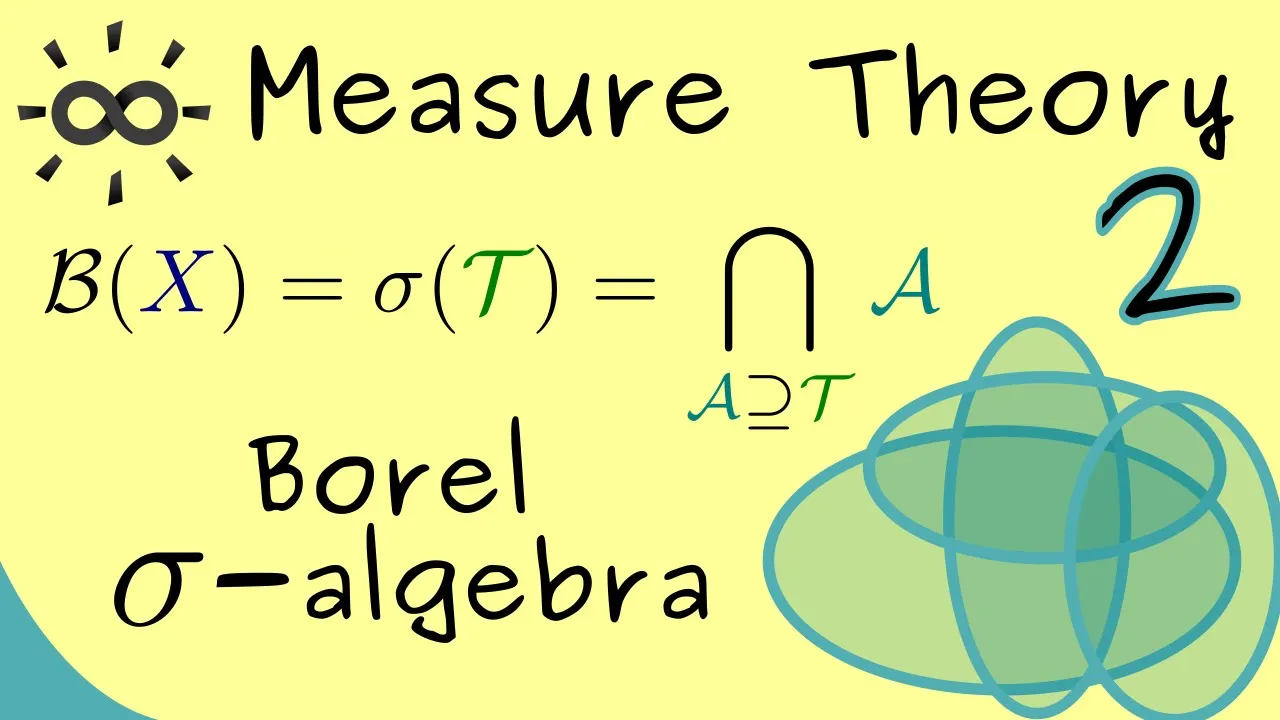
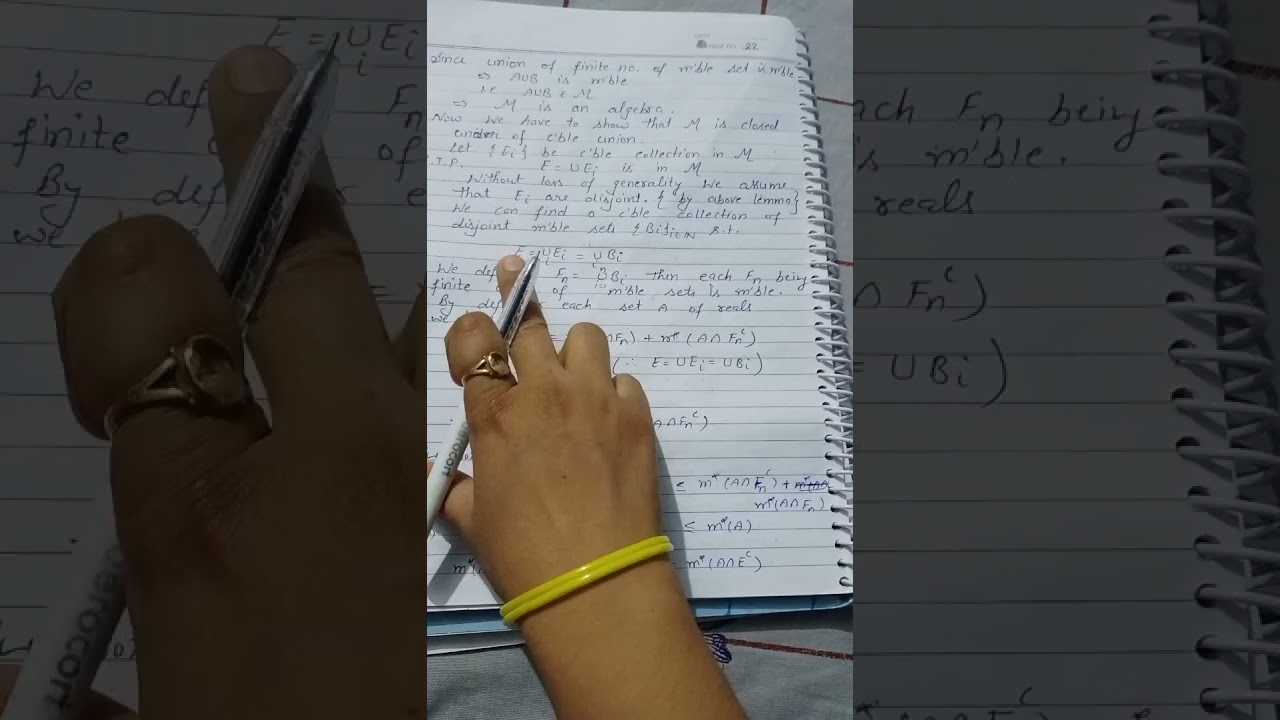
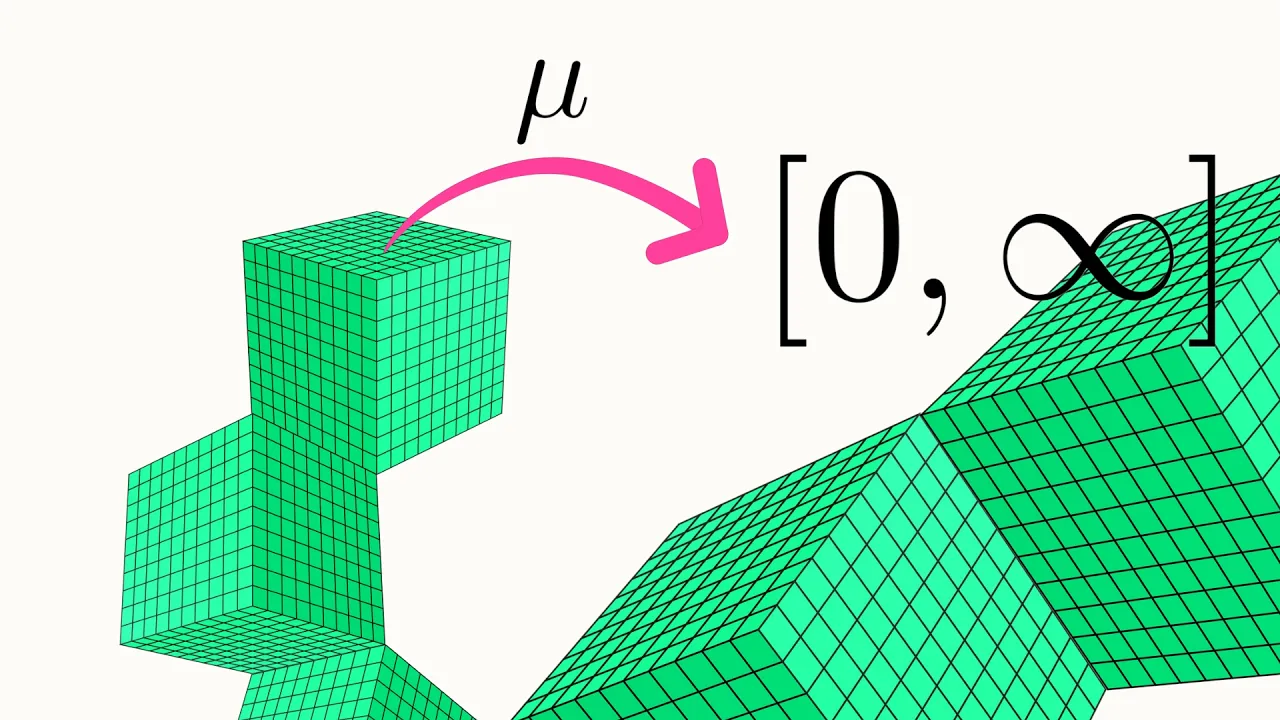


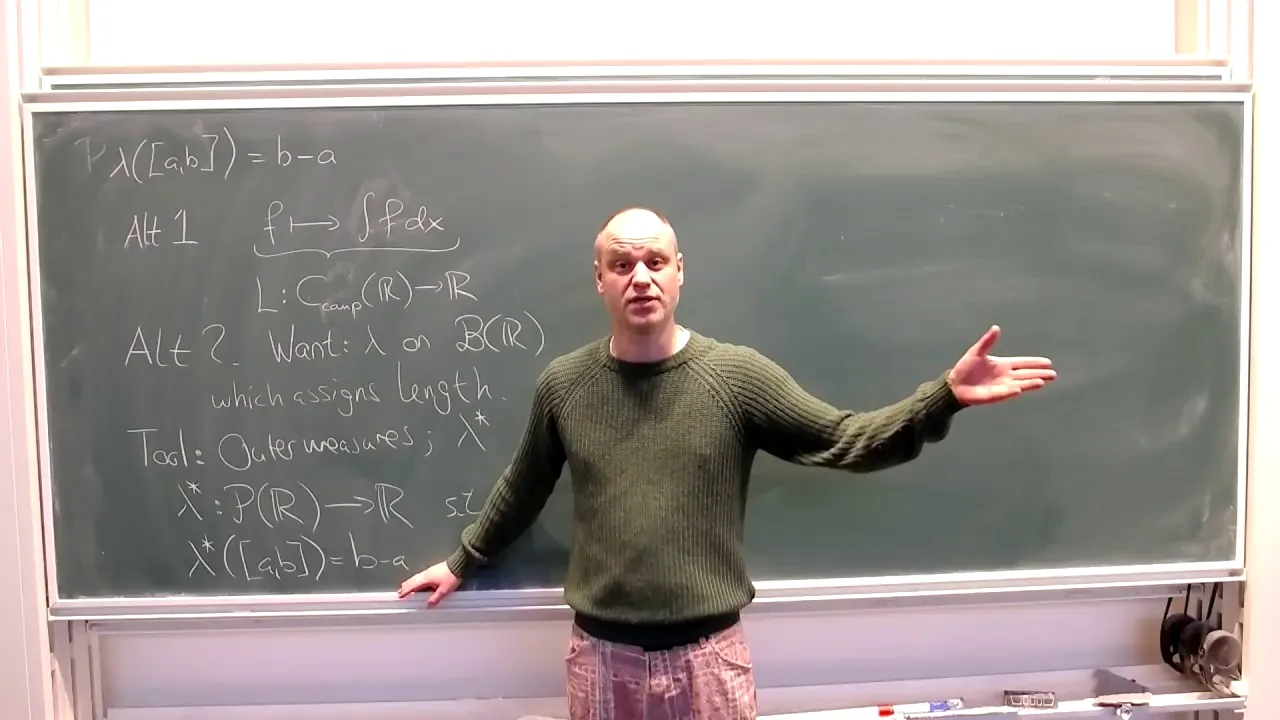



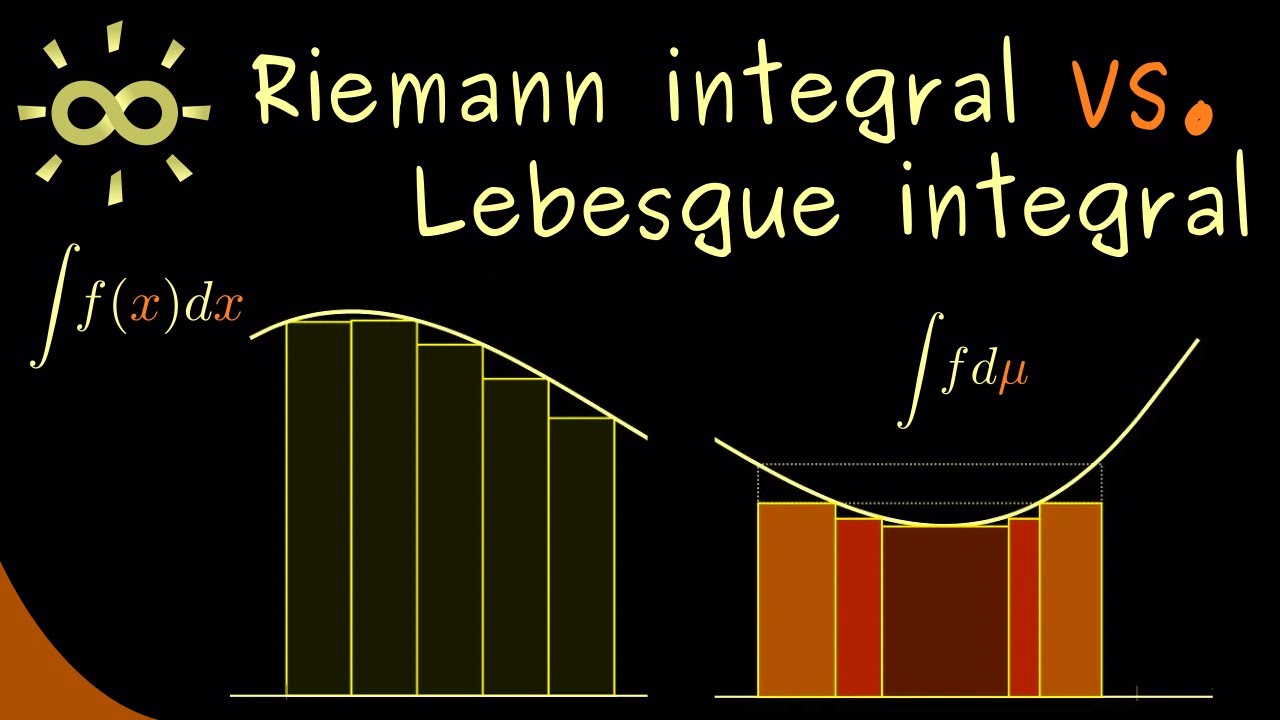
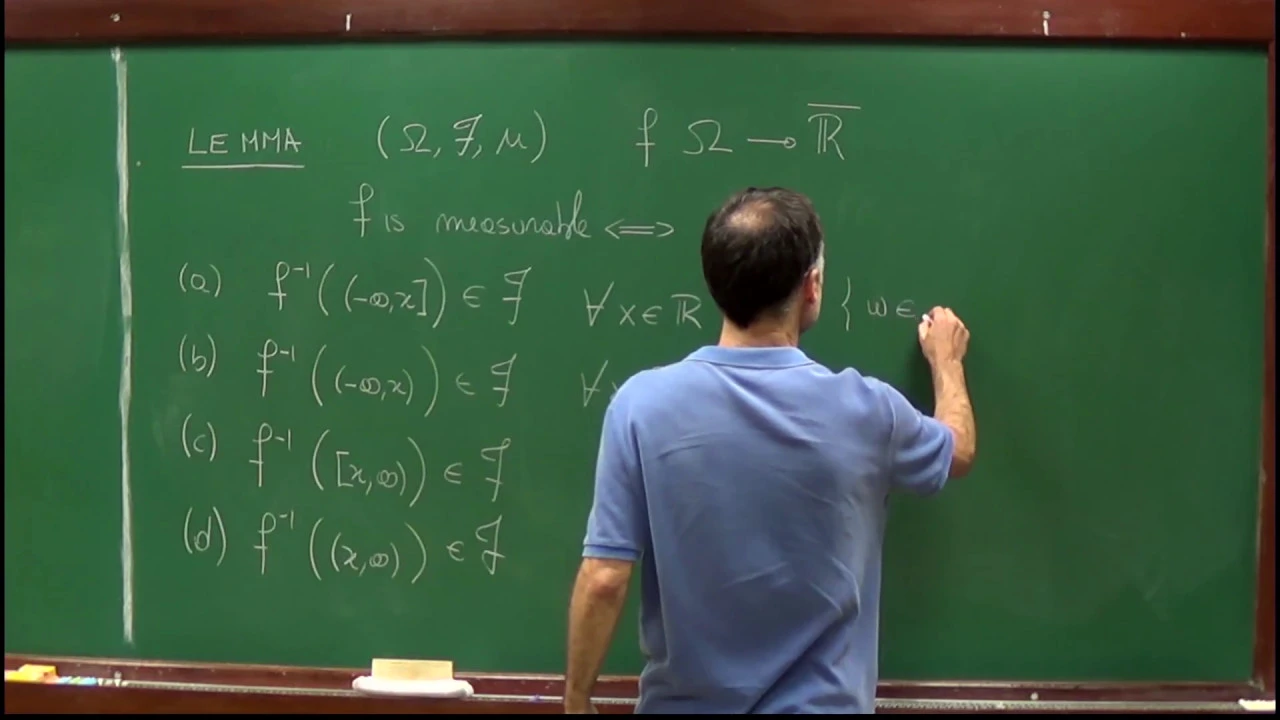



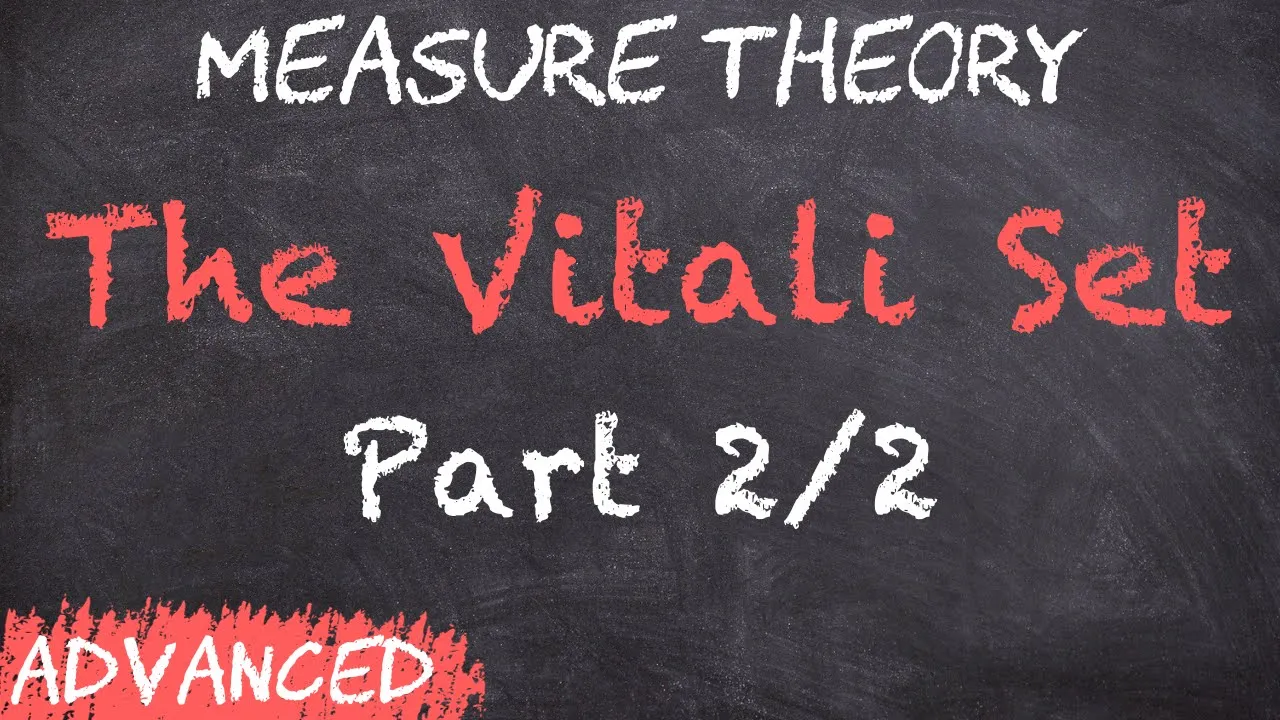
In measure theory, it is impossible to construct a function λ defined on all subsets of R that satisfies four natural properties: (1) λ([a,b]) = b-a for intervals, (2) translation invariance (λ(A+x) = λ(A)), (3) sigma-additivity (measure of disjoint union equals sum of measures), and (4) taking values in [0, ∞]. This is proven using the axiom of choice to construct a Vitali set, which leads to a contradiction when assuming such a measure exists.
Measure Theory 1: Non-Measurable Sets | Intro to Lebesgue Measure
Added:Basic Set Theory and Cardinality, specifically understanding countable versus uncountable sets, power sets, and equivalence relations.
Introductory Real Analysis, including the topology of the real line, properties of open and closed sets, and the classical definition of interval length.
The Axiom of Choice, as this foundational logical axiom is necessary to construct non-measurable sets like the Vitali set.
The concept of mathematical invariance, specifically translation invariance (how shifting a subset of real numbers along the number line preserves its 'size').
The definition and algebraic properties of Sigma-Algebras, which define the families of 'measurable' subsets we restrict ourselves to.
The construction of the Lebesgue Outer Measure and the application of Carathéodory's Criterion to define Lebesgue measurable sets.
The Lebesgue Integral, understanding how measuring subsets of the domain allows for a more robust and complete integration theory than Riemann integration.
The Banach-Tarski Paradox, which extends the concept of non-measurable sets to three dimensions, demonstrating how a sphere can be decomposed and reassembled into two identical spheres.
152.5K views2.1Klikes31:45Original Release: 2018-05-04
hello so today I will try to explain what will be the goal of these lectures what we as you'll probably expect if you have in are an interval a B let's say open at a and close that be you know that the length of this interval a B which I will represent by lambda of a B it's given by B minus a so what we would like to do in these lectures is to extend this function to a function which is defined on all subsets of R so my goal will be try to find a function lambda which is defined on all subsets of R and I'm representing by P of our all the subsets of r2 the sets are plus Union plus infinity which extends the idea of length so it's clear what we mean by the length of an interval we would like to extend this idea to a function which is defined for all subsets of R so what would be the natural extension of say let me call this function measure the measure of an interval it's B minus a what would be the measure say of the rational numbers or the rational numbers between 0 & 1 so this is the type of question we would like to answer and what are the properties we expect lambda to satisfy well first I think you all agree that note that I'm defining lambda as taking values in R plus Union plus infinity eventually if you take an infinite interval it's measure will be plus infinity so I have to add plus infinity but what else would we like to have well first let's say we would like to define it for all subsets of R then as let me rewrite this so let me call this property say property 0 we would like the measure of an interval a B which can be open or closed on the left open or closed on the right as B minus a what else we would like well I think you all agree let me represent by 2 a second property which means that if you take a set and you just translate it by a certain number it's natural to ask that the measure of this set it's equal to the measure of the set translated by X so let me represent if a it's a subset of R let me represent by a plus X the set of all points X plus u where X plus y where Y belongs to pay so what I just said is that for all a subsets of R and for all X in R we would like this function lambda to be such that 12 the measure of the set a plus X so the translation by X of the set a to be equal to the measure of the set a so this is a natural condition and then there is a last condition which is also quite natural which is that well if a set is a union of the joint subsets so let's say that a it's equal to the you of AJ and if these sets are the joint which means two by two which means that AJ intersection with a K it's empty well it's natural to ask that the measure of a to be equal to the sum of the measures of the set AJ so I will require this function lambda to be such that the measure of lambda to be equal to the sum of the measures of a T so my goal will be to try to define a function lambda with these four properties it has to be defined for all subsets of R it has to be an extension of the idea of length so the measure of an interval should be equal to the length of this interval it should be invariant by translations so the measure of a translation of a set should be equal to the measure of the set and finally it should be what I will call later Sigma and ative which means that if a set a can be written as the union of subsets AJ which are the joint two by two then the measure of a should be equal to the sum of the measures a so this would be go try to define such a lambda so today what I will do is that I will show that this is impossible so I will start by assuming that there is such a function and I will reach to a contradiction and to do that we will use the axiom of choice right so I just wrote here the four properties I'm assuming that lambda satisfies so it property zeros that it's defined for all subsets of R that it's an extension of the length of an interval its translation I think invariant by translation and it's Sigma additive assuming all these four properties and the axiom of choice I will reach a contradiction so this is what we will do now to prove that let me introduce in our an equivalence relation so I will see that x and y are equivalent for x and y points in R if the difference between x and y is irrational so this defines an equivalent equivalence relation in r and i will represent by this symbol the class of equivalence of x so this is a set of all points in R which are equivalent to X so these are all Y in R such that Y minus X is a rational and let me represent by lambda the set of equivalence classes so these are this is the set R modulo this equivalence relation and I will represent the points of lambda by the symbols alpha the Greek letters of a bit and maybe gamma if I need gamma so it's clear that gamma is not countable because if gamma if lambda sorry is countable then since these sets are countable R would be countable because any point in R can be represented by an element of lambda and of the equivalence class so lambda it's clearly not countable it's finally the set of all equivalent classes which we defined above so what I will do now is I will construct a new set which is obtained as follows so lambda it's a set of equivalence class it's a now uncountable set and each element of lambda it's in fact an equivalent class so a set a family of points well what I will do I will use the axiom of choice in order to for each equivalent class I will take an element of this equivalent class and in this way I will form a set Omega so Omega is a subset of R which contains one and only one point of the equivalent class of lambda so let me explain it again lambda it's a subset of equivalent classes so each point alpha of lambda represent an equivalent class it's a set so for each point alpha of lambda alpha it's an equivalent class so it's a set accountable set I will choose one point and I will form in this way a set Omega it is clear that I can always choose a representative of this equivalent class which belongs to the interval 0 1 so in fact I can assume that Omega it's in fact contain in zero one right because if I choose an element of this equivalent class which belongs to 0 1 in the construction of the set Omega obtain that Omega it's contained between 0 it's contained in the interval 0 1 so maybe this is the the main step in this proof that it's not possible to construct a function lambda with the 4 properties it's the construction of this set Omega now I will prove some properties of Omega what I claim is the following take the set Lam Omega plus Q and the set Omega plus P where Q and P are rationals what I claim is that either these two sets are equal or they are the joint so the intersection of Omega plus Q with Omega plus P is the empty set so what will prove is this dichotomy either these two sets have no intersection or they are equal if Q and P are rational numbers so let's prove this claim to prove this claim I will assume that this intersection is not empty and I will prove that in this case these two sets are equal so let's assume that Omega plus piu T intersection Omega plus Q is not empty and let's take therefore a point X in this set since X belongs to Omega plus P X is equal to some alpha plus P where alpha belongs to Omega well on the other hand if X belongs to Omega plus Q X its equal to beta plus Q where beta belongs to Omega therefore I have that alpha plus alpha minus beta sorry it's equal to Q minus P well Q and P are rational so Q minus P is rational which means that alpha minus beta is a rational numbers which means that alpha and beta are equivalent but since in the construction of the set Omega I took just one element of each equivalent class this means that and since alpha and beta are equivalent this means that alpha is equal to beta well but if alpha is equal to beta Q it's equal to P and therefore Omega plus Q P is equal to Omega plus Q proving our first claim so we just proved that if we take two rational numbers Q and P which are different then the set Omega plus Q has no intersection with the set Omega plus P so let me consider this set sum over all Q which is with a rational number Q between minus 1 and 1 of Omega plus Q so I'm taking let me just first set annotation whenever I have the joint subsets instead of writing the Union I will write this symbol to mean that I'm taking the union of the joint sets so here I'm taking the union of all sets Omega plus Q where Q is a rational number between minus 1 and 1 and what's important to realize here is that well these sets are all D joined by the claim I proved a minute ago now let's see my I have a second claim which is clear is that at this sets Omega plus Q all contained between minus 1 and 2 because Omega by a construction it's contained between 0 & 1 and Q it's contained between minus 1 and 1 therefore if I translate Omega by Q in the worst case I'm bigger than minus 1 and in the worst case I am also smaller than 2 so it's clear that all the sets Omega plus Q are contained between in the interval minus 1 to in particular if I take the union of all these sets since each set its contained between in the interval minus 1 to the Union is also contained in minus 1 2 so this set here on the one hand it's contained in minus 1/2 which means that the measure of this set should be less or equal then so let me prove that then the measure of the interval minus 1/2 so let me show you why this inequality holds well what I claim is that what I'm using here is that if the set E it's contained in a set F then I have that lambda e it's less or equal than lambda of F right why this is true well because I can always write f as e Union F minus in these two sets of the joint lambda F is equal to lambda e Union F minus e by our property three if I take a 1 to be e a 2 to be F minus e and all the other sets to be the empty set this will be equal to lambda e plus lambda f minus e plus the measure of the empty set but the measure of the empty set it's equal to zero because I can write always the interval say minus one one has minus 1 1 Union the empty set Union the empty set and so on to use this relation to say that the measure of this set which is two it's equal to the measure of this set which is 2 plus the measures infinite times the measures of the empty set which has to be equal to zero to satisfy this identity so it's clear that the measure of the empty set is zero and therefore by using property 3 I can conclude that the measure of the set F should be equal to the measure of the set e plus the measure of the set F minus e well if the measure of this set is plus infinity I get that the measure of lambda F it's plus infinity because lambda takes only non-negative values so if lambda F it's the measure of the set F minus e it's plus infinity lambda F it's plus infinity in which case this inequality holds trivially on the other hand if this set has finite measure well we do get that the measure lambda F it's greater or equal than the measure of e so in both cases we can conclude that the set the measure of the set e it's less than or equal to the measure of the set F if F contains C so I can apply this identity which I just this inequality which I just proved here we've seen that the union of this set it's contained in interval minus 1 2 and therefore the measure of this union it's smaller equal than the measure of this interval which is equal to 3 so I have a bound on the measure of this set on the other hand by property 3 again which tells us that the measure of the joint Union it's equal to the sum of the measures apply this property 3 to these sets which are the joint 2 by 2 as we have seen the measure of this Union it's equal to the measure the sum of the measures and we've so we've seen that this some well the measure of this set it's less we call entry which is what I am writing here then now property 2 tells us that if I take a set a and I translate it by X its measure its sequel to the measure of a which means here that all these sets have measure the same measure since this Sun it's bounded by a finite number it must be equal to 0 so we just conclude that well if all the properties of lambda we wrote hold we have that lambda of Q plus Omega which is lambda of Omega should be equal to 0 right because if it were to strictly positive this identity this inequality could not hold so we concluded that the measure of Omega which is the measure of Q plus Omega has to be equal to 0 so up to this point we proved that the measure of this sets Omega plus Q are all equal to 0 and therefore that the measure of the union of these sets for Q rational between minus 1 and 1 is equal to 0 now I claim that the set 0 1 it's contained in this Union okay so to prove this claim let me fix a point X in zero one let me take so I know that there exist a point alpha in the equivalent class of X which belongs also to the set Omega and remember that this point so remember that in the construction of the set Omega we chose one representative of each equivalent class so we one of the points it's a representative of this class and we chose this point in 0 1 so alpha also belongs to 0 1 well so since alpha belongs to the equivalent class of X we know that alpha minus X is a rational half a minus X I'm sorry alpha minus X which I will call Q it's a rational because alpha and X are equivalent but alpha it's a point in 0 1 and X it's also a point in 0 1 so this means that alpha minus X in the worst case alpha is 1 and X it's 0 so Q it's smaller than 1 and in the worst case alpha it's 0 and X it's 1 so Q it's also bigger than 1 so this rational Q has to be strictly greater than minus 1 and 3 is smaller than 1 because alpha belongs to and X belongs to 0 1 which means that X its equal to alpha plus Q where Q is a rational number between minus 1 and 1 which means that Q X belongs to Omega because alpha it's a point in omega plus Q for some Q rational between minus 1 and 1 and this is exactly what it's claimed here again since this set contains that 1 we know that the measure of this set has to be greater or equal than the measure of this set the measure of this set is 1 so 1 it's smaller than the measure of the union of all Q between minus 1 and 1 rationals of Omega plus Q right which is in contradiction with what we proved before because we proved before that the measure of this set it's equal to 0 so here is the contradiction showing that it's not possible to have a function satisfying all these four properties so this was my statement at the beginning of this lecture that it's not possible to construct a function lambda which is defined on all subsets of R and which takes non-negative values and or plus infinity and which is an extension of the lens so which associates which maps the interval a B to the length of the interval a B which is environmental Asian and which is Sigma additives so this is unfortunately not possible so what can we do well we would like very much to extend of this function a function which extends the notion of the length of an interval well it's since we are not able to define a function with all these four properties we will have to accept to remove one of these conditions it's clear that we don't want to remove condition one well it's not so clear that we wouldn't like to have a function which is not translation invariant also how intuition tells us that if you take sets AJ which are which do not have intersection it's natural to ask that the measure of team to be the sum of the measures so the point here is that we will accept to have functions which are not defined at all subsets which means that there are some subsets of our to which we cannot associate a measure this will be called the non measurable sets and the goal of the next lectures will be to start with a function which is on the intervals defined by property one and step by step extend it to large largest possible family of subsets of R so this is what we'll do in view of what I just proved today which is that it's not possible to define a function with all these four properties well let's try to see how far we can go so for which which is the largest class of subsets of for which we can associate a measure and this will be the goal of the next lectures
Up Next
9:16
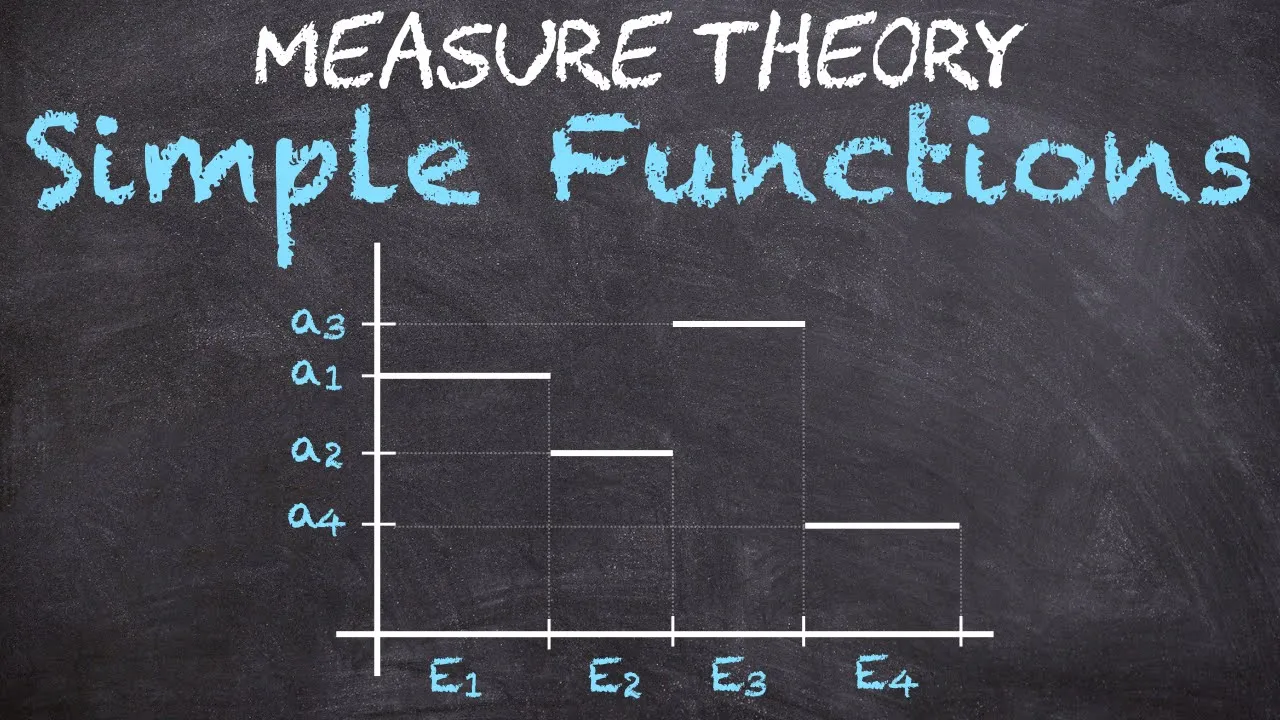
Approximating Measurable Functions with Simple Functions | Measure Theory
@Problemathic
2.7K views•2024-01-04

4:43
Elliptic Curve Cryptography Explained: ECC, ECDSA, ECDH
@PracticalNetworking
28.5K views•2024-10-21
10:44
Fourier Series Introduction: The Big Idea Explained
@DrTrefor
387K views•2021-05-03

6:00
The Mathematical Impossibility of Accurate World Maps
@Vox
23.3M views•2016-12-02
Related Study Plans & Knowledge Roadmaps
Structured learning paths in Mathematics
mathematics
Tensor Calculus: Vectors to Riemann Curvature
01Mathematical Foundations: Linear Algebra & Calculus
02Covectors, Dual Spaces, and Tensor Basics
03The Metric Tensor and Index Gymnastics
+ 2 more learning modules
40h5 modules
Explore Roadmap
mathematics
Gödel's Incompleteness: Logic, Proofs & Limits
01Introduction to Formal Systems & Hilbert's Dream
02Set Theory, Cardinality, and Cantor's Diagonal Argument
03Arithmetization and Gödel Numbering
+ 2 more learning modules
14h5 modules
Explore Roadmap
mathematics
Galois Theory: Fields, Groups & Solvability
01Foundations of Abstract Algebra: Groups & Fields
02Polynomials & Field Extensions
03Splitting Fields & Symmetries
+ 2 more learning modules
24h5 modules
Explore Roadmap
mathematics
Non-Euclidean Geometry: Models & Geodesics
01Euclid's Fifth Postulate and the Birth of New Geometries
02Hyperbolic Space and the Poincaré Disk Model
03Geodesics: Defining Straight Lines in Curved Spaces
+ 2 more learning modules
15h5 modules
Explore Roadmap