
















![Catalysis A-Z [ Surface Chemistry ] Catalyst | Enzymes | Zeolites](https://i.ytimg.com/vi/-CF0Wk6IMMA/maxresdefault.jpg)





Chemical reactions require molecules to collide with sufficient energy (activation energy) and proper orientation; the reaction rate depends on the concentrations of reactants raised to specific exponents in a rate law, which is determined experimentally, and the overall reaction rate is governed by the slowest step (rate-determining step) in a multi-step mechanism, with catalysts lowering activation energy to speed up reactions.
Chemical Kinetics: Collision Theory and Rate Laws Explained
Added:Balanced chemical equations and stoichiometry to understand reactant-to-product relationships.
The Kinetic Molecular Theory of matter, which describes how particles move, collide, and possess kinetic energy.
The concept of chemical concentration (molarity) and how to calculate and express solution concentrations.
Basic chemical thermodynamics, specifically the distinction between endothermic and exothermic reactions and enthalpy changes (Delta H).
The Arrhenius Equation, to quantitatively analyze how temperature and activation energy affect the reaction rate constant.
Catalysis, including the mechanisms of how homogeneous, heterogeneous, and enzymatic catalysts lower activation energy.
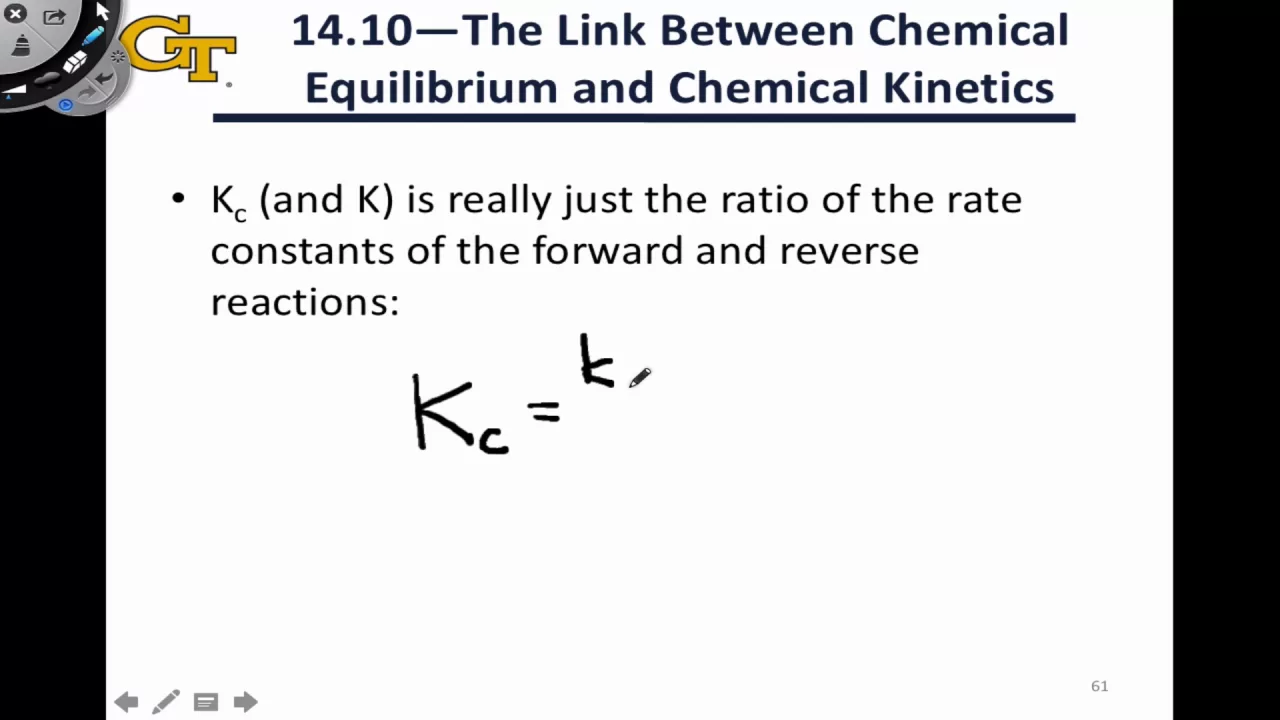
Chemical Equilibrium, exploring how forward and reverse reaction rates become equal and how rate constants relate to the equilibrium constant (K).
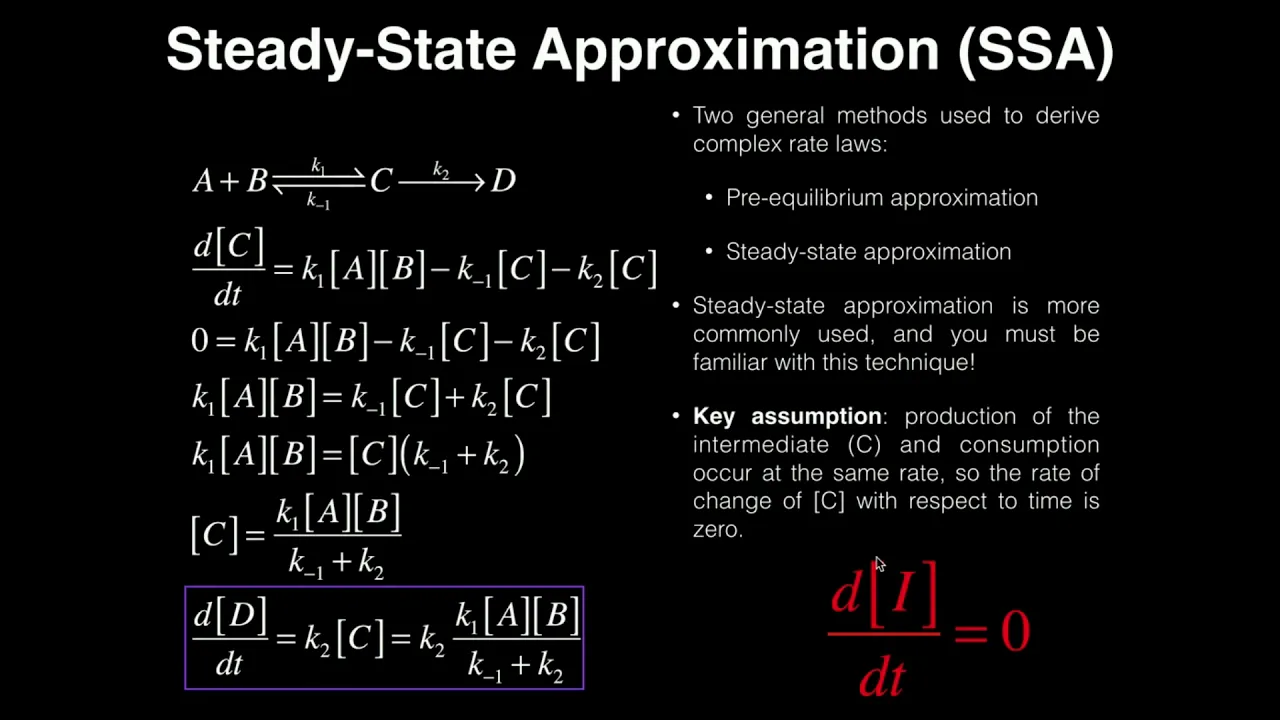
The Steady-State Approximation and other advanced mathematical techniques for deriving rate laws from complex, multi-step reaction mechanisms.
1M views12Klikes9:57Original Release: 2013-09-24
Have you ever been to a demolition derby?
Basically it's a bunch of people driving cars around a field, doing their best to ram into each other while protecting themselves as much as possible.
The goal of course is to damage the other cars so badly that they can't be driven anymore.
The driver of the last operational car wins.
You know Crash Course chemistry well enough to know that I probably wouldn't have mentioned this if it have some relation to chemistry.
So yeah it does, chemical reactions basically work just like this.
Atoms and molecules move around their environment occasionally ramming into each other.
If they do it right, a reaction happens between them, and if enough of them do it, the concentration of the reacting molecules will go down while the concentration of the products goes up. Win.
But it's not as simple as it sounds, for demolition drivers, or for chemicals; in both cases a lot of the collisions that occur have very little effect on the end result.
One molecule hitting another doesn't mean a reaction's going to take place.
In the same way that just randomly bumping into a guys car doesn't mean you're gonna ram him out of the derby.
So, what makes a collision effective? The hit has to be hard enough and it has to be aligned just right.
The branch of chemistry that studies how these collisions effect the rate of reactions is Kinetics.
And if you ask me it's just as exciting and a heck of a lot more useful than demolition derbies.
If only they sold funnel cakes in chemistry class.
[Theme Music] So if chemical reactions only work when particles bang into each other good and hard, just how hard do they have to bang into each other?
Every reaction has a minimum amount of energy required to get it started.
This is known as the activation energy.
Molecules require this much energy to hit other molecules hard enough to break them apart and reform them in different ways; without it nothing will happen.
It's like a hill that molecules have to get over before they can go any farther.
So where do they get this energy? Well it's kinetic energy, the actual speed of the particles.
So just like the cars in a demolition derby, all else being equal, the faster the particles move, the harder the collision will be.
But still no matter how hard they hit it won't do any good if they're not hitting the right way, in the right places.
Like, if you keep smashing into the back of some guy's trunk it's not going to stop his car, there's no engine back there.
You can bang Velcro together all day and night and if it's not turned the right way it'll never stick together.
Same thing with molecules.
As an example take nitric oxide, one of the byproducts of gasoline combustion, and something that you can smell quite clearly at a demolition derby.
Under the right conditions it reacts with hydrogen gas to produce nitrogen gas and water.
But the molecules have to hit each other just the right way.
To make N2 two NO's have to collide in such a way that the nitrogens are together, and to get H2O, a molecule of H2 has to collide with the oxygen side of an NO molecule.
Just like Velcro being turned the wrong way, you can smack the N side against the H2 all day and you'll never get any water from it.
Now let's say we're having a lot of solid, effective collisions between the molecules.
The reaction should hum along with no further hindrances, right? Well yes and no.
Once the energy requirements are met the reaction will proceed, but its speed, or reaction rate, will vary wildly from super fast to super slow.
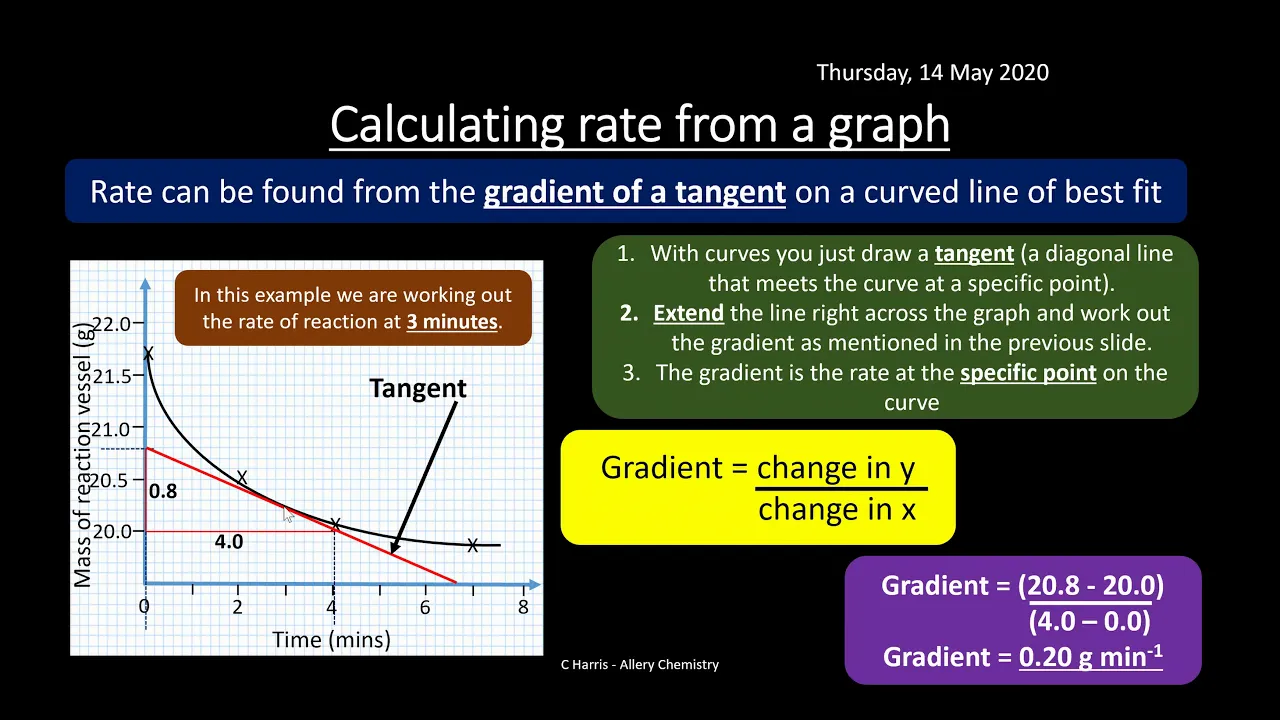
So the reaction rate, that's the rate at which the concentrations of the reacts decrease and this has to be determined experimentally.
It can't be calculated from the energy change or any other thermodynamic factor.
One useful way to think about the rate is a quantity called the reaction's rate law.
It describes the relationship between the initial concentrations of the reactants and the rate at which they react.
The rate law for a reaction is written like this: The rate equals a constant, k, times the concentrations of each reactant, raised to some power.
Notice that only the reactants are used for this not the products.
The rate law for our nitric oxide reaction then ends up as k times the nitric oxide concentration raised to some power, times the hydrogen concentration also raised to some power.
So you're probably wondering about all those raised to some power.
Like, what power? And you should be wondering that.
The exponents in rate laws are tricky even for professional chemists and engineers because like I said they can only be determined experimentally.
It's kinda intense, but we can handle it, check it out.
Suppose we did the reaction a few different ways and calculated the rate for each instance.
Let's say that with the first reaction we got a rate of 0.006 moles per liter per second.
Then we repeat the reaction with the same amount of nitric oxide but this time with twice as much hydrogen as before.
And now we find that the rate of the reaction is 0.012 moles per liter per second.
What does this tell us?
Well, doubling the hydrogen, doubled the rate; meaning that the rate and the H2 concentration change in exactly the same way.
So in the rate law this can be expressed be the concentration being raised to the power of 1.
Finally we do it one last night with the original amount of hydrogen and twice as much NO.
This time we find that we get a rate of 0.048 moles per liter per second.
Doubling the nitric oxide caused the rate to increase by 8 times, and that can be expressed in mathematical terms by cubing the concentration term.
This means that the final rate law for this reaction is: k times the concentration of hydrogen gas to the first power, you need to write out the 1 obviously, times the concentration of nitric oxide cubed.
A rate law in this form is said to be of the fourth order.
We get that by adding the exponents together: 3+1 (there is some math that isn't hard here) that equals 4 Fourth order reactions are actually quite rare, most reactions are of the zero, first, or second order, but in all cases it's calculated exactly as we have done here.
Now if you've watched our episode on equilibrium this formula should look familiar to you.
Equilibrium expressions also use bracketed concentrations with exponents, and that's no accident.
Those formulas come from these ones.
A reaction is at equilibrium when its forward and reverse rates are equal, right?
So if we were to find the reverse rate law for a reaction it would take the same form as the forward one, but using the initial concentrations for the products rather than the reactants.
Think of like an imaginary reaction A plus B yields C plus D.
The lower case letters represent the coefficients of the reactants and products.
The forward rate law if k multiplied by the concentration of A raised to some power times the initial concentration of B raised to some power.
And the reverse is it the same, except with C and D in place of A and B.
Notice that these exponents are not however the coefficients of the balanced equation.
If we write these two terms together to show that the forward and reverse rates are equal, like in equilibrium, and solve for a single constant, we get something that looks very much like an equilibrium expression.
For mathematical reasons the exponents don't translate, but, yeah basically this is where the equilibrium equation's come from, pretty cool.
But if it's that simple why don't all reactions just go to an equilibrium state and stay there?
Well sometimes the reverse reaction isn't as thermodynamic spontaneous for one reason or another.
Sometimes that forward reaction is so vigorous that any reactants that might reform are immediately pushed back into products.
Or the products might physically separate and have little chance of colliding at all, like when products separate into solids and gases.
Often though it's just that the reverse reaction has such a high activation energy that the collisions are almost always ineffective.
Because, remember, most reactions don't happen instantly, boom, all at once; instead they happen in steps.
And as with any multi-step process the reaction can only happen as fast as the slowest step takes.
And sometimes that step is very slow indeed.
Since its what controls how fast everything else can go, we call it the rate limiting or rate determining step.
The slowest step, is the one that has the highest activation energy.
If the particles have trouble getting over that part of the energy hill, then they'll have trouble making it to the finish line, not matter how fast the other steps are.
So in the case of the nitric oxide reaction we've been discussing, there are actually three steps.
First the nitric oxide and the H2 form water and elemental nitrogen; then the nitrogen combines with another molecule of NO to form N2 and elemental oxygen; finally that atom of oxygen combines with another molecule of H2 to form water.
Here step two is the slow one and no matter how fast you take the first step, the water product can never be produced until the nitrogen gas is.
The problem is we can't always afford to wait around for reactions to happen on their own, sometimes they need to be forced along. And that's the job of catalysts.
A catalyst is a chemical that lowers the activation energy of a reaction, thereby speeding it up without actually being changed by it.
Catalysts take many different forms, they can be just another chemical added to the reaction vessel, a piece of metal that's in contact with the reacting chemicals, or even a gas that's added to the environment.
One of the most common and important classes of catalysts are the enzymes in living things.
Without them, many other chemical processes that our bodies must do every day to keep us alive would slow essentially to a stop, we literally could not survive without them.
So there you go, in demolition derbies and in chemistry it all comes down to how hard you can hit, and how well you can aim your punches.
Chemistry! Surprisingly exciting even without funnel-cakes.
Thanks for hanging out for this episode of Crash Course chemistry, if you paid attention you learned that: chemical reactions depend on collisions between molecules and atoms, that the particles have to be oriented correctly when they collide, and that they have to collide with enough energy to meet the threshold for the reaction known as the activation energy.
You also learned how to write rate laws and figure out their exponents and how to calculate the form or order of a rate law; you learned how rate laws are related to equilibrium expressions, and finally you learned that chemical reactions actually happen in steps.
That the slowest step determines the overall rate of the reaction and that the reason for that come right back around the activation energy.
This episode was written by Edi González and edited by Blake de Pastino, our chemistry consultant is Dr. Heiko Langner and was filmed, edited, and directed by Nicholas Jenkins.
The script supervisor was Michael Aranda, who is also our sound designer and our graphics team is Thought Café.
Up Next

8:48
Collision Theory: Orientation & Activation Energy | AP Chem
@readysetorgo
333.3K views•2014-11-08
83:56
Biocatalysis and Catalysis in Islatravir Synthesis | Merck Webinar
@SCIwheresciencemeetsbusiness
675 views•2020-10-08
9:57
Nuclear Chemistry: Radioactive Decay & Half-Life Explained
@crashcourse
2.1M views•2013-11-11

17:31
Edible Water Bottles: A DIY Guide to Sodium Alginate Spherification
@ryan
10.5M views•2019-06-21
Related Study Plans & Knowledge Roadmaps
Structured learning paths in Chemistry
chemistry
Nuclear Chemistry: Decay, Meds & Fuel Cycle
01Introduction to Nuclear Structure and Radioactivity
02Decay Dynamics and Kinetics
03Radiation Interaction and Detection
+ 2 more learning modules
24h5 modules
Explore Roadmap
chemistry
Supramolecular Chemistry: Forces & Machines
01Foundations of Chemical Bonding and Intermolecular Forces
02Introduction to Host-Guest Chemistry
03Thermodynamics and Dynamics of Self-Assembly
+ 2 more learning modules
16h5 modules
Explore Roadmap
chemistry
Photochemistry: Excited States & Reactions
01Foundations of Light-Matter Interactions
02Molecular Orbitals and Electronic States
03Photophysical Processes and Jablonski Diagrams
+ 2 more learning modules
18h5 modules
Explore Roadmap
chemistry
Coordination Chemistry: Bonding & Properties
01Introduction to Transition Metals and Ligands
02Crystal Field Theory (CFT) and Geometry
03Magnetic Behavior and Spin States
+ 2 more learning modules
14h5 modules
Explore Roadmap