
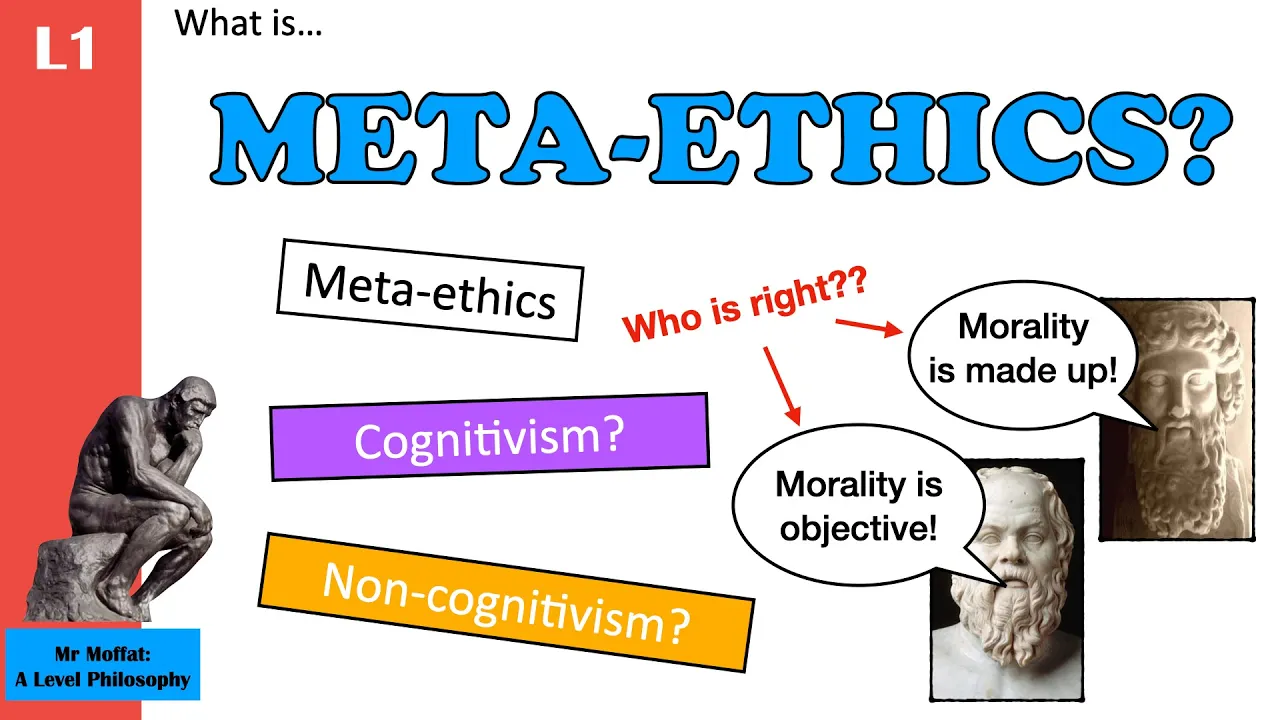


















The debate between ethical naturalism and non-naturalism concerns whether moral facts can be reduced to natural properties or represent a fundamentally distinct metaphysical category; while ethical naturalism proposes various strategies including analytic naturalism (claiming moral properties are analytically equivalent to natural properties like welfare maximization) and one-term naturalism (arguing moral properties are already natural), non-naturalists counter that moral facts possess a distinctive feature called normativity—a reason-giving quality that cannot be captured by purely descriptive natural facts, as demonstrated by the failure of Moore's Open Question Argument against non-analytic naturalism and the structural distinction between first-order descriptive facts and second-order normative facts about practical relevance.
Ethical Naturalism vs Non-Naturalism: Normativity Explained
Added:[music] Welcome to the deep dive. Today we are diving straight into um what you could call a foundational crisis in philosophy.
>> It's one that really dictates how we view moral reality itself.
>> Absolutely. Our mission is to cut right to the core of this this really profound and persistent argument. Are the truths we hold about morality and ethics, you know, facts like murder is wrong or charity is good, or are they just facts about the natural world, >> right? Like facts you could theoretically find in a science textbook, maybe a really, really complicated one.
>> Or are they something else entirely?
Something, I don't know, fundamentally distinct sort of lurking outside that purely descriptive sphere. This is the definitive ethical fault line we're exploring today. And it's it's really a fight for the metaphysical territory of morality itself.
>> Okay. So on one side we have what's called ethical naturalism.
>> That's right. Ethical naturalism or enalist asserts that all ethical properties, all the distinctions, all the facts we talk about in ethics are also natural facts.
>> So they're just complex arrangements of the world that we can in principle at least describe using purely descriptive scientific terminology.
>> Exactly. And then facing them you have the proponents of ethical non-naturalism or enn >> and they argue that ethical properties things like you know goodness rightness or moral reasons are absolutely distinct from anything we would call natural.
>> They occupy their own unique metaphysical space. It's defined by a feature that they believe physical science can just never capture.
>> But there is a huge problem right at the start. Isn't there a foundational challenge?
>> There is. And it's important for you, the listener, to grasp this vital piece of context right away. The sharpest philosophical critique of this whole debate often centers on the fact that there is no um universally agreed upon clear account of what it even means to be natural.
>> We use the term constantly >> all the time. But defining the boundaries of the natural world is well, it's notoriously difficult. So if you can't even define the box you're claiming morality fits into or doesn't fit into how sharp can your argument really be >> precisely that lack of definitional clarity as you said it often visiates the entire discussion.
>> Okay, so that's the first bit of context. What's the second?
>> The second crucial point is that this entire debate no matter how complex the arguments get takes place among moral realists.
>> Right. This is critical. Yeah.
>> Both sides agree that ethical properties and facts exist. Yes, they both agree that there are genuine matters of ethical fact. They aren't arguing about whether morality is real. They're arguing about its location and its substance.
>> So, we're not talking about moral skepticism here. Not at all. We're talking about the nature of moral truth.
>> And while many ethical naturalists are also metaphysical naturalists, you know, the view that the natural world is all there is, you don't have to be.
>> You could believe in a purely natural world and still theoretically think that moral facts are somehow distinct. it's possible. So, our mission today is to dive deep into the specific varieties of naturalism that have been proposed and then, you know, really analyze the core arguments designed to refute them.
>> And we're going to focus very closely on that single slippery concept the non-naturalists believe gives them the win.
>> Normativity, that's the key. It's the unique juice that they claim makes moral facts different.
>> Okay, let's unpack this then. If you approach this issue, you you quickly realize naturalism isn't just one single position.
>> Not at all. Philosophers have devised vastly different ways to claim that mortal properties are in fact natural properties.
>> So, we need a way to categorize them to get a handle on how they try to make that connection. The first major family seems to try to build a bridge by uh by translation.
>> You can label this the two-term naturalism family. The name itself reflects the underlying assumption here which is >> that there are two separate vocabularies we use. The first is the evaluative or moral vocabulary. You know terms like good, right, ought.
>> And the second is the descriptive or natural vocabulary.
>> Exactly. Terms describing physical, psychological or sociological facts. And the core goal here is to show that anything expressed in the evaluative term must be logically equivalent or at least metaphysically identical to something expressable in the descriptive term.
>> And this family immediately splits into two. Right?
>> If you think the translation from moral to natural is just a matter of definition, >> then you land in analytic naturalism.
>> But if you think the translation is more like a scientific discovery, something found empirically, >> then you're in non-analytic naturalism.
Let's start with the most ambitious version, maybe the most extreme one.
Analytic naturalism. This is associated with philosophers like Frank Jackson.
>> It is. Jackson's view is that ethical facts are not just connected to natural facts. They are actually analytically equivalent to them.
>> Meaning they have the exact same meaning.
>> The exact same meaning like bachelor, an unmarried man.
>> How does he possibly argue that? I mean my immediate common sense reaction is that good means something far beyond any simple description of say maximizing pleasure.
>> He offers two pretty strong direct arguments. The first is almost a common sense metaphysical claim.
>> Okay, >> it's that we are natural creatures. We operate entirely within the natural world. Therefore, any distinction we can recognize or grasp, including the distinction between right and wrong, it must necessarily be a natural distinction, >> one that is expressable descriptively.
>> Exactly. If rightness is understandable by natural creatures like us, it must have some kind of descriptively specifiable pattern.
>> That's intriguing, but it's still just a premise really. It's his second argument that forces us to think deeply about the logic of it all.
>> The supervenience argument. This is where we really need to slow down and absorb the technical mechanics >> because it's Jackson's attempt to show that every single evaluative predicate is necessarily equivalent to and analytically the same as some descriptive predicate.
>> Right? Let's try an analogy to make this dense concept a bit more accessible.
Imagine you're trying to describe what makes a piece of music beautiful. You can't just say it's beautiful. You have to point to the underlying arrangement of notes, rhythms, harmonies. Jackson's argument is like saying that for every possible piece of music that is beautiful that's the evaluative predicate E there is a complete massive descriptive notation of its notes tempo and instruments we can call that D to one >> so if we have an action that satisfies the evaluative predicate E let's say is a right action there is a complete description of the natural world that gives rise to that rightness and we're calling that deed aloner >> precisely and by the principle of supervenience The descriptive base ded one determines the evaluative result E.
>> It's impossible for any action to have that detailed descriptive property deton without also being a right action without satisfying E.
>> In philosophical terms, D dollar1 entails E.
>> But the reverse isn't true, is it? Just saying an action is right E doesn't tell you the precise description D dollar one.
>> Exactly. Right actions come in infinite varieties. A right action done in the 17th century looks descriptively very different from a right action done today. But charital donation looks different from saving someone from a burning building, >> right? And each of these distinct right actions has its own exhaustive descriptive predicate. DD2, DT33, D44 wires, and so on for every possible world and every possible right action.
>> So here's Jackson's crucial move. He tells us to form the disjunction, the ore of every single possible descriptive predicate that could ever ground a right action in any possible world. This vast, possibly infinite, enormous, disjunctive, descriptive description is what we call delta.
>> Delta.
>> So, think of delta as the master blueprint.
>> A great way to put it. It's the summation of every possible natural and descriptive way the property of rightness could ever exist.
>> Okay. So, now we examine the logical relationship between E, the ethical predicate is a right action, and this massive descriptive blueprint delta.
>> Right. First, E entails delta. If an action is right, it must satisfy one of the descriptive blueprints within delta.
That's just a matter of logic.
>> And second, delta entails E. Yes, because if delta is satisfied, one of the individual blueprints inside it, D dollar or D dollar 2, etc. must be satisfied. And since we already established that each individual blueprint entails E, the total master blueprint delta must also entail E.
>> So the conclusion is pretty powerful. E, the ethical predicate both entails and is entailed by delta, the huge descriptive predicate.
>> They are necessarily equivalent. And Jackson then takes the final leap. He argues that necessarily equivalent predicates pick out the same property.
>> No, he concludes that ethical properties are these possibly infinite disjunctive descriptive properties.
>> And critically for his analytic position, he says the two ways of describing this, the evaluative way, right, and the descriptive way delta are analytically equivalent. They mean the same thing. That sounds like an elegant logical solution, but it carries a massive conceptual cost.
>> It does.
>> It means that in theory, the concept of rightness is the concept of this infinitely long unimaginable description delta. It feels too outlandish for most people to accept.
>> And that's why most naturalists prefer simpler properties like maximizes human welfare or is commanded by law. Which brings us to the more moderate and frankly more resilient position >> which is nonanalytic naturalism.
>> Right? This group still agrees with the ultimate conclusion. Evaluative properties are natural properties. They occupy the same metaphysical space. They are identity theorists just like Jackson.
>> But they reject Jackson's analytical claim. They insist that the evaluative way of thinking about the property does not have the same conceptual meaning as the descriptive way.
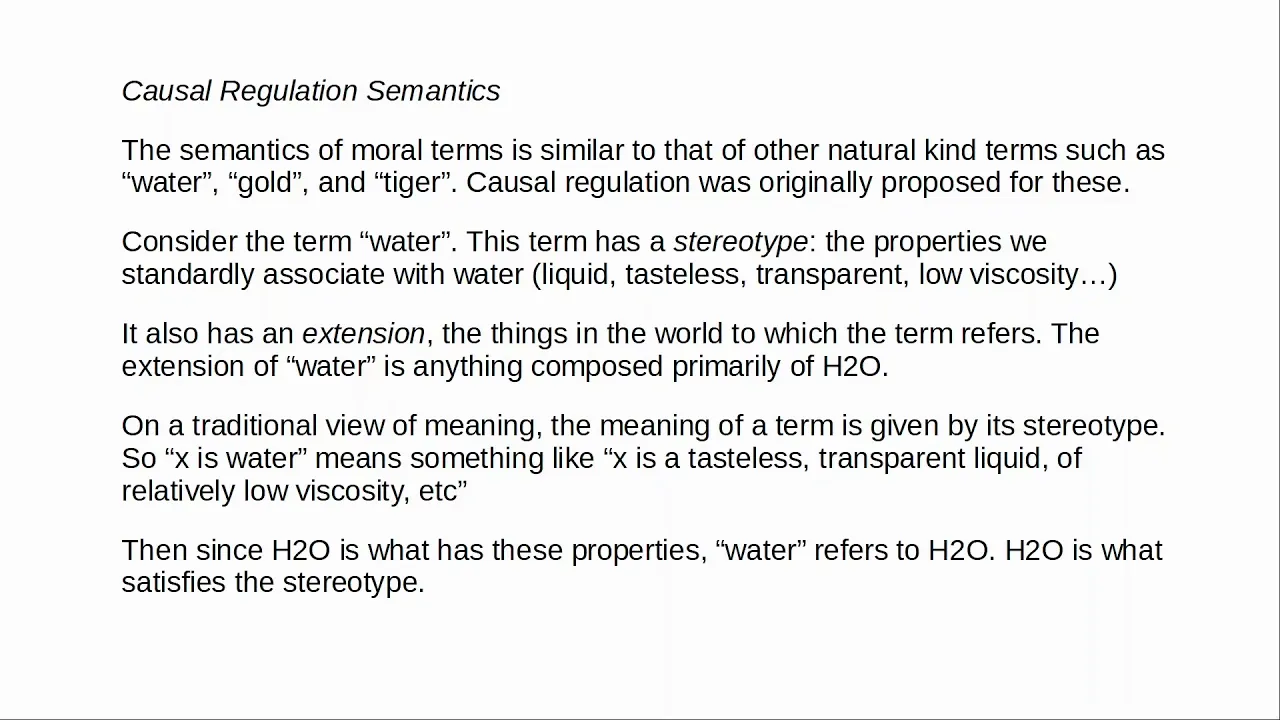
>> This is where we can look at the classic scientific identity. Water is identical to H2O.
>> Right? The concepts are different. One involves our everyday experience, the other involves chemistry, but they refer to the one and the same property in the world.
>> Exactly. So they can say good and welfare maximizer are identical properties even though the question is welfare maximization good is conceptually open and meaningful. They claim this is an identity discovered through theory not through analyzing the meanings of words.
>> Okay, so that covers the two-term approaches which rely on finding some kind of translation or identity. But then we shift to a fundamentally different strategy, >> a much stronger one in many people's view. This is one-term naturalism which is most associated with Nicholas Sturgeon.
>> And Sturgeon decided to just bypass the whole problem of translation entirely.
>> His core claim is simple. Moral distinctions like goodness or wrongness are already natural.
>> We don't need to find a natural equivalent for them >> because they're just a complex part of the natural reality from the very start.
They are just there like gravity or biology. and his primary support for this is what's called the causal role argument. He looked at how moral properties actually function in the real world.
>> He starts by observing that moral properties appear to play a genuine explanatory causal role.
>> Think about historical lens. If you're explaining why the Union won the Civil War, you talk about industrial capacity, manpower, things like that, >> right? Descriptive facts. But if you're explaining the rise of the anti-slavery movement, you can argue that the badness, the moral depravity of child slavery was a key part of the causal nexus that generated moral outrage and political action.
>> So the moral fact itself seemed to exert a causal pull on human beliefs and behaviors.
>> That's his claim. Of course, the immediate counterargument is always, "Wait, the cause wasn't the badness itself, but the belief that it was bad."
>> And Sturgeon's reply is forceful. He says, "But why did they come to believe it was bad?" Because it was in fact bad.
If we strip moral facts of any causal efficacy, we end up with explanations for human behavior that seem woefully incomplete. We need the moral facts to make sense of the historical record.
>> So, if they are causally efficacious, Sturgeon suggests, why invent a special spooky metaphysical category for them?
>> Exactly. Let them remain within the bounds of the natural world since they behave like other natural entities that cause things.
>> Now, here is where I think the non-naturalist has a perfect counter. If we accept the causal efficacy of moral facts, does that absolutely force them to be natural? I mean, just because something causes a real world effect, does that make it natural?
>> That is the precise point the non-naturalist presses. They argue that the premise that only the natural can play a causal role is dubious. So for example, if you believe in divine intervention, >> perfect example, if a supernatural being like God miraculously heals someone, that being has played a causal role in the course of nature. Yet that doesn't mean the supernatural being is now suddenly natural.
>> So Sturgeon's attempt to naturalize morality merely through its causal function fails because causal efficacy is insufficient to mandate a property be labeled natural.
>> And we're right back to that initial problem. We still don't know where the boundary of natural is. Okay, so with the varieties of naturalism defined, the non-naturalist needed a weapon.
>> They traditionally sought a definitive blockbuster argument to demolish all forms of naturalism at once, hoping to show that moral facts are inherently unnaturalizable.
>> And for over a century, that definitive argument was GE Moore's open question argument, the OQA. We have to understand this mechanism thoroughly because its success and its subsequent failure really defined much of 20th century ethics. Moore's argument relies heavily on conceptual analysis on the meaning of words. He asks us to take any candidate natural property that a naturalist might propose let's call it X >> and let's use a common one welfare maximizer. The naturalist claims that the property of goodness is the property of welfare maximization.
>> So Moore tests this claim by asking two questions. First is being a welfare maximizer being a welfare maximizer.
>> That's a definitionally trivial question. It's a tautology. It provides no new information. Any competent speaker recognizes this immediately.
>> Then second, Moore asks, "Is being a welfare maximizer good?"
>> And his observation, which is undeniably true to our linguistic intuition, is that this second question always remains open? It's substantial. It's informative. We can coherently, meaningfully ask it.
>> And his point is, if goodness were analytically identical to welfare maximizer, as the analytic naturalist claims, >> then the second question should be just as trivial as the first, >> right? And since the ethical question always feels substantial and requires thought, it's not a mere definition.
Goodness cannot be defined by any natural property. Moore believed this refuted all possible naturalist definitions, >> leading to his famous conclusion that good is a simple unanalyzable non-natural property.
>> The OQA put simply, assumes that if a definition is correct, it must be an obvious recognized analytic truth. But that assumption is precisely where the argument ran into a wall, >> particularly with the rise of the philosophy of science.
>> That's right. This is known as the scientific discovery objection and it is the undoing of the OQA against nonanalytic naturalism.
>> Give us the classic example.
>> Consider this. Before the discovery of thermodynamics, if you asked a competent English speaker, is having a certain degree of molecular kinetic energy hot?
They would have been surprised. They would have needed time maybe years of physics education to confirm the identification.
>> The question was informative and substantial. It was open.
>> Yet we know the identification is correct. Hotness is molecular kinetic energy. The question was open only because the two concepts hotness and kinetic energy had different meanings even though they referred to one in the same property in the world. So the OQA only reveals something about the concepts or meanings we use, not about the ultimate identity of the properties they pick out.
>> And the non-analytic naturalists stand triumphant here. They fully agree that good and welfare maximizer have different meanings, which is why the question remains open, but they insist that these two terms are merely pointing at the same physical natural entity. So Moore's argument because it's purely conceptual simply cannot touch facts of property identity that are discovered theoretically or empirically.
>> It can't. So that significantly limits the OQA. At best, it's a decisive reputation of analytic naturalism, but it leaves the more subtle non-analytic naturalism completely untouched.
>> And there's a second deeper flaw, isn't there? The one you call the sturgeon defect.
>> Yes. And this one hits one term naturalism. Moore's argument takes for granted right from the start that the term good does not itself pick out a natural property.
>> He assumes that if the property is natural, it must be describable by some other non-ethical term like pleasure or welfare.
>> Precisely. Moore never addressed the possibility that the property of goodness, the one that the term good stands for, is already natural as Sturgeon holds it to be. Sturgeon avoids the OQA entirely because he doesn't define good in terms of welfare maximization in the first place.
>> Right? He claims good is the name of a natural property without requiring a definition in non-ethical terms. The OQA is designed to challenge definitions. It doesn't challenge the metaphysical location of the property itself. Since the OQA is wounded, non-naturalists needed a more devastating metaphysical argument.
>> And that really sets the stage for the modern debate. If the OQA only wounds analytic naturalism, we need sharper tools that cut deeper into the nature of the property itself rather than just the language we use to describe it.
>> This is where we turn to the objections explored by Derek Parfett.
>> The first one is the triviality objection. It aims to show that even if the naturalist identity claim is true, it renders our moral discourse pretty much pointless.
>> It does. If we accept the most ambitious claim of analytic naturalism that is right and minimizes suffering have the exact same meaning, then any ethical statement that links them becomes totally trivial.
>> If they mean the same thing, saying this act of minimizing suffering is right is just it's a redundant restatement.
>> It's like saying this dog is a canine.
It contains no new information and therefore it loses all its force as an ethical assertion. But we know instinctively that when we say an act is right, we are adding significant non-trivial information beyond just its description.
>> This objection is a bit less definitive against non-analytic naturalism, but it's still potent.
>> How so?
>> Well, non-analytic naturalists say the meanings differ, but they refer to the same fact. But even if they report the same fact twice, the utterance, this minimizing suffering act is right, still seems to lose its crucial normative significance. Why bother adding the second claim if you're just reporting the identical state of affairs?
>> Exactly. The identity theorists seem stuck saying one thing when we feel they are saying two important things.
>> Now, you mentioned earlier that the triviality objection struggles with Jackson's extreme version of analytic naturalism, the one with the infinite descriptive disjunction delta. Why is that? Because the triviality objection primarily works against naturalists who offer ordinary candidate natural properties for identity like maximizing welfare. These ordinary properties are often proposed as the reasons for action.
>> And when you equate the reason with the moral property, you get triviality.
>> You do. But Jackson avoids this because his descriptive property delta is too vast and complex to function as a reason for action.
>> So Jackson isn't saying act right because it has this infinite description delta. He's just saying the property is the description.
>> Precisely. Since Jackson's descriptive property is conceptually impossible to use as a practical justification or reason, the triviality charge doesn't land in the same way. Jackson's claim might be metaphysically bizarre, but it is logically protected from the charge of triviality that plagues simpler naturalisms.
>> Which brings us to Parid's second objection, the one that the non-naturalist truly relies on today.
>> This is the normativity objection. This moves beyond semantics and definition and it attacks the very metaphysical structure of the moral property.
>> The claim is devastatingly simple.
>> It is moral and evaluative facts possess a distinctive feature called normativity that no natural fact could possibly possess.
>> So if we identify moral facts with natural facts, if we reduce the moral fact to the descriptive fact, their normativity is irreversibly lost.
>> The natural facts are just descriptive reports. They lack the special mustness or reason giving quality that ethics requires.
>> This means the entire non-naturalist project hinges on defining and defending this special feature. If they can't define what normativity is, they can't prove that the naturalist destroys it.
>> This is the absolute crux of the issue.
We have this deep intuition that moral facts have a distinctive style, an action-guiding quality. But what is this feature called normativity? and why is it metaphysically incompatible with being natural?
>> Okay, so the first philosophical hazard we must avoid is confusing the nature of the fact with the nature of the utterance.
>> Right? Moral realists who agree moral facts exist objectively cannot define normativity as prescriptive force.
>> Why not?
>> Well, prescriptive force belongs to the speech act. When I shout, "You ought to stop," the force of the utterance comes from my intent, my tone, the situation.
A fact sitting quietly in reality, whether moral or otherwise, cannot possess force or push.
>> So if moral facts exist objectively, normativity has to be characterized as a distinctive style, a unique feature belonging to the matter of fact itself.
>> Exactly. So let's review some attempts to define this style. Starting with the relation between moral facts and motivation. It seems intuitive that moral facts are uniquely connected to action.
>> So what's the first attempt? One initial idea defines a normative fact as one which necessarily motivates all rational beings who recognize it. But this is far too strong. It fails immediately due to psychological exceptions.
>> The famous example being the person suffering from profound depression.
>> Right? They might still recognize rationally that they ought to help a friend in need, but their depression has rendered them wholly unmotivated to act.
>> They haven't lost their capacity to recognize the moral fact. they've lost their capacity for resulting action.
>> So we weaken the definition. Maybe normative facts are merely intrinsically motivating. They are capable of motivating purely on their own even if external factors can interfere.
>> But if we accept that definition, the game is over for the non-naturalist immediately. Why?
>> Because many perfectly non-normative natural facts are intrinsically motivating. The natural fact that this course of action promises enormous pleasure is intrinsically motivating for most people. So if the naturalist can point to a descriptive property like pleasure or welfare and say that is what the moral fact is and it is intrinsically motivating then they've successfully captured normativity within the natural world >> and the argument is over. So normativity cannot be defined purely in terms of motivation or it loses its power as a tool to separate the moral from the natural. The non-naturalist has to look elsewhere >> particularly toward the concept of ought.
>> Yes. The next strategy is to assert that facts are normative if they are facts about an ought or about something fundamentally related to an ought.
Primarily the notion of a reason.
Reasons are supposed to be the building blocks of the ought.
>> And the classical way of explaining what a reason is pioneered by philosophers like Ross uses this difficult notion of an isolation test for reasonhood.
>> Right? This definition states that a feature F is a reason for doing action A. In one case, if and only if in any case where F is present and there are no opposing reasons.
>> So F is totally isolated.
>> The presence of that feature makes it the case that one ought to do action A.
>> That sounds logically robust. But the source material we've looked at indicates this isolation test is deeply flawed and potentially misconceived.
What specifically goes wrong when we try to isolate a reason?
>> Well, the first problem is that the test assumes a simplistic, contextfree, moral ontology. It assumes that a feature that is a reason in one complex context will be a reason in any context where it appears.
>> But our moral reality is often highly contextual.
>> Incredibly so. Think about the descriptive fact that this person is your family member. That may be a reason to prioritize them in one scenario, but it might be an opposing factor or reason not to prioritize them if you are serving on a jury in their trial. So the ethical relevance of a descriptive fact can flip depending on the circumstances which invalidates the idea that a reason carries its meaning uniformly across all isolated contexts.
>> Exactly. Second, the test defines the contribution a reason makes by focusing only on the extremely rare artificial case where it's the only reason present.
It completely sidelines the standard moral reality which is a complex battlefield of competing reasons both pro and con.
>> Why define the whole operation by such a rare exception? It seems wrong. And then there's the specific logical problem of conditional reasons. You gave the example of a conditional promise.
>> I promise to do A only if there is already another reason to do A.
>> Okay. So in that situation, the promise itself can't stand alone.
>> It can't. If you remove all other reasons, the promise just dissolves. Yet when the condition is met, the promise functions perfectly well as a valid reason for action. So the isolation test by demanding that every genuine reason must be able to generate an ought when standing alone incorrectly dismisses legitimate conditional reasons.
>> Right? And let's not forget the odd implies can't problem.
>> If we accept that we only have a duty to do a if we are able to do a >> then the fact that one is able to do a becomes a necessary condition for duty.
If we follow the isolation test logic too strictly, the fact that you are able to pay your taxes turns into a reason for paying your taxes.
>> But ability is a mere precondition. It's metaphysically ridiculous to claim that your capacity to act is a reason for the duty itself.
>> Of course not. The reason is the tax law or the need for civic funding, not your biceps.
>> And finally, let's explore the difference between mandatory moral reasons and what you called enticing reasons. This further complicates the simple equation of reason with ought.
Enticing reasons are those based on pleasure, enjoyment, or fun. If the fun option is A, and it gives you the most reason to choose A, we might say you ought to choose A in a rational sense.
>> But this enticing ought often does not feel mandatory.
>> Not at all. It feels compatible with a rational permission not to act. You can choose the less fun option without being irrational or immoral. So we have the moral oughtu which seems mandatory and the enticing oughtu which seems permissible.
>> And if we define normativity simply by pointing at the word ought, we are pointing to a cluster of different sometimes contradictory notions without characterizing the underlying unified feature itself.
>> So we are left where we started in this section. We have this strong stubborn feeling that facts about right and wrong and what we have reason to do have something distinctive in common a unique style that a natural fact lacks. But if we can't articulate what that feature is, we haven't yet defeated the naturalists.
>> Okay? So we need a constructive positive definition of normativity that draws a clear metaphysical line. One that survives the critiques against motivation and the failures of the isolation test.
>> This is where Jonathan Dansy's suggestion becomes highly influential.
>> What does he propose?
>> Dancy offers a powerful idea. Normative facts have their practical relevance on their face. They are inherently, explicitly, and primarily answers to the practical question, what to do.
>> And this contrasts fundamentally with descriptive natural facts.
>> It does. Let's use a highly simplified analogy. Imagine a purely descriptive science textbook. It might contain the fact this object is made of wood, metal, and plastic and is shaped to hold a human body. That is a natural fact.
>> Okay? A description of a chair, >> right? That fact has significance for a human trying to sit down. But it doesn't say what the human should do. It requires an additional secondary non-escriptive judgment-like objects shaped this way are for sitting on to become practically relevant.
>> The normative fact, however, is a fact that bears its instruction or guidance explicitly. It bypasses the need for that secondary judgment.
>> And this introduces the key structural concept, the meta fact.
>> We have to distinguish between a first order natural fact and the second order normative fact.
>> Let's take the first order fact. The action maximizes comfort. This is a natural fact. It has descriptive and perhaps psychological properties. It has normative significance.
>> But the normative fact is the second order or metaph.
>> The metact is the fact that the action maximizes comfort makes it the case that one ought to act.
>> So the normative fact is a fact about the practical relevance of the first order fact. It's a feature of the world that tells us that the descriptive property comfort maximization stands in a special normative relationike being a reason for to an action or belief. You can talk about how things are descriptively until you're blue in the face, but until you turn to the explicit difference these things make to how to act, you haven't said anything normative.
>> So the normative fact is the statement of the functional relationship between a feature and guidance. And this structural difference, first order descriptive fact versus second order relevance fact is what justifies the separation of the natural from the non-natural.
>> Yes, the subject matter itself is different. Natural science deals with how the world is descriptively. Ethics deals with how the descriptive facts bear on what we should do.
>> Does this distinction hold for all types of normative claims? You mentioned a structural difference between value facts and deontic facts earlier.
>> It does. Deontic facts facts about ought or reason are very specific. They answer the question what to do by specifying the action for example. You ought to return that wallet.
>> But value facts like this violin is good are also normative.
>> They are because they explicitly state that the object's nature makes a difference to how you ought to act.
>> But they are less well focused as the source material put it.
>> Exactly. The goodness of the violin signals that it has reason giving features. features that count in favor of certain actions like protecting it, listening to it, valuing it highly, but it is silent on which specific action is required.
>> Its goodness means it is worth a certain kind of attention. But that attention isn't necessarily a specific ought.
>> Precisely. But both deontic and value facts are fundamentally about explicit practical relevance. They are both metapacts about the role of first order features. But they bear that relevance in different ways. This distinct subject matter justifies placing all of them in a special metaphysical category separate from the descriptive domain.
>> So now we can return to the varieties of naturalism armed with this definition of normativity as the unique subject matter of explicit practical relevance.
>> The second order fact about the first order fact.
>> Exactly. Let's see how this fares against our naturalist opponents.
Starting with Sturgeon's one-term naturalism. Sturgeon, you'll remember, relied on the causal role argument, claiming moral facts were natural because they affected the world.
>> But his argument is now insufficient.
>> Absolutely. If normative facts are defined by their distinctive subject matter, explicit practical relevance, that difference in style justifies a special category regardless of whether they kick up dust in the causal order.
>> We already established that mere causal efficacy doesn't make something natural with a supernatural intervention case.
So Sturgeon's argument falls short because he fails to account for the unique style of the moral fact. The fact that X is a reason to do A is not the sort of thing we find in physics or psychology even if X itself is.
>> Okay, next up the two-term naturalists, the identity theorists.
>> They claimed a single underlying natural fact could be captured by both a descriptive concept and a normative concept. They must hold that the single fact is simultaneously descriptive and normative.
>> And the normativity argument is the rebuttal here.
>> It is. If the normative fact is structurally a meta fact, a fact about the practical relevance of a first order fact, then identifying it with the first order natural fact abolishes the normative fact itself.
>> This is the crux of the modern non-naturalist attack. If the identity theorist insists there is only one fact, the natural fact like maximizing welfare, then the entire subject matter of the second order fact just disappears.
>> The explicit claim that welfare maximization matters practically just vanishes.
>> So the naturalist is left with only the descriptive property. They have preserved the fact, but they have destroyed the unique normative style that defined the subject matter of ethics.
>> Right? Identity in this case is inherently reductive. destroying the normativity it sought to explain. You're left reporting a state of affairs not issuing guidance.
>> That's a very strong attack on the identity claim. But let's revisit the triviality argument, focusing specifically on the function of reasons, because this is perhaps the most difficult logical paradox for the naturalist to escape.
>> This targets those naturalists who reduce rightness to an obvious right-making property like minimizing pain. They identify that feature as the primary reason for action. And then crucially they equate rightness itself with that property.
>> The paradox arises because we must be able to justify an action by citing the reason. We do X because it maximizes welfare.
>> Yes. The feature that makes the action right is the reason for doing the action. But if you then collapse the distinction and say that rightness is maximizing welfare, you run into this problem. Rightness itself is not a reason for action. You don't perform an action because it is right because it is right. That's a circular empty justification. We seek reasons why something is right.
>> By equating the reason giving feature maximizing welfare with the concept of rightness, the naturalist deprivives their system of the very reasons necessary to explain why the action should be done in the first place.
>> The claim that this action maximizes welfare and it is right loses all its normative content. It just becomes this action is X and it is X. It's normatively useless.
>> So by trying to achieve perfect metaphysical efficiency through identity, the naturalist destroys the functional practical relevance of moral discourse.
>> That's the non-naturalist argument. It rests on the conviction that to say a feature is practically relevant is to make a fundamentally different kind of claim from any descriptive claim. The central idea is that the fact of practical relevance is something over and above the feature that is of practical relevance. It's the meta fact that organizes the first order facts into a system of guidance.
>> This deep dive into the source material really shows that the debate between ethical naturalism and ethical non-naturalism is far more than a technical dispute over labels. It's a profound disagreement over whether facts about practical guidance normativity can exist without being reduced and subsequently destroyed by being equated with first order features of the world.
>> We've seen that the most sophisticated arguments from the non-naturalists rely on the belief that there just isn't a descriptive way to capture the distinct style of practical relevance.
>> Right? The question, is this a reason to act? Seems inherently separate from the question, what descriptive properties does this fact possess? And we've established that every time the naturalist tries to force an identity between the reason-giving fact and the moral fact, [snorts] they either render the claim trivially obvious, or more damningly, they eliminate the normative meta fact entirely by collapsing the structural difference between description and guidance.
>> So what does this all mean for you, the learner of this complex terrain? We are left with the massive foundational obstacle that started this whole conversation. Until we can agree on a shared robust account of what exactly counts as the natural, until we draw those boundaries clearly, how can we definitively determine if the fact that X is a reason to do A is truly a fact of nature?
>> It's a question that hangs over the entire debate.
>> And this lack of agreement forces a final provocative thought. We have spent all this time debating the total naturalist claim that all moral facts are natural >> versus the total non-naturalist claim that no moral facts are natural. But imagine a philosophical inquiry or perhaps some unexpected theoretical breakthrough revealed that both were wrong.
>> What if some ethical properties were found to be reducible to natural facts?
Perhaps those related to basic self-preservation or welfare, but that others like high order duties or reasons of justice proved stubbornly irreducible. That messy middle ground where irreducibility applies only to a subset of our ethical life would be a profound defeat for both the total naturalist and the total non-naturalist positions.
>> It would force a radical metaphysical readjustment in ethics. That possibility, the partial non-naturalist reality, suggests the most fruitful area for philosophical exploration might be right there in the mixed landscape.
Up Next
Meta-Ethics Explained: Realism & Anti-Realism (Philosophy)
@philosophymania
5.4K views•2025-03-31

John of Damascus on Holy Images: A Theological Defense
@BannedBooks
139 views•2026-04-25

Should We Destroy the Machines? Big Tech Surveillance Critique
@TheStoriesWeTell303
167.9K views•2025-11-30
The Myth of Sisyphus: A Greek Legend of Eternal Punishment
@TEDEd
8.6M views•2018-11-13
Related Study Plans & Knowledge Roadmaps
Structured learning paths in Philosophy