

















Lagrange Point L1 is a stable equilibrium point in the Sun-Earth system where the gravitational forces of the Sun and Earth balance each other, allowing objects to maintain a fixed position relative to both bodies. Using Newton's law of gravitation and orbital mechanics, the distance from Earth to L1 can be calculated using the formula L1 = R × cube root(Me/(3Ms)), where R is the Earth-Sun distance, Me is Earth's mass, and Ms is the Sun's mass. Substituting the known values (R = 1.5 × 10^11 meters, Me = 5.98 × 10^24 kg, Ms = 1.99 × 10^30 kg) yields L1 ≈ 1.5099 × 10^9 meters, which is approximately 1.5 million kilometers from Earth—about 1% of the total Earth-Sun distance. This strategic location provides an ideal vantage point for solar observation missions like India's Aditya L1 mission.
How to Calculate the Lagrange Point L1 in the Sun-Earth System
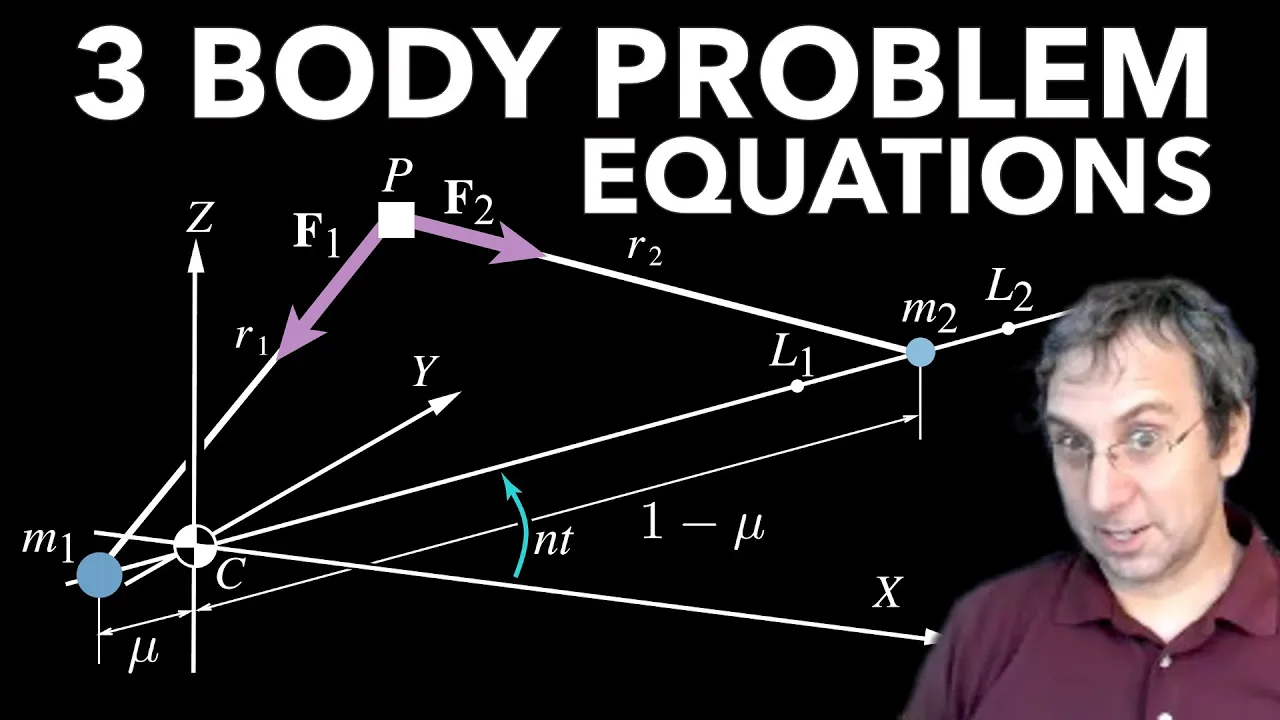
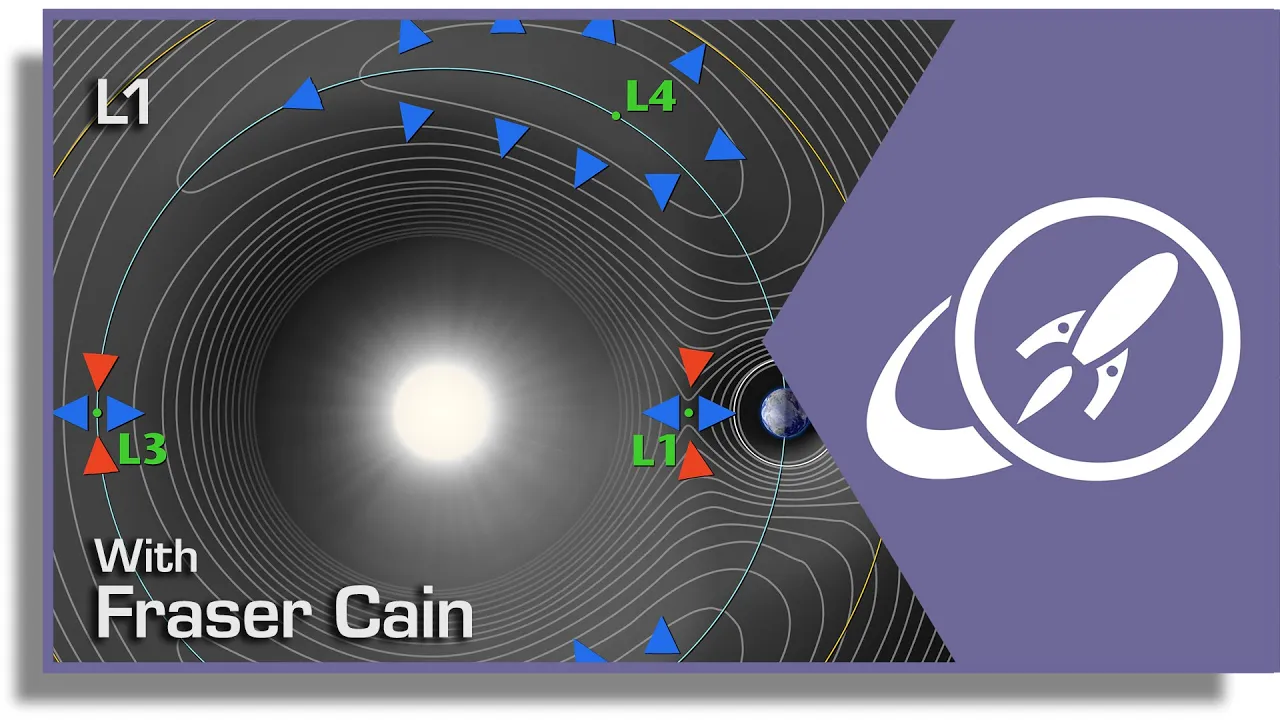
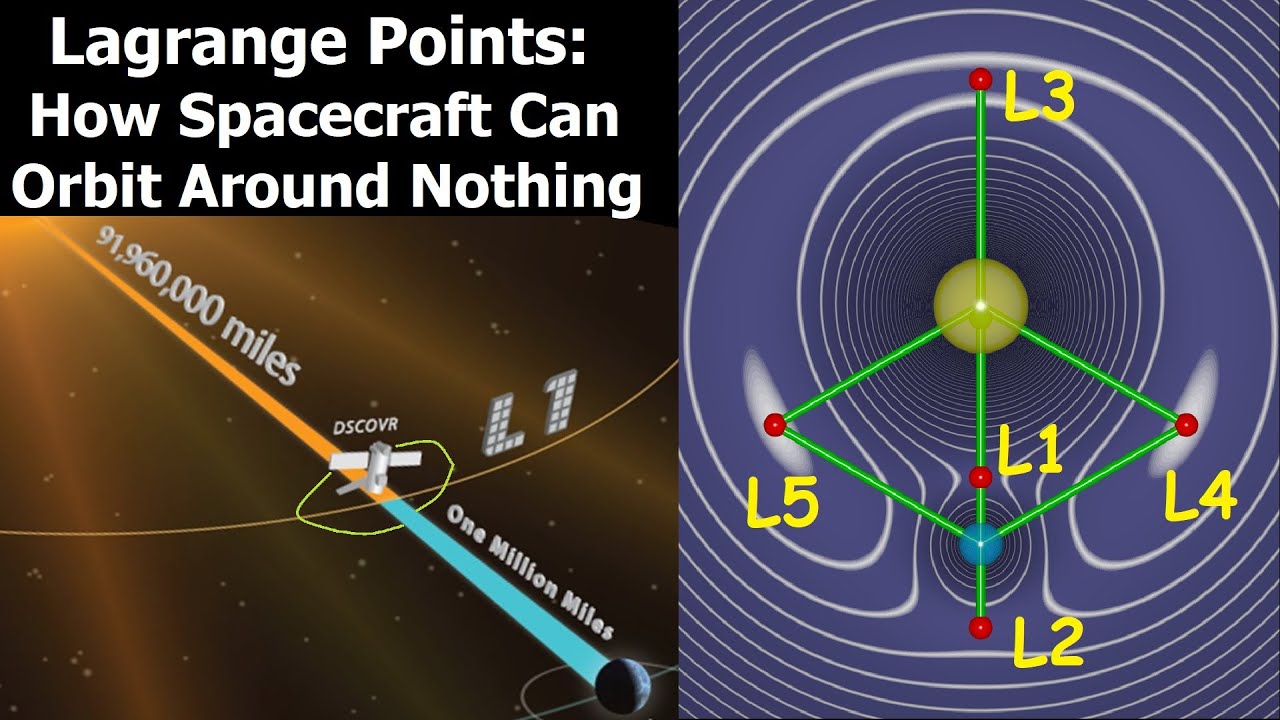
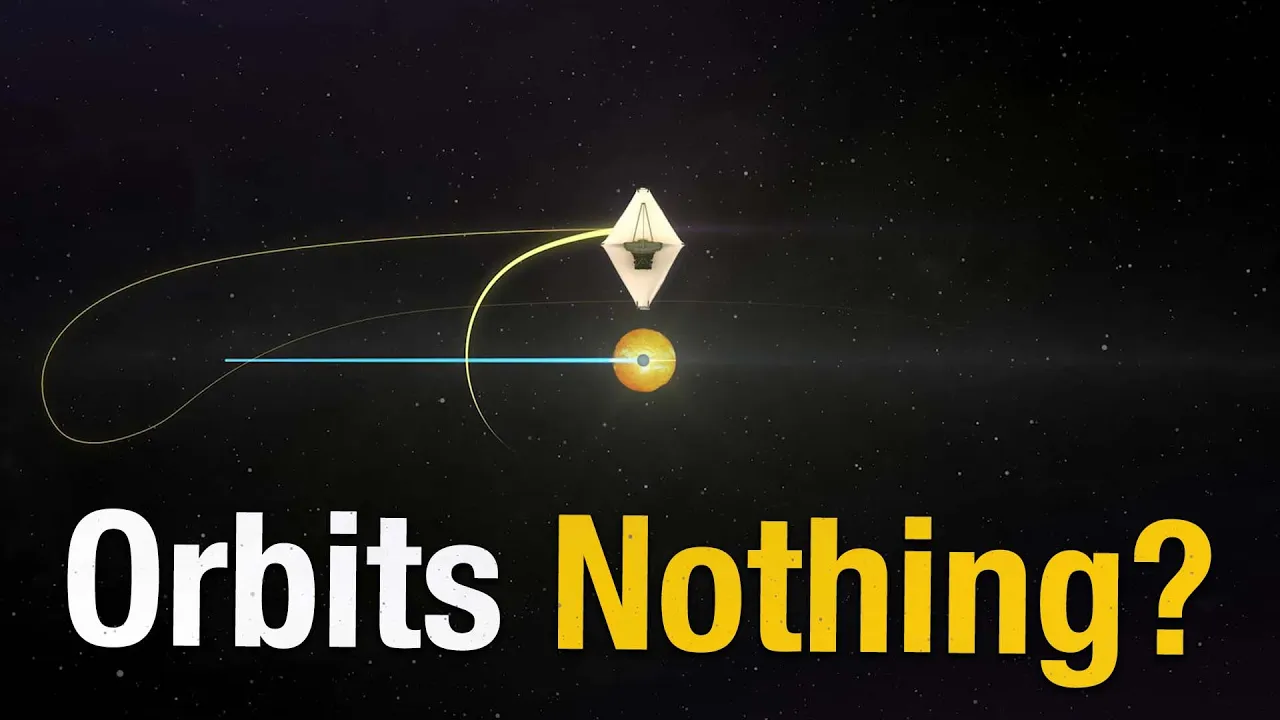
Added:fellow enthusiasts of celestial mechanics I welcome you to today's lecture where we embark on the exciting Journey Through the intricacies of our sun earth system our primary objective for this session is to delve deep into the realm of astrodynamics as we Endeavor to calculate one of the most fascinating and crucial points in this Cosmic dance the LaGrange Point L1 the sun earth system a Celestial ballot that has captivated human curiosity for centuries presents a captivating playground for Celestial mechanics as we explore this intricate dance between a radiant sun and our resilient Earth we will unearth the delicate balance of the gravitational force orbital Dynamics and Cosmic harmonics that governs the interaction the LaGrange points first discovered by the brilliant French mathematician Joseph Louis LaGrange in the 18th century represents stable equilibrium points within the gravitational interplay our focal point L1 is the place where the gravitational force of Sun and Earth conspire to create an equilibrium allowing the objects to maintain relative position with respect to our planet throughout this lecture we'll not only unveil the theoretical under pinning of the lagrangi point L1 but also embark on the fascinating journey of mathematical calculations striving to pinpoint this Celestial sweet spot we'll examine the significance of L1 in the space exploration of satellite positioning and even space missions like James Webb Space Telescope yesterday successful beginning of Aditya album Mission has created Mass awareness of the vantage point LaGrange Point L1 the Sun that brilliant sphere of energy has captivated human imagination since the time immemorial it is not only the life Giver to our planet but also a cosmic laboratory where the intense process Drive the Dynamics of our solar neighborhood understanding sense behavior is just not the scientific curiosity it is essential for safeguarding our technological infrastructure predicting space weather and unrevilling the fundamental secrets of the universe Mission born from the vision and dedication of India's space agency the Indian space research organization ISRO represents a remarkable step forward in our quest to comprehend the enigmatic Sun named after the radiant Hindu daitya Aditya this mission is set to venture closer to the Sun than any previous Indian space mission at the L1 LaGrange a point which provides an ideal Vantage Point are the tail one aims to study the sun with unprecedented precision and death you have started watching this video to gain insight into the calculation of the LaGrange Point L1 and I am your instructor Dr sham Kant and one a professor and head of physics department at SRI shivaji education Society amravati science College nagpur India the Sun is the star at the center of our solar system it is the massive hot ball of plasma inflated and heated by nuclear fusion reactions at its core part of its internal energy is imitate from sun's surface as light ultraviolet and infrared radiations providing most of the energy for life on Earth Suns radius is about you can say 109 times bigger than Earth and the radius of Earth is 6400 kilometers its mass is about 330 000 times that of the mass of Earth roughly three quarters of Sun's mass consists of hydrogen that is 73 percent and the rest mostly helium that is 25 percent with much smaller quantities of heavier element including oxygen carbon neuron and iron then we have my very educated mother just showed us nine planets so these are the planets revolving around sun Earth's rotation or Earth spin is the rotation of planet Earth around its own axis as well as changes the orientation of rotation axis in space Earth rotates Eastward in prograde motion as viewed from the northern Polar Star Polaris Earth turns counterclockwise Earth rotates once in about 24 hours with respect to Sun but once every 23 hours 54 minutes and 4 seconds with respect to other distant Stars on your screen you can observe a wonderful Contour plot of the effective potential due to gravity and centrifugal force of two body system in a rotating frame of reference the three collinear lagrangier points I am talking about L1 this L2 and L3 were discovered by the Swiss mathematician Leonard Euler around 1715 a decade before the Italian Bar Joseph Louis LaGrange discovered the remaining two in 1772 LaGrange published an essay on the three body problem in the first chapter he considered the general three body problem from that in the second chapter he demonstrated two special constant pattern Solutions the collinear and the equilateral for the three masses with circular orbit now I am going to roll through little familiar terms for physics students the orbital velocity of Earth around the Sun is 30 kilometer per second Earth takes 365 days trying to complete one such Revolution which is in fact in an orbit that is elliptical in shape and the Sun is at one of the foci for Simplicity in the mathematical equations we shall consider Earth is taking an orbit of radius r that describes complete trajectory 2 pi r that is circumference of the trajectory in the time period capital T that is 365 days here we can explore Earth's velocity from the simple formula that ve that is velocity of Earth is equal to distance upon time and distance is 2 pi r and the time taken is 365 days you can convert it into seconds in physics we call this issue a two body problem wherein we have two gravitating objects Sun and Earth here we are conveniently ignoring the mass of satellite small M that I am going to consider in our equations as it is negligible as compared to mass of the giant Sun and Earth now we shall write two equations for force first one is Force on Earth due to Sun and secondly we shall deal with force on satellite due to Sun and Earth let us tackle the problem one by one force on Earth due to Sun so summation of all forces experienced by Earth is equal to m ER that is acceleration here the force on Earth is composed of the gravitational force on Earth due to Sun and according to Newton's law of gravitation it is g m m upon R square so M suffix e is mass of Earth and M suffix s is mass of sun R is the distance between Center of Earth and center of sun G is the gravitational constant given by Isaac Newton this is equal to the centripetal force m e v e Square upon R in fact you must be remembering m v Square upon R so as Earth is rotating around the sun we have to consider mass of Earth velocity of Earth and distance between Sun and Earth now here we can eliminate mass of Earth from this equation and we are left with g m s upon R square this is equal to 1 by r this R I have carried and v e Square I want to substitute and it is to be substituted from this place so this will be 4 Pi Square R square upon T Square so here it is being substituted now simplifying this R from the that can be canceled with one of the r here so on left hand side we have g m s upon R square that is equal to 4 Pi Square R upon T Square this is one important equation that we are going to use for substitution later on so I am going to pin it on the top of the slide now here I have pinned the equation of our requirement which we have concluded in the last slide and now here I have new equation velocity of satellite equal to distance traveled by the satellite in the given type so here the distance traveled by the satellite we want to find now let us come back to this figure here this is the point where we have Center option and this is the place where we have our planet Earth and this is the probable LaGrange point I am talking about L1 is the distance of this point from Earth and then r small r I want to cite it is the distance between Center of sun and Earth so here one part of the distance is L1 and another part of this distance this is R minus L1 now our satellite is going to be placed at this point L one I want to mention that small M represents mass of satellite and the distance of satellite from Sun right I just want to highlight that the distance of the satellite from Sun is this one and this is R minus L I hope you understand this now here I want to make it clear that again we are finding the force on satellite due to Sun and Earth so here at this point L1 we have satellite of mass m and we want to find force on satellite because of sun and because of Earth the basic equation being summation of all forces equal to m a r bar that is acceleration now here we have Force on satellite because of sun so Newton's law of gravitation g into M1 M2 upon R square mass of one object is mass of sun mass of satellite divided by distance between them that we have estimated R minus L1 Square minus so here I am using minus with this summation side because the Force because of Sun gravitational force of attraction is going this way and because of Earth it is going this way in opposite direction so that is incorporated into the equation with negative sign G M1 M2 upon distance Square so g into mass of Earth into mass of satellite divided by distance between the position of satellite that we are calling L1 distance from Earth and that is our objective of finding that L1 distance so L1 is already introduced into our equation that is equal to MV Square upon R where we have to use V square of satellite so as Earth is orbiting around the Sun so here you can take a look Earth is orbiting around the Sun at the same time this satellite will also be orbiting around sun and as I said small R is this distance and L1 is this distance the remaining part that we want to chart is this one this can be R minus n rather R minus L one so in this way we have MV Square upon r that distance is actually R minus L1 now V Square satellite is 4 pi r minus L1 Square upon T Square this we need to substitute in this place reset Square let's go ahead furthermore I want to mention that we can divide the equation by small M so that mass of satellite is not going to play any role in our equation of L one that is LaGrange a point and our simplified version of the equation is like this g m s upon R minus L1 Square minus G m e upon L1 square that is equal to 1 upon R minus L1 so this m is replaced by unity and this V sat Square I am taking 4 Pi Square R minus L1 whole Square divided by T Square now we want to simplify this I am taking this R common and we have here R square and then we are left with 1 minus L1 upon R to the power minus 2 if we bring it up now here we are going to use the binomial theorem and if we have X Plus y to the power n where Y is very small quantity then it is equal to 1 plus n times y l 1 is a small distance from Earth divided by the total distance between Center of Sun and Earth this quantity is also going to be small so 1 minus L1 upon R to the power minus 2 this is equal to 1 plus 2 L1 upon R so this binomial expansion approximation we are considering under the condition Y is small so here L1 upon R is small so we are going to replace this bracket 1 minus L1 upon R to the power minus 2 by this now that we are very close to the solution that we are looking forward this is the last equation we have had on our earlier slide and by replacing the binomial expansion with the approximation that L1 upon R is small we can rewrite this equation like this so here 4 Pi R square upon T Square I am coupling together and this can be substituted from the first equation that we have written as GMS upon R square so we want to replace this we have already done this binomial exponential and then we have g m s upon R square inside bracket 1 plus 2 l 1 upon R minus g m e upon L1 this is equal to g m s upon R square we have done this substitution into bracket 1 minus L1 upon r now we just want to simplify this equation before going a step ahead I want to cancel out G from our equation you can divide the equation by G and G will be eliminated from the equation and let's go ahead so Ms upon R square into bracket 1 plus 2 l 1 upon R minus me upon L1 square that is equal to Ms upon R square into bracket 1 minus L1 upon r now we can further simplify this now this one and this one with same coefficient m s upon R square can be ignored and then we can take this term to left hand side it will be with plus sign and that will be Thrice L1 upon r m s upon R square minus m e upon L1 Square as it is here so let's go ahead with this equation on the next slide so I am rewriting the last equation and simplifying this equation further taking me upon L1 Square on right hand side so Thrice L1 Ms upon R cube is equal to me upon L1 Square we can take L1 on left hand side so L1 Cube on left hand side we want to find that quantity and on right hand side we have R Cube me upon price Ms taking cube root of the equation L1 is equal to R times cube root of M A upon price MS now the distance of Earth from Sun is 1.5 into 10 power 11.
this is about 8 light minutes the light the light minute distance we are finding 8 into 60 Seconds into speed of light 3 into 10 Power 8 meters so 8 light minutes distance this you can find out it is 1.5 into 10 power 11 meters or else you can find this as 150 million kilometers then mass of sun is 1.99 into 10 power 30 kg mass of Earth is 5.98 into 10 power 24 kg so we can substitute all these values in the equation for L1 and we can find out L1 is equal to 1.5099 into 10 power 9 meters so 10 power 9 meters is 1 million kilometers so million means 10 power 6 and kilo means 10 power 3 so that makes 10 power 9.
so the distance between Sun and Earth is 150 million kilometers and this is 1.5 million kilometers about one percent of the total distance thank you so here you can see this is Sun this is Earth Moon is revolving around Earth and we have Point L1 which is 1.5 million kilometers from Earth now Aditya L1 mission is launching satellite to this point L1 following its schedule on subtable 2 2023 are the tell one stays Earthbound Orbits for 16 days during which it undergoes five manures to gain the energy rather velocity which is necessary for its Journey subsequently Aditya L1 undergoes trans lagrangian intersection manure making the beginning of its 110 days trajectory to the destination around lagrangi point upon arrival at L1 Point another maneuver means Aditya L1 to the orbit around L1 a balanced gravitational location between Earth and Sun is our Point L1 the satellite spends its whole mission life orbiting around L1 in an irregularly shaped orbit in a plain roughly perpendicular to the line joining Earth and Sun the Strategic placement at L1 LaGrange a point ensures that Adit L1 can maintain a constant uninterrupted view of the Sun this location allows the satellite to access solar radiation and Magnetic storms before they are influenced by Earth's magnetic field and atmosphere additionally Bell one points gravitational stability minimizes the needs for frequent orbital maintenance efforts optimizing satellites operational efficiency so I hope that this discussion has helped you in understanding how to find this point L1 which is about 1.5 million kilometers from Earth which is one percent of its distance between Earth and Sun thank you for your patience and listen I would request you to follow my YouTube channels thank you very much
Up Next

How Do Wind Turbines Work? | Wind Energy Technology Explained
@SabinCivil
9.7M views•2015-07-29

21cm Hyperfine Transition in Neutral Hydrogen: Radio Astronomy Basics
@AaronRobertParsons
12.4K views•2011-10-13

NMR Spin Physics I: Zeeman Effect, Resonance Condition & Larmor Frequency
@nptel-indianinstituteofsci8064
2.3K views•2024-01-17

Entropy and the Second Law of Thermodynamics Explained
@veritasium
27.5M views•2023-07-01
Related Study Plans & Knowledge Roadmaps
Structured learning paths in Physics