John Rawls' 'veil of ignorance' is a thought experiment where individuals design a just society without knowing their future position (such as wealth, race, gender, or abilities), leading them to choose principles of extensive freedom and fair equality of opportunity, with extreme inequalities only permitted if they directly benefit the poorest members of society.
John Rawls' Veil of Ignorance Explained in 2 Minutes
Added:Deep Dive
The concept of a philosophical 'thought experiment' and how virtual scenarios are used to analyze ethical questions.
Intro to Philosophy | What Are Thought Experiments and Why Do We Use Them? | Dr. Gregory B. Sadler
1.1K
Thought experiments are imaginative scenarios used in philosophy to explore complex ideas by asking 'what if' questions, helping us examine our intuitions and stretch our reasoning abilities without physical experimentation; they appear throughout history from Mencius's child-in-well scenario to Plato's Ring of Gyges, and are also used in science, history, and literature to deepen understanding of ethical, metaphysical, and epistemological questions.
Click to watch →

Season 4 Episode 9 Ft. Virginia Philosophy Reality Lab! The Between Realities VR Podcast
294
Traditional philosophical thought experiments rely on hypothetical scenarios that may not translate to real-world moral decision making. People who claim they would sacrifice themselves to save others in hypothetical situations often behave differently in actual emergencies. This discrepancy occurs because hypothetical scenarios lack the emotional intensity and immediate consequences of real situations. Virtual reality offers potential solutions by creating immersive simulations that engage emotional and cognitive processes more authentically than abstract hypotheticals.
Click to watch →

Alex O’Connor TRAPS Craig Biddle Into Admitting Ethics Exists Without Death
331
The objectivist philosopher argues that thought experiments like the immortal scenario are not useful for ethics because they deal with situations outside the realm of possibility. She claims ethics is a practical subject that helps us make life and death decisions, set up relationships, businesses, and societies. When we imagine scenarios that don't exist, we are no longer dealing with ethics but with a different situation entirely. This represents a methodological disagreement about how thought experiments should be used in philosophical inquiry.
Click to watch →

【夜眠れなくなる】怖い思考実験10選【ゆっくり解説】
767.9K
Thought experiments are hypothetical scenarios used to explore philosophical questions by examining what would happen under certain conditions. The Trolley Problem illustrates this: a runaway trolley threatens five workers, and you can either do nothing (five die) or switch tracks (one dies). The purpose is not to find the 'correct' answer but to examine the reasoning behind choices and explore ethical theories. The Violinist Thought Experiment asks whether you have an obligation to stay connected to a famous violinist for nine months to save his life, even though you were kidnapped and didn't consent. This explores whether we have moral obligations to help others at significant personal cost, and whether consent matters in such cases.
Click to watch →

きわめて風変わりな思考実験ランキング
56.8K
Thought experiments are philosophical scenarios where listeners are placed in special situations to explore fundamental questions about morality, time, and consciousness. They require only imagination, not laboratory equipment. Five classic examples are presented: Mary's Room (Frank Jackson) explores whether physical knowledge alone can explain consciousness; The Experience Machine (Robert Nozick) challenges hedonism by showing people prefer authentic reality over simulated happiness; Newcomb's Paradox (William H. Newcomb) raises questions about free will and determinism through a prediction-based game; The Veil of Ignorance (John Rawls) asks us to design society without knowing our future position, promoting fairness; Plato's Cave allegory suggests sensory experience reveals only shadows of true reality, with philosophers as those who escaped the cave to return and explain truth to those still trapped.
Click to watch →
Deep Dive
The fundamentals of Social Contract Theory, particularly the ideas of Thomas Hobbes, John Locke, and Jean-Jacques Rousseau regarding the origins of societal rules.

राज्य एवं उत्पत्ति के सिद्धान्त UNIT-19 , POLITY, MPTET VARG-3 CHAYAN PARIKSHA 2025 BY SAMARPAN SIR
28.4K
Thomas Hobbes developed the Social Contract Theory in 'Leviathan,' arguing humans are naturally selfish and aggressive, requiring an absolute monarch to maintain order. John Locke believed humans are naturally good and peaceful, forming the state to protect natural rights to life, liberty, and property, supporting democratic government. Jean-Jacques Rousseau argued humans are shaped by circumstances, and with the development of agriculture and private property, people became greedy and selfish, leading to conflict. All three agreed the state originated through voluntary agreement among people to escape the violent conditions of the state of nature.
Click to watch →

The Social Contract | Hobbes, Locke, Rousseau | Keyword
4.8K
Social contract theory examines how individuals consent to form societies through mutual agreements for collective benefit; Thomas Hobbes viewed the state of nature as a chaotic 'war of all against all' requiring an absolute sovereign to enforce order, while John Locke saw nature as orderly with inherent rights to life, liberty, and property that government should protect, and Jean-Jacques Rousseau argued that society actually restricts human freedom despite emerging from a potentially better state of nature.
Click to watch →
CSS Sociology | Sociability & Sociality of Man Explained | Individual & Society #css2026 #upsc #pms
343
Enlightenment philosophers Thomas Hobbes, John Locke, and Jean-Jacques Rousseau developed social contract theory to explain how society came into existence. When humans lived alone, they created a consensus among themselves to form society and a state. Hobbes emphasized collective security for life, while Locke identified three fundamental rights protected by this contract: life, liberty, and property. Rousseau advocated for all fundamental rights through this social agreement.
Click to watch →

Theories on the emergence of Society. Lecture-5
631
The three classical representatives of Social Contract Theory are Thomas Hobbes, John Locke, and Rousseau. These philosophers developed the theory to explain how society originated. Before civil society was formed, individuals lived in a pre-social state. The theory explains that individuals made a social contract to form society, which transformed natural freedom into civil freedom. Civil society is characterized by rules, laws, rights, and duties that govern social interactions.
Click to watch →

Theories of Social Contract Thomas Hobbes Rousseau John Locke 1
122
Social contract theory explains how societies and states are created through voluntary agreements. Thomas Hobbes (16th-17th century England) believed the state of nature was violent and insecure, leading people to surrender all powers to a single ruler for security, resulting in absolutism. John Locke (18th century England) challenged this, arguing people were happy alone but formed societies to maximize pleasure through exchange systems, with representatives who could be deposed if they failed—reflecting democratic principles. Jean-Jacques Rousseau (18th century France) criticized society entirely, believing man was only truly free in nature without government, proposing that individuals recognize each other as rulers, creating the 'general will' where the masses decide their own fate. These theories influenced European political movements and revolutions.
Click to watch →
Deep Dive
A basic understanding of distributive justice, which addresses the fair allocation of resources, rights, and opportunities within a society.

Justice procedural and distributive. Political science BA 1 semester I NEP2020 KU
127
Distributive justice focuses on the fairness of outcomes, specifically how resources, rights, and opportunities are distributed in society. It examines the distribution of wealth, education, healthcare, power, and opportunities. The central question is: who gets what, and why? Three guiding principles exist: equality (everyone receives the same), merit (those with more talent or effort receive more), and need (those with greater needs receive more). Examples include scholarships for poor students, reservations for disadvantaged groups, and welfare schemes for economically weak populations. A just society requires both procedural justice (fair processes) and distributive justice (fair outcomes) to maintain legitimacy and social stability.
Click to watch →

Political Science 11000+ One liners (Lecture 11)
397
Distributive justice concerns the fair distribution of resources, opportunities, and benefits in society. According to Aristotle, it is based on three principles: (1) Equality - all individuals should receive equal shares; (2) Merit - rewards should be based on contribution and effort; (3) Need - resources should be distributed according to individual requirements. For example, if a society has 100 units of resources and 10 people, each should receive 10 units (equality). However, if some contribute more, they may receive more (merit), and those with greater needs should receive adequate support (need).
Click to watch →
Dialogue| Web Series|Distributive Justice|Communitarian Critique on Distributive Justice| Chapter-I|
599
Distributive justice concerns the fair allocation of resources in society, defined as the perceived fairness of how rewards and costs are shared by group members. According to Aristotle, justice is classified into distributive justice (distribution of rights, honors, goods based on proportionate equality) and corrective justice. The scope includes citizens' rights to franchise, labor rights, and amenities, as well as the right to form unions. In democratic societies, distributive justice is dispensed by legislative bodies, while in non-democratic states, it is dispensed by autocratic rulers. Procedural justice emphasizes fair principles and criteria for distribution, relating to liberalism. Substantive justice emphasizes beneficiaries, particularly the poor, relating to socialism. Rawls' two principles of justice are: (1) Each person has an equal claim to a fully adequate scheme of equal basic liberties, and (2) Economic inequalities must satisfy conditions of fair equality of opportunity and be to the greatest advantage of the least advantaged members of society.
Click to watch →
Five Nights at Freddy's and Justice
89.9K
Distributive justice, also called economic justice, concerns the fair distribution of resources in society. It addresses questions about equality and human rights, including whether people deserve basic necessities like food, water, healthcare, cell service, and transportation without expectation of exchange. It also examines how much it is fair to take from those who have more to give to those who have less. These questions significantly impact voting, education, and how we treat those with less than us.
Click to watch →

BPSC 131 Important Questions BPSC 131 राजनीतिक सिद्धांत का परिचय BPSC 131 Pervious Year Question
25.4K
Distributive justice (वितरणकारी न्याय) refers to the fair distribution of benefits and burdens in society. This concept holds that individuals should receive what they deserve based on their contributions, abilities, and needs. Distributive justice is concerned with how resources, opportunities, and responsibilities are allocated among members of society. This concept is central to debates about economic policy and social welfare.
Click to watch →
Prerequisite Knowledge
- Concept 01The concept of a philosophical 'thought experiment' and how virtual scenarios are used to analyze ethical questions.
- Concept 02The fundamentals of Social Contract Theory, particularly the ideas of Thomas Hobbes, John Locke, and Jean-Jacques Rousseau regarding the origins of societal rules.
- Concept 03A basic understanding of distributive justice, which addresses the fair allocation of resources, rights, and opportunities within a society.
Subsequent Learning
- Step 01John Rawls' resulting Two Principles of Justice: the Liberty Principle and the Difference Principle.
- Step 02Prominent critiques of Rawls' theory, including Robert Nozick's libertarian arguments and communitarian objections.
- Step 03Real-world applications of the Veil of Ignorance to modern policy issues like progressive taxation, healthcare reform, and systemic inequality.
- Step 04A comparative study of Rawls' 'justice as fairness' versus Utilitarianism and other consequentialist ethical frameworks.
Veil of Ignorance
Veil of Ignorance
0:01Playing Section
- 1
Introduces the veil of ignorance thought experiment for designing a fair society.
- 2
Argues it would lead to extensive freedoms and fair equality of opportunity.
- 3
Suggests limiting high pay unless it directly benefits the poorest.
Robert Nozick's Libertarian Critique (Entitlement Theory)
Robert Nozick, a prominent libertarian philosopher, offered a major critique of Rawls in his book 'Anarchy, State, and Utopia'. Nozick argues that Rawls’ 'Veil of Ignorance' incorrectly treats resources as if they appeared out of nowhere, waiting to be distributed. Instead, Nozick presents the 'Entitlement Theory,' which asserts that wealth and resources are just if they were acquired justly (through labor or voluntary exchange) and transferred justly. From this perspective, continuous state redistribution to maintain equality—as Rawls’ Difference Principle demands—violates individual liberty by unjustly seizing private property. Rather than focusing on 'end-state' distributions, Nozick argues that justice is about respecting the historical processes and individual choices that created those distributions.
Deep Dive
John Rawls' resulting Two Principles of Justice: the Liberty Principle and the Difference Principle.

John Rawls, A Theory of Justice | Two Principles of Justice | Philosophy Core Concepts
28.9K
John Rawls' theory of justice proposes two fundamental principles that rational agents would choose behind a veil of ignorance: (1) Each person has an equal right to the most extensive scheme of equal basic liberties compatible with similar liberties for others, including political liberty, freedom of speech, liberty of conscience, freedom of thought, freedom from psychological oppression, right to hold personal property, and freedom from arbitrary arrest; (2) Social and economic inequalities are only just if they are reasonably expected to be to everyone's advantage and attached to positions and offices open to all. The first principle takes priority over the second, meaning no amount of social or economic benefit can justify violating basic liberties.
Click to watch →

Bbmku sem 8 MJ-20 history important questions l mj 20 history sem 8 bbmku question answer rk centre
780
Rawls proposed two principles of justice: (1) The principle of equal liberty - Every person should have an equal right to the most extensive basic liberties compatible with similar liberties for others; (2) The difference principle - Social and economic inequalities are permissible only if they benefit the least advantaged members of society. These principles together ensure both individual freedom and social justice, with the second principle specifically protecting vulnerable populations. Rawls argued that these principles would be chosen by rational individuals behind the veil of ignorance.
Click to watch →

Concepts of liberty, equality, justice and rights unit 2 Introduction to pol theory sem 1 ba program
76.6K
Rawls proposed two principles of justice: (1) Equal Basic Liberties - all individuals should have equal basic liberties including personal freedom and freedom of speech and assembly; (2) Fair Equality of Opportunity - social and economic inequalities should be arranged to benefit the least advantaged members of society, empowering those who have received fewer advantages. Critics argue that the veil of ignorance is unrealistic as judges cannot literally ignore personal biases, and the theory is too idealistic for real-world application.
Click to watch →

John Rawls y su Teoría de la Justicia - Filosofía del siglo XX
100.9K
Rawls breaks down his theory into three principles with a strict lexical order of priority. The first principle states that every person must have equal right to the most extensive system of basic liberties compatible with similar freedom for all, including political freedom, freedom of expression, conscience, personal liberty, property rights, and freedom from arbitrary detention. This takes absolute priority. The second principle has two parts: part 2b requires social and economic inequalities to benefit the least advantaged and ensure fair equality of opportunity; part 2a (the difference principle) mandates maximizing the position of the most disadvantaged. This maximin principle ensures that even in uncertain situations, individuals behind the veil of ignorance will choose principles protecting the worst-off, generating growth benefits for the entire system.
Click to watch →
Rawls - Justice and Fairness in Society
85.9K
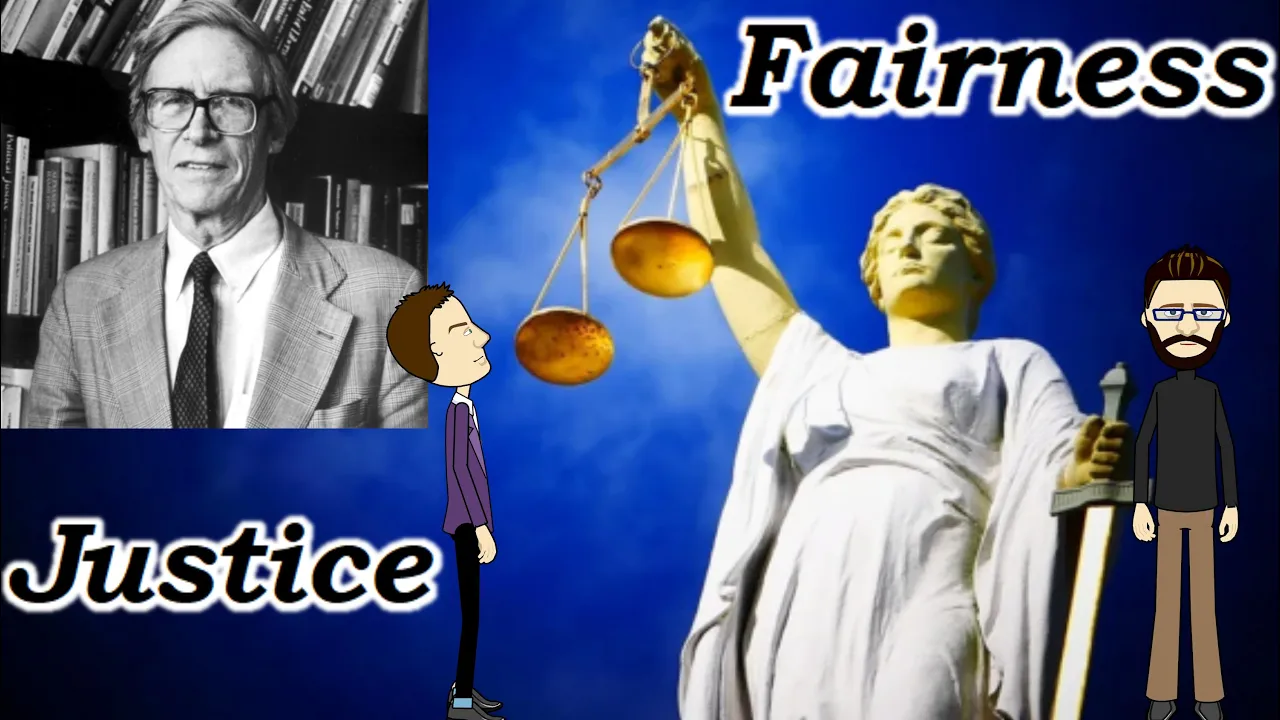
Rawls derived two fundamental principles of justice from the original position: First, the Equal Liberty Principle guarantees equal basic liberties for all, including political rights, freedom of speech, assembly, conscience, property ownership, and protection from arbitrary detention. Second, the Difference Principle allows for social and economic inequalities only if they benefit the least advantaged members of society. This framework justifies some inequality when it improves outcomes for the poorest, such as allowing talented individuals to innovate and create wealth that ultimately raises everyone's standard of living.
Click to watch →
Deep Dive
Prominent critiques of Rawls' theory, including Robert Nozick's libertarian arguments and communitarian objections.

Справедливость | Вадим Чалый | Сева Ловкачев, Евгений Цуркан | Подкаст о философии
58K
John Rawls proposed that we should imagine ourselves in an 'original position' behind a 'veil of ignorance' where we don't know our place in society, abilities, or social status. From this position, rational people would choose principles of justice that maximize the position of the least advantaged. Rawls argues for two principles: equal basic liberties for all, and inequalities that benefit the least advantaged. Critics argue this is too abstract and culturally biased. Robert Nozick, a libertarian philosopher, argued that justice requires respecting property rights and that any distribution resulting from voluntary exchanges is just, regardless of inequality. Communitarianism argues that justice cannot be understood abstractly but must be connected to communities and relationships that shape human identity. The challenge is whether universal principles can capture the full complexity of human moral life or whether justice must be understood within particular cultural and community contexts.
Click to watch →
John Rawls and Robert Nozick
17.5K
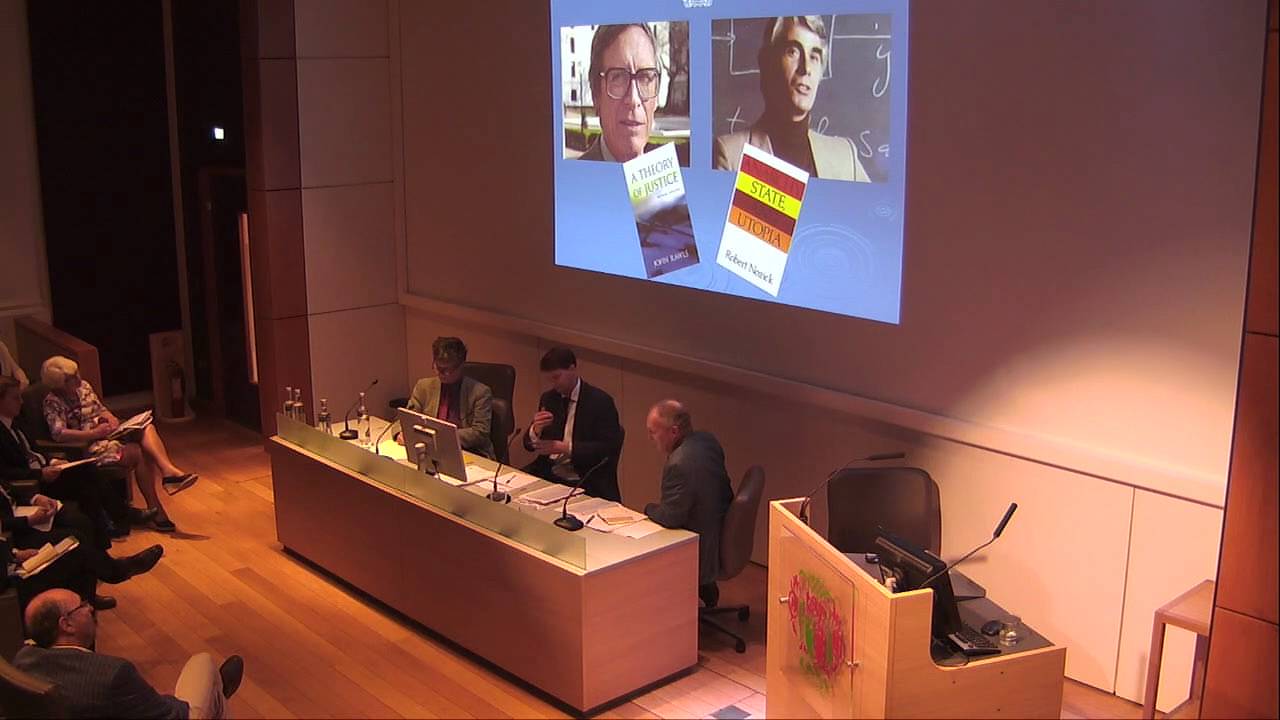
Robert Nozick, a moral realist, critiques Rawls' contractualist approach as arbitrary and lacking moral foundation. He argues that humans are ends in themselves with inherent rights that cannot be overridden by collective agreements. Nozick contends the state has only minimal legitimate functions: defending against force, theft, fraud, and enforcing freely entered contracts. He rejects forced redistribution, calling it slavery, and challenges Rawls' thought experiments as retro-engineered to produce liberal outcomes rather than discovering objective moral truths.
Click to watch →
8.2. John Rawls 2/3 - Los principios de justicia y sus objeciones
4.7K
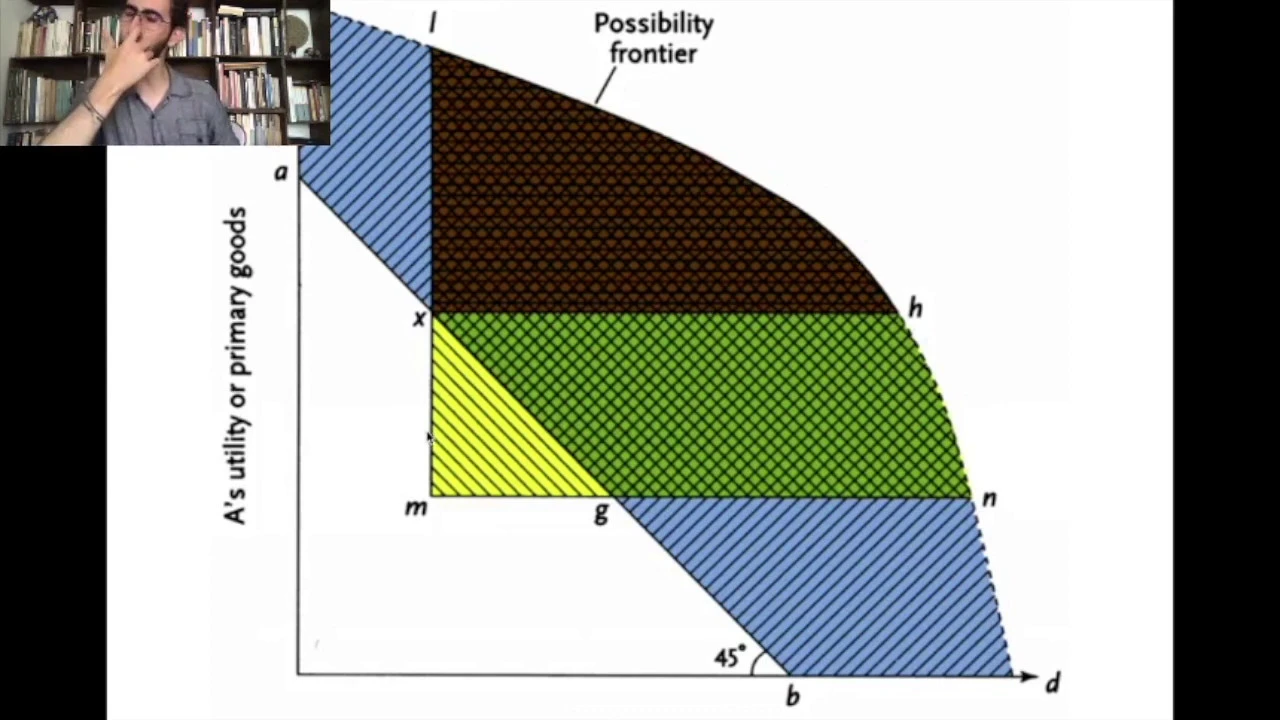
Rawls faced three major criticisms: (1) The incentive problem: critics argued his principle of difference undermines incentives for the wealthy to work and use their talents, potentially making everyone worse off. Rawls responded that a just society must balance efficiency with justice, ensuring the free market is open to all without excessive inequality. (2) The meritocracy criticism: critics argued Rawls rejects that people should own the fruits of their labor. Rawls countered that effort itself is morally arbitrary because it is influenced by family background and upbringing. (3) The libertarian criticism from Robert Nozick: argued Rawls violates property rights and individual freedom by taxing the wealthy to redistribute resources. Rawls responded that the natural distribution of talents is neither just nor unjust—it is merely a natural fact. What can be just or unjust is how institutions respond to these facts.
Click to watch →

Rawls, théorie de la justice et souverainisme
3.2K
Rawls' theory generated extensive debate through multiple critical responses. Robert Nozick's libertarian alternative proposes three principles: self-ownership, original acquisition, and fair transfer—arguing free transactions preserve justice like logical operations. Marxist scholars Jerry Cohen and Alan Gewirth criticized Rawls for ignoring structural barriers and social recognition, arguing that merely distributing goods without addressing how people became disadvantaged perpetuates marginalization. Communitarian Michael Sandel (a former Rawls student) critiqued liberalism for judging individuals only by abstract attributes rather than recognizing community attachments. Feminist Susan Moller Okin argued Rawls ignored gender injustice within families. Multicultural theorists proposed adding specific freedoms for distinct communities. Rawls' framework maintains relevance partly because alternatives haven't successfully replaced it, demonstrating the ongoing vitality of debates about justice and the proper role of government in society.
Click to watch →

John Rawl's Theory of Justice and its Critiques (Part-II)
5.1K
Rawls' Theory of Justice (1971) faced criticism from liberal and Marxist traditions. Communitarians argue Rawls ignores community linkages of identity, believing persons cannot detach from community. Robert Nozick criticized Rawls' Minimax principle as a degradation of liberty, advocating a minimalist state based on entitlement theory. Marxist scholars argue Rawls' basic structure conceals exploitation in capitalist society. Feminist scholar Susan Okin criticized Rawls for attaching women to family and husbands, failing to address distribution within the family. Michael Walzer criticizes Rawls for universalist principles, arguing justice cannot be universal because distribution should depend on the site of production. Ronald Dworkin, a luck egalitarian, builds on Rawls by introducing 'brute luck' (unchosen circumstances like disabilities) into distribution. Joseph Raz synthesizes Rawls and Dworkin by combining individual good and the common good.
Click to watch →
Deep Dive
Real-world applications of the Veil of Ignorance to modern policy issues like progressive taxation, healthcare reform, and systemic inequality.

Rawls: 🤯la teoría que REVOLUCIONA el Pensamiento
211
Rawls' Veil of Ignorance can be applied to evaluate real-world policies. In Argentina, women receive pensions 5 years earlier than men, which would be unjust if one did not know their gender. The 2008 pension reform from Capitalization to Redistribution is unjust because workers who cannot afford basic living costs should not have their wages taken for housing loans or provincial debts. Public resources should prioritize essential services like healthcare and education over superfluous expenses like concerts or official vehicle renewals.
Click to watch →

PolSci_XI_Social Justice_Part4_John Rawls Theory of Justice_Rishabh Jain
9.9K
Rawls calls the state of not knowing one's position the 'veil of ignorance.' When policy makers are under this veil, they don't know if they will be born rich, poor, upper caste, or lower caste. Therefore, they should create policies that would benefit even the worst-off section. Basic requirements include free healthcare, free education, and food. When these are met for the poor, they can lift themselves up, and this also benefits the rich by reducing the gap between them.
Click to watch →

一個思想實驗 足以推翻你對公平的所有想像-無知之幕-《正義論-第一集》A Theory of Justice丨約翰羅爾斯John Rawls丨陳老C丨廣東話丨Ep1583
2.1K
Achieving true fairness is difficult because everyone uses the word 'fairness' to protect their own position. Rawls proposes the Veil of Ignorance as a solution: design social rules without knowing your future position. This forces impartial consideration of fairness. Behind the Veil, we don't know our wealth, health, intelligence, race, or social position, making it impossible to favor any particular system. Arguments for marketizing healthcare include competition improving service and government savings. Arguments against include healthcare becoming a commodity based on profitability rather than need, medical risks becoming individual burdens that can bankrupt families, and those who need healthcare most may not receive it. Behind the Veil of Ignorance, no one would support canceling healthcare because the risk of ending up unable to afford necessary medical care is too great.
Click to watch →
GTAA Season 3 Episode 9: How to Be An Anti-Capitalist in the 2020s (ft. Meagan Day)
2.2K
Applying Rawls' veil of ignorance to contemporary capitalism reveals problems with extreme economic inequality. If you didn't know whether you'd be born into wealth or poverty, you wouldn't support systems where some are born into privilege regardless of effort, or where losing your job means losing healthcare. The same logic applies to other arbitrary factors like attractiveness or physical ability that affect life outcomes. Rawls argued this shows why we should design societies that protect the least advantaged.
Click to watch →

무지의 베일(Veil of Ignorance)이란? 무지의 장막, 존 롤스(John Rawls)
3.2K
The Veil of Ignorance is a philosophical thought experiment developed by John Rawls, where individuals design society's rules without knowing their future position. This ensures fairness by preventing bias toward any particular group. Behind the veil, people are ignorant of their age, gender, intelligence, abilities, location, health, family background, and occupation. Using South Korean statistics (average income 2.5 million won/month, 5% disability rate, average age mid-40s), a just society should implement: proportional rewards for hard work, government support for disabled individuals, welfare for low-income earners, progressive taxation on high earners, and appropriate taxation on capital gains like real estate. This framework ensures social rules benefit everyone regardless of their actual circumstances.
Click to watch →
Deep Dive
A comparative study of Rawls' 'justice as fairness' versus Utilitarianism and other consequentialist ethical frameworks.

존 롤스 '정의론'1 , 인문학 대마왕 안치용의 고전 뽀개기 # 16
184
Rawls proposes justice as fairness as an alternative to utilitarianism. Utilitarianism aggregates individual utilities and may sacrifice the interests of some for the greater good, violating the principle of equal respect for persons. Rawls' first principle requires equal basic liberties for all. The second principle requires fair equality of opportunity and the difference principle, which permits inequalities only if they benefit the least advantaged. Rawls argues that justice is the first virtue of social institutions, and principles of justice should be derived from an impartial framework that ensures fairness to all members of society.
Click to watch →

Classics Revisited Webinar Series: A Theory of Justice
583
John Rawls proposes that justice should be regarded as fairness, integrating social contract theory with Kantian ethics. He critiques utilitarianism for potentially justifying harmful policies like slavery if enough people derive pleasure from oppression. Rawls introduces the veil of ignorance—a thought experiment where individuals choose society's structure without knowing their position (rich/poor, talented/untalented, male/female). Rational risk minimizers would create societies maximizing the welfare of the least advantaged. His two principles of justice establish maximum liberty for all consistent with equal liberty, plus the difference principle allowing inequalities only if they benefit the least advantaged. This prevents tyranny of the majority by ensuring policies never harm the least among us. The section then compares Rawls with Kantian ethics (absolute rules with no exceptions) and utilitarianism (greatest good for greatest number), showing how Rawls synthesizes both approaches while acknowledging limitations in each framework.
Click to watch →
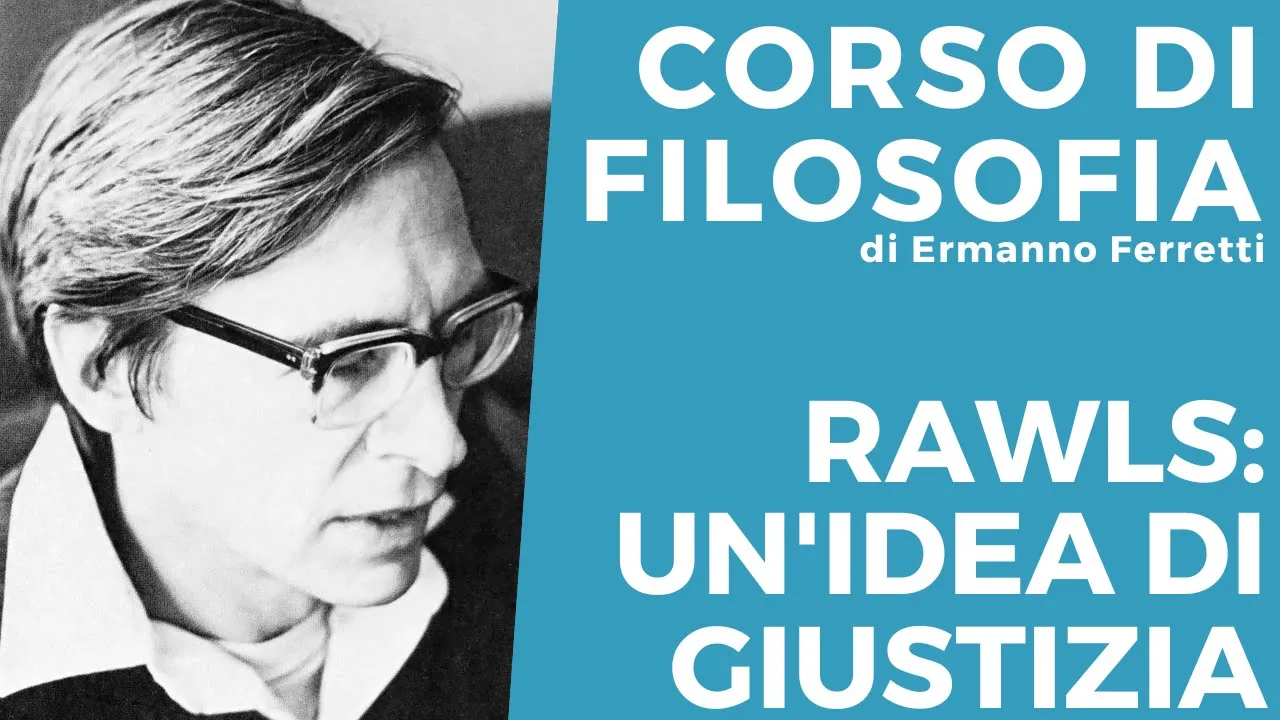
Rawls: verso una idea di giustizia
12.5K
John Rawls critiques utilitarianism as the starting point of his reflection. Utilitarianism holds that the purpose of society is to pursue the greatest possible pleasure for the greatest possible number of people. Rawls argues this approach has serious problems because it can justify unjust outcomes—for example, exploiting a minority if this generates greater advantage for the majority. He contends that justice comes before pleasure and pain, and that we need to base political doctrines on the concept of justice rather than calculations of aggregate happiness.
Click to watch →

47. La justicia. Rawls. 3: El utilitarismo y su crítica
1.4K
Rawls argues that utilitarianism is flawed because it requires sacrificing justice for the sake of maximizing overall happiness, as illustrated by the hypothetical case of O.J. Simpson where a utilitarian would advise declaring an innocent person guilty to prevent social unrest, whereas Rawls' theory of justice as fairness holds that justice must be independent of consequences and cannot be compromised for greater aggregate happiness.
Click to watch →
Libertarian Debate w/ Adam Kokesh - MR Live - 12/12/18
110.6K
Rawls' justice as fairness involves making all governing decisions behind the veil of ignorance, where you don't know what your place in society will be in the future. This is described as a deontological approach that tries to make decisions that benefit all of society. The question is whether this approach is more effective than utilitarian or libertarian approaches.
Click to watch →
Veil of Ignorance
Veil of Ignorance
0:01- 1
Introduces the veil of ignorance thought experiment for designing a fair society.
- 2
Argues it would lead to extensive freedoms and fair equality of opportunity.
- 3
Suggests limiting high pay unless it directly benefits the poorest.
Robert Nozick's Libertarian Critique (Entitlement Theory)
Robert Nozick, a prominent libertarian philosopher, offered a major critique of Rawls in his book 'Anarchy, State, and Utopia'. Nozick argues that Rawls’ 'Veil of Ignorance' incorrectly treats resources as if they appeared out of nowhere, waiting to be distributed. Instead, Nozick presents the 'Entitlement Theory,' which asserts that wealth and resources are just if they were acquired justly (through labor or voluntary exchange) and transferred justly. From this perspective, continuous state redistribution to maintain equality—as Rawls’ Difference Principle demands—violates individual liberty by unjustly seizing private property. Rather than focusing on 'end-state' distributions, Nozick argues that justice is about respecting the historical processes and individual choices that created those distributions.
The concept of a philosophical 'thought experiment' and how virtual scenarios are used to analyze ethical questions.
The fundamentals of Social Contract Theory, particularly the ideas of Thomas Hobbes, John Locke, and Jean-Jacques Rousseau regarding the origins of societal rules.
A basic understanding of distributive justice, which addresses the fair allocation of resources, rights, and opportunities within a society.
John Rawls' resulting Two Principles of Justice: the Liberty Principle and the Difference Principle.
Prominent critiques of Rawls' theory, including Robert Nozick's libertarian arguments and communitarian objections.
Real-world applications of the Veil of Ignorance to modern policy issues like progressive taxation, healthcare reform, and systemic inequality.
A comparative study of Rawls' 'justice as fairness' versus Utilitarianism and other consequentialist ethical frameworks.
393.6K views4Klikes1:37@bbcradio4Original Release: 2015-04-08
[Music] what's your blueprint for a just Society your answer probably reflects who you are and the situation you find yourself in if you're rich you may well be in favor of the freedom to earn and enjoy the fruits of your efforts if you're poor you're likely to be more supportive of a system that redistributes wealth now answer the same question with this twist you won't know what kind of a person you'll be in the society you design what you have to do is construct it from behind a veil of ignorance you might end up black white in a wheelchair straight Gay born into a wealthy family or living in extreme poverty you might enjoy knitting rock music Opera tily Winks or cage fighting maybe even all of these you just don't know how you'll end up this is the thought experiment at the heart of John rs's book a theory of Justice he argued that from behind the veil we had opt for a much fairer Society than we now have there would be extensive freedom and fair equality of opportunity but there wouldn't be extremes of high pay unless it could be shown that the poorest in society directly benefited as a result [Music]
Up Next
25:33
Aristotle's Six Types of Justice: Nicomachean Ethics Explained
@GregoryBSadler
26.8K views•2013-12-01

164:01
John of Damascus on Holy Images: A Theological Defense
@BannedBooks
139 views•2026-04-25

1:48
Edmund Burke on the Sublime: A Philosophical Inquiry
@bbcradio4
230K views•2014-11-07
4:57
The Myth of Sisyphus: A Greek Legend of Eternal Punishment
@TEDEd
8.6M views•2018-11-13
Related Study Plans & Knowledge Roadmaps
Structured learning paths in Philosophy
philosophy
Frankfurt School: Critical Theory & Culture
01Foundations of the Frankfurt School and Critical Theory
02Horkheimer & Adorno: The Critique of Instrumental Reason
03The Culture Industry and Mass Deception
+ 2 more learning modules
12h5 modules
Explore Roadmap
philosophy
Philosophy of Language: From Frege to Austin
01The Linguistic Turn: An Introduction to Language in Philosophy
02Gottlob Frege: Sense and Reference
03Early Wittgenstein: The Picture Theory of Meaning
+ 3 more learning modules
15h6 modules
Explore Roadmap
philosophy
Feminist Epistemology: Standpoint & Injustice
01Introduction to Epistemology and Feminist Critiques
02Sandra Harding and Standpoint Theory
03Donna Haraway and Situated Knowledges
+ 2 more learning modules
12h5 modules
Explore Roadmap
philosophy
Environmental Philosophy: Ethics & Deep Ecology
01Foundations of Environmental Ethics & Anthropocentrism
02Biocentric Individualism and Animal Liberation
03Ecocentric Holism and Deep Ecology
+ 1 more learning modules
10h4 modules
Explore Roadmap