














Mind-body dualism argues that minds and bodies are distinct substances using a logical argument: if you were identical to your body (Bert), then it could not have been false that you are Bert (since identity is necessary), but since you could have existed without Bert (disembodied), it could have been false that you are Bert, leading to the conclusion that you are not identical to Bert; this argument, developed by Saul Kripke based on Descartes' original ideas, demonstrates that the mind and body are separate entities.
Mind-Body Dualism: Kripke's Argument Explained
Added:Cartesian Dualism: Understanding René Descartes' classical view that the mind (a thinking, non-extended thing) and the body (an extended, non-thinking thing) are separate substances.
Mind-Brain Identity Theory: Familiarity with the physicalist thesis that mental states (e.g., pain) are identical to physical brain states (e.g., C-fiber stimulation).
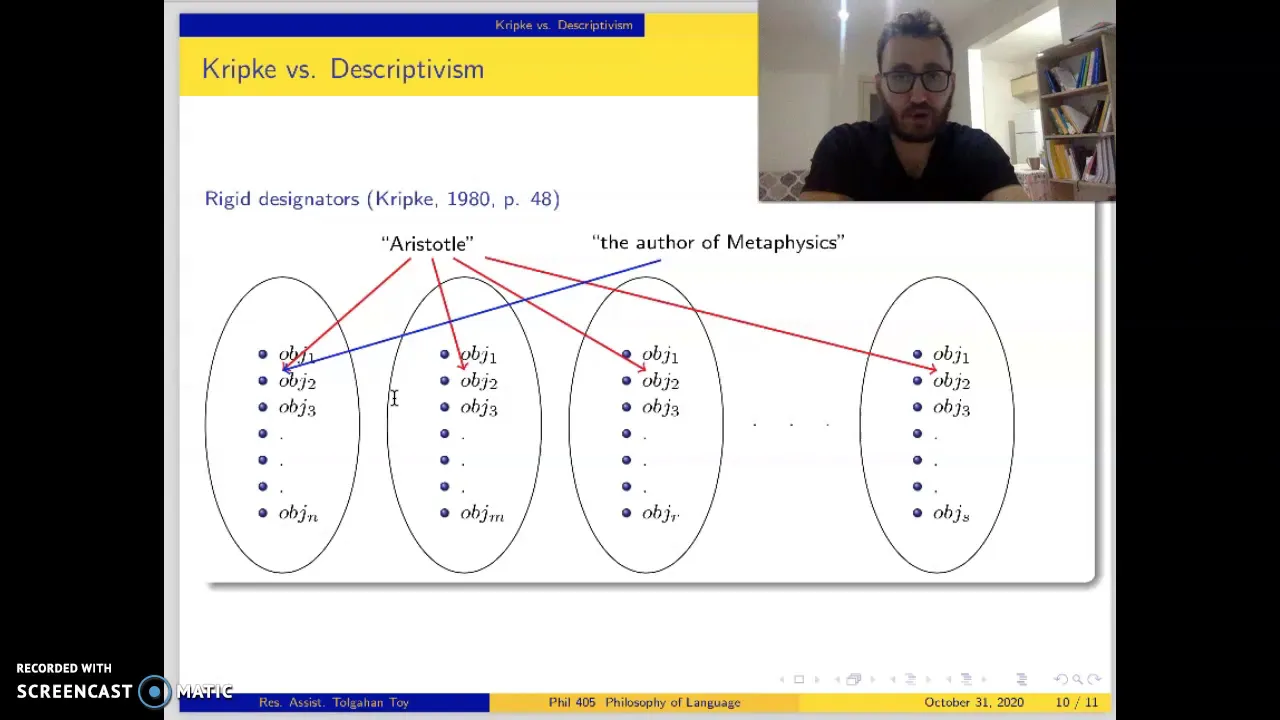
Rigid Designators: A basic grasp of Saul Kripke's semantic concept of terms that refer to the same object in every possible world where that object exists.
Modal Metaphysics (Necessity vs. Contingency): Comprehending the distinction between necessary truths (statements that must be true in all possible worlds) and contingent truths (statements that happen to be true but could have been otherwise).
David Chalmers' Zombie Argument: Exploring how Kripke's modal argument laid the groundwork for modern conceivability arguments against physicalism using 'philosophical zombies'.
Physicalist Counterarguments: Examining how materialist philosophers defend the identity theory against Kripke, such as through the Phenomenal Concept Strategy or rejecting the link between conceivability and possibility.
The Hard Problem of Consciousness: Investigating the wider contemporary debate regarding why and how physical brain processes give rise to subjective, qualitative experience (qualia).
Epistemic vs. Metaphysical Necessity: Delving deeper into the philosophy of language and metaphysics to understand the debates surrounding 'a posteriori' necessities.
322.5K views2.1Klikes8:24Original Release: 2014-09-19
(intro music) So my name's Alex Byrne.
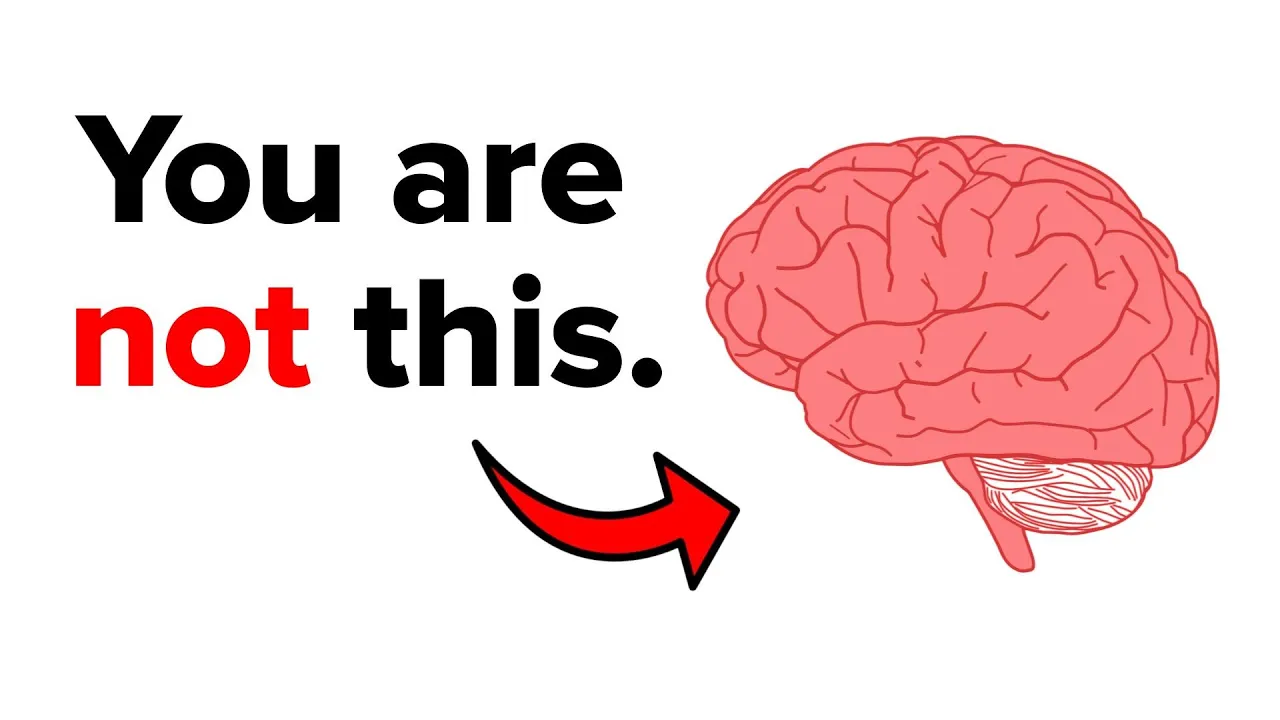
I teach philosophy at MIT, and today I'm going to explain an argument for so-called mind-body dualism, the view that we are not physical or material things.
And if we're not physical or material things, the natural alternative is that we're mental things of some kind.
Immaterial minds or souls, as it's sometimes put.
Hence the term "mind-body dualism."
On this view, the universe contains two quite different sorts of things: physical bodies like stones and planets and brains on the one hand, and non-physical minds on the other.
Well why is this view important?
Well, physical things normally aren't around forever.
If I smash my watch into tiny pieces or throw it in a furnace, that's the end of this beautiful piece of Swiss engineering.
The watch doesn't exist anymore.
Similarly if your body is devoured by worms or consumed in a crematorium, that's the end of this beautiful piece of biological engineering.
Your body doesn't exist anymore.
So, if you're a physical thing, a complicated bag of cells, then your eventual bodily destruction means that there's no hope for immortality.
So, if you're invested in the prospect of life after death, a lot hangs on the argument for mind-body dualism.
The seventeenth-century philosopher Rene Descartes is the most famous proponent of mind-body dualism, and that's why the view is sometimes called "Cartesian dualism."
You'll remember Cartesian coordinates from high school geometry, and Descartes invented those.
His most famous work is called "Meditations on First Philosophy," which was published in Latin in 1641.
And the sub-title promises that the work will demonstrate the existence of God and the immortality of the soul.
We can only do so much in a few minutes, so we'll have to leave the demonstration of the existence of God for another episode of Wi-Phi.
Now the argument I'm going to present is not quite Descartes's argument as we find it in the Meditations.
It's basically a variant of Descartes's argument, given by the contemporary philosopher Saul Kripke in his classic book "Naming a Necessity," which was published in 1980.
And what's more, it's a simplified version of Kripke's argument.
But even with the simplifications, I think we can see that it certainly leads to an argument that deserves to be taken seriously.
All right, so now to the argument.
Let's give your physical body a name.
Call it "Bert."
Everyone, dualist or not, can agree you and Bert are intimately connected.
Stamp on Bert's toe, and you feel pain.
If you decide to get some aspirin, that will result in Bert moving towards the medicine cabinet.
However, that doesn't mean that you are Bert.
And according to the dualist, you aren't.
There are two things here: you and Bert.
And what the dualist argument tries to establish is that you are not Bert.
More explicitly, you are not identical to Bert.
You are not one in the same thing as Bert.
Okay, so that's the conclusion.
So now, to prepare for the premises of the argument, we need a distinction, between truths that could have been false and truths that could not have been false.
For example, here's a truth: I am a philosopher.
That truth could have been false.
I could have been a plumber, say.
Plumbing might have struck me as a more fulfilling and secure career than philosophy, and I might have studied for a plumbing certificate instead of studying for a PhD in philosophy.
Here's another example: it's true that there were dinosaurs.
But that could have been false.
Evolution could have failed to produce any dinosaurs, or life might not have evolved at all.
So some truths, then, could have been false.
But some truths could not have been false.
They had to be true, come what may.
For example, here's a logical truth: either there were dinosaurs, or there were no dinosaurs.
That's true, but it didn't just happen to be true.
It couldn't have been otherwise.
However the world turned out, that logical truth would have been true.
Here's another example, which is the relevant one for our purposes.
Imagine that the President of the United States, say, is sitting opposite us.
I point to him and say, "He is Barack Obama."
That's true.
But could it have been false?
Well, how could it?
How could that very man fail to be Barack Obama?
We have just one thing here: that man, also known as "Barack Obama."
When I say "He is Barack Obama," I'm picking out the same thing twice over.
It's as if I were to say "He," pointing at Obama, "is him," pointing at Obama again.
A thing can't fail to be identical to itself.
So "He," here I point at Obama, "can't fail to be identical to Obama."
So, when I say "He is Obama," what I say is not just true, it had to be true.
It's one of those truths like that logical truth I just mentioned.
It could not have been false.
If you're inclined to doubt this, you're probably thinking of some different, but related, truth that could have been false.
For example, it's also true that he, pointing at Obama, is named "Barack Obama."
But that's a truth that could have been false.
He might have had some, different name say Fred Blogs.
But the truth that he is Barack Obama is not the same as the truth he's named Barack Obama.
The first truth is not about language, although of course it is stated in language, like truths in general.
It's just about the man, Barack Obama.
The second truth is about language, at least in part.
Specifically, it's about the name "Barack Obama."
And of course these are quite different things.
Barack Obama is the president, but his name has not been elected to any office.
All right, now we're ready for the argument.
Go back to you and Bert, your body.
Imagine I point to you and say "You are Bert."
Suppose that's true.
Then, since it's just like the Obama example, it's one of those truths that could not have been false.
In other words, if it's true that you are Bert, it had to be true that you were Bert.
You are Bert, come what may.
So this gives us the first premise of our argument for dualism.
If it's true that you are Bert, then it could not have been false that you are Bert.
But hold on.
Couldn't you have existed without Bert existing?
For example, you can imagine being disembodied, not having a body at all or you can imagine that you have another body, Bertha, not Bert.
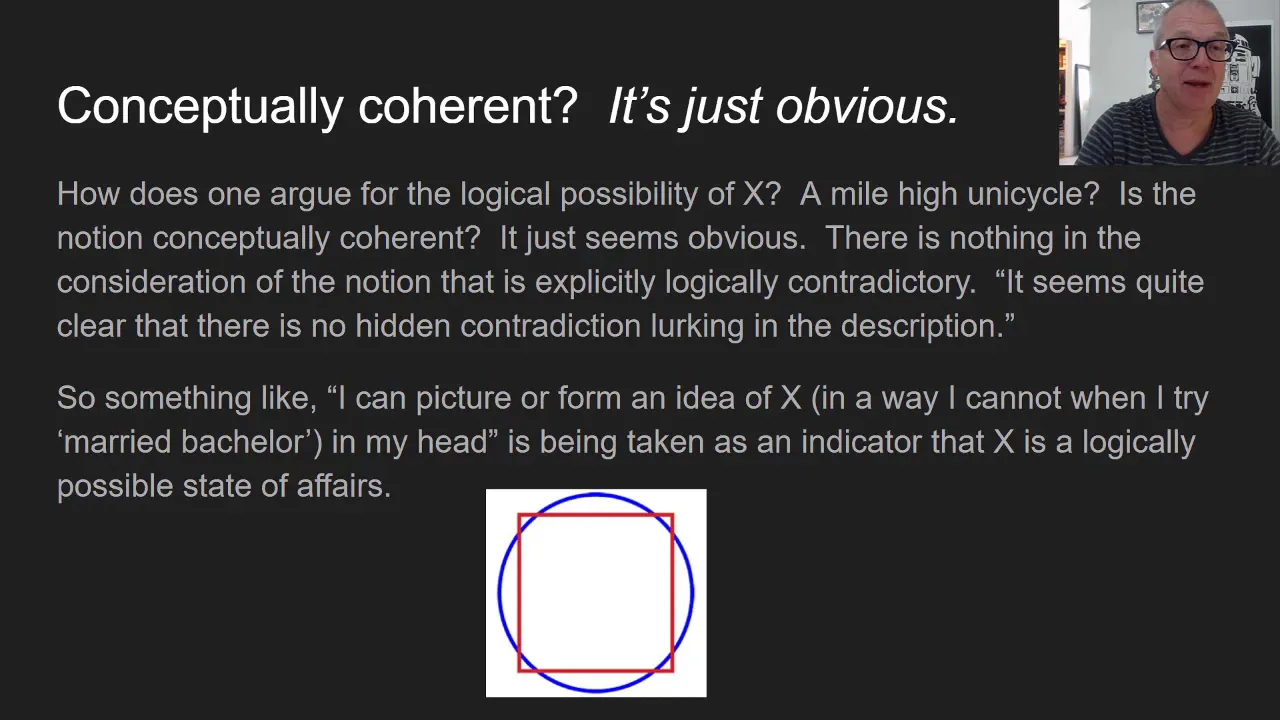
Imagining these situations is not at all like imagining, or trying to imagine, say, a situation in which there's a round square table.
That situation seems obviously impossible, not a situation that could have obtained.
There could not have been a round square table.
But there seems nothing at all impossible about a situation in which you exist without Burt existing, perhaps because you're disembodied, perhaps because you have Bertha and not Bert as your body.
This is not the actual situation, but it seems like a possible situation.
You could have existed without Bert existing.
But if you could have existed without Bert existing, then it could have been false that you are Bert.
A situation in which you're around and Bert isn't is a situation in which you aren't Bert.
So this gives us our second premise, "it could have been false that you are Bert."
So now notice that the second premise is the negation of the sentence after the word "then," in the first premise.
So our two premises have the following abstract form: "If P, then Q; and not Q."
And premises of this form logically imply, by a rule of inference called "modus tollens," "not P."
And our two plausible seeming premises, then, imply "it's not true that you are Bert."
In other words, you are not Bert, which is the dualist conclusion.
Subtitles by the Amara.org community
Up Next
29:24
Functionalism in Philosophy of Mind: Putnam's Multiple Realizability
@profjeffreykaplan
100.9K views•2020-08-28

164:01
John of Damascus on Holy Images: A Theological Defense
@BannedBooks
139 views•2026-04-25
9:32
Epicurus' Four-Part Remedy for Unhappiness | Philosophy Explained
@WirelessPhilosophy
272.4K views•2014-08-19
4:57
The Myth of Sisyphus: A Greek Legend of Eternal Punishment
@TEDEd
8.6M views•2018-11-13
Related Study Plans & Knowledge Roadmaps
Structured learning paths in Philosophy
philosophy
Frankfurt School: Critical Theory & Culture
01Foundations of the Frankfurt School and Critical Theory
02Horkheimer & Adorno: The Critique of Instrumental Reason
03The Culture Industry and Mass Deception
+ 2 more learning modules
12h5 modules
Explore Roadmap
philosophy
Philosophy of Language: From Frege to Austin
01The Linguistic Turn: An Introduction to Language in Philosophy
02Gottlob Frege: Sense and Reference
03Early Wittgenstein: The Picture Theory of Meaning
+ 3 more learning modules
15h6 modules
Explore Roadmap
philosophy
Feminist Epistemology: Standpoint & Injustice
01Introduction to Epistemology and Feminist Critiques
02Sandra Harding and Standpoint Theory
03Donna Haraway and Situated Knowledges
+ 2 more learning modules
12h5 modules
Explore Roadmap
philosophy
Environmental Philosophy: Ethics & Deep Ecology
01Foundations of Environmental Ethics & Anthropocentrism
02Biocentric Individualism and Animal Liberation
03Ecocentric Holism and Deep Ecology
+ 1 more learning modules
10h4 modules
Explore Roadmap