

























The six classical orbital elements (semi-major axis, eccentricity, inclination, longitude of ascending node, argument of periapsis, and true anomaly) are the fundamental parameters that uniquely define any orbit in space; they specify the size (semi-major axis), shape (eccentricity), orientation (inclination and longitude of ascending node), and position (argument of periapsis and true anomaly) of an orbiting body's path around a central gravitational source.
Classical Orbital Elements Explained | Keplerian Parameters
Added:Kepler's Laws of Planetary Motion, particularly the first law stating that orbits are ellipses with the primary body at one focus.
Basic geometry of ellipses, including concepts of the major axis, minor axis, foci, and the geometric definition of eccentricity.
Fundamental 3D coordinate systems, specifically Cartesian coordinates (X, Y, Z) and the concept of reference planes, such as the equatorial plane.
Basic physics of gravity, including Newton's Law of Universal Gravitation and the concept of orbital velocity.
Converting between Cartesian state vectors (position and velocity) and Keplerian orbital elements mathematically.
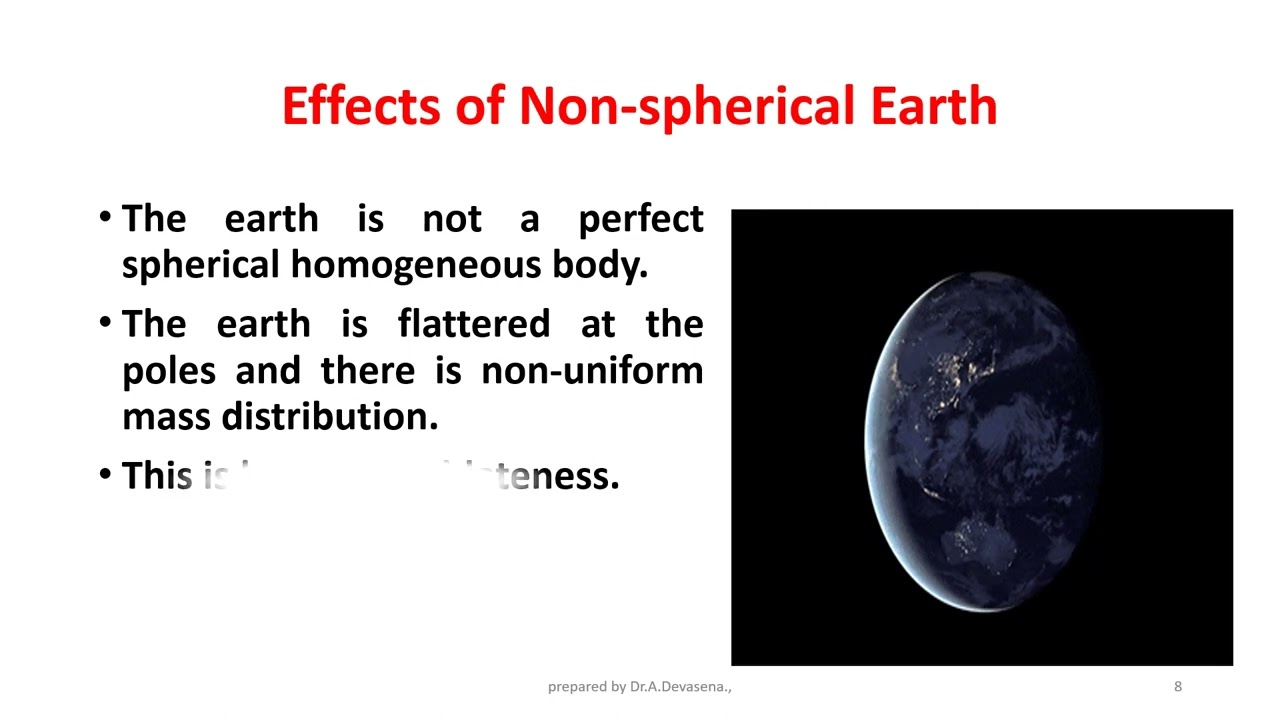
Orbital perturbations, such as Earth's oblateness (the J2 effect), atmospheric drag, and solar radiation pressure, which cause orbital elements to change over time.
Orbital maneuvers and transfer trajectories, including Hohmann transfers, bi-elliptic transfers, and plane-change maneuvers.
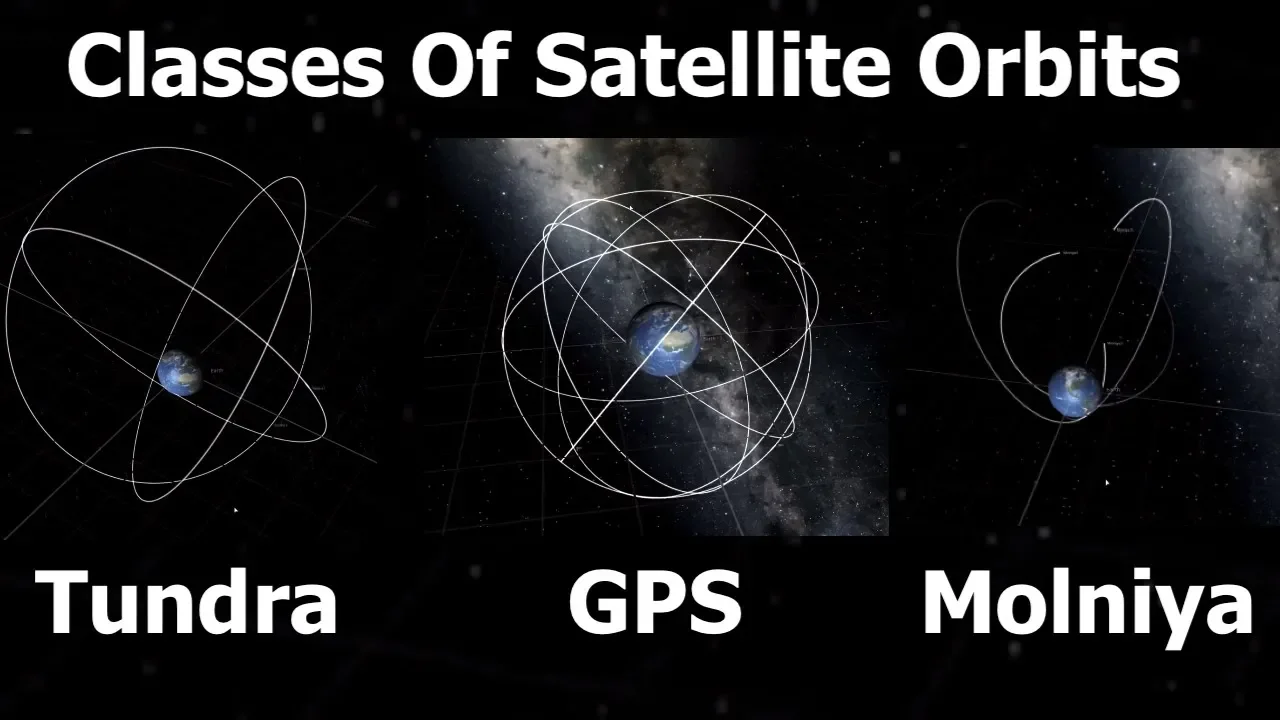
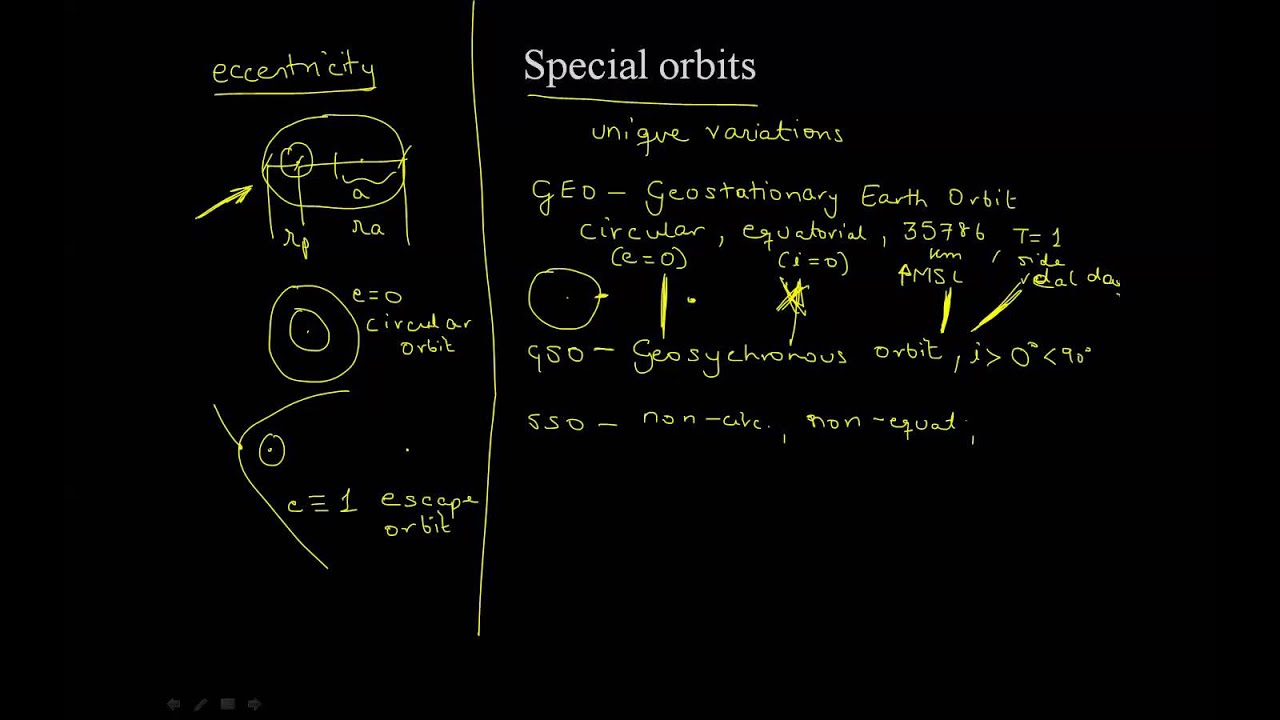
Specialized orbit classifications and their specific orbital elements, such as Geostationary (GEO), Sun-synchronous (SSO), and Molniya orbits.
142.4K views2.5Klikes15:02Original Release: 2013-04-20
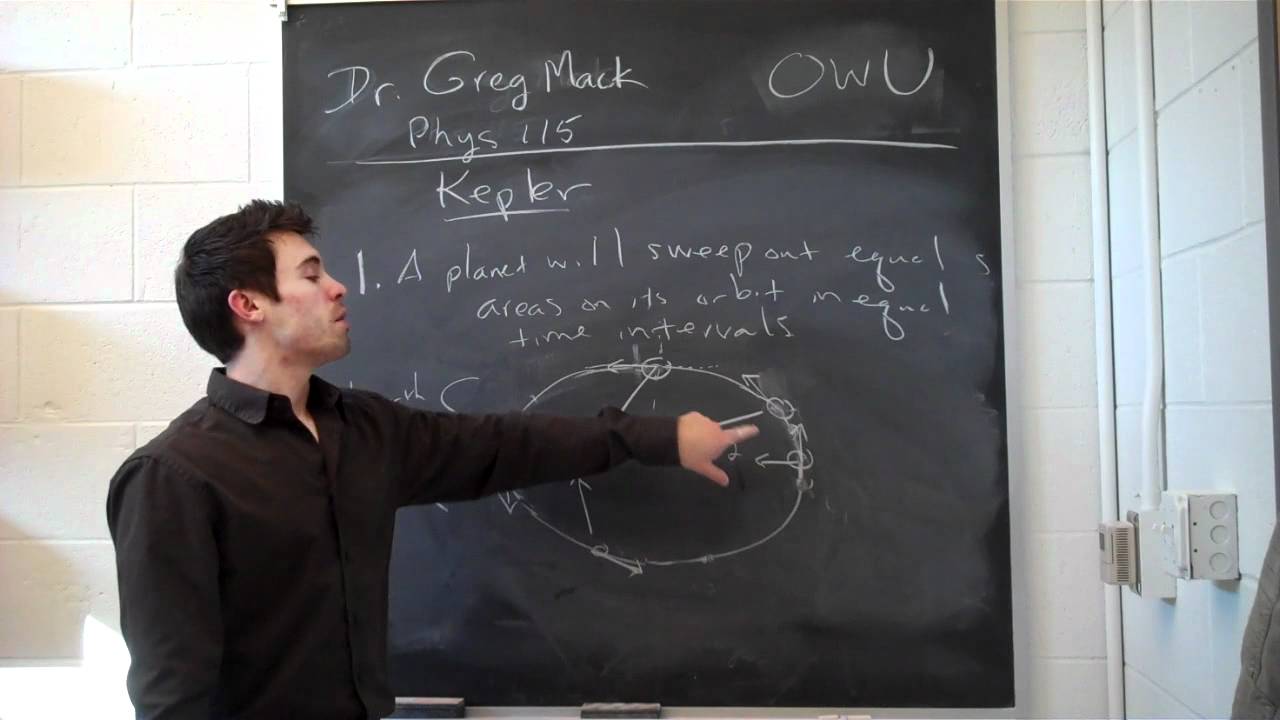
hello and welcome to orbital Basics this is part three in the first part we answered the question what is an orbit and in the second we saw what it takes to remain in a stable closed orbit here we'll answer the third question how do we Define orbits what we have here is a picture where you can see there is a central body we'll call it the Earth to make it simple around the Earth you can see that there is an elliptical orbit now you know this is an elliptical orbit because one I said so two it looks like it and three and the most important is that this orbit is following one of Kepler's three laws of planetary motion or orbital motion which is that all orbits are ellipses with the central body here the Earth at one of the two focal points a commonly asked question to confuse students in exams is what is at the other focal point the answer in most cases is nothing there doesn't have to be anything at the other focal point in this orbit we see that there is a long axis because it is an ellipse and as any ellipse there is a short axis the long axis is known as the major axis major axis and the short one is known as the minor axis here along the major axis you see that there is a point that goes that comes the closest to the Center of the Earth this point here and another point that goes the furthest away from the center of the earth among all the points or locations in that orbit these two points together are known as the absis this one here being the periapsis and this one here being the apoapsis Apple for furthest and perryi for closest or nearest here we can see that if I were to change the size of the major axis and make it longer and longer and longer the orbit would drastically increase in size and that is our first parameter size and the size is indicated by the length of half the major axis also known as the semi major axis semi major axis and that is our first parameter denoted by the letter A now notice that if I hold the measor axis length steady there and if I were to change the length of the minor axis so that it gets shorter for example the orbit will flatten out now if I change the length of the minor axis to make it longer there will come a point where the minor axis length is equal to the major axis length and the orbit will therefore be perfectly circular this is our second element because because the minor axis length determines how Ecentric the orbit is the second element that determines the shape of the orbit is called eccentricity denoted by the letter e and it is directly related to the radius of the periapsis the distance from the center of the earth to the periapsis the radius of the apoapsis the distance from the center to the apoapsis and because the center the the radius of the periapsis plus the radius of the apoapsis equals the total length of the major axis it also depends on the length of the major axis a we have defined the size and the shape now we need to understand how this orbit is oriented around the Earth in this image I have drawn it in 3D format it can be a little tricky because I am depicting a 3D orbit or a 3D concept on basically a 2d screen but here we see the Blue Earth and the center of the Earth has two axes going through it one here or actually let's start with this one one here that goes through the North and the South Poles the north south pole Axis or the axis of the poles and this one here which is seemingly arbitrary axis because it is an arbitrary arbitrary axis and it points to the vernal equinox vernal equinox the gray plane here is the one that passes through the equator of the earth and is known as the equatorial plane equatorial plane similarly the orbit also passes through its own plane the red one known as the orbital plane notice here that the orbital plane intersects the equatorial plane forming a line of intersection where there are two points where an object going this way across this point here will tend to cross the equatorial plane ascending it from ascending From Below to above it this point is known therefore as the ascending node ascending node similarly on the other side the orbit will the object will descend to below the equatorial plane and this point therefore is known as the descending node if here I hold the earth and the equatorial plane and the north south pole axis steady or the North Pole north south pole axis steady and the line that joins the two nodes steady what I can do is I can change the tilt of this orbit around this line that connects the two nodes either by tilting it this way or rotating it this way or rotating it the other way or this way this determines the angle between the orbital plane and the equatorial plane that angle there and that is a our third parameter that which determines the tilt of the orbit the parameter itself is known as inclination denoted by the letter I measured in degrees from the equatorial plane to the orbital plane notice here that there is another angle if I hold the earth and the equatorial plane as well as a North South Pole axis steady I can without changing this tilt angle I can simply swivel this orbit around the North Pole one way or the other way thereby shifting both the nodes this way or that way depending on how I till or swivel this orbit and this is the fourth parameter that which determines the swivel of the orbit how do we measure it notice that the swivel changes this angle from the vernal equinox to the ascending node that angle there that angle is known as the longitude of the ascending node it is denoted by the capital Greek letter Omega measured in degrees along the equatorial plane from the ver from the vernal equinox to the ascending node we have determined the size and the shape as well as the orientation so we have completely determined the orbit itself but if there is an object in this orbit we still haven't figured out how to position it and how to locate it we'll do that now notice in this cleaner picture again the two nodes and this looks like it would be the periapsis the closest point of closest approach and similarly that one over there will be the point of furthest approach suppose that there is an object in this orbit at this location going this way it is approaching the apoapsis and has already passed the periapsis but where is the periapsis in the orbit I can hold everything steady including the nodes and the equatorial plane and the inclination and I can change the length and the width of the orbit to determine where this periapsis lies it could basically lie here or say here suppose that it lies here if you notice that it makes an angle in the orbital plane from the line that joins the ascending node to the Center of the Earth all the way to the line that joins the periapsis to the Center of the Earth that angle there that angle is our fifth element and this determines the location of the periapsis the location and the nomenclature is the argument of the periapsis and it is denoted by the letter Omega in its lowercase form measured in degrees this time in the orbital plane not in the equatorial plane from the line of the ascending node to the to the per the per absis radius always in a counterclockwise Direction when measured from the North Pole so counterclockwise that way as you can see now we have determined where the location of the periapsis but where is the location of the body that is where is the body positioned in this orbit notice that if suppose if this is the periapsis so we'll erase that point suppose that this is the periapsis here denoted by the asterisk now the body has crossed the periapsis and it also forms an angle from the line of the or the radius of the periapsis to the line that joins the center of the body to the Center of the Earth itself that is this angle there and this is our Sixth Element the position of the object in the orbit itself and this angle is known as true anomaly denoted by the letter mu again measured in degrees again in the orbital plane from the line or the radius of the periapsis counterclockwise in the orbital plane to actually where the body is positioned so we have determined the six orbital classical or capillarian elements size and shape of the orbit are given respectively by the semi- mejor axis and the sensity the orientation of the orbit in space is given by the tilt of the orbit determined by the inclination and the swivel of the orbit the position of the periapsis is given by the argument of the periapsis and the location of the body from the periapsis is given by the true anomaly in this way we can hold any of the six elements steady and change any of the other elements and we have entirely different orbits yet we can Define all orbits using just these six elements however as you will see there are some special cases for example if I go back back actually let me go back to a clean picture if I have the periapsis here and the apoapsis here and if I reduce or increase the length of the minor axis so that the orbit becomes let's say this is the increased length of the minor axis such that the orbit is perfectly circular in a circular orbit there is no point that is any further away than any other point they're all at the same distance from the center of the orbit so in this case the eccentricity will go to zero and there is no longer an argument of periapsis because the periapsis is the same as the apoapsis is the same as any other point in orbit so what is that orbit that is a circular orbit and that is a special case of an of the characterization of the orbital elements such that we have defined a unique orbit the same thing happens with inclination if I decrease the inclination that is if I decrease this angle and make it zero such that the orbital plane coincides with the equatorial plane then we have an equatorial orbit which can be circular as well or may not be so as you can see there are various special orbits and we will learn about these in the next session this is it for now I hope you've enjoyed it thank you
Up Next
0:42
Amateur Astronomy: Tracking James Webb Space Telescope to L2
@Astronomy_Live
404.1K views•2021-12-26
61:17
First Billion Years of the Universe with the Square Kilometre Array
@iaaudc
121 views•2022-05-26

6:25
Kepler's Laws of Planetary Motion Explained (Educational Astronomy Video)
@Peekaboo_Kidz
404.9K views•2023-02-17
6:10
Gamma-Ray Bursts: Cosmic Snipers Explained | Astronomy
@kurzgesagt
15M views•2016-07-31
Related Study Plans & Knowledge Roadmaps
Structured learning paths in Astronomy
astronomy
Reionization: Pop III Stars, IGM & 21cm Line
01Foundations of Cosmology & the Early Universe
02Population III Stars & Cosmic Dawn
03Physical Mechanisms of Reionization
+ 2 more learning modules
17h5 modules
Explore Roadmap
astronomy
Planetary Rings: Dynamics, Roche & Resonances
01Foundations of Gravity and Orbital Mechanics
02Tidal Forces and the Roche Limit
03Structure, Composition, and Collisions
+ 2 more learning modules
10h5 modules
Explore Roadmap
astronomy
Asteroseismology: Stellar Waves, Ages & Cores
01Foundations of Stellar Astrophysics & Wave Mechanics
02Stellar Oscillation Modes: P-modes and G-modes
03Mathematical Framework of Asteroseismology
+ 2 more learning modules
35h5 modules
Explore Roadmap
astronomy
Adaptive Optics: Physics, Engineering & Control
01Foundations of Wave Optics and Wavefronts
02Atmospheric Turbulence & Optical Distortion
03Wavefront Sensing Technologies
+ 3 more learning modules
35h6 modules
Explore Roadmap