











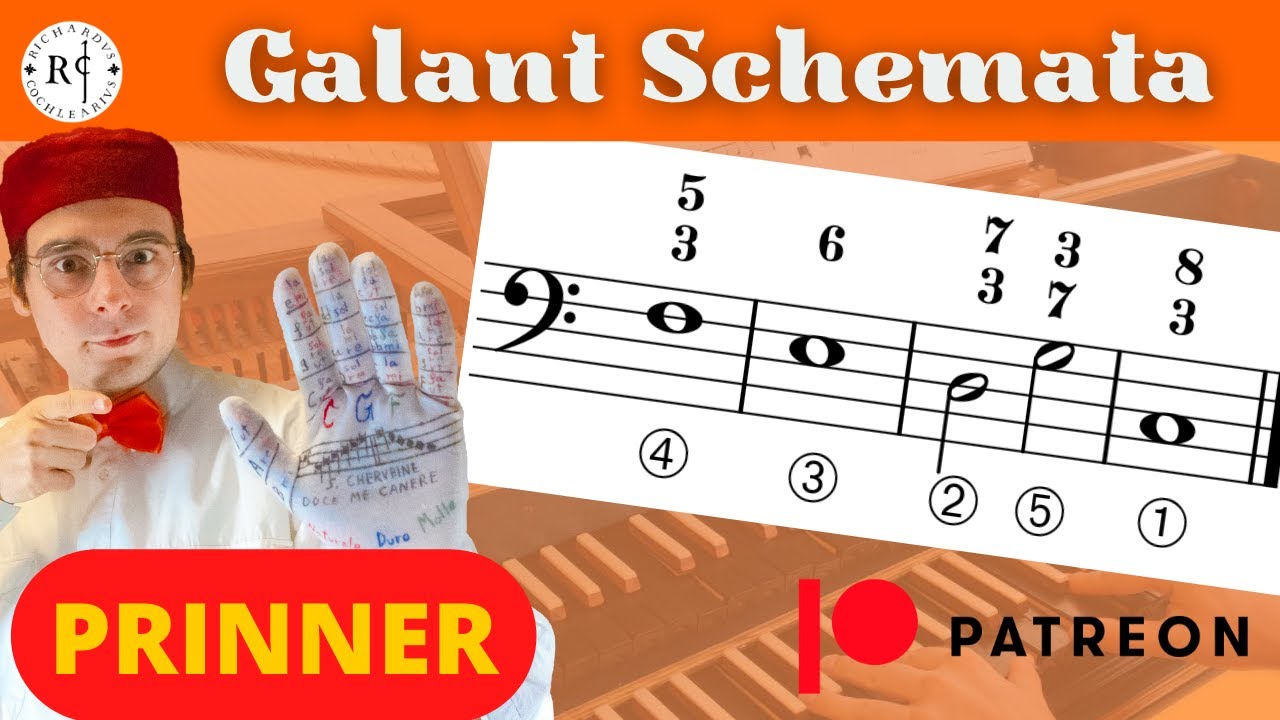





The fonte is a descending musical pattern from 18th-century music theory, consisting of two musical events where the first is in a minor key and the second is in a major key a step lower, with a characteristic 4-3 melodic movement in the upper voice and 7-1 movement in the bass, often accompanied by the 6-5-4-3 'La Solfami' or 'Fala Sofa' melodic flourish.
Understanding the Fonte Schema in Galant Harmony and Counterpoint
Added:Familiarity with the historical context of the 18th-century Galant style and the fundamentals of Schema Theory.
Solid understanding of diatonic and chromatic harmonic sequences, particularly descending step-wise progressions.
Knowledge of basic voice-leading principles, Roman numeral analysis, and figured bass notation.
Understanding of secondary dominants and the concept of local tonicization or temporary modulation.
Exploration of other essential Galant schemata, such as the Monte, Prinner, Meyer, and Romanesca, to see how they interact.
Application of the Fonte schema in historical partimento realization and keyboard improvisation exercises.
Structural analysis of complete movements by Classical composers (like Haydn, Mozart, and C.P.E. Bach) to identify the Fonte's role in formal sections like the development or digression.
Composition of original small binary forms, such as minuets, utilizing the Fonte schema as a primary modulating device.
3.7K views151likes14:09Original Release: 2022-12-21
welcome to this new video about Galaxy madas I'm Ricardo the music's practicus and here on the web I share with you a lot of contents about your music improvisation Harmony Counterpoint composition and more the Gallant schemata of today videos is the fonte remember that for this video there is a PDF with all destruction all the explanation all the examples I'm gonna show you in this video and you can download it and many other PDFs and also get the access to improvisation element that is a series with which you can learn improvisation at the keyboard step by steps following new exercises every week with a little membership on my patreon so don't talk anymore let's start our video about the fontein we find the word fonte in A Treatise by Ripper a musician of the 18th century in his 30s it talks about three kinds of patterns and the names that he gives to this Factor are fonte Monte and Ponte in this video we talk about the fonte the fonte recalls an image of something that is descending and for explaining was the fonte Ripple writes a Melody that helps us to understand the melodic succession of the fonte let's see it [Music] as you can see this melody is composed of two parts where the second part is a step lower than the previous one in this reproduction of the same pattern but a step down we recognize the image of the font as something that is descending below this melody we can build a base as in this example [Music] as I said we have two musical events at the first time in D Minor [Music] and the second time in C major [Music] the movement of the base is a passage between the leading tone of the first key the minor so C sharp and the first note the first degree and in the second time it's the same but estimation SO trading tone is B and the first degree of this case is C so we have a structure that is a 4 3 movement against a seven and one movement talking about the degrees of the scale D Minor leading tone and fourth one and three C major leading tone and fourth one and three [Music] we find the same situation in a party window by trito as you can see C sharp b c this is an example of a fonte another important aspect of the fonte is that the first event must be minor and the second one must be measure this is really important because the fonte must respect this succession of minor and measure as you can see in the example by Ripple with the added base for flourishing the melody between the four and the three passage a very spread solution in the gallon style is making a Melody that moves in what they used to call La sulfami or fala sofa depending on if we are in a minor mode or in a measure mode and the numbers is 6 5 4 3.
let's see it we have the 4 here and then 6 5 4 3.
then four six five four three this is really simple but we can have these notes heated in a more complex melody in the minor part is Fala sofa [Music] salsa and the major part is La Soul family according to the position of the symmeter this is a really important aspect of socialization that was a debate of all what a musician in the 18th century must know and if you want to learn fermentation there is a complete course about that for you following this link the two elements of the fonte 7 1 in the bass and four three in the melody can be inverted let's see this was the previous example okay anyway I think that these two notes we have the C sharp in the melody and the g in the base and the same here a particular variant of the fonte is what Ripple called hermaphrodite fonde in the hermaphrodite fonte we have two musical events where the second one is minor as the previous one [Music] foreign thank you [Music] we have the sixth degree of the second part that is flattened but the third degree so the resolution it is usually measure as it should be let's see now the first example of rigbed but in a hermaphrodite version [Music] foreign and finally here is some possible harmonizations of the font the first one is the most simple with a six chord and a three five card in the second one we have a 5 6 chord followed by A35 chord [Music] [Applause] another possible amortization is with the dimness 7th in this way foreign Ty because in the second part for having the diminished seventh we should put a flat on the sixth degree of the scale that is the diminished event of the seventh degree b a flat this determatization of the fonte but with the inversion of the two voices [Music] two four six card with the augmented fourth and C spot two four six four and six four and the organization of the hammer for this fonte with the inversion of the two vices is the following one this is an inversion the second inversion of the diminished seventh chord [Music] followed by a sixth one and then the same [Music] in this way let's see now some examples from the musical Gallant repertoire the first one is by gasparini from itamerland [Music] thank you as you can see we have a first part in minor with the Cadence to E minor and the second part in measure with the Cadence to the measure this is an example of a fonte in three voices so we have the melody seventh one that is typical of the bass in the upper voice and the melody 6543 according to socialization in the middle voice and the bass sings five one [Music] the same happens in the second part but in major [Music] another example is from a Sonata by purpura let's play it [Music] [Applause] [Music] [Applause] [Music] okay we have two musical events the first one in G minor and the second one in F major that is one degree lower the particular aspect of this example is that the seventh degree of a structure of the fonte is really long the one degree of each path look at the base [Music] so we have four bars of the harmony of the seventh degree and then only one bar of diamond of the first degree and the same in the second part seven one another example is a minuet by Pasquale in this example we can see the inversion of the two vices of default [Music] The Melody of the bass is really the passage six five four three and we have a diminution and the passage seven one in the upper voice [Music] all of the fonte is foreign [Music] but also in this case we have the structure of the fonte a minor G major and for finishing in glory an example of an unrefredited fonte by gluc foreign as you can see in the base we have the melody 6543 the first time in minor we are in F minor and the second time at the place of measure here the seventh degree is D and the third degree is E flat and at the place of a natural sea we have SC with the flat in the base and in the upper voice we can recognize the seventh one Passage [Music] and this is a structure of our font did you enjoyed this video do you know that there are more exclusive contents for you on my pattern yes I have a patreon where you can support my work in making more videos like that for you and receive new exclusive contents as a thank you every week for example with a little subscription like a coffee a week you can download all the didactic PDFs of my videos furthermore you'll get the access to improvisation elements improvisation element is an exclusive pattern series that consists in video tutorials for practicing improvisation at the keyboard I upload new videos of improvisation elements series every week each video is based on a specific topic like for example sequences spiridiones cadences X exercises for diminution for the organ the harpsichord the piano and more for each video there is in the next PDF and by watching the videos of improvisation elements and downloading the PDFs you can develop specific keyboard skills and become a better improviser check the link in the description to discover all the benefits you can get on my patreon a special heartful thanks to all those who are already my patterns for your important and Priceless support thank you so much and if you haven't joined my patreon yet we are waiting for you you are welcome so have a nice day and see you over it foreign
Up Next

11:39
Improvising an Allemande over a Romanesca Bass: Baroque Practice
@RichardusCochlearius
2.6K views•2022-11-09

10:20
Mozart's Musical Dice Game Explained: History, Rules, & Fun
@webpianoacademy
5K views•2023-03-13

15:47
Partimento Realization: Mastering Durante's Diminutions at the Keyboard
@RichardusCochlearius
2.5K views•2022-10-05
10:49
Understanding John Coltrane's Giant Steps: A Music Theory Analysis
@Vox
10.4M views•2018-11-12
Related Study Plans & Knowledge Roadmaps
Structured learning paths in Music Theory
music-theory
Composing Galant Music: Partimento & Schemata
01Foundations of Figured Bass and Keyboard Harmony
02The Rule of the Octave (Regola dell'Ottava)
03Galant Schemata: The Building Blocks of Form
+ 2 more learning modules
30h5 modules
Explore Roadmap
music-theory
Decoding Overtone Series: Tuning & Drone Music
01Acoustic Foundations: The Physics of the Overtone Series
02Tuning Systems: Equal Temperament vs. Just Intonation
03Microtonality and Spectralism: Beyond Standard Pitches
+ 2 more learning modules
24h5 modules
Explore Roadmap
music-theory
Impressionist Harmony: Scales, Planing & RPGs
01Foundational Music Theory: Keys, Intervals, and Seventh Chords
02Impressionist Color: Chord Planing and Parallel Harmony
03Whimsical Textures: Pentatonic Cascades and Whole-Tone Scales
+ 1 more learning modules
14h4 modules
Explore Roadmap
music-theory
Negative Harmony: Axis Reflection in Indie Pop
01Music Theory Foundations: Scales, Intervals, and Triads
02Functional Harmony and the Circle of Fifths
03Demystifying the Negative Harmony Axis Reflection
+ 2 more learning modules
16h5 modules
Explore Roadmap