



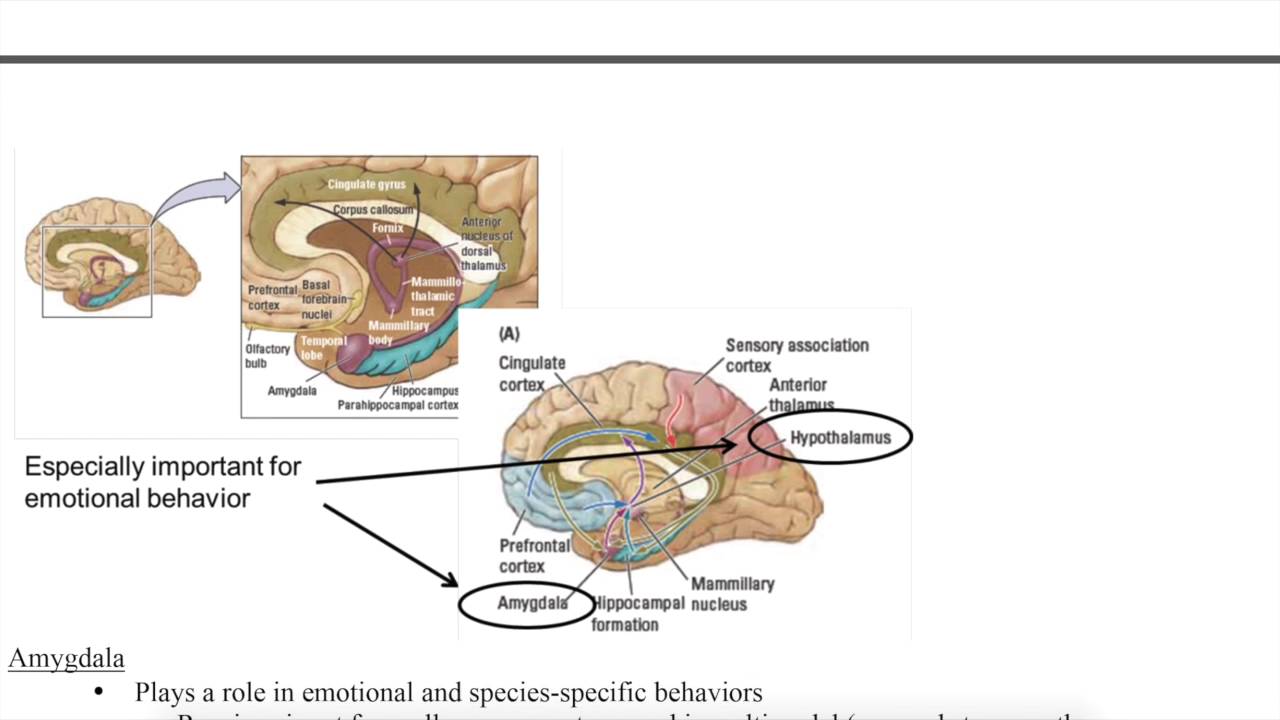



















Fear conditioning is a classical conditioning paradigm where a neutral stimulus paired with an aversive experience (like foot shock) produces fear responses including freezing and autonomic changes; the amygdala processes fear through two pathways—the low road (direct thalamus-amygdala connection for rapid responses) and the high road (thalamus-cortex-amygdala pathway for detailed processing)—with the central nucleus serving as the output hub that projects to brainstem regions to mediate emotional, autonomic, and hormonal fear responses. Cannabinoid receptors modulate fear extinction, and bilateral amygdala damage (as in patient SM) results in fearlessness while preserving other emotions, demonstrating the amygdala's specific role in fear processing.
Neurobiology of Fear: Amygdala Pathways and Fear Conditioning
Added:so for our fierce circuitry presentation i would like you to be able to compare and contrast how different regions of the amygdala relate to stress to produce distinct behaviors i'd like you to be able to compare and compress contrast the neurobiology of high versus low road to stress responsivity describe a fear conditioning experiment and give its definition i would like you to know how cannabinoid manipulation and immigration affects your conditioning and finally what do we know about sm and what are implications for multiple fear mechanisms fear conditioning is a type of classical conditioning where a previous neutral stimulus is repeatedly paired with shock or some other unpleasant experience causing the subject to act fearful in response to the stimulus fear conditioning can elicit fear by pairing a stimulus with an aversive stimulus like electric foot shock eventually the first stimulus by itself can produce fear including freezing and autonomic changes interestingly you might be like to know a little history here this was first reported as a conditioned reflex which we now recognize as a conditioned response uh but it was first reported by john watson the father of behaviorism uh you know he uh demonstrated this in a study where he was actually trying to replicate pavlov pavlov had just demonstrated his famous uh ringing of the bell experiment and uh watson wanted to replicate that experiment with the salivation and all that and tried in humans and failed because humans lack the same uh glands at least as well pronounced in dogs so he actually used uh one of pavlov's rivals in russia by the name of besturov interestingly besturov was disappeared in russia an incredible story there in and of itself that i highly recommend you look up on your own but uh beshterov uh who was not a big fan of pavlov was his rival sort of did the same thing as pavlov but by using dogs and made them jump over electrical hurdles or electric shock grids overheard so watson used that same experiment or setup for people uh but had them put their hand on as sort of a shocker and uh showed that he could produce a conditioned avoidance response or sort of like based off of fear in a way you could get a conditioned reaction uh you know based on fearful stimuli and then eventually the person uh you know technically that's more of an avoidance response but uh you know there is some relationship there although i mean it is worth noting that avoidance and fear are neurobiologically the sociable concepts but both involve the amygdala which is going to be one of the primary circuits that we talk about now so here you can see sort of a general fear conditioning experiment is illustrated in a cartoon on uh you know you know you wouldn't always do this first day but it is an important experiment you can show that if you play a tone in the animals uh box that this uh alone uh isn't sufficient to induce any sort of fearful response or freezing response it also wouldn't increase blood pressure if you were also looking at that additional physiological measure then on the next session you would uh put the animal in the box and when the tone plays i'll also deliver uh electrical foot shock to the grid floor uh interestingly the two actually have to overlap if the tone precedes the electrical foot shock or the electrical foot chuck precedes the tone they don't tear they do have to overlap by at least a few seconds typically at some point uh and you only have to really pair the ti the two two or three times it doesn't take uh 50 pairings really after just about three pairings you have very good fear response begin to emerge and really the animal is going to be freezing the entire time they sort of turn into a bit of a statue and that freezing response is supposed to be as thought to measure the animal sphere then on the the next day uh you would bring in the animal into the apparatus play back the tone alone and at this point the tone alone is sufficient to produce the uh freezing response without the shock itself and at this point you can do various manipulations to see how for example a brain lesion would influence the development of the fear and also its extinction over time with the idea that its extinction over time might be relevant for things like post-traumatic stress disorder now it's really not a one-to-one relationship and there are advanced models and ways of getting it a better model of post-traumatic stress but you're getting in that direction uh you know by getting at these uh the extinction of the fear memory so i want you to be able to tell me about the low and high roads of dear circuitry in the brain um but before we sort of go in there and look at this sort of amygdala-centric approach let's look at it from the the big picture here so i mean you you would first visualize in a lot of cases it's not always visual but you can visualize a uh fearful stimulus and uh then this information will be processed or at the level of the thalamus where it would then be either relayed along a low road directly to the amygdala or a high road first to the cortex and then back to the amygdala also at some level through the hippocampus and it's these low and high roads within the amygdala that we are really going to focus on but keep in mind that this is a larger circuit i mean like where we think of the amygdalas being very important here and it is it is very important uh you know there is a larger circuit involved which is really how the brain works so now you can see a more fine-tuned amygdala-centric uh view of these high and low roads at fear circuitry again you would first bring in whatever information it was through the sensory systems then you see things processed by that big relay breaker the thalamus the big switch board then some of this signal would be relayed along the high road to the cortex and processed also by the hippocampus whereas another low road of circuitry will go directly to the amygdala where it would also converge with information arriving from the high road at this point the information is first received by the lateral nucleus of the amygdala at that point it would split between three amygdala circuits some would be processed by the basal lateral amygdala others by the accessory basal nucleus of the amygdala while still others by the central nucleus of the immigrant and then all that information would converge at the level of the output nucleus the central nucleus and leave the amygdala to one of three brain regions part of the information would head to the central gray which is involved and implicated in the emotional response other to the lateral hypothalamus which is known to control autonomic responses and still others to the bed nucleus of the striat terminalis which would influence the hormonal response different regions of the amygdala react to a stimulus and send a message to the central nucleus of the amygdala which would be that big output and the central nucleus would then transmit the information to different brain stem regions to mediate different components of the fear response those that would be emotional autonomic and hormone the central nucleus projects to the central gray also known as a periaqueductal gray uh a brain region is also known to be involved in opioid-induced analgesia but this region is involved in processing emotional responses and associated with the deer circuitry the lateral hypothalamus would be involved in evoking autonomic responses and the bed nucleus of the striat terminalis again involved in evoking hormonal responses learn fear is slow to extinguish avoidance behavior is even slower to extinguish uh you know and uh in fact it's very difficult to extinguish it all but uh it can be even slower in uh mice that are lacking a cannabinoid receptors uh the cannabinoid if you the mice are missing cannabinoid receptors uh you see even uh slower rates of fear extinction uh and this can the uh reverse happens if uh you treat the animal with uh endocannabinoids or increase their endocannabinoid levels this was first demonstrated by a scientist in bordeaux france by the name of giovanni marcicano uh in a seminal nature study um you know and then rafael shulam one of the really leaders in the cannabinoid field who dis covered the uh really well first identified and cloned the cd1 receptor in the brain also identified anandamide and helped to identify two arachidonyl glycerol as well but uh you know he likes to point out that uh you know learning how to forget could be more important than learning how to remember uh you know one of the freight like stories he likes to point out is you know if you were riding home on public transportation would you really want to remember everybody's face and everything that you saw and smelled along the way definitely not uh you know so you know it could actually be argued that forgetting is a very important function of the brain and and this is in response to the the question like why on earth would you have endogenous molecules like the endocannabinoids that might be involved in helping to forget these could be very evolutionarily advantageous as well people with damage to their amygdalas bilaterally show little to no fear at all these people do not show the typical physiological responses to fearful stimuli and have a hard time recognizing fear in others although they can still recognize others emotions one of the most famous case studies in the fear literature was from a patient known as sm she had bilateral irregular damage it made her fearless to those triggers interestingly there are additional fear mechanisms for suffocation and physiological state that likely arise from peripheral mechanisms and processing at the level of the brainstem uh if you want to read more about this uh here's a link to an article uh i mean you would have to type it in but you know it would provide additional information about these uh you know additional redundant uh fear mechanisms and again this will be a common theme of the brain that there are a lot of built-in redundancies uh so i mean like even if you do have amygdala damage you know you might not completely die of suffocation and other things it's like there's a lot of sort of built-in redundancy in the brain for a reason to you know make it resilient uh in the face of damage and insults so this is a brief uh video clip about patient hsm that i think you will find very interesting so sm is one of the most um famous case studies in all of affective neuroscience she's a woman who is currently i think in her 40s and um as far as we can tell the destruction of her amygdala has left her essentially fearless to at least external stimuli and to test whether sm is in fact fearless the researchers who worked with her took her to a couple of the most frightening places that they could think of in the local area so one was an exotic pet store and they offered her exotic snakes to to hold in the store even though she says she's afraid of snakes many people would hesitate to hold a snake right up to their face and touch its tongue and inspect its face really closely but some had no problem doing that um they also took her to a place that's it is called the most haunted house in the united states and they decorate it up for halloween and they have people the staff dressing up as monsters and things to try to scare people and the researchers and asam went through with just a regular group and all the other people who were in the group as soon as they were in this haunted houses apparently very spooky were you know huddling together and they were really slow to go around corners and as sound was taking the lead and saying come on guys follow me and she would be the first around the corners and when the monsters jumped out and tried to scare her apparently she would scare them sometimes because she had no clear response to them which they were not expecting um and so what was really interesting about this is that sm is not emotionless she experienced a lot of curiosity and excitement which we think are governed by other regions of the brain predominantly um but she just doesn't seem to have any normal anticipatory fear response um but her lack of fear response gets in trouble so she uh apparently walks home in the evenings through sort of the vacant lot and she was mugged there at one point and i think at knife point and uh most people when something scary like that happens to you and you are at risk of getting hurt you have a normal fear response when you're approaching that same place that would send you avoiding it i think that's what the free response is all about avoid things that might hurt you uh and she doesn't have that response so she continues to take that same route home every night by herself and here's just a a graph from your book illustrating uh a variety of independent fearful stimuli or independent measures of fear that evoke a rating of fear and control subjects but not in sm
Up Next

How Fear Extinction Rewires the Brain to Reduce Anxiety
@dr.carolinebuzanko
1.5K views•2022-03-08

Neuroscience and Genetics of PTSD: A Precision Medicine Approach
@UWPBSCI
221 views•2024-05-09

Vagus Nerve (CN X): Anatomy, Nuclei & Functions Explained
@Alilamedicalmedia
305.2K views•2022-10-31
How Exercise Benefits Your Brain: Science Explained
@TED
11.4M views•2018-03-21
Related Study Plans & Knowledge Roadmaps
Structured learning paths in Neuroscience