
















![충격! 미국 분위기 장난 아냐..이재명 끝나나? [배승희 뉴스배송 장예찬 출연]](https://i.ytimg.com/vi/sySPF663wuI/maxresdefault.jpg)






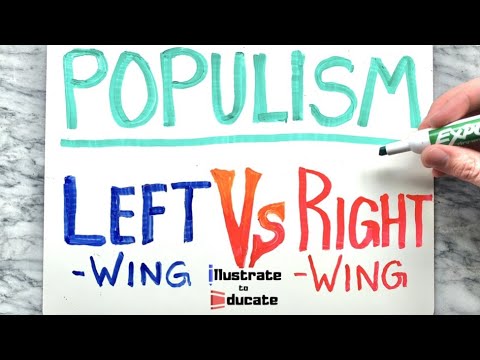
Populism is a political approach that rejects pluralism by simplifying complex political landscapes into a binary 'us versus them' framework, where populists position themselves as representing 'the people' (a selectively defined group) against 'elites' (those in positions of power). This approach is characterized by moral division (portraying elites as corrupt and wicked while depicting the people as virtuous), the supremacy of the people's views, and tendencies toward direct leader-people connections, externalized blame, conspiracy theories, and institutional stress-testing. Whether populism is dangerous depends on context, as some movements threaten democratic institutions while others may simply advocate for anti-corruption reform.
Populism Explained: Definition, Tendencies, and Dangers
Added:Basic principles of representative democracy, including pluralism, constitutionalism, and the rule of law.
An understanding of major political ideologies (such as liberalism, conservatism, and socialism) and how they shape political spectrums.
The concept of political polarization and how social, economic, or cultural divisions manifest within an electorate.
The role and function of democratic institutions (such as the judiciary, legislature, and free press) in maintaining checks and balances.
Comparative analysis of historical and contemporary populist movements, distinguishing between left-wing and right-wing variants.
The phenomenon of democratic backsliding and the specific mechanisms through which populist leaders may erode institutional norms.
The influence of modern media structures, particularly social media algorithms, in amplifying populist rhetoric and charismatic leadership.
Policy responses and institutional reforms aimed at addressing the root socio-economic grievances that fuel populist support.
282.5K views12.1Klikes14:54Original Release: 2021-09-27
Hey, what's up everyone? Today we're talking about populism. Populism has made a pretty big comeback in the 21st century. It's constantly used to describe contemporary movements and contemporary people. It's actually used to describe so many different movements and people that some think that it's no longer possible to give any one definition of populism because they think the term has just been spread out too far. But I'm not one of those people. So, I think one coherent explanation is possible. So, I'm going to try to nail that down today. Okay.
So, what is populism? I think a good place to start is to think about diversity. If you're in a country that allows for free speech, you're probably aware of how many different types of people and opinions exist in the public and in turn, how many different types of demands are levied at the government.
So, that's the normal state of affairs in any type of society that allows for free speech. You get lots of different types of people and lots of different types of opinions and demands and they can't be neatly reconciled with each other. So the recognition of that type of diversity and even the support for that type of diversity is called pluralism. So you're a pluralist if you try to maintain a recognition and even an appreciation for how diverse society is and that includes ideological diversity. The first thing to understand about populism is that it rejects pluralism. So populists simplify the political landscape. They say politics actually aren't that complicated and you could actually boil politics down to a simple conflict between two sides and within that populists pick a side. So populism tells a simplified story of us versus them. I'm going to start by talking about the us. The US in populism is described as the people. That might sound like they're talking about the entire public, but they never are. And the reason why is because to be a populist, you have to make generalizations about who the people are. So they say things like the people want less immigration or the people want socialism. And within that, they say that they represent the interests of the people. So to be a populist you have to make generalizations about who the people are which necessarily includes some while excluding others and then within that populists say that they represent the interests of the people.
So that's the us in populism the people which is actually just a portion of the public which is a portion that's carved out through the descriptions by the populist movement or the populist leader. Moving on to them. There can be multiple them in populism, but one of them and you could say the main one has to be elites. So the main narrative of populism is the people verse elites where populists are on the side of the people. So whatever the issue is that populists are concerned with, elites are a major source of opposition for the people. And it could be political elites, it could be cultural elites, media elites, any type of people in a position of power. And whatever they're doing, they're not helping the people.
They're either actively hurting them or they're just stopping the people from getting what they want. So take an issue like immigration. If the populist movement was against immigration, then immigrants would be considered another them here cuz they're not included in the people. So they would be like a tertiary them. But populists would frame elites as being at the heart of the problem because they'd probably say that their policy decisions were allowing the immigration to happen. So in order to fix the problem, the populist movement would have to battle elites and not the immigrants. That's just one example, but that dynamic should work for any populist movement. So say for example, if it's a socialist movement, there might be other them. Like say if there's a rival conservative movement, that conservative movement would probably be another them. But the main opposition would be elites, which would probably include financial elites. They would say that elites are stopping socialism from happening. A common term that populists like to use for elites is the establishment. I think because the term alone does a lot of work, it gives the impression that elites are entrenched in power and that they've been there for a long time and that thought process naturally transitions into the notion that the establishment's grip on power ought to be challenged and possibly even broken. I don't know if this needs saying, but obviously not everyone that uses the term the establishment is a populist. It's just a common term among populists, I think, because saying it conveys a lot of your ideas for you. So consider this us versus them, the people versus elites as ingredient one of populism where the political landscape isn't diverse and described as featuring a broad range of public opinion but instead flattened into a binary where on one side you have us who are the people and on the other side you have them who are elites and within that populists say that they represent the interests of the people. So this is the first of three ingredients. The second ingredient of populism concerns morality and more specifically moral division. In populism, the two sides are divided along moral lines which breaks down to the morally good versus the morally bad.
The elites in populism are always described as morally bad. So they're described as wicked, corrupt, they're abusing their power. They're negligent.
They're constantly described through morally negative terms. The people on the other hand are described as morally good. So some populists go kind of heavy on that terminology calling the people virtuous and stuff like that. But I think most populists just describe the people as good and deserving better. And they really don't want to contradict that. So populists don't want to morally criticize their chosen section of the public. So gang populists to morally criticize their chosen us is sort of like trying to push two like positively charged magnets together. they just don't want to do it. Populists also like to build up the wisdom of the people typically by saying that the people have common sense that elites don't have. So in populist framing, the people are wise and elites are ignorant. And also because the people are good, their wisdom and their goodness means that their ideas will improve society. And elites on the other hand are morally corrupt and they're ignorant. So to the extent that elites can influence society, they degrade it. Because populist narratives are framed through morality, having a democratic majority behind their cause is optional. So it's not a dealbreaker to populists if they're actually a minority within their society. They think that they can still call themselves the people because their claim is based in morality and not actual numbers. So ingredient number two was moral division. Society is divided by populists along moral lines. the morally good people versus the morally bad elites. The third major ingredient is that the views of the people are supreme. Populism places the people on the moral high ground and elites on the moral low ground. The people are morally good and wise and elites are morally corrupt and ignorant. From that perspective, it's probably not appealing to grant legitimacy to what elites have to say. And it's also not appealing to work cooperatively with elites. So this places populists in an inherently combative political position where the views of the people, which means the views of the populist movement and the populist leader are supreme. Which means that once the views of the people are established, populists really don't want those views to be contradicted, especially if that contradiction comes from outside of the people. So the views of the people are granted especially strong legitimacy. As you may have gathered from what I've said so far, populism itself isn't very deep and is often called by academics a thin ideology. So populism tends to be accompanied by other isms in order to flesh things out more. To make some generalizations, populist movements on the right are often accompanied by nationalism and populist movements on the left are often accompanied by socialism. If a movement has an especially strong ism to it, an ism with an especially strong doctrine like Marxism Leninism, then we don't need to bring in the label of populism because calling that movement Marxist Leninist does a good enough job of accounting for the whole thing. But isms like nationalism or socialism are more ambiguous. So if calling it populist on top of that is accurate, then it brings helpful context to the movement. I've been holding off on doing this, but I think it's time to bring in some examples of populism. Here is a partial list of major contemporary political figures that are widely considered populist. And I'll add Occupy Wall Street, too, as an example of a contemporary movement that's widely considered populist and was notably leaderless. So, you don't necessarily need a strong, charismatic leader for your movement to be considered populist.
There's one name on this list that's especially contested where about half the academic work I read considered him a populist and the other half didn't.
The other half pushed back on that. and that's Bernie Sanders, which I think comes down to different perceptions of what his movement was about and also messy conceptions of populism. So, I'm going to put an asterisk next to his name. I personally consider him a populist, but he's not as on the nose as the rest of the people on this list. So, he doesn't have a lot of the tendencies of other populists. Speaking of which, let's get into the tendencies of populism. So, these aren't requirements, but instead just notable tendencies of populism. The first is that the leader wants a direct connection with the people. They don't want, for example, political parties screening and filtering their messages or publishers or TV networks shaping their messages.
They tend to want to wipe away these intermediaries to create as direct of a connection as possible with the people.
They also tend to externalize blame because the ideas of the people are supreme in populism. The leaders who represent the people are especially reluctant to portray themselves as being wrong. So if something goes wrong, blame tends to be externalized. So for example, they could blame their problems on other countries or they could blame their problems on elites. Which brings me to the next tendency. Populists are especially prone to engaging in conspiracy theories. I was hesitant to say this one because conspiracy theories are already stigmatized and I don't want to add to that. So, it's worth saying that elites sometimes do engage in conspiracies and that's just demonstrabably true. So, this is just saying that populists are especially prone to engaging in conspiracy theories, especially if something is going wrong for that populist. It's natural for them to suggest that it's happening because elites are conspiring against them. The fourth tendency is just for populist politicians and that's stress testing institutions. Populist politicians tend to test the institutional strength of the countries that they come into power in. They tend to see political institutions like constitutions and court systems as things that should further their power and not check it. So populists often test the strength of institutions that are designed to check their power.
Countries with weaker institutions are sometimes taken over by populists who rewrite their constitutions or reshape their courts in a way that helps them consolidate power, stay in office, and check the power of political opposition.
Okay, so we have our three necessary ingredients for populism and four additional tendencies of populism. If I wanted for some reason to give a concise definition of populism, I'd do it by somehow summarizing these three necessary ingredients. But instead of trying to do that, I'd rather close this video out by posing a question that kind of looms over populism as a subject. And that question is, is dangerous? It's a polarizing question. I put some thought into how I might answer it. And the best answer I came up with was to compare populism to fire.
So, if I asked you, "Is fire dangerous?"
After you probably would take a moment to recover from how weird of a question it is, you might respond saying something like, "What kind of fire are we talking about?" And by that, you mean how much fire and what context is this fire in? Is it a small amount of fire in a lighter or is it a large amount of fire out in the wilderness and uncontrolled? Because that very much matters in how you go about thinking about if it's dangerous or not. Getting back to populism, I think the inherent combiveness of populism and the flattening of nuance, the flattening of pluralism that's needed in populism makes it inherently alarming and you could even say concerning. But I think to elevate that to calling it dangerous requires you to know something about the movement and it requires you to know the context that the movement's in. So some populist movements are extremely dangerous. Say that the movement is malicious. Say the movement actually wants to hurt other people and say that it's happening in a society that has weak institutions. So the movement threatens to actually take over that society. Then that's very dangerous populism. That populist movement is extremely dangerous. But then there's other movements where say they just want to fight political corruption and say that that political corruption is demonstrabably say that it's a leaderless movement so nobody wants to run for office. All they're trying to do is use populism to galvanize public support and create reform to fight corruption. I wouldn't call that movement dangerous. So I think to call populism dangerous to elevate it beyond being just concerning requires you to know something about the populist movement. So, just like fire is inherently, you could say concerning, but only truly dangerous in some contexts, populism is also inherently concerning, but only truly dangerous in some contexts where the word danger is really appropriate and you could argue even helpful in other contexts with the caveat that there might be a better way to solve that same problem that's more cooperative and allows for ideological diversity. And that's all I've got for today. As always, thanks for watching, thanks for listening, and I'll see you next time.
[music] Added to the one you left behind.
Up Next
14:09
Chile's Shift to Right-Wing Populism: A Continental Political Realignment
@DrSteveTurleyTV
468.7K views•2025-12-15

24:30
BRICS Pay and de-dollarization: A New Financial Order Emerges? | 55 chars
@DannyHaiphongYT
164.6K views•2024-10-22

7:33
Government Surveillance Methods: 10 Ways You May Be Watched
@BeAmazed
1.6M views•2017-04-09
10:19
Explaining the Saudi-Iranian Proxy Conflict in the Middle East
@Vox
18.2M views•2017-07-17
Related Study Plans & Knowledge Roadmaps
Structured learning paths in Political Science
political-science
Economic Statecraft: Sanctions & Chokepoints
01Foundations of Geoeconomics and Economic Statecraft
02The Mechanics of Weaponized Interdependence
03International Sanctions: Types, Implementation, and Efficacy
+ 2 more learning modules
12h5 modules
Explore Roadmap
political-science
Central Bank Independence: Politics & Policy
01Foundations of Central Banking and Monetary Policy
02The Time Inconsistency Problem & Inflation Bias
03The Delegation Model and Designing Independence
+ 2 more learning modules
12h5 modules
Explore Roadmap
political-science
Consociationalism: Power-Sharing & Stability
01Democratic Dilemmas in Divided Societies
02Introduction to Consociational Democracy
03The Four Pillars of Consociational Design
+ 2 more learning modules
12h5 modules
Explore Roadmap
political-science
Rebel Governance: Legitimacy, Economy & State
01Foundations of Rebel Governance and Statehood
02Establishing Political Legitimacy and the Rebel Social Contract
03Wartime Economies and Rebel Resource Management
+ 2 more learning modules
14h5 modules
Explore Roadmap