

![VBU FYUGP Sem-1/2/3 [All Sessions] Sec - Sustainable Development Objective Questions With Answer](https://i.ytimg.com/vi_webp/EcofLqrDsOo/maxresdefault.webp)






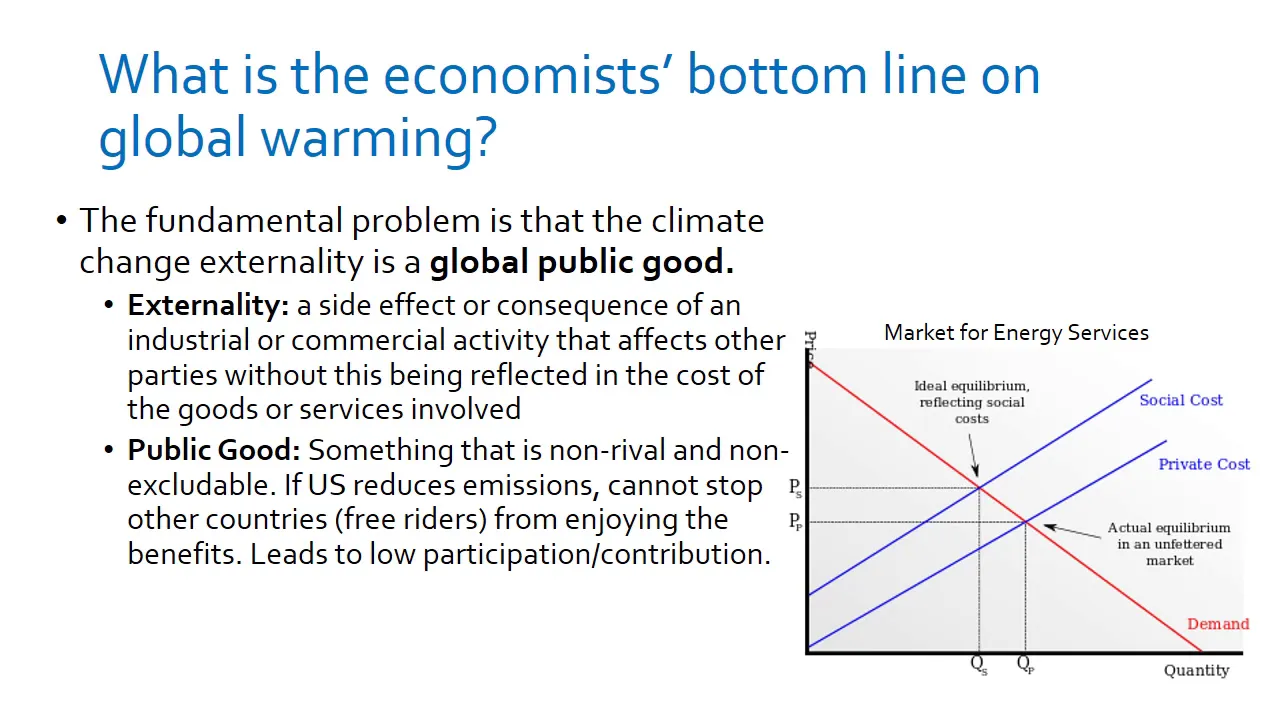






Climate change represents a unique intergenerational challenge where current generations' actions affect future generations who may not yet exist, requiring us to apply ethical principles of temporal impartiality (valuing future generations equally to present ones) rather than relying on standard economic discounting that favors present consumption; effective climate policy requires combining carbon pricing mechanisms (like carbon taxes or cap-and-trade systems) with local-level action and international cooperation, as demonstrated by Elinor Ostrom's work on common-pool resource management, while recognizing that GDP alone fails to account for natural capital depletion and that true wealth measurement must include environmental assets.
Intergenerational Justice and Climate Change Policy | Gresham College
Added:The economic concept of the 'Tragedy of the Commons' and how shared-resource systems are depleted by individual self-interest.
Basic principles of environmental ethics, specifically distributive justice and how societies allocate benefits and burdens.
The fundamentals of international climate policy, including major frameworks like the United Nations Framework Convention on Climate Change (UNFCCC).
The concept of discounting in economics, which is used to determine how much future costs and benefits are valued in today's terms.
Advanced climate economics, including the use of Integrated Assessment Models (IAMs) to calculate the social cost of carbon.
Legal frameworks and climate litigation cases that leverage the rights of future generations (e.g., youth-led climate lawsuits).
The application of game theory to global environmental politics and the challenges of international treaty compliance.
Evaluating specific intergenerational policy instruments, such as green bonds, sovereign wealth funds, and long-term infrastructure planning.
3.4K views62likes1:07:49Original Release: 2021-04-19
we all know the story of east of ireland the collapse of a once flourishing civilization as the last tree was cut down to jared diamond in his book collapse it was a case of econocide well to the demonstrators of extinction rebellion they also fear that if we do not change our behavior and very soon we're also heading in the same direction as a result of climate change it is difficult to imagine what was going on in the minds of the final generation on east of ireland as they cut down the last tree and lost their fuel and building material did they not stop sooner how did they debate their plight and what steps did they take well the situation they found themselves in is the example of what gavit hardin in 1968 called the tragedy of the commons the situation where a common resource forest fisheries grazing land belongs to no one individual as he said ruin is the destination to which all men rush each pursues its own best interest in a society that believes in the freedom of the commons freedom in a commons brings ruins to all as you saw each forester fisherman or farmer has an individual interest to maximize the number of trees cut down of fish caught or sheep grazing in the common pool of resources if any one individual stopped others might not so everybody would continue they would follow their own individual self-interest to the ultimate harm of everyone whether there were no trees no fish no grass left and as he said throughout history human exploitation of the earth has produced this progression colonize destroy move on well that might work for one or two generations but ultimately a future generation will suffer as on east of ireland hardin's own concern was not with climate change but with population growth he thought that population would continue to grow because the welfare state meant that the imprudent did not die out he therefore argued that people must surrender their freedom to breed he said if each human family were dependent only on his own resources if the children of improvement parents starved to death there would be no public interest in controlling the breeding of families but he said our society is deeply committed to the welfare state and hence is confronted with another aspect of the tragedy of the commons well garrett hardin's analysis is a very disturbing combination of malthusianism population outshipping resources and eugenics trying to breed a fitter race now when i was a student back in the 1960s the risk of population growth was what was on the agenda the idea that the earth would exceed the carrying the population growth would exceed the carrying capacity of the planet and we found that in reports such as the club of rome report on limits to growth in 1972.
that report which is a bestseller at the time argued that the behavior mode of the system the planet is clearly that of overshoot and collapse and they argued for a state of global equilibrium by deliberate reduction of population with limits on individual freedom to have children and to consume resources and thinking like that informed the one child policy of china now these debates have now moved on to climate change rather than population eugenics as argued for by harden are rightly beyond the pale and we now see some of the social consequences of china's one child policy the fact that the elderly now only have one child the problem putting pressure upon the family so actions we take now can have long-term impact on future generations now these debates back in the 1970s did lead to an interest in the ways in which common pool resources can be preserved for future generations how over exploitation can be prevented and econo side avoided and the thinking that emerged at that time can help us think about how to respond to climate change now historically there were three different approaches to how to resolve the problem of the tragedy of the commons the first was property rights if the common land the count the forest could be allocated to an individual that individual would protect that land against over exploitation by others it was less easy to do that in the case of fishery you can't really farm divide up the ocean like you could a common field it was not so easy for pollution of the atmosphere as happened after the industrial revolution so the second approach would be state action state action regulation against smoke pollution against polluting rivers government banning admissions or imposing fines now that could work at the local or the national level it could stop smog in london or in los angeles it was not so easy to deal with spillovers across national boundaries the third approach was to have institutions to manage resources and one of the most important books on this was eleanor ostrom who wrote the book governing the commons in 1990 and she argued that hardin had basically got it wrong that communities could create institutions which could manage resources to prevent their overuse and to prevent harm to future generations and what she did was to consider actual communities like fishermen in maine or forests in nepal and she found there diverse institutions could manage successfully the common pool resources to avoid the tragedy of the commons and to avoid a con aside now she found that success in creating such institutions depended upon a number of factors and i'll come back to these later on in the lecture because these factors are also important in trying to mitigate climate change so success would depend upon first of all the ability to exclude external people who are not entitled to the common resource secondly the size of the resource system itself mattered if it's a moderate territory you could more easily self-organize if it was a large scale thirdly it depends how mobile resources were self-organization was was easier if it's a fixed or stationary resource like a lake it's harder if it's mobile like a river fourthly there's the number of users if you have a large number of users it might be expensive to regulate on the other hand more people there could be more resource make it easier to regulate so it depends it depends how productive the system is if the resource is over abundant don't think well why bother to regulate if it's already exhausted it might be a battle of everybody to use those limited resources so it depends again how productive the system is it depends whether there are shared moral and ethical standards trust and reciprocity it depends on decision making are people able to participate in the use of the resource deciding how it's used can you have effective monitoring by people who are considered to be like neutral and impartial can you have sanctions against those who violate community rules and are there mechanisms for conflict resolution which are cheap and of easy access now if we take those different approaches those three possible solutions to the tragedy of the commons we can see that they are actually all difficult to apply to the issue of climate change the first option is of private ownership is problematic can property rights in the atmosphere and in the future the planet be established well probably not secondly state action well that is possible to use for controlling emissions within one country for example i gave a smog in london but most individual nations are a small part of the total global emission other countries can free right if one acts how do you create global state action and thirdly institutions are difficult to create for they need to be global they can't apply to the whole world as they can to fields or forests it's not possible to exclude people from the planet as you could exclude them from the use of a forest the group is now the entire population of the world or at least all the governments of the world the atmosphere is even more difficult to control than a lake certainly not like like a river is more difficult than that and we cannot assume common values of trust and reciprocity between all nations monitoring enforcement and sanctions are difficult at a global level well at the end of her life eleanor ostrom puzzled over how to scale up the institution she talked about in her book of 1990 how to scale them up to the global level and i will come back to her thoughts at the end of the lecture so the political difficulties are particularly powerful in the case of climate change they raise intergenerational or intertemporal concerns in a stark way fish stocks forests grazing land can recover from over-exploitation within a generation or two if remedial action is taken carbon in the environment is there for much longer and our action now can affect future generations who are not yet born and if we do not behave ourselves now they might not be born in this lecture my aim is not to venture into the science of climate change which other people could do much better than i could rather it is to consider the policy responses to climate change how should we deal with the tragedy of the commons who should act at what cost and how to deal with spillovers across national boundaries how should we respond to free riders who continue with carbon emissions even as others take action and to what extent should we control our behavior for the benefit of future generations now in looking at these like more political and economic and social questions i want to start off by considering the apparently very technical almighty almost say geeky topic of social discount rates the members of extinction rebellion as they go on their marches and demonstrations probably do not chant out change the discount rate well perhaps they should as i argued in the first lecture in this series very often policy is driven by measures devised by economists that are not publicly debated and are embedded deep in government departments and in models and algorithms but which affect very much the policies which are being adopted and we should probe at these methods of argument and calculation in order to understand what's involved not just taking them on trust so what i want to do now is to probe at this question of the social discount rate which affects how much governments spend on climate change mitigation and how urgently they approach that question so when i gave the first lecture in the series of three a comment was posted on the gresham college website congratulating i think sarcastically uh gresham college for i quote introducing yet another marxist adjective to undo the standalone noun justice intergenerational well the term in fact has nothing at all to do with marxism and alas it was not invented by russian college in fact it has been a standard theme in philosophy and economics for well over a century and i'll start off by taking one figure arthur pigue who was the professor of economics a cambridge a colleague slightly older of keynes he remarked in 1920 that our telescopic function is defective we see future pleasures as it were on a diminished scale this reveals far reaching economic disharmony for it implies that people distribute their resources between the present the near future and the remote future on the basis of a wholly irrational preference what it means is people are looking at the future through the wrong end of the telescope and making it look smaller he went on to say that efforts directed towards a remote future are starved relatively to those directed towards the near future it is not so much that this decision in pigous analysis was immoral it was mistaken it was a stakeholder because we might consume now rather than saving for the future all societies have to invest in the future so the question is you if you're sp if you're not doing that then the future will suffer so he's trying to work out the savings rate it's also followed to pick up that individuals and families could not be left themselves to look after the remote future as you said in 1924 the state should protect the interests of the future in some degree against our preference for ourselves over our descendants now his line was taken up by another cambridge academic intellectual frank ramsey they were both fellows of king's college cambridge frank ramsey was a cambridge mathematician economist and philosopher who very sadly died in 1930 shortly before his 27th birthday this is a warning for anybody who goes to cambridge don't swim in the river cam because he probably died from wild's disease caught from the river he was a colleague of keynes and of wittgenstein friend of both of them and in many people's eyes he was a greater economist or philosopher than either of those men his article of 1928 a mathematical theory of saving is still a foundation stone of how we think about these issues he started his article with the deceptively simple question how much of its income shall a nation save now this is an intergenerational or intertemporal issue if we consume a lot now we are not setting aside enough savings for investment that will benefit the future on the other hand if we save too much we hold down our current enjoyment and we might actually be producing excess savings which will not have profitable outlets and therefore will not benefit either ourselves or the future as much as it might the question is where to draw that line between present consumption and saving which will help the future so it's a very important issue it's a fundamental to economics now ramsey argued that in fact we should not discount later enjoyments in comparison with earlier ones he said it is ethically indefensible and arises merely from the weakness of the imagination so we don't discount enjoyments of future generations we don't look through the wrong end of the telescope he went beyond piggy he said neglecting the remote future was not only mistaken but it was immoral and in and unethical to this particular tradition in cambridge then future people should count for the same as present people now you might think that that is self-evident but in fact that view is rejected by most economists who do discount later enjoyments okay so it's a simple issue suppose i offer you a cake now or a cake in two years time most people would probably take the immediate satisfaction of the cake now they might calculate that they might be dead in a year or they might be rich in a year so they could actually afford to buy three cakes in a year uh so in other words a cake in the future is worth less in real terms and than one cake now we discount all the time future benefits or in the case of the environment and climate change we discount future damage why do we do that well there are three reasons here one is time preference we prefer to have immediate satisfaction rather than to delay consumption if we're going to delay consumption we would need to be paid interest that that is what we're paid to delay uh spending money now so we can use the amount of interest which we would be paid to delay consumption as an observed measure of how much we discount in the future so it's a descriptive observation the interest rate secondly we might change our consumption behavior as income rises as income rises in the future we might not spend such a large proportion to secure the same level of satisfaction and thirdly the future might well be richer if we're thinking about the current moment we would say it is ethically fair to tax richer people more than poorer people in other words you want to tax the rich more than the poor but if the future is going to be rich richer than we are then we should not delay our consumption now because we could impose a tax the cost upon the future generation so for these three reasons then we might say we don't look after we don't delay our consumption now the future can look after itself better so we work out from these three measures how much any benefit or damage is worth in 10 50 100 years time into the future this intergenerational calculation is not marxist it's used by the treasury in its green book to decide whether to build a railway here or a road a road there it's used all the time it's a standard part of uh government calculations now by this stage you're probably wondering what on earth this has got to do with climate change to which the answer is a lot because what discount rate we use has a major impact on how much we spend to mitigate climate change and whether we treat it as urgent or not the discount rate has a major impact upon policy and i will take two key players in this to show why that is the case or how that is the case the first is nick stern lord stern who wrote a report for the british government in 2007 in that book he had a very low discount rate of 1.4 percent his discount rate was low because he said the time preference remember what i said about the time preference is only naught point one percent you put it so low so low just to take account or there might be a meteor strike which might wipe us out so we don't have the ability to enjoy our our cake in the future what he wanted therefore to do is not to take a descriptive approach but a prescriptive approach like ramsay we should value the future as much as we value ourselves except for the fact they might all be wiped out by a major strike he therefore argued that one trillion dollars of damage in a hundred years time would be worth in the future 247 billion pounds that's a lot therefore we need to take action immediately and drastically investment now will be worthwhile to make that saving and he argued we should spend one percent of total production to reduce greenhouse gases so he is following the same line as piggy and ramsay if you care little about the future you will care little about climate change that is not a position which has much foundation in ethics so like like ramsay and if little or no value were placed on prospects in the long run future then climate change will be seen as much less of a problem if however one thinks about the ethics in terms of most standard ethical frameworks there's every reason to take these prospects very seriously so what sturd is doing is saying act now quickly and extensively william nordhaus an american economist who won the nobel prize for economics doesn't agree he's not a climate change denier and he did point out in this book of 2013 that there is a tendency for current generations to ride free by pushing the cost of dealing with climate change onto future generation so he does accept that we need to act the question is how much he takes a discount rate which in various of his books ranges from six percent to four point three percent it's descriptive he's saying how much interest do we need to be paid in order to delay consumption so rather than taking an ethical stance you're taking descriptive stance at a six percent discount rate one trillion dollars worth of damage caused in a hundred years time is only valued at 2.5 billion pounds it's negligible so that means it's hardly enough to justify cost of reducing greenhouse gases now it's better to spend the money on other things health education whatever so he recommends spending only point one percent of total production or nine dollars ahead so action would be slow and modest because the costs now are too high relative to the discounted benefits in the future so he argues then we need to use a discount rate which is reflecting the actual market as it operates market opportunities rather than taking an abstract definition of equity which is what stern was doing and the discount rate should be set so that our investable funds are devoted to the most productive uses that could be health curing topical diseases education around the world basic research well that's fair up to a point those are all whole desirable things but what have we tried to do both of them what do we raise taxes to do both including perhaps a tax on carbon emissions now these technical debates matter the governments are using these methods to set a carbon price which demonstrates whether fossil fuels or renewables are cheaper the discount rate determines how urgent action is compared with alternative spending and social and ethical assumptions and political choices are hidden in seemingly technical and objective measures we need to understand the assumptions which are embedded there my own view is that stern's approach following ramsey is the correct one we should apply temporal impartiality and why should we do that well we can think of a number of reasons why time discounting might be applicable to building a railway it might be sensible to art is it better to spend money on this railway or that road but if we get it wrong if we were wrong to build high speed 2 it is not an existential issue we write it off that doesn't apply to climate change we can't move to another planet so rather than a descriptive approach how people behave in the real world we should have a prescriptive approach how they ought to behave just because we observe people acting a certain way doesn't mean to say it's an ethical way to behave our own individual time preference in choosing to save or conserve or consume as self-injured individuals do you want the cake now or later is not the same as how we might think about future generations if i ask you the question do you think future generations matter you might well say yes we might take a normative or altruistic attitude future generations are not present to have voice about their interest well they should have voice they should be given some ethical value will the future actually be richer well that assumes that can that growth will continue but in fact our own behavior now might make that growth in the future less likely growth in global output according to the nord house approach is necessary in order to pay for the damage we are now causing but what if future growth if the future doesn't grow so much in any case growing now in order to solve a problem in the future is the cell making the problem worse because it's increasing the carbon carbon emissions and a larger ecological footprint any case future generations might have different assumptions about growth they might say well why were you doing that we didn't want to do that we want a different form of society the future also has a right to enjoy a world whose climate or environment has not been degraded and this takes me to another report and that is part of da scrupter profit descriptor's recent report argues that the future has a right to enjoy a world which has ecological and bio biological diversity as he points out what counts is not only what can be counted in the gross domestic product so part of the scriptures recent report for the government the economics of biodiversity argues that we need to get away from the approach of simply measuring gross domestic product and i might just point out that until he retired path of descriptor was the frank ramsey professor of economics at cambridge he says that nations need to adopt a system of economic accounts that record an inclusive measure of wealth wealth includes nature as an asset domestic product is he says a faulty application of economics gross domestic products is a flow of market dollars of output a year not inclusive wealth which is the entire stock of assets that society owns and that stock would include nature in gdp the g stands for gross in other words it doesn't take account of depreciation of assets net and it might be that we're growing by destroying nature so he says an economy could record a high rate of growth of gdp by depreciating its assets but one would not know that from national statistics in recent decades eroding natural capital has been precisely the means the world economy is deployed for enjoying what has routinely celebrated economic growth the founding father of economics adam smith asked after the wealth of nations not the gdp of nations so he points out in the book that if you take produce capital actual you know capital factories housing whatever an investment in human capital they might be growing but natural capital is shrinking so he says that what we need to do is to change our attitudes so that if you look at this diagram here which is from his book you embed the economy in the biosphere is the economy is not external to the biosphere so he's arguing for fundamental change in the way of understanding the economy so my message so far is this don't be fooled by technical economics and highly mathematical models always ask what are the assumptions upon which the argument rests economics is not physics it's ideology now if we agree as i hope you do that immediate action is needed on a large scale what policies could we use well i can't i don't have time to go through all of these but if you look at the literature there are different approaches one is adaptation we just accept the climate is going to change we adapt to it we live with the changes i think that's rather doubtful geoengineering we intervene to reverse the impact of carbon emissions by sequestration carbon capture well that is advocating untested and costly solutions which might have harmful unintended consequences we can change our personal behavior well perhaps we should change our personal behavior but this can also be a way of deflecting uh from desirable systematic change by saying it's all the fault of bill gates for flying in his private jet or that we go if we were allowed to um jetting across the world on holiday the real issues come down to supply or demand side the supply side is to ban pipelines and fracking ban petrol cars or gas and oil burners in a new house it's a regulatory response the other approach is to have a demand side approach by pricing carbon now very often that approach is denounced by progressives by extinction rebellion by the supporters of the green new deal as being neo-liberal and neo-liberal is a bad thing in their eyes so what i now want to turn to is should we use price signals should we use that demand side approach now i said a moment ago that the word marxist is often used to criticize an approach has nothing to do with marxism it's a way of just denigrating an approach you don't like well equally the term neoliberal is used by progressives as a casual term to reject ideas that might in fact be entirely sensible and i think this is what has happened over the idea of a carbon tax or what is called cap and trade in 2013 william nordhaus argued for both the carbon tax and for cap and trade schemes now having criticized him earlier on i think in this sense he's right his central point is that we need to raise the price of carbon at present emitters of carbon dioxide are dumping carbon in the atmosphere free of charge we need a level playing field against their behavior to vectorize their behavior against zero carbon users and as he says the most uh most effective incentive is a high price of carbon so we could have a carbon tax that is a tax upon firms and households for the amount of carbon that they emit the alternative is cap and trade a country sets a cap to its total amount of carbon emissions and then issues permits to emit up to a certain amount so a firm is given a permit up to a certain amount if it reduces admissions it can then sell those permits to the highest bidder who is not able to reduce the emissions that will lead to the most efficient outcome it was used in the united states in 1990 for sulphur emissions it was used then by the by the european union in its emissions trading scheme and when the united kingdom left brexit we set up in this country our own united kingdom emissions trading scheme on the first of january this year now the attraction of the carbon tax is that the revenue goes to the government and not as in cap and trade being a trade between emitters also in the carbon tax the price is more constant whereas under the trading scheme it varies according to the buying and selling of permits on the market so carbon tax gives revenue and it also gives you a more consistent price signal nordhouse thinks that either approach is better than any other he said the price of carbon signals to consumers what goods and services are carbon intensive it provides incentive to producers to move to low-carbon technologies it provides incentive to inventors and investors to develop new technology he argues that setting a hard target at a a target for emissions as in the paris climate change agreement is not as effective as a cost benefit analysis as a price signal now here he suggests a carbon tax of 25 a ton now as you might imagine from his earlier analysis that is on the low side as low than many others propose so is in fave then of a carbon tax to reduce undesirable activity why are progressives not always in favor of it well partly because of the way he then goes on to justify the carbon tax it makes the progressives uneasy because he sees the carbon tax as a way of getting rid of inefficient government regulation in other words it's hostile to the state and the progressives might prefer to have state regulation but also he says the revenue from the carbon tax can be reduced to used to reduce fiscal deficits and reduce other taxes and he says it's an ideal policy for a true conservative because it's going to preserve the planet with economic incentives and minimal government as he says we can effectively slow global warming in a conservative way but in fact the supporters of the green new deal want to slow global warming in a progressive way by having a more activist state nordhouse thought he would please fiscal conservatives and environmental activists indeed carbon pricing or supported by all the republican former chairs of the united states president's council of economic advisers but in fact it could split as well as divide you find that on the right the brothers funders of the tea party oppose carbon tax they were in cahoots with coal mines and oil companies which fought this was designed against them and on the other hand on the on the right on the left some people against the carbon tax because they said it was a neoliberal agenda now a few countries have adopted a carbon tax canada has it has a tax of 15 rising to 38 by 2022 but bernie sanders before the last presidential election in america rejected carbon pricing it's not part of the green new deal 600 environmental organizations wrote to congress in 2019 supporting the green new deal but they said we will vigorously oppose any legislation that promotes corporate schemes that place profits over community burdens and benefits including market-based mechanisms such as carbon and emissions trading and offsets now i think that that was foolish that this indeed is a way in which one can try to shape behavior same thing happened in in australia the labour government there proposed a carbon trading scheme in 2011 to come into effect in 2012 it was attacked by the murder press and portrayed as a burden upon business and households it was lost when tony abbott won the election it was repealed in 2014 and the greens in australia voted against the carbon tax because it was seen as some neoliberal activity so most climate groups opposed cap and trade because they said it was the creation of property rights to pollute if you remember how i said you can resolve the issue about the global economy by creating a property right well i think this is a property right you shouldn't have a property right in the right to pollute what the progressives preferred was action on the supply side fossil fuel divestment a lot of students argue for universities to divest from fossil fuels opposition to pipelines opposition to fracking well that's all very good but i don't think that one should also reject carbon pricing it's not a neoliberal agenda it's not necessarily a regressive or conservative approach it can in fact be very much a progressive approach it had a bad name in france when president macron was introducing higher pricing of fossil fuels and so on alongside taxes which were cut on the rich cutting benefits and and reducing uh employment rights but it doesn't need to be in that that way a carbon tax can also be radical and progressive it is proposed by thomas piketty the progressive left's favorite economist he said that a carbon tax could in fact be progressive by giving an progressive in the sense of putting more more tax upon the rich by exempting households which admit less than the global average increasing the carbon tax to a hundred dollars a ton on anybody who goes above the average taking it up to five hundred dollars a ton if you're two point three times above the global average and at the thousand dollars if you're 9.1 times above the global average i'm not quite sure where these precise figures come from but you can see it's actually going higher and higher the more you are polluting and then you can take that extra revenue to give to those people who will be suffering uh from fuel poverty uh and so on and such ideas don't only come from left-wing french economists it also comes from the imf in 2019 the imf suggested a global carbon tax rising to 75 dollars a ton by 2030 to be distributed to poor households and communities and to invest in new jobs and renewable energy so i think that a carbon tax makes a lot of sense it's better than the uh the trading system because it has a wider coverage it could be used to compensate losers the big issue is how to make it politically acceptable and as this graph here shows that the percentage of people who support uh the uh the tax drops very very rapidly and most people only pay quite a modest level of tax on that graph it comes out as uh majority support would be in the range of two to eight dollars which is not enough so perhaps this is an area where there should be a focus of the radical green new deals but how to make people accept a higher level of global taxation how to create a support for that now i'm going to conclude by looking at one final area which is coming back to what i was arguing earlier on from austral how do we try to create collective action for the global commons at what level should we act now i said it's more difficult to do this to create the organizational forms for global action on climate change securing international agreement has not been easy so far and existing multinational organizations like the world trade organization actually been weakened so what can we do and that is the question that eleanor ostrom considered so just a few reflections are on this now there have been some attempts at global action one of which is called red plus reducing it emissions from deforestation and forest degradation red plus which is complement which was completed at the un climate change conference cop 21 in 2015. now default station is a is a major contributor to global emissions and forests like the amazon of a major sink for carbon so the idea here was that people go out and they create a benchmark a threshold by looking at the rainforest they established a reference baseline you set a target then you monitor against that target you report the result you verify the results but then when we get on a plane and we fly somewhere we can have a carbon offset to put the money into this system countries which are trying to meet their national targets set by the paris climate agreement can use it then to fund this system to keep the rainforest going now there are shortcomings with this how do you set the reference level how do you measure it how do you safeguard indigenous communities how do you make sure there's not leakage instead of using timber you use cement which is even worse the funds are modest and really it all depends upon local decisions about how land tenure is used here how politics plays out in the in the amazon so but there are have been discussions then about this sort of uh change this this global initiative through cop which is going to be in glasgow perhaps later this year the commitments of paris red plus but what ostrom says is that in fact we shouldn't just think about this as top down in position the problem with the top down in imposition is it will lead to reaction against it so when the imf said there should be a tax of 75 dollars a ton on carbon emissions the immediate result was outcry by scott morrison the australian prime minister against what he called an unaccountable internationalist bureaucracy which seeks to elevate global institutions above the authority of nation-states to direct national policies and again you might imagine what bolsonaro would say well it did say to macron when macron said stop cutting down the rainforest of the amazon and i will give you compensation baltimore said go away and why don't you go and put the whole of france back under trees which you cut down in the past now it's very difficult to deal with this sort of this sort of issue what ostrom argues is don't start at the top think globally and act locally as the phrases the approach he says should be polycentric what you should do is start at the local level the global level won't work it's too complex you're not going to get buy-in there are too many actors there are too many interests global solutions might might help somewhat but what we need to do is to think about what level can you get that sort of institutional support commitment that she talked about so local action can have a global impact actions generating emissions occurred all levels households businesses actions should be as close to events and actors as possible by creating cooperation at diverse levels where you can create mutual trust so what she's arguing is start at the local build up i would also add to it carbon taxes those carbon taxes can go alongside interventions by international institutions so if one country reduces its emissions by using a carbon tax but another country does not and is selling its commodities to the country which has reduced that country which is importing those goods could impose a border tax upon the carbon that is contained in the goods which are coming that can be controlled regulated by the world trade organization which the new director general of the world trade organization is supporting so we can have global action but it needs to be considered within what ostrom calls as polycentric approach all levels now what is my conclusion to this uh this this argument well my argument is as as follows we need social science as well as climate science if we are to take effective action we should follow frank ramsey it is ethically indefensible to discount later generations we should count for as much as us that implies spending a larger sum immediately in measuring harm and growth we should include natural capital it is not enough to say that the future will be richer in terms of gross domestic product which is an inadequate measure we should not reject the use of price signals through carbon taxes they're not necessarily neoliberal projects they can be progressive projects and action needs to be at all levels but in considering local action and compliance we should also encourage global agreement on monitoring border taxes uh to make sure that there are not free riders on the system and we need then to act to help future generations unfortunately we will not be there to receive their gratitude but ethical behavior now should be its own reward thank you professor donson thank you very much for a really interesting thought-provoking lecture um it has provoked some questions in our audience yes so um if i could just direct a few of those to you we will try to get to most of the questions we may not make them all but let's give it a go the first question asks when price premiums for renewables equals zero in relation to fossil fuels then the industry will move so is government funding essential or do we rely on private enterprise well certainly that's that's part of it i think that um the reduction in the uh the cost of generating win wind power and um solar power is is now com competitive with um a lot of uh the uh default the fossil fuels uh so i think that's certainly going to be part of the the trend uh one point which uh i was going to make in the in the lecture but i i cut out for a lack of time is that i mentioned scott morrison uh who has supported fossil fuel industry in australia and exporting coal from queensland and so on but you also got the situation whereby in new south wales the state premier there has said uh we're going to make new south wales a sort of energy superpower by uh by having solar solar energy uh and this will be cheaper we'll be able to to compete more so yeah certainly uh the the private uh industry is is part of that but we must make sure there's a level playing field because sometimes the the fossil fuel industry has got subsidies uh which the uh the renewable sector might might not uh and of course what the present government is doing in this country is trying to to try to rectify that having just myself installed an air source heat pump with uh with a government grant my behavior has been shifted uh by that that government intervention in time i'm sure that they will they will not need to be given that subsidy okay a more general question sorry shouldn't we be asking our children some of them are deeply disturbed by their fears for the future and by the way the respon the questioner says i was one of the generation uh at those lectures in the late 60s about the population explosion well i'm sure that sam we should be asking i don't have children but i'm sure we should be asked asking children and you may have noticed uh the difference between the age profile on my uh on two slides um i think the average age there is probably about the same as my age uh whereas the average age in my opening slide is shall we say uh if i go back there slightly younger i think it's it's the young generation are really concerned about about this i mean obviously extinction rebellion the the school children uh not uh uh going to school on certain days and and protesting it's it's very much the children are concerned about it we have a couple of questions specific to carbon taxes right um the question is isn't the problem with carbon taxes that they will be passed on to consumers and poorer consumers will be harder hit than wealthy ones wouldn't rationing for example of air travel be more fair well yeah that's that's an interesting i don't think that the tax necessarily needs to to be regressive um as i was arguing from from piketty and d and and the imf um i think this really comes down to an ideological point does doesn't it what what you feel i mean nord house wants to get rid of regulation and um and state action he wants to wants us to ration our behavior by price signals uh and there's a lot to be said for that i suppose you could say uh the government does that already on things like taxes upon alcohol or or taxes upon petrol there is already a carbon tax in a sense the tax tax upon every time we fill up our cars it's probably easier to do it through the price signal i think than than by by rationing what are we going to do we're going to have some sort of you know you give us a certificate you can have for a you know your one international flight flight a year there are other ways to do it i just noticed this morning in the the newspaper that the french government is just banned air france from flying between french cities where there's already a train service so that that's another way of trying trying to uh to shape be behavior i think the question comes down how do we change people's behavior is it rationing you know like in the second world war is it by price signals is it by government action oversight you can't have an air port here you've got to use the train i think that comes down to an ideological quest interesting um another question about carbon tax should we not work towards stopping the use of fossil fuel rather than making profit from carbon tax which means that carbon is still allowed to be emitted carbon tax can help to reduce carbon but should the goal not be to stop fossil fuel use well this comes down to the supply side against demand side argument i i think that my point was that some people in the grain green new deal argument are going entirely for the supply side stop the fracking stop the coal mine in cumbria um fine i've got no problem with that personally at all but i don't think you should then exclude the demand side one because uh i think in the realistic world we're not going to suddenly stop all fossil fuel everywhere in the world what we might be able to do is if if we if we ban fossil fuels in this this country and scott morrison in australia doesn't then what we need to do then is the point i rather skipped over we could say if we're going to import anything which which has fossil fuel embedded in it then we put a border tax on so we have a carbon tax on on carbons that we admit but we then make sure that other people who are still using um fossil fuels are not getting away with being free riders and of course this is a big issue with with china because i think the figure that i saw most recently was 58 of chinese electricity generation is still from fossil fuels now they're switching very rapidly um but i think we need to try and compensate for for that but by having the carbon using the carbon tax and you also do need to have some fossil fuels unless i'm mistaken for things like making um steel so we're not going to get away from it completely so i think we need we need an eclectic mix we need we need both supply side and demand side the thing which worried me was that by opposing carbon taxes we might be giving up one of the levers we could have to shape behavior one last question um the discount rate does not take account of technology improvements for example battery costs uh reduced 80 percent over the last 10 years it's more i guess that's more of an observation well i think that uh i i think that's that's why i mean i think it's a very it's a very interesting question about about batteries i i wish i knew knew uh more about it i have colleagues in cambridge who who work on on this so i try to uh keep you up with it and there are some issues about batteries as well about um how they're made and what the technology is and there's also this if there's a geo there's there are geopolitical issues behind this as well i'm not a physicist or an engineer or camera's allowed but if you think about what is going to happen a lot of rare versions on using lithium whatever and cobalt for batteries are coming from the congo um so you've got a failed state and you've also got major chinese investment china is making a rapid transition to battery technology um i think that they're the major producer of electric cars they're going to benefit in the long and the longer term who so other people are going to lose so countries which are fossil fuel producers where a large part of their revenue comes from the uh the generation of oil and coal but we'll lose out so it's going to be a geopolitical impact of these technological changes i think that again this is why i say we need to have social science and political science thinking about these issues as well as the technologists we need to work together i think that's a good place to end working together thank you very very much again for a wonderful lecture and for a fascinating series on intergenerational justice and thank you to the audience for attending uh please do come back tomorrow we've got a couple of lectures a lecture on dickens at noon uh sorry at one o'clock and then at six o'clock a lecture on uh literature in the supernatural thank you very much
Up Next

10:26
The Nonidentity Problem Explained | Ethics & Moral Philosophy
@WirelessPhilosophy
51.9K views•2015-10-03

164:01
John of Damascus on Holy Images: A Theological Defense
@BannedBooks
139 views•2026-04-25

68:32
Should We Destroy the Machines? Big Tech Surveillance Critique
@TheStoriesWeTell303
167.9K views•2025-11-30
4:57
The Myth of Sisyphus: A Greek Legend of Eternal Punishment
@TEDEd
8.6M views•2018-11-13
Related Study Plans & Knowledge Roadmaps
Structured learning paths in Philosophy
philosophy
Frankfurt School: Critical Theory & Culture
01Foundations of the Frankfurt School and Critical Theory
02Horkheimer & Adorno: The Critique of Instrumental Reason
03The Culture Industry and Mass Deception
+ 2 more learning modules
12h5 modules
Explore Roadmap
philosophy
Philosophy of Language: From Frege to Austin
01The Linguistic Turn: An Introduction to Language in Philosophy
02Gottlob Frege: Sense and Reference
03Early Wittgenstein: The Picture Theory of Meaning
+ 3 more learning modules
15h6 modules
Explore Roadmap
philosophy
Feminist Epistemology: Standpoint & Injustice
01Introduction to Epistemology and Feminist Critiques
02Sandra Harding and Standpoint Theory
03Donna Haraway and Situated Knowledges
+ 2 more learning modules
12h5 modules
Explore Roadmap
philosophy
Environmental Philosophy: Ethics & Deep Ecology
01Foundations of Environmental Ethics & Anthropocentrism
02Biocentric Individualism and Animal Liberation
03Ecocentric Holism and Deep Ecology
+ 1 more learning modules
10h4 modules
Explore Roadmap