


![[Civilization and Innovation 2008-12-29 HQ] Huochong the First Cannon 1/2](https://i.ytimg.com/vi/-5Rdc5-Lts4/sddefault.jpg)

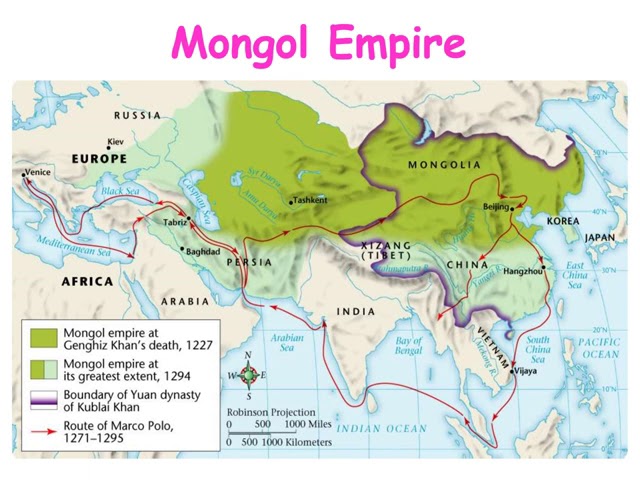










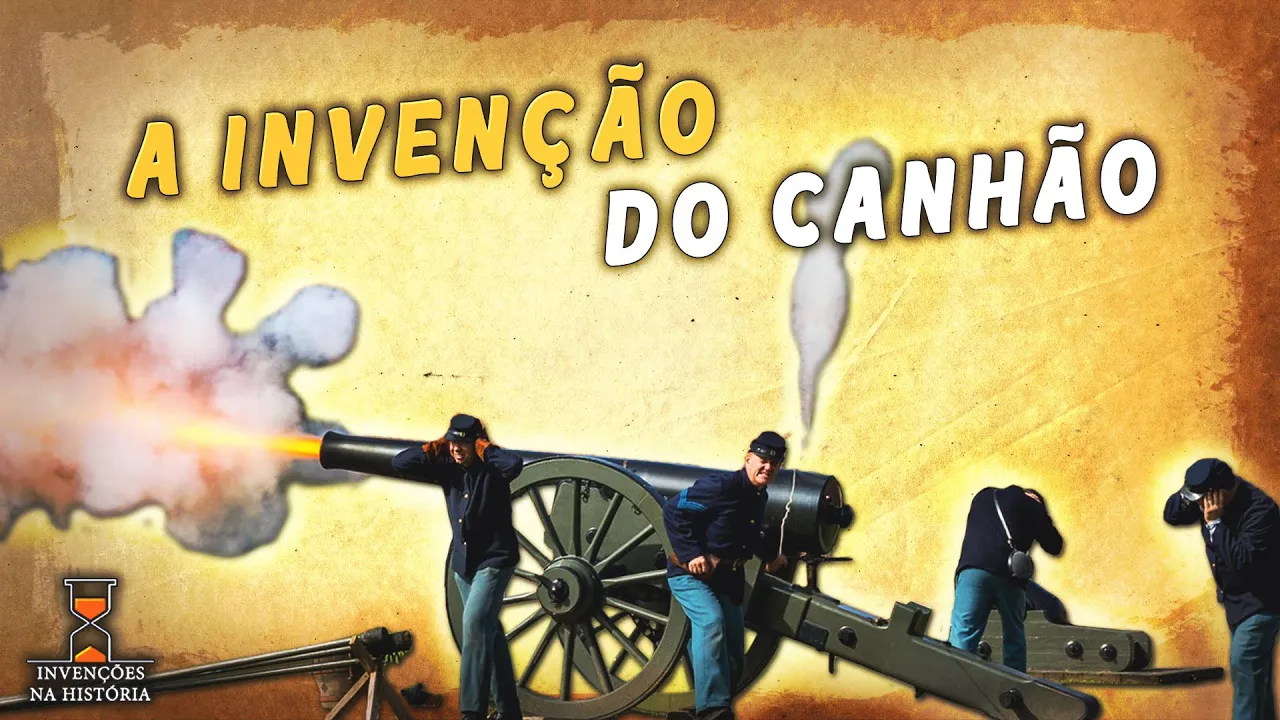

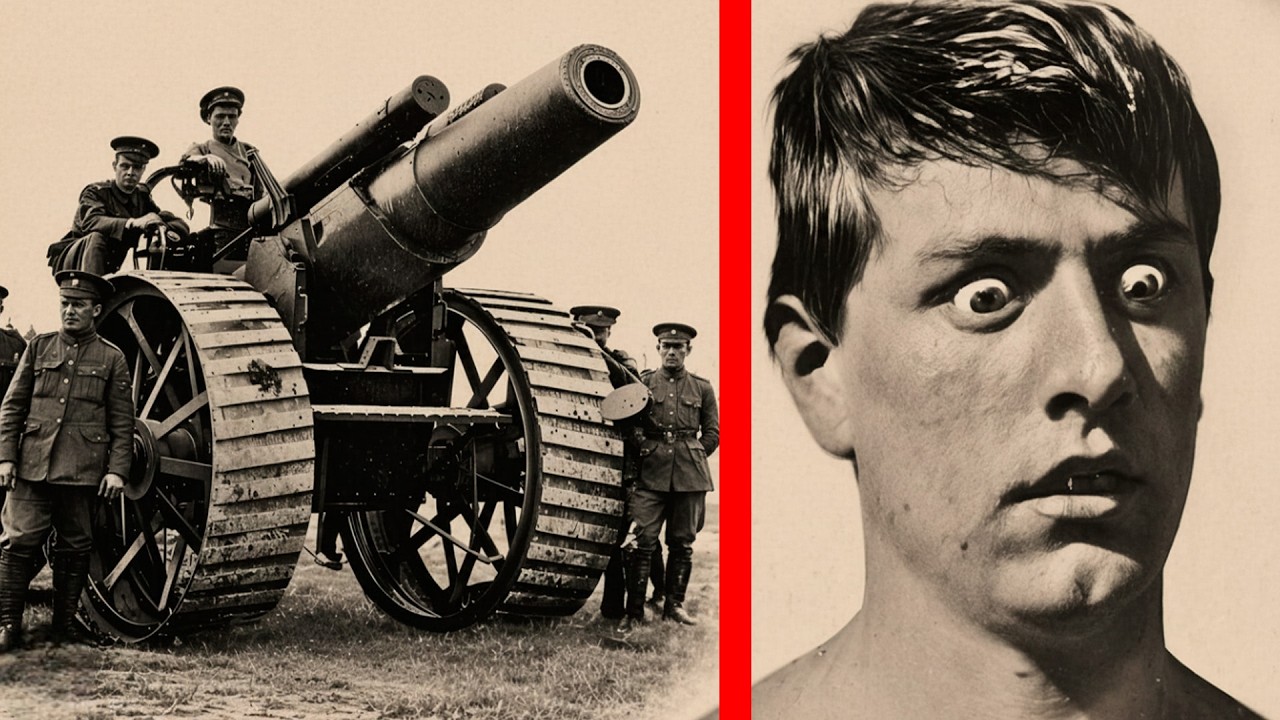
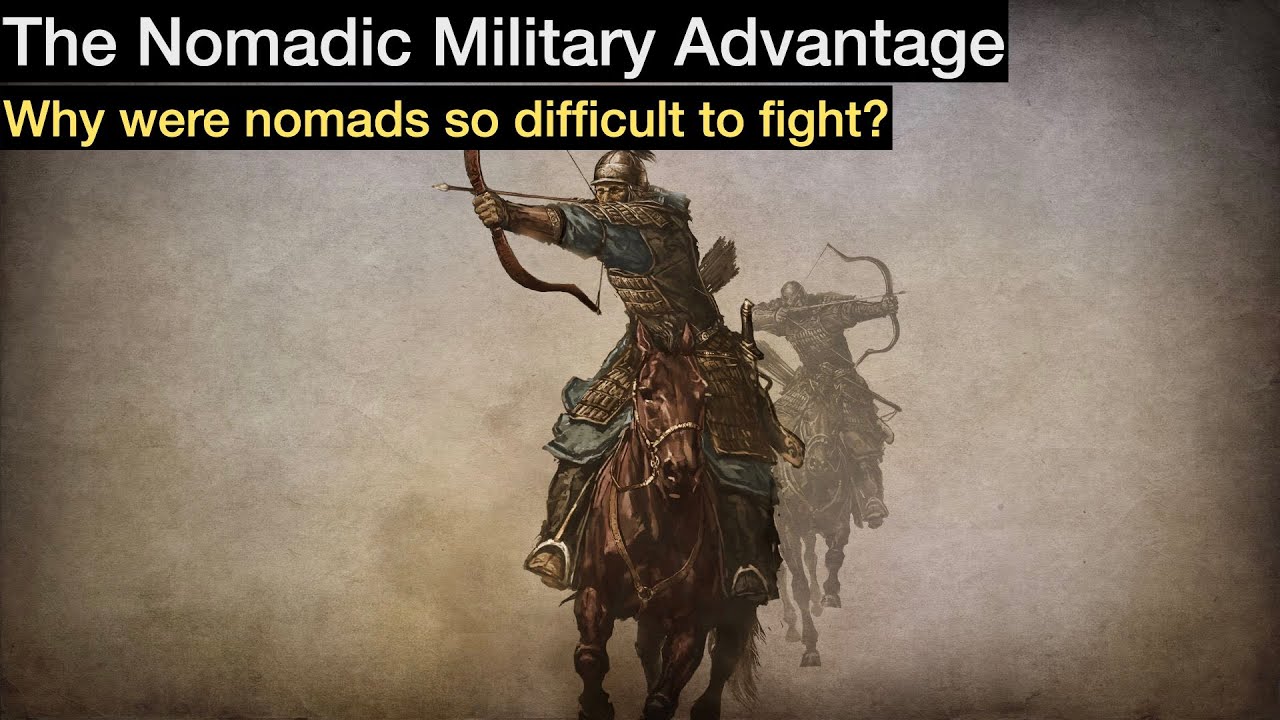


The Mongol Empire played a crucial role in transmitting gunpowder technology across Eurasia during the 13th and 14th centuries, though they primarily used Chinese siege engineers and weapons rather than developing gunpowder themselves; this technology evolved from Chinese innovations including fire-lances, bombs, and rockets, which were later adapted into cannons and hand-held firearms that transformed warfare across Europe, the Islamic world, and India.
Mongol Army's Gunpowder Technology | Historical Documentary
Added:The rise and territorial expansion of the Mongol Empire in the 13th century under Genghis Khan and his successors.
The invention of gunpowder in Tang/Song Dynasty China and its initial military applications, such as fire arrows and incendiary devices.
The concept of the 'Pax Mongolica' and how it facilitated trade, communication, and technological transfer across Eurasia via the Silk Road.
Basic principles of medieval siege warfare, including the traditional use of catapults, trebuchets, and fortified city walls.
The rise of the 'Gunpowder Empires' (Ottoman, Safavid, and Mughal) and how firearms helped centralize imperial power.
The 'Military Revolution' in early modern Europe, focusing on how gunpowder transformed feudal castles and knightly warfare.
The technological evolution from early 'fire lances' and crude bombs to standardized cast-bronze artillery and hand cannons.
The shift in global geopolitical dominance from nomadic horse archers of the Eurasian steppe to sedentary states with industrializing military capabilities.
333.6K views13Klikes21:51Original Release: 2021-07-09
The rapid expansion of the Mongol Empire in the thirteenth century cannot be attributed to a single new military invention providing technological supremacy over their enemies.
Still, the Mongols were adept in employing the tools of their foes.
As historian Timothy May wrote, “the Mongols rarely met a weapon they did not like.” In today’s entry in our series on the Mongol army, we will examine the Mongol Empire’s use of and possible role in the transmission in gunpowder and gunpowder weapons over the 13th and 14th centuries.
Speaking of the explosive action, this video is kindly sponsored by Conqueror’s Blade!
This excellent tactical MMO set in a vast open medieval world is available for free on PC and its Season 8 called Dynasty just launched on July 8th, and you can download it via our link in the description.
In Conqueror’s Blade you select from more than 10 warlord types and more than 85 units and fight 15 vs 15 player versus player medieval sieges!
Create or join a House to ally with other players and fight in massive, bi-weekly server-wide battles known as Territory Wars!
Conqueror’s Blade is updated all the time, and the 8th season inspired by the Tang follows the rise of a dynasty, of its heroes and warriors, through years of chaos and war to a time of order and prosperity.
The update adds Longting and Hao Jing regions to the game, alongside the pike weapon class for the warlords, new units including Cudgel Monks, Greyhair Garrison, Modao Battalion, and the legendary Linwu Fortress as a siege map.
The battle pass unlocks 100+ season-exclusive rewards from including new Hero Attire, weapon skins, Emotes, and so much more!
Register through the link in the description and get a free 7-day Premium account, which includes 30% boost to earned Hero and Unit XP, Bronze Coins, and Honour, as well as additional Vault Keys for the completion of Weekly Quests!
For some historians, like J.J.
Saunders or Kate Raphael, the idea of the Mongols as both users of gunpowder and transmitters of its knowledge to the west is a total negative or extremely unlikely.
But the great British sinologist Joseph Needham demonstrated thoroughly that the Mongols used a variety of gunpowder weapons during their wars in China, while more recent historians such as Iqtidar Alam Khan, Thomas T. Allsen and Stephen G. Haw, have argued that the Mongols carried a number of gunpowder weapons, such as bombs, fire-lances and rockets, west in their conquests over the rest of Eurasia.
The first recipe for gunpowder appears during the Tang Dynasty in the 8th century CE, in a Taoist work urging alchemists not to mix saltpetre (potassium nitrate), sulphur and carbon-rich materials like coal, and to especially not add arsenic to the mixture, as the result would light aflame.
The Chinese quickly found the energy produced by these materials quite mesmerizing when used in fireworks display, and in civil engineering projects and mining.
Contrary to some popular sentiments that the Chinese only used it for peaceful purposes, it did not take long for it to be turned to warfare.
By 1044, possibly in reaction to military defeats against the Tangut Xi Xia, the Song Dynasty was presented a collection of nine kinds of gunpowder weapons and three distinct gunpowder recipes in the Wujing Zongyao.
This technology advanced under the Song Dynasty, which faced a collection of ever-more fearsome foes on its northern borders.
These weapons took a number of forms. Bombs thrown from catapults (huopao), enclosed in pottery or fragmenting metal shells.
Arrows (huojian) with incendiary packages strapped to them, launched from bows or massive mounted crossbows, developing into early rockets over the twelfth century.
Most infamous was the fire-lance (huojiang): a bamboo or metal tube capable of shooting a jet of flame three metres in length, sometimes with shrapnel and toxic materials packed into the tube to form a terrifying, flame-spouting shotgun. some to explode and throw armour piercing shrapnel, some to spread flame and destroy buildings, with others to have a choking, blinding gas dispersed by the explosion to envelop and confuse the enemy.
The Song Dynasty government was so terrified of their foes acquiring them- that it prohibited the sale of any of the materials composing gunpowder to the Khitan Liao Dynasty or Tangut Xi Xia in the 11th century.
Both lacked access to natural reserves of saltpetre producing lands.
But with the Jurchen conquest of the Liao and Northern Song in the early 12th century, the newly formed Jin Dynasty seized not only stores of these weapons, but the knowledge and resources to produce their own.
The first textual references to fire-lances, rockets, and new kinds of bombs appear as Song forces desperately resisted Jin invasions.
When Chinggis Khan invaded the Jin Dynasty in 1211, whole companies of Chinese siege engineers entered into his service, bringing with them knowledge to construct Chinese siege machines.
One such Chinese siege specialist who willingly deserted, Guo Baoyu, accompanied Chinggis Khan west on his campaign against the Khwarezmian Empire.
According to his biography in the Yuanshi, when the Mongols attempted to force a crossing of the Amu Darya, a number of Khwarezmian ships blocked their path.
Guo Baoyu ordered a volley of huojian to be launched against the fleet.
The ships were all set aflame, allowing the Mongols passage.
While huojian originally and literally meant fire arrows, according to Joseph Needham, Jixing Pan, and Thomas Allsen, over the twelfth century the term came to signify rockets, when powdered gunpowder mixtures with higher percentages of saltpetre, charcoal and less sulphur made for effective rocket propellants.
While Chinggis Khan certainly brought Chinese siege engineers westwards with him, gunpowder was not a key component of his tactics.
Likely, Chinggis lacked the resources to manufacture gunpowder and gunpowder weapons, and if he was making use of them, it was in limited quantities and quickly depleted.
After Chinggis Khan’s death in 1227, his son and successor Ogedai completed the war with the Jin Dynasty, in the process acquiring greater experience with gunpowder weapons, as well as the natural and manpower resources to produce them.
In 1231, for instance, the Jin utilized a new development in bomb technology, the heaven-shaking thunder-bomb (zhen tien lei), to sink Mongol ships in a naval engagement.
These were bombs with high nitrate content encased in a cast-iron shell.
When set off, they created a monstrous noise like thunder, splintering the iron shell into a wave of armour and flesh tearing shrapnel, an early fragmentation grenade.
In 1232, the great Mongol general Subedei besieged the Jin capital of Kaifeng, in a year-long siege in which both sides utilized gunpowder weapons.
Subedei’s catapults launched bombs into the city, while the Jin defenders annihilated mobile shelters pushed up to the walls by dropping thundercrash bombs on them via an iron chain.
The defenders also employed a number of ‘flying-fire-spears’ (feihuojiang).
Depending on the interpretation, these were fire-lances packed with wads of shrapnel and arrows which when fired acted like a flaming shot gun, while others like Jixing Pan suggest these were rockets.
At one point in the siege, a Jin commander took 450 men armed with flying fire-lances into the Mongol encampment, a surprise attack resulting in hundreds of Mongol troops killed or drowned then they tried to flee.
It was remarked that the thundercrash bombs and flying-fire-lances were the only two weapons the Mongols feared.
Yet, these devices could not arrest the fate of the dynasty.
The reliability of these weapons was questionable.
Different proportions of the chemicals, might result in a device going off early, too late, or not at all.
The range of these weapons was short, and they were best utilized in the defense, in situations where their effect on enemy morale could be maximized.
These bombs were not yet the secret to destroying city walls, though they could damage wooden structures, towers or gates along the battlements.
Regardless, they were a frightful weapon when used properly.
Thus it seems unusual that Subedei, the commander of the final campaigns against the Jin who faced these gunpowder weapons, made little use of them in the great western campaign begun a few years later.
Though specialized Chinese artillery was employed against the Alans of the north Caucasus, Rus’ principalities and Hungarians, there is little direct indication of the use of gunpowder weaponry in the west.
Many of the mostly wooden cities of the Rus’ principalities were burned, but the Rus’ sources generally offer no description of how this occurred.
A possible indication is supplied by the Franciscan friar John de Plano Carpini, who travelled through the Rus’ principalities late in the 1240s bearing messages from the Pope to the Great Khan.
In his report Carpini very accurately describes Mongol battle and siege tactics, with the intention that his observations would help prepare Christendom against further attacks.
He wrote that the Mongols threw Greek fire onto cities, in addition to melted down fat from prisoners, a combination which was very difficult to extinguish.
As the Mongols, as far as is known, did not use Greek Fire, it seems that Carpini attempted to describe an incendiary of unusual properties using cultural terms he was familiar with.
As Carpini’s knowledge of Mongol siege tactics came from survivors in the Rus’ territories, it seems to imply that a special type of fire-causing weapon was used against the Rus’: quite possible gunpowder weapons Subedei had brought from China.
The famous smoke screen employed by Mongol forces at the battle of Liegnitz in Poland in April 1241 may also have been a type of gunpowder weapon, as suggested by Stephen Haw.
Devices to deploy toxic smoke and smoke screens have been used in Chinese warfare since at least the 4th century CE, but during the Song Dynasty more effective versions were developed with gunpowder.
In easily shatterable pottery containers, these weapons were packed with poisons, foul-smelling ingredients, shrapnel, arsenic and lime.
Dispersed by the force of the explosion, these bombs unleashed a cloud or fog of painful gas which blinded, disoriented and confused enemy forces- very similar to the smoke weapon described at Liegnitz.
Not understanding it was a gunpowder weapon, either a bomb via a small catapult or modified fire-lance, the Poles focused on the most visible ‘tool’ as the origins of the smoke, mistakenly identifying a Mongolian horse-hair standard as the device.
Lacking words for these new devices, which the Mongols were unwilling to let non-military individuals examine, it is hard to determine when a medieval author is using a familiar term, such as Greek Fire or Naptha, to refer to a new technology which served a similar purpose.
In some cases, it is even hard to tell if it is just a dramatic description.
Such is the case of the Persian writer Juvaini’s account of Hulegu’s campaign in the 1250s, to which he was a direct eye-witness.
Juvaini writes of how Hulegu was provided by his brother, the Grand Khan Mongke, a thousand households of Chinese catapultmen, as well as naptha throwers.
At the siege of the Nizari Assassin fortress of Maymun Diz, Juvaini mentions a large crossbow-like weapon deployed by Hulegu’s Chinese siege engineers, which he called an ox-bow, a direct translation of the Chinese term for the weapon ba niu nu.
Juvaini writes that it delivered meteoric shafts which burnt the enemy, in comparison to stones lobbed by the defenders, which did little but harm a single person.
These ox-bows in Chinese warfare, as described by the Wujing Zongyao, could have gunpowder packages attached to the bolts, and were used in the same manner as Juvaini describes.
While some historians like Stephen Haw see this as a clear usage of gunpowder, it must be remarked that Juvaini’s tendency for over-flowery language makes it difficult to gauge how literal this passage must be taken, though he was an eye-witness to the siege.
Generally it seems that gunpowder was little used in the Mongols’ western campaigns.
Likely difficulties in travelling with it prevented them from taking great quantities of it, and at the time of the conquests there was not sufficient knowledge in the west that allowed them to procure more supplies.
The matter was very different in the continuing Mongol wars in China, where under Khubilai Khan bombs were a main component of the wars against the Song Dynasty, which also employed them.
Thousands of bombs were made every month in the Song Dynasty, though getting them to where they needed to be was another matter.
One Song official in 1257 inspecting the border arsenals lamented how poorly supplied these vulnerable sites were in these weapons, and how repeated requests to the central government were fruitless.
The Song continued to throw whatever they could against the Mongols as they advanced deeper into southern China, but by then the Mongols not only had ample supplies of these weapons for war in China, but manpower reserves, a powerful military structure and a leadership hell-bent on overrunning the south, driven by the energetic Khubilai who believed in the eventuality of his conquest.
Khubilai’s great general Bayan set up ranks upon ranks of huopao during his drive to Hangzhou, lobbing stones to pound down the walls, gunpowder bombs to annihilate gates and towers and terrify the defenders within.
Against such an implacable foe, the last of Song resistance was ground to dust.
It appears that an advance in gunpowder weapons was made sometime in the late thirteenth century.
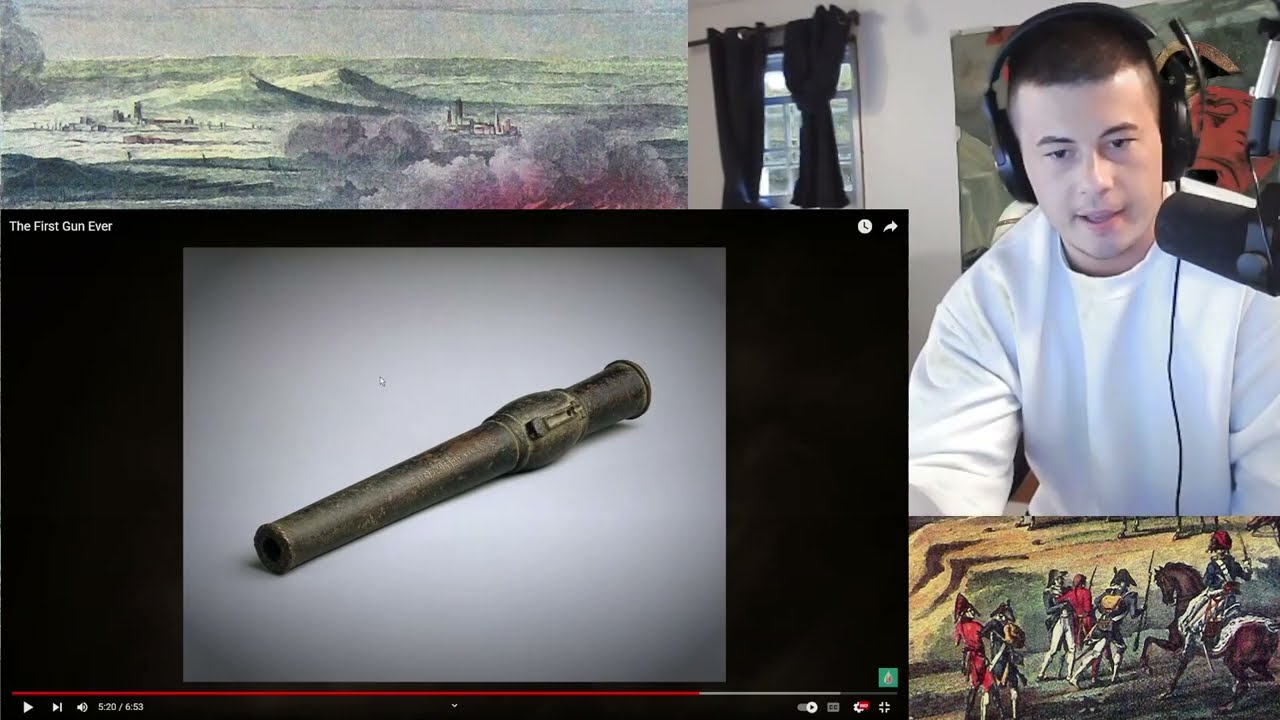
Near the ruins of Khubilai’s summer capital of Shangdu, the earliest confirmed cannon has been found.
Bearing a serial number and an inscription in the ‘Phags-pa script dating it to 1298, weighing 6 kilograms (13 lb 11 oz) and just under 35 cm (approx.
14 in) in length, it suggests a product of considerable experimentation and systemization.
Much more primitive and rougher versions have been found that seem to date to the last years of the Tangut Xi Xia Dynasty, crushed in 1227 by Chinggis Khan.
It is probable that the evolution of fire-lances from bamboo to metal tubes was a stepping stone to larger metal tubes capable of larger gunpowder charges and projectiles, brought on by the emergency of the Mongol invasions.
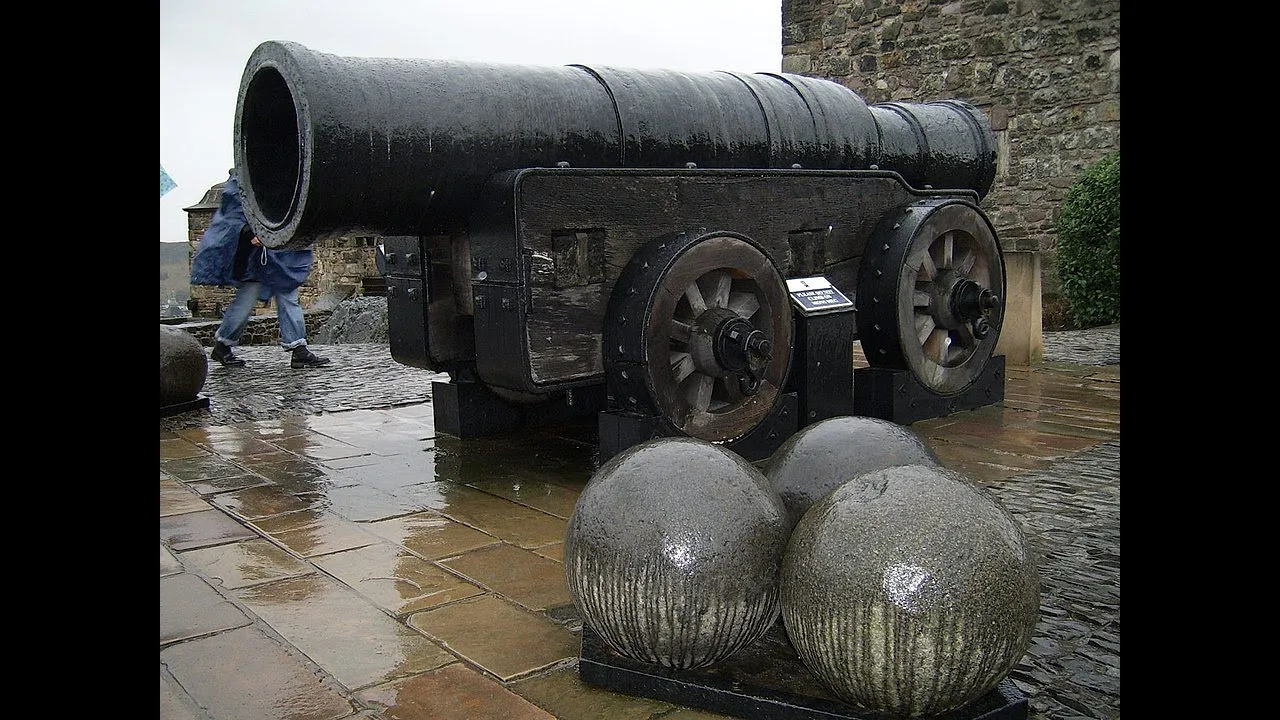
Only in the last years of the 13th century did these models reach a level of standardization and sophistication to become true bombards, and more and more sophisticated models are known from over the fourteenth century.
There are a few passages from 13th and 14th century Chinese texts which may indicate the usage of these cannons, usually in naval engagements; where muzzle flashes seem to be described when Mongol ships fire upon fleeing Jin ships, or with small vessels at the blockade of Xiangyang bearing huopao, but from ships too small for catapult.
Much like the western texts, the Chinese did not yet have a name for this new technology though.
Calling them huopao, the same name for the catapults which threw gunpowder bombs, it is impossible to know, unless a description is given, which texts refer to bombs, and which to early cannons.
From 1288 we have perhaps the earliest description of small hand-held guns or cannons.
In the war against his rebel cousin Nayan, Khubilai Khan led his army against Nayan himself, but attacked from multiple fronts.
One such operation was led by a Jurchen commander in Khubilai’s service, Li Ting.
Using the word for fire-catapult or cannon, huopao, Li Ting and his small squad of Korean soldiers one night snuck into an encampment of Nayan’s men in Manchuria and set off these weapons to great effect.
From the context, it is clear that these weapons are too small and mobile to be catapults.
In further support of this interpretation, it appears one of these actual weapons was found.
Discovered in 1970 in Heilongjiang province, near where Li Ting’s troops fought Nayan, a small bronze cannon or handgun has been discovered from an archaeological site supporting a late thirteenth century context.
Weighing 3 and a half kilograms, 34 cm in length, with a bore of 2 and a half centimeters, these were small, anti-personnel weapons.
Not much use against walls, but devastating against men and horses.
The Yuan Dynasty continued to produce cannon over the fourteenth century.
One well known example from 1332 bears an inscription with its date and purpose of manufacture, intended to be used on board a ship for suppression of rebels.
By the rise of Zhu Yuanzhang and the Ming Dynasty in the late fourteenth century, cannons and other firearms were standard features of Chinese armies.
So did the Mongols spread gunpowder westwards?
Recipes for gunpowder and even the first gunpowder weapons appear in Europe, the Islamic World and India late in the thirteenth century and early fourteenth centuries, after the Mongol expansions.
However, the diffusion is difficult to track due to the already mentioned ambiguities in terminology.
It’s likely the Mongol armies did not travel with great quantities of powder and were reluctant to share its knowledge.
It is notable though that when perhaps the earliest recipe for gunpowder is recorded in Arabic in 1280 by Hasan al-Rammah, he records the ingredients as being Chinese in origin, with saltpetre for instance called Chinese snow, or rockets as Chinese arrows.
A common word for gunpowder in Arabic and Persian meant drug, a literal translation of the Chinese huoyao, fire-drug which implies that knowledge was transmitted directly from Chinese engineers in Mongol service.
By the start of the fourteenth century, fireworks appear as objects of regular entertainment in the Ilkhanate.
Many diplomats, travellers, priests and merchants made the trek from Europe across the Mongol Empire and back, and many brought gifts from the Khans with them, or observed closely the Mongol army in an attempt to learn its secrets.
The Franciscan friar, William of Rubruck, spent time with a European goldsmith in Mongol service, William Buchier, the man who made the famous Silver Tree of Karakorum.
Buchier appears to have worked often in conjunction with Chinese artisans in his work for the Mongols.
Though Rubruck does not describe gunpowder, he did meet, while back in Paris, the first European who did: Roger Bacon, who later describes with amazement his experience viewing Chinese firecrackers going off in Europe.
Even if the Mongol army itself did not directly or intentionally transfer gunpowder, or use it in quantities to replace their own bows and arrows, they opened the pathways that allowed its knowledge to move across the Eurasian continent.
Over the early decades of the fourteenth century, fearsome hand guns and bombards became regular features of battlefield across the continent, the secret to gunpowder no longer restricted to Chinese dynasties.
More videos on Mongol history are on the way, so make sure you are subscribed and have pressed the bell button to see the next video in the series.
Please, consider liking, commenting, and sharing - it helps immensely.
Our videos would be impossible without our kind patrons and youtube channel members, whose ranks you can join via the links in the description to know our schedule, get early access to our videos, access our discord, and much more.
This is the Kings and Generals channel, and we will catch you on the next one.
Up Next

94:14
Globalization of Baghdad: Imperial Capital & Global Trade
@UChicagoHK
272 views•2025-06-16

33:02
The Great Schism of 1054: Causes and Consequences
@SacredCathedrals
113.5K views•2026-02-19
19:41
The Great Schism: Catholic-Orthodox Rivalry in Medieval Christianity
@KingsandGenerals
2.6M views•2020-02-06

17:05
Understanding the Cold War: Superpower Conflicts and the Road to Détente
@OverSimplified
46.1M views•2019-01-24
Related Study Plans & Knowledge Roadmaps
Structured learning paths in History
history
Byzantine Iconoclasm: Theology, Art & Politics
01Foundations of Byzantium and Early Christian Images
02The First Iconoclasm: Leo III and the Crisis of Images
03Empress Irene, Nicaea II, and the Second Iconoclasm
+ 2 more learning modules
9h5 modules
Explore Roadmap
history
Iranian Revolution (Causes, Events & Legacy)
01The Pahlavi Dynasty and the Roots of Discontent
02The Spark of Rebellion and the Rise of Khomeini
031979: The Fall of the Shah and the Climax of the Revolution
+ 2 more learning modules
8h5 modules
Explore Roadmap
history
Mali Empire: Mansa Musa, Trade & Timbuktu
01Foundations of the Mali Empire
02The Trans-Saharan Gold and Salt Trade
03The Reign and Pilgrimage of Mansa Musa
+ 1 more learning modules
6h4 modules
Explore Roadmap
history
1947 Partition: Politics, Borders & Legacies
01Foundations of British India and the Divide
02The Political Negotiations and the Mountbatten Plan
03Drawing the Boundary: The Radcliffe Line
+ 2 more learning modules
8h5 modules
Explore Roadmap