






![[Introduction to Linguistics] Word Order, Grammaticality, Word Classes](https://i.ytimg.com/vi_webp/E3eTNgPXkG4/maxresdefault.webp)












![[상담이론] 제26강 대상관계이론(클라인 위니컷 페어베언)](https://i.ytimg.com/vi/MVelKHj7JKM/hqdefault.jpg)
![[Syntax] Case Theory](https://i.ytimg.com/vi_webp/7X7V8wpjaGI/maxresdefault.webp)


In generative syntax, the affix hopping rule explains how inflectional affixes (like -ed, -ing, -en) generated in functional categories (T, PerfP, ProgP, VoiceP) move down to attach to the main verb, accounting for the interleaving patterns observed in complex sentences with multiple grammatical markers such as tense, perfective, progressive, and passive constructions.
Syntax 7.5: Affix Hopping in TP, ProgP, PerfP & VoiceP
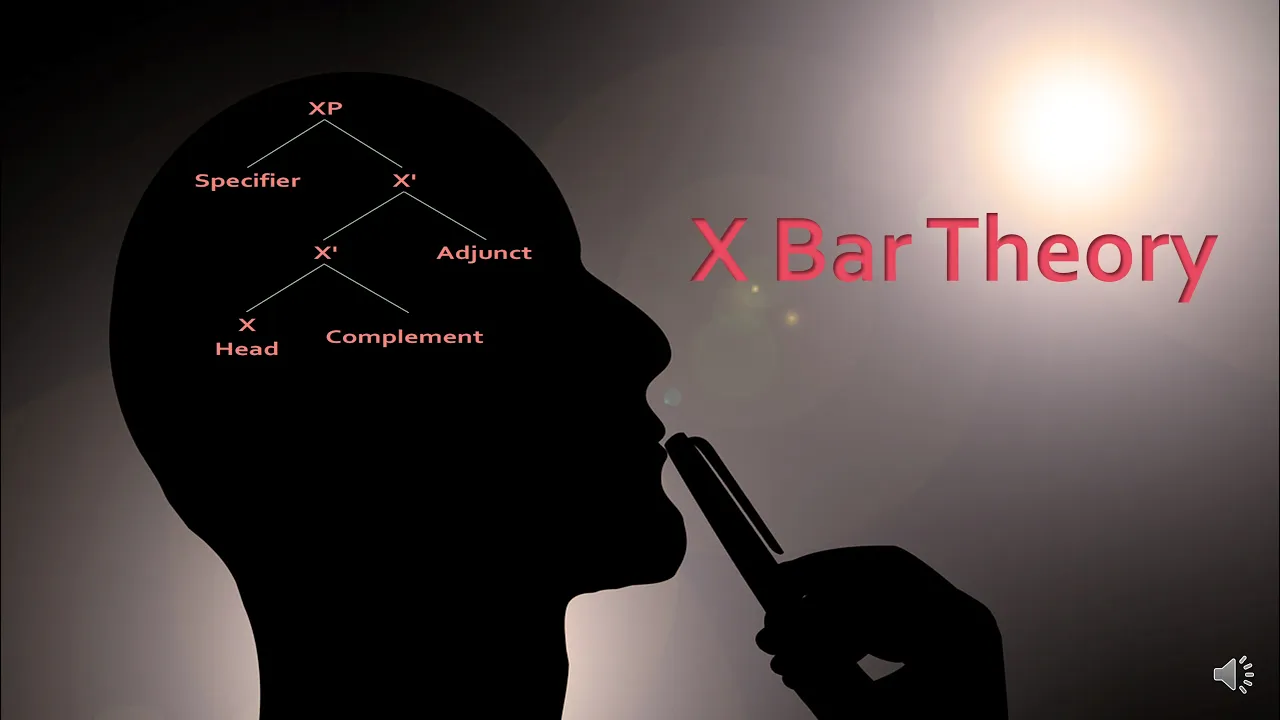
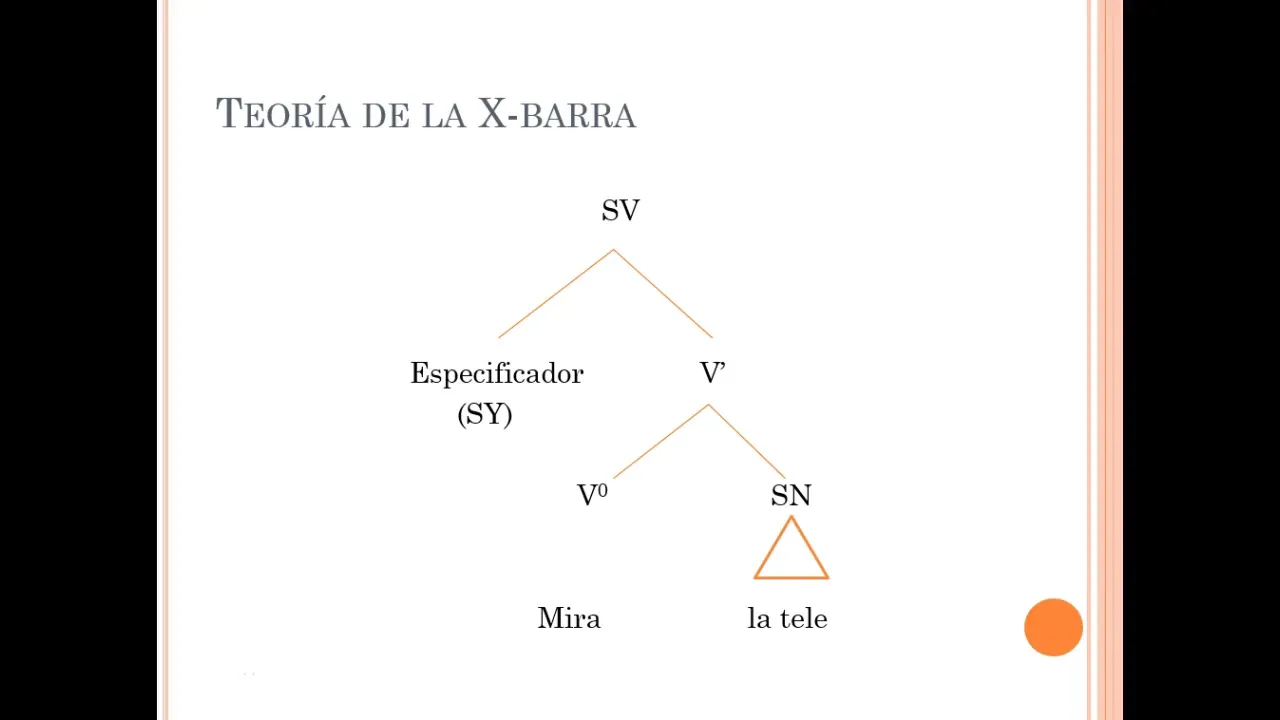
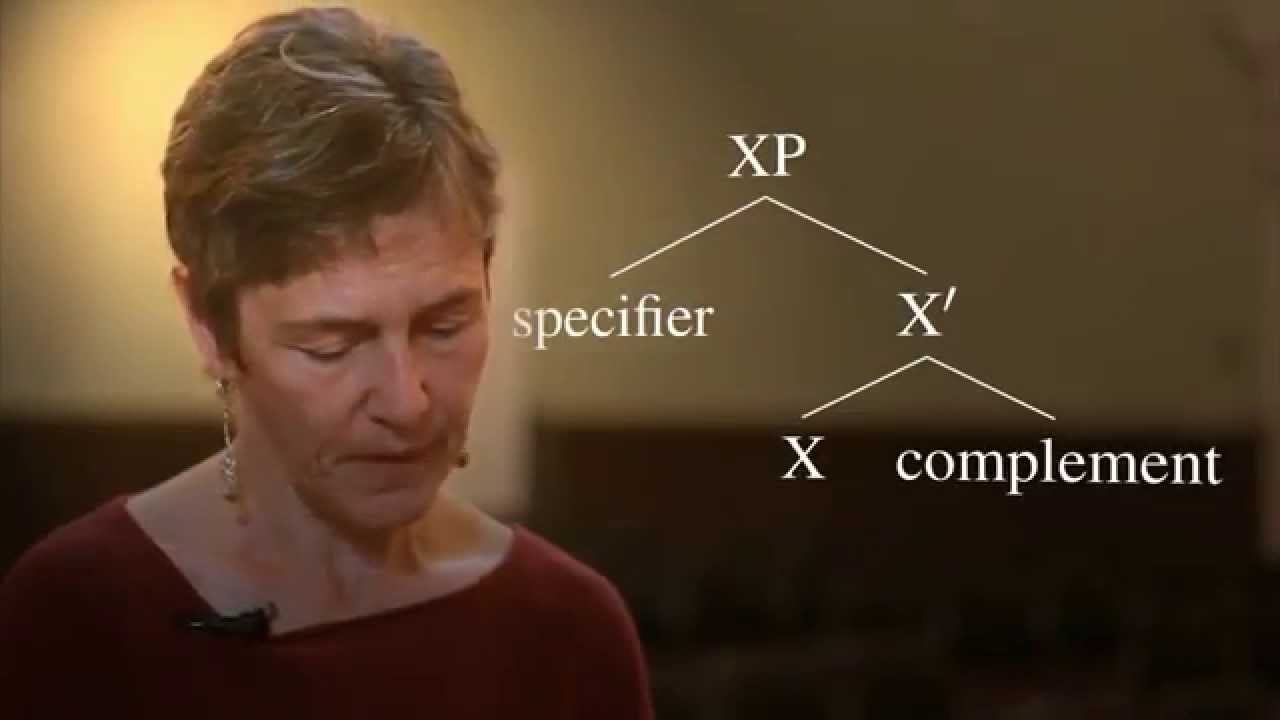
Added:Basic X-bar Theory: Understanding the universal phrase structure schema (Heads, Complements, and Specifiers) as applied to lexical categories.
Structure of the Tense Phrase (TP): Familiarity with the basic clause structure where Tense (T) projects to a TP and hosts modal auxiliaries or abstract tense features.
Lexical vs. Functional Categories: Understanding the distinction between content words (like verbs in VP) and functional morphemes (like tense, aspect, and voice).
English Verbal Morphology: Basic awareness of grammatical aspect (Progressive '-ing' and Perfective '-en') and passive voice, and how they relate to auxiliary verbs ('be' and 'have').
Head-to-Head Movement (V-to-T): Studying how languages like French differ from English by raising the lexical verb to the Tense head syntactically, rather than lowering the affix.
Do-Support in English: Analyzing how English saves a sentence when Affix Hopping is blocked by syntactic interveners like negation ('not') or during Subject-Auxiliary Inversion.
The Split-INFL Hypothesis: Exploring more advanced syntactic frameworks that decompose TP into separate functional projections like Agreement Phrase (AgrP) and Tense Phrase (TP).
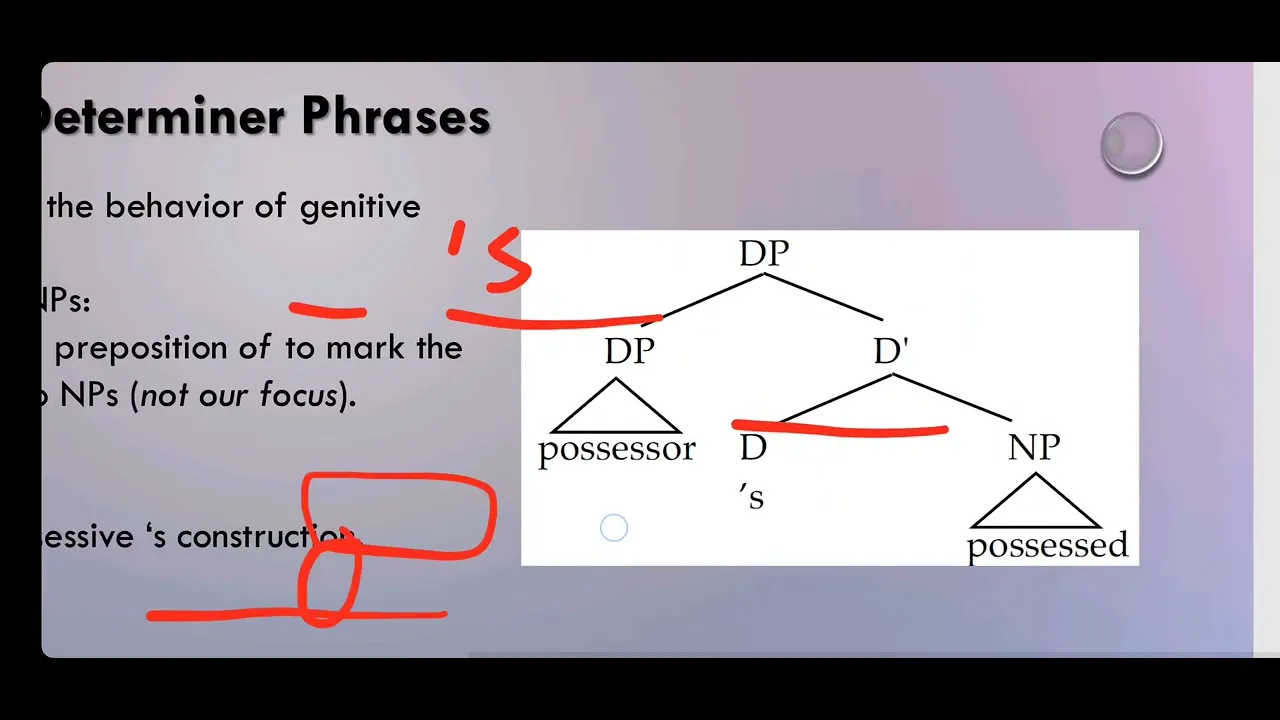
DP Movement and Case Theory: Investigating how the subject DP moves from its thematic origin inside the verb phrase (Spec-vP/Spec-VP) to the Spec-TP position to check Nominative Case.
7.8K views126likes12:36Original Release: 2020-09-01
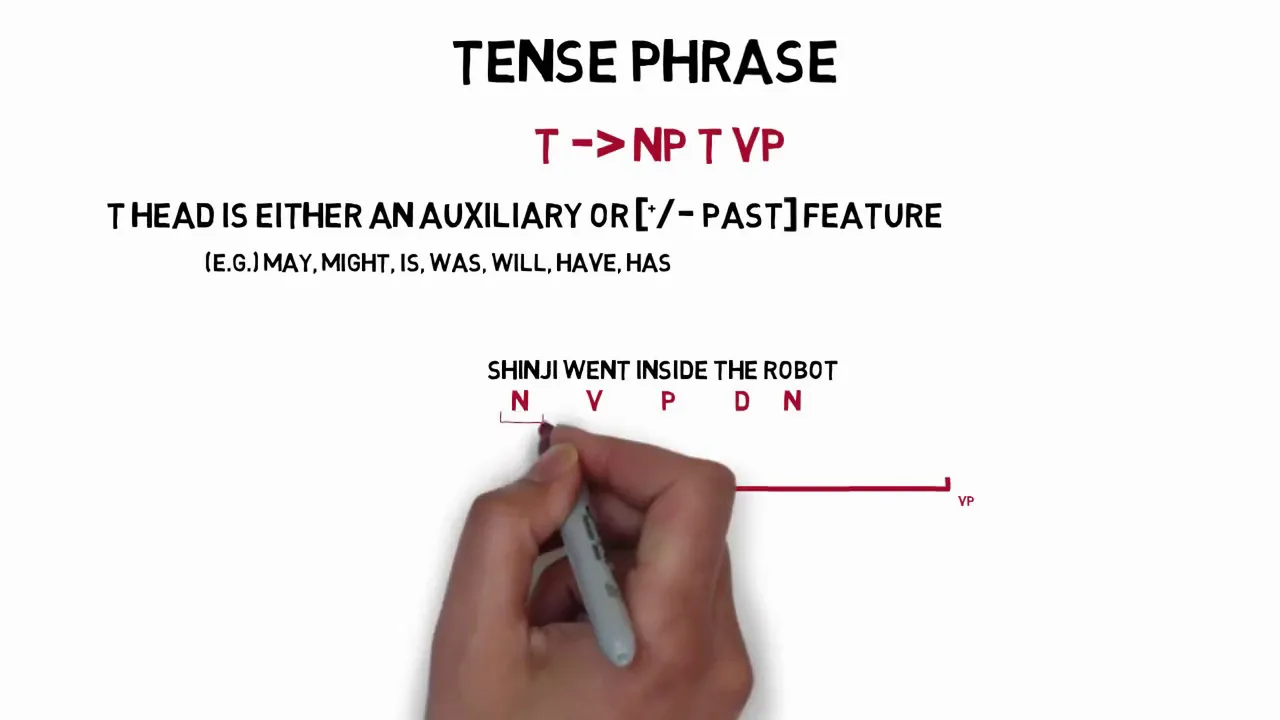
[Music] welcome to syntax a generative introduction fourth edition my name is andrew carney i'm a professor of linguistics at the university of arizona i'm the author of your textbook and i'll be leading you through this series of video tutorials in this video we're going to talk about the application of x bar theory to the categories we've been discussing the tp the progressives the perfectives and the voices and we're going to propose four categories tp prog p perfect p or perf p and voice p let's start off with tp t is the head of tp that should be no surprise we put the tp in x bar format we put the subject in the specifier of that position foreshadowing what we're going to do with species specifiers more generally subjects are specifier positions and the verb phrase or other kinds of phrases can act as the complement to the head tea the things that go in tea include auxiliaries like is have as well as modals in fact modals are probably our best example of things that go in t so should can will etc i'll go in t um you're going to find if you explore the syntax literature a variety of names for the things that we've been calling the tp it's often also called ip or infill phrase or agar p for agreement phrase these are all essentially names for the same thing as tp uh there's sort of older names that aren't used as much uh but they are all names you will find you will also sometimes find tp referenced as s this is a very old name s stands for sentence you will also find the tense node sometimes called infill all right so now what happens with tps in sentences where we don't have an auxiliary like will what's going on in that kind of situation so if we've got x bar theory the tp has to have a t in it because the tense and the t bar and the tp are the obligatory parts as defined by x bar theory but what about sentences like juanita loves peanut butter sandwiches where's the t note here if t is going to be optional how could it possibly be the head of the tp phrase well we're going to claim that there are tenses in sentences like this i'm going to give you two analyses throughout this video course series the first analysis we're going to talk about is the analysis called affix hopping and we're going to do that now in unit 9 we're going to come back to that and propose an alternative to affix hopping that involves selection both analyses work one is a little more explanatory than the other that's the selection analysis but it also requires a lot more technology than we have right now so the affix hopping analysis is probably the easiest one to do so here's the observation auxiliaries and modals are in complementary distribution with inflectional suffixes on the verb so i must dance there's no suffix on dance i will dance there's no suffix on dance i danced there's a suffix there and it's the past tense suffix we have a preterit form but you can't say i will dance or i can dance these are impossible so it looks like when you have a modal or an auxiliary it's in complementary distribution with those suffixes on the verb one of the things we know about complementary distribution is if you have two instances that cannot appear at the same time they are likely items of the same category so that suggests that the tenth suffix is in fact of category t this should be no surprise because it indicates tense but it's in the wrong place the tense node is higher and to the left of the verb but this affix is showing up on the verb what's our solution one proposal the proposal that we're pursuing in this video is called affix hopping and it's due to chomsky 1957 the probably the most classic work in syntactic theory called syntactic structures he proposes this rule in that volume affix hopping is the idea that affixes are generated in the t node and then they literally lower down onto the verb they hop down one position so while with a modal we have a situation like the tree on the left where the modal occupies a t node when we have an affix we're going to put that affix in the t node but we have to get it down onto the verb and we have this special rule called affix hopping that takes that affix and moves it down this explains those cases where it appears as if the the tense information is in the wrong place we're actually going to be able to expand this idea along with x-bar theory to the complex pattern of aspect and voice that we talked about in the last unit where we noticed that there was a strange interleaving between items that marked the the perfective the progressive and the passive voice and we by using affix hopping we can correctly get all the information in the correct place so let's start off with perfects so you remember from the last unit the perfects consist of the ver the auxiliary verb have and the participle form of the of the verb um here i'm indicating the participle form with the suffix e n just as a convenience so now let's propose that have plus e n form the head of a um a particular functional category we call perf or or for perfect which itself is subject to x-bar theory so here in this tree we have in fact indicated an x-bar structure to dominate this aspectual marker so this is our aspectual marker it's the auxiliary have plus the marker of the participle but again the participle marker is in the wrong place it really belongs down onto the verb so we can solve that problem by using affix hopping again we're going to take that en and we're going to move it down and hop it onto the verb below it you can do the same thing with progressives progressives you'll recall are indicated by taking the verb to be in any of its forms and uh making sure that the verb that follows it is in its gerundo form or gerund form which means it's marked with ing so the information that is involved in marking the progressive so being marked by the progressive head is the verb to be plus an ing suffix here again we've taken progressive and we've put it into x-bar theory in order to make it fit the rest of the theory however this ing is in the wrong place if we have is eating we want the ing on eat so we can do affix hopping again and take that ing and lower it down onto eat and that gives us is eating passives same thing remember a passive is marked by the verb to be plus a participle here again represented by the en suffix so the passive voice taken together is b plus en which is why they sit here together under this voice head the voice head is x-bar theoretic but the e-m is in the wrong place it needs to be on the verb because we say was eaten it's not being it's was eaten so we're going to lower that en down onto eat just the same way we did with all the other forms via affix hopping this gives us the tight interleaving of the information you need to determine whether something is a passive a progressive or a perfect now recall that you can combine all these forms together so you can have a complex structure that has tense it has perfect it has progressive it has passive voice and it has a main verb so here's the sentence we're going to to draw the diagram of the pudding should have been being eaten at the table when bill walked in we're not going to leave off the when bit but this is a little complicated structure some native speakers don't like it just because it's so complex but it does in fact have all the allowable bits of a sentence and highly literate english will in fact have sentences like this so what do we have we have the modal should we have have which come when combined with the participle um gives us the perfect in order to make that work we are going to um make we're going to put have plus the perfect marker here under the perfect head and we're going to do affix lowering of the en onto the b making it into the participial form so that's have and e n form the perfect the progressive is formed by b plus a gerund so the b part stays here underneath the progressive but the ing actually has to appear one verb down so the b the first b marks the progressive and the ing on the following b marks the progressive so we start with them together underneath the progressive head and then we lower the ing onto the lower b the voice the passive voice is indicated by e plus a participle so here we have the auxiliary b and here we have the en that marks the participle they mark out the passive voice but this en is in the wrong place it shouldn't be on the verb to be it should be on the following verb so once again we have the option of lowering it and this gives us the sentence the pudding should have been being eaten at the table when bill walked in [Music]
Up Next
8:12
Syntactic Movement and Traces: An Introduction
@thelingspace
42.8K views•2015-02-18
36:52
Constraint Interaction in Optimality Theory: Epenthesis & Deletion
@Vidyamitra
180 views•2018-08-20

18:22
Syntax: DP Movement & Case Theory Explained by Andrew Carnie
@CarnieSyntaxthEdition
14.3K views•2020-09-29

21:32
Accent Expert Explains U.S. Regional Dialects | Part 1
@WIRED
9.3M views•2021-01-21
Related Study Plans & Knowledge Roadmaps
Structured learning paths in Linguistics
linguistics
Optimality Theory: Tableaux & Constraints
01Phonological Basics: Sounds, Syllables & Rules
02Foundations of Optimality Theory: GEN, CON, and EVAL
03The Constraint Inventory: Markedness vs. Faithfulness
+ 2 more learning modules
15h5 modules
Explore Roadmap
linguistics
Morphosyntactic Alignment: S, A & P Systems
01Foundations of Syntax: Transitivity and Arguments
02The Linguistic Variables: Mapping S, A, and P
03Nominative-Accusative Alignment
+ 3 more learning modules
12h6 modules
Explore Roadmap
linguistics
Analyzing Sign Language: Phonology & Syntax
01Foundations of Sign Language Linguistics
02Phonology: The Five Parameters of a Sign
03Morphology: Word Formation and Classifiers
+ 2 more learning modules
14h5 modules
Explore Roadmap
linguistics
Pragmatics: Speech Acts, Grice & Politeness
01Introduction to Pragmatics: Meaning in Context
02Grice’s Cooperative Principle & Implicature
03Speech Act Theory
+ 2 more learning modules
14h5 modules
Explore Roadmap