The glass transition temperature (Tg) is the critical temperature at which an amorphous polymer transitions from a hard, brittle glassy state to a soft, flexible rubbery state; this transformation is influenced by several factors including molecular weight (higher molecular weight increases Tg), chain flexibility (rigid chains yield higher Tg), steric hindrance from bulky substituents (which raise Tg), cross-linking density (cross-linked structures have higher Tg), and crystallinity (crystallization increases Tg).
Glass Transition Temperature (Tg) | Polymer Properties Explained
Added:Deep Dive
Basic polymer chemistry, including the definition of monomers, polymer chains, and molecular weight.

Polymer Basics: Monomer, Degree of Polymerization, & Microstructure
90.6K
Polymers are long-chain molecules of covalently bonded repeat units, derived from Greek meaning 'many units.' Common examples include polyethylene (C2H4 for milk containers), PVC (C2H3Cl for pipes), and polypropylene (C3H6 with CH3 side groups). Polymer chains have a coiled, string-like shape due to carbon-carbon single bonds rotating freely at 109° angles, with van der Waals forces holding chains together. Key terminology includes: monomer (unreacted single molecule capable of polymerization), mer (repeat unit within polymer chain), and polymer (entire chain molecule). Degree of polymerization (n) is the number of mer units per polymer molecule, calculated as n = molecular weight of polymer / molecular weight of mer. Molecular weight significantly affects properties: paraffin (n=10, ~280 g/mol, melting ~40-50°C) versus HDPE (n=10,000, ~280,000 g/mol, melting ~120-130°C). Longer chains have more van der Waals bonds, requiring more energy to overcome during melting.
Click to watch →

Army Bharti 2026 | Chemistry Demo 01 | Army Nursing/Technical Syllabus 2026
7.6K
Polymers (Bhulak) are macromolecules with high molecular weight formed by combining many small units. The term 'polymer' derives from 'poly' (many) and 'mer' (unit). A polymer is defined as a compound with high molecular weight composed of numerous small molecules joined together. A monomer (Ekalk) is a small molecule that serves as the basic building unit from which polymers are formed. Polymerization (Bhulakikaran) is the process by which monomers join together to form polymers. For example, ethylene (ethene) is the monomer that combines to form polyethylene.
Click to watch →

Unit-2 Polymers and Composites (Polymers Definition & Polymerization) - Chemistry
49.1K
Polymers are macromolecules with very high molecular weight formed by combining many small molecules called monomers. Monomers have low molecular weight and contain at least two reactive sites or functional groups. The degree of polymerization represents how many times the monomeric unit repeats in the polymer chain, which determines the polymer's properties. Polymers range from 10^4 to 10^6 g/mol molecular weight, causing dramatic changes in physical properties compared to monomers. Based on molecular weight, polymers are classified as high polymers (significant mechanical importance) or oligomers (insufficient strength for practical use).
Click to watch →
(Part 1) POLYMERS One Shot Revision | Class 12 Chemistry 2026 | VVI Questions for Board Exam! 🔥
841
Polymers (बहुलक) are macromolecules with molecular sizes ranging from 10^3 to 10^7 cm, formed by the repetition of small units. The term 'polymer' derives from Greek words 'poly' (many) and 'mer' (unit). All polymers are macromolecules, but not all macromolecules are polymers. The process of forming polymers from monomers is called polymerization (बहुलकन, बहुलीकरण, or बहुलकीकरण). A monomer (एकलक) is a small molecule with low molecular weight that serves as the building block for polymers. For example, ethylene (CH2=CH2) is a monomer with molecular weight 28 amu, while polyethylene has high molecular weight due to the repetition of many monomer units.
Click to watch →

Polymer Engineering Full Course - Part 1
18.8K
Polymers are large molecules composed of many repeating monomer units, derived from Greek 'poly' (many) and 'mer' (repeating unit). Monomers are single structural units connecting to form chains; oligomers are shorter chains. Polymers classify by origin: natural polymers occur in nature (DNA, cellulose, proteins, rubber, wool, silk), synthetic polymers are man-made (plastics, containers, automotive parts), and semi-synthetic polymers are chemically modified versions (vulcanized rubber, rayon). Chain structures include linear (thermoplastics), branched, star-branched, polymer networks (thermosets), and interpenetrating networks. Molecular weight ranges from 1000 to millions g/mol, affecting properties like strength and processability. Number average molecular weight (Mn) represents most frequent chain length; weight average molecular weight (Mw) weights by mass. Polydispersity index (PDI = Mw/Mn) measures molecular weight distribution—low PDI indicates uniform chains, high PDI indicates diverse chain lengths. Higher molecular weight increases impact strength, tensile strength, melting temperature, and toughness but reduces processability due to increased viscosity. Polymer configuration refers to chemically fixed atomic arrangements, requiring bond breaking to change. Stereoisomers share connectivity but differ spatially: cis-trans isomers differ around double bonds; tacticity describes stereo regularity around single bonds (isotactic, syndiotactic, atactic). Polymer conformation refers to physical shape determined by rotation around single bonds, affected by steric hindrance, temperature, and crystallinity. Primary bonds (covalent) are strongest, holding monomers together; secondary bonds include van der Waals forces (temporary attractions) and hydrogen bonding (dipole-dipole interactions).
Click to watch →
Deep Dive
The difference between amorphous and semi-crystalline polymer structures.

Ep2 More examples of polymers, glass transition, molecular weight UCSD NANO 134 Darren Lipomi
18.4K
Polymers exhibit two fundamental structural states: amorphous (disordered, like frozen spaghetti) and semi-crystalline (ordered crystallites mixed with amorphous regions). Amorphous polymers lack long-range order and are characterized solely by their glass transition temperature (Tg), the temperature at which chains gain mobility. Semi-crystalline polymers contain both ordered crystalline domains and disordered amorphous regions, exhibiting both Tg and a melting temperature (Tm). The ability to form ordered structures depends on molecular regularity, with isotactic and syndiotactic configurations enabling crystallization while atactic configurations remain amorphous.
Click to watch →

Semi-Crystalline vs Amorphous Materials
6.5K
Thermoplastic materials are classified into two morphologies based on their molecular structure: amorphous materials have a random, disordered polymer arrangement and appear clear with gradual softening when heated, while semi-crystalline materials have organized crystalline regions that make them appear opaque or cloudy with a sharp melting point; these structural differences affect key properties including chemical resistance (semi-crystalline materials like polypropylene resist solvents better than amorphous materials like polycarbonate), flexibility (semi-crystalline materials are more durable under repeated bending), and shrinkage during cooling (semi-crystalline materials shrink more than amorphous materials).
Click to watch →
Polymer Engineering Full Course - Part 1
18.8K
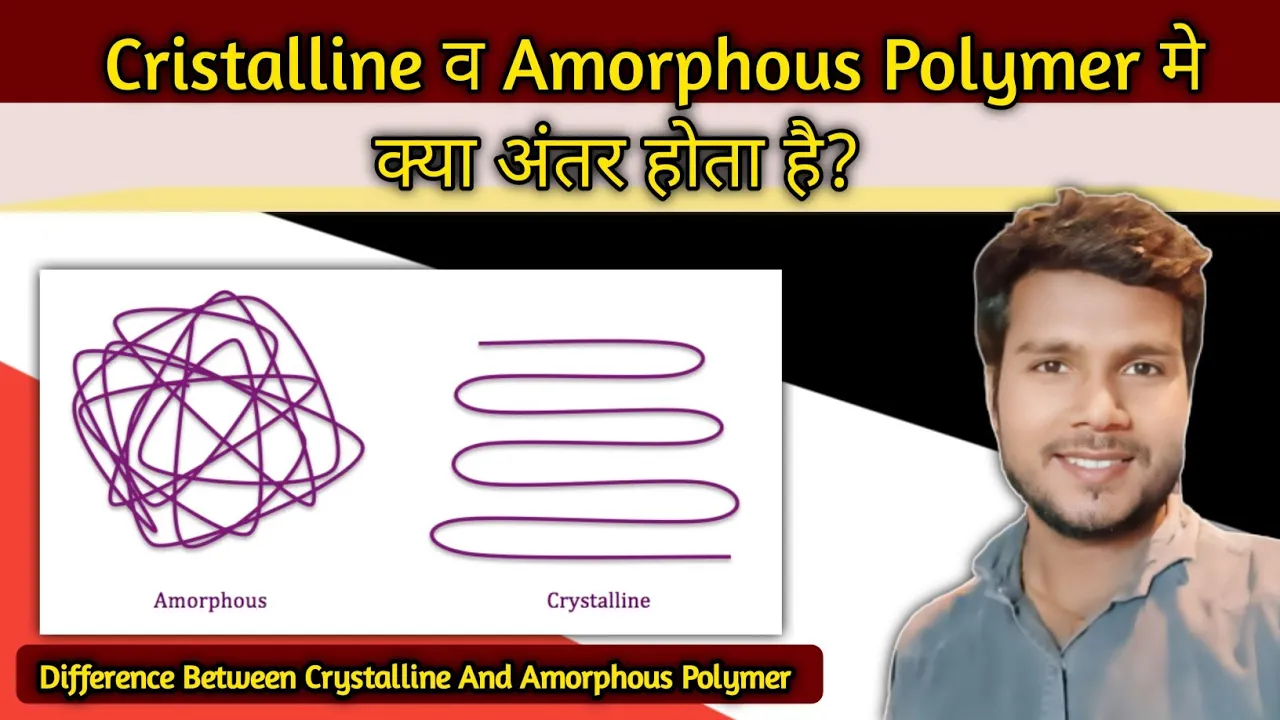
Crystalline polymers have densely packed, ordered molecular arrangements forming crystalline regions, resulting in higher density, rigidity, strength, and chemical resistance. Amorphous polymers have randomly arranged, noodle-like chains with no ordered structure, resulting in lower density, flexibility, and transparency. Crystallinity depends on cooling rate, polymer polarity, chain flexibility, and tacticity.
Click to watch →
Difference Between Crystalline And Amorphous Polymer | Crystalline व Amorphous Polymer के बीच अंतर।
918
Crystalline and amorphous polymers differ fundamentally in their molecular arrangement: crystalline polymers have organized, ordered molecular structures with high density, opacity, and definite melting points, while amorphous polymers have random, disordered molecular arrangements with lower density, transparency, and no specific melting point. These structural differences result in distinct mechanical properties, including crystalline polymers being harder, stronger, and more thermally stable, while amorphous polymers are softer, more flexible, and easier to process.
Click to watch →
The ACTUAL REASON why 3D Prints WARP (FULLY EXPLAINED)
5.8K
Polymers are classified as amorphous (random chain arrangement like noodles) or semi-crystalline (forming strong ordered regions between Tm and Tg). Amorphous materials like PETG and Polycarbonate lose strength near Tg, while semi-crystalline materials like Nylon and PET maintain strength above Tg and only fail at Tm. Annealing post-processing helps semi-crystalline materials form more strong regions. PLA is technically semi-crystalline but behaves amorphously during printing. This classification determines optimal printing parameters and explains why different materials require different approaches to minimize warping.
Click to watch →
Deep Dive
Fundamental concepts of intermolecular forces (such as Van der Waals forces and hydrogen bonding) in macromolecules.

QUÍMICA. Fuerzas intermoleculares. Van der Waals, London y enlaces de hidrógeno
2.2M
Intermolecular forces are attractive forces that hold molecules together. There are three main types: dipole-dipole interactions (van der Waals forces) between polar molecules, London dispersion forces between nonpolar molecules, and hydrogen bonds. Polar molecules develop partial charges due to electronegativity differences, where more electronegative atoms pull shared electrons closer, creating partial negative and positive regions. Nonpolar molecules lack permanent dipoles but experience temporary attractions through London forces when electron movements create instantaneous dipoles that induce corresponding dipoles in neighboring molecules. These forces determine physical properties like boiling points and states of matter.
Click to watch →

||L-3||Fundamental of chemistry bsc 1st year|| Van-der Waal forces #vanderwaalforces#chemistrybsc1st
88.9K
Intermolecular interactions are attractive forces between molecules, distinct from repulsive forces. Strong interactions include covalent bonds, ionic bonds, and electrostatic forces. Van der Waals forces are weak attractive forces occurring between any combination of polar and non-polar molecules. The five types are: dipole-dipole (between polar molecules), dipole-induced dipole (polar and non-polar), ion-induced dipole (ions and non-polar), ion-induced dipole (ions and polar), and London dispersion forces (instantaneous dipole-induced dipole between any molecules). Dipole moment (μ = q × d) measures charge separation and determines interaction strength. When polar molecules are stationary, interaction energy is proportional to μ²; when rotating, energy varies with orientation.
Click to watch →

Complete CHEMICAL BONDING in One Video | NEET 2024: 20 Marks in 2 Hours 💯
100.9K
Van der Waals forces are weak intermolecular forces including: (1) Dipole-dipole interactions (between polar molecules), (2) Dipole-induced dipole interactions (between polar and non-polar molecules), (3) London dispersion forces (between non-polar molecules). Hydrogen bonding occurs when hydrogen is bonded to highly electronegative atoms (F, O, N). Hydrogen bonding significantly affects physical properties: boiling point, melting point, viscosity, and vapor pressure.
Click to watch →

كيمياء الثاني متوسط/ المراجعة المركزة/ المحاضرة الثالثة/ المنهج الدراسي الجديد/ #العراق
512.9K
Van der Waals forces are weak physical forces arising from random electron motion causing temporary charge separation between atoms or molecules. These forces increase with atomic or molecular size. Hydrogen bonding is a stronger intermolecular force occurring between hydrogen atoms and highly electronegative atoms (oxygen, nitrogen, fluorine) with lone pairs. Water molecules are polar with partial charges, enabling hydrogen bonds. This explains water's high boiling point and why ice floats (less dense than liquid water), protecting aquatic life by preventing surface freezing.
Click to watch →

রসায়নের ২য় অধ্যায় || একটি ক্লাসে সম্পূর্ণ কম্পিলিট || ১০০% কমন || SSC Chemistry Chapter 2
188.4K
Van der Waals forces (ভ্যান্ডারওয়ালস আকর্ষণ বল) are intermolecular attractive forces. The strength of these forces is inversely related to intermolecular distance - greater distance means weaker forces. Gases have the weakest Van der Waals forces due to large intermolecular distances. This explains why gases are most compressible.
Click to watch →
Deep Dive
An understanding of basic thermal states of matter and the concept of thermal energy and molecular motion.

الأستاذ خالد الحوتري حالات المادة 2 2007
37.4K
This lesson introduces three fundamental thermodynamic concepts: temperature, heat, and thermal energy. All matter consists of atoms (protons, electrons, neutrons) arranged differently in each state: solids have close atoms with strong cohesive forces and fixed shape/volume with vibrational motion; liquids have medium atom spacing with moderate forces and variable shape but fixed volume; gases have widely spaced atoms with weak forces and no fixed shape/volume. The molecular motion varies accordingly: solids exhibit simple harmonic motion around equilibrium positions, while liquids and gases show translational, rotational, and random motion.
Click to watch →

unit 2 concept 1 thermal energy and states of matter part 1
208
Thermal energy is the energy that matter possesses due to the motion of its molecules. The faster the molecules move, the more thermal energy the matter has. For example, melted wax has more thermal energy than solid wax because its molecules move faster.
Click to watch →

Science-Primary 6-first term- unit 2-Concept 1-Lesson 2
458
Thermal energy depends on the movement of particles. All molecules and atoms in the world, even in solids, are in continuous motion and never stop. When you move, your body generates thermal energy because kinetic energy is part of thermal energy. Materials with faster-moving molecules have higher thermal energy and are hotter, while materials with slower-moving molecules have lower thermal energy and are colder. Thermal energy is the total kinetic energy of all molecules in a substance.
Click to watch →
Temperature and thermal energy
2.3K
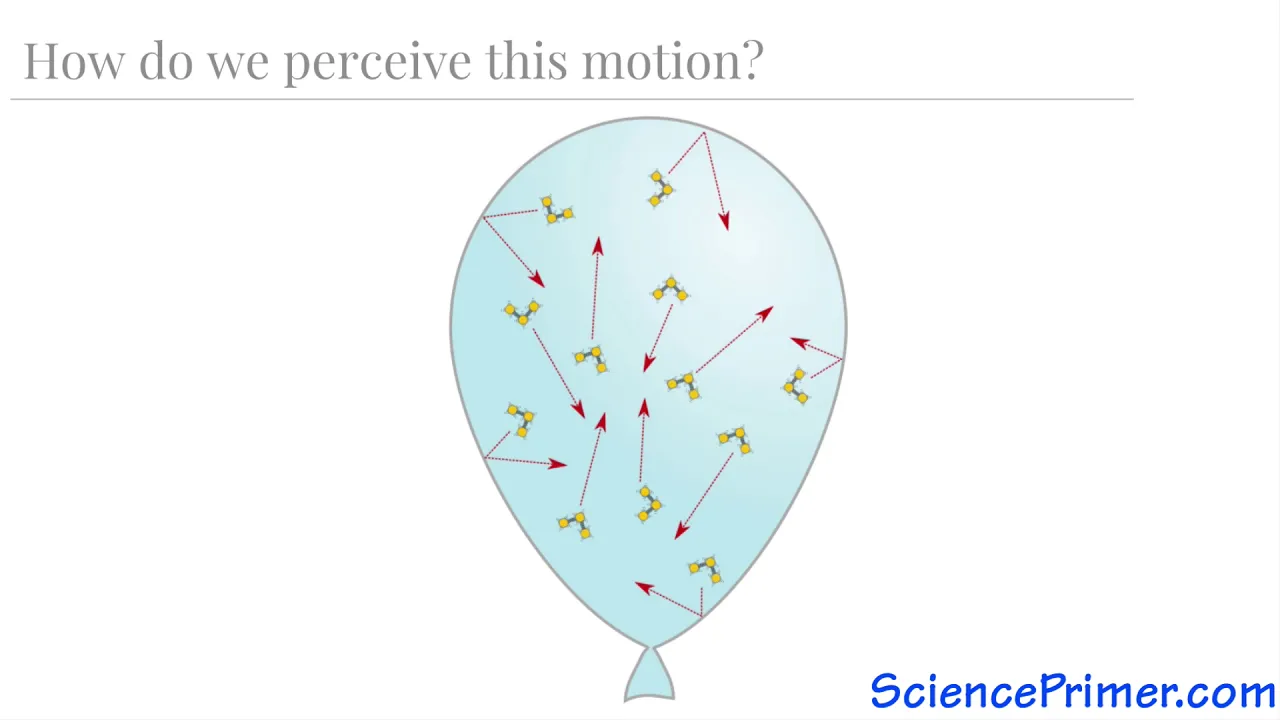
Thermal energy is the internal energy of motion at the atomic level, related to but distinct from temperature. The kinetic molecular theory explains matter through four assumptions: all matter consists of small particles separated in space, these particles are always in motion, and they exchange energy upon collision. Diffusion demonstrates molecular motion—perfume sprayed in a room spreads because molecules move through air. The rate of diffusion changes with thermal energy: warmer temperatures cause faster spreading. Matter exists in three phases determined by molecular motion: solids have locked atoms with only vibrational motion; liquids allow molecules to slide past each other; gases have widely separated molecules moving independently at high speeds.
Click to watch →

الدرس الاول علوم الصف السادس الابتدائي مفهوم الطاقة الحرارية وحالات المادة نشاط 1 - 2 - 3 ترم اول
2.2K
The thermal energy possessed by matter depends on the motion of its molecules. Different states of matter have different amounts of thermal energy due to differences in molecular motion. The amount of thermal energy determines how molecules move and interact.
Click to watch →
Prerequisite Knowledge
- Concept 01Basic polymer chemistry, including the definition of monomers, polymer chains, and molecular weight.
- Concept 02The difference between amorphous and semi-crystalline polymer structures.
- Concept 03Fundamental concepts of intermolecular forces (such as Van der Waals forces and hydrogen bonding) in macromolecules.
- Concept 04An understanding of basic thermal states of matter and the concept of thermal energy and molecular motion.
Subsequent Learning
- Step 01Experimental techniques used to measure Tg, such as Differential Scanning Calorimetry (DSC) and Dynamic Mechanical Analysis (DMA).
- Step 02The concept of viscoelasticity and how mechanical properties change below and above the glass transition temperature.
- Step 03Industrial polymer processing techniques (like extrusion and injection molding) and how Tg determines processing temperature windows.
- Step 04The role of plasticizers and copolymerization in modifying Tg for specific commercial applications.
Glass Transition
Tg Factors
Glass Transition
0:00Playing Section
- 1
Defines Tg as solid-to-melt transformation point.
- 2
Contrasts brittle glassy vs soft rubbery states.
The Kinetic vs. Thermodynamic Debate of the Glass Transition
While introductory polymer science often treats the glass transition temperature (Tg) as a defined, intrinsic material property governed by molecular structure, a major debate exists regarding its fundamental physical nature. A prominent counter-perspective argues that Tg is not a true thermodynamic phase transition, but rather a purely kinetic phenomenon. Under this kinetic view, Tg is highly dependent on the cooling rate and measurement timescale; if a polymer could be cooled infinitely slowly, it would remain a supercooled liquid rather than transitioning into a glass. Conversely, thermodynamic theories (like the Gibbs-DiMarzio theory) propose that a true second-order thermodynamic transition does exist at equilibrium but is practically inaccessible due to extreme kinetic slowdown (the Kauzmann paradox). Introducing this debate helps students understand that Tg is not a fixed physical constant, but a highly dynamic, path-dependent behavior that challenges our fundamental understanding of amorphous states.
Deep Dive
Experimental techniques used to measure Tg, such as Differential Scanning Calorimetry (DSC) and Dynamic Mechanical Analysis (DMA).

Basismaterial - Made in Europe
122
Tg can be measured using three methods: DSC (Differential Scanning Calorimetry), TMA (Thermomechanical Analysis), and DMA (Dynamic Mechanical Analysis). DSC measures changes in specific heat capacity during heating. TMA monitors dimensional changes. DMA applies oscillatory stress and measures modulus changes. Each method yields different Tg values - DMA typically gives the highest values. Standard data sheets assume DSC-measured Tg unless specified. DSC can detect moisture content and under-curing (Delta Tg should be ≤3°C for DC systems, ≤5°C for Novolac systems).
Click to watch →

Comportamento Térmico - Teoria
303
This section covers the two primary techniques for characterizing polymer thermal behavior. Dynamic Mechanical Analysis (DMA) measures the storage modulus (stiffness) as a function of temperature, showing dramatic drops at Tg and Tm. For amorphous polymers: high modulus at low temperatures (glassy state), dramatic drop at Tg (rubbery state), and further drop at flow temperature (viscous flow). For semi-crystalline polymers: high modulus at low temperatures, drop at Tg, then another drop at Tm. Secondary transitions (like Tβ) occur below Tg and involve motion of smaller molecular segments. Differential Scanning Calorimetry (DSC) measures heat flow required to maintain sample and reference at the same temperature. First-order transitions (melting) appear as peaks proportional to enthalpy changes. The glass transition appears as a step change in heat capacity. DSC equipment includes sample pan, reference pan, temperature-controlled furnace, and heat flow sensors. For materials with Tg below ambient temperature, special cooling equipment is needed to reach temperatures as low as -120°C.
Click to watch →
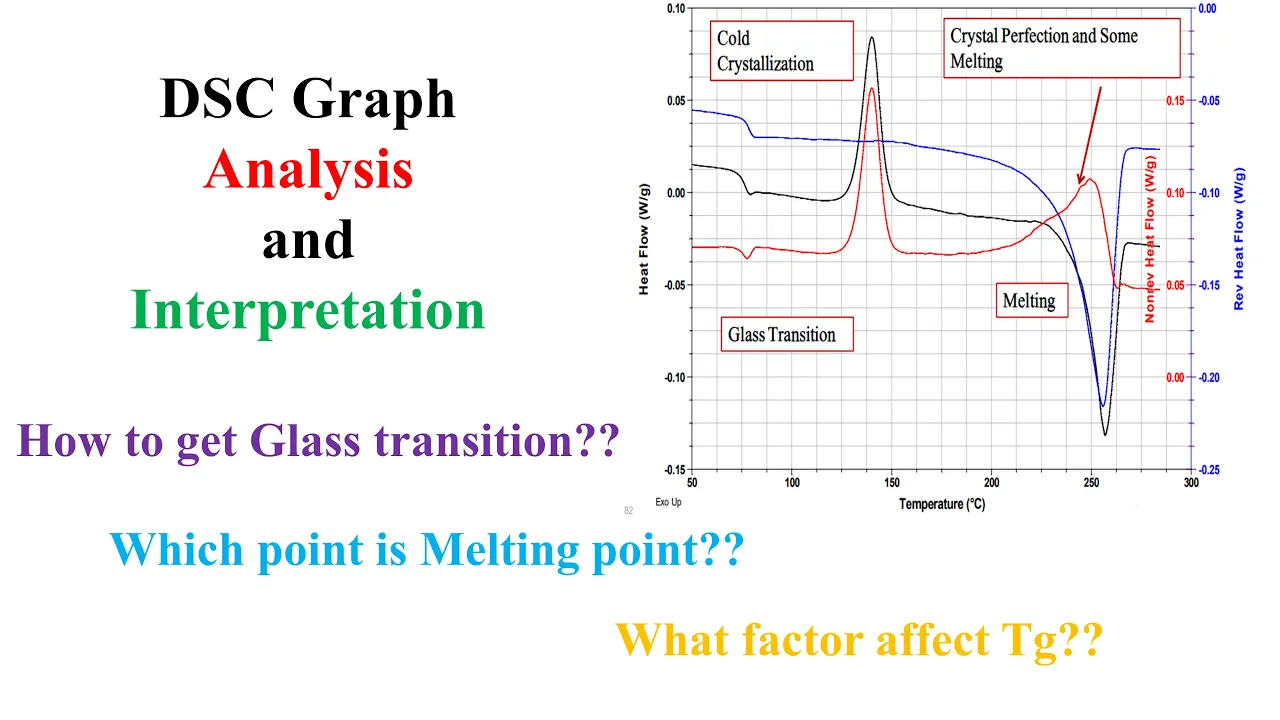
How to understand, Analyse and Interpret DSC (Differential scanning calorimetry) data
58.5K
Multiple techniques detect glass transition: conventional DSC, modulated DSC (highest sensitivity), and dynamic mechanical analysis (DMA, highest sensitivity). Factors affecting glass transition include molecular weight, plasticizers, fillers, crystalline side chains, copolymer composition, and hydrogen bonding (reduces mobility, increases Tg). Melting point determination criteria differ: pure low-molecular-weight materials use extrapolated onset, while polymers use peak temperature. DSC derives comprehensive information including glass transition temperature, melting point, boiling point, crystallization parameters, specific heat, oxidative stability, purity, reaction kinetics, and cure characteristics.
Click to watch →
What is Polymer Glass Transition Temperature | DSC vs DMA for Tg Determination
267
The glass transition temperature (Tg) is the temperature range where amorphous polymers transition from a hard, glassy state to a soft, rubbery state, and it can be determined using two main analytical techniques: Differential Scanning Calorimetry (DSC), which detects Tg as a step change in heat capacity and is best suited for quick routine measurements of well-defined polymer systems; and Dynamic Mechanical Analysis (DMA), which measures mechanical responses like tan δ peak and provides higher sensitivity for detecting subtle transitions in complex formulations such as adhesives, elastomers, and filled systems.
Click to watch →

How Does DSC Measure Glass Transition Temperature (Tg)? - Chemistry For Everyone
392
Differential Scanning Calorimetry (DSC) measures glass transition temperature (Tg) by comparing the heat flow of a sample material to a reference material as both are heated or cooled at a constant rate; when a polymer reaches its Tg, its molecular structure transitions from a rigid glassy state to a more flexible rubbery state, causing an increase in heat capacity that appears as a gradual slope on the DSC curve, with the midpoint of this slope (determined using the half-height method) reported as Tg, and standardized methods like ASTM E1356 or ISO 11357-2 ensure measurement accuracy.
Click to watch →
Deep Dive
The concept of viscoelasticity and how mechanical properties change below and above the glass transition temperature.
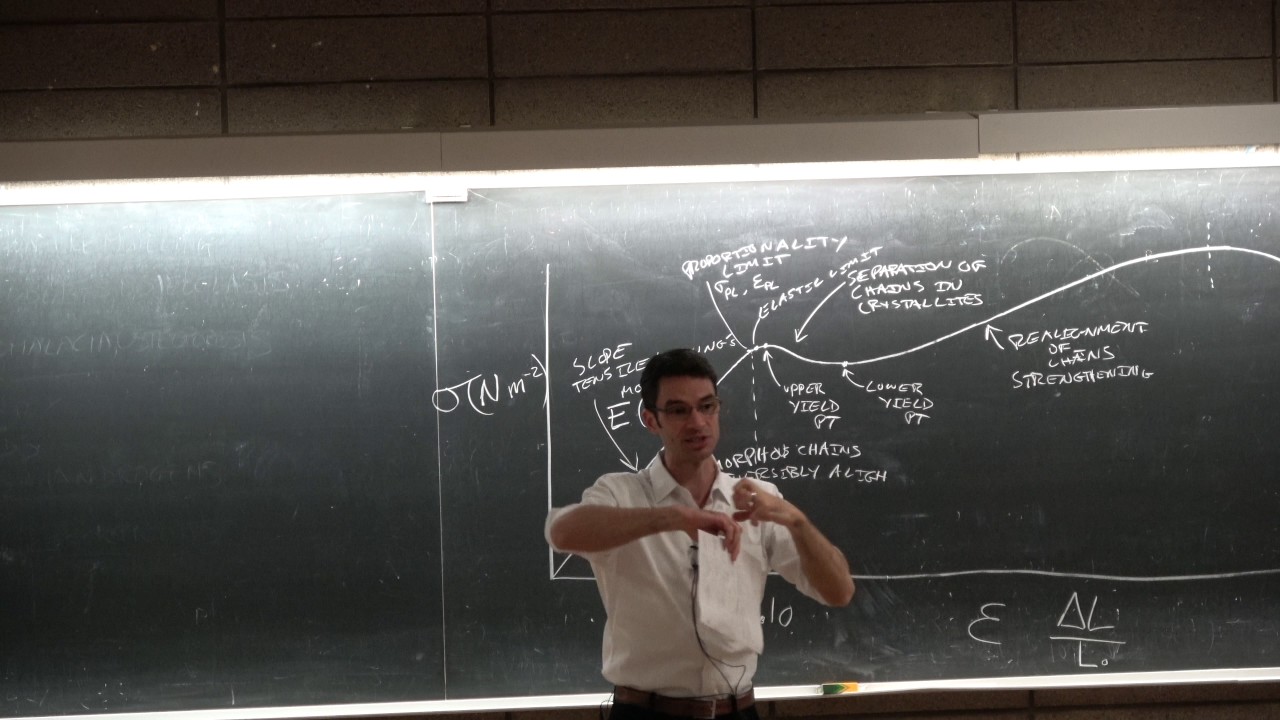
Ep22 Mechanical properties of polymers & viscoelastic models NANO 134 UCSD Darren Lipomi
56.9K
Polymer mechanical behavior depends critically on temperature relative to the glass transition temperature (Tg). At temperatures below Tg, polymers exist in the glassy state with high modulus (>1 GPa), rigid and brittle behavior. Near Tg, materials enter the leathery state with time-dependent elasticity. Above Tg, the rubbery state exhibits high elasticity with partial time dependence. Further heating produces the rubbery flow state (immediate elastic recovery plus permanent deformation) and finally the viscous state (purely viscous flow with no recovery). Poisson's ratio varies from ~0.15 for diamond/graphene to ~0.5 for natural rubber, affecting lateral deformation characteristics. Relaxation modulus experiments reveal these transitions by measuring force after fixed waiting times following strain application. Understanding these states enables prediction of polymer behavior across different environmental conditions and service temperatures.
Click to watch →

Effects of Glass transition temperature
35.5K
The glass transition temperature (Tg) is the critical temperature where polymers transition from rigid, brittle glassy state to flexible, rubbery state. Below Tg, polymer chains lack sufficient energy for movement and behave like hard glass; above Tg, chain segments gain mobility and exhibit rubber-like flexibility. This phenomenon is unique to amorphous polymers and determines whether a polymer functions as rigid plastic (used below Tg) or flexible rubber (used above Tg). Polymer solidification follows distinct pathways based on cooling rate: rapid supercooling produces glassy solids, moderate cooling yields semicrystalline structures, and very slow cooling results in crystalline solids. Thermoplastic polymers exhibit five characteristic viscoelastic regions as temperature increases: glassy region (high modulus, hard), leathery/glass transition region (modulus decreases), rubber region (both elastic and viscous), rubber flow region (viscosity dominates), and viscous flow/liquid region. Thermosets differ fundamentally because chemical cross-linking restricts molecular motion entirely, eliminating the glass transition and producing materials that degrade rather than melt.
Click to watch →

2A Temperature effects, glassy regime
2.4K
Amorphous polymers exhibit five distinct mechanical regimes as temperature increases: (1) Glassy regime - below Tg, high modulus (~3 GPa), elastic deformation; (2) Glass transition/viscoelastic regime - near Tg, dramatic modulus drop, time-dependent deformation; (3) Rubbery regime - above Tg, constant modulus plateau, rubbery behavior; (4) Viscous regime - further heating causes viscous flow, material melts; (5) Decomposition regime - for thermosets, further heating breaks primary covalent bonds causing depolymerization. Thermoplastics can be remolded in the viscous regime, while thermosets decompose instead.
Click to watch →
Polymer Basics: Monomer, Degree of Polymerization, & Microstructure
90.6K
Polymers are classified into two main categories based on heat response: (1) Thermoplastic polymers can be melted and remelted multiple times without structural change, including amorphous polymers (randomly oriented chains, brittle below Tg, e.g., polystyrene wine glasses) and semicrystalline polymers (alternating crystalline lamellae and amorphous regions, e.g., HDPE trash bags); (2) Thermoset polymers undergo irreversible curing reactions creating permanent cross-links, including elastomers (lightly cross-linked, elastic above Tg, e.g., rubber shoe soles) and thermosets (heavily cross-linked, rigid amorphous solids, e.g., ivory billiard balls). The glass transition temperature (Tg) is critical: below Tg, amorphous regions behave brittle and glassy; above Tg, they act like viscous leather-like liquids. Four polymer morphologies exhibit distinct mechanical behaviors: thermosets have highest elastic modulus and tensile strength but lowest ductility; amorphous thermoplastics have second-highest properties and brittle behavior below Tg; semicrystalline thermoplastics show intermediate properties with higher ductility; elastomers have lowest modulus/strength but highest ductility because they remain above their Tg while cross-links prevent flow.
Click to watch →

Glass transition temperature (Tg)/ introduction to glass transition temperature/ MSc chemistry
3.7K
The glass transition temperature (Tg) is the critical temperature that separates the glassy state (hard and brittle) from the rubbery state (soft and flexible) in polymers; below Tg, polymers exhibit glass-like rigidity and brittleness, while above Tg, they become viscoelastic and flexible, with this transition being a fundamental property of amorphous polymers.
Click to watch →
Deep Dive
Industrial polymer processing techniques (like extrusion and injection molding) and how Tg determines processing temperature windows.

Determination of Glass Transition Temperature||Glass Transition Temperature (Part-3) #dilatometry
9K
Polymer processing and application depend critically on temperature relative to Tg and melting point. Below Tg, polymers are rigid and brittle, unsuitable for forming. Between Tg and melting point lies the optimal processing window where polymers exhibit rubbery behavior—flexible yet maintainable shape. This range enables molding, extrusion, and forming operations. Above melting point, polymers become fully liquid and lose structural integrity. The use temperature range (between Tg and melting point) defines conditions where polymers retain useful properties for applications. Understanding these temperature-dependent behaviors guides material selection and processing conditions for polymer manufacturing and end-use applications.
Click to watch →

PROCESAMIENTO POLIMEROS PARTE 1/CLASE EN VIVO.
444
Polymers are materials that can withstand medium temperatures (below 300°C) and are processed using techniques like extrusion, injection molding, and blow molding. The glass transition temperature (Tg) is critical, marking when polymers lose mechanical properties and become rigid; for example, polystyrene has a Tg of approximately 125°C, PVC around 68°C, and polypropylene about -67°C. Polymers are classified as thermoplastics (recyclable, deformable with heat) or thermosets (non-recyclable, heat-resistant). Key advantages include low processing temperatures (allowing aluminum molds), low density (lightweight), and good electrical insulation. However, UV radiation is the main enemy causing degradation, and most polymers are not biodegradable.
Click to watch →

Mod-01 Lec-37 Polymer Properties and Evaluation : Mechanical Properties
13.3K
Polymer processing converts raw polymer resins into useful products through melt-state and solution-state techniques. Melt processing includes extrusion (continuous production of films, profiles, pipes, rods) and molding (injection molding for thermoplastics, compression molding for thermosets). Solution processing includes casting for films and spinning for fibers. Processing temperatures vary: amorphous materials at Tg + 80-140°C, semi-crystalline materials at Tm + 20-50°C. Understanding processing is essential for polymer chemists to bridge synthesis and application.
Click to watch →

4- CONFERENCIA: RELACIÓN ENTRE CONDICIONES DEL PROCESO DE EXTRUSIÓN Y PRODUCTIVIDAD
904
Process temperatures are defined by material properties: amorphous materials require Tg + 100°C, while semi-crystalline materials require Tm + 70°C. Reference values: PVC (Tg=80°C), Polystyrene (Tg=95°C), Polyethylene (Tm=125°C), Polypropylene (Tm=160°C). These values come from technical literature, supplier specifications, or laboratory testing. The temperature should be measured at the last head zone where polymer experiences maximum temperature. Starting processes with temperatures far from recommended values increases waste, setup time, and reduces productivity.
Click to watch →
Introduction to course
38K
Week 2 covers three fundamental polymer processing processes: extrusion, compression molding, and injection molding. Each process will be examined in detail including basic concepts, machine types, operating parameters (temperature, pressure, holding time), application areas, advantages, and limitations. These processes can also be applied to polymer composites, though processing requirements change when reinforcement is incorporated. The course will discuss how these processes work for pure polymers before extending to composite materials, providing a comprehensive understanding of polymer manufacturing techniques.
Click to watch →
Deep Dive
The role of plasticizers and copolymerization in modifying Tg for specific commercial applications.

Polymères :Partie 5
7.2K
Side chain chemistry profoundly affects polymer flexibility and Tg. Alkyl groups slightly decrease flexibility by occupying space and reducing free volume between chains. Polar groups dramatically increase Tg through enhanced intermolecular interactions. Copolymerization enables precise Tg control by mixing monomers with different Tgs, predictable via the Fox equation. Plasticizers add molecules between chains to decrease Tg and increase flexibility. Multiple strategies enable precise polymer property control: copolymerization mixes monomers with different Tgs; plasticizers add molecules between chains; additives (stabilizers, pigments, reinforcements) modify specific properties. Density-strength trade-offs exist across all materials—polymers uniquely compete with natural materials like wood by achieving low density combined with high Young's modulus in their vitreous state. Controlling crystallinity enables optimization of this trade-off.
Click to watch →

Mod-01 Lec-35 Amorphous and Crystalline State : Tg and Tm
26.3K
Molecular weight affects Tg through chain end effects: shorter chains have more mobile ends with greater free volume, lowering Tg. Above a critical molecular weight, Tg becomes independent of molecular weight because chain ends contribute negligibly to overall mobility. Plasticizing side groups increase free volume and reduce chain mobility, lowering Tg. In methacrylates, Tg decreases from ~105°C (methyl) to ~-42°C (tert-butyl) with increasing side chain length. This plasticizing effect demonstrates how side chain architecture can tune polymer flexibility for specific applications.
Click to watch →

Plasticizer (A Plastic Additive)
8.7K
Plasticizers are broadly classified into internal and external categories. Internal plasticizers are co-polymers added during polymerization, forming chemical bonds with the polymer chain using monomers like vinyl acetate and vinyl chloride, though they have limited availability. External plasticizers dominate commercial applications as low-cost additives added during extrusion or injection molding without chemical bonding. External plasticizers are further divided into primary and secondary types: primary plasticizers offer high compatibility and flexibility independently, while secondary plasticizers reduce costs and improve low-temperature properties but require combination with primaries. Extenders represent a subset of secondary plasticizers used to reduce costs in flexible PVC, including naphthenic hydrocarbons and chlorinated paraffins. Selection depends on polymer compatibility, processing conditions, aging resistance, cost, and regulatory requirements for food contact or medical applications.
Click to watch →
#33 Additives for Polymeric Systems | Polymers Concepts, Properties, Uses & Sustainability
10.1K
Plasticizers modify both processing behavior and final properties through molecular interactions. They reduce viscosity for easier processing and lower the glass transition temperature via free volume theory - increasing space between polymer chains enables greater segmental mobility. The Gordon-Taylor equation predicts Tg of plasticized polymers based on pure polymer and plasticizer Tg values, weight fractions, and the Gordon-Taylor parameter. Water functions as a natural plasticizer for nylon, explaining property changes between dry and conditioned states. Residual monomers and solvents also act as unintentional plasticizers. Understanding molecular structure allows prediction of additive function - analyzing functional groups reveals whether a compound serves as plasticizer, flame retardant, or stabilizer.
Click to watch →

صيدلة | المرحلة الثانية | الفيزياوية | PHARMACEUTICAL POLYMERS Chapter | المحاضرة 8 والأخيرة
2.7K
Glass transition temperature (Tg) is when amorphous polymers transition from hard glassy to soft rubbery state. Below Tg: hard, rigid, brittle. Above Tg: flexible, rubbery. Plasticizers increase chain mobility, lowering Tg and making polymers more flexible. The glassy state is hard and rigid, while the rubbery state is flexible and can flow.
Click to watch →
Glass Transition
Tg Factors
Glass Transition
0:00- 1
Defines Tg as solid-to-melt transformation point.
- 2
Contrasts brittle glassy vs soft rubbery states.
The Kinetic vs. Thermodynamic Debate of the Glass Transition
While introductory polymer science often treats the glass transition temperature (Tg) as a defined, intrinsic material property governed by molecular structure, a major debate exists regarding its fundamental physical nature. A prominent counter-perspective argues that Tg is not a true thermodynamic phase transition, but rather a purely kinetic phenomenon. Under this kinetic view, Tg is highly dependent on the cooling rate and measurement timescale; if a polymer could be cooled infinitely slowly, it would remain a supercooled liquid rather than transitioning into a glass. Conversely, thermodynamic theories (like the Gibbs-DiMarzio theory) propose that a true second-order thermodynamic transition does exist at equilibrium but is practically inaccessible due to extreme kinetic slowdown (the Kauzmann paradox). Introducing this debate helps students understand that Tg is not a fixed physical constant, but a highly dynamic, path-dependent behavior that challenges our fundamental understanding of amorphous states.
Basic polymer chemistry, including the definition of monomers, polymer chains, and molecular weight.
The difference between amorphous and semi-crystalline polymer structures.
Fundamental concepts of intermolecular forces (such as Van der Waals forces and hydrogen bonding) in macromolecules.
An understanding of basic thermal states of matter and the concept of thermal energy and molecular motion.
Experimental techniques used to measure Tg, such as Differential Scanning Calorimetry (DSC) and Dynamic Mechanical Analysis (DMA).
The concept of viscoelasticity and how mechanical properties change below and above the glass transition temperature.
Industrial polymer processing techniques (like extrusion and injection molding) and how Tg determines processing temperature windows.
The role of plasticizers and copolymerization in modifying Tg for specific commercial applications.
81.9K views507likes2:54@rajavallieducationOriginal Release: 2015-08-17
now we discuss the glass transition temperature this is also the properties of uh polymer glass transition temperature is the temperature at which the amha solid state is transformed to the Melt State let us consider this is the amoa solid when we Heat this amha solid we get molten state of material at this temperature we get glass transition temperature this is represented as TG now we see the properties of amorus and molten state of material am solid is H molten state of material is soft am solid is Britt in state molten state of material is soft flexible state am solid is glass State molten state of material is rubbery or visco elastic State we can also Define the glass transition temperature by the temperature at which the glass state is transformed into the rubbery State now we see the examples of glassy State and rubbery state polyer is the example for glass state polyethyl accrate is the example for Rubber State now we discuss the uh what are the factors influencing the teaching molecular weight chain flexibility steric effect cross linking and and crystallization these factors are influencing the teach the molecular weight of the polymer increases TG increases the polymer chain is rigid we will get high TG if it is flexible it will be low TG the chain having bulky substituent it will have high glass transition temperature if it is smaller substituent it will have low glass transition temperature cross linking in the polymer chain increases it will have high TG if it is linear molecule it will have low TG crystallization of the polymer increases TG increases thank you
Up Next

47:51
Solid State Chemistry: Glass Formation &amorphous Solids | MIT 3.091SC
@mitocw
33.1K views•2010-12-18
83:56
Biocatalysis and Catalysis in Islatravir Synthesis | Merck Webinar
@SCIwheresciencemeetsbusiness
675 views•2020-10-08
10:06
1H NMR: Determining Number of Peaks from Structure
@MSJChem
59.2K views•2017-04-06

17:31
Edible Water Bottles: A DIY Guide to Sodium Alginate Spherification
@ryan
10.5M views•2019-06-21
Related Study Plans & Knowledge Roadmaps
Structured learning paths in Chemistry
chemistry
Nuclear Chemistry: Decay, Meds & Fuel Cycle
01Introduction to Nuclear Structure and Radioactivity
02Decay Dynamics and Kinetics
03Radiation Interaction and Detection
+ 2 more learning modules
24h5 modules
Explore Roadmap
chemistry
Supramolecular Chemistry: Forces & Machines
01Foundations of Chemical Bonding and Intermolecular Forces
02Introduction to Host-Guest Chemistry
03Thermodynamics and Dynamics of Self-Assembly
+ 2 more learning modules
16h5 modules
Explore Roadmap
chemistry
Photochemistry: Excited States & Reactions
01Foundations of Light-Matter Interactions
02Molecular Orbitals and Electronic States
03Photophysical Processes and Jablonski Diagrams
+ 2 more learning modules
18h5 modules
Explore Roadmap
chemistry
Coordination Chemistry: Bonding & Properties
01Introduction to Transition Metals and Ligands
02Crystal Field Theory (CFT) and Geometry
03Magnetic Behavior and Spin States
+ 2 more learning modules
14h5 modules
Explore Roadmap