























Astronomers observed M87*, a supermassive black hole 55 million light-years away, shooting jets of material at over 99% the speed of light; however, apparent speeds exceeding light speed are actually optical illusions caused by the jet's angle relative to Earth's line of sight, where the combination of extreme velocity and viewing angle creates superluminal motion without violating physics.
Supermassive Black Hole Jets Approach Light Speed: M87* | Astronomy Physics
Added:Basic concepts of General Relativity and the structure of black holes, such as the event horizon and singularity.
The electromagnetic spectrum, specifically how X-ray telescopes detect high-energy cosmic phenomena.
Fundamental principles of Special Relativity, including the speed of light as an absolute speed limit in a vacuum.
The mechanics of Active Galactic Nuclei (AGN), specifically how accretion disks feed supermassive black holes.
The mathematics of Superluminal Motion, explaining the optical illusion where jets appear to travel faster than light due to viewing angles.
The Blandford-Znajek process, which describes how magnetic fields extract rotational energy from spinning black holes to power jets.
Very Long Baseline Interferometry (VLBI) and the engineering behind the Event Horizon Telescope (EHT) imaging.
The impact of AGN feedback on galaxy evolution, specifically how relativistic jets regulate star formation in host galaxies.
198.4K views6.6Klikes4:50Original Release: 2020-02-26
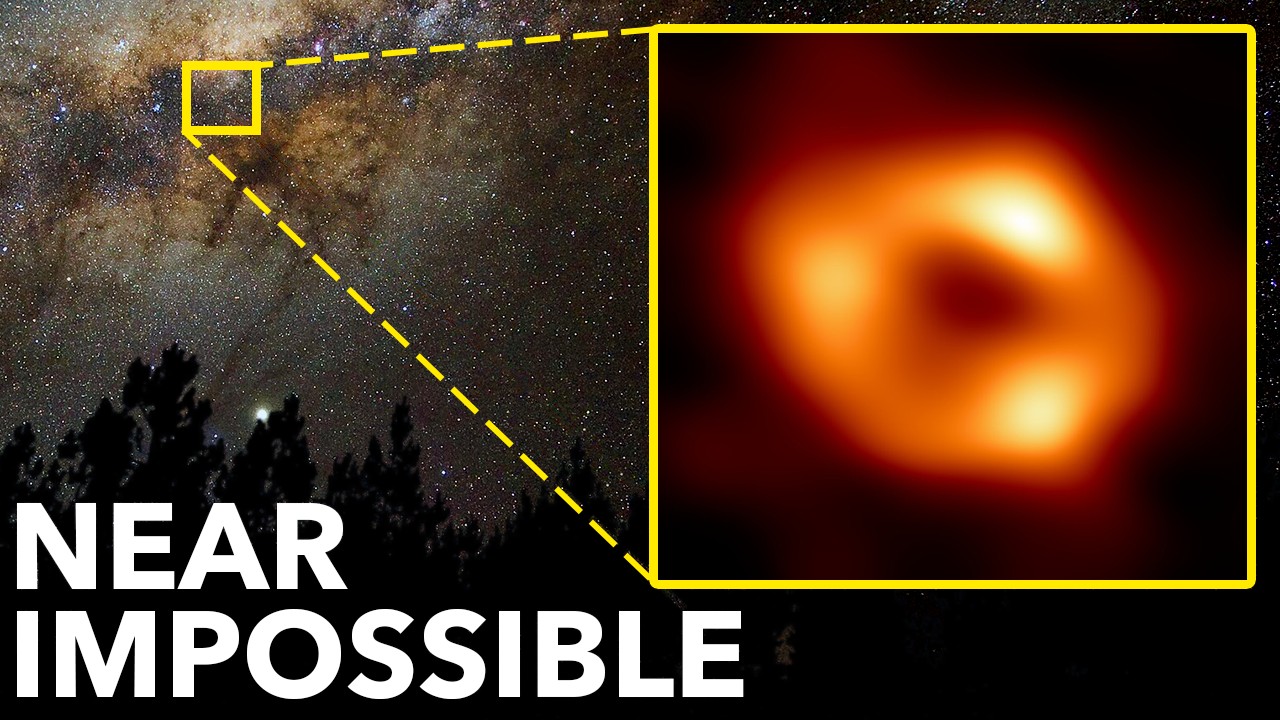
In April of 2019, astronomers revealed they had successfully taken the first picture ever of a black hole.
Well, you know, the black hole’s silhouette at least, since it’s impossible to take a photo of a black hole itself without crossing the event horizon and getting spaghetti-fied.
Now, astronomers have announced that the same black hole has been observed shooting jets of physical material out into space at insane speeds... and at first glance, it looks like that material is traveling even faster than the speed of light.
Wait what? That can’t be right.
The black hole in question is M87*, the supermassive black hole in the center of the enormous elliptical galaxy Messier 87.
M87* is roughly 55 million light-years away and absolutely dwarfs our own galaxy’s supermassive black hole, Sagittarius A*.
While Sagittarius A* is about 4 million solar masses, M87* is in the neighborhood of 6.5 billion solar masses.
And from where we stand it looks like it’s getting bigger.
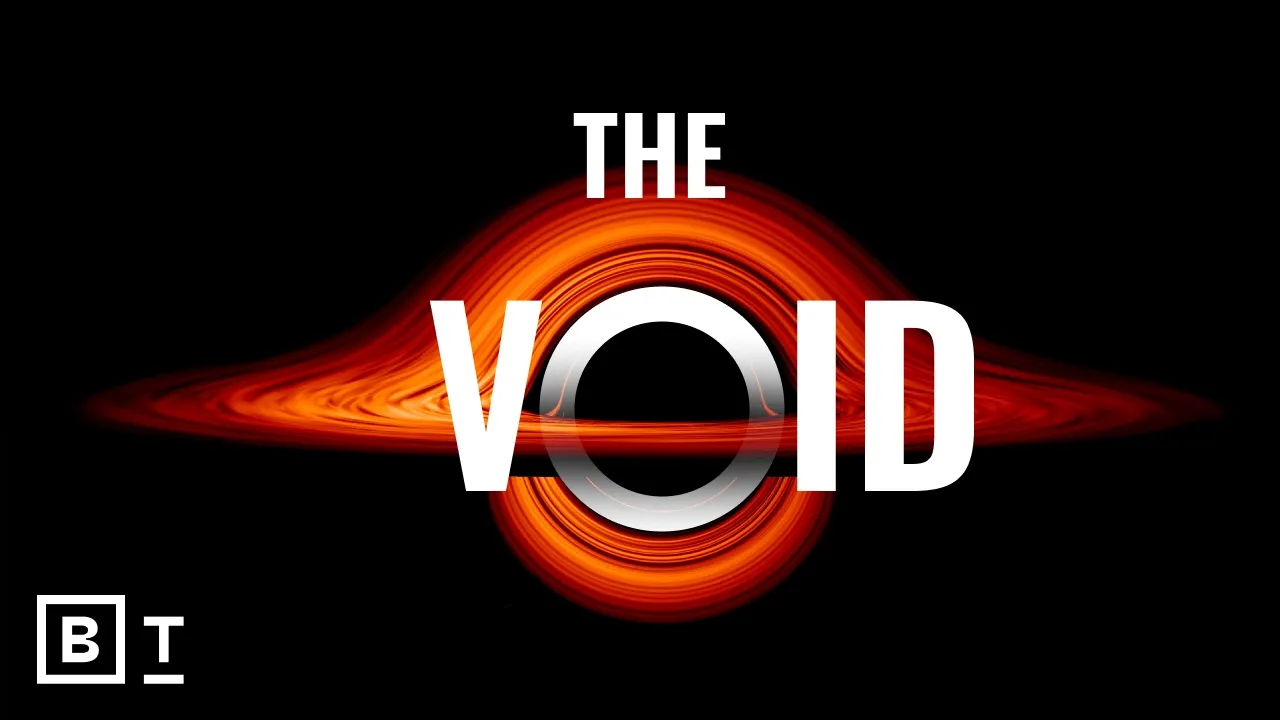
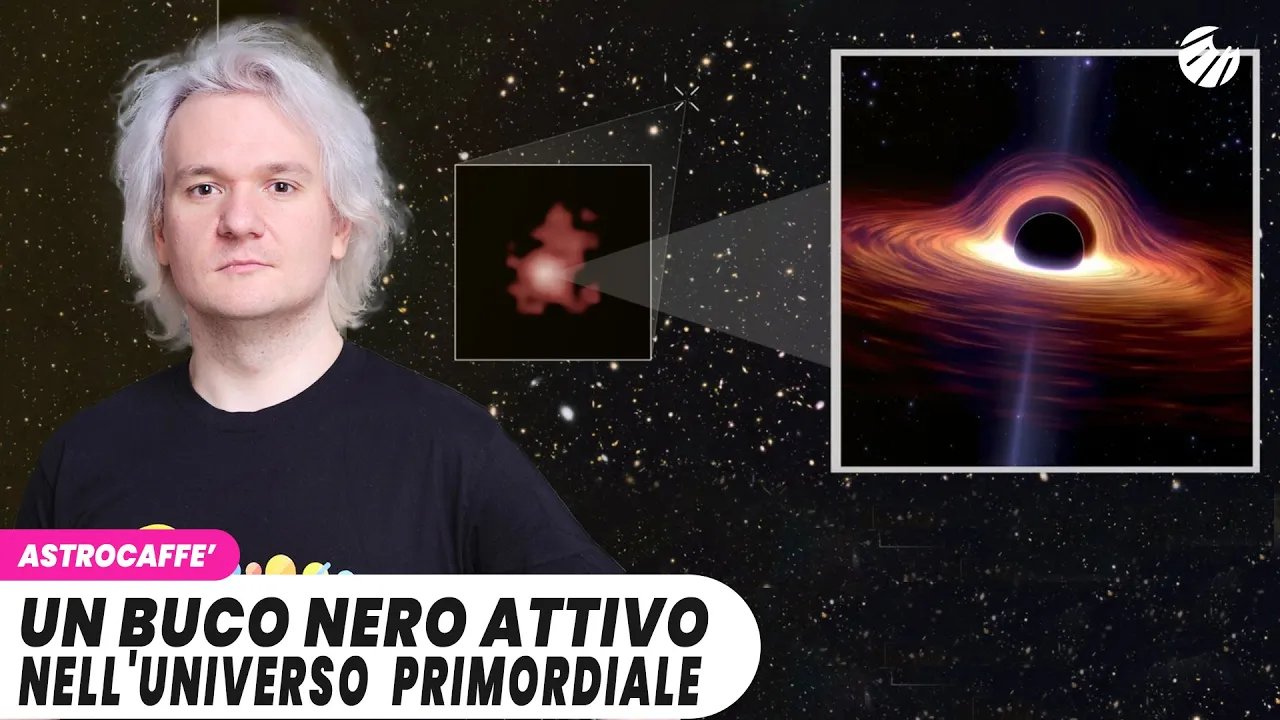
That glowing orange halo in the famous photo represents superheated gas and dust that’s orbiting and feeding the black hole.
This is what’s known as an accretion disk.
Some of that matter will fall into the black hole, but some of it gets shot off into space in the form of jets spewing from the poles of the spinning black hole.
We’ve known for some time that M87* has these jets streaming from its poles.
It was as far back as 1918 when one astronomer first noted a “curious straight ray” coming from the galaxy.
More recently, the Hubble Space telescope took multiple images in the infrared and visible light spectra.
The composite photo shows a striking blue beam extending as far out as 5,000 light years against the yellow glow from the combined light of billions of stars.
Knowing M87* is an active black hole with matter falling into it is actually one of the reasons astronomers picked it as their target to photograph, unlike Sagittarius A* which is closer, but obscured by the stars and dust in our own galaxy.
So yes, we’ve taken pictures of M87*’s jet of matter before, but this is the first time scientists have observed it in the X-ray spectrum in such fine detail.
X-ray light confirms that what’s moving at extreme velocities in the jet is actually physical material, as opposed to something else, like shock waves.
How fast was the material moving?
Well, the material isn’t shot off in one continuous beam, but rather in clumps...like bubble tea through a straw.
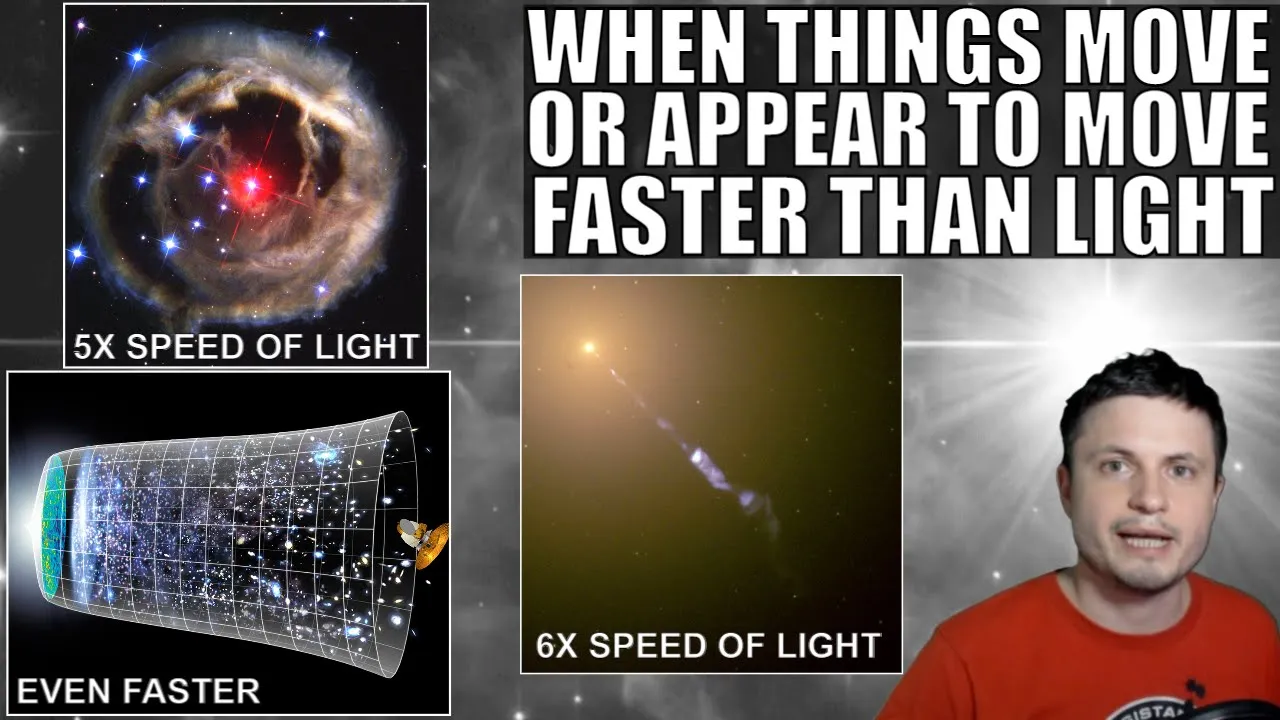
The astronomers observed a clump farther along in the beam traveling at 2.4 times the speed of light, while another mass of matter closer to M87* appeared to be moving at 6.3 times the speed of light.
But hold on—something doesn’t add up here.
We know for a fact that these clumps we’re looking at are solid matter thanks to the X-ray imaging, and we also know that nothing with mass can travel the speed of light, let alone multiple times faster.
Well, it turns out those ludicrous speeds are a product of an optical illusion.
the angle the jet is being shot towards us and the material’s extreme speed produces what’s called superluminal motion, but really no laws of physics are being broken.
Still, the material is really shifting.
Taking the illusion of superluminal motion into account, the researchers still estimate sections of the jet of matter are traveling at over 99% light speed.
They think that the material gets funneled up to the poles of the rotating black hole and shot out by following its twisting magnetic field lines.
The blue glow is generated by electrons traveling along the spiral path, a process called synchrotron radiation.
Now, I’m sure some of you may be disappointed to learn that the material isn’t actually traveling at over 6 times the speed of light.
There goes our hopes of faster than light travel.
But the dreamers and optimists among you may hear that supermassive black holes still accelerate matter to over 99% light speed and think that sounds like a pretty good deal.
Maybe you’re thinking we could harness it for space travel one day like a Mass Relay in Mass Effect.
Just remember though that material was only shot out at those great speeds after becoming superheated and turned into plasma by the friction of other matter swirling around the accretion disk.
So, while M87* and its jet of matter may make for good sci-fi fodder, it’s probably best to admire it only in pretty pictures.
Up Next

101:53
Revealing Cosmic Origins: Habitable Worlds Observatory Science, Part 2
@stsciresearch6722
420 views•2025-07-31
61:17
First Billion Years of the Universe with the Square Kilometre Array
@iaaudc
121 views•2022-05-26

7:30
Living on Mars: Inside HI-SEAS Analog Astronaut Research
@Seeker
112.5K views•2021-11-14

6:10
Gamma-Ray Bursts: Cosmic Snipers Explained | Astronomy
@kurzgesagt
15M views•2016-07-31
Related Study Plans & Knowledge Roadmaps
Structured learning paths in Astronomy
astronomy
Reionization: Pop III Stars, IGM & 21cm Line
01Foundations of Cosmology & the Early Universe
02Population III Stars & Cosmic Dawn
03Physical Mechanisms of Reionization
+ 2 more learning modules
17h5 modules
Explore Roadmap
astronomy
Planetary Rings: Dynamics, Roche & Resonances
01Foundations of Gravity and Orbital Mechanics
02Tidal Forces and the Roche Limit
03Structure, Composition, and Collisions
+ 2 more learning modules
10h5 modules
Explore Roadmap
astronomy
Asteroseismology: Stellar Waves, Ages & Cores
01Foundations of Stellar Astrophysics & Wave Mechanics
02Stellar Oscillation Modes: P-modes and G-modes
03Mathematical Framework of Asteroseismology
+ 2 more learning modules
35h5 modules
Explore Roadmap
astronomy
Adaptive Optics: Physics, Engineering & Control
01Foundations of Wave Optics and Wavefronts
02Atmospheric Turbulence & Optical Distortion
03Wavefront Sensing Technologies
+ 3 more learning modules
35h6 modules
Explore Roadmap