















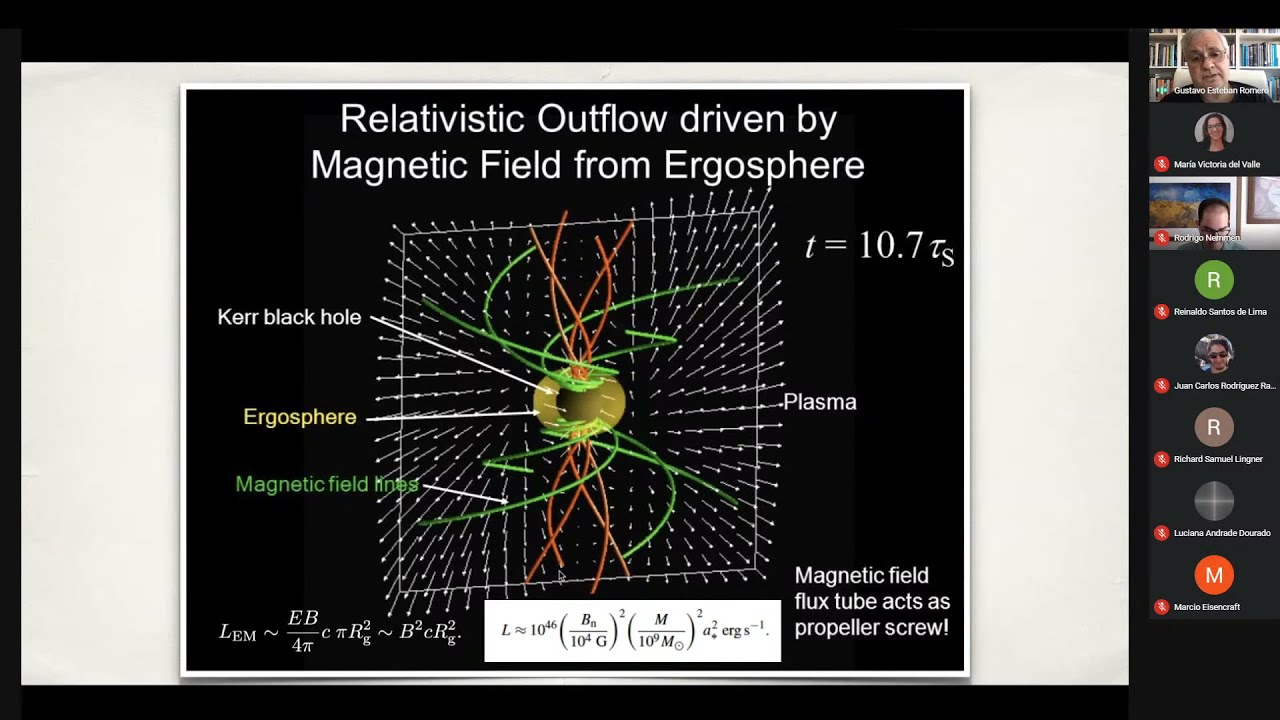




The Blandford-Znajek mechanism explains how rotating black holes extract their rotational energy to power astrophysical jets through electromagnetic processes: magnetic field lines from the accretion disc are twisted by the black hole's frame-dragging effect (due to its rotation), inducing electric fields that create a Poynting flux carrying energy away from the black hole; the extracted power follows the formula P = (μ²Ω²)/(4π²), where μ is the magnetic flux and Ω is the angular velocity, making this mechanism scale-independent and applicable to both microquasars and active galactic nuclei.
Understanding the Blandford-Znajek Mechanism for Black Hole Jets
Added:Fundamentals of General Relativity, specifically the Kerr metric, frame-dragging (Lense-Thirring effect), and the concept of a rotating black hole's ergosphere.
Basic Electromagnetism and Maxwell's equations in curved spacetime, focusing on magnetic field lines and how they interact with conducting mediums.
Introduction to Magnetohydrodynamics (MHD), specifically the behavior of ionized plasma and magnetic fields in astrophysical environments.
The phenomenological understanding of Active Galactic Nuclei (AGN) and the general structure of accretion disks around supermassive black holes.
Advanced General Relativistic Magnetohydrodynamics (GRMHD) numerical simulations, which are used to computationally model jet launching and propagation.
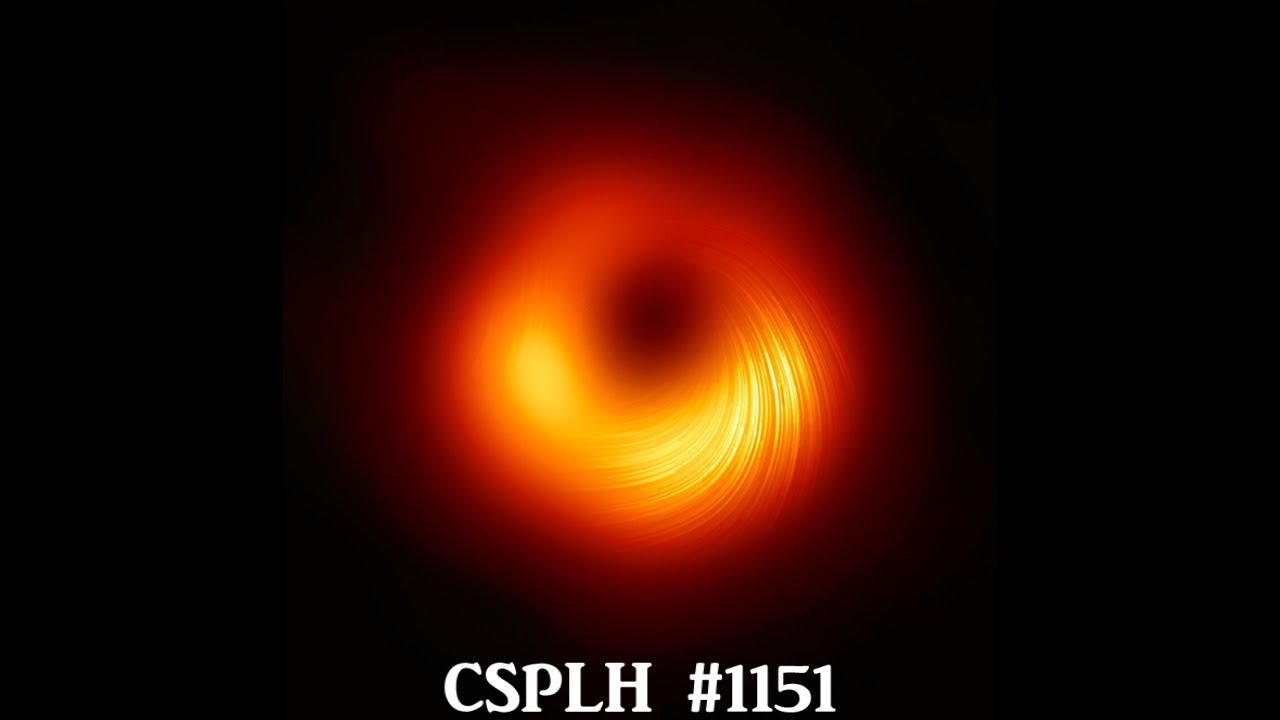
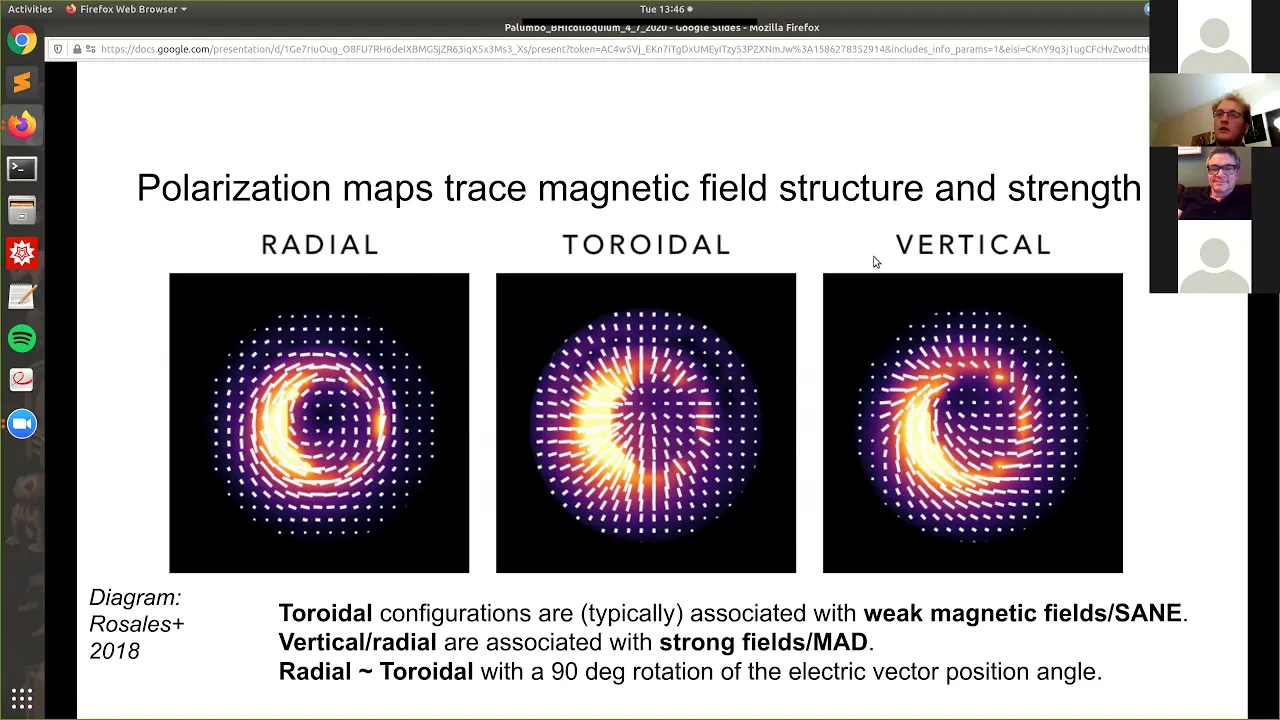
Observational astrophysics evidence from projects like the Event Horizon Telescope (EHT), analyzing polarization and magnetic fields near the event horizons of M87* and Sgr A*.
Alternative and complementary jet-launching theories, such as the Blandford-Payne mechanism, which extracts energy centrifugally from the accretion disk.
High-energy particle acceleration processes (e.g., magnetic reconnection and shock acceleration) that explain the synchrotron radiation observed from these jets.
The role of the Blandford-Znajek mechanism in cosmic evolution, feedback loops in galaxy formation, and the energetics of Gamma-Ray Bursts (GRBs).
272 views10likes27:57Original Release: 2025-09-04
feral University of caros in bra and he will be talking to us about magic and if you have any questions oh okay so thank you guys uh well I'm actually I'm an undergraduate student here from Brazil I'm finishing my undergraduate Stu uh studies and uh I'm going to talk about for you about uh about a little bit the rotating black holes and a mechanism to extract uh energy rotational energy from the uh from the core of the of the astrophysical right so uh well first of all a little bit of me how I found found you guys how I found Ein to kids so I published a paper about actually wormholes Shadows of wormholes in 2022 and uh one of the uh authors of the paper uh was a visiting scholar in Rochester Institute and uh well then I searched the the site of Russ Institute in the center of computational relativ and gravitation and I see the tag products and I find you guys here the I to kit uh so just a quick uh comment about this paper well we are we are uh we were studying actually the photon ring of charged black hole so uh me and Daniela we did the uh the analytical calculations and then Hing this third author wrote used the code called Skylight and he plotted the photon ring and he puted a star beyond the mouth of the wormhole in the other patch of the manifold right so in the other in the other connected region and he put a star a model of a simple star and we saw a sort of uh Einstein ring right right so uh well uh about this uh this talk so I'm going to talk like almost Semite Technical and communication talk about black holes and the Blen for S mechanism so we know about gravitation right so here is the ice and field equations and uh basically these equations tells us about how matter curves the SpaceTime and then how SpaceTime uh affects the the matter right so here's a cartoon of the of the whole thing and once again the Einstein field equation uh in his uh whole form right so uh okay gravity and classical gravitation is a vast study as we know so we have you know warm holes War drives the whole cosmology and uh gravitational waves and of course black holes right so uh and the the concept of a black hole is you know it's uh it's quite simple is a In classical room uh gravity is a really of pure void right so is technically the the Solutions in Shar and Care cases uh solutions for the vacuum I and field equations right so uh we have of course a very important region actually a surface called Event Horizon so a new Surface so uh information cannot uh go backwards uh go beyond the go return sorry the Event Horizon for the for the universe so basically everything you throw in a black hole stays okay in the black hole so uh the pathological feature of black holes are of course singularities so general relativity in his classical form uh predicts in some some sense its own failure due to physical singularities uh okay uh the first black hole Solutions is of course Shar solution in 19 uh in 19 16 and uh its version uh uh with rotation so a rotating black hole is due to care Roy care in 1963 right so it's a more complex metric uh and you know probably all know here that due to the Cross terms in a matrix this very feature in the metric uh we can you know have all sorts of new effects like the very important one here uh which is the frame Dragon so the of course the the cross terms induced this effect the frame draging effect right so okay uh a nice picture from Sage manifolds a uh package from from python uh you can you can find this online very easily so yeah here just to depict a sh arched black hole which is the one without rotation a here is the spin parameter which is associated with J the angular momentum and the mass right so in a very in a very rapid uh care black hole we have uh all sorts of new regions like the outer osphere and the VAR actually two other kinds of Horizons and uh another ero surface another region inner ER region and of course the ring Singularity the whole topology of singularity in this case uh is changes just due to rotation so yeah of course this uh this uh this mathematics here is of of care black holes uh is not actually is not actually accurate for astrophysical ones because we don't expect that inner Horizons or inner Ergo surface exist exist because you know there are studies about the stabilities of these inner regions but the outer osphere and the Very outer Horizon you know they exist of course another picture here about more technically about how to define mathematically this these surfaces here right uh okay so a very important feature of C black holes uh which is associated with I what I am going to talk a little bit now uh is the possibility of extraction of energy due to rotation right so the first person I think that uh studied this was pen rows right so it's a very simple uh a very simple effect to understand here so of course this scaler here is the energy the relativistic energy so suppose you have a particle zero here with a momentum P0 and you throw this this particle in a very intelligent way like uh so that in the point D inside the erosphere uh we have a decay of this part when some part part of the particle goes goes in and inside the black hole and the other one escapes from the osphere right so uh this effect here is very nice because we can understand due to this effect again uh the causal character of vectors inside the erosphere so uh in fact inside agrosphere observers are uh you know observers cannot stay actually static they must to rotate in the same uh at the same uh the same direction angular direction of the black hole right so also we have a change of causal character of vectors and you know qu physical quantities is like uh this this momentums here this contractions inside the erosphere we have uh space likee character of vectors so of course the sign of the of the energy will you know will not uh be the same as the sign of the energy outside of the erosphere so do to this CLE character of the of the SC space time uh just a pure mathematical thing we can you know uh calculate the output of the energy and we can see that the energy that goes out from the from the from the black hole due to this particle of course uh is greater than the energy that entered or the energy that the particle P0 carried so okay well uh knowing that uh about care black holes and the whole important uh and the whole importance of the erosphere so in reality we have of course not pure Eternal uh and isolated care black holes we have a more complicated uh scenario which which are the astrophysical black holes which have you know astrophysical gas and whole all sorts of uh things orbita in the the object right so here are two pictures of galaxies uh for you can for we can see the the Jets the whole the whole point of the of the the talk here so we have here a very Compact and point centered object uh you know throwing out matter from its Center and the very famous One M missere uh 87 we also have this uh this structure this jet which is called so again we have a jet coming out from the center of the the whole galaxy and you know uh the center of the object must be a very uh powerful thing because you know this is a whole elliptical galaxy and we have a structure that is reaching out its boundaries in some way so it's a matter that coming out very very uh a very centered object and is traveling through uh thousands of light years uh from the center right so which mechanism can do that again another picture a composition of St ARA I think so we have whole galaxies and huge objects expelling matter so of course the the standard model here of active Galactic nuclei are the black holes power just Jets so okay uh a little bit about the mechanism so as I said astrophysical black holes are are not isolated so we have the astrophysical gas and all all other sorts of matter uh orbiting the the compact object so in a form of accre right accre forming an accretion disc but uh as we know most of the astrophysical gas carry a component of magnetic field so they are magnetized like you know the sun expelling corono ejectors uh these are carrying field lines of of the magnetic field and you know this clouds interacts here with the magnetic field of Earth and so on so in the interesting case of black holes we also have this these uh magnetic field lines but uh due to relativistic uh Behavior or and the extreme gravity uh around this these objects we have uh uh in this accretion disc we have a convection of the poloidal magnetic fields right due to the accretion and uh yeah here we can see a a cartoon of the what is happening happening with the magnetic field lines uh carried by acction right so it's very interesting because we have this poloidal magnetic field lines components here coming from you know the outer accre disc regions and as soon as these field lines reach uh reach the magnetosphere which is more or less bounded by the erosphere uh this field lines are of course uh they they they are they are experience torsion of of the they experience a tortion right due to the due to the rotation Extreme rotation of the object so this rotation creates another sort of of configuration of the mag magnetic field which are the poloidal magnetic sorry the tooo magnetic field lines so and uh yeah it's very interesting because in this other cartoon here we have again the depiction of the magnetic field lines coming in uh coming in the encountering the black hole and then as I said uh we have due to the uh rotation of the black hole inducing a to a twisting of the magnetic field lines we have appear we have an appearance of tooo magnetic field lines also of course we have polido electric Fields induced electric Fields so uh yeah the pointing flux and this is the the main information here here of course we have the the poloidal electric field and toroidal components as we can see I put this just to comment the the electric field the toid electric field is zero here in this in this region so uh in a very simple way we can uh calculate the pointing flux between the polido electric field and tooo magnet itic field and we can see that you know we have a flux coming out from the from the from the black hole right due to this magnetic and electric field configuration uh of course uh this is a uh excert of of Blen for paper so we uh as a you know external obser we see a strong flux right so of energy coming out due to this uh due to this mechanism that I that I comment here now right so I'm GNA pass this a little bit and uh the very form has first calculated in the paper uh which uh is the theor theoretical prediction of the of the effect which is the the the pointing the the value of the pointing flux here uh well we have of course the the vector field here the the vector potential right so and we have here the rotation of the Event Horizon and the rotation Omega the little Omega of the magnetic field lines the the too you know the twist this quantity says to you the that very close to Black to the black hole the the magnetic the polido magnetic field have uh angular component here compon angular velocity component right so another uh important quantity about this about this effect is the power that we can calculate right so here we can uh here you can calculate using the the energy momentum tensor but the first version of this calculation due to blenford and sagic I think that is in the the first paper uh is the power that uh we can associate it with this uh with this effect which is the very the very famous five minutes please conclude okay sorry which is the very uh famous uh plan for power from the system the output power the output power so we can see here that uh you know is is defined uh using the the magnetic flux and the Very angular velocity velocity of the of the black hole right so another interesting fact of uh bz mechanism is that you know is believed to be independent of the scale so we have quers and micro quers uh but both of them uh exhibit the jet the Jets right so uh but of course the the scale between the two are very very different one is uh the Galaxy and the other one you know uh is the is a Stiller Mass black hole not a super massive one so so yeah here is my references and yeah thank you for your attention and the opportunity to talk here you actually have quite a bit of time the five minutes one was five minutes to your questions if you have some can you hear me yes of course um I was saying you actually have a little bit more time than five minutes was to your question so you have about minutes or so left oh do do we have questions I am not hearing well are there any questions in the room actually any questions onl I have some question most I think it was very nice to see the description of how process as well now ever having worked on this myself um I'm wondering if you have a way to um make it intuitive why exactly the black magnetic field like actually twist um is frame dragging effect or is there something else that I can think of that well um I'm sorry I I didn't hear well the question but I think that just said about the main uh the main effect that twists the magnetic field lines am I right yeah as far as I understood the effect so of course we have the the accretion disc so you know the whole disc is spinning but and of course uh together uh with this acan spinning induced by the spinning of the black hole we have the matter uh falling in the black hole so uh due to the Magneto hydrodynamic uh physics of the acre disc we have the that that poloidal components going uh going in together with the with the matter but as I said as far as I understood the fact you know uh close to the close to the the black hole and of course close to the erosphere we have the this effect which is due to the frame dragging uh this effect that is of course the frame dagger frame dragging the effect of rotation and as I said the frame dagger uh per se uh twists the magnetic field lines okay thank you um let me see oh there's one question locally Johnny okay let me repeat the question because it didn't quite go through but it's a question okay it's about the visualization slide that you had and the Skylight package and basically how much memory and how much compute power one needs to do these sorts of visualization well uh these exact numbers I I don't have because uh is it was all Hawkins uh part of the of the work but you know it was not um uh very uh cons you know he didn't use much much computer power of course as far as I remember he said to me that uh one simulation was during was about you know uh two or three hours I think but you know I I it's not a question of days or weeks you know to simulate the Einstein Rings here so it's comparatively uh from the other lectures here about you know adaptative MH refinement and the other sorts of things uh I think he did this in in his laptop I think okay thank you um let me see uh any more question call for questions online or offline okay you're are apparently competing with lunch but thank you very much for a very interesting talk thank you guys I'm gonna stop sharing now so yeah for the next hour afterwards we're back in this room um with uh more
Up Next

8:37
Why Quasar Jets Appear to Move Faster Than Light | Superluminal Motion Explained
@paulfrancis825
992 views•2020-01-22

12:53
21cm Hyperfine Transition in Neutral Hydrogen: Radio Astronomy Basics
@AaronRobertParsons
12.4K views•2011-10-13

32:32
NMR Spin Physics I: Zeeman Effect, Resonance Condition & Larmor Frequency
@nptel-indianinstituteofsci8064
2.3K views•2024-01-17

27:14
Entropy and the Second Law of Thermodynamics Explained
@veritasium
27.5M views•2023-07-01
Related Study Plans & Knowledge Roadmaps
Structured learning paths in Physics
physics
Nuclear Physics (Decay, Fission & Reactors)
01Atomic Structure and the Binding Force
02Radioactive Decay and Half-Life
03Nuclear Fission Mechanics and Chain Reactions
+ 2 more learning modules
12h5 modules
Explore Roadmap
physics
Soft Matter (Polymers, Colloids & Rheology)
01Foundations of Soft Matter & Thermal Forces
02Polymer Physics and Macromolecules
03Colloids, Surfactants, and Self-Assembly
+ 2 more learning modules
38h5 modules
Explore Roadmap
physics
Analytical Mechanics: Lagrangian & Hamiltonian
01Mathematical Foundations: Calculus of Variations
02From Newtonian Mechanics to Constraint Dynamics
03The Principle of Least Action & Lagrangian Mechanics
+ 3 more learning modules
28h6 modules
Explore Roadmap
physics
General Relativity (Spacetime & Cosmology)
01Foundations of Relativity: Special Relativity
02The Geometry of Spacetime: Equivalence Principle & Curvature
03Einstein's Field Equations: The Mathematics of Gravity
+ 2 more learning modules
55h5 modules
Explore Roadmap