







![Аккордопедия - SUS аккорды в хвост и в гриву [Теория музыки по-пацански]](https://i.ytimg.com/vi_webp/NXXzfzG2k94/maxresdefault.webp)









Seventh chords are constructed by adding a seventh interval (major 7th, minor 7th, or diminished 7th) to five fundamental triad types: major, minor, augmented, diminished, and suspended. This systematic approach reveals that all seventh chords can be understood as extensions of these basic triads, with modifications to the fifth (sharp five or flat five) creating variations like augmented seventh chords, half-diminished chords (m7b5), and fully diminished seventh chords. The key to mastering seventh chords lies in recognizing how each chord type derives from its parent triad and understanding the interval relationships that define their unique harmonic qualities.
How to Build Every 7th Chord in Music: A Complete Guide
Added:Understanding of intervals, specifically major, minor, perfect, diminished, and augmented intervals.
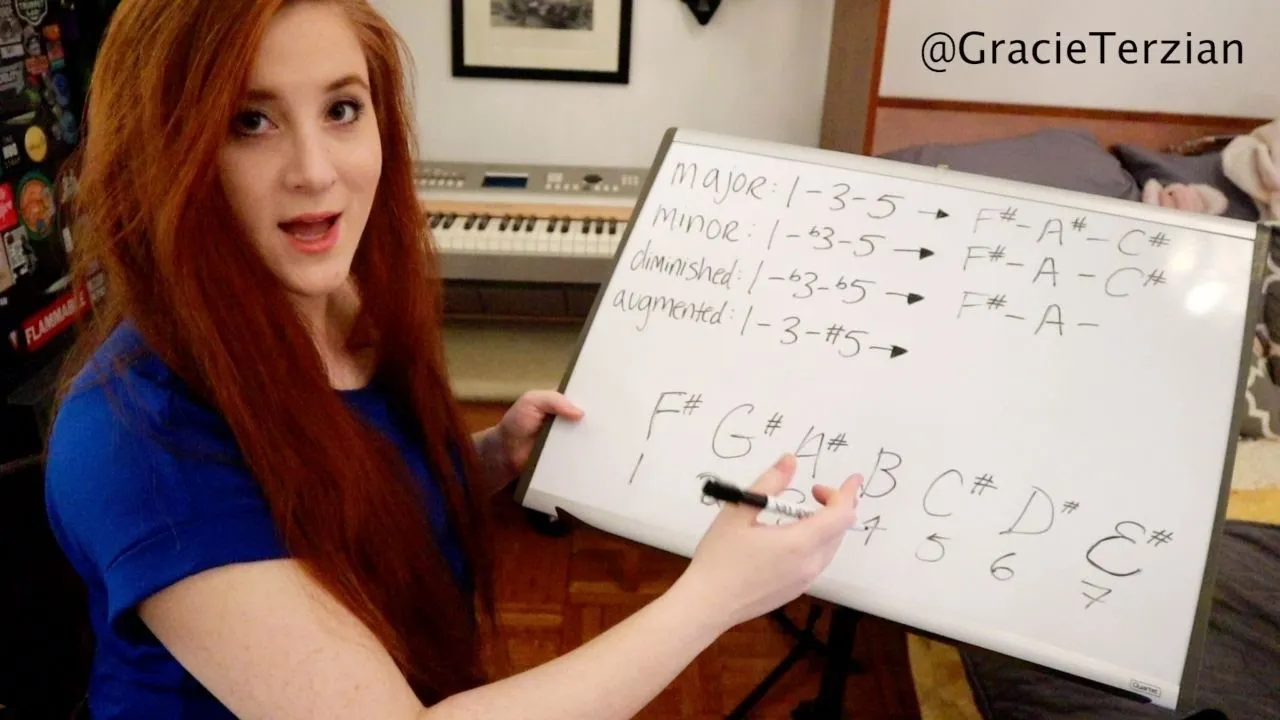
The construction of basic triads (major, minor, diminished, and augmented) and their scale degrees (1-3-5).
Familiarity with the major and natural minor scales and how to find scale degrees within them.
The concept of suspended chords (sus2 and sus4) where the third of a triad is replaced by a second or fourth.
Learning the four inversions of 7th chords (root position, first, second, and third inversion).
Understanding diatonic 7th chords and their functional harmony within major and minor keys (e.g., the ii-V-I progression).
Exploring voice leading techniques and specific instrument voicings, such as drop 2 and drop 3 chords.
Advancing to extended chords, including 9th, 11th, and 13th chords, as well as altered dominant chords.
3.5K views136likes29:38Original Release: 2025-03-22
[Music] hi everyone this is Jason Zach from Nathaniel School of Music we are going to dedicate an entire tutorial this one to the study of seven chords we're going to look at how to form them theoretically and we're going to look at how to play them practically on an instrument like the piano or whichever instrument that you might be playing at the moment okay uh seventh chords there are a few of them which are taught in the basics of cod Theory or rather diatonic Cod Theory so in the major scale you have a set of them in the minor scale you have a set of them however in the minor scale you have the natural minor you have the harmonic minor you have the melodic minor you even have the Dorian you have modes and so on so it's it's a bit difficult to remember them diatonically so I thought this lesson can be dedicated to exploring each and every cord not from the perspective of the scale but from the perspective of Triads and intervals so the Triads that we are going to look at as a base as a home base would be the major chord the minor chord the augmented chord and the diminished chord and also not to leave behind the suspended chord more so the sus for okay so repeat major minor diminished augmented suspended so for the entirety of the tutorial we look at forming seventh cords from the key of D however in our staff notation which you'll find on our patreon page you'll get access to other Keys as well we leave a few there and we will try and make this as exhaustive as possible we look at seventh cards which are not commonly found which are not even in Scales to be to begin with so yeah we look at the ones from diatonic to far beyond okay so stay tuned till the very end and uh get yourselves a book a pen paper would help and also get your keyboards or guitar or whichever instrument you play and learn a long or don't forget to hit that subscribe button and turn on the Bell icon for regular notifications let's get cracking so the key of D let's first look at all the Triads from within the key of D I said it earlier but let's break it down so Major D major okay it's also essential at this stage to crack the inversions of that particular Triad so D major root Position will start on the root D then you go then then you start on the first inversion namely f f a d and then the second inversion a d f sh okay that's your D major base and I call it a D major base because from here we'll build all the respective seventh chords okay okay now coming to D Minor so D Minor would be root minor 3 perfect fifth you you need to remember your perfect fifths well all of these intervals really minor third perfect fifth while a major chord was a major third and a perfect fifth so minor third again minor third perfect fifth okay so this is D Minor again formulate it in uh all the inversions root position first inversion second inversion so first inversion we have the root note at the top in this case D second inversion we have the root in the middle again D so that's D Minor then we have D augmented so an augmented chord would be would be formed as a major with a sharp five now that's one way to remember an augmented cord but what I like to think of uh when I'm looking at augmented would be it's just two major thirds so a good way to form cords would be to not rely on some other cord it's the same issue with notes in music We tend to be by towards one note let's say C in lot of the learning uh examples people give us it's the same issue with cords we base it on something we already know like a major chord while an augmented chord can so easily be formed via two major thirds so root major third and then from F sh another major third and it's interesting to know that all augmented chords are inversions of each other so D augmented F sharp augmented B flat augmented so there are three augmented chords which are just inversions of each other okay okay that's about your augmented another way to look at it is you take the five perfect fifth and you raise it up a half step or up one chromatic note and you get the augmented chord okay uh coming to diminished it's very similar so coming to diminished you take a minor chord and you drop the fifth down to a diminished fifth or a trone interval so minor chord drop it down you get yourself a trone interval or a diminished Fifth and this is a diminished chord and the way I like to remember a diminished chord would be 2 minor3 D to F minor 3rd F to a flat again minor third so there we go so diminished augmented major minor and one more to go the suspension so a suspended Triad would be one perfect fourth and perfect fifth a perfect fourth could be looked at as a major third up a chromatic [Music] step now another way to look at the perfect fourth is it's the circle of fifths counterclockwise neighbor so D is there c g d d g will be a perfect fourth while d a would be a perfect fifth clockwise neighbor perfect fifth counterclockwise neighbor perfect fourth okay so you combine a perfect fourth and a perfect fifth and you get a suspension and the good thing about a suspended cord d D sus 4 when you invert it will be G sus 2 so D sus 4 is G sus 2 and if you further invert that and start on the a you'll get an A quartal chord just kind of an A7 sus4 sound but we call it as a qule with a Q sign okay so suspend suspended cords when you invert them they become other cord so D sus 4 becomes G sus 2 becomes a qule so these are all the basic Triads so that's over and done with now let's try and form all of the seventh chords from the Triads okay having known the Triads so the first kind of seventh chords would be keeping the major Triad as a base Triad so we'll start with D major and try to build up all the seventh chords in and around it okay and we're going to build it up by using extended intervals so the extended intervals would be major 7th and the minor 7th the other kinds of intervals would be interval modifications and usually when we form seventh cods we would be modifying not the third we'll be modifying not the root but we'll be modifying the fifth and two ways to modify the fifth this is your fifth a perfect fifth you can go Sharp five or you can do flat five so you can have a D major with a with a sharp five which is essentially a d augmented or you could have a D major with a flat five which is essentially well there's no name for it I actually call it the Simpsons card come to think of it but anyway so that'll be a D major flat five you can even say it has a lydian sound or a lydian vibe okay so in addition to the extended intervals we'll also modify or we'll do Replacements of the perfect five to either be a diminished five or an augmented five so thus it'll give us four seventh chords with a major base Triad so let's form them real quick D major plus a major 7th what will be a major 7th a easy way to remember it would be octave minus one so d e -1 the reason why it's useful to remember it that way is whichever shape you are whichever position you are on your instrument if you already know D major you're just finding the additional note which in this case is D minus one or root or octave minus one which happens to be C sharp what do we mean by minus one again minus one step we use terms like semitone and tone which are honestly quite confusing to me so just down a chromatic step or down two chromatic steps or up one or up two it's easier to remember that way so you take Triad down one and see you can get a major 7th flavor from any inversion or you take the second inversion and now you're stacking up C Shar so the major 7th of D is C Shar you should remember that there we go okay so it's essentially built via the major chord plus the major 7 so D major plus major 7th or if you play D major like this plus major 7th yeah now coming to the next extension you have the minor 7th interval so there are three seventh intervals in music you have a major 7th which is octave minus one you have a minor 7th which is octave minus 2 you also have which we are going to look at shortly a diminished 7th which is octave - 3 so diminish 7th is where the major 7th comes down becomes minor and the minor comes down again it becomes diminished so we use a diminish 7th sparingly for a few chords namely the diminished sth chord which is that more on that soon so if you take the major D major chord and you stack up now we we've looked at a major 7th forms a major 7th chord if you stack up a minor 7th it becomes a d 7th chord or you can a bigger way to call it would be a d dominant 7th chord okay the notes would be 1 3 5 7 flat so if you're [Music] here in this inversion you'll have to add the [Music] C that one or if you're [Music] here c a c d f sh there we go it'll be a d dominance 7 Okay so we've looked at D major 7 D dominant 7 now let's modify the five let's keep that major 7 shape and now you have a lot of options you can do D major 7th sharp [Music] five okay also known as actually also known as a d augmented major 7th because this is a major 7 7 major 7 sharp five but major major cord with a sharp five itself is called augmented so you can either call this as D major 7 Shar 5 or you can call it as D augmented major 7th I repeat D major 7 sharp 5 or D augmented major 7th so we've messed with the five by sharpening it now let's mess with the five by sharp flattening it now this is a unique chord this is called D major 7th flat 5 [Music] okay beautiful chord very lydian in [Music] nature there we go so we've altered the five with relation to a Major Seventh base now let's alter the five with relation to a dominant sth base that will be a minor 7th up top so the same story you can do a sharp five so D7 sharp five would be the chord sharp five means a goes to a sharp so this is called as a D7 sharp 5 also known as a d augmented 7th so you go D augmented 7th D augmented 7th or D7 shop 5 D7 Shar 5 and similarly you can have a D7 flat five so this is your D7 vanilla D dominant 7th you sharpen it D7 sharp 5 flatten it you get a D7 flat 5 that's literally the card I don't think there's any other name for this card if you think there is let me know in the comments so D7 flat 5 so we've now built up every major Triad based 7eventh cord and there was six if I remember right right major 7th dominant 7th then you have the messing up of the five with the major 7 so major 7 sharp five also known as augmented major 7 then major 7 flat five then you have seven sharp five which is also called as augmented 7 and then 7even flat 5 which is just seven flat 5 that's it so now let's do the same same ecosystem with the Minor triad base so if you take D Minor same story as earlier you extend it with first of all the sevens what are the two types of sevens in life major 7th minor 7th and there we have it so what are these two chords called you take A Minor triad with a major 7th it'll be called d D Minor major 7th weird name you have to deal with it D Minor major 7th okay and the traditional way to write it would be you write d m with a major 7th in Brackets to avoid confusion so D you can see my notes D Minor major 7 so essentially even if you're here f a in an inversion you're just adding in that c Shar or if you're here yeah you hear okay that's a minor major 7 then if you take D Minor with a flat 7 remember major 7 flat 7 flat 7 would be D Minor 7th traditional D Minor 7th okay and uh now let's mess with the fives so I leave the flattening of the five for the later one because that will actually be a diminished Triad extension because when you take a D minor and flatten the five it's already a diminished as I taught you earlier so we look at D Minor 7th with a sharp five very uplifting kind of chord you could also call it as a B Flat add 9/ D or you can visualize it as a D Minor 7th Shar 5 could also say add Flat 6 but we have it named as a D minus 7 sharp 5 right so those are your minor extensions Minor triad extensions let's now look at the diminished extensions so you already know D diminished by now we looked at it earlier right DF a flat and the same story as earlier we are going to do D diminished with a major 7th D diminished with a minor 7th but we'll also add D diminished with a diminished 7th which is three minus three root minus 3 so you go this would be D diminished major 7th so you write D dim in Brackets major 7th D diminished major 7 red cord [Music] though okay then we have D Minor 7 flat 5 now there are two names for it you can either say D Minor 7 flat 5 which is a very obvious way of forming it it's easy on the brain I think even though it's a big name D Minor 7 which is this flat 5 D Min 7 flat 5 but officially we also have a term called This is D half diminish so D half diminished so you can either say d half diminished or D Minor 7 flat 5 D- 7th D- 7 flat 5 also known as D half diminished okay and then in addition to this you have a d fully diminished chord which is a diminished chord plus a diminished 7th so a diminished chord plus a major 7th is diminish major 7th a diminish chord plus a minor 7th is a D Minor 7 flat 5 also known as half diminished D half diminished a diminished chord plus a diminished 7th would be a fully diminished or a d diminish 7th in this case and it's interesting to note that all diminish 7th chords are inversions of each other so D diminish 7th if you invert it you get F diminish 7th you invert that you get G sharp or a flat diminish 7th you invert that you get B diminished 7th there we go we've done a proper comp comparison and contrast between the two cards check it out in the description also I've made a playlist way back in the day where where we actually made a playlist of as I call it my favorite cards of all time so the Minor 7 flat 5 is definitely there the minor major 7th is definitely there lot of these cards will be there so imagine an entire YouTube video on just one card that's what you're going to find in the description check it out so diminish cards are over and done with now let's look at the the augmented setup so augmented we already learned earlier when we built it via the major and the dominant 7th chords but nevertheless I'll just bring it out there as a formality so this is your D augmented D augmented major 7th you can also say D major 7 sharp 5 we discussed this earlier I've just put it in a different topic okay then we have D augmented 7th so when we say D7 it actually means flat 7 when we say D major 7th and write that ma m AJ then it means major 7 but if you don't write anything D7 it means minor 7th okay so similarly D augmented 7th would imply you have a minor 7th with an augmented chord so augmented chord with a flat 7 so augmented chords are done and then uh we will get into the name of these cords with symbols and all that just at the end of the lecture but before that let's finish off suspended cords which I like a lot so D major first of all to get it to be suspended this is sus 4 so D sus4 so same old story D major 7th sus4 which is a suspended Triad plus a major 7th [Music] beautiful cord especially when you apegate it so that's D major 7 sus 4 major 7 and now we have D7 sus 4 which is a sus chord with a minor 7th up top okay D7 sus 4 D major 7 sus 4 so let's now reverse whatever we've studied so far let's break down all the seventh chords but while revising it let's also understand all the symbols that are used this can get a bit challenging because different symbols are used by different musicians for different genres I guess you could say that so yeah let's take ourselves back to the major extensions major 7th you can call it as d m aj7 you don't write D major 7 no D Maj 7 maj7 or you can write D ma7 ma7 if you want or you can write D equilateral triangle 7 okay D triangle 7 if you want or there are some people who will do D triangle that's it so MA 7 MA 7 triangle 7 only triangle right I hope there's nothing else but we in luck when it comes to the D7 chord that's all you'll ever write D7 because it's an ancient chord it's been used from the time of Bak so uh it's just that D7 that's it okay then D major 7 flat 5 you can write it as D Maj 7 flat 5 uh that's usually the tradition or D Marge 7 sharp five you can do it like that and then if you do the dominant 7s with the altered fives you can do D7 flat five D7 Sharp five and remember what I said whenever you have a sharp five you can also refer to it as augmented and the way the symbols work is whenever you write anything that is augmented in nature that is a major cord with a sharp five you can also write instead of writing D OG 7 or D OG major 7 you can write instead of the word OG you can replace Aug with a plus sign the plus sign you write usually at the top right of the capital letter of that root so D augmented major 7th could be written down as D+ triangle 7 because a triangle is for major right or you can just make it easy for yourself and say D major 7 Shar 5 or D augmented major 7 so to write D augmented major 7 probably you can write d o in Brackets major 7th okay so or D Plus major 7th plus means augmented always okay then we have D augmented 7th which as I told you earlier is like a D7 sharp 5 so that would be augmented so D + 7 D+ sign 7 okay so that's about your major and augmented extensions now let's look at minor and diminished okay so minor first of all minor 7th pretty easy D small M7 small M for minor now minor cords could also be replaced that M you can replace it by writing minus sign probably to save paper it's a smaller easier thing to write so you write that minus sign on top right again of the alphabet so minor has has a minus augmented has a plus okay and as we'll see with diminish it has a degree sign so minor will have a minus so you can write D minus 7 or you can write d M7 small M7 not Big M Small M okay then D Minor major 7th would be D M Small m in Brackets MA 7 so D Minor major 7 that major 7 should be in Brackets or you can perhaps also go D minus triangle 7 that could also work D minus triangle 7 okay that's D Minor major 7 okay then you have your Minor 7 Shar 5 which is as it's written dm7 sharp 5 uh diminished major 7th now for diminished you can write D degree any kind of diminished chord any Triad especially you can either write D dim or D degree both work so D diminished major 7th in Brackets D dim Mar 7 now this gets interesting D Minor 7 flat 5 you can write it as it's called D M7 flat 5 you can write it peacefully like that so D small M7 flat 5 and if that's a bit long to write especially in a chord chart with a l of changes you can do D and fi the Greek symbol fi so d f used in maths class right so that and that or I don't know exactly how it's drawn there are a lot of ways so D Minor 7 flat 5 or D5 but officially you call it D half diminished okay and then D fully diminished would be D degree 7 D degree 7 or you can write D dim 7 D diminish 7 or D degree 7 okay and yeah that's about all the symbols yeah you have the suspension so D major 7 sus4 or D 7 sus4 D7 suso suso there's no I guess there's no shorter way of writing it so d m 7 suso or D 7 sus4 so Ive explored everything on D we will write this down on a couple more roots in our uh staff notation uh PDF sheet which is available for you on our patreon page you can also download the MIDI files of that and play it and actually hear how it sounds as a good revision you will also have the M sco file so you can import it and transpose it and play around with the data a bit more if you want to uh or share it around or print it or whatever you wish and you also have my handwritten notes as I've been going through in the lecture all on our patreon and if you like the video it'll be nice if you can consider hitting the like button there's a subscribe also somewhere there try to hit it and turn on the Bell icon for regular notifications also feel free to share the video with your friends family and leave us a comment let us know what you'd like us to cover in the next one thanks a ton for watching the video I will catch you in the next one cheers
Up Next

21:08
Orchestration Fundamentals: Chord Spacing & Timbre
@AlexHeppelmann
4K views•2021-01-30

51:08
Simon Rattle on Early 20th-Century Music: Tonality's Decline
@theclandestinum
18.3K views•2012-06-16

38:29
Master Jazz Piano Chords: 9th, 11th, and 13th Voicings Explained
@nathanielmusicschool
8.8K views•2024-07-03
10:49
Understanding John Coltrane's Giant Steps: A Music Theory Analysis
@Vox
10.4M views•2018-11-12
Related Study Plans & Knowledge Roadmaps
Structured learning paths in Music Theory
music-theory
Tintinnabuli: Pärt's Counterpoint & Composition
01Music Theory Foundations: Intervals and Triads
02Fundamentals of Counterpoint and Voice Leading
03Arvo Pärt and the Spirit of Holy Minimalism
+ 2 more learning modules
16h5 modules
Explore Roadmap
music-theory
Composing Galant Music: Partimento & Schemata
01Foundations of Figured Bass and Keyboard Harmony
02The Rule of the Octave (Regola dell'Ottava)
03Galant Schemata: The Building Blocks of Form
+ 2 more learning modules
30h5 modules
Explore Roadmap
music-theory
Decoding Overtone Series: Tuning & Drone Music
01Acoustic Foundations: The Physics of the Overtone Series
02Tuning Systems: Equal Temperament vs. Just Intonation
03Microtonality and Spectralism: Beyond Standard Pitches
+ 2 more learning modules
24h5 modules
Explore Roadmap
music-theory
Impressionist Harmony: Scales, Planing & RPGs
01Foundational Music Theory: Keys, Intervals, and Seventh Chords
02Impressionist Color: Chord Planing and Parallel Harmony
03Whimsical Textures: Pentatonic Cascades and Whole-Tone Scales
+ 1 more learning modules
14h4 modules
Explore Roadmap