Matching markets are economic systems where outcomes depend not just on prices but on mutual choices between participants, unlike traditional markets where price alone determines allocation; these markets apply to critical life decisions such as college admissions, job placements, marriage, and organ transplants, where individuals must both choose and be chosen by others.
Nobel Laureate Alvin Roth on Game Theory and Market Design
Added:Deep Dive
Basic Game Theory concepts, such as strategic decision-making, payoffs, and the Nash Equilibrium.

खेळ सिद्धांत मधील मूलभूत संकल्पना Basic Concepts of Game Theory in Marathi
2.1K
Game theory is a mathematical framework for analyzing strategic decision-making in competitive situations where multiple participants interact, involving concepts like strategic decisions, payoffs, and equilibrium strategies to predict optimal outcomes.
Click to watch →

01. Vorlesung - Grundzüge der Spieltheorie
76.8K
Game theory is a decision theory analyzing optimal choices in interdependent situations where multiple actors make decisions affecting each other's outcomes. Key concepts include: (1) A 'move' is a single decision at a specific point in the game; (2) A 'strategy' is a complete game plan specifying actions for every possible situation before the game begins; (3) A 'strategy combination' is an ordered set of one strategy per player that determines the entire game course; (4) 'Payoffs' are evaluation measures (not necessarily monetary) assessing outcome advantage from each player's perspective; (5) A 'Nash equilibrium' is a strategy combination where no player would want to change their strategy after learning what others have done, meaning each player's strategy is the best response to the others' strategies. Game theory classifies situations as static (simultaneous decisions without knowledge of others' actions) or dynamic (sequential decisions with observed actions), and as non-cooperative (no binding contracts possible) or cooperative (binding contracts can be enforced).
Click to watch →

Game Theory: Dominant Strategy & Nash Equilibrium Explained
23.4K
Game theory involves three fundamental elements: (1) Players - the decision-makers in the game, such as Player A and Player B; (2) Strategies - the choices available to each player, such as Player A having options 'top' or 'bottom' while Player B has options 'left' or 'right'; (3) Payoffs - the numerical outcomes that each player receives based on the combination of strategies chosen. The payoff matrix displays these outcomes where the first number represents Player A's payoff and the second number represents Player B's payoff for each strategy combination.
Click to watch →

B.Sc 5th sem Maths || Ch- Nash Equilibrium || By Jyoti Chaudhary ✍️✍️
34.7K
Game Theory is the study of strategic decision-making in competitive situations where players cannot know what others are thinking. It was first introduced by John von Neumann in 1921, further developed by von Neumann and Morgenstern in 1944, and revolutionized by John Nash's Nash Equilibrium in 1950-51. The theory involves two main types of strategies: Pure Strategy (unconditional choices for best outcomes) and Mixed Strategy (random choices based on probabilities). Key concepts include Dominant Strategy (superior regardless of others' actions) and Dominated Strategy (inferior to alternatives). Payoff represents the outcome received by players, which can be positive (gain), negative (loss), or zero. A Payoff Matrix organizes all possible outcomes in a structured format. Nash Equilibrium represents an action profile for all players and predicts outcomes of decision-making interactions. To find Pure Strategy Nash Equilibrium, follow three steps: circle maximum payoffs for Player B in each row, enclose maximum payoffs for Player A in each column with squares, and identify the cell containing maximum payoffs for both players.
Click to watch →
09. GAME THEORY
8.8K
Game theory introduces core concepts including choices (decisions players make), payoff (benefits received at game conclusion), and information (knowledge available to players). A Nash Equilibrium occurs when no player has incentive to change their strategy given others' strategies. A dominant strategy provides higher payoffs regardless of other players' actions. These foundational concepts form the basis for analyzing strategic interactions where outcomes depend on multiple decision-makers' choices.
Click to watch →
Deep Dive
The distinction between traditional price-clearing markets and matching markets where prices cannot be used to allocate resources.

2016 Methods Lecture, Alvin Roth, "Introduction to Matching Markets and Market Design Theory and..."
1.5K
Matching markets are markets where prices cannot do all the work because participants cannot simply choose what they want even if they can afford it—they also need to be chosen by others. Examples include labor markets (where universities compete to hire professors) and college admissions (where students must be admitted by institutions). These markets function similarly to marriage, where individuals cannot unilaterally choose their spouse but must also be selected by another party.
Click to watch →
Allocation and Exchange of Indivisible Resources
1.3K
Matching markets address allocation of indivisible goods (like organs, dorm rooms, parking spaces, school seats) when money cannot clear the market due to institutional, legal, or timing constraints. From a mechanism design perspective, matching clearing houses can be designed to make these markets function better. The lecture focuses on models without money, where matching theory becomes essential for achieving efficient allocations.
Click to watch →

Nobel Laureate Al Roth on Market Design & Kidney Exchange
57.7K
Markets serve fundamentally different purposes depending on context. Commodity markets like stock exchanges use price discovery to allocate goods anonymously—neither buyer nor seller cares about the other's identity. However, most important markets are matching markets where both parties must consent: college admissions, employment, marriage, and organ transplantation. In these markets, prices alone don't determine outcomes because participants care deeply about who they're transacting with. The kidney transplantation crisis exemplifies this challenge—with 95,000 people on waiting lists but only 11,000 annual deceased donor transplants. Kidney exchange addresses compatibility barriers through structured exchanges where donor-recipient pairs swap kidneys when direct donation isn't possible. The system requires simultaneous surgeries across multiple locations due to legal prohibitions on kidney contracts, creating complex logistical challenges that market design must solve.
Click to watch →

Alvin Roth, 2012 Nobel Prize winner, speaks about mechanism design at the University of San Francisc
977
In commodity markets, prices clear the market by finding equilibrium where supply equals demand. In matching markets, prices don't determine who gets what—both parties must be chosen by each other. Stanford doesn't set tuition high enough to limit enrollment; they set it low enough that many want to attend, then select from applicants.
Click to watch →

ESMT Open Lecture and book presentation with Alvin E. Roth
190
Matching markets differ fundamentally from traditional commodity markets where anonymous price discovery determines transactions. In matching markets, participants cannot simply purchase what they want—they must also be chosen by others. Examples include college admissions, labor markets, and marriage. Successful marketplaces must perform three essential functions: making the market thick by bringing sufficient participants together, dealing with congestion that arises from success, and ensuring safety through trust-building mechanisms. The American medical school admissions market was redesigned using a centralized computerized clearing house after unraveling caused early offers and strategic behavior. Students now submit ranked preferences alongside employers, with a computer algorithm matching everyone simultaneously. Similarly, New York City redesigned its school choice system to prevent strategic manipulation, ensuring equal likelihood of getting any choice regardless of ranking.
Click to watch →
Deep Dive
The fundamental concept of market failure, particularly in situations where ethical or legal constraints prevent monetary transactions.
The Failure of the Market Failure Argument - John Hasnas
885
Market failure occurs when market transactions impose costs on third parties (social costs) that are not taken into account by the parties to the transaction. When these social costs exceed the benefits received by the transacting parties, the market transaction makes society worse off rather than increasing prosperity. This concept justifies government regulation as a corrective mechanism.
Click to watch →

El pensamiento económico de Adam Smith, su vigencia hoy - Sesión 3
10.6K
Market failures occur when one of the parties involved in an exchange engages in deceptive practices (giving 'cat for rabbit' - providing something different from what was promised). For example, a seller might deceive a buyer by selling a cat instead of a rabbit, or a buyer might use counterfeit money. However, when both parties act ethically and exchanges are voluntary, the result is an increase in well-being for all involved. Market failures are thus related to ethical behavior rather than the exchange mechanism itself.
Click to watch →

Principles of Microeconomics Part 9
261
Some markets don't develop despite apparent demand and supply (like body parts markets) due to ethical and legal considerations. Economic inequality creates situations where vulnerable populations might be exploited in markets for essential goods. Societies often establish ethical boundaries (like keeping organ donations as gifts rather than economic exchanges) to prevent exploitation of disadvantaged groups. These boundaries reflect societal values about what markets should and should not cover.
Click to watch →

17年1次ベーシック講座 経済学・経済政策
654
Market failure refers to situations where market transactions are not efficient or complete. Some goods and services, such as fireworks displays, cannot be provided by private markets alone and require government intervention. This concept explains why markets are not always self-sufficient.
Click to watch →

Ethical Decision MAking
985
According to Heath (2014), the justification of the market is that it produces efficient outcomes, but this only happens when the conditions of perfect competition are obtained such as perfect information, no market power, and no barriers to entry or exit. On the market failures approach, these conditions become the sources of ethical rules for market actors. However, it is difficult to select any one normative framework for applying it to a range of issues encountered in various situations in life.
Click to watch →
Deep Dive
An introductory understanding of stable matching and the Gale-Shapley Deferred Acceptance Algorithm.

Algorithms: DAA (IISc): Lec2 (part B). Stable Matching Algo (Gale-Shapley)
960
The Gale-Shapley algorithm, developed by David Gale and Lloyd Shapley and awarded the 2012 Nobel Prize in Economic Sciences, provides an efficient solution to the stable matching problem where n men and n women each have preference lists over the opposite sex. The algorithm works through a deferred acceptance process where one side (typically men) proposes to their highest-ranked available partner, and the other side (women) accepts or rejects proposals based on their own preferences, ensuring termination within O(n²) iterations. The algorithm guarantees producing a stable matching—a perfect matching with no blocking pairs—and importantly, every man ends up with their best possible valid partner under stability, while every woman receives their worst possible valid partner. This elegant algorithm demonstrates how algorithmic thinking can solve complex real-world allocation problems efficiently.
Click to watch →

Gale-Shapley Algorithm: Stable Matching with Step-by-Step Examples
134.2K
The Gale-Shapley Algorithm is a solution to the stable marriage problem, which involves matching two equal-sized groups of people (such as men and women) based on mutual preferences, ensuring that no two individuals would prefer to be matched together over their current partners; the algorithm works by having one group (traditionally proposers) sequentially propose to their most preferred choice who hasn't rejected them, while the receiving group accepts or rejects proposals based on whether the new offer is more favorable than their current engagement, resulting in a stable matching that is optimal for the proposers but pessimal for the receivers, with a computational complexity of O(n²).
Click to watch →

Yuval Peres: History of mathematics
2.2K
A stable matching is a matching where no unstable pair exists. An unstable pair is a man and woman who are not matched to each other but prefer each other to their designated matches. The Gale-Shapley algorithm finds a stable matching: each man proposes to the first woman on his list; women collect proposals and reject all but the top proposer; rejected men go down their list and propose again; this iterates until every woman has exactly one proposer. This algorithm, developed by David Gale and Lloyd Shapley, always finds a stable matching. It has been applied to workers to jobs, colleges to students, and medical residents to hospitals.
Click to watch →

Gale-shapely Algorithm (Stable Matching)
124
The Gale-Shapley algorithm is a stable matching algorithm that works by having one group of people (proposers) propose to members of another group (acceptors) based on preference lists; the algorithm guarantees finding a stable matching where no two pairs would prefer to swap partners, with the proposing side always getting their best possible stable match and the accepting side getting their worst possible stable match, and the algorithm runs in O(n²) time complexity.
Click to watch →
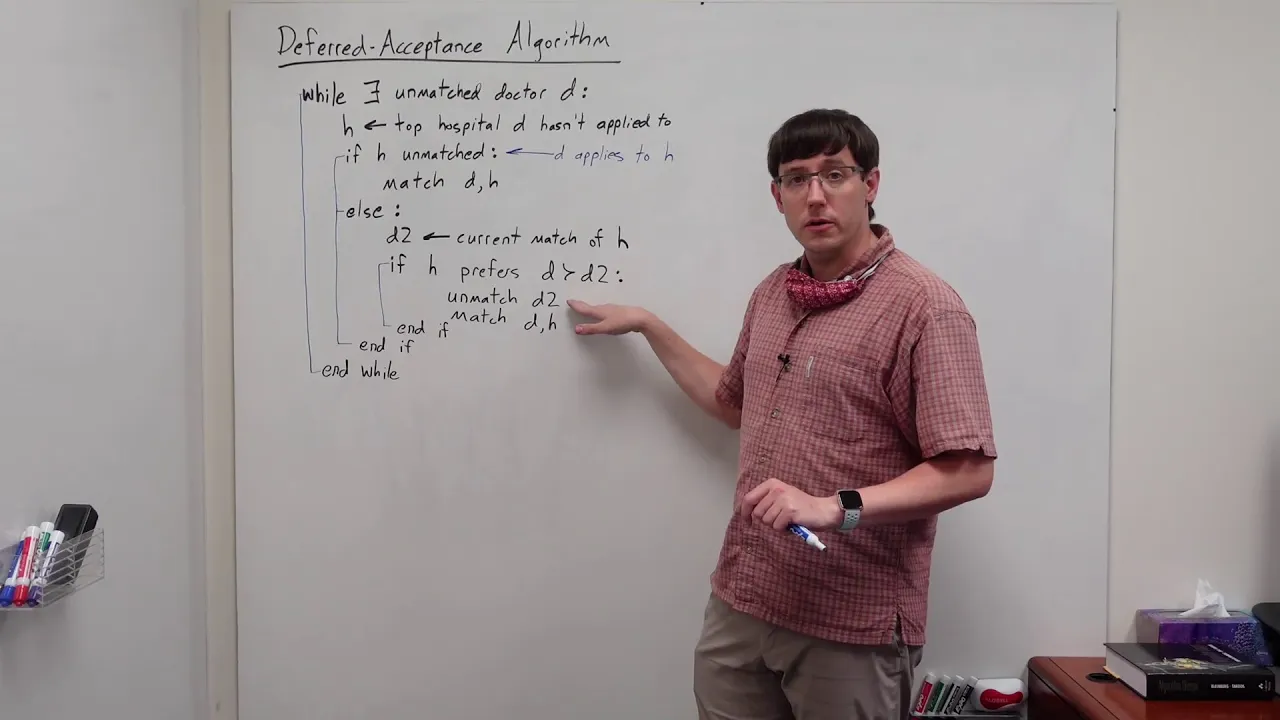
Stable Matching (Algorithms 02)
6.3K
The stable matching problem involves finding a perfect matching between two equal-sized sets (such as doctors and hospitals) where no pair would prefer to deviate from their assigned matches; the deferred acceptance algorithm solves this by having unmatched doctors sequentially apply to their top-choice hospitals, which tentatively accept or reject based on preference rankings, with acceptances deferred until the end of the algorithm to ensure stability and guarantee termination within n² iterations.
Click to watch →
Prerequisite Knowledge
- Concept 01Basic Game Theory concepts, such as strategic decision-making, payoffs, and the Nash Equilibrium.
- Concept 02The distinction between traditional price-clearing markets and matching markets where prices cannot be used to allocate resources.
- Concept 03The fundamental concept of market failure, particularly in situations where ethical or legal constraints prevent monetary transactions.
- Concept 04An introductory understanding of stable matching and the Gale-Shapley Deferred Acceptance Algorithm.
Subsequent Learning
- Step 01The Top Trading Cycles (TTC) algorithm and its specific application to multi-hospital kidney exchange chains.
- Step 02Mechanism Design Theory, exploring how to construct rules and incentives to achieve desired social or economic outcomes.
- Step 03The practical application of matching algorithms to public school choice systems and residency matching for medical graduates.
- Step 04The economic concept of 'repugnant markets' and the ethical boundaries of applying market design to human organs, labor, and education.
Nobel Prize
Reaction
Key Questions
Market Focus
Life Impact
Teaching Plan
Stanford Joy
Nobel Prize
0:02Playing Section
- 1
Academy awards Alvin Roth the 2012 Economics Nobel.
- 2
News spreads quickly, filling his home with media.
- 3
He prepares for brief phone interviews.
The Price-Mechanism Critique of Non-Monetary Matching
While Alvin Roth’s matching algorithms design efficient systems within the constraint of 'repugnant transactions' (situations where money cannot legally or ethically change hands), free-market economists, notably Gary Becker, offer a major counterpoint. They argue that non-monetary matching markets are merely 'second-best' solutions. In the case of kidney transplants, critics contend that allowing regulated financial compensation for donors would utilize the price mechanism to entirely eliminate organ shortages. From this perspective, accommodating public repugnance through complex matching algorithms, rather than challenging it with monetary incentives, ultimately restricts the supply of organs and costs lives.
Deep Dive
The Top Trading Cycles (TTC) algorithm and its specific application to multi-hospital kidney exchange chains.
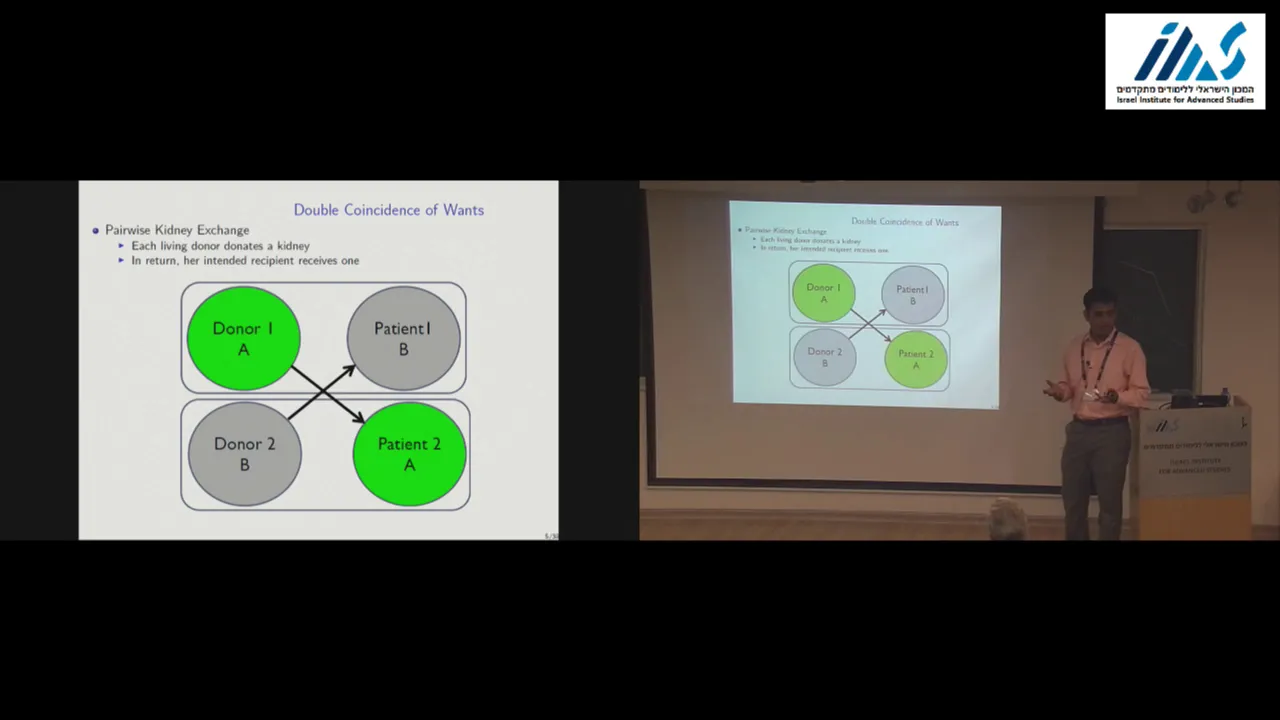
Nikhil Agarwal - The Organization of Organ Markets
454
The top trading cycles mechanism is the backbone algorithm used in modern kidney exchange platforms. It constructs a graph where nodes represent patient-donor pairs and non-directed altruistic donors. An arrow points from one node to another if the donor in the first node is compatible with the patient in the second node. The algorithm identifies cycles (where each participant receives a kidney from someone else in the cycle) and chains (where an altruistic donor starts a chain of transplants). Longer cycles require simultaneous surgeries (typically 6 for a 3-way cycle) because doctors cannot extract a kidney before confirming the recipient can undergo surgery safely. Chains can be longer because they don't require simultaneity.
Click to watch →
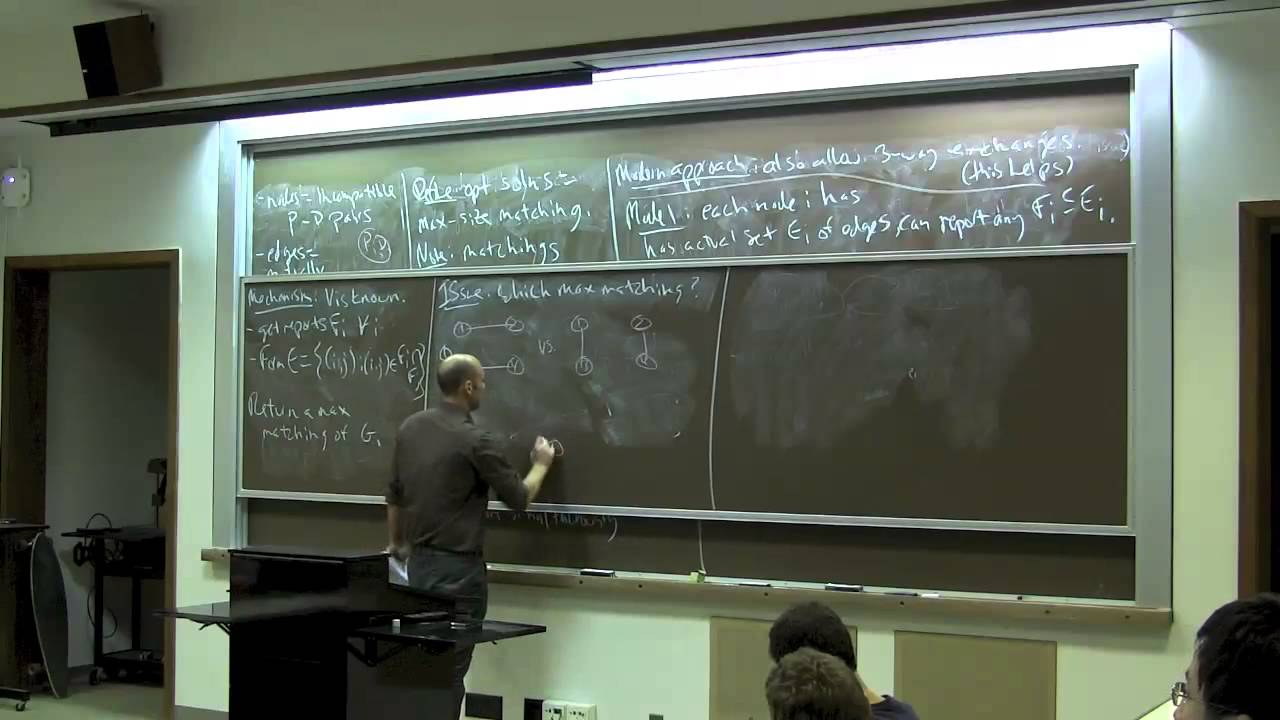
Algorithmic Game Theory (Lecture 10: Kidney Exchange and Stable Matching)
7.4K
The top trading cycle (TTC) algorithm, originally developed for housing allocation problems by Shapley and Scarf in 1974, can be applied to kidney exchange. In this context, each patient-donor pair represents an agent with an initial endowment (their incompatible donor). Agents propose to their most preferred compatible donor, and cycles are identified where everyone can improve. The algorithm ensures that no one ends up worse off than before, with the best case being significantly improved compatibility.
Click to watch →

نظریه بازی ها- دکترسید فرشاد فاطمی 26
530
The TTC algorithm proceeds in stages: identifying active agents, connecting patients to preferred kidneys, identifying cycles and chains, executing exchanges, and repeating. Chain selection rules determine which chains to execute when multiple exist, including selecting the shortest chain (to minimize coordination complexity) or the longest chain (to maximize immediate transplants). The choice of rule affects overall system efficiency and fairness, with trade-offs between immediate transplant maximization and preserving options for future patients.
Click to watch →
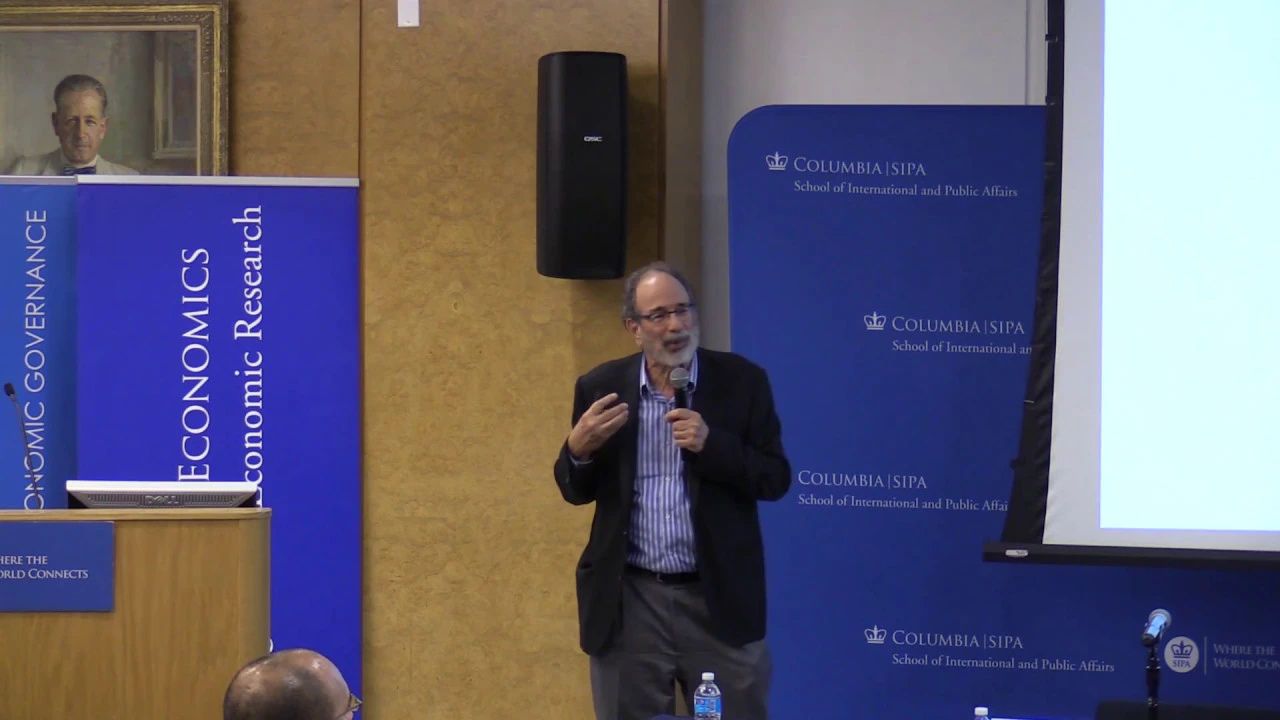
The 11th Annual Kenneth J. Arrow Lecture
804
Kidney exchange solves the problem of incompatible donor-recipient pairs. Healthy people can live with one kidney, so exchanges transform failed transplants into successes. The top trading cycles algorithm (Shapley-Scarf 1974) produces core allocations where no coalition can improve. Simultaneous surgeries prevent exploitation. Non-directed donors enable longer chains. In the US, 10-15% of living donor transplants now use kidney exchange. Expanding internationally increases pool size for highly sensitized patients, though repugnance constraints create opposition viewed as organ trafficking or exploitation.
Click to watch →
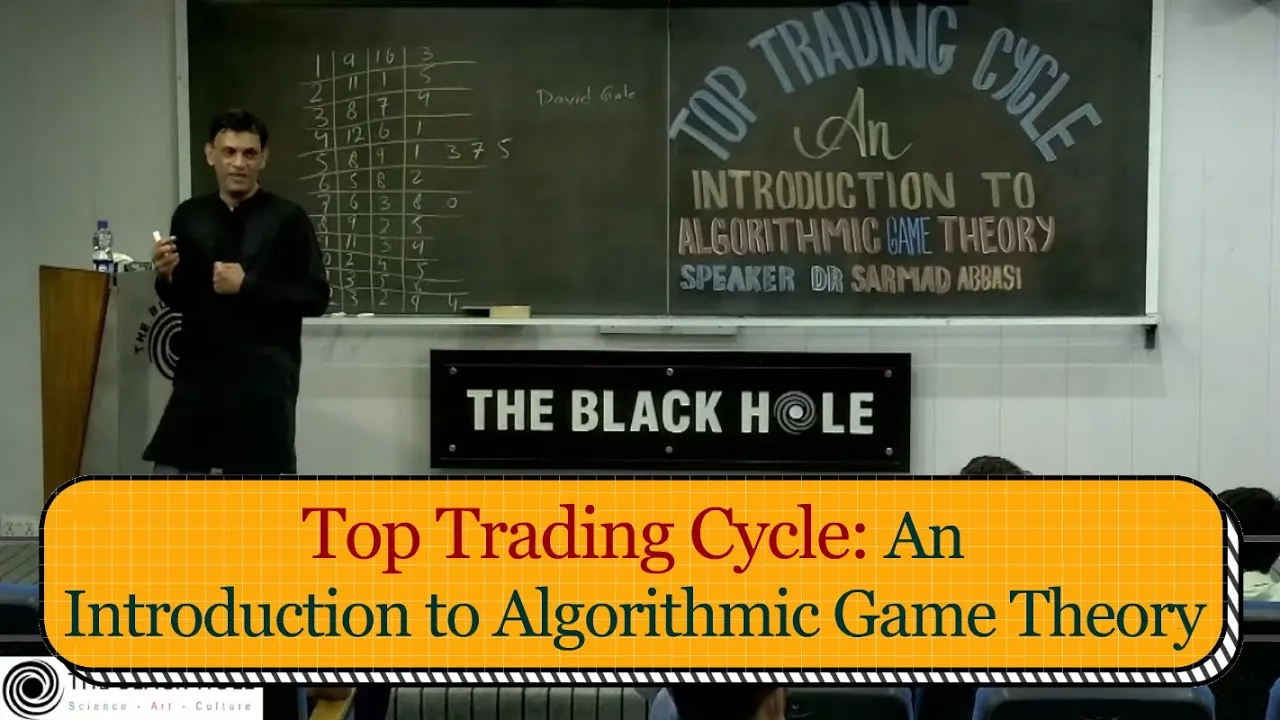
Top Trading Cycle: An Introduction to Algorithmic Game Theory | Dr. Sarmad Abbasi
1.9K
The kidney exchange problem addresses incompatible donor-patient pairs in transplant systems. Patients need kidneys but their donors are incompatible due to blood type or other factors. Each patient has a willing donor (often family members), but direct donation isn't possible. The Top Trading Cycle algorithm solves this by constructing a directed graph where each patient points to their top-choice donor. Since every vertex has exactly one outgoing edge, the graph must contain at least one cycle. This is proven by noting that with finite vertices and always-followable outgoing edges, following any path must eventually repeat a vertex, forming a cycle. Floyd's Cycle Finding Algorithm detects these cycles using two pointers—one moving one step, the other two steps—meeting when they enter the cycle. This constant-memory approach efficiently identifies exchange opportunities for kidney swaps.
Click to watch →
Deep Dive
Mechanism Design Theory, exploring how to construct rules and incentives to achieve desired social or economic outcomes.
Mechanism Design Theory Explained by Eric Maskin (Nobel Laureate)
37.1K
Mechanism design theory is the branch of economics that works backwards from desired outcomes to design institutions or rules that will achieve those outcomes, even when the designer lacks complete information about participants' preferences; a key example is the second-price sealed-bid auction mechanism, where bidders submit sealed bids and the highest bidder wins but pays the second-highest price, ensuring each participant has an incentive to bid their true valuation and thus achieving efficient resource allocation without requiring the designer to know participants' private values in advance.
Click to watch →

Eric Maskin - Mechanism Design: How to Implement Social Goals
600
Mechanism design theory is the engineering part of economics, working in reverse of traditional economics. While most economics predicts outcomes from existing institutions, mechanism design starts with desired goals and asks what institutions can achieve them. The key insight is that designers often lack information about participants' preferences or valuations, so they must create mechanisms that generate necessary information through strategic incentives. This normative approach belongs to welfare economics and addresses how to construct institutions that achieve social objectives despite informational asymmetries and conflicting individual incentives.
Click to watch →

Matemáticas en finanzas (Julio Cesar Rodriguez)
593
Mechanism design is the study of how to structure rules and incentives so that self-interested players will achieve desired outcomes. In the Prisoner's Dilemma, mechanism design could create rules that make cooperation (not confessing) the equilibrium outcome. This field applies to auctions, voting systems, and market design.
Click to watch →

Mechanism Design
9.9K
Mechanism design is a field in economics and game theory that takes an engineering approach to designing economic incentives toward desired objectives in strategic settings, working backward from desired outcomes to create rules that shape human behavior; it applies to markets, auctions, voting procedures, and token economics, where the goal is to align individual incentives with collective outcomes through feedback loops and reputation systems, as demonstrated by platforms like Uber and emerging blockchain-based feedback systems.
Click to watch →
Destruction créatrice et richesse des nations (2) - Philippe Aghion (2020-2021)
167
Mechanism design is a branch of game theory where the designer can choose the game itself, rather than just observing how people play a given game. The designer anticipates how people will play and what equilibrium will result, then chooses institutions (rules of interaction) to achieve desired outcomes. This concept involves the complementarity between the state (which chooses the game) and the participants (who then interact within those rules).
Click to watch →
Deep Dive
The practical application of matching algorithms to public school choice systems and residency matching for medical graduates.

How the NRMP Matching Algorithm Works
17.7K
The NRMP matching algorithm is an applicant-proposing system that matches medical school graduates to residency programs by starting with each applicant's rank order list and attempting to place them at their highest-ranked program that has also ranked them, with matches being tentative until the final round; both applicants and programs must rank each other for a match to occur, and the optimal strategy for all participants is to rank all acceptable options in true preference order without penalty for reaching for better opportunities.
Click to watch →

Aula 1 - Liberdade Médica nos EUA 🇺🇸
2.1K
The Match algorithm (National Resident Matching Program) is a Nobel Prize-winning economic system that matches medical graduates with residency positions. Both applicants and programs submit ranked preference lists, and the algorithm processes these lists to find optimal matches. The system prioritizes the applicant's preferences, meaning it searches through the applicant's list to find the highest-ranked program where they can be matched. Once a match is confirmed, the applicant is legally obligated to accept that position.
Click to watch →
Is there a better residency matching algorithm?
7K
A new algorithm called 'Residency Optimizer' using mixed integer linear programming can achieve better matching outcomes than the traditional Roth-Parson deferred acceptance algorithm by minimizing the total sum of ranks for both applicants and programs, but this optimization creates a fatal flaw: it incentivizes strategic gaming where applicants can manipulate their rank order lists to secure better positions, and the resulting matches are unstable because both applicants and programs may prefer different pairings than assigned, making the system unsuitable for real-world implementation despite its theoretical advantages.
Click to watch →

ACOEM Presents – The National Resident Match Program and Occupational and Environmental Medicine
473
The NRMP uses a computerized mathematical algorithm called the matching algorithm, which is applicant-proposing. It begins with a random applicant and attempts to match them to their first choice program. If that cannot be guaranteed, it tries the second choice, and so on. Matches are considered tentative because an applicant matched to a program may be removed later to make space for a higher-ranked applicant. The algorithm continues until all applicants are matched or all choices are exhausted. The algorithm will never penalize applicants for ranking reach programs, but if applicants rank programs lower than their true preference, they may never get to find out if those reach programs would have been a match.
Click to watch →

Introduction to the 2026 Main Residency Match for Medical Schools
582
The NRMP matching algorithm is applicant-proposing: applicants propose to their top-ranked program, and tentative matches occur when programs accept or prefer over current matches. This continues until all parties are optimally matched. Match Week (March 16-20) includes SOAP for unfilled positions offered to unmatched/partially matched applicants. Partially matched applicants have secured one position type but not another. The NRMP provides extensive resources: data reports on student participation, registration status, and outcomes; the Charting Outcomes Medical School Report; webinars; user guides; checklists; FAQs; and support videos. The Match Participation Agreement contains binding rules governing participation, with different versions for programs, applicants, and institutions. The R3 system includes support guides accessible both within the system and on the NRMP website.
Click to watch →
Deep Dive
The economic concept of 'repugnant markets' and the ethical boundaries of applying market design to human organs, labor, and education.
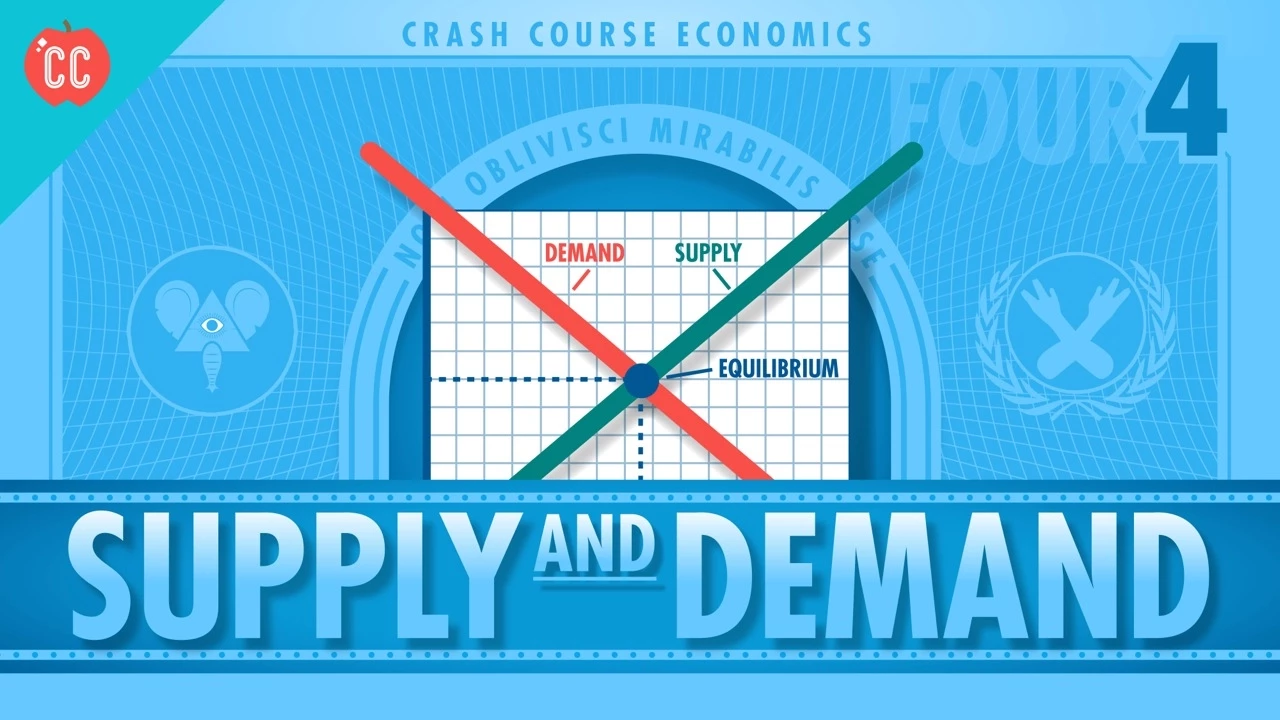
What Is Supply and Demand? | Economics Explained
4.8M
Markets are not always appropriate solutions. In the case of human organs, an unregulated market would create ethical problems: poor people might die while rich people live, and higher prices could incentivize theft and human trafficking. The World Health Organization notes that payment for organs takes unfair advantage of vulnerable groups and undermines altruistic donations. However, economists support regulated approaches like kidney exchanges that match willing donors with strangers to increase supply without creating black markets.
Click to watch →

Auberon Herbert, Capitalism, Self-Sacrificing Businessmen, Capitalism, and More!
109
The video discusses arguments for allowing markets in human organs (like kidneys). Proponents argue it's an individual rights issue where people should be able to do what they want with their own bodies. Arguments include: benefiting the poor by giving them additional opportunity to make money, reducing black markets, lowering overall costs through increased market supply, and addressing the scarcity caused by not allowing people to commodify their resources. The current lottery system that keeps people waiting for organs for months is argued to be more despicable than the ugliness of a repugnant economy.
Click to watch →
Repugnant Markets | Sandra Klein
184
Repugnance toward certain markets (such as organ trading or dwarf tossing) is merely a subjective preference already factored into participants' decisions, not a market failure requiring intervention; the 1984 ban on organ sales functions as a price ceiling at zero, creating shortages that cost lives, and allowing markets to operate would allocate scarce resources more efficiently through price mechanisms.
Click to watch →

Who Gets What and Why: The New Economics of Matchmaking and Market Design
238
Repugnant transactions are those some want to engage in but others believe shouldn't—examples include kidney sales, surrogacy, and prostitution. What's repugnant varies culturally: surrogacy is illegal in Germany but legal in California; prostitution is legal in Nevada but illegal in most U.S. states. Market designers must consider not just how to organize existing markets but which markets society should allow. Implementation faces political challenges—hospitals have financial incentives to keep transplants local, and referring patients for transplantation takes time away from dialysis revenue. Success requires convincing stakeholders they'll do better as everyone else does better. The kidney exchange story shows that victories in increasing transplant numbers are part of a larger war being lost against the growing waiting list.
Click to watch →

Limits to markets
313
Markets do not exist for certain goods due to ethical and social considerations. Repugnant markets violate ethical norms or undermine human dignity, such as markets for human organs, children, votes, or sex. While competitive markets can be efficient, many believe certain things should not be bought or sold. Merit goods are goods that should be available to everyone regardless of ability to pay, including K-12 schooling, healthcare, and police protection. These are typically provided by governments rather than markets. The allocation of goods involves trade-offs between markets, firms, families, and governments, with competition determining the balance between these mechanisms.
Click to watch →
Nobel Prize
Reaction
Key Questions
Market Focus
Life Impact
Teaching Plan
Stanford Joy
Nobel Prize
0:02- 1
Academy awards Alvin Roth the 2012 Economics Nobel.
- 2
News spreads quickly, filling his home with media.
- 3
He prepares for brief phone interviews.
The Price-Mechanism Critique of Non-Monetary Matching
While Alvin Roth’s matching algorithms design efficient systems within the constraint of 'repugnant transactions' (situations where money cannot legally or ethically change hands), free-market economists, notably Gary Becker, offer a major counterpoint. They argue that non-monetary matching markets are merely 'second-best' solutions. In the case of kidney transplants, critics contend that allowing regulated financial compensation for donors would utilize the price mechanism to entirely eliminate organ shortages. From this perspective, accommodating public repugnance through complex matching algorithms, rather than challenging it with monetary incentives, ultimately restricts the supply of organs and costs lives.
Basic Game Theory concepts, such as strategic decision-making, payoffs, and the Nash Equilibrium.
The distinction between traditional price-clearing markets and matching markets where prices cannot be used to allocate resources.
The fundamental concept of market failure, particularly in situations where ethical or legal constraints prevent monetary transactions.
An introductory understanding of stable matching and the Gale-Shapley Deferred Acceptance Algorithm.
The Top Trading Cycles (TTC) algorithm and its specific application to multi-hospital kidney exchange chains.
Mechanism Design Theory, exploring how to construct rules and incentives to achieve desired social or economic outcomes.
The practical application of matching algorithms to public school choice systems and residency matching for medical graduates.
The economic concept of 'repugnant markets' and the ethical boundaries of applying market design to human organs, labor, and education.
25.3K views215likes2:15@stanfordOriginal Release: 2012-10-15
Stanford University. The Royal Swedish Academy of Sciences has decided to award the Sveriges Riksbank Prize in Economic Sciences in memory of Alfred Nobel, 2012, to Professor Alvin Roth.
As soon as their news conference started, I started to get emails from friends, from news services. My dining room is full of cameramen and photographers so I won't stay on the phone long.
[laugh] Going to be a good life.. [laugh] I'm learning to give brief radio interviews on the telephone. The answers to those questions are complicated but the questions are important.
I have to admit that none of us really understood what the what the award was for. So, if I could ask you to explain.
My colleagues and I study matching markets. And, unlike financial markets, matching markets are markets where the price isn't the only thing that decides who gets what. Economists have spent lots of time studying markets that don't involve matching.
Where the price decides who gets what. But, In many markets, you know, college admissions, getting a job, getting married, getting an organ, you can't just choose when you want, you also have to be chosen and those are the markets that we study.
Congratulations. They mark some of the most important passages of your life. I mean, where you go to school, what job you get, who you marry you can, you know, hardly have more important things than that. I'll be teaching my class in market design at Standford later today. Starting the celebration here in the Standford Economics Department.. Al, congratulations. Hey, guys.
Congratulations. I'm delighted to be at Stanford, we've just arrived here.
Part of the fun of Stanford is that a number of my PhD students from Harvard are my colleagues here. That is very gratifying I'm very happy to be here. Thank you for coming.
. For more, please visit us at stanford.edu
Up Next
59:15
Nobel Laureate Al Roth on Market Design & Kidney Exchange
@stanfordgsb
57.7K views•2013-05-13

5:07
Impact of Yuan in Indo-Russian Trade Amid Sanctions
@WION
261.9K views•2022-07-01

35:37
US National Debt Sustainability | Mohamed El-Erian Analysis
@stanfordgsb
41.2K views•2024-09-19

113:18
The Age of Easy Money: Fed & Inflation | Full Documentary
@frontline
21.2M views•2023-03-15
Related Study Plans & Knowledge Roadmaps
Structured learning paths in Economics
economics
Sovereign Debt: Defaults, IMF & Restructuring
01Introduction to Sovereign Debt & Government Bonds
02Debt Sustainability & Credit Ratings
03Anatomy and History of Debt Crises
+ 2 more learning modules
12h5 modules
Explore Roadmap
economics
Market Design: Matching Theory & Gale-Shapley
01Introduction to Market Design and Price-Free Markets
02Two-Sided Matching & The Gale-Shapley Algorithm
03School Choice Systems and Mechanism Design
+ 2 more learning modules
10h5 modules
Explore Roadmap
economics
Impossible Trinity: Forex, Capital & Policy
01Introduction to Monetary Policy and Central Banking
02Exchange Rates and International Capital Flows
03The Mundell-Fleming Model
+ 2 more learning modules
8h5 modules
Explore Roadmap
economics
Healthcare Economics: Market Failures & Systems
01Introduction to Healthcare Markets and Market Failure
02Asymmetric Information and Adverse Selection
03Moral Hazard and Insurance Design
+ 2 more learning modules
12h5 modules
Explore Roadmap