
















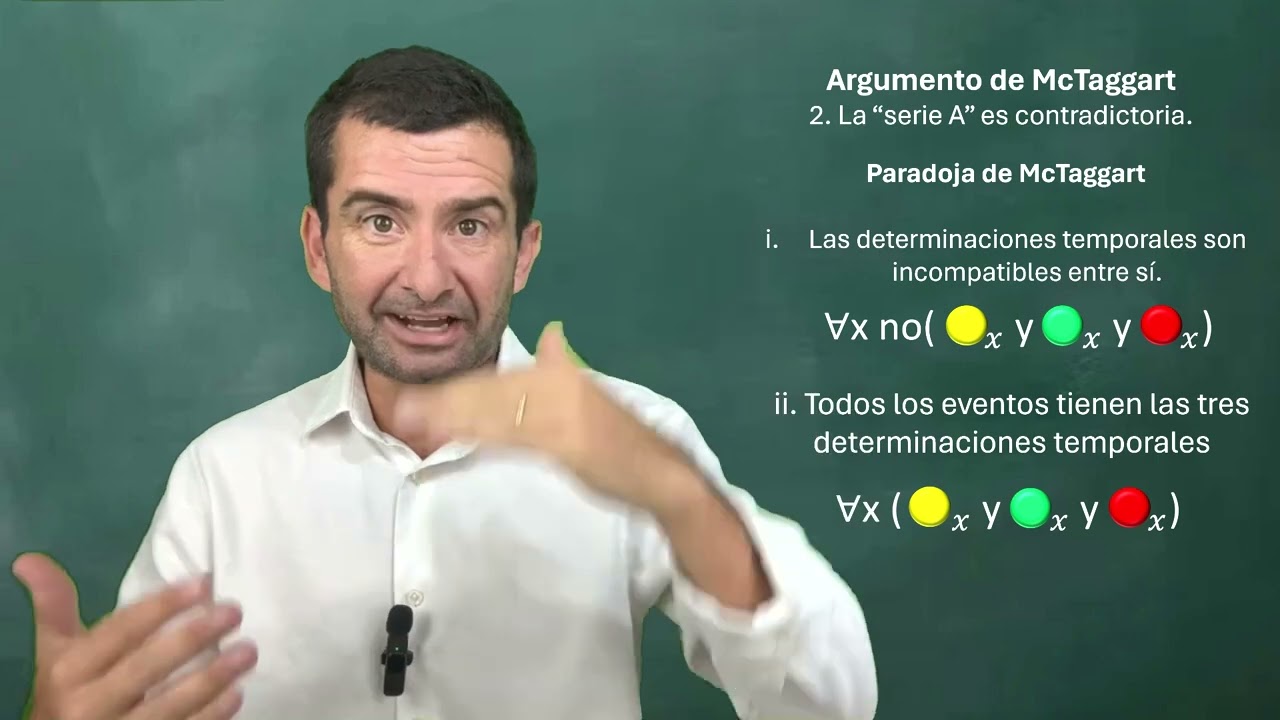







John McTaggart argued that time is not real because examining our concept of time reveals a contradiction; he proposed two competing theories of time: the A-theory (tense theory) which holds that events are objectively ordered into past, present, and future with events constantly changing their position in this series, and the B-theory (eternalism) which holds that time consists merely in events being earlier, later, or simultaneous with one another in a static series where no event ever changes its position.
McTaggart's A-Theory & B-Theory of Time Explained
Added:The basic philosophical distinction between ontology (the study of existence) and epistemology (the study of knowledge) as applied to temporal concepts.
The concept of 'change' in metaphysics, specifically how physical objects or events transition from one state to another.
An introductory understanding of philosophical paradoxes (like Zeno's Paradoxes) that challenge our intuitive, common-sense perceptions of reality.
The difference between subjective temporal experience (the psychological passage of time) and objective physical measurement (clock time).
The major modern ontological positions on time: Presentism (only the present exists), Eternalism (past, present, and future all exist), and the Growing Block Universe.
The intersection of philosophy of time and modern physics, particularly how Einstein's Theory of Special Relativity supports the B-theory (block universe) by rejecting absolute simultaneity.
A deep dive into J.M.E. McTaggart's seminal 1908 paper, 'The Unreality of Time', and the major historical counterarguments raised against his paradox.
The thermodynamic arrow of time and how physical entropy provides a direction to time, bridging the gap between physics and metaphysical B-theory.
Tensed vs. Tenseless theories of language, exploring how the grammar of our language shapes our metaphysical assumptions about the past, present, and future.
13.8K views327likes9:41Original Release: 2015-05-14
[Music] ah the metaphysics of time it's one of those areas of analytic philosophy where you still find argumentative serious defenses of views that we would otherwise describe as completely Bonkers you have people arguing that ordinary objects like tables and chairs are actually four-dimensional space time worms and that they're stretched out over time and the way that they're stretched out over space so that every time you interact with an ordinary object really you're just interacting with a minuscule piece of some gigantic SpaceTime worm you have people arguing that now is the only moment that's real and that the past and the future are merely an illusion you have people arguing that according to the laws of logic every single event that ever will happen is already faded to happen you have people arguing that past present and future aren't real things and others unsurprisingly this whole area of philosophy had its Beginnings with a defense of a view that we would ordinarily describe as Bonkers too namely The View that time isn't even real it All Began in the early 20th century with a redundantly named haunted photograph model John mctaggert Ellis mctaggert a metaphysician at Trinity colle at Cambridge who defended the idealist philosophy of Hegel and in 1908 wrote his own Treatise on the nature of existence called the nature of existence it's a couple thousand pages and very complicated but basically in it mctaggert argues that the only things that are ultimately real are Immortal Souls and the relationships of love in between them yes it turns out that mcard was kind of a hippie if you're actually curious about this philosophy you don't have to read all 2,000 pages of the nature of existence instead you can check out the book truth love and immortality by Peter gich which is a clear contemporary representation of what mcgard's philosophy would really amount to in light of present scholarly philosophical questions now mcer thought that our concept of time didn't make any sense at all and that when you examined it closely you'd realize that it involved a contradiction but he thought if you're going to try to make sense of the notion of time and defend it as a real objective feature of our world there are two approaches to doing so both approaches agree on one thing namely that whatever time is time is some kind of order more specifically it's an ordering of events or an ordering of states of Affairs All realists About Time agree that time is some kind of ordering what they disagree over is what that order consists in the two approaches that mcag lays out are two ways to explain temporal ordering these approaches are still defended and taken seriously by philosophers today the first approach is the a theory of time or the tense theory of time a theorists believe that the nature of time is such that events are ordered into past present and future it's an objective fact according to the a theory that some events in the future have not happened yet but they will happen soon other events are in the present in the objective now and other events still have already been in the now and now they are in the past the aorist believes that the distinction of past present and future is not relative it is not perspectival rather it is an objective fact about the universe that it is made it up until this point and that certain events are now in its past while other events are now in its future the division of events into past present and future constitute a series called the Aeries so according to the a theory the order which time consists in is is the ordering of past present and future the other approach that MC tagert lays out is the B Theory or the deten theory of time according to B theorists time consists in merely this fact that some events are earlier than others some events are later than others and other events are simultaneous with one another and that's it there's no objective now which is moving along the be theorist will admit that some events are pasted relative to other events and other events are future relative to some events but they will not think that there's an objective past and an objective future be theorists tend to think of time as a static line with events all equal laid along various parts of it be theorists believe that the division of events into being earlier later and simultaneous constitute a series called the B series now wait a minute you may find saying yourself why aren't these two theories the very same thing why isn't the a series just the B series why isn't the division of events into past present and future just the same thing as dividing events into being earlier and later than one another well the basic reason why the a series and the B series are not the same thing is that an event can change its position in the a series but no event will ever change its position in the B series so let's take an example consider two events Halloween of 2014 and Halloween of 2200 Halloween of 2014 is in the past now but it wasn't always in the past once Halloween of 2014 was in the present even before it was in the present Halloween of 2014 was in the future it was once the case in other words that Halloween of 2014 14 was a future event way back in 2013 we could have said hey Halloween of 2014's in the future and we would be speaking truthfully so given that an event's position in the a series is just its status of being a past event a present event or a future event we can see that Halloween of 2014 changes its position in the a series it was once future and then it was once present but now it's past the same thing holds for Halloween of 2200 right now Halloween of 2200 is in the future but someday it will be October 31st 2200 and at that point Halloween of 2200 will be in the present once Halloween of 2200 is over furthermore that event will no longer be present instead it will be a literal thing of the past like Halloween of 2014 Halloween of 2200 changes its position in the a series 2o and so it is with every event when we examine events from the perspective of the a theory we see that they are constantly changing their position in the a series going from the future to the present and going from the present to the past this is in fact the way that aorists give literal content to the idea that time flows or passes think about how time feels for a moment it feels like your next birthday is getting closer and closer while your last birthday is getting further and further into the past we say that time flies when we're having fun but that events drag on when we're not having fun we say that it passes that it flows that it steals our years away leaving memories behind and that keeps on into the future when we describe our experience of time in other words it's common to use Dynamic language language that implies something like flow or movement in space this language which is metaphorical of course time can't literally flow or pass I mean think about it if time literally flowed or passed what would be the rate at which it passed 1 second per second yes obviously but that's hardly informative in fact philosophers have been keenly interested in what if anything is the literal content of our temporal idioms like time flows or time passes when we say that time passes what on Earth do we mean the a theorist claims to have an answer when we say that time flows what we literally mean according to the a theorist is that events which are now in the future will soon be present that once they are in the present they will soon be past and that in general events are constantly changing their position in the a series a continuous change which once we notice that events occur in a single sequence is kind of like flow or movement when we look at the a series what we see is that events change their position constantly now let's take a look at those same events Halloween of 2014 and Halloween of 2200 and ask ourselves do these events change their position in the B series when we remember that an event's position in the B series is nothing more than it's being earlier and later than various events we can immediately conclude that no events do not change their position in the B series if you look at the event of Halloween 2014 its position in the B series amounts to this Halloween of 2014 is later than Halloween of 2013 and earlier than Halloween of 2015 and much earlier than Halloween of 2200 Halloween of 2014 was simultaneous with a half moon so what is Halloween 2014's position in the B series its position in the B series is just that it is later than Halloween 2013 simultan anous with a certain Half Moon earlier than both Halloween 2015 and Halloween 2200 and so on its position in the B series is just its being earlier later and simultaneous with various events but look none of those relations ever change if Halloween of 2014 is later than Halloween of 2013 it always was later than Halloween 2013 and always will be later than Halloween of 2013 there was never a point in history nor will there ever be a point in history when somehow Halloween of 2014 is earlier than Halloween of 2013 it just can't happen it's impossible given that those events are positioned where they are in the timeline their positions will never change the event of Halloween 2014 is locked in place on the timeline so that its place on the timeline will never change no matter how much time passes if it's earlier than Halloween 2200 it always was and always will be earlier than Halloween of 2200 and so it is with all events this is nothing special about Halloween if one event is earlier than another event the first event will always be earlier than the second event it will never be the case that that second event is somehow earlier than the first this is true no matter which events we're talking about no single event changes its position on the timeline relative to other events no single event changes its position in the B series the B series is really a static collection of events laid out in a certain order and that order never changes there's no passage there's no movement there's no alteration there's nothing Dynamic if we look at the B series and the B series alone and this is why being in the B series is very different from being in the a series an event in the a series will change its status within the a series going from the future to the present from the present to the past and then receding ever further into the past ever more remote from the present the reason why the a series and the B series are different is that an event will change his position in one but not in the other okay so now that we're clear on that let's turn to MCT Tag's Arguments for the unreality of time which is the topic of our next video
Up Next

14:36
The Metaphysics of Time: Philosophical Theories Explained
@AllSkeptic
167 views•2025-12-07

164:01
John of Damascus on Holy Images: A Theological Defense
@BannedBooks
139 views•2026-04-25

68:32
Should We Destroy the Machines? Big Tech Surveillance Critique
@TheStoriesWeTell303
167.9K views•2025-11-30
4:57
The Myth of Sisyphus: A Greek Legend of Eternal Punishment
@TEDEd
8.6M views•2018-11-13
Related Study Plans & Knowledge Roadmaps
Structured learning paths in Philosophy
philosophy
Frankfurt School: Critical Theory & Culture
01Foundations of the Frankfurt School and Critical Theory
02Horkheimer & Adorno: The Critique of Instrumental Reason
03The Culture Industry and Mass Deception
+ 2 more learning modules
12h5 modules
Explore Roadmap
philosophy
Philosophy of Language: From Frege to Austin
01The Linguistic Turn: An Introduction to Language in Philosophy
02Gottlob Frege: Sense and Reference
03Early Wittgenstein: The Picture Theory of Meaning
+ 3 more learning modules
15h6 modules
Explore Roadmap
philosophy
Feminist Epistemology: Standpoint & Injustice
01Introduction to Epistemology and Feminist Critiques
02Sandra Harding and Standpoint Theory
03Donna Haraway and Situated Knowledges
+ 2 more learning modules
12h5 modules
Explore Roadmap
philosophy
Environmental Philosophy: Ethics & Deep Ecology
01Foundations of Environmental Ethics & Anthropocentrism
02Biocentric Individualism and Animal Liberation
03Ecocentric Holism and Deep Ecology
+ 1 more learning modules
10h4 modules
Explore Roadmap