















![71 - TEORÍA CUÁNTICA de CAMPOS [ KLEIN-GORDON - Coordenadas Curvilíneas ]](https://i.ytimg.com/vi/Yspmxhq1w6Q/maxresdefault.jpg)
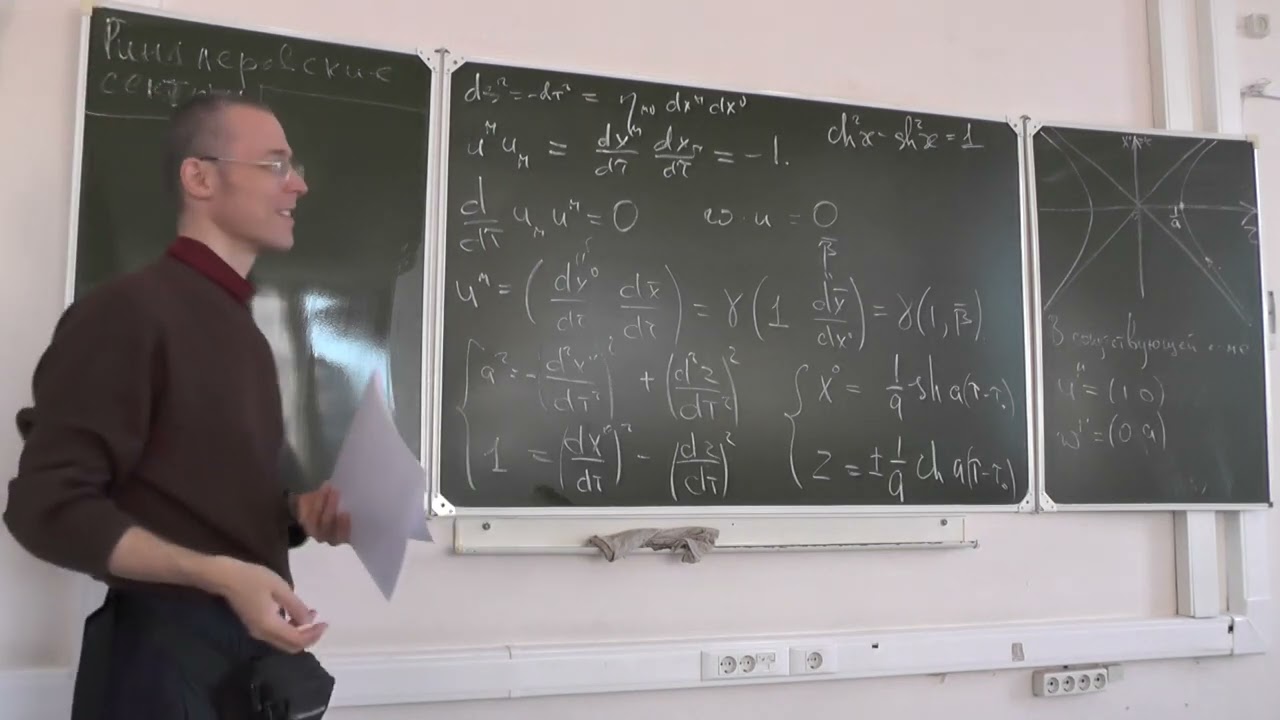
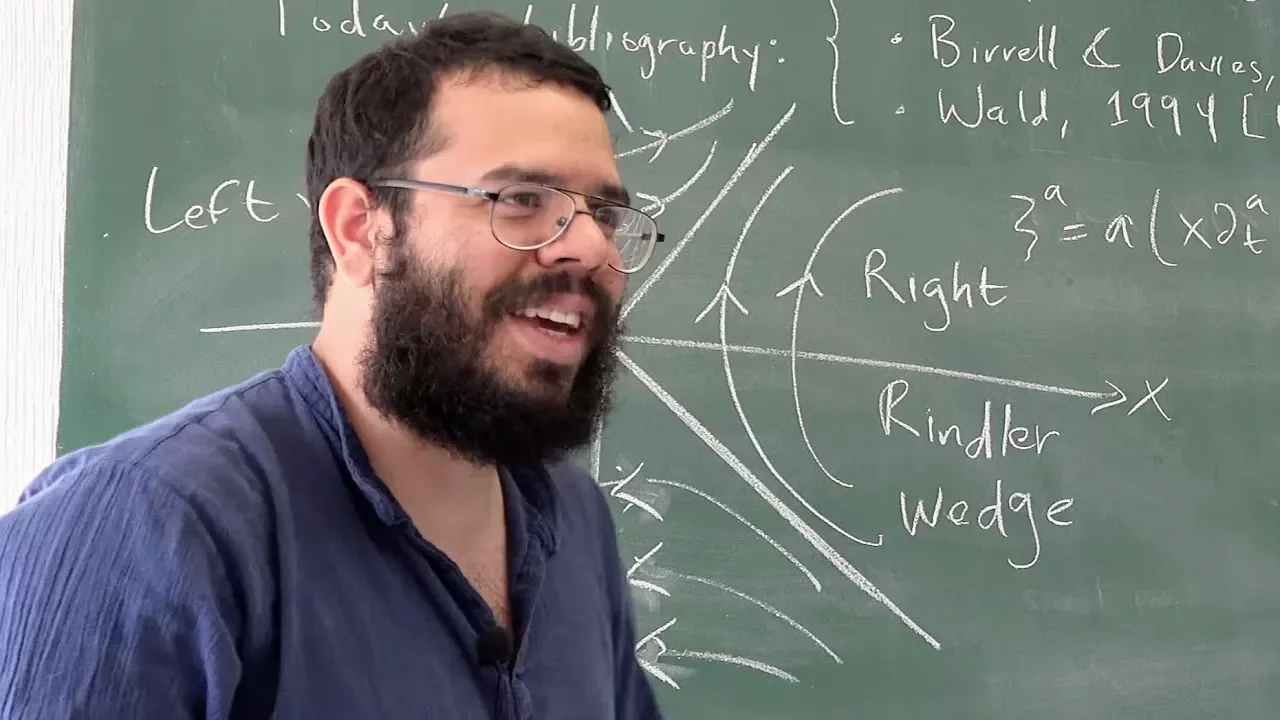
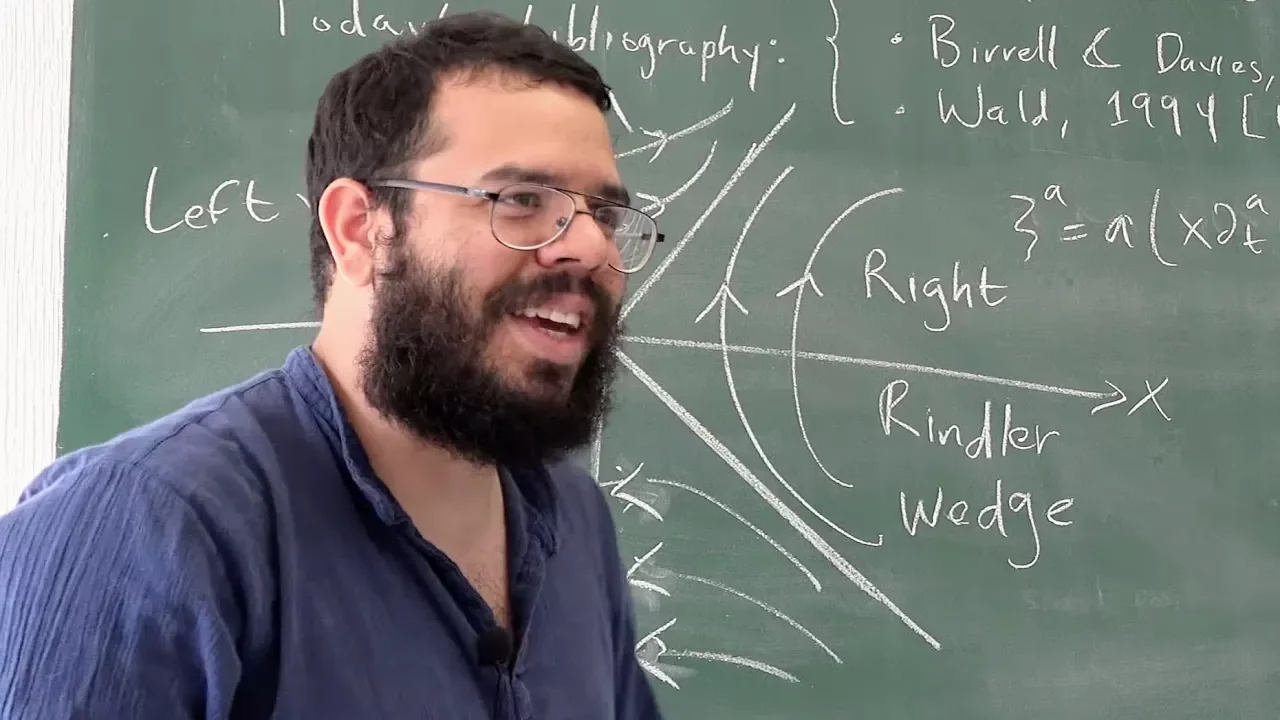
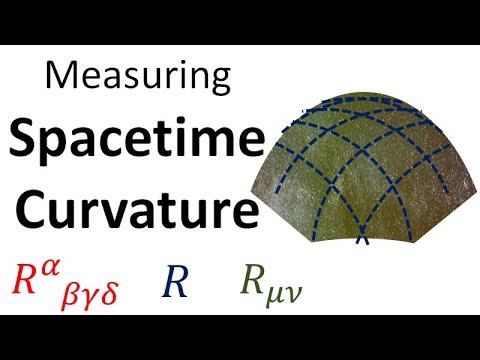
The Riemann curvature tensor can be calculated using the formula R^a_{bcd} = ∂_c Γ^a_{bd} - ∂_d Γ^a_{bc} + Γ^a_{ce} Γ^e_{bd} - Γ^a_{de} Γ^e_{bc}, where Γ are the Christoffel symbols. For a 2-sphere with metric ds² = dθ² + sin²θ dφ², the only independent component is R^1_{212} = sin²θ, and the Ricci scalar is R = 2, which is constant everywhere due to the sphere's high symmetry. For Rindler coordinates in flat spacetime (ds² = -a²x²dt² + dx² + dy² + dz²), the Riemann tensor vanishes as expected for flat space, demonstrating that coordinate transformations do not change intrinsic curvature.
Riemann Tensor: Newtonian Limit, 2-Sphere, Accelerating Coordinates
Added:Familiarity with tensor calculus, including covariant derivatives, index notation, and the Einstein summation convention.
Understanding of the metric tensor and how it defines the geometry of a coordinate system or spacetime manifold.
Basic knowledge of the geodesic equation and how it describes paths of extremum length in curved spaces.
Fundamental concepts of Newtonian gravity, particularly the gravitational potential and its relation to classical equations of motion.
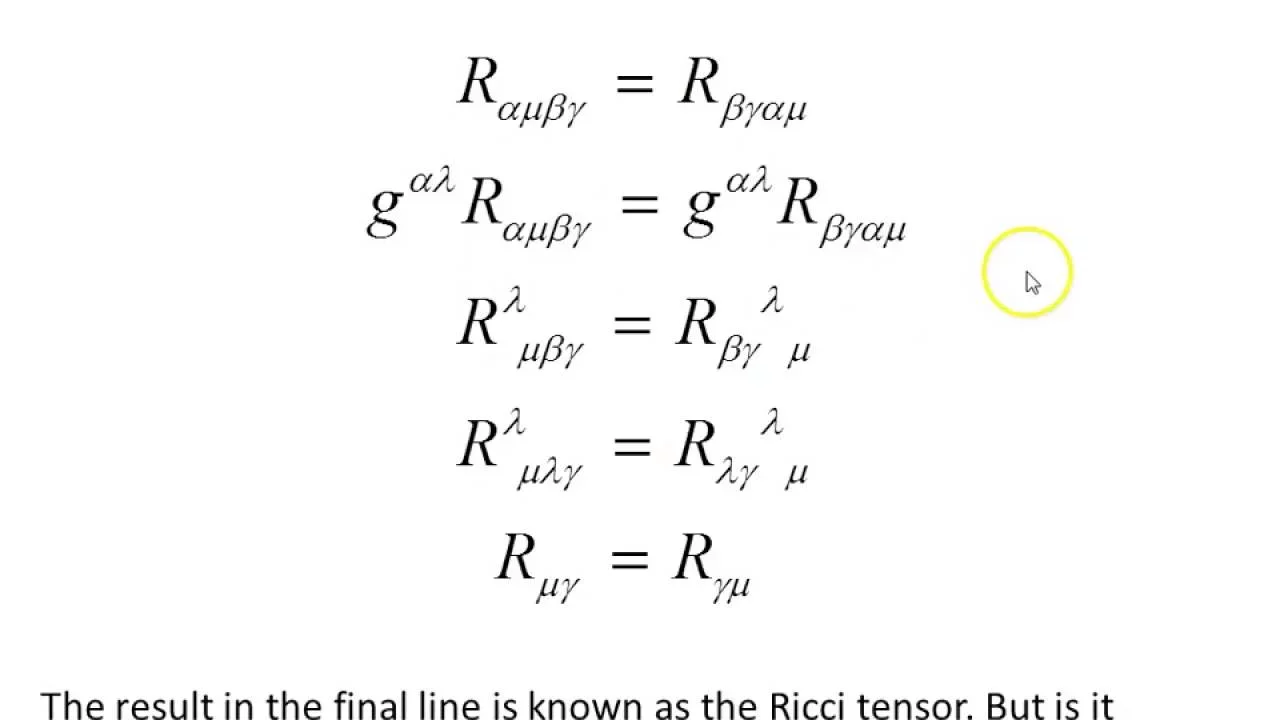
Derivation of the Einstein Field Equations by contracting the Riemann curvature tensor to obtain the Ricci tensor and Ricci scalar.
Analysis of geodesic deviation to physically interpret the Riemann tensor as the mathematical representation of tidal gravitational forces.
Application of these curvature calculations to the Schwarzschild metric to study the spacetime geometry around spherical, non-rotating black holes.
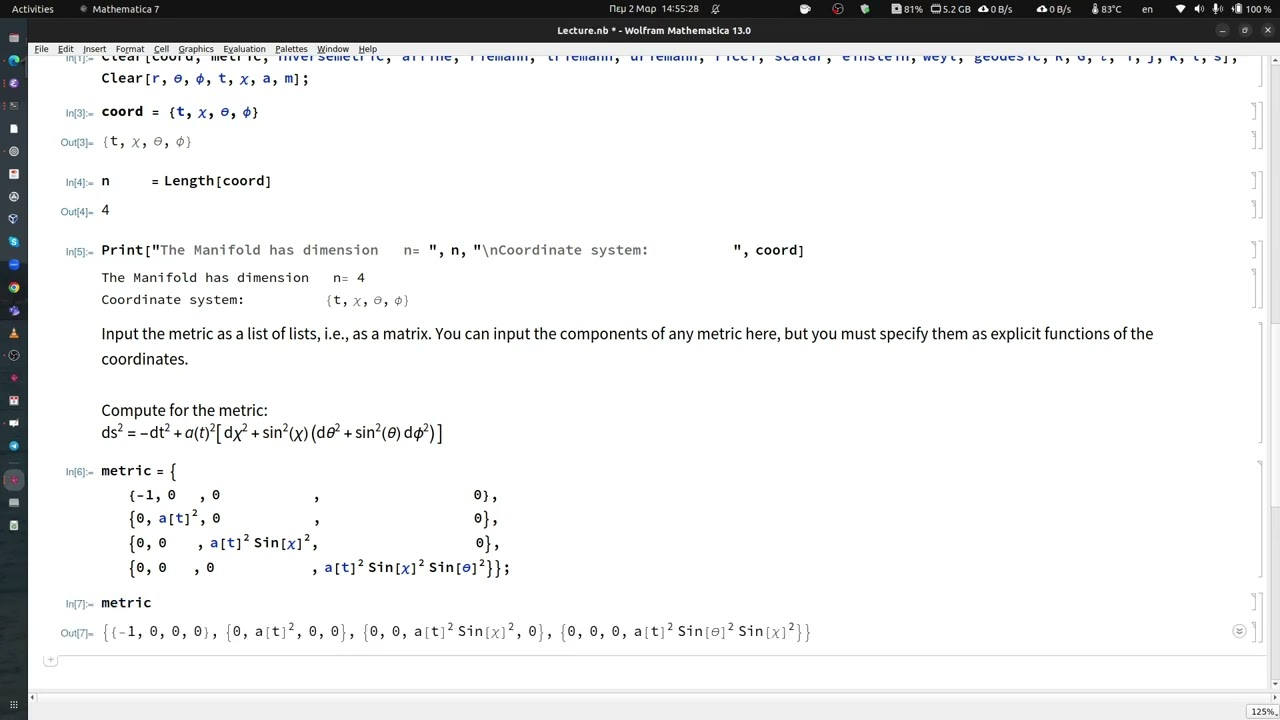
Investigation of quantum field theory in curved spacetime, specifically exploring the Unruh effect as experienced by accelerating observers in Rindler spacetime.
180 views7likes1:02:48Original Release: 2024-05-07
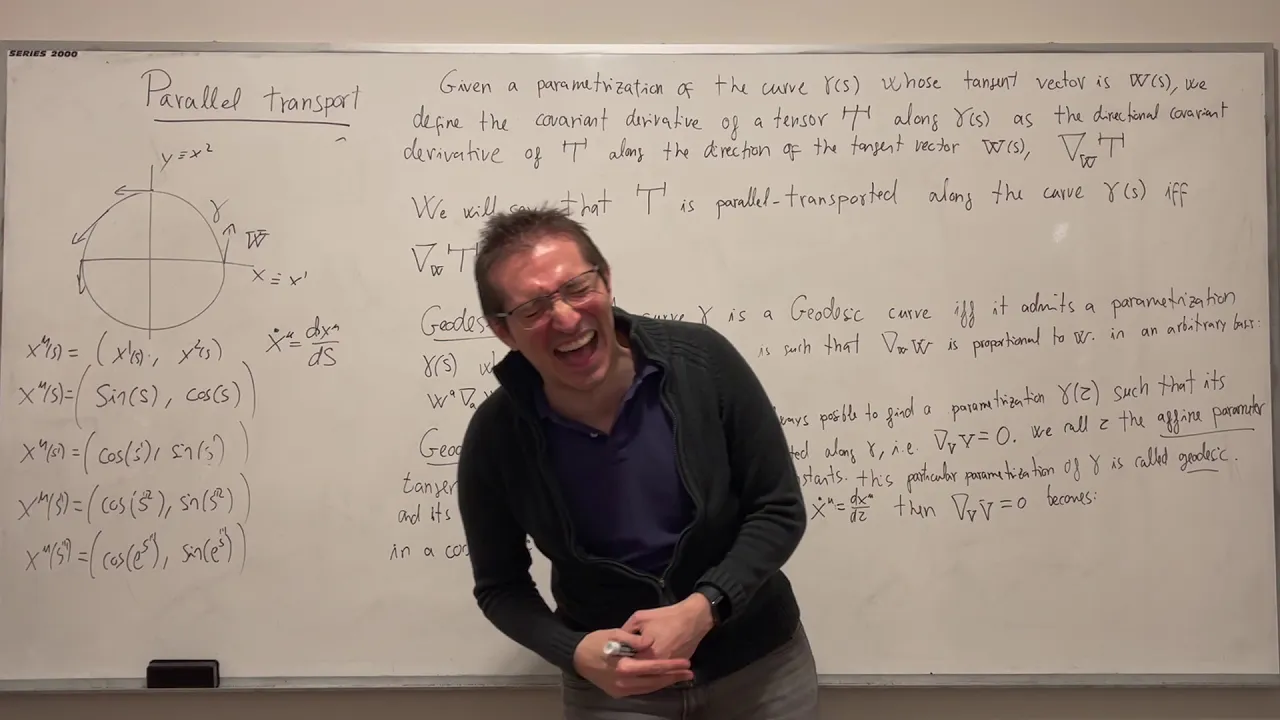
[Music] hello everyone it's already 9: so we can begin the lecture um today we will have only one hour of lecture unfortunately I'm I've got some private business to do later but we will make up for this last hour I I can promise that we should have enough time for that okay uh last time we were discussing the reman curvature tensor and its applications uh and we also had a board lecture which involved the Christopher symbols uh yeah and this is what we will begin with today I I I would like to I would like us to go back to the board lecture and there is a couple of things we need to do uh I want too the example where we were calculating the Christopher symbols of the metric in Newtonian per ation theory in newon approximation and then we will do two examples of calculating the remon tensor of a given metric tensor so I will share the screen right now so we will do the Newtonian approximation I'm not entirely happy with the way we have done it last time and this calculating the christopal symbols of a given metric is one of most important skills you should develop during this lecture so I would like to do this example again in slow motion so that everybody could follow exactly how we proceed because there is some subtle steps there so if you remember the metric took the form of minus dt^ 2 uh for people who have just uh logged in and joined us uh we'll have only a one hour lecture today without a break uh this depends only on XI Plus let's say dx^ 2 + D y^ 2+ d z^ 2 1 - 25 of x i and we will assume that five is a very small number and also that its derivatives are very small so we can neglect all quadratic terms um we can also write this part of the metric as Delta i j DX I DX so if you remember I have shown you the lran method B of determining the christopal symbols basically write down the lran for AIC which amounts to writing one2 and then replacing all the X's by appropriate uh derivatives with respect to the parameter with a minus here sorry plus 1 - 25 Delta i j x do I X do J uh and now this is a Lal which is a function of the three positions TX y z and their derivatives TX dot T dox do y do Z dot we calculate the oiler lrange [Music] equations so we take the full derivative with respect to Lambda Lambda is the parameter so X Y ZT are all functions of Lambda we take formally the derivatives with respect to each of the derivatives of each component minus the L over thex mu and this should be zero yeah so after appropriate differentiation I will not repeat this part you can show that the resulting equations take the following form it's 2 plus 2 Fe let's say a / over 1 - 25 x do K T dot equal to zero so X I remember it's just a different notation for x y z and the second equation let me write it below x k double dot minus 2 m 1 - 25 x do m x do n no x. k sorry plus Pi K 1 - 2 5 and here we obtain T do^ 2 plus let's say Delta PQ x. p x doq this is also equal to zero and that's the oiler lrange equations and now the trick is to read all the coefficients of all the christopal symbols from what we have here so this is supposed to be a the form xou do mu plus gamma Mu Alpha Beta X do alpha x do beta equals to zero okay the first equation is relatively easy um so we write the answer on the second layer here so we've got gamma not uh so it seems that there is only one type of coefficients which does not vanish and this is basically uh gamma not not K where K runs from 1 to three it numbers the special components uh an important Point here again is to notice that uh this guy uh there's this two coefficient here but it's simply responds to the fact that the summation over here involves 0k and k0 x do0 x.k x.k x do0 both of which are identical so for different values of indices here we've got a double summation and hence the two so for a single Christoper symbol which is what we are more interested in gamma z0 K which is the same as gamma 0 k0 that's uh a single 5 K 1 - 2 pi and all other vanish so let's write them explicitly gamma 0 0 is equal to0 gamma 0 k l is equal to zero um and now this equation which is a little bit harder because it contains more terms uh and what I will do now is that I will simply rewrite this equation a little little bit uh just to make it a little simpler to work with so uh so the index indices here have been risen and L by Delta i j which is which is basically a flat metrix so I can easily write that this is the same as the X do K minus and now I will do a bit trick a small trick with this term here so there's there Remains the option of Simply calculating all possible types of christopal symbols uh Gamma 1 2 3 Gamma 1 13 and so on separately uh but there is also a a faster way and somewhat more elegant I will show you right now and we can write it as x.l Delta K let's write this way uh yeah and then we've got plus I L Delta k l over 1 - 25 t squ [Music] plus r l so I have risen this in this lower index K to an upper one and then renamed the index K into L here just to just to be able to use K as an uh Unum index that's the whole trick here uh it will also help me a little bit with reading of the results and here I'm left with Delta PQ x.p x.q and this is zero so now let's read of the coefficients and in fact we can do it so in principle we could do it by first considering uh the situation where all three indices the K and I are different and then calculating this expression over here in this this case uh then when two two of them are the same and calculating them again so that would be option number one option one [Music] calculate set Power bre to gamma let's say one one one gamma 222 as I explained before since the special components are in are completely equivalent in this formulation it's enough to read one of them and then just substitute the index one for two and three then Gamma 1 one 2 and Associate gamma 22 1 gamma 2 2 3 Etc then Gamma 1 2 2 gamma uh 1 33 Etc and finally Gamma 1 2 3 equivalent to Gamma 1 2 gamma 2 1 3 Etc so we could in principle calculate them separately and that's fine but we can also do a little better and a little faster if we do the following so let's have a look at this first term over here [Music] I'll change the color let's say this one um we can write it in the following way this is minus 2 i m Delta k l over 1 - 2 pi x m x.l but note that this is completely symmetric with respect to the two indices and because of that we can symmetrize these indices over here but once we do it we very quickly realize that this is simply a part of the contribution to the uh to the gamma coefficient over here right because gamma is by definition symmetric something symmetric multiplied by products x. alpha x do beta so this over here is simply the contribution to K ml uh component of the uh Christoper symbols and so let's me write down this contribution this is - 2 pi I Delta K KJ recall that this is the symmetrization symbol so a k l is just a 12 a k l plus 12 a l k and this is divided by 1 1 minus 25 but that's not the end of the story because we've got more terms to go this ter over here if you think of that it contains only the z0 part so contributes only so let's go back here [Music] this is a separate method of calculation we are not following here uh so we should do it on different place gamma k0 0 contains uh the term i l Delta K l/ 1 - 25 good and then we've got the last term uh again it's explicitly symmetric in PQ so it's simply so it simply contributes to gamma K EQ and in order to understand this contribution in in our language we need to rename the Index P and Q to I and J and that's it so this term contributes to this do this one and it gives us five I write it here I differentiate with respect to L Delta i j Delta k l and this is divided by 1 minus 25 uh and there's also the mixed terms but nothing contributes to them so they're equal to zero and this is equal to gamma K i0 so this way we obtained explicit expressions for each of these uh terms uh separately and the trick was simply to think uh to rewrite all these terms explicitly in terms of the product of x do index one x. index 2 and a symmetrized object over here symmetric or at least or or symmetrized it's not explicitly symmetric and then the components of the symmetric objects translate immediately to the contributions to the appropriate gamma coefficient okay uh in the last step we can neglect the quadratic terms which means simply neglecting two F in the denominator and we can just write that this is uh- 2 I symmetri Delta k j plus 5 L Delta i j Delta KL and and we can perform something similar here and we obtain simplify L Delta k l [Music] okay and also here this is just fine okay uh k z z is already here okay very good any questions to this part okay I don't see any and if this is so uh we can go to the next problem so we will not now uh calculate the curvature tensor for a to sphere a two sphere is just a sphere as you know it in dimension three uh so let me go back uh let me go back to the metric tensor uh so in fact we have already calculated the Christoper symbols on the previous lecture the metric tensor has this form over here if you remember this is the form of the of the metric we have calculated the Christoper symbols this is our coordinate system and we know that Gamma 1 to 2 is minus sin Theta cosine Theta and Gamma 21 2 is equal to Cent Theta and that's the same as gamma 2 2 1 and everything else vanishes and now the task is to calculate the remens or gamma a b c d a runs from one to two Okay so the first question is how many independent comp components do we really have in the REM tensor in dimension two so if you remember the remon tensor is antisymmetric with respect to each of these pairs over here so all we can plug in is just one two and one two or one two two one or one two or 2 one one two or or something like that but because of this antism all of these components are related to each other uh these are the only options we have to obtain a nonzero value of the reman otherwise there will be a repetition of the indices in one of these pairs and the component will be zero and they tend to be and they happen to be related to each other so there's just one independent component we can Rec reconstruct the whole Reon fenor just out of one component let's say R1 1212 It's relatively easy to calculate so we calculate r one 2 one 2 uh since the inverse metric tensor gab is diagonal and with the one one component being one this is the same as R1 212 uh remember recall that we've got an expression for the remon tensor in terms of the first component raised and all three component and three other components uh being low and this is D1 GMA 1 2 2 minus B2 Gamma 1 2 1 and then we've got the products let me write them down explicitly Gamma 1 a 1 gamma a 22 minus GMA 1 a 2 gamma a 2 1 okay is it does it agree with my notes yes okay now the next step is to think which terms of here might contribute because we have relatively few nonvanishing components here just three just three components of the Christoper symbols don't vanish so we have Gamma 1 22 which is non Vanishing and the differentiation was with respect to Theta so this one will not vanish on the other hand we've got the derivative of one to one and this one actually does vanish so this contributes nothing then we've got Gamma 1 a gamma a22 it's a product so let's see if any of these necessary vages this consists of two two different terms Gamma 1 1 1 Gamma 1 22 plus Gamma 1 21 gamma 222 uh Gamma 1 one one certainly vanishes there is no one one one component here and no 222 component so this is zero so this is zero in both cases so that's all zero and then we have the last component over here it consists of one Gamma 1 1 2 * Gamma 1 2 1 Gamma 1 1 2 does it exist here no it's zero but then we've got also Gamma 1 2 2 * gamma 2 2 1 and these two are non Vanishing so out of that what survives is minus Gamma 1 to 2 * GMA 2 to 1 okay let's go to the next Blackboard so we've got just to write the thing Gamma 1 one to2 minus Gamma 1 2 two GMA 2 2 one uh this is the derivative with respect to Theta of let's go back here uh minus sin Theta cosine Theta minus and now we got Gamma 1 [Music] to2 that's again minus sign Co minus sin cosine and that's multiplied by gamma 2 to 1 which is the Cent Okay so first we we obtain we're using the the the product rule for differentiation this is uh minus thetive of s which is cosine time cosine which is cosine s Theta and then we've got- sin Theta timeus sin Theta so there is a plus here and then we get sin Theta cos Theta cot Theta this is taken together since cotan is cosine / s this is cosine squ and now we can reduce minus cosine squ with this cosine squ and we obtain sin s Theta okay so we find out that 1 R 21 2 is sin Square Theta and that's all that is to calculate here uh have you got any questions okay I don't see any so now let's let's move on the next next problem is to calculate the rich tensor and the reg scaler [Music] so if you remember the rich tensor is a symmetric tensor R and B which we obtain if we contract the indices one and three of the reman and then the rich scalar is something we obtain by Contracting the components of the re tensor using the inverse metric so it's obvious we have to start with the rich tensor uh okay let me go to my next yeah there's only three components of the of the r tensor so we can start we can go component by component so we've got R11 which is R C1 C1 which is r 1 one one one but this is obviously zero plus reman 21 21 now that's not zero [Music] uh we can write this one as R [Music] 21 21 G 22 because again the metric is diagonal so raising the index is just multiplying by the appropriate diagonal component which is very convenient uh the 2121 component is the same as the one two one2 component so this is just s^ squ Theta and what is the G upper 22 the inverse metric component that's s to the^ ofus 2 Theta so we can write that this is dividing by S sare Theta so this is one then we've got the mixed [Music] component which is one 1 1 1 2+ R 2 1 2 2 obviously this guy is equal to zero and then this guy over here that's G11 R1 one one2 again we've got a repetition of uh of an index within one of the pairs so this is again zero so there is no mixed components of the r tensor of the re tensor and then finally we've got rich two two component that's reman c 2 C2 that's R1 2 1 2 + R2 2 2 2 that's zero but that one is not zero that's just G1 1 r 1 2 one 2 again in a diagonal metric raising indices is cheap it's just multiplying by the diagonal uh term in the metric uh this thing here is by the way one and then this thing here is sin s so this is sin s Theta yes and that's all that is to to it so r i is just 1 0 0 sin s Theta does this ring a bell this is just the metric so the rich is identical to the metric uh it's not a normal situation this is because sphere is a rather surprising type of surface High symmetric and then in the end we calculate R AB gab which is the scalar and that's just uh R11 E11 + R22 G22 which is 1 plus sin s Theta / sin s Theta PES two so the reg scalar is a constant it's the same at every point and again that's something to be expected a sphere is a very special type of surface in the sense that it's identical in every Point uh meaning if you pick a point over here and over there you can perform a rotation in this threedimensional space and just identify this point with that one and the geometry of the sphere is invariant with respect to rotations so in a sense every point on a sphere is equivalent to any other one this space has a lot of a large group of symmetries if you if you're familiar with mathematical Jon you understand what this means what it simply means is that in simple terms is that when you have two different points you can perform an appropriate rotation of your two dimensional sphere which identifies these two points and because of that the geometry at every point is the same this may seem surprising because when you look at this metric uh it obviously depends on Theta so it seems that there's a the metric is not invariant it depends at least on the Theta variable but in fact the reason why why the metric appears to depend on on the on one of the angles is that the coordinate system uh breaks this this symmetry so let me draw it over here we've got our sphere and the standard spherical coordinate system defines the Theta equal to pi2 which is sort of an equator and then the geometry in this coordinate system at appears a little different depending on your latitude or on the Theta aimal angle simply because the constant Theta curves are circles of different radius so because of that the geometry will appear a bit different when you write it when you write the metric uh as a component in the Theta 5 frame it will appear different depending on Theta but that's just the artifact of the coordinate system uh unfortunately there is no coordinate system which would make the homogeneity of a sphere explicit there is no coordinate system in which the metric is constant it's a sad but deep fact in differential geometry so the sphere itself and geometry is identical everywhere the curvature is constant all across this surface but the coordinate system somehow breaks this symmetry uh and this is not apparent when you look at the metric itself uh have you got any questions to this particular example uh I have one thing in yes so when you say that there is no such coordinate system which defines this kind of sphere is it because that are you talking about the isotropic nature of the sphere where every point is identical to each other so there should be just one um one parameter that Define the whole sphere uh what what I mean is that there's no coordinate system in which the components of the uh metric tensor are constant ah okay okay in that case it would be kind of obvious by inspection that just like a flat plane the uh just think about a plane or the minkovski space you don't have any kind of dependence of the coeff on on on the position on Theta or whatever you call the components and it's kind of obvious that every point is equivalent to every other because every Point sees exactly the same metric this coordinate system there is no coordinate system of this kind on a sphere because that would be ukan coordinate system and this metric has a nonvanishing curvature this is very much related to the problem of [Music] um of mapping a sphere to a plan to a plane and and and trying to produce as adequate projection of the Earth's uh surface to a flat surface as possible it turns out that it's not possible to find a perfect map and this is very much related to the curvature of the Sphere not being equal to two the fenial geometry has a lot to say about uh various types of projections of uh of the uh spherical surface of Earth uh into a plane when you want to construct a global map of the world it turns out that you have to make compromises uh between various between various types of uh various types of compromises regarding what features of uh of the projections you want to retain and the reason why you have to do it has again something to do with the fact that the surface is curved and the remon does not is not equal to two this is a fascinating topic but a bit too far from from what we're are doing right now yeah I just had one last question I guess can ask uh it's on this topic itself so the thing is that when we are uh like when you're saying that this is the sphere so then these are the reduced coordinates right there is no such other coordinates where we can have a lower parameterization than this one right so is this the reduced coordinates for sphere reduced coordinates I don't know know what you mean by reduced coordinates these are in the sense the simplest coordinates for sphere yes the simplest in the sense that uh this is the coordinate system everybody uses for a couple of reasons one of them is that it's relatively easily related to the so so typically we don't think of a sphere as an object in itself we think that it's embedded in an implicit threedimensional space over here and in that case the relation between these Theta and five and the three uh cartisian components is relatively simple uh it's the wellknown relation that x cosine Theta cosine Y is sorry sin Theta cosine sin Theta sin F and Z is cosine Theta so this coordinate system is simple in the sense that this relation is relatively simple on top of that this coordinate system is very well adapted to thinking in terms of uh spherical harmonics so usually we we like to decompose various components various function on a sphere in terms of spherical harmonics and these particular coordinates work very well with that and that sense this is the the most widely used coordinate system on a sphere but there are other coordinate systems you can use uh there are coordinate systems which which come from projections of of a sphere onto a plane this is very much related to the problem of of uh uh of uh drawing an appropriate map of a spherical uh of the spherical surface of Earth but that's a bit of a complicated thing okay thank you okay so that was the first example of calculating the reman tensor uh it was two dimensional because of that it was a relatively simple one now let's go to Dimension four so we will calculate the REM of a flat of this flat space time uh so if you remember uh we showed at some point that it is possible to uh present uh to define a coordinate system on the minkovski space in which the line element takes the following form as the sigma squ that's the uh rers accelerating coordinates uh since since this is just accelerating coordinates in M kovski we are looking at a flat space time in this guys uh it seems that there is some kind of dependence on sorry this was supposed to be this is supposed to be a uh yes uh there's a dependence on one of these components over here uh however we know very well that there's an there's a transformation of these coordinates back to the flat space time so the reman has to be zero we know that there is coordinates here so the has to be zero but it will be a nice exercise just to calculate it and see if this is really true so again uh We Begin by calculating the Christal symbols and we do it let WR here we need to calculate the crystalle symbols again we do it using the lran method the lran takes a fairly simple form uh the derivative with respect to x dot let's begin with Sigma with respect to Sigma dot that's minus a 2 over there is no over two a 2 Sigma dot because this is the only term which depends on Sigma uh we can calculate the derivative with respect to the parameter again we are talking about the parametr curve in which Sigma x y and a depend on Lambda so we will get - A 2 Sigma dble dot - 2 a DOT Sigma dot That's What You Get by differentiating this with respect to Lambda then we can do the x dot here the result is very simple that's equal to X double dot and the same for for y oh and we can also we also notice that the does not depend on Sigma explicit so this is zero and the same goes for X and Y and finally we've got a as a component we got simply a DOT so derivative here is simple that's a double dot but there is an explicit dependence of the Rion on the a coordinate so we get a because we got 2 a which then uh cancels this one half here uh minus a sigma dot s okay so let's begin with this equation over here so we have - a² Sigma do- to a do Sigma s that's this thing over here and we have to subtract this which is zero so we can rewrite this equation as Sigma double dot plus 2 over a squ sorry there's an a here I forgot about this a if we differentiate that we get to a a DOT so there's an a here it's good that I have got my notes over here there's an a here and here we got 2 over 8 a do Sigma do to Z that's the first equation then we go to the second one [Music] so the equations for X are very simple x dot = to0 and Y dot = to0 right X do minus 0 equal to 0 and the same for y and finally we've got the a equation able dot minus this thing here which is plus a Sig s = to 0al to zero and I will write this equation over here the coordinate system is Sigma X Y A so what do we know about the crystalle symbols now so this this gives us the gamma Z components and the only nonvanishing will be gamma 0 3 equals to gamma 03 0 and they they sum up to 2 over a sigma. a dots so each of them separately needs to be uh 1/ a yeah uh here we have components gamma 3 and the only nonvanishing seems to be gamma 3000 and it's equal to a and then Gamma 1 Alpha betaal to gamma to Alpha Beta all of that is zero yes so we have three nonvanishing components gamma 003 gamma 030 and Gamma 3 0 all of them all of other components vanish so not that many non-al gamas yes okay so now now calculate the [Music] reman just to remind you our mu Mu Alpha Beta is D Alpha Gamma beta minus V beta gamma U Alpha plus gamma U Sigma Alpha Gamma Sigma U betus GMA Sigma beta G Sigma okay so let's there's a lot of components of the reman as many as 20 but not that many uh gamma coefficients and also not that many derivatives so in this case it's best to approach this problem instead of writing the component by component and calculating which of them uh what is the value of each of them the best strategy is to First think which of them have any chance of non Vanishing because they contain non Vanishing components of gamma or their derivatives so uh when it comes to derivatives uh the only nonvanishing components of derivatives are uh so GMA 3 0 0 a is X3 so this guy does not vanish uh and also gamma 0 03 3 = to gamma 03 03 this is m 1 a 2 and also these don't finish let me use a bit of color to highlight that this doesn't punish this doesn't punish this doesn't punish this doesn't punish [Music] um okay so a term like this well a term like this never appears so the reman contains the derivatives here and products of gamas uh let's see where we have a CH in which components we have a chance for non Vanishing derivative or combination of derivatives and non Vanishing combination of products uh so we have let's begin with the derivatives so gamma 3 0 03 can it appear in in a reman component uh well it could appear in principle in R uh three um 3 Z and then 03 and this is the only type or in minus R3 030 but that's pretty much the same thing up to a sign so this component and only this component will contain this derivative over here so this component has a chance of non Vanishing because it contains this thing over here uh on top of that we've got noning 0 033 but this one cannot really appear anywhere in the because it could in principle appear in the derivative of uh gamma mu mu beta [Music] um in this one over here but this one is by definition zero it could also appear here as as a minus and then it would appear in gamma 0 zero then this would correspond to that one this one but this is also zero so this guy over here cannot contribute to the Rema another non Vanishing derivative is right here and this one could in principle so let's cross out this one this one could contribute to zero [Music] three 3 0 = to- R 0 3 for okay and that's it there are not the derivatives of the christops cannot contribute to any other components of the reman now what about the products uh just to ask you is it clear what we are doing doing here we're trying to figure out into which components of the reman these only nonvanishing derivatives can contribute and turns out that there's only two components 3 z03 and of course the one with inverted it's here and 0330 they're by the way related because you can lower the index over here and find out that uh that's pretty much the same component but it doesn't really matter the moment we have found these components but then we also have products and it's important to see uh where the into which products these nonv Vanishing components could contribute so we've got 03 and three 0 so in order for them to contribute you have to have a match between the index here and the index here so one of the lower indices has to match one of the upper indices let's see when happens with these guys over here so we've got gamma 03 0 with GMA 3 0 Z okay but here we have a repetition of the final index and again this will uh this time will be canell in the antisymmetrization the resulting thing has to be antisymmetric so these guys have to vanish they cannot contribute but we can also have the product of [Music] gamma 3 0 0 and Gamma 0 3 0 this one would that one again we've got a repetition of index so this will be zero after anti symmetrization this is again zero after anti symmetrization so it does not contribute then we could potentially have gamma 3 0 0 gamma 0 0 3 and that's a bit of a different story this one does contribute and contributes to reman R three zero that's the summation index gamma zero um this is new alha so let's go back here uh this would be new this would be Alpha so this would be 3 Z this would be new which is this one over here zero and this would be Alpha 3 or the other way around it also contributes to 3 0 3 0 and we also can have gamma 0 0 products of these things here gamma 0 0 3 gamma 0 03 but again this does not contribute because there is a repeated index but we could also have gamma zero 03 gamma 03 0 and here we don't have a repeated Index this guy could contribute to reman r0 this is Al this is Mu this would be Alpha this is new and this is beta or it's inverse 03 03 so this guy appears in this component over here so the only non vening C 3003 that's correct and 0 03 03 0 that's correct yeah and I think these are all possible options so you can check yourself that uh we need to find a situation when one of these guys meets one of either itself or so so when a Christopher symbol from this set meets another one in a product like this and I claim that these are the three on these are the only five options and turns out that only two of them seriously contribute to particular components of the reman so in the end of the day this is the list of components we will deal with it's 33al to minus 330 and 0 33 0 and this one goes to again 3 0 03 and this 0 330 okay so it seems that there is only two series components we will need to calculate R 3 0 03 and r0 33 0 uh which are independent and which have any nonvanishing contributions from the crystal course here so calculate that and we'll do it next time fortunately it's not that difficult okay I think it's the time is up do you have any questions to this to these calculations over here okay I don't see any so uh yeah in this case this is we are only having one hours of the lecture today uh and see you next week [Music]
Up Next
4:43
Elliptic Curve Cryptography Explained: ECC, ECDSA, ECDH
@PracticalNetworking
28.5K views•2024-10-21
29:13
Riemann Curvature Tensor: Geometric Meaning in Tensor Calculus
@eigenchris
131.7K views•2019-06-16
10:44
Fourier Series Introduction: The Big Idea Explained
@DrTrefor
387K views•2021-05-03

6:00
The Mathematical Impossibility of Accurate World Maps
@Vox
23.3M views•2016-12-02
Related Study Plans & Knowledge Roadmaps
Structured learning paths in Mathematics
mathematics
Tensor Calculus: Vectors to Riemann Curvature
01Mathematical Foundations: Linear Algebra & Calculus
02Covectors, Dual Spaces, and Tensor Basics
03The Metric Tensor and Index Gymnastics
+ 2 more learning modules
40h5 modules
Explore Roadmap
mathematics
Gödel's Incompleteness: Logic, Proofs & Limits
01Introduction to Formal Systems & Hilbert's Dream
02Set Theory, Cardinality, and Cantor's Diagonal Argument
03Arithmetization and Gödel Numbering
+ 2 more learning modules
14h5 modules
Explore Roadmap
mathematics
Galois Theory: Fields, Groups & Solvability
01Foundations of Abstract Algebra: Groups & Fields
02Polynomials & Field Extensions
03Splitting Fields & Symmetries
+ 2 more learning modules
24h5 modules
Explore Roadmap
mathematics
Non-Euclidean Geometry: Models & Geodesics
01Euclid's Fifth Postulate and the Birth of New Geometries
02Hyperbolic Space and the Poincaré Disk Model
03Geodesics: Defining Straight Lines in Curved Spaces
+ 2 more learning modules
15h5 modules
Explore Roadmap