









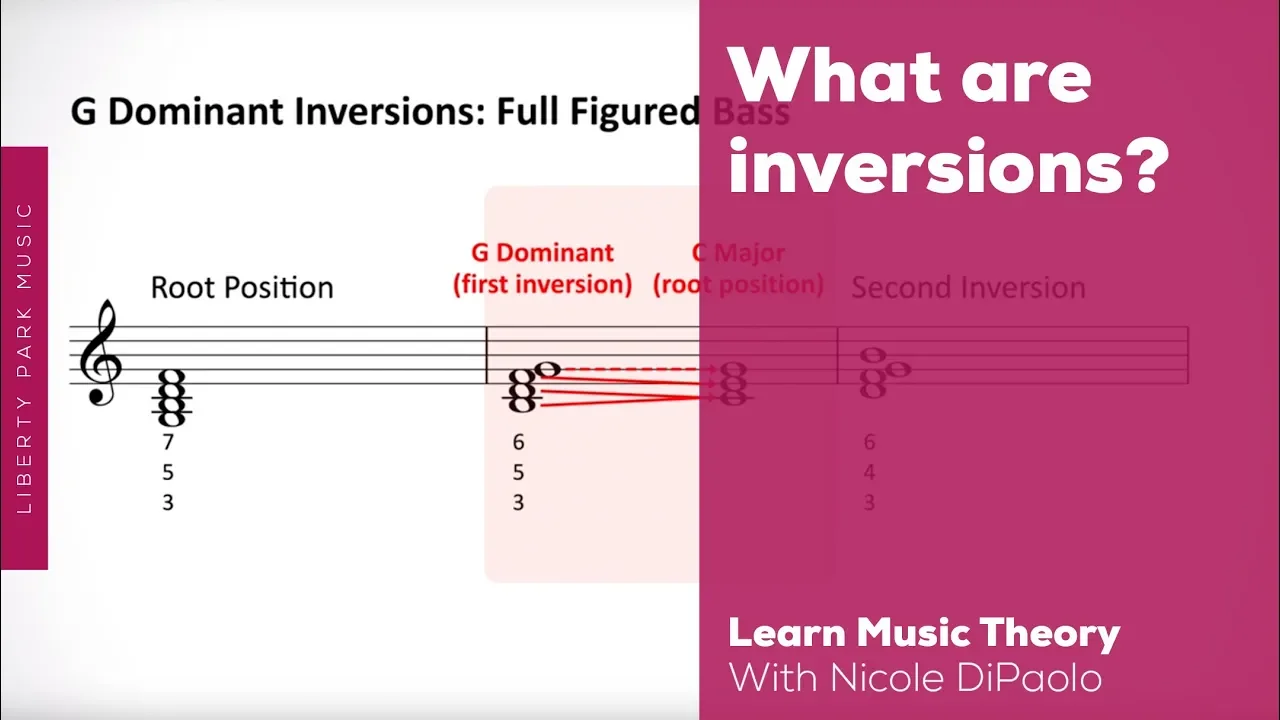







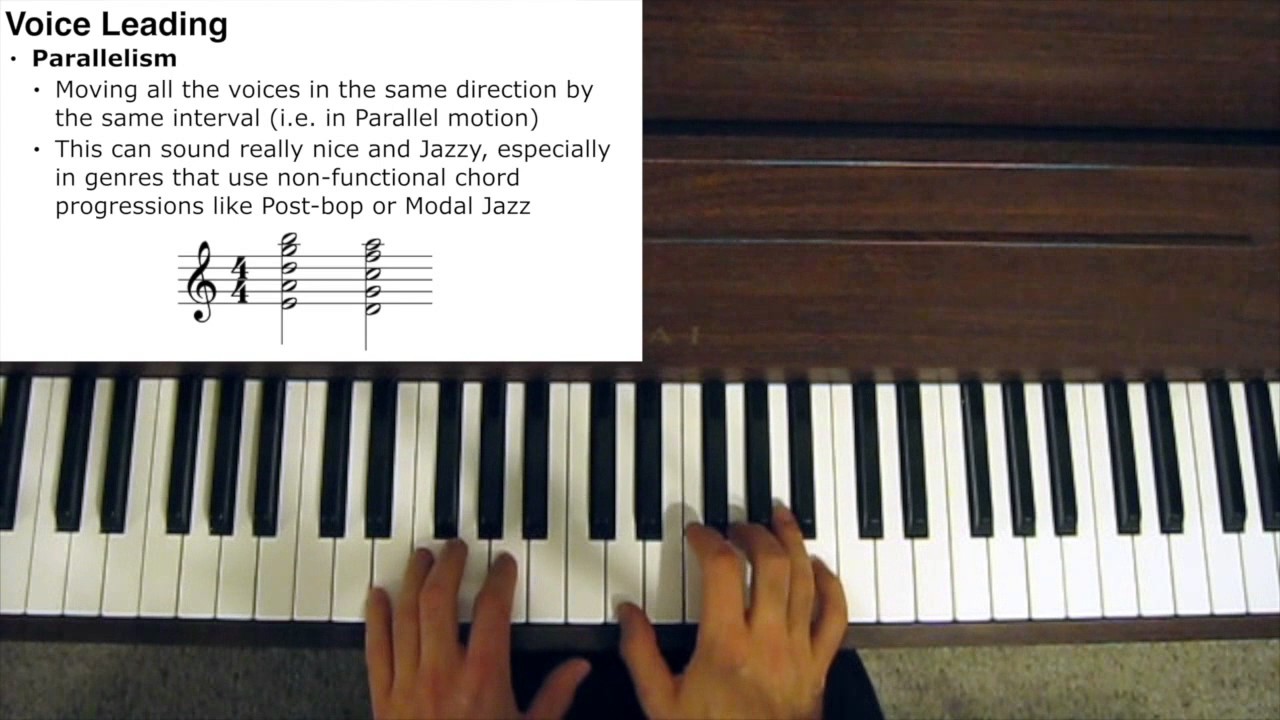
Chord inversions involve rearranging chord notes to create different voicings (root position, first inversion, second inversion, and third inversion for four-note chords), and effective voice leading follows two key rules: (1) keep common notes between consecutive chords stationary, and (2) move other voices by the smallest possible step, which creates smoother, more elegant musical arrangements and makes performances easier to execute.
Chord Inversions & Voice Leading: A Music Theory Guide
Added:Basic chord construction, specifically how to build major and minor triads in root position.
An understanding of musical intervals, such as thirds, fifths, and octaves, and how they define chord qualities.
Familiarity with basic music notation, clefs (treble and bass), and scale degrees.
An introductory understanding of harmonic functions (e.g., tonic, subdominant, and dominant relationships).
Standard four-part (SATB) harmony and strict voice-leading rules, such as avoiding parallel fifths and octaves.
Inversions of seventh chords (such as 6/5, 4/3, and 4/2 chords) and their resolutions.
An introduction to species counterpoint, focusing on writing independent, overlapping melodic lines.
Practical application of voice leading in keyboard harmony, jazz comping, or string arranging.
1.1K views106likes12:22Original Release: 2023-07-15
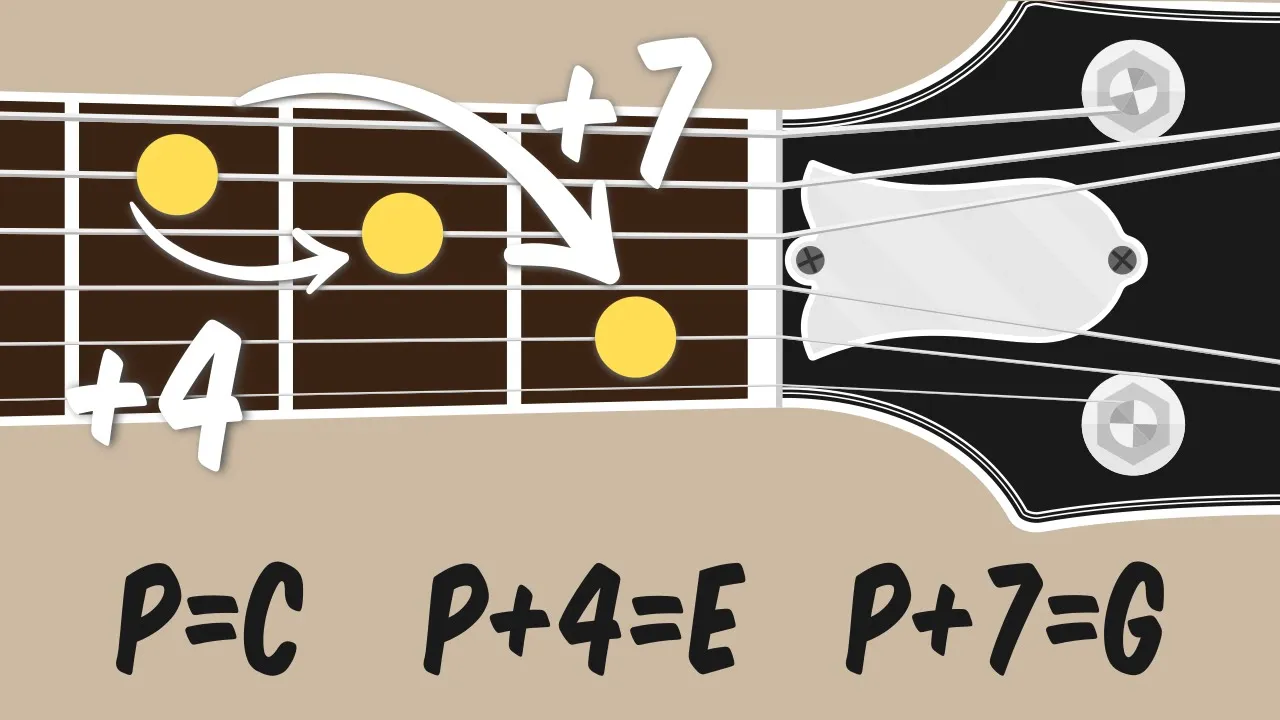
hi it's Chris with implied music where to begin we've got a playlist going on with real fundamental ideas about music theory music theory you can use for yourself music theory for everybody we've looked at naming notes scales diatonic chords dominant chords seventh chords today I want to talk about another trick a basic fundamental manipulation that we do with chords it's called an inversion when you invert a chord you take the basic notes from the chord and you put them in a different order doesn't have to have the root on the bottom could be on the top can be tricky there's lots of notes in a chord how do I arrange it what's the rules what's the idea let's take a tune look at it a couple of different ways maybe when we're done by the end of the video you'll know a lot more about chord inversions [Music] well first of all just a little housekeeping if this is the second or third video of mine you've watched and you're not subscribed now is a great time to subscribe you'll be notified when I do my videos and this series this fundamental Series where to begin I think has a lot of use there's plenty of other things going on on the channel more sophisticated ideas uh reviews of software and some Hardware um you know just basically what do we do as musicians that's my question so what do we do as musicians when we're arranging I've decided to use the old standard it's an Old Chestnut Take Me Out to the Ball Game and Take Me Out to the Ball Game is a pretty simple song listen to these three versions of it it's the same Melody where in the key of C I've just handled the chords differently in each example you can see the chords above me here [Music] back to C I'm playing all these chords in root position and it means the courts hop around you can see their like little blocks on the screen that go up and down it's not very elegant well the simplest solution to that is to take notes from the top or bottom and move them around that's an inverted G7 [Music] much smoother and The Melodies in the clear isn't it [Music] still really separates the Melody from the chords the final trick is to have notes from the chord follow the melody that's what happens in the last example thank you this would be great for string riding or horns definitely inversion going on here it's a great Melody I've heard it my whole life and known it forever well let's look at how to picture a chord and how to invert it so for me inversion is about knowing the names of the notes and the sort of identity of the notes of each chord and that's where I like to begin so we'll do a little review and see where that takes us the diatonic chords in the key of C appear as a stack of thirds I'm just going up the C scale playing stacks of thirds each of them has a name but perhaps more importantly there's individual nodes within each as well c e g is a c Triad now those three notes are the thing that makes that Triad a c Triad it's not the fact that it's those notes together like this it's those three notes that's it and that's great because that means I can play those three notes in a different configuration I can take the E and play it down here and I still have a c chord in fact I have a beautiful c chord sometimes called a drop two version of it this is an inversion it's a gradient version listen to how beautiful this sounds it's so much better than this here I'm going to invert it using drop2 enormously more beautiful right away because we inverted the chords now my basic rule for inverting chords is laziness and in fact there's a rule called the rule of parsimony parsimony means cheap or you know somebody who doesn't want to spend a lot of money or do a lot and in fact I don't want to do a lot I'll show you what I mean if I'm going to go from the chord c to the chord G7 my hand picks up and moves and that pick up and go that hopping motion is would be awkward to sing it's difficult for the hand if you're sliding yourself along the guitar that's hard too so we have two simple rules that we use let's make this G7 chord here a three note chord so here are my two chords C and G7 my simple rule is this if I have one of the notes from the next chord or two of the notes or three of the notes from the next chord in the first one already and I do it has to stay right there that's an excellent first rule and it anchors the chord progression I know that that top voice is still going to be a g and now I know that I need a b and an F and what what happens is this C in root position becomes G7 in inversion and really what happened was these two bottom voices changed a little bit of a position the E went up to F the C went down to B if I just play the C chord like so we say it's a root position chord if I play it with its third on the bottom it's a first inversion if I play it with the G on the bottom it's a second inversion if I have four notes I could have a third inversion what that means is my G chord my G7 there's its root position there's its first inversion there's its second inversion and because I have four notes there's its third inversion those inversions are are very useful for us as we move smoothly from chord to chord so our chord progression the yellow one up here if I moved smoothly through it might look like this C [Music] 7 C G7 [Music] A7 D minor D7 G7 I've tried to keep as much as possible every voice to a tiny little gesture if I have the note I keep it all the other voices move by as little as possible in fact it's possible to have them move by only a step my first rule was if I have a note I keep it my second rule is all the other voices move only by a step sometimes I break that rule depending on how things work here you can see I've kept the G from the C to the G7 chord and back to the C and then to the G7 now G7 everything could just go up to A7 but I want it to go down and so here I broke the rule and I broke it for a reason that um is really very very simple I wanted that g to stay on top so once I've broken the rule once I'm going to go back to my basic trick which is if I have the node I keep it if I don't have the note it moves only by a step things are kept or moved only by a step and I get beautiful smooth voice leading smooth voice leading is not only pleasing to the ear it's easier to perform and it's easier to manage in your Arrangement inverting chords leads to smooth voice leading well the next step is to take a melody and figure out how to add notes underneath it I've had to put my glasses on to remember what I've done the melody now becomes king and I ask myself the question what are the other notes from the chord that fit underneath it so the very first Melody note in Take Me Out to the Ball Game is a c so is the second Melody note then a g e and now it's time for a G7 chord with the melodic tone G so what I've done is ask myself the question what other notes from the chord fit underneath in the first instance I have C on top and I've added the E and the g I've inverted the C chord now the C's on top and then exactly the same thing because it's just an octave up another C the next three Melody notes a g e means I've got to do some tricks here and you can see what I've done I've put the C of the E here and the C there underneath the a note the melody now it's kind of a passing tone and then under the G it makes perfect sense so see on top that's an inversion sort of a root position and then now I'm going down to an E Melody and so I invert the C chord in second inversion there's a G that I need and a c that I need and the E is the melody I made it right too here so going on to the A7 chord this is a blast I love that sound right there the computer is confused because I'm not playing an A but if I add the a it says A7 over G and the rest of it goes on A7 to D D I'm just inverting chords D7 if I add the D the computer recognizes it I'm just playing three notes because as you know I'm lazy all of the voices are chasing the melody the melody is King I don't care if I never get back the inversions are there to create smooth voice leading and smooth voice leading is more pleasing to our ear it always takes a little bit of extra time to get your inversions right and it's worth it it creates a much better more sophisticated elegant and professional sounding Arrangement well I hope this has been useful like And subscribe ding the Bell you'll be notified when I do my videos I'll see you next time [Music]
Up Next
4:35
Neo-Riemannian Analysis Explained: A Music Theory Guide
@12tone
76.4K views•2016-05-20

10:20
Mozart's Musical Dice Game Explained: History, Rules, & Fun
@webpianoacademy
5K views•2023-03-13

47:36
Understanding Diatonic 7th Chords in Major Keys | Music Theory Tutorial
@GracieTerzian
54.7K views•2022-03-02
10:49
Understanding John Coltrane's Giant Steps: A Music Theory Analysis
@Vox
10.4M views•2018-11-12
Related Study Plans & Knowledge Roadmaps
Structured learning paths in Music Theory
music-theory
Composing Galant Music: Partimento & Schemata
01Foundations of Figured Bass and Keyboard Harmony
02The Rule of the Octave (Regola dell'Ottava)
03Galant Schemata: The Building Blocks of Form
+ 2 more learning modules
30h5 modules
Explore Roadmap
music-theory
Decoding Overtone Series: Tuning & Drone Music
01Acoustic Foundations: The Physics of the Overtone Series
02Tuning Systems: Equal Temperament vs. Just Intonation
03Microtonality and Spectralism: Beyond Standard Pitches
+ 2 more learning modules
24h5 modules
Explore Roadmap
music-theory
Impressionist Harmony: Scales, Planing & RPGs
01Foundational Music Theory: Keys, Intervals, and Seventh Chords
02Impressionist Color: Chord Planing and Parallel Harmony
03Whimsical Textures: Pentatonic Cascades and Whole-Tone Scales
+ 1 more learning modules
14h4 modules
Explore Roadmap
music-theory
Negative Harmony: Axis Reflection in Indie Pop
01Music Theory Foundations: Scales, Intervals, and Triads
02Functional Harmony and the Circle of Fifths
03Demystifying the Negative Harmony Axis Reflection
+ 2 more learning modules
16h5 modules
Explore Roadmap