


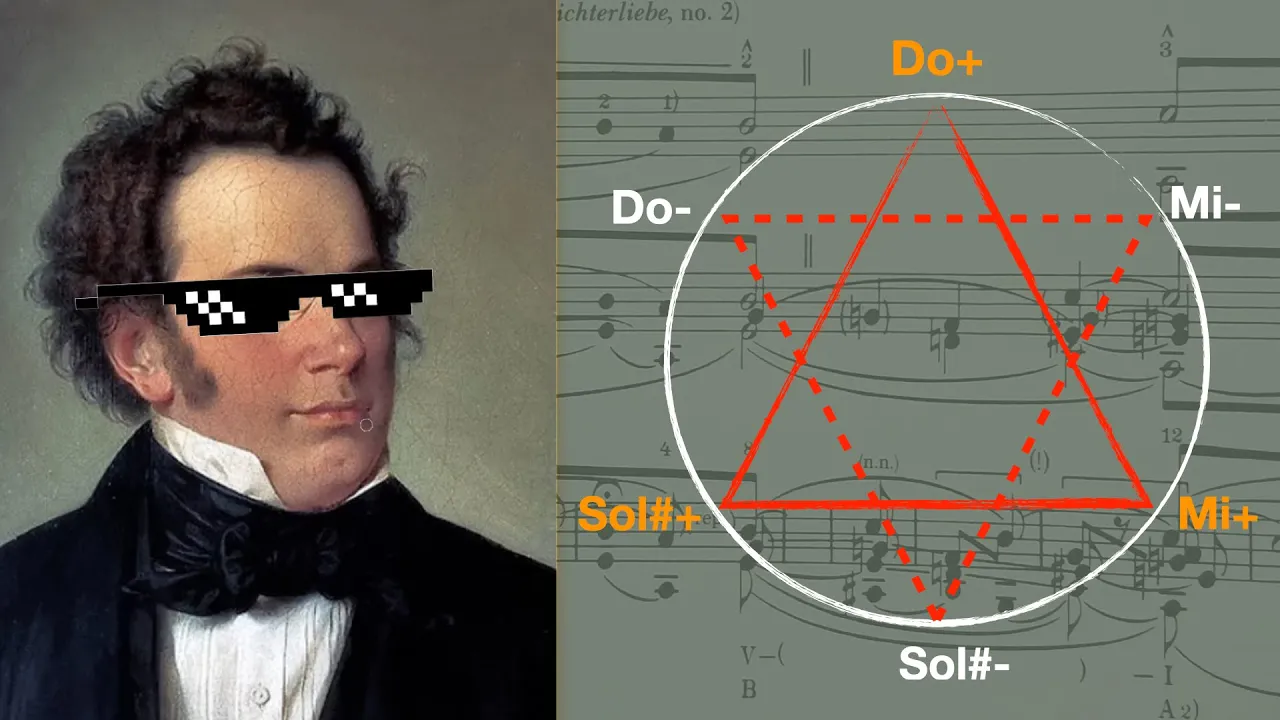














Neo-Riemannian analysis is a music theory framework that analyzes harmonic relationships using three basic transformations (P, R, L) that preserve two notes of a triad while changing the third, allowing for the exploration of chord connections without reference to a fixed tonal center; the P transformation (Parallel) maintains the root and fifth while switching between major and minor triads, the R transformation (Relative) moves the fifth up a whole step to become the root of a minor triad, and the L transformation (Leading Tone) moves the root down a half step to become the fifth of a minor triad, with compound transformations revealing relationships like chromatic mediants, secondary dominants, and hexatonic poles.
Neo-Riemannian Analysis Explained: A Music Theory Guide
Added:A strong foundation in triadic harmony, including the construction of major and minor triads and their inversions.
An understanding of traditional functional harmony and Roman numeral analysis, which Neo-Riemannian theory seeks to expand upon or bypass.
Familiarity with the concept of voice leading, particularly 'parsimonious' or smooth voice leading where voices move by minimal step-wise motion.
Basic knowledge of the chromatic scale, intervals (specifically semitones and whole tones), and enharmonic equivalence.
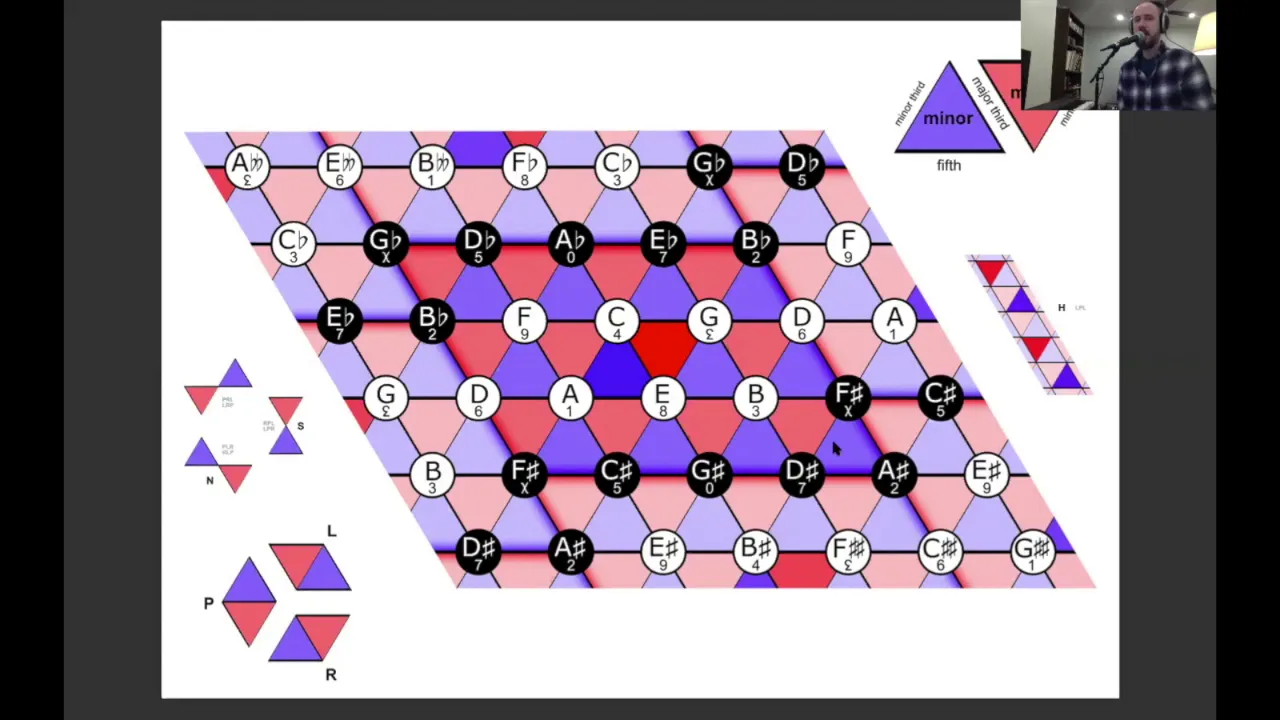
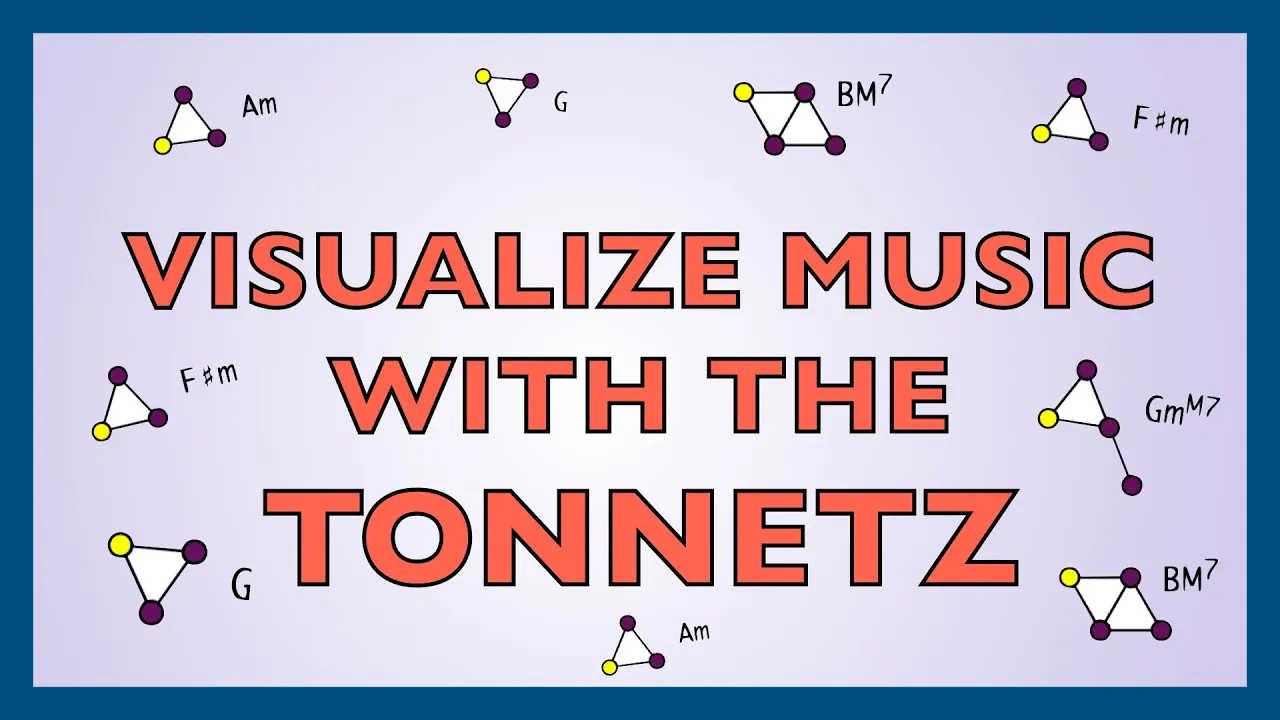
Exploring the 'Tonnetz' (tone network), a geometric grid used to visualize chord relationships and voice-leading spaces.
Studying compound transformations and cyclic operations, such as the 'SLIDE' transformation or the combination of P, R, and L operations into algebraic groups.
Applying Neo-Riemannian analysis to late-Romantic repertoire (such as Wagner, Liszt, and Schubert) and modern film scores that feature non-functional chromaticism.
Investigating Richard Cohn's 'Hexatonic Systems' and the mathematical group theory underpinning these triadic transformations.
76.4K views2.7Klikes4:35Original Release: 2016-05-20
hey, welcome to 12tone, today we're gonna talk about neo-Riemmannian analysis.
I know that sounds like the final boss in a video game about homework, but trust me, it's actually pretty simple, and it's really cool. and like most cool things, we have to start with a little history.
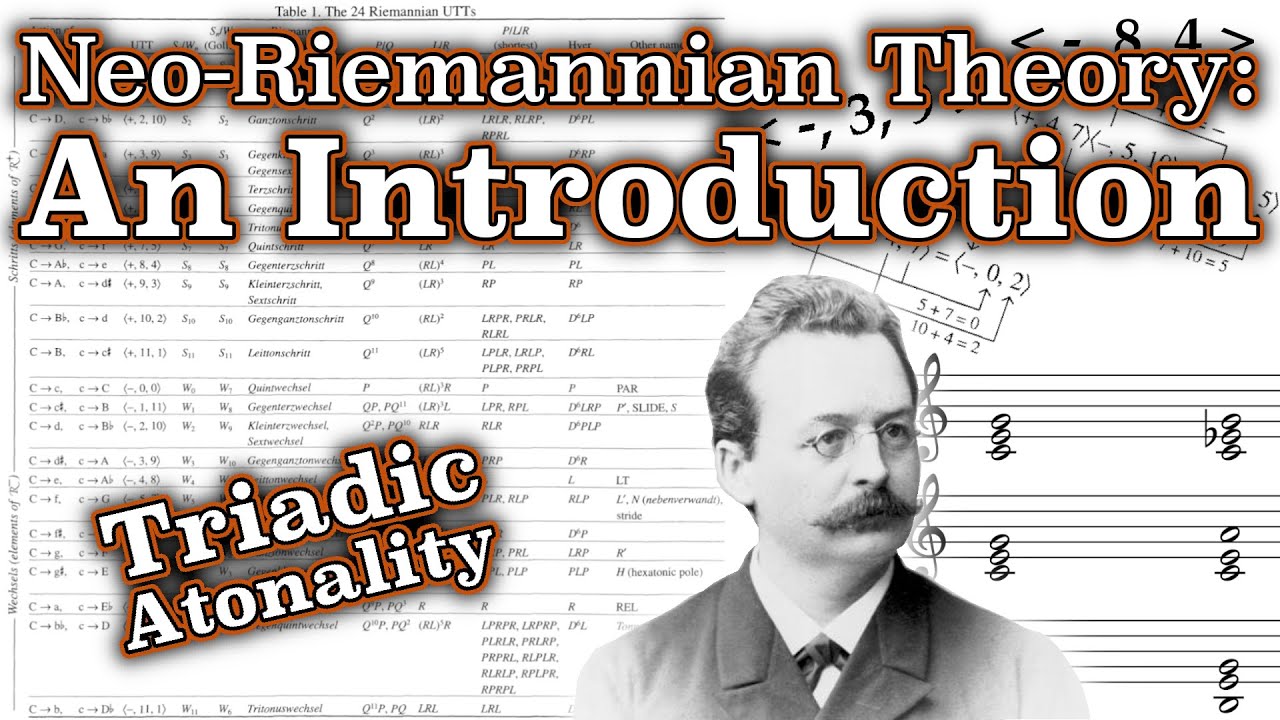
we mentioned Hugo Riemmann all the way back in our tonic function video. he's kind of the father of modern functional harmony, and a large part of his work involved an idea called dualism.
put simply, this is the idea that major and minor triads are sort of mirrors of each other.
a minor triad is just an upside-down major one.
combining that inversion with various transpositions gave Riemmann a set of transformations that could convert from one chord to another.
Neo-Riemmannian theory takes the idea of triadic transformations and runs with it.
it leaves dualism behind in favor of its own voice-leading-inspired operations.
there are three basic transformations, each preserving two of the three notes in the triad.
the first is the Parallel transformation, abbreviated P, which maintains the root and the fifth, so this F major (bang) would become F minor (bang) and vice versa.
(bang) the second transformation is the Relative, or R transformation.
this evokes the idea of relative major and minor, which we've covered before.
here we take the fifth of our major triad (bang) and move it up a whole step to become the root of a minor triad.
(bang) and, again, this works in reverse too.
(bang) the last transformation is kind of the opposite of that.
whereas with the R transformation the fifth of the major triad becomes the root of the minor one, in the Leading Tone or L transformation, the root of the major triad (bang) becomes the fifth of the minor one, (bang) moving down a half step to its own leading tone in the process.
(bang) and… that's it.
those are the rules.
well, ok, there's one more thing: compound transformations.
that is, how many of these transformations does it take to get from one chord to another?
well, let's try some.
we'll start on A major.
(bang) if we do a parallel transformation we get A minor, (bang) a relative one gives F# minor, (bang) and a leading tone gives us C# minor.
(bang) these are the closest relations A major has.
and that makes sense.
this one is modal interchange, borrowing the I chord from the parallel minor, and these three together make up tonic function in the key of A. of course they're related.
now what happens if we transform these again?
if we do an L transformation to this one, we get D major, (bang) and an R transformation to this one gives us E major.
(bang) and those, again, make sense: they're the IV and the V chord.
but what about the others?
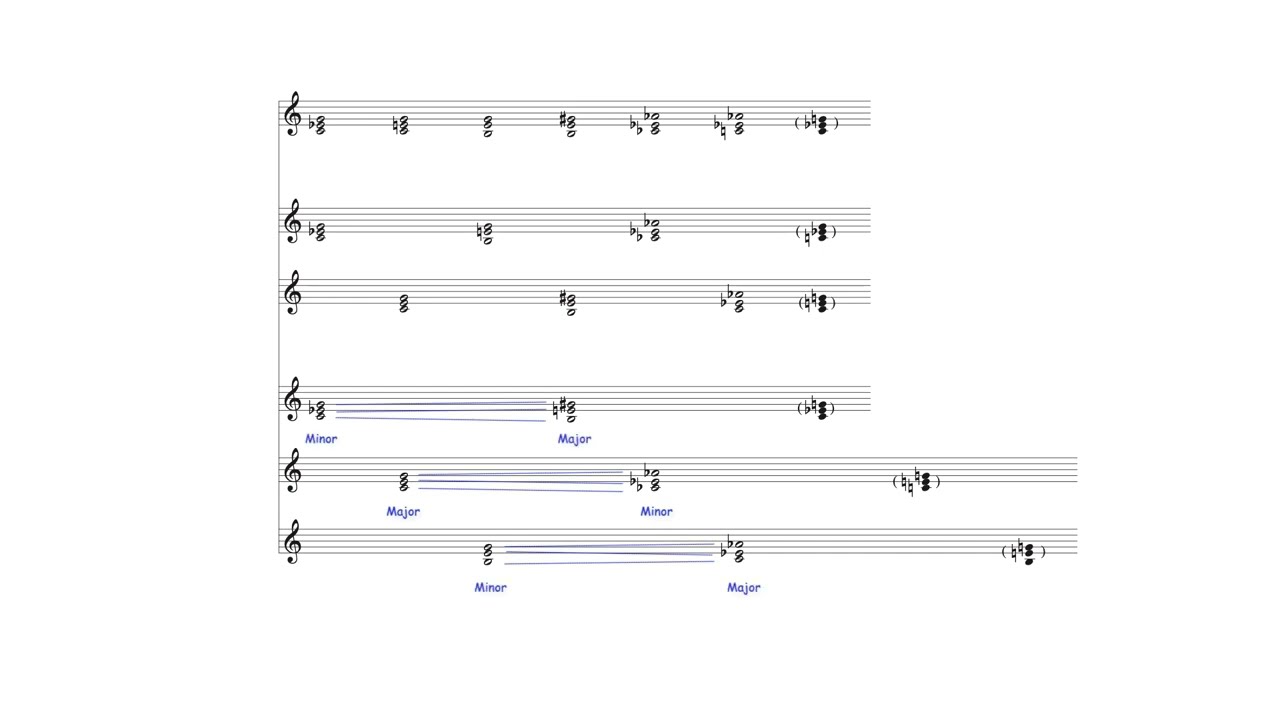
well, if we quickly go through and apply the rest of the transformations, we get something interesting.
these are all the major chromatic mediants of A major.
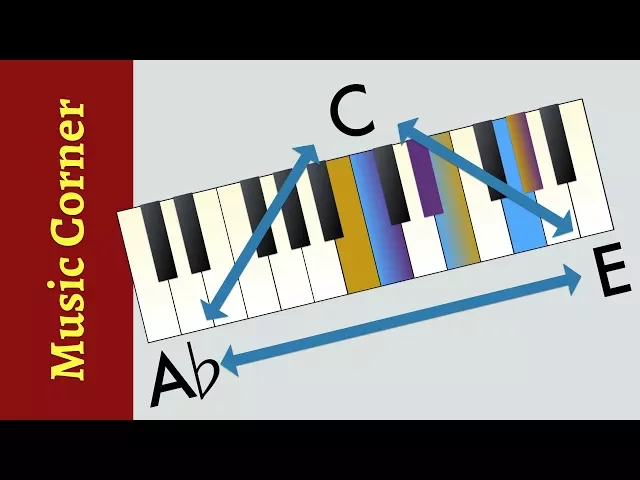
we talked about chromatic mediants back in our Q&A video, but as a refresher, it's a chord whose root is a third away from your original chord but with one or more notes that should be common tones chromatically altered.
for instance, this F major has a C natural, whereas A major has a C#.
so that's two transformations.
what about three?
as you might imagine, we have a lot of options.
for instance, this path (bang) takes us to the II chord, this one (bang) takes us to the hexatonic pole, where every note is a half step away from a chord tone in our original chord, and this one, (bang) called a slide, takes us to the minor triad with the same third degree.
but more than any specific path, what I find fascinating is what happens when we look at all of them together.
check it out.
yeah, that's a lot of minor triads. in fact, if we add in this row, we have every single… wait.
no, we don't.
we've only got 11.
there's no G minor.
you need five steps (bang) to get there.
so what does that mean? that the furthest thing from a major triad is the minor triad a whole step below it?
maybe.
it'd make sense: there's no way to voice-lead from one to the other without jumping a third in one voice.
so is this the best way to think about harmony?
well, not necessarily.
for instance, this tells us that, in the key of A major, B minor and C minor are equally distant, but that's clearly not true.
one is the diatonic II chord, while the other is borrowed from the parallel locrian mode.
neo-Riemannian analysis is just a tool.
it gives us a great way to think about chord relations without reference to a tonal center, but sometimes that's not what we need.
it also doesn't really work on seventh chords: you need more complicated structures to account for those.
still, though, it provides some valuable insight into late romantic and other post-tonal works, and besides, it's a lot of fun.
and that's Neo-Riemmannian analysis!
try the exercises, join our mailing list for scans of all our episodes, feel free to suggest other topics in the comments, and keep on rockin'.
Up Next

9:06
Neo-Riemannian Theory: Transformations in Music Analysis
@AshStemke
38.5K views•2015-05-06

10:20
Mozart's Musical Dice Game Explained: History, Rules, & Fun
@webpianoacademy
5K views•2023-03-13
5:00
Understanding Figured Bass: A Complete Guide
@12tone
94.3K views•2015-11-27
10:49
Understanding John Coltrane's Giant Steps: A Music Theory Analysis
@Vox
10.4M views•2018-11-12
Related Study Plans & Knowledge Roadmaps
Structured learning paths in Music Theory
music-theory
Composing Galant Music: Partimento & Schemata
01Foundations of Figured Bass and Keyboard Harmony
02The Rule of the Octave (Regola dell'Ottava)
03Galant Schemata: The Building Blocks of Form
+ 2 more learning modules
30h5 modules
Explore Roadmap
music-theory
Decoding Overtone Series: Tuning & Drone Music
01Acoustic Foundations: The Physics of the Overtone Series
02Tuning Systems: Equal Temperament vs. Just Intonation
03Microtonality and Spectralism: Beyond Standard Pitches
+ 2 more learning modules
24h5 modules
Explore Roadmap
music-theory
Impressionist Harmony: Scales, Planing & RPGs
01Foundational Music Theory: Keys, Intervals, and Seventh Chords
02Impressionist Color: Chord Planing and Parallel Harmony
03Whimsical Textures: Pentatonic Cascades and Whole-Tone Scales
+ 1 more learning modules
14h4 modules
Explore Roadmap
music-theory
Negative Harmony: Axis Reflection in Indie Pop
01Music Theory Foundations: Scales, Intervals, and Triads
02Functional Harmony and the Circle of Fifths
03Demystifying the Negative Harmony Axis Reflection
+ 2 more learning modules
16h5 modules
Explore Roadmap