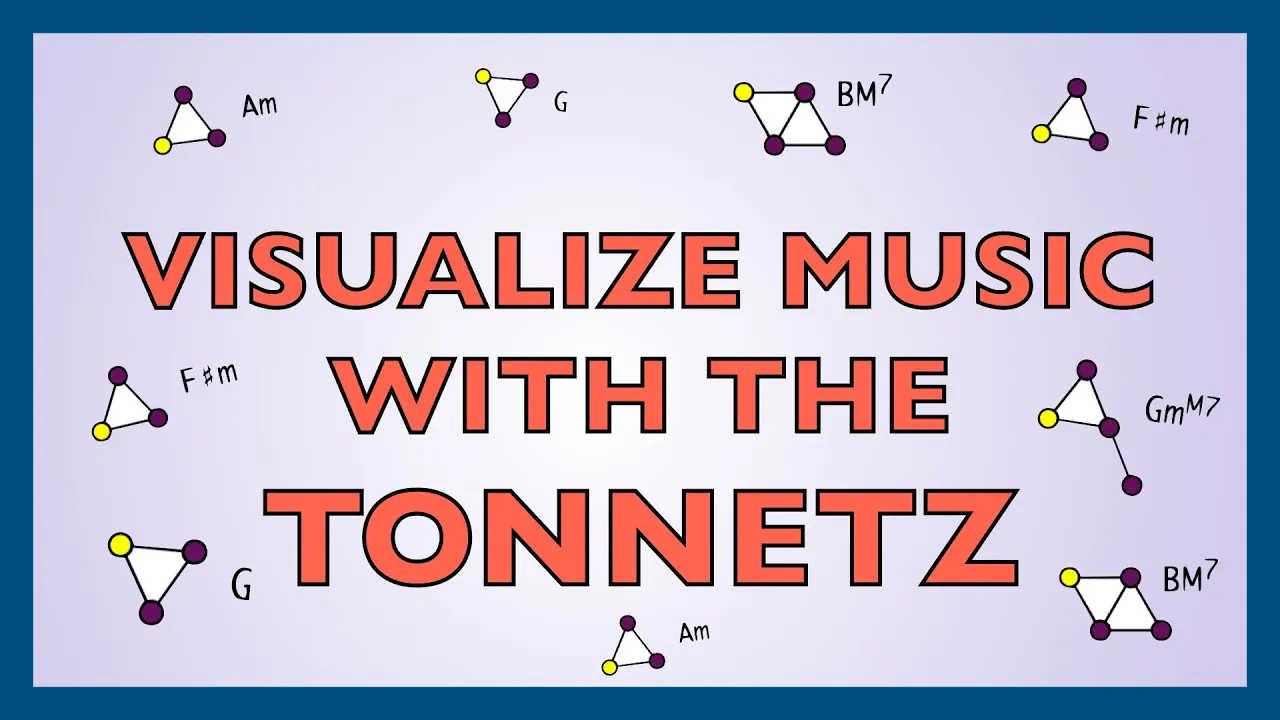


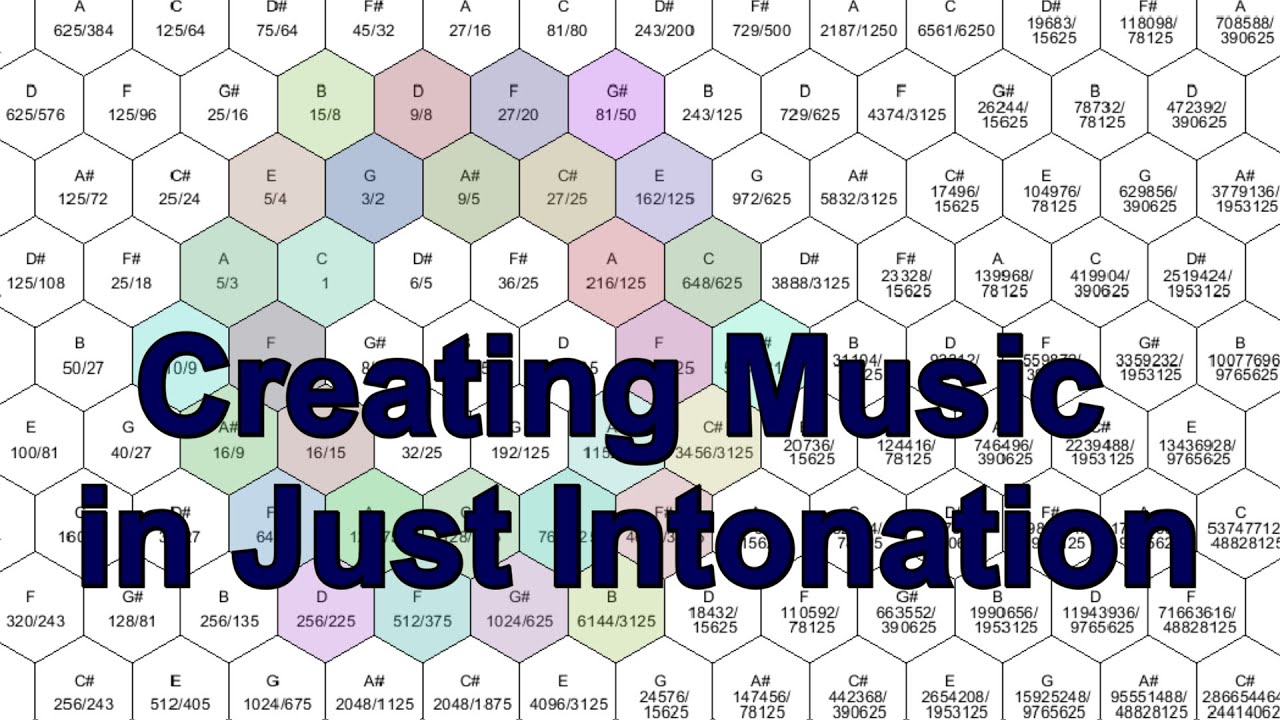
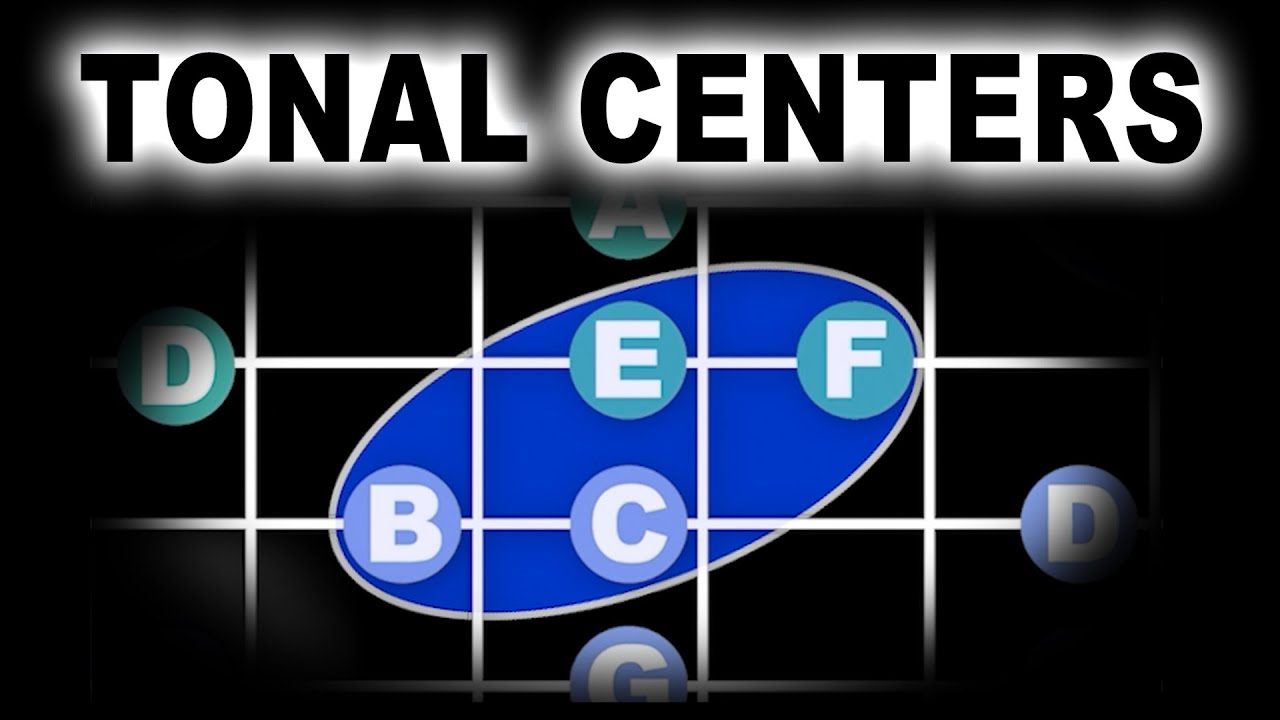







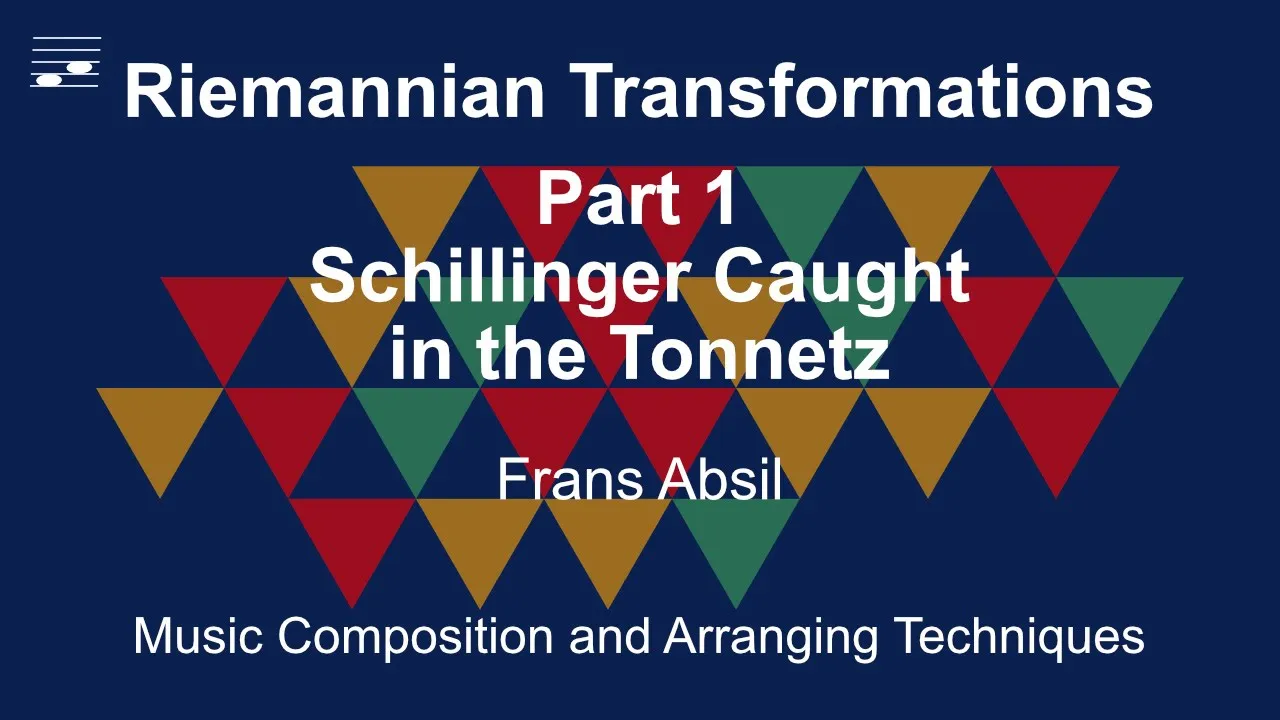
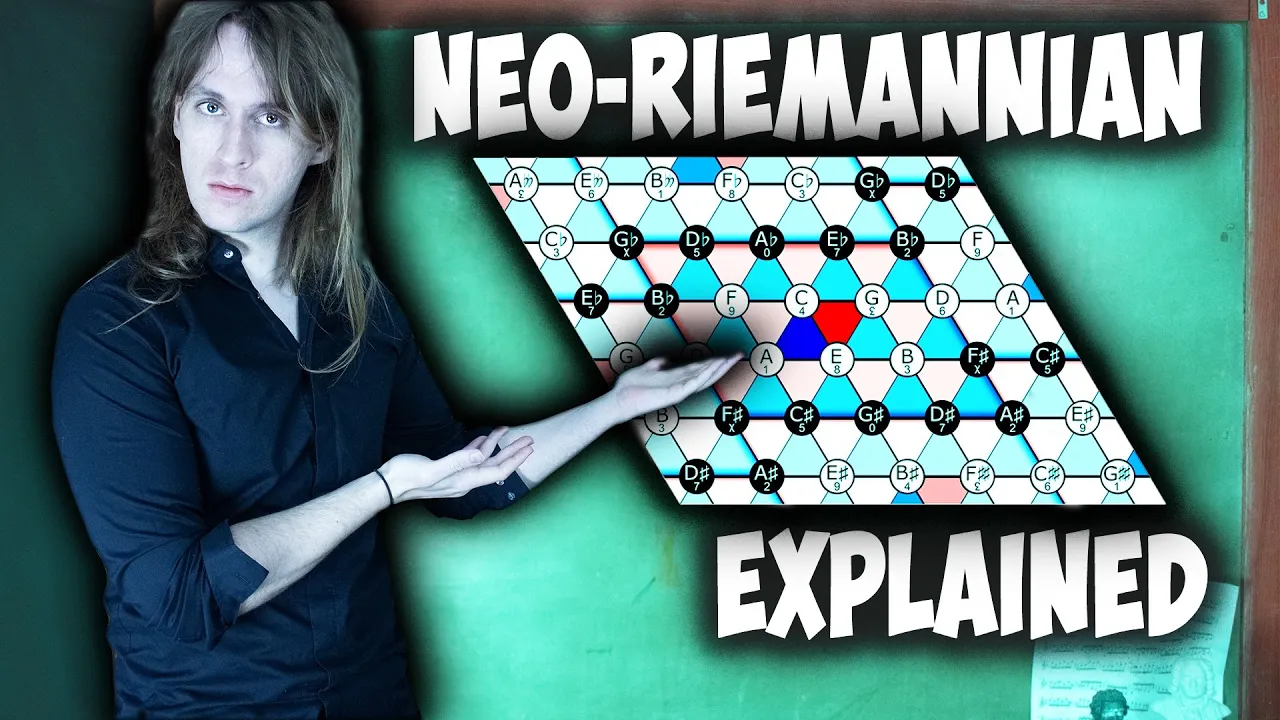


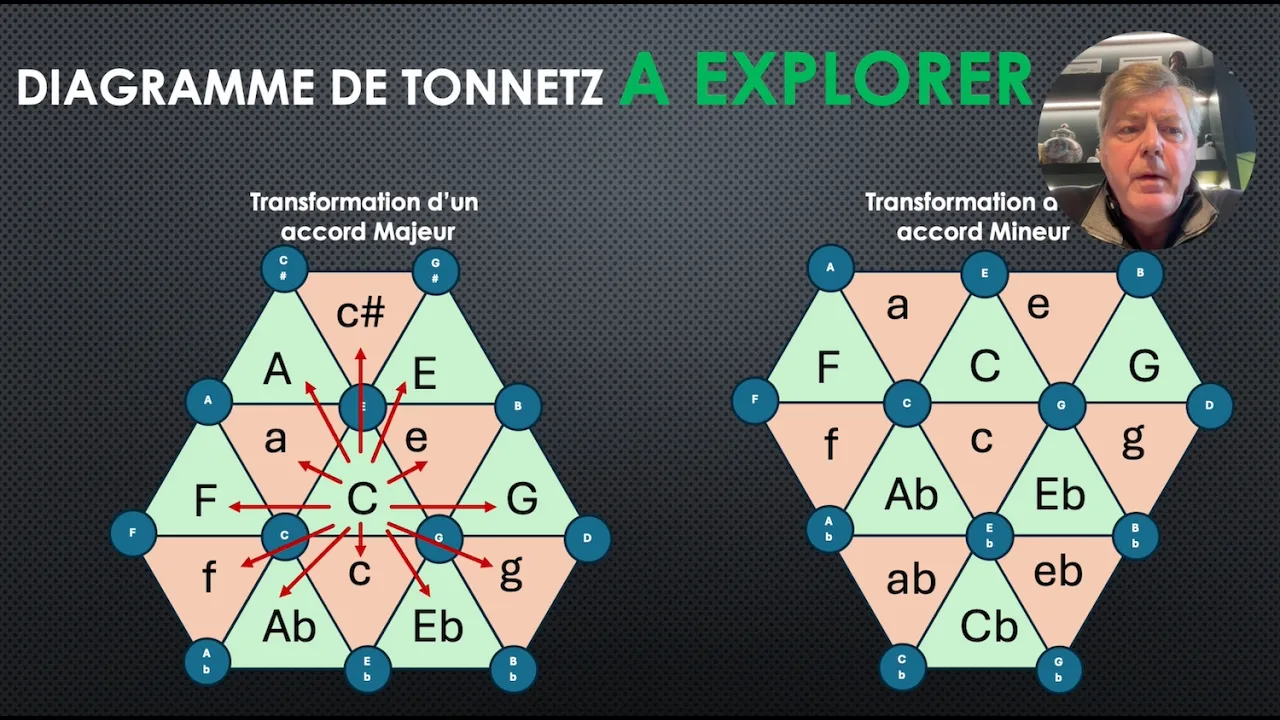



The Tonnetz chart is a visual tool that arranges the 12 chromatic notes in a grid where moving left to right increases by perfect fifths, moving diagonally up increases by major thirds, and moving diagonally down increases by minor thirds. This arrangement enables musicians to identify chord structures, scales, and intervals by recognizing geometric patterns: major triads form downward-pointing triangles, minor triads form upward-pointing triangles, suspended chords form horizontal lines, and symmetrical chords like augmented triads and diminished triads follow diagonal lines. The chart can be used to quickly determine chord members (major, minor, seventh, ninth, thirteenth), scale notes (major, natural minor, pentatonic), and modes (Ionian, Dorian, Phrygian, Lydian, Mixolydian, Aeolian, Locrian) for any key, making it a practical tool for understanding harmonic relationships and improvisation.
25 Practical Tonnetz Chart Applications: Chords & Scales
Added:in this video i'm giving you 25 practical applications that you can take and you can directly apply by using this chart we're not going to get super deep into the derivation of this chart which was kind of what the first part was about and i think i lost a lot of people about six minutes into the video that's when i started getting into the practical applications but a lot of people didn't make it that far so this video it's just pure practical application of this chart all right so here we have this tonics chart so in music we only have 12 notes so you have your seven natural notes your a b c d e f and g but then the other five notes can either be expressed as sharps or as flats so for example the note a flat is the same note as g sharp or the note a sharp is the same note as b flat so this chart just takes those 12 notes and it arranges them in a way that we can just get tons and tons of practical use out of it so moving from left to right the notes always increase by perfect fifths start on any note it does not matter what it is the note directly to the right of it will be a perfect fifth above the note that you started with again pick a note any note it doesn't matter which note you start on if you move downwards to the right by one single step that note is going to be a major third higher than the note that you started on pick a note any note it doesn't matter which note you start on if you move upwards to the right that note is going to be a minor third higher than the note that you started on so that's how these notes are arranged on this tone it's chart as i said in the beginning you have your 12 notes in music you have your seven natural notes but then you have those other five notes that can either be expressed as flats or as sharps so we express them as flats on the top of this chart and we express them as sharps on the bottom of this chart so if you want to know the notes of any major chord a major chord just consists of three notes a root third and a fifth it's always going to form a triangle that points downwards like so so what are the notes of a c major chord the notes of a c major chord are c e and g what are the notes of a d major chord the notes of a d major quarter d f sharp and a the notes of an e major chord are e g sharp and b the notes of a d flat major chord are d flat f a flat all notes are created equal just pick a note form this little downward triangle those are the three notes that make up a major chord let's look at minor chords now so a minor chord again it's just three notes you have a root you have a flattened third that's what differentiates it's between a major chord and you have a fifth so this forms an upward pointing triangle so what are the notes of a c minor chord c e flat g what are the notes of a g minor chord g b flat d what are the notes of a c sharp minor chord c sharp e g sharp all right so now we're going to form suspended chords otherwise known as sus chords so you've probably seen sus2 chords and sus4 chords before well all that means is you're removing the third from a major or a minor triad and you're replacing it with either a two or four so sus2 chords and sus4 chords they form straight horizontal lines on this chart let's start out with sus4 chords all right so you have your root right to the left you have the four directly to the right you have the five a c sus4 chord contains the notes c f and g and e sus4 chord contains the notes e a and b a d flat sus 4 chord contains the notes d flat g flat and a flat let's now look at sus 2 chords you have a root you have a 5 and you have a 2.
again it forms a straight line but your root is all the way to the left so a c sus2 chord contains the notes c g d a d sus2 chord contains the notes d a e an e sus2 chord contains the notes e b f sharp all right now we're going to look at extended chords so we're going to start out with a major triad which is your root third fifth and we are going to extend the chords into major seventh chords and so on let's do that now so you already know what your major chord is it forms this downward pointing triangle let's look at a major seventh chord a major seventh chord you have your downward pointing triangle and then you have your seventh as you can see here a c major seventh chord contains the notes c e g b an f major seventh chord contains the notes f-a-c-e a d-flat major seventh chord contains the notes d-flat f a flat and c so let's further extend this let's make a major ninth chord a major ninth chord is just a major seventh chord but you add the ninth in there as well so you have your major seventh your root third fifth and seventh but now you have your nine a c major nine chord c e g b d an a major nine chord a c sharp e g sharp b a b flat major nine chord b flat d f a c now we're going to look at the dominant chords a dominant chord is similar to a major 7th chord except it has a major triad and then a flat 7 as opposed to a major triad and a major 7.
a dominant seventh chord is a root third fifth flat seven there you have your root third fifth and your flat seven can always be found there a c dominant seven chord otherwise known as just a c seven chord contains the notes c e g b flat and a dominant seven chord contains the notes a c sharp e g a d flat dominant seven chord d flat f a flat b so now let's further extend these seventh chords let's make ninth chords now not to be confused with major ninth chords it's just a ninth chord a ninth chord has your major triad on there just like a seventh does a ninth chord has that flat seven in there just like a seventh chord does so this is a ninth chord this is a dominant seventh chord with the extension of a nine on there it forms this shape if you want to play a c nine chord c e g b flat throw the note d in there you have yourself a c9 chord if you want to play a d9 chord d f a c e if you want to play an e flat nine chord e flat g b flat d flat f those are the five notes that make up your ninth chord let's further extend this into a 13th chord not to be confused with a major 13th chord it's just a 13 chord when you see a number a 7 a 9 an 11 or 13 but there's no mage in front of it that tells you that it is a major triad it has a flat seven interval in there because it's a dominant type of chord and then it has some extensions in there so your 13th chord you have your major triad your root third and fifth you have your flat seven and then you have your 9 11 and 13 in there as well so the notes that make up a c 13 chord again not to be confused with a c major 13 chord just a c 13 chord you have your major triad your c e g you have that flat 7 interval in there that b flat and then you have your 9 11 and 13 in there which is the notes d f and a here's a d 13 chord not to be confused with a d major 13 chord it's just a d 13 chord here's an f 13 chord all right so let's look at some extended minor chords now so extended minor chords you start with your minor triad that's the foundation you have your root you have your flat third you have your fifth it forms this upward pointing triangle like so let's start out by making minor seventh chords so minor seventh chords form the shape you have your minor triad and then you have your flat seven let's look at some examples the notes that are found in a minor 7 chord a c e g the notes that are found in a c minor 7 chord c e flat g b flat the notes that are found in a b minor 7 chord b d f sharp a let's further extend this to minor 9th chords now a minor 9th chord is going to have all the same stuff that a minor 7 chord has but now you're going to include the 9 as well that is going to form this shape right here an a minor 9 chord you have your a c e g that's the minor 7 the a minor 7 chord throw in your nine now you have the five notes that make up an a minor nine chord these are the five notes that make up a d minor nine chord these are the five notes that make up a c sharp minor nine chord now we're going to look at augmented triads augmented triads are known as symmetrical chords so a major chord is a root third and a fifth an augmented chord is a root third and a sharp five so you take your five you raise it by one half step essentially what you're doing is you're just stacking major thirds let's look at how this works so the notes c e and g sharp those three notes form an augmented triad so if you start on the note c a major third above c is the note e a major third above e is the note g sharp you're just stacking major third intervals and that is how you come up with an augmented triad let's look at a couple other examples a g augmented triad has the three notes g b d sharp a d flat augmented triad d flat f a now as i said this is a symmetrical chord you're just stacking major thirds so technically you could just keep on going up or down this line in the same diagonal fashion like this pick a note any note in this line it doesn't matter play three of the notes together it's an augmented chord you could start on the note a and play a d-flat and f and that's going to be the exact same chord giving you the exact same sound function the exact same way as if you were to start on the note d flat and play d flat f a or if you were to start on the note f and play f a c sharp or if you were to start on the note c sharp and play c sharp f a it's just major thirds being stacked that's the cool thing about augmented triads it's called a symmetrical chord let's look at some more symmetrical chords now but now we're going to start with a minor triad a minor triad again has a root a flat third and a perfect fifth if you take that perfect fifth and you lower by one half step you're going to have what is known as a diminished triad you have a root you have a flat third you have a flat fifth this forms this diagonal line moving in the upwards direction e g b flat that is an e diminished triad the notes of an f diminished triad f a flat b so a diminished triad is just three minor thirds being stacked on top of one another similarly to how an augmented triad is three major thirds being stacked on top of one another a diminished triad just stacks minor thirds taking this one step further you have what is known as a fully diminished chord a fully diminished chord contains four notes it's a root a flat third a flat fifth and a double flatted seventh again these are just minor thirds stacked on top of one another and it forms this diagonal line moving in the upwards direction towards the right b d f a flat that's a b fully diminished chord f sharp a c e flat that's a fully diminished chord we run into a bit of a problem here this chord contains four notes but one of the notes is written as a sharp and the other note is written as a flat so instead of calling the e flat e flat why don't we just call it d sharp it's the same note oh look at that there you go you have a d sharp right down there so just as we did with these symmetrical augmented chords you can continue moving in this diagonal line indefinitely for diminished chords as well it's just minor thirds stacked on top of one another so c d sharp f sharp a that's a fully diminished chord that is exactly the same as a d sharp f sharp a c that is exactly the same as an f sharp a c e flat again you might want to call that e flat by its sharp name just to keep sharps consistent but again fully diminished chords are symmetrical and therefore this diagonal line will just continue going on in both directions indefinitely the only limitation is how big you decide to make your tone its chart or how big of a chart you happen to look up online it goes on for infinity in both directions though that is what a symmetrical chord does next we have half diminished chords you may have heard of half diminished chords because in any given key signature you have three major chords three minor chords and you have a diminished chord when you look at that diminished chord in the key it's known as a half diminished chord a half diminished chord does not have that same symmetrical property that a fully diminished chord does that's why the diagonal line moves up but then it goes down for just a flat seven it's not a double flatted seven it's just a flat seven so if you memorize that that pattern again you could start on any note that you want and then you can create your half diminished chords the notes have an a half diminished chord are a c e flat g if you wanted to make that into a fully diminished chord you would take that g you would further flatten it into a g flat the notes of a b half diminished chord b d f a all right final example here we have a d half diminished chord which contains the four notes d f a flat and c all right so we've looked at a bunch of chords already now it's time to look at some scales so the notes in any given major scale will always form this pattern on this chart so what are the notes of a c major scale right there you have a c d e f g a b what about the notes of a b major scale there you go you have b c sharp d sharp e f g sharp a sharp what about the notes of the f major scale there you go there's your seven notes for the f major scale now keep in mind that when you're using this chart there's always going to be more than one way to arrive at the same information right now we're looking for the notes of the f major scale so there's multiple f's on this chart so having a bit of understanding about music theory will help you to use this chart as i said in the first video this is not an all-encompassing chart that's going to teach you everything that you need to know about music theory this chart has its place it's a tool that can be used but knowing things such as the key of f major is a key that contains flat notes as opposed to sharp notes that will let you know look for your f on the top of the chart as opposed to looking for it on the bottom of the chart so right here you see this pattern formed this gives your seven notes of the f major scale you could also find it there there's your seven notes of the f major scale but you wouldn't want to look in the bottom because that's where the sharp notes are so just having a little bit of music theory understanding will help you out with this chart alright so now we're going to determine the five major pentatonic notes for any key the the major pentatonic scale is just five of the seven total notes of the major scale so the notes of c major pentatonic you just cross out those two notes you cross out the four and the seven resulting in five notes those are your c major pentatonic scale notes these are your five a major pentatonic scale notes these are your five b flat major pentatonic scale notes let's now look at the natural minor scale the natural minor scale forms the exact same shape as we were just looking at for the major scale because really the natural minor scale is the major scale but just rearranged such that the sixth note of the major scale now becomes your new one and then you just rearrange the rest of the notes accordingly that's all that the natural minor scale is so starting out this is the a natural minor scale these are the same notes as the c major scale but now we're just saying okay a is our one c is not our one a is our one you have your a b c d e f g those are the seven notes of the natural minor scale the seven notes of the c major scale c d e f g a b same seven notes [Music] it's just that you're calling the a the one now these are your seven notes of the f sharp natural minor scale these are also the same seven notes as the a major scale these are the seven notes for the c natural minor scale also the same seven notes as the e flat major scale again the minor pentatonic scale is just five of the seven total notes of the natural minor scale so you take your seven natural minor scale notes you remove the two notes that are found in the exact same location in the shape that's formed on this chart here the same the same location as when we looked at it from the major perspective the result is the five minor pentatonic scale note your five a minor pentatonic scale notes are a c d e g your five d minor pentatonic scale notes are d f g a c your five c sharp minor pentatonic scale notes are c sharp e f sharp g sharp b now we're going to look at some modes a mode is just simply a key signature the seven notes of a key signature or more specifically the seven chords found in any given key signature and it's just rearranged from another perspective we already looked at two modes so far the major scale is one of the modes the natural minor scale which is just a rearrangement of the major scale is another one of the modes let's now look at all seven modes of the major scale first we have to pick a key signature let's pick the key signature of i don't know f major boom there's the seven notes for the key signature of f major of course each of those seven notes also corresponds to a chord because in any given key signature you have seven notes you have seven chords so depending on which one of these seven notes and of course corresponding chord you dictate to be the tonal center or that you dictate to be the quote unquote one that is your mode for that key signature so the first mode of this key signature is f ionian you have your one two three four five six and seven organized like so your second mode is g g dorian that's the second mode of the parent key of f major g is now your new one and then you rearrange the other seven numbers accordingly one two three four five six seven the third mode of this key signature is a phrygian the fourth mode of this key signature is b flat lydian the fifth mode is c mixolydian the sixth mode is d aeolian seventh mode is e locrian all right so i just want to give you two more scales i want to give you the harmonic minor scale and the melodic minor scale so the natural minor scale as you already know it's just a mode of the major scale you take your major scale you rearrange it such that the sixth note or the sixth chord is your new tonal center you're calling that the one that's your new home creating music based around that new tonal center results in a sound that is known as aoen aeolian natural minor they go hand in hand with one another you can take this natural minor scale and you can make alterations to come up with these other more exotic sounding scales one in particular is called the harmonic minor scale if you take your natural minor scale your one two three four five six seven and you take the seventh note and you raise it by one half step the result is the harmonic minor scale so that forms this shape so let's look at some examples so the seven notes of the a harmonic minor scale a b c d e f and then instead of just a g it's now a g sharp you're raising the seventh note that's your harmonic minor scale the e harmonic minor scale e f g a b c d sharp instead of just a natural d it's a d sharp because it's a raised seventh degree all right so this final example of the harmonic minor scale this is the c sharp harmonic minor scale so the notes are c sharp d sharp e f sharp g sharp a and then instead of a b you raise it by one half step it becomes a c now this is where n harmonic equivalents come into play again when you write out a seven note scale any seven note scale you you wanna have one instance of each of the seven notes in the musical alphabet you want to have an a b c d e f and g in that scale written on paper that's just one of the rules of music theory so as you can see here you have a c and you have a c sharp so that breaks that rule of having one instance of each of the seven notes so in this case you may want to call that note c you may want to call it b sharp so the seven notes of a c sharp harmonic minor scale are going to be c sharp d sharp e f sharp g sharp a b sharp i know it's weird to call to be sharp when you've been used to calling it c all your life but that's just music theory for you finally we're going to take a look at the melodic minor scale the melodic minor scale you start with your natural minor scale and you raise the sixth and the seventh degree by one half step and that forms this shape right here so looking at some examples the notes of the a melodic minor scale you have a b c d e f sharp and g sharp the a natural minor scale has all the seven natural notes but you're raising the sixth and you're raising the seventh and it results in the shape the notes of the e melodic minor scale are as follows and the notes of the c melodic minor scale are as follows all right guys i hope you enjoyed the presentation that was just 25 things that you could possibly do with this tonight's chart again this is just another tool that you may or may not want to use in your arsenal it's a general music theory tool just like the circle of fifths is it doesn't just apply to the guitar some people may find use out of it other people may not think it's useful at all you know it's just i put it out there just like if you're a guitar player there's a bunch of different ways to visualize the fretboard you have the five pentatonic positions you have the seven three note per string pattern system you have the three patterns approach to visualizing the entire fretboard for any seven note scale you could possibly think of that's one of my favorite ways to approach visualizing scales across the neck you have the cage system which is about chords so there's all these different ways to visualize the fretboards some of them may work for you some may not work for you you pick and choose what you like here on zombie guitar we take an in-depth look at all the different possible systems whether it's just a guitar specific system or if it's a general music theory type of system and then we say hey this is what this does maybe you want to use it maybe you don't want to use it if you don't want to use it there's a bunch of other things that you can look at and a bunch of things that you can dive into that's what i do i hope you guys enjoyed this video thank you very much for watching take it easy [Music]
Up Next

Triadic Transformations: Parallel, Leading-Tone, Relative, and Slide
@daniellewis1058
751 views•2020-04-19

Mozart's Musical Dice Game Explained: History, Rules, & Fun
@webpianoacademy
5K views•2023-03-13

Understanding Diatonic 7th Chords in Major Keys | Music Theory Tutorial
@GracieTerzian
54.7K views•2022-03-02
Understanding John Coltrane's Giant Steps: A Music Theory Analysis
@Vox
10.4M views•2018-11-12
Related Study Plans & Knowledge Roadmaps
Structured learning paths in Music Theory