The Tonnetz is a triangular grid of musical notes introduced by Swiss mathematician Leonard Euler in 1739, constructed from interlocking chains of major thirds, minor thirds, and fifths that repeat infinitely in all directions; this geometric layout creates a visual link between harmony and geometry, where consonant chords like major 7th and minor 7th appear as simple shapes while dissonant chords create strange, irregular shapes, effectively visualizing both the structure and emotional quality of musical harmony.
The Tonnetz: Euler's 300-Year-Old Map of Musical Harmony
Added:Deep Dive
Basic construction of major and minor triads in Western music theory
Les bases de la THÉORIE musicale en 15 MINUTES ! (pour les nuls)
136.2K
A basic triad (three-note chord) consists of three specific notes: the root (fundamental), the third, and the fifth. To build a major chord, start with the root, add the major third (two tones above the root), then add the perfect fifth (three-and-a-half tones above the root). For example, C major consists of C, E, and G. To build a minor chord, lower the third by one semitone (making it a minor third). Thus, C minor consists of C, Eb, and G.
Click to watch →

Curso de Teoria Musical - Aula 05: Acordes Diminutos, Aumentados e Com Números l Aula #56
325K
Major and minor triads are constructed using the first, third, and fifth degrees of a major scale. A major triad uses the tonic (1st degree), major third (3rd degree), and perfect fifth (5th degree). A minor triad uses the same structure but lowers the third degree by one semitone (half step). For example, in C major: C (tonic) + E (major third) + G (perfect fifth) = C major chord; C (tonic) + Eb (minor third) + G (perfect fifth) = C minor chord.
Click to watch →

Строим мажорные и минорные трезвучия на propianino.ru
42.1K
A triad consists of two thirds stacked together. A major triad is built by first creating a major third, then a minor third from its top note (e.g., do-mi-sol). A minor triad is built by first creating a minor third, then a major third from its top note (e.g., do-mi-flat-sol). To convert a major triad to minor, keep the outer notes and lower the middle note. To build a major triad from any note: count three keys inside for the major third, then two keys inside for the minor third. To build a minor triad: count two keys inside for the minor third, then three keys inside for the major third.
Click to watch →

Анна Виленская. Как работает музыка
90.2K
The major triad (C-E-G) is the most basic and stable chord in Western music: (1) It consists of three notes that are all harmonically related; (2) It creates a sense of stability and completeness; (3) The minor triad (C-Eb-G) is similar but with a lowered third, creating a more melancholic quality; (4) These triads form the foundation of most Western music and are the starting point for understanding chord progressions.
Click to watch →

Dica de Harmonia #1 - Tríade Maior e Menor
6.5K
A triad is a chord formed by three notes stacked in thirds. A major triad consists of a root, major third, and perfect fifth, built by stacking a major third between root and third, and a minor third between third and fifth. For example, C major is C-E-G. A minor triad differs only in the third: it has a minor third between root and third, and a major third between third and fifth. For C minor: C-Eb-G. The fifth remains a perfect fifth in both types. In chord notation, a symbol without suffix indicates major (e.g., 'C'), while 'm' indicates minor (e.g., 'Cm'). These principles apply consistently across all 12 keys, forming the foundation of Western harmony and chord progressions.
Click to watch →
Deep Dive
The concept of musical intervals, specifically perfect fifths, major thirds, and minor thirds
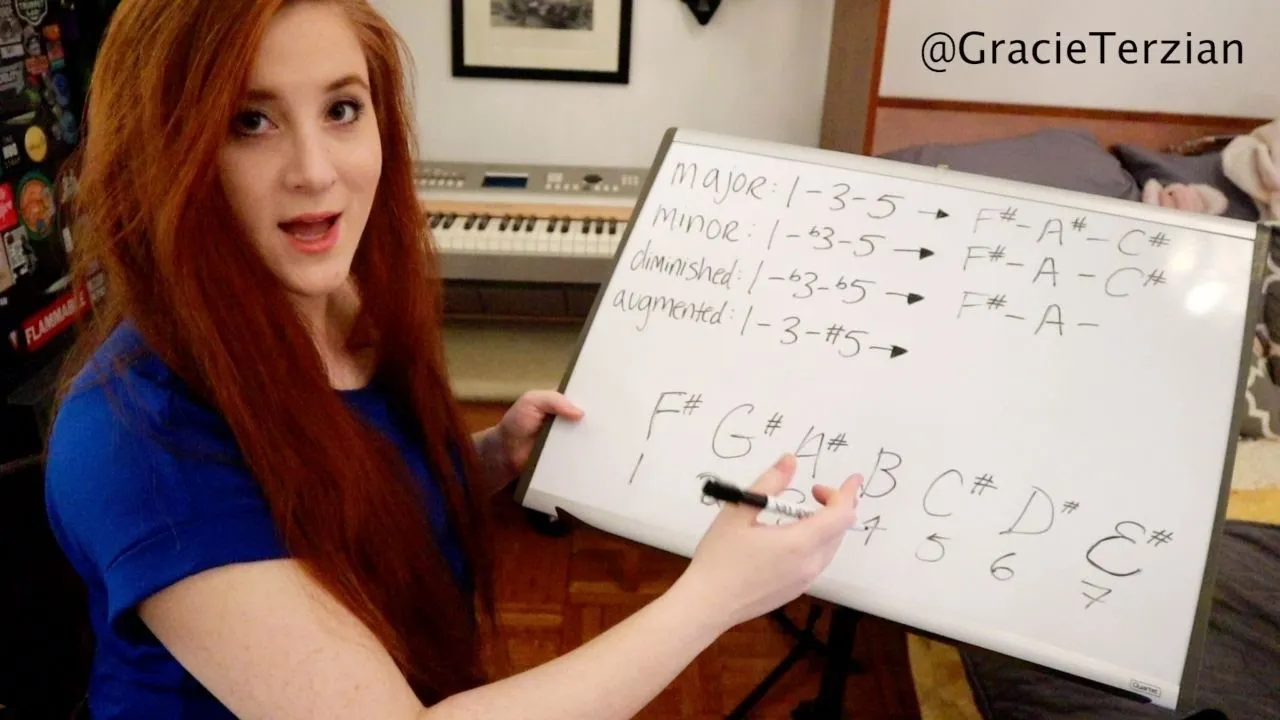
Easy Chord Theory - Triads and Intervals
271.6K
In a major triad (like C-E-G), the distance from the root to the 3rd is a major third (4 half steps), and from the 3rd to the 5th is a minor third (3 half steps). In a minor triad (like C-Eb-G), the distance from the root to the flat 3rd is a minor third (3 half steps), and from the flat 3rd to the 5th is a major third (4 half steps). The overall distance from the root to the 5th in both cases is a perfect fifth (7 half steps or 3 whole steps and 1 half step).
Click to watch →

Lesson 12 - Intervals
41.7K
The 13 simple intervals form the foundation of Western music, measured in half steps and whole steps. The minor second (half step) and major second (whole step) are the building blocks. The minor third is 3 half steps, major third is 4 half steps. The perfect fourth is 5 half steps, and the perfect fifth is 7 half steps. These are called 'perfect' intervals because they come directly from the three most important notes in music: 1, 5, and 8. The augmented fourth (6 half steps) and diminished fifth are the same interval, commonly called the tritone. Each interval has two names depending on which note it lands on in the musical number system.
Click to watch →

INTERVALLE AUF DER GITARRE - Crashkurs!
11.3K
Intervals are categorized as major, minor, or perfect based on their half-step count. Major intervals are larger, minor intervals are smaller, and perfect intervals remain consistent across scales. From C: major second (D, 2 half steps), minor second (Cb, 1 half step), major third (E, 4 half steps), minor third (Eb, 3 half steps), perfect fourth (F, 5 half steps), perfect fifth (G, 7 half steps). The tritone (6 half steps) is enharmonically equivalent to the augmented fourth and diminished fifth. Perfect intervals like the fifth appear in both major and minor keys.
Click to watch →
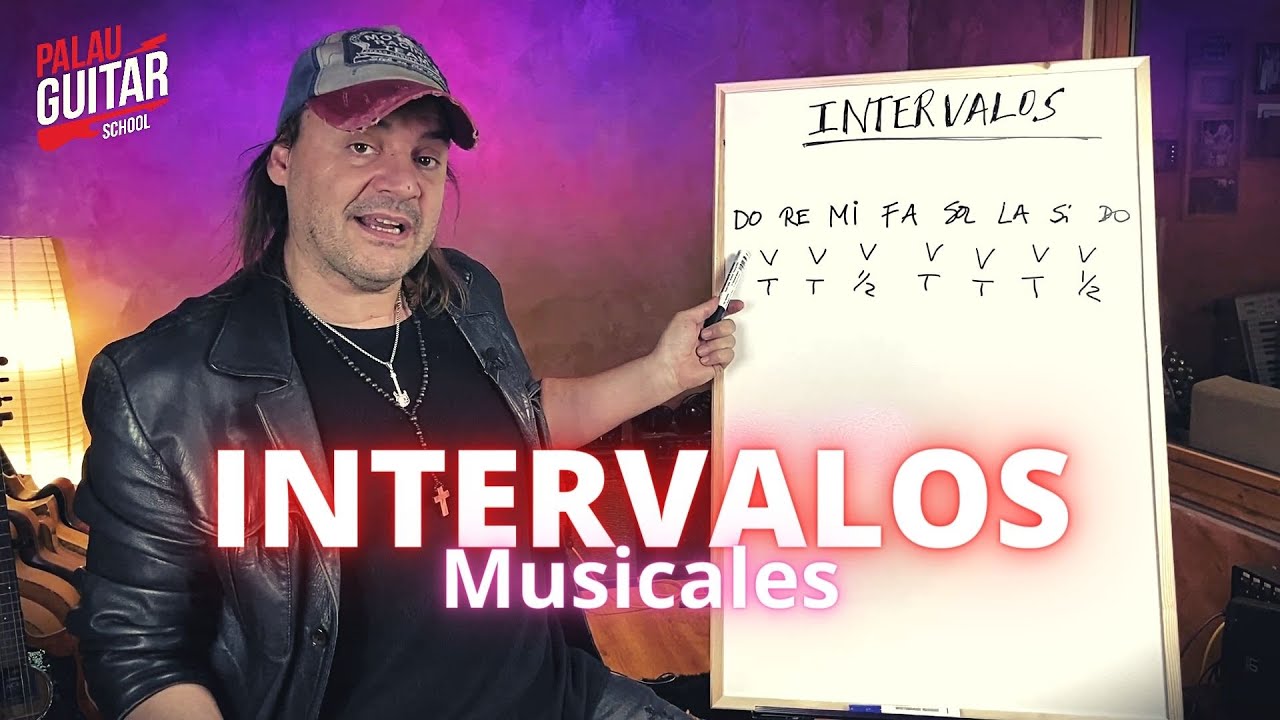
DAVID PALAU - Intervalos Musicales. COMPRÉNDELOS FÁCILMENTE !!
65K
Thirds are intervals spanning two tones (major third) or one and a half tones (minor third). The major third (Do to Mi) determines major chords, while the minor third (Do to Mi flat) determines minor chords. Fourths span two and a half tones (Do to Fa) and are called 'perfect' due to their stable sound. These intervals are measured by counting scale degrees: thirds span three degrees, fourths span four degrees. The perfect fourth is a fundamental consonant interval in Western music.
Click to watch →

TRINITY COLLEGE LONDON MUSIC THEORY WORKBOOK GRADE 3 PART 18 INTERVALS MAJOR AND MINOR 6TH AND 7TH
5.6K
Third intervals are classified as major (4 semitones) or minor (3 semitones). Fourth and fifth intervals are always perfect: perfect fourth is 5 semitones, perfect fifth is 7 semitones. Octave intervals are also perfect. For example, D to F sharp is a major third (4 semitones), while G to B flat is a minor third (3 semitones). B flat to F is a perfect fifth (7 semitones), and D to G is a perfect fourth (5 semitones).
Click to watch →
Deep Dive
Pitch-class space and octave equivalence (treating notes of the same name in different octaves as the same)
Post-Tonal Theory: Pitch Class
13.3K
In post-tonal music theory, octave equivalency establishes that all pitches one or more octaves apart are considered the same, enabling classification into pitch classes (e.g., every A, regardless of octave, belongs to the A pitch class); unlike tonal music where correct spelling indicates harmonic function, post-tonal music treats enharmonic equivalents (like C# and Db) as identical since pitches relate only to each other, not to a central tonic.
Click to watch →
The Chord That's Made Of Everything
40.5K
Notes that are an octave apart sound so similar that our ears process them as belonging to the same category, called a pitch class. All the G's across all octaves form one pitch class, and for the purposes of chord analysis, they are considered exactly the same. This principle allows musicians to treat notes separated by octaves as equivalent when analyzing harmonic structures.
Click to watch →
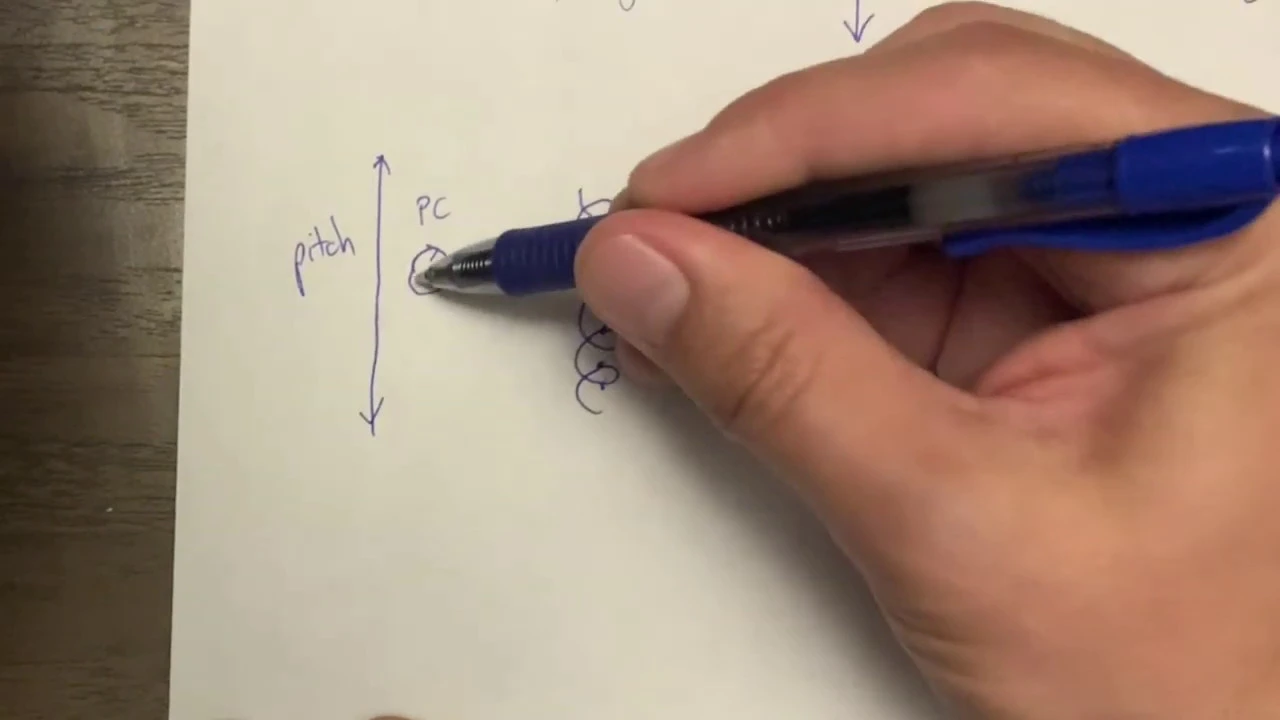
Episode 8: Pitch and the miracle of octave equivalence
381
Pitch in music has two dimensions: a linear continuum of highness/lowness and a circular dimension called pitch class, where notes an octave apart are perceived as equivalent despite being different frequencies; this 'miracle' of octave equivalence occurs because our inner ear's basilar membrane processes sounds in a way that makes pitches separated by octaves sound the same, similar to how meter combines linear time with circular rhythmic patterns.
Click to watch →

The Mathematical Problem with Music, and How to Solve It
852.3K
An octave is a musical interval corresponding to a frequency ratio of 2:1. For example, tones at 880 Hz and 440 Hz are an octave apart. Octaves are especially pleasant to the ear due to psychological phenomena called octave equivalence, where people perceive tones an octave apart as highly similar. Musicians call them by the same name (e.g., both 440 Hz and 880 Hz are called 'A'), and musicologists say they belong to the same pitch class.
Click to watch →
2.7 The Grand Staff and Pitch Notation (Music Theory and Ear Training Course)
1.1K
Pitch class groups all notes sharing the same letter name across all octaves. For example, all Cs belong to pitch class C, and all Ds to pitch class D. This concept only applies to notes separated by whole octaves; enharmonically related notes like C-sharp and D-flat are different pitch classes despite sounding identical. The seven-letter system evolved from church modes. Pitch class doesn't indicate octave or height—only the letter name and accidental.
Click to watch →
Deep Dive
Introductory understanding of geometric lattices or graph theory (vertices, edges, and faces)

Vértice, aresta e face
184.1K
In three-dimensional geometric figures, a vertex is the point where two line segments meet, an edge is the line segment connecting two vertices, and a face is the flat surface enclosed by edges and bounded by vertices; for example, a parallelepiped has 8 vertices, 12 edges, and 6 faces.
Click to watch →
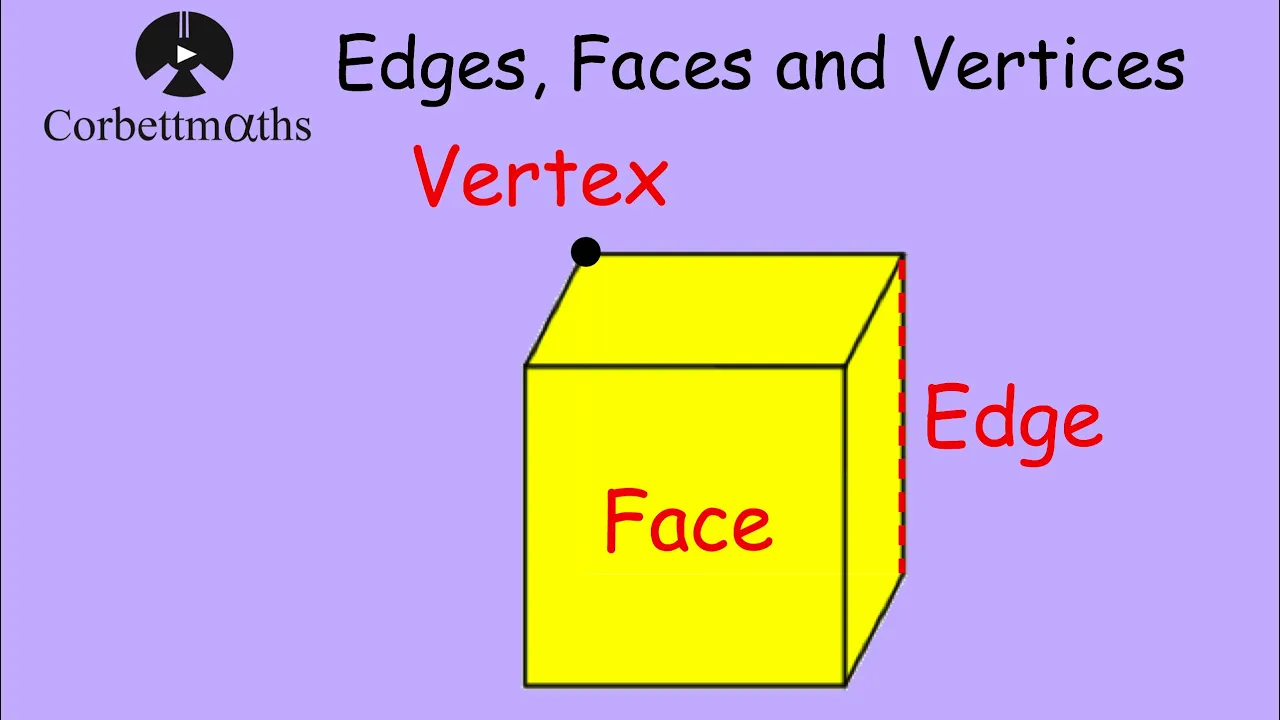
Edges, Faces and Vertices - Corbettmaths
116.8K
In three-dimensional geometry, a face is an individual flat surface of a shape (such as the six squares on a cube), a vertex (plural: vertices) is a corner where edges meet (a cube has eight vertices), and an edge is a line segment joining two vertices; common examples include a cube with 6 faces, 8 vertices, and 12 edges; a square-based pyramid with 5 vertices, 5 faces, and 8 edges; a triangular prism with 6 vertices, 5 faces, and 9 edges; a cuboid with 8 vertices, 6 faces, and 12 edges; and a pentagonal prism with 10 vertices, 7 faces, and 15 edges.
Click to watch →

VÉRTICE, FACE E ARESTA | CUBO, PIRAMIDE E PRISMA | GEOMETRIA ESPACIAL
323K
In three-dimensional geometry, a vertex is a point where edges meet (like the corners of a cube), an edge is a line segment formed by the intersection of two faces, and a face is a flat planar surface; for example, a cube has 8 vertices, 12 edges, and 6 square faces, while a pentagonal pyramid has 6 vertices and 10 edges, and a triangular prism has 6 vertices and 9 edges.
Click to watch →

Faces, Edges and Vertices - Understanding Elementary Shapes | Class 6 Maths
62.5K
In 3D shapes, a face is a flat surface, an edge is a line segment where two faces meet, and a vertex is a point where three or more edges meet; for example, a cube has 6 faces, 12 edges, and 8 vertices, while a pyramid has 4 faces, 5 edges, and 4 vertices.
Click to watch →
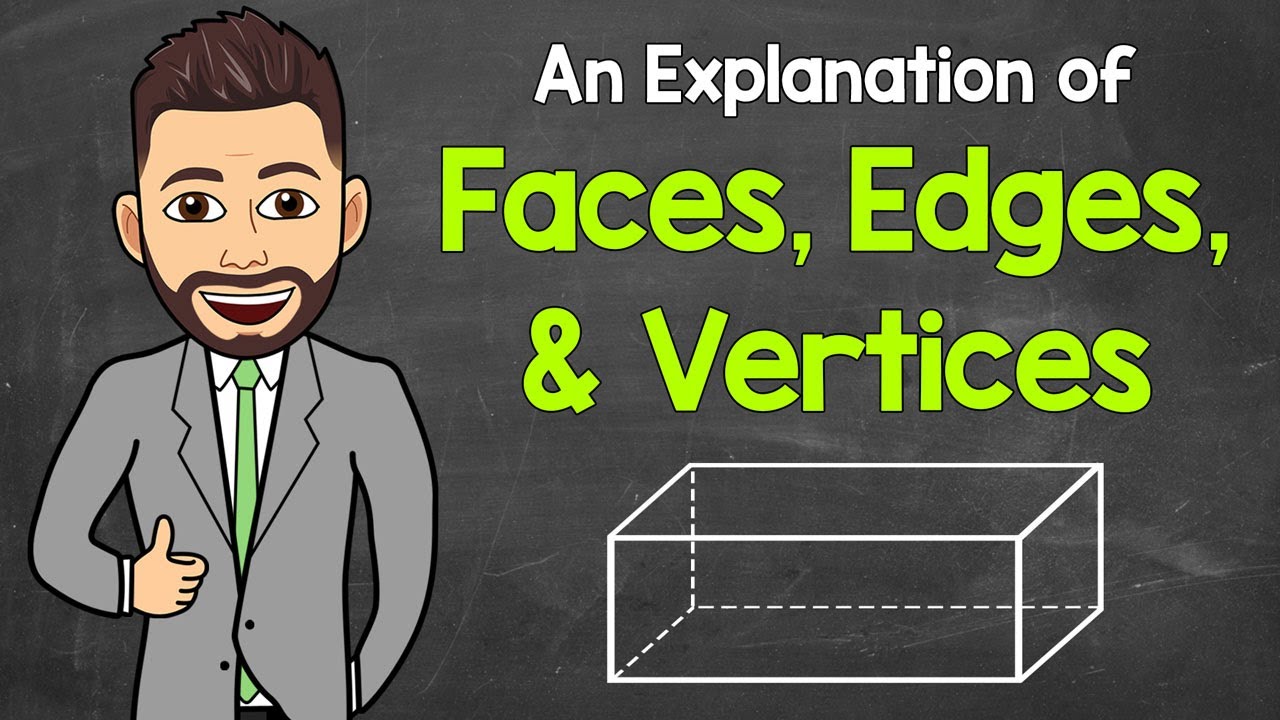
Faces, Edges, and Vertices | How to Identify and Count | Polyhedra | Geometry | Math with Mr. J
338.2K
In geometry, faces are the flat surfaces of a 3D shape, edges are the line segments where two faces meet, and vertices (plural of vertex) are the corners or points where three or more edges intersect; for example, a rectangular prism has 6 faces, 12 edges, and 8 vertices, while a square pyramid has 5 faces, 8 edges, and 5 vertices.
Click to watch →
Prerequisite Knowledge
- Concept 01Basic construction of major and minor triads in Western music theory
- Concept 02The concept of musical intervals, specifically perfect fifths, major thirds, and minor thirds
- Concept 03Pitch-class space and octave equivalence (treating notes of the same name in different octaves as the same)
- Concept 04Introductory understanding of geometric lattices or graph theory (vertices, edges, and faces)
Subsequent Learning
- Step 01Neo-Riemannian theory and the PLR (Parallel, Leading-tone, Relative) transformations
- Step 02Analysis of late-Romantic and cinematic music (e.g., Wagner, John Williams) using the Tonnetz model
- Step 03Mathematical music theory and the application of group theory to chord progressions
- Step 04Advanced geometric music theory, including higher-dimensional orbifolds and voice-leading spaces
Tonets Intro
Tonets Intro
0:00Playing Section
- 1
Introduces triangular note layout called tonets, created by Euler in 1739.
- 2
Maps chords to geometric shapes, linking harmony with visual patterns.
- 3
Consonant chords appear simple; dissonant ones create complex shapes.
Linear Voice-Leading and Functional Tonal Hierarchy
While Euler's Tonnetz and modern Neo-Riemannian theory excel at visualizing triadic relationships through abstract geometry, critics argue this spatial representation overlooks the temporal, hierarchical, and functional nature of tonal music. Traditional functional harmony and Schenkerian analysis offer a powerful counterpoint. They assert that harmony is not merely a set of geometric transitions between isolated chords, but a hierarchical system governed by a tonal center (tonal gravity) and linear voice-leading. In Schenkerian theory, chords are often passing events generated by horizontal, contrapuntal motion rather than self-contained spatial coordinates. Opponents argue that by treating all triadic transitions as equal on a grid, the Tonnetz abstracts music away from the goal-directed, time-bound cognitive experience of listening to functional harmonic resolution.
Deep Dive
Neo-Riemannian theory and the PLR (Parallel, Leading-tone, Relative) transformations
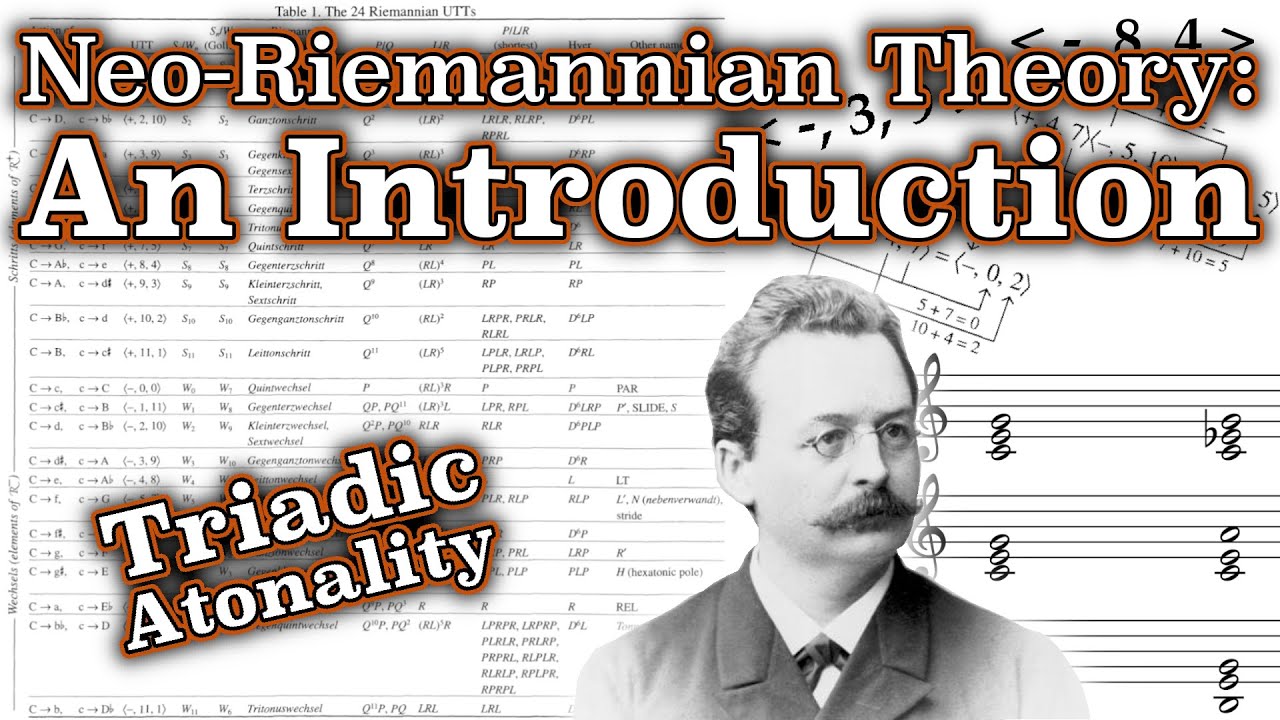
Neo-Riemannian Theory: Transformations & Hexatonic Poles
79.8K
Neo-Riemannian theory, developed by theorists including David Lewin, Richard Cohn, Henry Klumpenhauer, and Brian Hyer based on Hugo Riemann's harmonic dualism, provides a system for analyzing triadic relationships without reference to traditional tonal key centers. The theory uses three basic invertible transformations (P for parallel, R for relative, and L for leading-tone exchange) that convert major triads to minor triads and vice versa while maintaining maximally smooth voice leading. Secondary transformations (N, S, H) extend these operations, and Uniform Triadic Transformations (UTTs) offer an algebraic shorthand using plus/minus signs and numerical values that add to 12 to represent any triadic relationship. This analytical framework is particularly suited for studying music that uses tonal harmonies without functional tonality, such as works by Strauss, Wagner, and Schnittke.
Click to watch →
Neo-Riemannian Triad Transformations: PLR and Compound Inversions
23.1K
Neo-Riemannian Theory provides three elementary transformations (P: parallel minor, R: relative minor, L: leading-tone exchange) that move between major and minor triads by thirds with two common pitches, which correspond to Schillinger's diatonic root cycles (r3i and r4i); compound transformations (PL, PR, RP, LP) create chromatic mediant progressions with single common pitches and have specific narrative associations in film music (magic, hero, eerie, sinister), while symmetric scales formed by combining triads along the r3i and r4i axes produce diminished seventh and octatonic scales used in Bartók and Stravinsky's works.
Click to watch →
Riemannian Transformations: Part 3 "Order, order, order!"
2.9K
This section establishes the theoretical framework for understanding third-order transformations. It covers the Triad Doughnuts diagram structure depicting chromatic pitch classes and triads, the three elementary Neo-Riemannian transformations (Parallel, Relative, Leading tone exchange), and Schillinger's classification of root cycles into diatonic systems (horizontal, descending thirds) and symmetric systems (diagonal, three/four semitone movements). These foundational concepts enable systematic analysis of chord connections through geometric paths.
Click to watch →

Neo-Riemannian Theory for Epic Chord Progressions
3.2K
Neo-Riemannian Theory provides a systematic framework for understanding how triads relate to each other through three basic transformations (P - Parallel, R - Relative, and L - Leading Tone Exchange), enabling composers to create epic chord progressions like those in The Lord of the Rings and Star Wars by navigating the Tonnetz diagram to connect mediant-related chords with minimal voice leading.
Click to watch →
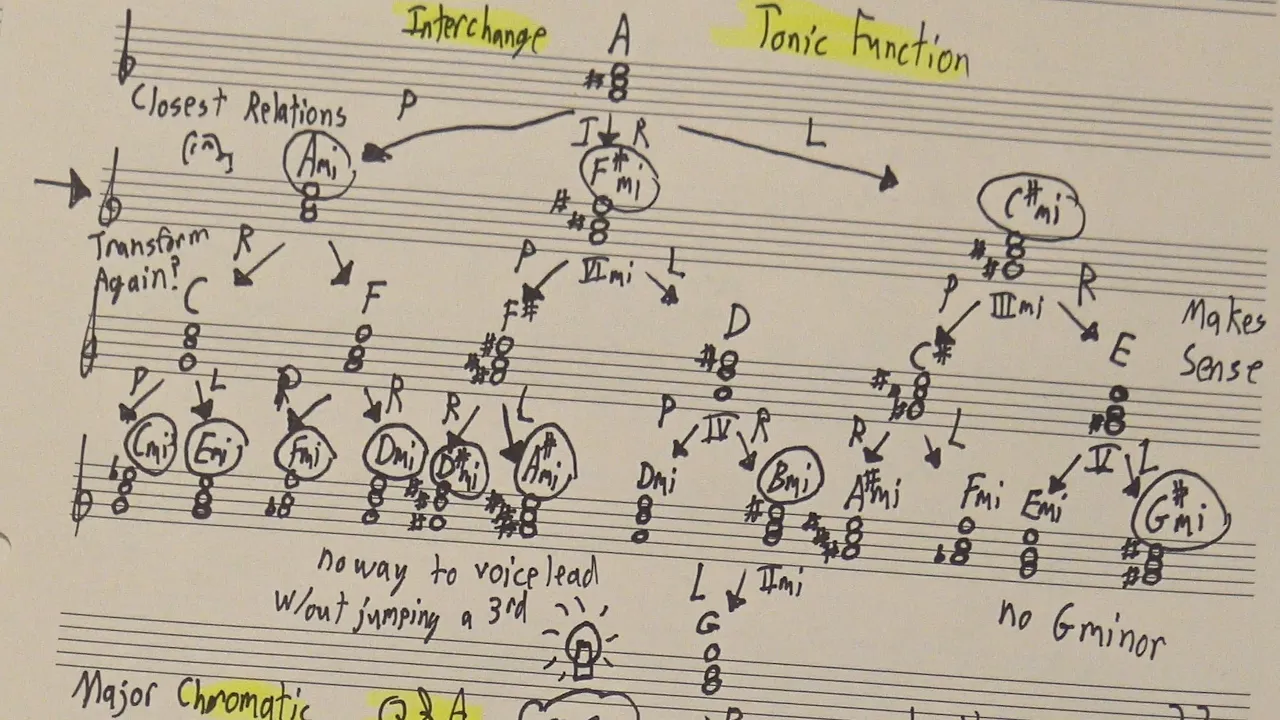
Neo-Riemannian Analysis Explained: A Music Theory Guide
76.4K
Neo-Riemannian analysis is a music theory framework that analyzes harmonic relationships using three basic transformations (P, R, L) that preserve two notes of a triad while changing the third, allowing for the exploration of chord connections without reference to a fixed tonal center; the P transformation (Parallel) maintains the root and fifth while switching between major and minor triads, the R transformation (Relative) moves the fifth up a whole step to become the root of a minor triad, and the L transformation (Leading Tone) moves the root down a half step to become the fifth of a minor triad, with compound transformations revealing relationships like chromatic mediants, secondary dominants, and hexatonic poles.
Click to watch →
Deep Dive
Analysis of late-Romantic and cinematic music (e.g., Wagner, John Williams) using the Tonnetz model
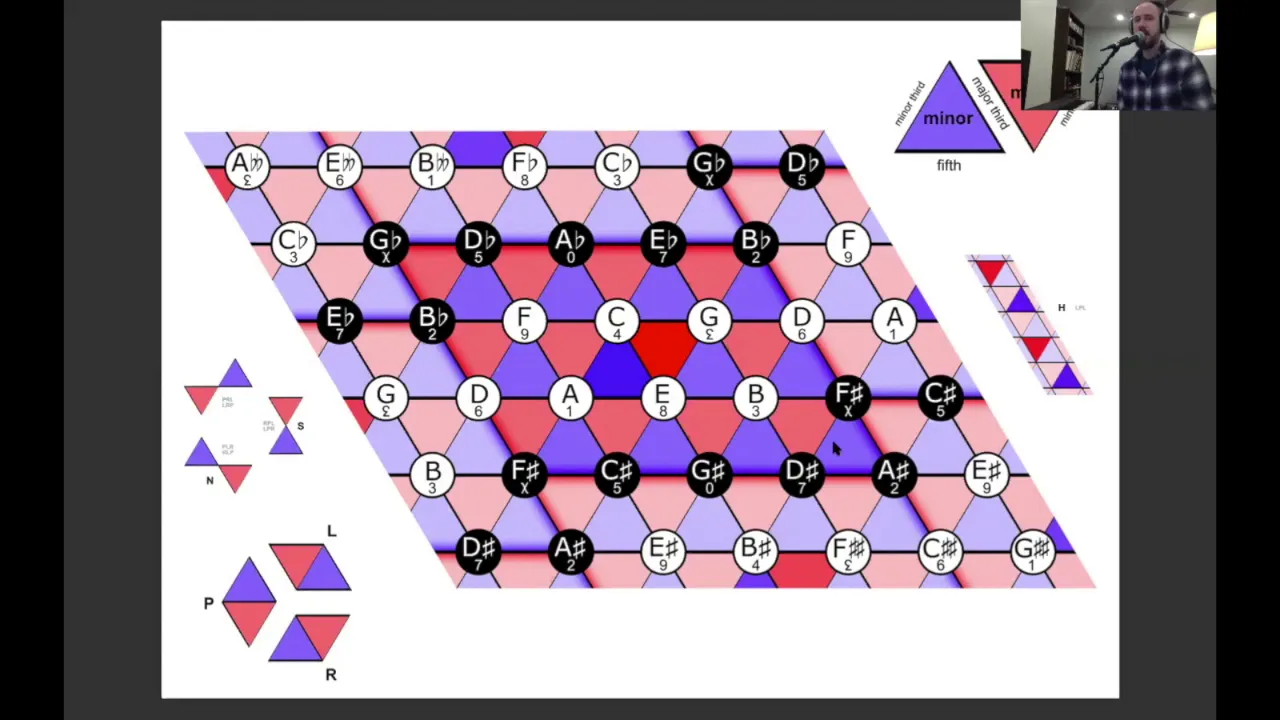
Using the Tonnetz
13.4K
The Tonnetz (German for 'tone network') is a visual tool that represents all possible major and minor triads as interconnected triangles, with blue indicating minor triads and red indicating major triads; this diagram allows musicians to clearly visualize the relationships between chords, including the P (parallel), L (leading tone), R (relative), and S (slide) transformations, by showing how chords connect through shared notes and common tones, making it easier to construct and analyze chord progressions.
Click to watch →
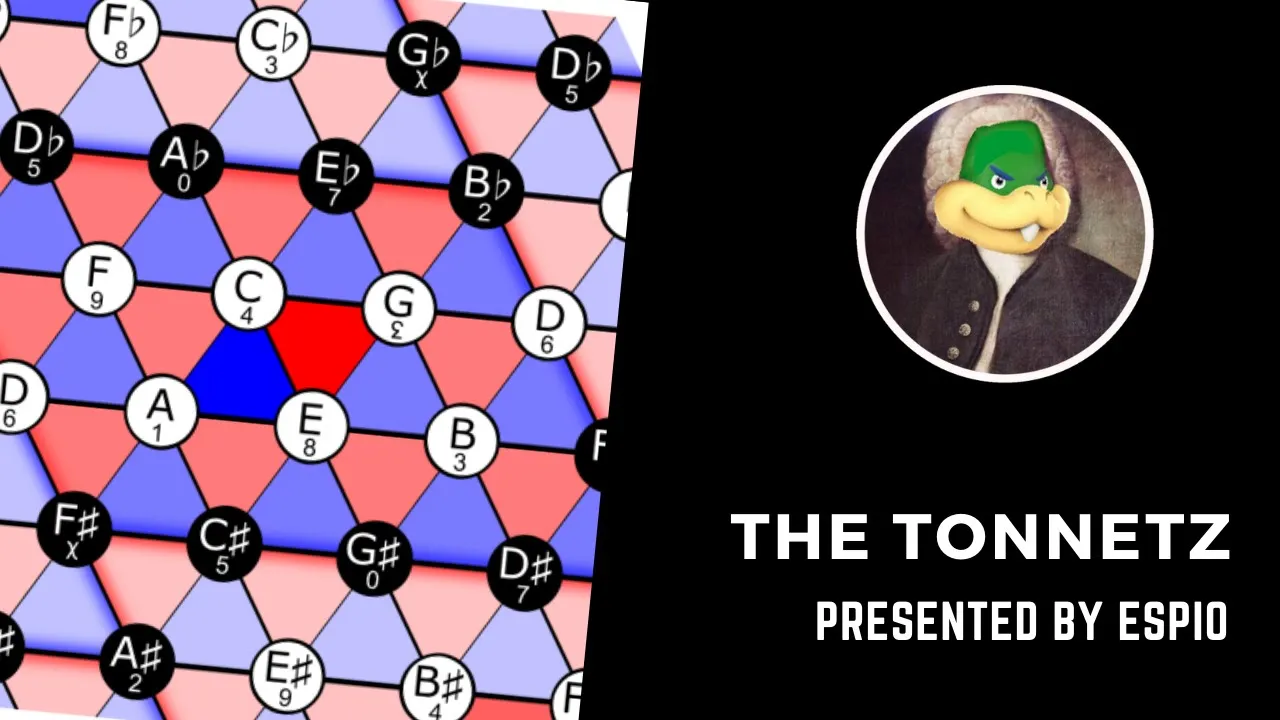
The Tonnetz Explained: Euler, Oettingen, Riemann & Vogel's Harmonic Networks
1.2K
The Tonnetz is a geometric representation of musical pitch relationships developed by mathematician Leonhard Euler, visualized as a torus (doughnut shape) where notes are arranged in a grid pattern with horizontal connections representing major thirds and vertical connections representing major fifths; this framework was later expanded by theorists like Hugo Riemann to develop transformation theory using P, L, and R operations for analyzing chord progressions, and further extended into three dimensions by Martin Vogel to analyze complex harmonies like the Tristan chord from Wagner's opera.
Click to watch →

Cómo Wagner influyó en el cine, la música y la forma de contar historias
5.6K
Many film composers, particularly John Williams, adopted Wagner's leitmotif technique. The distinctive sound of an imminent threat, an unsettling moment, or the seductive power of temptation all derive from this tradition. These musical cues have become so recognizable that audiences can identify them instantly, demonstrating how Wagner's innovations in musical storytelling fundamentally shaped the language of film music.
Click to watch →

Alain Franco - Histoire(s) de Musique
328
The fragmentation is no longer only of compositions but of the entire musical field. The 19th century may be less striking than the 20th and 21st centuries because the tonal consensus, instrumental centralism, and temperament ensure sonic unity, but retrospectively, there is already a fragmentation that is no longer only of compositions but of the entire compositional field. The concept of the total work of art by Wagner may have been the will to visualize what the partitions already contained. The speaker makes the supposition that Wagner was perhaps the first composer to be in need of a film strip, which was invented around the same time as the construction of Bayreuth. No rupture is identified between an avant and after of the tonal system or thematism.
Click to watch →

25 Practical Tonnetz Chart Applications: Chords & Scales
33.1K
The Tonnetz chart is a visual tool that arranges the 12 chromatic notes in a grid where moving left to right increases by perfect fifths, moving diagonally up increases by major thirds, and moving diagonally down increases by minor thirds. This arrangement enables musicians to identify chord structures, scales, and intervals by recognizing geometric patterns: major triads form downward-pointing triangles, minor triads form upward-pointing triangles, suspended chords form horizontal lines, and symmetrical chords like augmented triads and diminished triads follow diagonal lines. The chart can be used to quickly determine chord members (major, minor, seventh, ninth, thirteenth), scale notes (major, natural minor, pentatonic), and modes (Ionian, Dorian, Phrygian, Lydian, Mixolydian, Aeolian, Locrian) for any key, making it a practical tool for understanding harmonic relationships and improvisation.
Click to watch →
Deep Dive
Mathematical music theory and the application of group theory to chord progressions

Teoría de grupos 101: Cómo tocar un cubo de Rubik como un piano - Michael Staff
24.6K
Group theory is a branch of abstract mathematics that studies collections of elements following four fundamental axioms: closure (operations stay within the group), associativity (parentheses don't change results), identity (an element that leaves others unchanged), and inverses (elements that cancel each other out). These axioms apply universally, whether to Rubik's cube rotations, integer addition, or musical chord inversions. Groups can contain many elements representing possible configurations or states, with larger groups having exponentially more permutations. This mathematical framework enables systematic analysis of complex systems, allowing solvers to determine solution sequences for puzzles like the Rubik's cube and helping composers understand chord progressions. The same principles that govern mathematical operations also underlie musical structure, demonstrating how abstract algebra provides a unifying language for understanding diverse phenomena.
Click to watch →
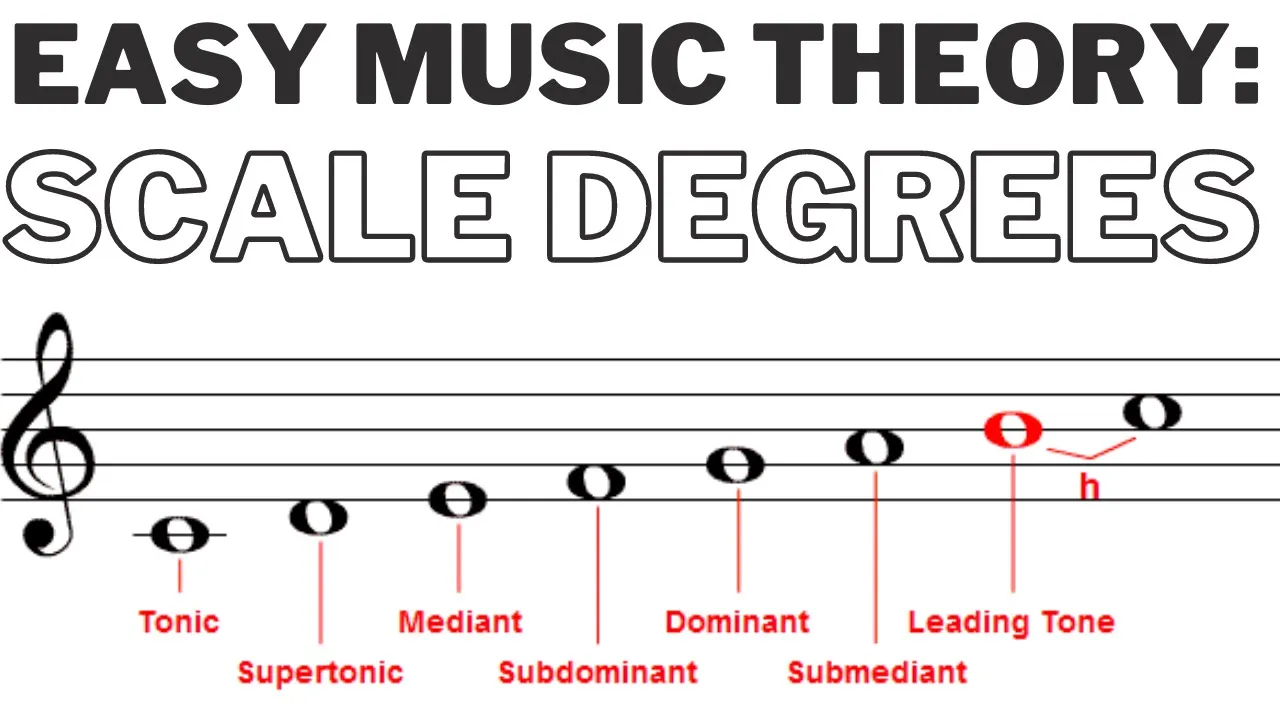
Easy Music Theory: Scale Degrees and Chords | FL Studio
13.9K
Scale degrees (numbered 1-7) provide a universal notation system for understanding chords and progressions across any musical scale, where the root note (1) serves as the comfortable starting point, while notes like 3, 5, and 7 offer varying levels of comfort and tension resolution, and the 1-7-5-6 progression demonstrates how chords can create a musical journey from home (1) through tension (7, 6) to resolution (5), with all scales sharing the same notes but differing only in notation and root position.
Click to watch →
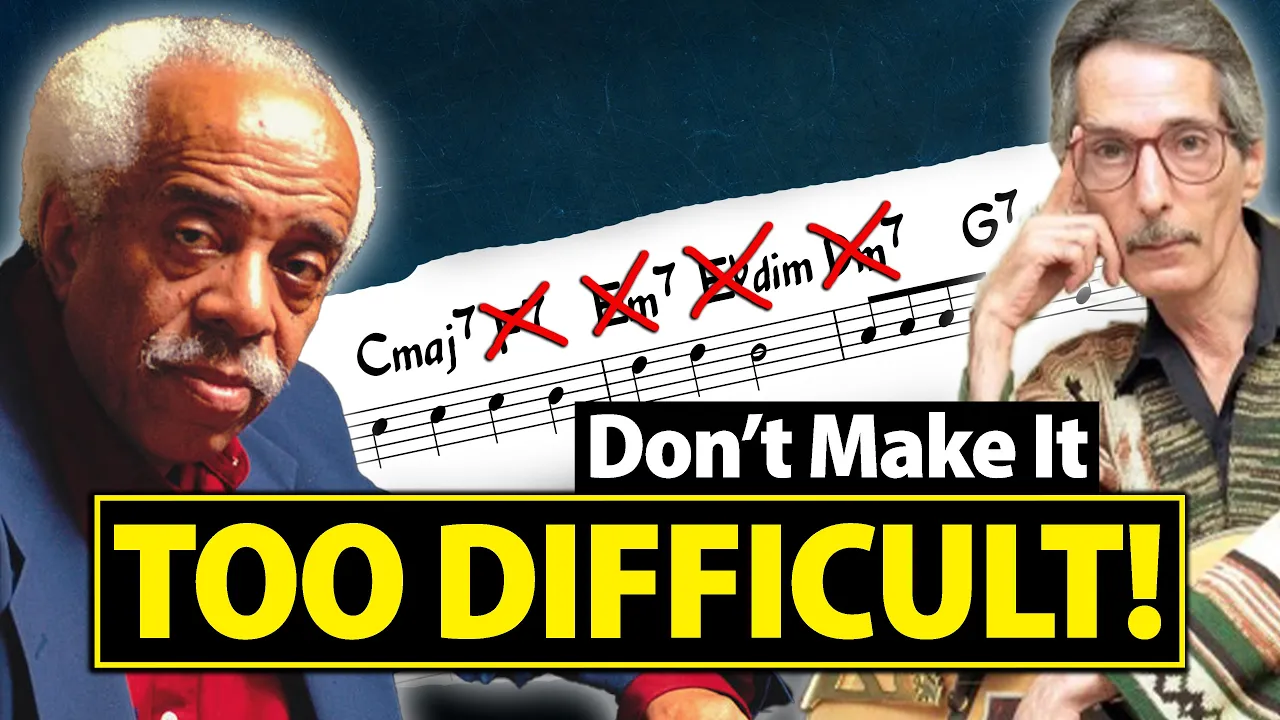
Don't think ALL The Chords! - Jazz Progression Secrets
47.7K
Grouping chords in progressions provides two main advantages: first, it reduces the amount of chords to track; second, it helps understand how progressions are similar even if they have different chords. Once this skill is developed, players have tools to create chunks that are easy to remember when learning songs, and can reference similar progressions in other songs. This makes learning jazz much easier and helps remove difficult things like memorizing chord progressions.
Click to watch →
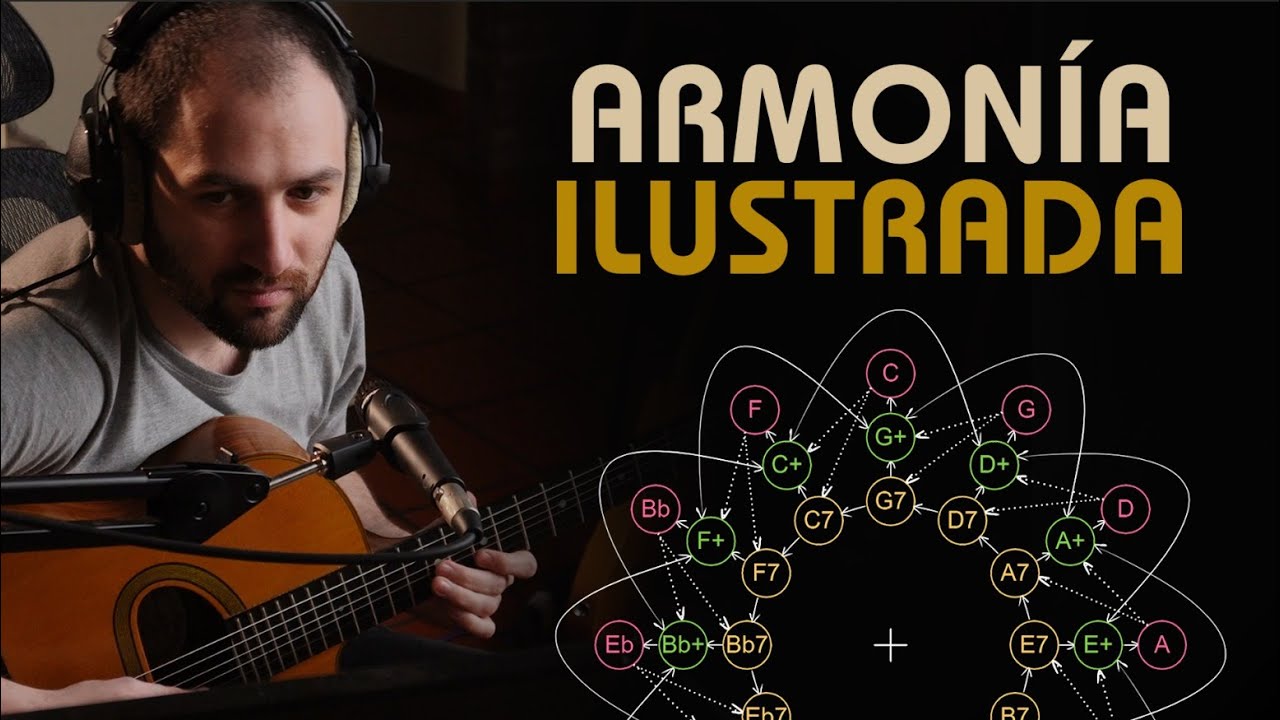
ARMONIA ILUSTRADA - BRIAN CALLI!!!
2.9K
Brian Calli explains how he applies graph theory to music theory by representing chords as nodes connected by arrows indicating possible transitions. For example, a G major chord can resolve to either C major or C minor, creating a node with two outgoing arrows. From C major, you can move to F major, and from F major, you can return to G major or move to other chords. This creates a visual map of musical possibilities, allowing composers to see all available paths and make informed decisions about chord progressions. Brian notes that this approach helps identify loops and patterns that can be used for composition, and he emphasizes that mathematical approaches provide algorithms for finding the shortest path, longest path, most unused path, or most tense path within a musical structure.
Click to watch →

Вся теория музыки за 90 минут #piano #теориямузыки #фортепиано
51.9K
Mode refers to sound relationships where each sound has a specific role. The first step is the tonic, the central sound others gravitate toward. Major mode has bright, joyful sound; minor mode has soft, sad sound. A tonality is a mode built from a specific tonic. There are 12 tones, each capable of supporting one major and one minor mode (24 tonalities), though enharmonic equivalence creates 30 unique tonalities. The major scale pattern is: whole tone, whole tone, semitone, whole tone, whole tone, whole tone, semitone. The Circle of Fifths geometrically represents tonalities: major keys on outer circle (capital letters), minor keys on inner circle (capital letter with 'm'). Starting from C major (no sharps/flats), moving clockwise by perfect fifths (7 semitones) gives: C, G, D, A, E, B, F#, C#, G#, D#, A#, F. Moving counterclockwise gives flat keys: C, F, Bb, Eb, Ab, Db, Gb, Cb. The three bottom sectors contain enharmonically equivalent tonalities. The natural minor scale pattern is: whole tone, semitone, whole tone, whole tone, semitone, whole tone, whole tone. Harmonic minor differs by raising the seventh degree (creating a leading tone that resolves to the tonic). Melodic minor differs by raising both sixth and seventh degrees when ascending, and lowering them when descending. A triad is a chord of three notes stacked in thirds. The tonic triad (built on the first degree) is the most stable chord. Stable steps are the first, third, and fifth degrees; unstable steps (second, fourth, sixth, seventh) require resolution to stable steps. The three primary triads in a major key are: tonic (I), subdominant (IV), and dominant (V). Triads are classified by interval structure: major triads (major third + minor third) create bright, open sound; minor triads (minor third + major third) create sad, lyrical sound; augmented triads (two major thirds) create mysterious, uncertain sound; diminished triads (two minor thirds) create tense, anxious sound. Relative tonalities are closely related through shared chords: from any key, there are 6 relative tonalities built on its degrees. Modulation temporarily shifts to a new tonality, creating harmonic interest. Chord symbols indicate which chords to play: capital letters indicate major triads; capital letters with 'm' indicate minor triads; slashes indicate inversions. Roman numerals indicate chord functions relative to the key. Seventh chords consist of four notes stacked in thirds: major seventh, minor seventh, dominant seventh. The dominant seventh has particularly strong resolution tendency to the tonic.
Click to watch →
Deep Dive
Advanced geometric music theory, including higher-dimensional orbifolds and voice-leading spaces

SIAM AN10: Dmitri Tymoczko Discusses Geometry in Music
18.3K
Music can be understood through geometric principles, where notes are represented as points in a musical space and melodies involve moving between nearby points; this geometric framework explains why certain music sounds ordered and pleasant while other music sounds random, and it reveals that Chopin's 1828 E Minor Prelude, despite being mysterious to musicians for centuries, can be explained by advanced geometric concepts like orbifolds and Mobius strips that were not formally studied until decades later.
Click to watch →

Prof. Dmitri Tymoczko (Princeton) "The Shape of Music"
5.2K
Instead of representing chords with multiple points on a one-dimensional circle, mathematicians represent chords with one point on a two-dimensional space called the configuration space. For two-note chords, this is the two-dimensional torus. The space of two-note chords is a Mobius strip with mirror-like properties. The space of three-note chords is a three-dimensional triangular prism with its top edge glued to its bottom edge. The space of four-note chords is a four-dimensional tesseract. In Chopin's E minor Prelude, Chopin moves between notes that form a circle of fifths, represented on this space by a rigorous pattern. Structures that are totally difficult to understand in notation become much more accessible when viewed from a geometrical point of view. This approach reveals deep structures linking different tonal genres from traditional Bach Harmony to romantic trickery to scale manipulations in Shostakovich or Steve Reich to contemporary rock music.
Click to watch →
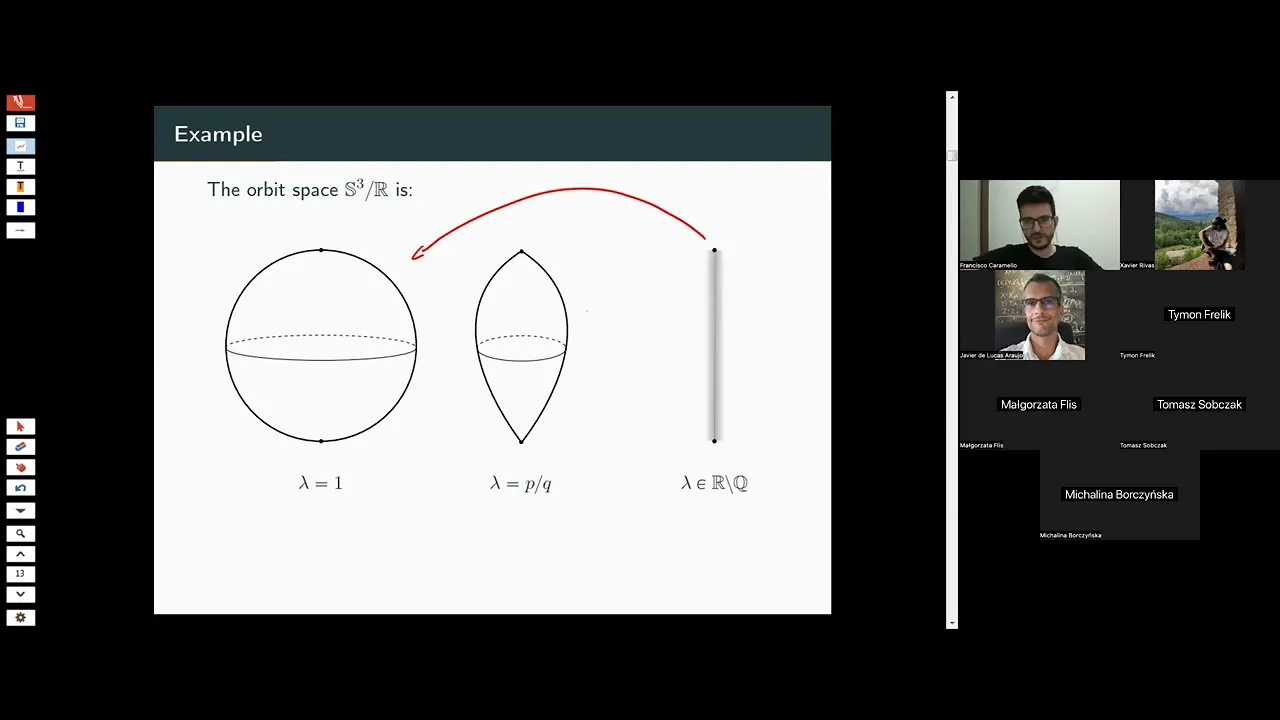
Francisco Caramello --- Orbifolds: and introduction with applications to foliations
134
The category of manifolds contains perfectly smooth objects, but this very regularity creates fundamental algebraic problems: limits and quotients typically fail to produce manifolds. This crisis motivates orbifolds as a more flexible framework that retains much of the manifold formalism while allowing better behavior under operations like taking quotients. An orbifold chart consists of an open Euclidean set, a finite group acting smoothly and effectively, and an invariant map to the underlying space whose quotient is a homeomorphism. Charts are compatible via embeddings respecting group homomorphisms. Manifolds are trivial orbifolds with trivial local groups. Quotients of manifolds by properly discontinuous Lie group actions yield orbifolds called 'good' or 'developable.' The simplest non-manifold orbifold is a cone: quotient of the plane by cyclic rotation group, featuring a single singular vertex lacking a well-defined tangent space. Musical chords provide a beautiful application: modeling tones as frequencies on a circle, chords as points in tori Tⁿ, and quotienting by symmetric groups yields orbifolds where Möbius strips represent two-note chords and Möbius prisms represent three-note chords, with singularities encoding repeated-note configurations.
Click to watch →

Dr. Dmitri Tymoczko - The geometry of music
29.3K
Dr. Dmitri Tymoczko explains how core concepts in music theory can be translated into contemporary geometric language. He introduces the "OPTIC transformations" — five types of musical transformations that musicians use to form equivalence classes of musical objects, such as chord, chord type, chord progression, voice leading, and pitch class. These equivalence classes are represented as points in singular quotient spaces known as orbifolds. For instance, two-note chords are modeled on a Möbius strip, where the boundary functions as a mirror, reflecting symmetries in musical structure. Four-note chord types are represented on a cone over the real projective plane, illustrating higher-dimensional musical relationships. The geometric representation reveals structural constraints that govern musical style and specific compositions. By visualizing music in these spaces, listeners and analysts can better understand how musical elements relate across transformations. The talk emphasizes the utility of interactive 3D computer models that allow simultaneous visualization and auditory experience of music, making abstract theoretical concepts tangible. This approach bridges music theory and geometry without requiring prior musical expertise, offering a novel framework for analyzing musical patterns through spatial reasoning.
Click to watch →

Guillermo Sienra - Islas y Orbifolios
210
This section introduces orbifolds as geometric objects modeling finite group actions on spaces, locally modeled on C with rotations or translations. The lecture explains that orbifolds capture branching behavior by assigning local degrees at each point. One-dimensional orbifolds are classified by their characteristic class (Euler characteristic): elliptic (characteristic > 0, covered by sphere), parabolic (characteristic = 0, covered by C), and hyperbolic (characteristic < 0, covered by hyperbolic plane). The signature specifies local degrees at cone points where degree exceeds 1.
Click to watch →
Tonets Intro
Tonets Intro
0:00- 1
Introduces triangular note layout called tonets, created by Euler in 1739.
- 2
Maps chords to geometric shapes, linking harmony with visual patterns.
- 3
Consonant chords appear simple; dissonant ones create complex shapes.
Linear Voice-Leading and Functional Tonal Hierarchy
While Euler's Tonnetz and modern Neo-Riemannian theory excel at visualizing triadic relationships through abstract geometry, critics argue this spatial representation overlooks the temporal, hierarchical, and functional nature of tonal music. Traditional functional harmony and Schenkerian analysis offer a powerful counterpoint. They assert that harmony is not merely a set of geometric transitions between isolated chords, but a hierarchical system governed by a tonal center (tonal gravity) and linear voice-leading. In Schenkerian theory, chords are often passing events generated by horizontal, contrapuntal motion rather than self-contained spatial coordinates. Opponents argue that by treating all triadic transitions as equal on a grid, the Tonnetz abstracts music away from the goal-directed, time-bound cognitive experience of listening to functional harmonic resolution.
Basic construction of major and minor triads in Western music theory
The concept of musical intervals, specifically perfect fifths, major thirds, and minor thirds
Pitch-class space and octave equivalence (treating notes of the same name in different octaves as the same)
Introductory understanding of geometric lattices or graph theory (vertices, edges, and faces)
Neo-Riemannian theory and the PLR (Parallel, Leading-tone, Relative) transformations
Analysis of late-Romantic and cinematic music (e.g., Wagner, John Williams) using the Tonnetz model
Mathematical music theory and the application of group theory to chord progressions
Advanced geometric music theory, including higher-dimensional orbifolds and voice-leading spaces
2.2M views81.6Klikes1:22@reuben_levineOriginal Release: 2025-05-18
You might be used to seeing the 12 notes laid out like this, or maybe like this. But today, I'm going to try to convince you to start thinking of notes like this. This triangular layout of musical notes is called the tonets. And it turns out to be crazy useful for understanding concepts in music theory.
It was introduced all the way back in 1739 by the legendary Swiss mathematician Leonard Oiler. You might know him as the guy responsible for the E key on your calculator. Oiler constructed the tonnets out of chains of repeating intervals, major thirds, minor thirds, and fifths in an interlocking web repeating infinitely in all directions. The effect of this unique layout is that any chord, interval, or scale in music can be represented as a shape on the tonet grid. But here's why that's so cool. The tonets creates a visual link between harmony and geometry. Consonant sweet sounding chords like the major 7th and minor 7th appear as beautifully simple shapes. On the other hand, dissonant chords, ones with crunchy or unstable sounds, create strange, wackier shapes. It's like the tonets doesn't just visualize a chord, it visualizes its feeling as well.
There's a lot more to say about the tonets. So, make sure you drop a follow to see part two where we're going to talk more about the math of the tonets, including how to reimagine it in 3D.
Peace.
Up Next
23:36
25 Practical Tonnetz Chart Applications: Chords & Scales
@zombieguitar
33.1K views•2022-08-27

10:20
Mozart's Musical Dice Game Explained: History, Rules, & Fun
@webpianoacademy
5K views•2023-03-13

47:36
Understanding Diatonic 7th Chords in Major Keys | Music Theory Tutorial
@GracieTerzian
54.7K views•2022-03-02
10:49
Understanding John Coltrane's Giant Steps: A Music Theory Analysis
@Vox
10.4M views•2018-11-12
Related Study Plans & Knowledge Roadmaps
Structured learning paths in Music Theory
music-theory
Composing Galant Music: Partimento & Schemata
01Foundations of Figured Bass and Keyboard Harmony
02The Rule of the Octave (Regola dell'Ottava)
03Galant Schemata: The Building Blocks of Form
+ 2 more learning modules
30h5 modules
Explore Roadmap
music-theory
Decoding Overtone Series: Tuning & Drone Music
01Acoustic Foundations: The Physics of the Overtone Series
02Tuning Systems: Equal Temperament vs. Just Intonation
03Microtonality and Spectralism: Beyond Standard Pitches
+ 2 more learning modules
24h5 modules
Explore Roadmap
music-theory
Impressionist Harmony: Scales, Planing & RPGs
01Foundational Music Theory: Keys, Intervals, and Seventh Chords
02Impressionist Color: Chord Planing and Parallel Harmony
03Whimsical Textures: Pentatonic Cascades and Whole-Tone Scales
+ 1 more learning modules
14h4 modules
Explore Roadmap
music-theory
Negative Harmony: Axis Reflection in Indie Pop
01Music Theory Foundations: Scales, Intervals, and Triads
02Functional Harmony and the Circle of Fifths
03Demystifying the Negative Harmony Axis Reflection
+ 2 more learning modules
16h5 modules
Explore Roadmap