Max Horkheimer, a leading figure of the Frankfurt School, argued that Enlightenment reason became 'instrumental reason'—a force that reduced human judgment to technical efficiency and market logic, creating 'pseudo-individuality' where consumers falsely believe they express uniqueness through commodity consumption while actually conforming to standardized production systems; this critique remains relevant today as markets pervade all aspects of life, reducing human flourishing to mere economic calculation.
Max Horkheimer's Critique of Instrumental Reason | Critical Theory
Added:Deep Dive
The fundamental philosophy of the Enlightenment, particularly Immanuel Kant's definition of reason, human autonomy, and intellectual progress.

German Literature of the Enlightenment | History of German Literature Episode 01
737
The Enlightenment was defined by Immanuel Kant as 'man's emergence from his self-imposed immaturity,' where immaturity means inability to use one's own reason without guidance. This philosophy rests on three pillars: (1) Reason as the measure of all things, beliefs, judgments, and actions; (2) Individual maturity and autonomy, meaning individuals should reach their own conclusions rather than follow authority; (3) Freedom of thought and action. These ideas challenged the dominant political system of absolutism, where rulers claimed divine right and were above the law, and the religious worldview where Christianity held sovereignty over ethical and existential questions. The Enlightenment's demand for reason-based orientation and individual freedom had enormous political and religious explosive power, contributing to revolutions like the French Revolution and US War of Independence.
Click to watch →
![Séptima clase de Filosofía (Unidad 3, apartados 1 a 4) [Curso de Ingreso UNLaM]](https://i.ytimg.com/vi/eMAEQdckUBQ/maxresdefault.jpg)
Séptima clase de Filosofía (Unidad 3, apartados 1 a 4) [Curso de Ingreso UNLaM]
9K
Immanuel Kant conceived the Enlightenment as the emancipation of humans - their independence and liberation. He defined enlightenment as 'the exit of man from his self-imposed immaturity.' This immaturity is not chronological but refers to a lack of self-consciousness - humans were not aware that they could think for themselves. Like an adult who behaves like a child, depending on others for decisions, humans were not autonomous. The Enlightenment called for 'Sapere aude' - 'Dare to think' - encouraging humans to use their own understanding without external guidance. The Enlightenment achieved a freedom that is responsible - humans began to give themselves norms that arise from within and are not imposed from outside. This is the principle of autonomy. The great Enlightenment values are liberty (all humans are free), utility (humans seek what benefits them), and equality (all citizens enjoy the same rights and obligations, and are equal before the law).
Click to watch →

What is Enlightenment? (Immanuel Kant)
166.4K
Immanuel Kant defined Enlightenment as humanity's emergence from self-imposed intellectual immaturity (nonage), characterized by the lack of courage to use one's own understanding without external guidance; he argued that freedom—specifically the freedom to publicly use one's reason—is the essential condition for enlightenment, and that individuals have a sacred duty to think for themselves rather than passively accepting authority, making Enlightenment fundamentally about human dignity and the right to autonomous judgment.
Click to watch →

Introdução à Filosofia de Immanuel Kant - parte 1 - Iluminismo | Professor Juliano Marcel
270
Kant's essay 'What is Enlightenment?' synthesizes the Enlightenment's optimistic view of human potential. The Enlightenment represents the period when individuals achieve maturity and can guide themselves through their own reason without being deceived by beliefs, traditions, or others' opinions. Kant distinguishes maturity from minors based on autonomy: minors have legal dependence and cannot be held responsible for their actions, while mature individuals gain legal autonomy and responsibility. The Enlightenment is fundamentally about achieving intellectual autonomy—the ability to think for oneself without outsourcing thinking to others.
Click to watch →

Kant and the Enlightenment: "What is Enlightenment?"
73.9K
In his essay 'What is Enlightenment?', Immanuel Kant defines Enlightenment as humanity's gradual emergence from self-incurred immaturity through the cultivation of individual reason; he distinguishes between private use of reason (which must be restricted in professional contexts) and public use of reason (which requires freedom for genuine intellectual progress), arguing that true enlightenment occurs when individuals dare to think for themselves rather than relying on external authorities.
Click to watch →
Deep Dive
Karl Marx's critique of capitalism, specifically the concepts of alienation, commodity fetishism, and how the economic base shapes societal superstructures.

Clase completa Sociología; Marx Durkheim Weber
33.2K
Karl Marx analyzed capitalism through the lens of capital—anything producing profit. The bourgeoisie own capital while the proletariat must sell labor to survive. The 'free market' is illusory: workers face survival pressure. Capitalists pay wages only sufficient to reproduce labor, while workers create surplus value (plusvalía)—the difference between product value and wage. This exploitation alienates workers from their labor, products, and themselves. The economic base (capital distribution) determines the superstructure (state, law, religion, education) that legitimizes and reproduces the system.
Click to watch →
"What is Critical Race Theory?" A Former Critical Theorist Answers (CRT Series: Episode 2)
110.4K
Karl Marx's theory held that history moves through various phases (feudal, capitalist) determined by changes in the economic base—the arrangement of means of production and who controls them. This base creates a complementary superstructure consisting of all social and political institutions. Marx believed that to change society, one must change the economic base, as the superstructure would then adjust accordingly. He predicted Western civilization was approaching socialism/communism.
Click to watch →

Karl Marx | kinds of materialism | Critique of Capitalism | Class struggle | Historical Materialism
95.6K
Marx divided society into base (economic foundation) and superstructure (political, legal, ideological institutions). The base determines the superstructure, meaning economic conditions shape all other aspects of society. The production system consists of forces of production (tools, machines, labor) and relations of production (social relationships in production). Together, these determine how society organizes economic activity.
Click to watch →

Consumer Society Explained: History, Philosophy & Psychology
2.6M
Karl Marx argued that capitalism alienates us from our true species-being. We fetishize commodities because monetary exchange value covers up the social processes that went into manufacturing products. We see the world through a cash nexus that hides what's really going on in reality—in factories, laborers, and beneath the surface. In his book 'Empire of Things,' historian Frank Trentman argues we used to see ourselves as part of the world more holistically, with the entire world and our experience of it thought of more organically, immediately, and sacredly. This view was torn apart by Descartes in the 1640s, who argued the mind was separate from the body and material world. Emmanuel Kant completed humankind's victory over things, arguing we could stand apart from the world, rationalize it, calculate it logically, and see things objectively. This shift contributed to our mistaken belief that we could control the world around us, manipulate and collect objects. Of course, things have effects on us—the world around us affects us regardless of how much we try to be owners of our stuff. Our things determine what we think, how we perceive ourselves, what we do—they can turn us into addicts, frustrate us, and lead us down routes without us knowing it.
Click to watch →
POLITICAL THEORY - Karl Marx
10M
Karl Marx (1818-1883), a German philosopher and economist who lived in London after fleeing Germany, critically analyzed capitalism by identifying five key problems: (1) alienation, where modern specialized work disconnects workers from their creations and sense of purpose; (2) worker insecurity, as capitalism treats humans as expendable factors of production; (3) exploitation, where capitalists pay workers less than the value they create (primitive accumulation); (4) economic instability, where capitalist systems periodically face crises of overproduction despite sufficient resources for universal prosperity; and (5) commodity fetishism, where economic interests distort genuine human relationships. Marx argued that capitalism generates an ideology teaching anxiety, competition, and political complacency, while his vision of communism aimed to eliminate private property, provide free public education, and enable people to pursue diverse activities without economic constraint.
Click to watch →
Deep Dive
Max Weber's sociological theories on rationalization, bureaucracy, and the concept of the 'iron cage' of modern society.
Max Weber: Social Theory | PhilSci19: 11
328
Weber argued that modern Western society consists of two mutually reinforcing systems: capitalism and bureaucracy. Both represent the most efficient ways to organize social systems in competition with alternatives. Bureaucratic organizations are characterized by hierarchy, written rules, expert training, separation of private and professional life, and rule-based management. Weber predicted that rationalization—the dominance of instrumental rationality—would create an 'iron cage' that determines human lives until the last fossil fuel is consumed. This process began when Puritan asceticism was carried into everyday life, creating a tremendous economic order bound to machine production.
Click to watch →

Theory of the Iron Cage by Max Weber | Sociology & Modernity
403
Max Weber's Theory of the Iron Cage describes how rationalization and bureaucratic systems in modern society create an inescapable framework that constrains individual freedom, creativity, and spontaneity, despite bringing efficiency and order; this concept, introduced in Weber's seminal work 'The Protestant Ethic and the Spirit of Capitalism,' remains relevant today as technology and algorithmic systems extend these bureaucratic constraints into new domains of human experience.
Click to watch →
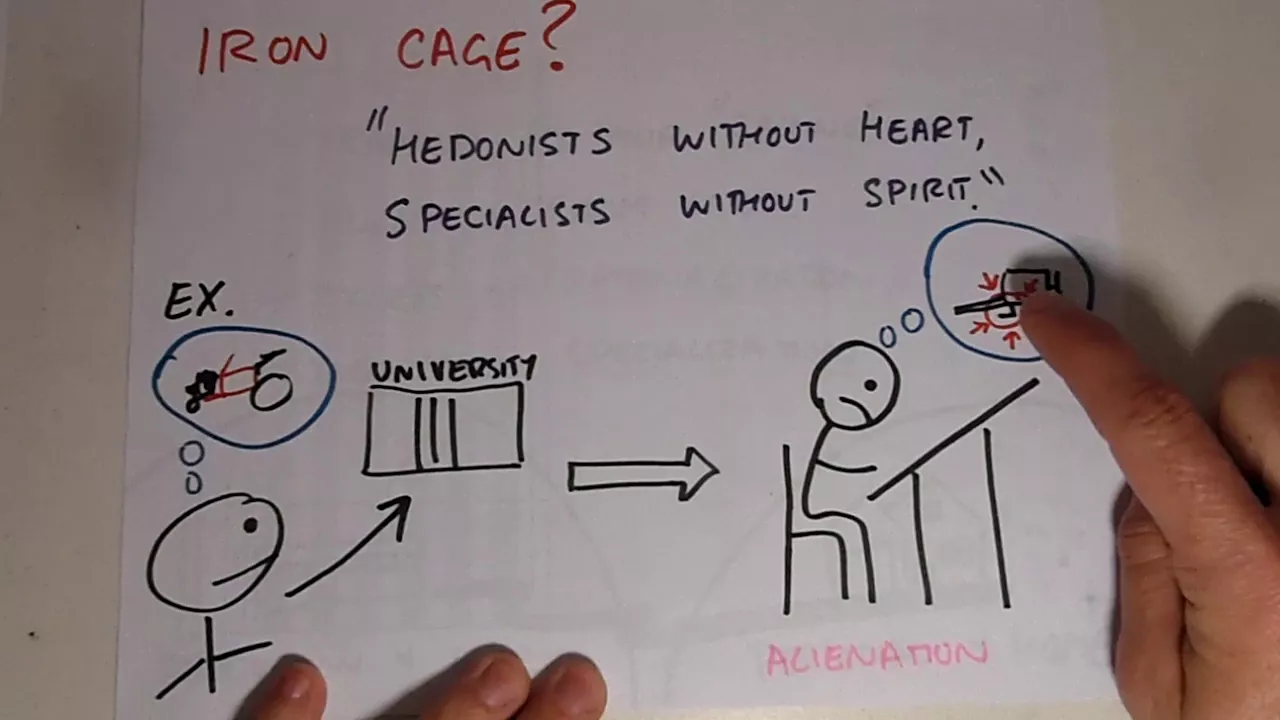
iron cage
45.3K
The iron cage is Max Weber's concept describing how modernization creates systemic traps for human fulfillment. Weber analyzed how modernization, rationalization, and industrialization transform organizations and social relationships. As organizations grow beyond 150 people, they implement rules, regulations, and formal policies that create impersonal environments. Specialization increases as tasks become more specific, prioritizing efficiency over human meaning. Weber observed that this rationalization extends beyond work into personal life, threatening authentic human experience.
Click to watch →

Luckaks, La Cosificación
1.5K
Weber described a long-term rationalization process since the Renaissance that abandoned mythological beliefs for technical rationality. Efficient calculation spreads from economics to all life domains through professionalization. Bureaucracy, originally designed to serve people, becomes reified and loses its original spirit, leaving only profit-seeking. This rationalization extends to legal, political, and media systems, creating what Weber called the 'iron cage' that traps individuals in instrumental rationality.
Click to watch →
Sosyal Bilim Okumaları "Sosyal Bilimler ve Gelecek"
206
Max Weber's concept of the 'iron cage' (Eisenkai) describes how rationalization and bureaucratic organization create a constraining social structure that limits human freedom and creativity. According to Weber, modern society has become trapped in a system of rational calculation and bureaucratic control that, while efficient, restricts human potential and meaning.
Click to watch →
Deep Dive
The origin and core mission of the Frankfurt School (Institute for Social Research) in synthesizing philosophy, sociology, and psychoanalysis to critique modern society.

DESEMPACA: ESCOLA DE FRANKFURT EM CINCO MINUTOS
105K
The Frankfurt School emerged between 1919-1938 at the Institute for Social Research in Frankfurt, Germany, founded by Theodor Adorno and Max Horkheimer. This philosophical movement developed a comprehensive critique of modern society through a Marxist lens, examining capitalism, totalitarian regimes (fascism, Nazism, Stalinism), and the failure of Enlightenment reason to achieve genuine emancipation. The school argued that knowledge and reason, when used as tools of domination, become totalitarian forces that exclude and control rather than liberate. Their interdisciplinary approach incorporated influences from Hegel and Max Weber, creating a critical framework that analyzes how modern institutions paradoxically serve as mechanisms of social control rather than liberation.
Click to watch →

Reflecting on Modernity: Frankfurt School | Theodor Adorno, Herbert Marcuse, Horkheimer, Habermas
674
The Frankfurt School, a group of German Jewish intellectuals who fled Nazi Germany and established the Institute for Social Research in Frankfurt (1923), developed critical theory by synthesizing Hegelian dialectics, Marxist analysis, and Freudian psychoanalysis to critique modernity, capitalism, and instrumental reason. The first generation (Horkheimer, Adorno, Marcuse, Benjamin) argued that Enlightenment rationality failed to emancipate humanity and instead produced new forms of domination, while the second generation (Habermas) shifted toward communicative action theory. Key concepts include the cultural industry, instrumental reason, and the connection between social and environmental domination. Despite criticisms of defeatism and provincialism, their analysis of how capitalism shapes consciousness and institutions remains influential in critical social theory.
Click to watch →

La filosofía fracasó ¿ahora qué? - Theodor Adorno
4.1K
Theodor Adorno (1903-1970) was a German Jewish philosopher born in Frankfurt into a wealthy family—his father was a wine merchant and his mother an opera singer. This privileged background gave him access to excellent education. He developed interests in both philosophy and music from a young age. Adorno contributed to sociology, philosophy, and musicology, and is recognized as one of the most important members of the Frankfurt School. The Frankfurt School was a group of thinkers organized around the Institute for Social Research in Frankfurt, focusing on critiquing modern industrialized society and capitalism. Key figures included Adorno, Eric Fromm, Herbert Marcuse, Max Horkheimer, and Walter Benjamin. These left-wing Marxists used Marxist ideas combined with psychoanalysis and sociological theories to analyze how capitalism affects individuals and society. Many were Jewish and faced persecution during the rise of National Socialism, forcing them into exile in other European countries and eventually in the United States, where Adorno integrated into academic circles to analyze how Nazism rose and how such atrocities could be prevented.
Click to watch →
Introduction to Frankfurt School and Critical Theory
693
The Frankfurt School, established in 1922 at the University of Frankfurt, developed Critical Theory as an interdisciplinary approach that rejects positivist claims of objectivity, emphasizing that social research must embrace subjectivity and commitment to emancipate marginalized groups; it initially focused on political economy under Carl Grunberg but transformed under Max Horkheimer to examine culture, psychoanalysis, and technology, arguing that capitalist technologies are not neutral but embody values that reproduce social domination, with key figures including Horkheimer, Adorno, Marcuse, Fromm, and Habermas contributing works on the culture industry, one-dimensional man, and legitimation crises.
Click to watch →

Introdución a la Teoría Crítica, Gianfranco Casuso
20.5K
Critical Theory is a philosophical and social science approach that originated in Frankfurt, Germany in 1923, known as the Frankfurt School. It emerged from the Institute for Social Research and was founded on the articulation of three major disciplines: philosophy (represented by Hegel), economics/sociology (represented by Marx), and psychoanalysis (represented by Freud). The theory's core purpose is to analyze social pathologies—hidden causes of societal suffering and dissatisfaction—and reveal how institutions, which appear natural and necessary, actually obstruct human freedom. Critical Theory operates through 'immanent criticism,' examining institutions by reconstructing their historical development to reveal contradictions between their actual functioning and their ideal purposes. The theory rejects historical determinism, viewing social change as a process of social learning and problem-solving rather than following a predetermined plan. Key figures include the first generation (Horkheimer, Adorno, Marcuse), second generation (returning from exile), third generation (Habermas), and fourth generation (Honneth).
Click to watch →
Prerequisite Knowledge
- Concept 01The fundamental philosophy of the Enlightenment, particularly Immanuel Kant's definition of reason, human autonomy, and intellectual progress.
- Concept 02Karl Marx's critique of capitalism, specifically the concepts of alienation, commodity fetishism, and how the economic base shapes societal superstructures.
- Concept 03Max Weber's sociological theories on rationalization, bureaucracy, and the concept of the 'iron cage' of modern society.
- Concept 04The origin and core mission of the Frankfurt School (Institute for Social Research) in synthesizing philosophy, sociology, and psychoanalysis to critique modern society.
Subsequent Learning
- Step 01The 'Dialectic of Enlightenment' by Max Horkheimer and Theodor Adorno, exploring how Enlightenment rationality regressed into mythology and totalitarianism.
- Step 02Herbert Marcuse's critique in 'One-Dimensional Man' regarding how advanced industrial society integrates and pacifies the working class through consumerism.
- Step 03Jürgen Habermas's theory of Communicative Action, which attempts to rescue the project of modernity by distinguishing communicative reason from instrumental reason.
- Step 04An analysis of contemporary digital capitalism, social media algorithms, and surveillance capitalism through the lens of the 'culture industry' and 'pseudo-individuality'.
Instrumental Reason
Market Logic
Beyond Market
Instrumental Reason
0:00Playing Section
- 1
Critique of reason's evolution from Enlightenment ideal to a tool of control.
- 2
Highlights how reason becomes instrumentalized, serving technical and economic ends.
- 3
Contrasts original quest for freedom with modern rationalized domination.
Communicative Rationality and the Defense of the Enlightenment
Jürgen Habermas, a prominent second-generation Critical Theorist, offers a major counterpoint to Horkheimer’s pessimistic critique of the Enlightenment. Habermas argues that Horkheimer and Adorno fell into a "performative contradiction" by using rational critique to declare reason itself entirely corrupt and instrumental. Instead of abandoning the Enlightenment project, Habermas rescues it by distinguishing between "instrumental reason" (aimed at control and efficiency) and "communicative reason" (aimed at mutual understanding, consensus, and democratic deliberation). According to Habermas, the crises of modern capitalism do not stem from reason itself, but rather from the "colonization of the lifeworld"—where bureaucratic and economic systems override communicative spheres. By focusing on the emancipatory potential of communicative rationality, Habermas argues that the Enlightenment is an "unfinished project" rather than an inherently destructive force. This perspective provides a constructive framework for social progress and democratic renewal, contrasting sharply with Horkheimer's deep skepticism regarding modern rationality and commodity logic.
Deep Dive
The 'Dialectic of Enlightenment' by Max Horkheimer and Theodor Adorno, exploring how Enlightenment rationality regressed into mythology and totalitarianism.
Adorno and Horkheimer: Dialectic of Enlightenment - Part I
147.1K
Adorno and Horkheimer argue that Enlightenment reason, despite its goal of liberating humanity from myth and superstition, paradoxically becomes a form of domination that reverts to mythology; both Enlightenment and mythology attempt to naturalize universal rules and dominate individuals through instrumental reason, as demonstrated through analyses of Odysseus's journey, the Marquis de Sade's works, and Nietzsche's philosophy, revealing how the rational calculation of utility leads to totalitarianism when applied universally to human relationships.
Click to watch →
The Proximate Ideological Origins of Critical Race Theory | James Lindsay
101.7K
The 'Dialectic of Enlightenment' (1944-47) by Max Horkheimer and Theodor Adorno argues that Western liberal societies, by rejecting myth and embracing rationalism, have paradoxically become irrational. The enlightenment's rejection of mythology has itself become a new form of mythology. This thesis represents a full assault on Western liberal democratic republics, arguing that reason has turned into unreason through this dialectical process.
Click to watch →
Dialectic of Enlightenment
100
Max Horkheimer and Theodor W. Adorno's 'Dialectic of Enlightenment' argues that the Enlightenment's pursuit of reason and mastery over nature, through instrumental reason focused on control and calculation, paradoxically leads to civilization's regression into violence and oppression rather than liberation, as demonstrated through analyses of Odysseus as the prototype of the modern entrepreneur, the transformation of morality into power dynamics, and anti-Semitism as a form of false projection stemming from repressed natural impulses.
Click to watch →

The Frankfurt School: Failed Revolution to Critical Theory
415.6K
Horkheimer and Adorno's 'Dialectic of Enlightenment' (1944) presented a provocative thesis that totalitarianism originated from Enlightenment thinking taken to extremes. While Enlightenment emphasized reason, empiricism, and universal laws—useful for natural sciences—applying this rationalistic approach to human society created dangerous consequences. Totalitarianism represented extreme objectivism, uniformity, and standardization applied to all of society, reducing individuals to mere numbers and parts of a machine. The authors observed that similar thinking permeated capitalist nations, particularly through what they called the 'culture industry' of film, radio, and magazines that created sameness and robbed people of imagination and individuality.
Click to watch →

M. HORKHEIMER y T. ADORNO - DIALÉCTICA DE LA ILUSTRACIÓN
9.8K
Max Horkheimer and Theodor Adorno's *Dialectic of Enlightenment* argues that the Enlightenment's pursuit of reason-based knowledge to liberate humanity ultimately fails because the same impulse to dominate and impose order that Enlightenment sought to overcome in myth now manifests within reason itself, transforming scientific knowledge into a new form of mythology that perpetuates domination rather than achieving genuine human emancipation.
Click to watch →
Deep Dive
Herbert Marcuse's critique in 'One-Dimensional Man' regarding how advanced industrial society integrates and pacifies the working class through consumerism.
Herbert Marcuse on One Dimensional Man
3.9K
Herbert Marcuse, a German philosopher and social theorist of the Frankfurt School, argues in his seminal work 'One Dimensional Man' (1964) that advanced industrial societies have created a one-dimensional social order where consumerism, mass media, and welfare states suppress critical thinking and class consciousness, rendering the working class incapable of revolutionary change and requiring external forces like students, minorities, and non-conformists to challenge the system; Marcuse envisions a utopian society where individuals achieve true freedom from economic, political, and intellectual constraints, rejecting the performance principle to embrace a new form of human existence based on autonomy, tranquility, and authentic needs.
Click to watch →

The One Dimensional Man by Herbert Marcuse
17.3K
Herbert Marcuse's 1964 book 'The One-Dimensional Man' argues that advanced capitalist societies create 'false needs' through advertising, consumerism, and media, which integrate individuals into a system where critical thought and opposition become impossible; this consumer-driven social control mechanism transforms people into passive consumers who pursue artificial desires rather than authentic human fulfillment, thereby stabilizing capitalism by preventing genuine revolutionary potential among the working class.
Click to watch →

One Dimensional Man by Herbert Marcuse
9K
Herbert Marcuse's 'One-Dimensional Man' (1964) argues that advanced industrial society creates a one-dimensional culture where technological rationality, consumerism, and repressive tolerance suppress critical thinking and genuine freedom, transforming technology from a neutral tool into a mechanism of social control that shapes individuals according to efficiency and productivity rather than human potential; Marcuse proposes that intellectuals must develop affirmative thinking and cultivate art and imagination as sources of resistance to transcend this one-dimensional reality.
Click to watch →

ANARQUISMO, CHE GUEVARA E O FIM DA DEMOCRACIA
38K
The One-Dimensional Man by Herbert Marcuse is a critical analysis of consumer society and mass culture. The book argues that advanced industrial society creates individuals who are psychologically and politically one-dimensional, unable to envision alternatives to the existing system. This analysis has influenced critical theory, sociology, and political philosophy by examining how consumer culture shapes consciousness and limits political imagination.
Click to watch →

الإنسان ذو البعد الواحد"ماركوزة" | قصة القضاء على إنسانية الإنسان | فيلم نادي القتال
13.1K
Herbert Marcuse's concept of 'One-Dimensional Man' describes how modern capitalist society has transformed domination from overt oppression to a subtle, rationalized form that controls individuals through consumerism, media, and false needs, making them willingly complicit in their own subjugation by equating personal identity with material possessions and eliminating critical thinking about the system.
Click to watch →
Deep Dive
Jürgen Habermas's theory of Communicative Action, which attempts to rescue the project of modernity by distinguishing communicative reason from instrumental reason.

ハーバーマス『コミュニケーション的行為の理論』【近代はまだ完成していない】
3.4K
Jürgen Habermas's Communication Theory of Action argues that modern society, characterized by the separation of system (money and power) from lifeworld (culture, morality, and democratic ideals), remains incomplete because instrumental rationality has colonized communicative action, preventing the ideal speech situation where all participants can freely engage in discourse to reach consensus; this theory synthesizes insights from Popper, Gadamer, and Luhmann to propose that democratic deliberation and communicative rationality are essential for overcoming modern barbarism and achieving a truly human society.
Click to watch →

Jurgen Habermas: Neo-Functionalism and Neo-Marxism (Sociology)
9.3K
Jürgen Habermas, a German sociologist from the Frankfurt School, developed the theory of communicative action emphasizing that modernity is an unfinished project requiring free and open communication to solve societal problems; he distinguished between purposive-rational action (based on self-interest among multiple actors) and instrumental-rational action (single actors using optimal means to achieve goals), arguing that their synthesis leads to instrumental mastery, while identifying three crises of modernity—economic crisis (excessive government intervention), legitimate crisis (actual crises with known reasons), and rationality crisis (disintegration between material production/bureaucracy and symbolic reproduction/cultural development)—which stem from the dualistic structure of modern life systems where culture, society, and personality fail to achieve synthesis.
Click to watch →

HABERMAS/2: LA TEORÍA DE LA ACCIÓN COMUNICATIVA
27.3K
Jürgen Habermas's Theory of Communicative Action proposes that rationality should be based on communicative rationality rather than instrumental/technical rationality, which dominates modern society. This theory emphasizes dialogue as the fundamental method for reaching intersubjective agreement, requiring two essential conditions: equality and freedom among all participants. Through reasoned argumentation and mutual understanding, participants can develop a consensual theory of the good—a set of universal, rational norms that guide human action while respecting diverse legitimate interests and maintaining the very conditions (equality and freedom) that make genuine dialogue possible.
Click to watch →

Habermas – Teoría de la Acción Comunicativa
21K
Jürgen Habermas’s Theory of Communicative Action is presented as one of the most significant works in philosophy and sociology in recent decades. It offers an alternative to instrumental and strategic reason by emphasizing communicative rationality as the foundation for social coordination. Habermas argues that in a deliberative democracy, political actors must engage in communicative action to enable diverse societal sectors to reach consensus through rational discourse, rather than coercion or power. This approach aims to rescue modernity and the Enlightenment project by grounding social integration in mutual understanding and dialogue. The theory seeks to prevent modern societies from descending into totalitarian regimes by promoting rational, inclusive communication as a normative ideal. The video outlines key sections including a theory of rationality, a theory of action, Habermasian deliberative democracy, a theory of social order, and a diagnosis of the contemporary era. These components collectively form a framework for understanding how communication, rather than domination, can sustain legitimate social structures. The video does not elaborate on technical philosophical distinctions beyond this conceptual overview.
Click to watch →

La herencia de Jürgen Habermas
187
In 'The Theory of Communicative Action,' Habermas operated a transformation of philosophy in an attempt to reformulate the normative foundations of critical social theory and the idea of reason on a basis now offered by language and argumentation. The potential of reason is now placed in the everyday communicative practice of subjects in the medium of ordinary language. He proposes developing a concept of rationality not limited to or dependent on any form of subjectivism or reference to a transcendental consciousness, as had occurred in modern thought from Descartes to the 20th century. This is the elaboration of a new concept of reason and rationality, now linked to language, communication, and argumentation. The perspective of emancipation was already disposed in the conditions of communicative socialization of individuals and is embedded in the linguistic mechanism of species reproduction.
Click to watch →
Deep Dive
An analysis of contemporary digital capitalism, social media algorithms, and surveillance capitalism through the lens of the 'culture industry' and 'pseudo-individuality'.

Adorno heute: Netflix, Sex & Dialektik der Aufklärung | Gert Scobel
159.9K
Adorno and Horkheimer's analysis applies to today's digital age and surveillance capitalism. Silicon Valley companies have replaced Hollywood as the new cultural industry. The new cultural product is no longer film or commodities, but rather data about users' behavior, which is adapted toward consumption and predictability. This represents the brutal subjugation of everything to the economy, extending the mechanisms of domination identified by the Frankfurt School into the digital realm.
Click to watch →

The Culture Industry and Charlie Sheen
2K
The Frankfurt School theorists Adorno and Horkheimer argued that modern society operates as a 'culture industry' where corporations standardize cultural products to create pseudo-individuality, making consumers feel unique within niche communities while actually conforming to mass-produced patterns; this system determines our needs and desires through standardized offerings, resulting in a conformist society where apparent individuality is manufactured rather than authentic.
Click to watch →

5.6/9 Pseudo-individuality and cult of cheapness | Dialectic of Enlightenment by Horkheimer & Adorno
146
Pseudo-individuality is a manufactured form of individuality where people appear unique and original while actually conforming to standardized patterns produced by the culture industry; this illusion of individuality serves as a mechanism of social control by making people believe they are free and autonomous while actually reinforcing the universal principles of competition and self-preservation that maintain the existing social order.
Click to watch →

The Culture Industry
448
The culture industry, a concept developed by Max Horkheimer and Theodor Adorno of the Frankfurt School, describes how capitalist mass production standardizes cultural products and consumers alike, creating a system where apparent consumer choice is actually corporate-driven manipulation; through techniques like style-over-content marketing, artificial desire creation, and pseudo-individuality, the culture industry produces passive consumers who believe they are exercising freedom while actually being molded into conformity, ultimately serving the profit motive of capitalism rather than genuine human flourishing.
Click to watch →
![[Xã hội số] Shoshana Zuboff: Chủ nghĩa Tư bản Giám sát và Dân chủ](https://i.ytimg.com/vi/kxVib7d9BqY/maxresdefault.jpg)
[Xã hội số] Shoshana Zuboff: Chủ nghĩa Tư bản Giám sát và Dân chủ
1.1K
Surveillance capitalism emerged from a 1997 debate where industry executives won against civil society, resulting in minimal regulation. It rests on the discovery that private human experience is the last virgin wood available for extraction, production, commodification, and sales. People became 'chattel for commerce.' Using Alice in Wonderland as a metaphor, we learned we can search Google, but now Google searches us. Privacy policies are actually surveillance policies. Privacy is not private—it's a collective action problem and political challenge. The digital century was meant to be democracy's golden age, but we now face extreme social inequality based on what we can learn, not earn. This is epistemic inequality: unequal access to learning imposed by private commercial mechanisms. 20th century society was based on division of labor; digital century shifts to division of learning. Google invented surveillance capitalism during the 2000 dot-com bust when they declared a state of emergency. Between 2000-2004, their revenue increased by 3590%—the surveillance dividend. This number would not exist without the new logic. Competitive dynamics drive surveillance capitalists toward totalities of information (economies of scale) and varieties of data (economies of scope). The most predictive data comes from intervening in behavior—nudging, coaxing, herding behavior toward outcomes guaranteed to business customers. This represents a shift from monitoring to actuation, where information cascades over a tipping point enabling remote control of human systems at scale. Facebook's 2012 and 2014 contagion experiments showed subliminal cues and social comparison dynamics can change real-world behavior and emotion while bypassing user awareness. Awareness is friction; if people know, they might refuse or hide. Pokemon Go established human futures markets with businesses like McDonald's, selling guaranteed footfall using gamification to herd people to commercial locations.
Click to watch →
Instrumental Reason
Market Logic
Beyond Market
Instrumental Reason
0:00- 1
Critique of reason's evolution from Enlightenment ideal to a tool of control.
- 2
Highlights how reason becomes instrumentalized, serving technical and economic ends.
- 3
Contrasts original quest for freedom with modern rationalized domination.
Communicative Rationality and the Defense of the Enlightenment
Jürgen Habermas, a prominent second-generation Critical Theorist, offers a major counterpoint to Horkheimer’s pessimistic critique of the Enlightenment. Habermas argues that Horkheimer and Adorno fell into a "performative contradiction" by using rational critique to declare reason itself entirely corrupt and instrumental. Instead of abandoning the Enlightenment project, Habermas rescues it by distinguishing between "instrumental reason" (aimed at control and efficiency) and "communicative reason" (aimed at mutual understanding, consensus, and democratic deliberation). According to Habermas, the crises of modern capitalism do not stem from reason itself, but rather from the "colonization of the lifeworld"—where bureaucratic and economic systems override communicative spheres. By focusing on the emancipatory potential of communicative rationality, Habermas argues that the Enlightenment is an "unfinished project" rather than an inherently destructive force. This perspective provides a constructive framework for social progress and democratic renewal, contrasting sharply with Horkheimer's deep skepticism regarding modern rationality and commodity logic.
The fundamental philosophy of the Enlightenment, particularly Immanuel Kant's definition of reason, human autonomy, and intellectual progress.
Karl Marx's critique of capitalism, specifically the concepts of alienation, commodity fetishism, and how the economic base shapes societal superstructures.
Max Weber's sociological theories on rationalization, bureaucracy, and the concept of the 'iron cage' of modern society.
The origin and core mission of the Frankfurt School (Institute for Social Research) in synthesizing philosophy, sociology, and psychoanalysis to critique modern society.
The 'Dialectic of Enlightenment' by Max Horkheimer and Theodor Adorno, exploring how Enlightenment rationality regressed into mythology and totalitarianism.
Herbert Marcuse's critique in 'One-Dimensional Man' regarding how advanced industrial society integrates and pacifies the working class through consumerism.
Jürgen Habermas's theory of Communicative Action, which attempts to rescue the project of modernity by distinguishing communicative reason from instrumental reason.
An analysis of contemporary digital capitalism, social media algorithms, and surveillance capitalism through the lens of the 'culture industry' and 'pseudo-individuality'.
37.4K views559likes4:21@theGuardianOriginal Release: 2013-07-23
[Music] we're here in Camden lock site of one of London's busiest markets to explore the ideas of Max Hulk Heimer the book critique of instrumental reason is a series of lectures and short writings that Hawk Heimer composed upon his return to Germany in the 1950s and it deals with questions such as what is the situation of the customer in contemporary consumer capital ISM I want to look at Hawk heimer's concept of instrumental reason to understand what instrumental reason is we first have to understand something about reason reason is the great idea of the Enlightenment it posits that humans should use their own judgment their own capacity to think in order to decide what is right and what is true and what should be done it represented a rejection of superstition and custom and Reliance on the authority of church or king or feudal Overlord it sets in train the emergence of the notion of human Freedom or even in a sense the growth of the notion of the individual who is a thinking being who takes responsibility for his or her own actions what haimer perceives from this though is that over time over a couple of hundred years reason becomes increasing instrumentalized hkim sees the ways in which reason goes into reverse in a sense the ways in which Enlightenment becomes a new mythology how humans bow down before New deities New Gods such as the commodity uh or technology or number um these abstractions that come to rule over human beings become new Mythic entities for him haimer also sees through this process the emergence of the market and the market comes to pervade everywhere a commodity logic is set in train which becomes the only logic uh the value of everything is its value upon the market haulk Heimer had observed the ways in which the enlightenment brought about a growth of individuality by the 1940s Hawk kimer and adoro were identifying something called pseudo individuality which is no sort of individuality at all that's why it's interesting to be here in Canden lock uh apparently a site of an efflorescence of individuality but if we look at its history we can see something interesting it begins as perhaps legitimately some sort of countercultural site where Outsiders might come to compendium books and find books that they couldn't find elsewhere some years down the line though perhaps this is the ultimate home of pseudo individuality that the people who come here think they are expressing themselves in their uniqueness and they buy from an array of stalls endless outfits that might Express a particular Niche that they're slotting themselves into they're not considering the identical conditions of manufacturer that's most usually the case in purchasing this or that leather jacket this or that t-shirt it's a place in which one might pick one's deviancy off the peg which is perhaps as pseudo individualistic a gesture as one could make Hulk kimer raises the question of happiness and suffering today we're expected to believe that happiness is constituted by our freedom to use the market P kimer raises happiness and suffering as a political and a social question perhaps he allows us to think that happiness might be constituted in something beyond the market something made out of social bonds and human Community something different to all this
Up Next
26:35
The Frankfurt School: Failed Revolution to Critical Theory
@Tom_Nicholas
415.6K views•2020-02-07

164:01
John of Damascus on Holy Images: A Theological Defense
@BannedBooks
139 views•2026-04-25

68:32
Should We Destroy the Machines? Big Tech Surveillance Critique
@TheStoriesWeTell303
167.9K views•2025-11-30
4:57
The Myth of Sisyphus: A Greek Legend of Eternal Punishment
@TEDEd
8.6M views•2018-11-13
Related Study Plans & Knowledge Roadmaps
Structured learning paths in Philosophy
philosophy
Frankfurt School: Critical Theory & Culture
01Foundations of the Frankfurt School and Critical Theory
02Horkheimer & Adorno: The Critique of Instrumental Reason
03The Culture Industry and Mass Deception
+ 2 more learning modules
12h5 modules
Explore Roadmap
philosophy
Philosophy of Language: From Frege to Austin
01The Linguistic Turn: An Introduction to Language in Philosophy
02Gottlob Frege: Sense and Reference
03Early Wittgenstein: The Picture Theory of Meaning
+ 3 more learning modules
15h6 modules
Explore Roadmap
philosophy
Feminist Epistemology: Standpoint & Injustice
01Introduction to Epistemology and Feminist Critiques
02Sandra Harding and Standpoint Theory
03Donna Haraway and Situated Knowledges
+ 2 more learning modules
12h5 modules
Explore Roadmap
philosophy
Environmental Philosophy: Ethics & Deep Ecology
01Foundations of Environmental Ethics & Anthropocentrism
02Biocentric Individualism and Animal Liberation
03Ecocentric Holism and Deep Ecology
+ 1 more learning modules
10h4 modules
Explore Roadmap