In organic chemistry, curved arrows in reaction mechanisms always point from electron-rich regions (nucleophiles, which can be negatively charged or neutral) to electron-poor regions (electrophiles, which can be positively charged or neutral), and charge is conserved throughout the reaction while the octet rule guides bond formation and breaking, particularly for elements in the second shell like carbon which can only form four bonds.
Curved Arrows in Reaction Mechanisms: A Guide
Added:Deep Dive
Understanding Lewis structures, including how to represent valence electrons, bonding pairs, and lone pairs.

3) Organik Kimya - Lewis Formülleri - Görkem Şahin - 2024
545.7K
Lewis structures represent atoms by placing dots around the element's symbol to indicate valence electrons. Valence electrons are the outermost electrons that determine bonding behavior. Atoms form bonds to achieve stable configurations: most aim for 8 electrons (octet rule), while hydrogen only needs 2 (duplet rule). The number of bonds an atom can form equals its unpaired valence electrons. Helium is an exception with only 2 electrons but cannot form bonds. To draw Lewis structures: write the element symbol, place valence electrons as dots, and pair electrons to form bonds. For diatomic molecules like H2, O2, and N2, atoms share electrons to achieve stable configurations. For polyatomic molecules like CH4, place the central atom and attach surrounding atoms to satisfy valence requirements. For organic molecules: identify the central atom (usually carbon with highest bonding capacity), place it in center, attach other atoms, and add hydrogen atoms to satisfy valence requirements. For C2H6: two carbons bonded together, each with 3 hydrogens. For C2H4: two carbons bonded with double bond, each with 2 hydrogens. For CH2O: carbon bonded to 2 H and 1 O (double bond). For HCOOH: carbon bonded to H, O (double bond), and OH group.
Click to watch →

الدرس الاول كيمياء تانية ثانوي الترم الثاني💪🏻| الاتحاد الكيميائي وانواع الروابط
244K
A bonding pair consists of two electrons shared between atoms to form a chemical bond. A lone pair consists of two electrons that do not participate in bonding and remain localized on one atom. To draw Lewis structures: identify the central atom (fewest atoms attached), draw valence electrons, connect atoms with bonding pairs, and add lone pairs to complete octets (except hydrogen which needs 2 electrons). The octet rule states atoms tend to achieve 8 valence electrons for stability.
Click to watch →

Chimie 01| CH 05|#5| Lewis's structure of molecules | تمرين شامل حول تمثيل لويس | الجزء الاول
57K
In Lewis structures: (1) Bonds are represented by lines connecting atoms, (2) Lone pairs of electrons are represented by dots (pairs of dots), (3) Each bond represents 2 shared electrons, (4) Each lone pair represents 2 non-bonding electrons. The instructor demonstrates how to draw bonds between atoms and place lone pairs around each atom to satisfy their valence electron requirements.
Click to watch →

حل اسئلة الدرس الأول انواع الروابط كيمياء تانيه ثانوى كتاب الامتحان الترم التانى ٢٠٢٦
59.1K
Lewis dot structures represent valence electrons as dots around an element symbol on four sides. The number of dots equals valence electrons in the outermost energy level. For ions, add or subtract electrons based on charge. Bonding pairs consist of 2 electrons responsible for forming bonds. In H₂O, oxygen shares 2 electrons with each hydrogen, creating 2 bonding pairs. In NF₃, nitrogen shares 1 electron with each fluorine, creating 3 bonding pairs. Lone pairs are electron pairs not involved in bonding. Ionic compounds form when metals lose electrons and non-metals gain electrons, creating oppositely charged ions. Covalent compounds form when non-metals share electrons.
Click to watch →

البداية الاسطورية😎الدرس الاول كيمياء تانية ثانوي الترم الثاني💪🏻| مفهوم التفاعل الكيميائي
59.3K
In Lewis structures, electrons are divided into bonding pairs (involved in forming chemical bonds) and lone pairs (not involved in bonding). For example, in ammonia (NH₃), nitrogen has three bonding pairs (shared with hydrogen atoms) and one lone pair. The octet rule states that atoms (except hydrogen) tend to have eight electrons in their valence shell for stability.
Click to watch →
Deep Dive
The concept of formal charge and how to calculate it for individual atoms within a molecule.
General_Ochem_Biochem_CH3_P7
152
To calculate formal charge for each atom: (1) Identify the valence electrons from the group number (Oxygen: 6, Carbon: 4, Nitrogen: 5), (2) Count the number of bonds the atom has, (3) Count the lone pair electrons (each dot represents one electron), (4) Apply the formula. For example, in cyanate: Oxygen (6 valence - 2 bonds - 4 lone pair electrons = 0), Carbon (4 valence - 4 bonds - 0 lone pair electrons = 0), Nitrogen (5 valence - 2 bonds - 4 lone pair electrons = -1).
Click to watch →
Formal Charge|Class 11 Unit-4|Chemical bonding and molecular structure|Formal charge kya h|
189
To calculate formal charge on each atom: 1) Identify valence electrons for the atom (from periodic table). 2) Count non-bonding electrons (lone pairs). 3) Count bonding electrons (shared electrons in bonds). 4) Apply the formula: FC = Valence - Non-bonding - Bonding/2. For example, in CO3 2-: Carbon has 4 valence electrons, 0 non-bonding, and 8 bonding electrons (4 bonds), so FC = 4 - 0 - 8/2 = 0. Oxygen atoms with single bonds have 6 valence electrons, 6 non-bonding, and 2 bonding electrons, so FC = 6 - 6 - 2/2 = -1. This calculation helps determine the most stable Lewis structure.
Click to watch →
How To Calculate The Formal Charge of an Atom - Chemistry
1.2M
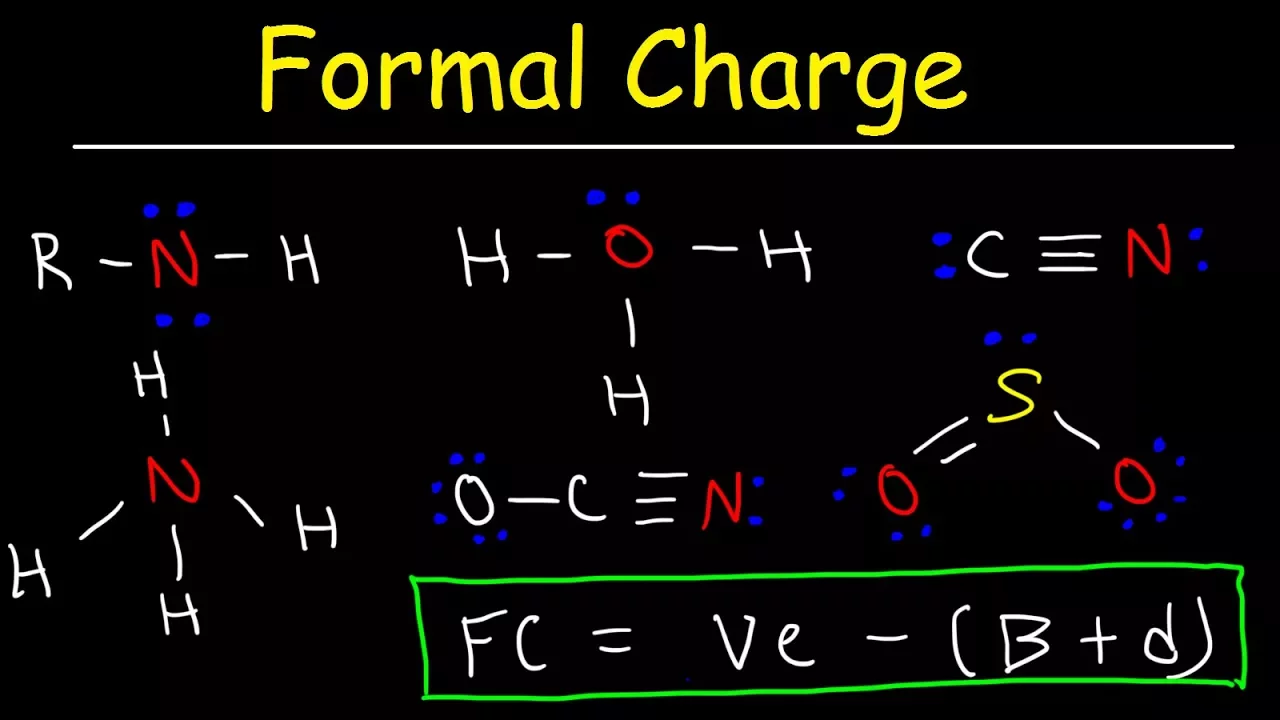
Formal charge is calculated using the formula: Formal Charge = Valence Electrons - (Number of Bonds + Number of Dots). This concept helps determine electron distribution in molecules. Examples include nitrogen with 5 valence electrons, 2 bonds, and 4 dots yielding -1 formal charge; oxygen in hydronium ion with 6 valence electrons, 3 bonds, and 2 dots yielding +1 formal charge. These calculations reveal which atoms bear positive or negative charges within molecules.
Click to watch →

Lewis Structure | شرح بالعربي
3.3K
To calculate formal charge for each atom: (1) Identify the valence electrons for that atom from its group number, (2) Count the non-bonding electrons (lone pair electrons) on that atom, (3) Count the bonding electrons and divide by 2, (4) Apply the formula. This calculation is done for each atom in the molecule.
Click to watch →

Formal Charge
10.6K
To calculate formal charge for any atom: (1) Determine the number of valence electrons the atom brought to the molecule (using group number or group number minus 10 for main block elements), (2) Subtract the number of lone pair electrons, (3) Subtract the number of bonds attached to the atom. The formula is: Formal Charge = Valence Electrons - Lone Pair Electrons - Number of Bonds.
Click to watch →
Deep Dive
Fundamental definitions of nucleophiles (electron-rich species) and electrophiles (electron-poor species).

PG TRB Chemistry UNIT 3 / Top 20 Questions (Part 2) @learningchemistry8578
4.8K
Nucleophiles are electron-rich species attracted to positive charges, acting as Lewis bases. They include neutral molecules (NH3, H2O, alcohols, thiols) and anionic species (Cl-, OH-, RO-, CN-). Electrophiles are electron-deficient species attracted to negative charges, acting as Lewis acids. They include neutral molecules (CO2, AlCl3, BF3) and cations (R+, H+, NO2+). The key distinction is that nucleophiles donate electron pairs while electrophiles accept them.
Click to watch →
Plus One Chemistry - Public Exam | Marathon | Session 2- Chapter 6-9 | Eduport Plus One
33.2K
A nucleophile is a nucleus-loving species that is electron-rich and seeks positive centers (e.g., OH-, NH3, H2O). An electrophile is an electron-loving species that is electron-deficient and seeks negative centers (e.g., H+, BF3, AlCl3). These terms are fundamental for understanding reaction mechanisms in organic chemistry.
Click to watch →

Plus One Public Exam: Chemistry | Exam Booster | Xylem Plus One
95.9K
Nucleophiles are electron-rich species that donate electron pairs (Lewis bases), while electrophiles are electron-deficient species that accept electron pairs (Lewis acids). Examples: OH- is a nucleophile; H+ is an electrophile. These concepts are fundamental to understanding reaction mechanisms.
Click to watch →

كيمياء السادس العلمي // الفصل السابع / الكيمياء العضوية / المحاضرة 2 / المنهج الجديد
80.8K
A nucleophile (نيوكليوفيل) is a species that seeks positive nuclei because it is electron-rich and possesses one or more lone pairs of electrons. Examples include halide ions (Cl-, Br-, I-), hydroxide ion (OH-), and water. An electrophile (إلكتروفيل) is a species that seeks electrons because it is electron-deficient and has an empty orbital capable of accepting electron pairs. Examples include carbocations and hydrogen ions (H+).
Click to watch →

الكيمياء العضوية - خواص هاليد الالكيل | محاضرة 3
60K
A nucleophile is a species that seeks out nuclei (positive centers) because it is electron-rich and possesses one or more lone pairs of electrons. An electrophile is a species that seeks out electrons because it is electron-deficient and possesses an empty orbital ready to accept an electron pair.
Click to watch →
Deep Dive
The octet rule and its implications for the stability of second-row elements like carbon, nitrogen, and oxygen.

Bio107Ch2
1K
The octet rule states that atoms achieve stability when they have 8 electrons in their outer orbital. Hydrogen is stable with 2 electrons. Carbon needs 4 more electrons, nitrogen needs 3 more, and oxygen needs 2 more to achieve stability. This rule explains why atoms form bonds and how they arrange electrons in their orbitals to reach a stable configuration.
Click to watch →

Building Bohr Models of the Atom
12.3K
The second row of the periodic table (atomic numbers 5-10) demonstrates the octet rule. Boron (Z=5) has 5 protons, 6 neutrons, and 5 electrons with 2 in the first orbital and 3 in the second. Carbon (Z=6) has 6 protons, 6 neutrons, and 6 electrons with 2 in the first and 4 in the second. Nitrogen (Z=7) has 7 protons, 7 neutrons, and 7 electrons with 2 in the first and 5 in the second. Oxygen (Z=8) has 8 protons, 8 neutrons, and 8 electrons with 2 in the first and 6 in the second. Fluorine (Z=9) has 9 protons, 10 neutrons, and 9 electrons with 2 in the first and 7 in the second. Neon (Z=10) has 10 protons, 10 neutrons, and 10 electrons with 2 in the first and 8 in the second, completing its outer shell and achieving stability.
Click to watch →

Organic Chemistry 1 Final Exam Review
692.6K
Second-row elements (C, N, O, F) cannot have more than eight electrons around them due to the absence of d-orbitals. Any Lewis structure showing these elements with more than eight electrons violates the octet rule and is incorrect. For example, a nitrogen atom with a triple bond (6 electrons) plus two lone pairs (4 electrons) would have 10 electrons, which is impossible for nitrogen.
Click to watch →
N2O Lewis Structure - Nitrous Oxide
195.5K
Second-row elements (like nitrogen and oxygen) cannot have expanded octets—they are limited to a maximum of 8 electrons in their outermost shell. Nitrogen can have a maximum of 4 bonds (which corresponds to 8 electrons). This means nitrogen cannot form 5 bonds as it would require 10 electrons. This limitation affects the possible Lewis structures that can be drawn for molecules containing these elements.
Click to watch →
![RESONANCE [L-01] BY ONKAR SHARMA SIR](https://i.ytimg.com/vi/L5LrXiZ6O_4/maxresdefault.jpg)
RESONANCE [L-01] BY ONKAR SHARMA SIR
105
Second period elements (B, C, N, O, F) must follow the octet rule in all resonance structures. They cannot have more than 8 electrons. Nitrogen can never be pentavalent. Third period elements can have expanded octets.
Click to watch →
Deep Dive
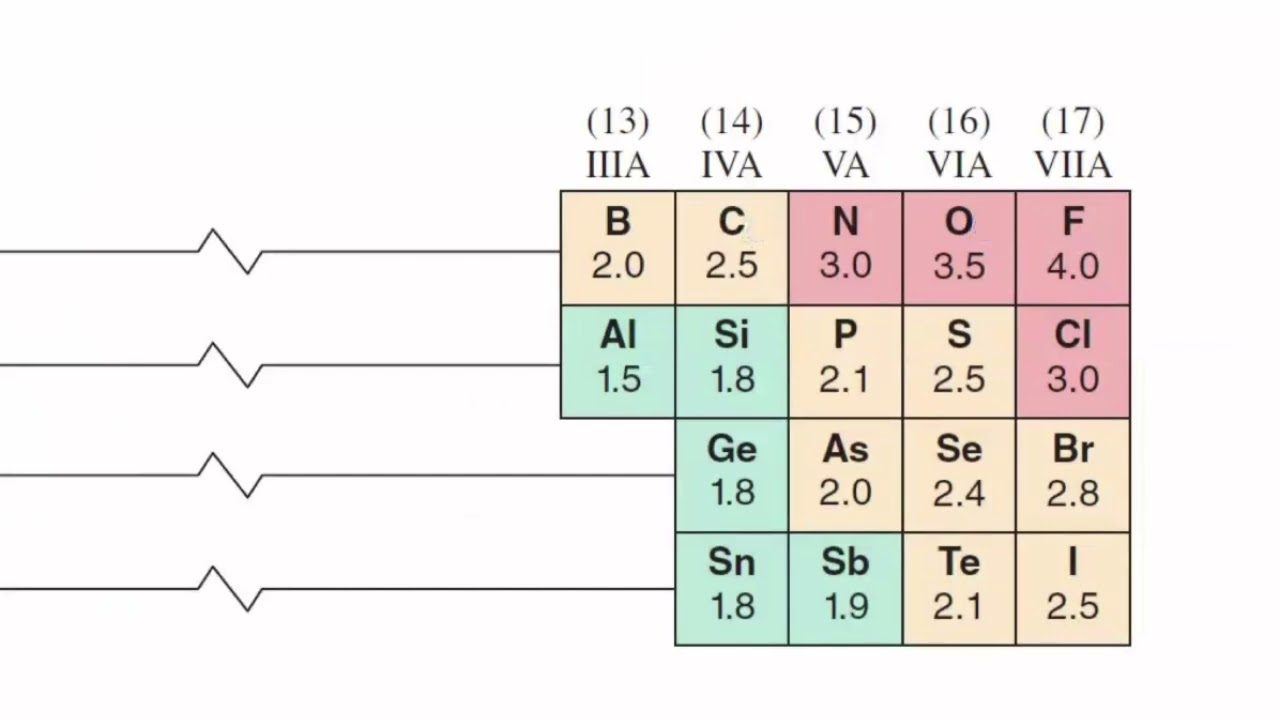
Electronegativity trends and polar covalent bonds, which dictate where electron density is concentrated.

Enlace covalente polar.
3.8K
Electronegativity is the ability of an atom to attract shared electrons in a chemical bond. It increases from left to right across a period and from bottom to top within a group in the periodic table. In polar covalent bonds, atoms with different electronegativities share electrons, but the more electronegative atom attracts the electrons more strongly. This causes the shared electrons to spend more time near the more electronegative atom, creating an uneven distribution of electron density. The more electronegative atom develops a partial negative charge (δ-), while the less electronegative atom develops a partial positive charge (δ+).
Click to watch →

Unit 2 Summative Assessment Practice
22.1K
Electronegativity values for representative elements increase from left to right across a period and decrease from top to bottom down a group. When atoms with unequal electronegativity share electrons in a covalent bond, the more electronegative atom develops a partial negative charge (δ-), while the less electronegative atom develops a partial positive charge (δ+). This unequal sharing creates a polar covalent bond.
Click to watch →

How to Create 3D Chemical Structures! - Electronegativity & Lewis Dot Structures (24)
494
Electronegativity increases across the periodic table from left to right and decreases down the table. Fluorine is the most electronegative element with a value of 4.0. Polar covalent bonds occur when nonmetal atoms share electrons unequally, with the difference falling between 0.5 and 1.7. For example, in water (H2O), oxygen (3.44) and hydrogen (2.20) have a difference of 1.24, making it polar covalent. The more electronegative atom (oxygen) gets more electrons, a larger sphere, and a partial negative charge.
Click to watch →
Topics 2.1 - 2.4
24.5K
Electronegativity values increase from left to right across a period and decrease down a group. When atoms share valence electrons with similar electronegativity, a non-polar covalent bond forms (e.g., C-H bonds). When atoms share electrons with unequal electronegativity, a polar covalent bond forms where the more electronegative atom develops a partial negative charge (δ⁻) and the less electronegative atom develops a partial positive charge (δ⁺). The bond dipole arrow always points toward the atom with higher electronegativity. Greater differences in electronegativity lead to greater bond dipoles. All polar bonds have some ionic character, and the distinction between ionic and covalent bonding exists on a continuum rather than being distinct categories.
Click to watch →
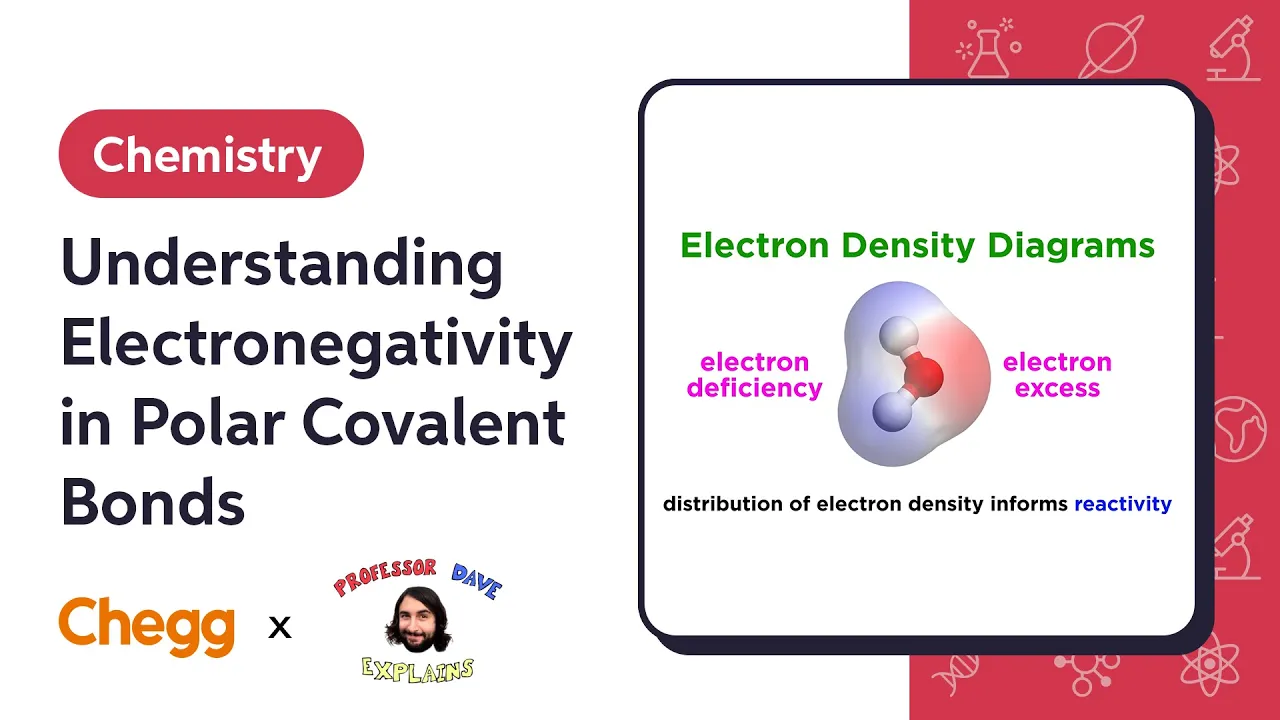
Understanding Electronegativity in Polar Covalent Bonds Ft. Professor Dave
51.5K
Chemical bonds exist on a spectrum from purely covalent to purely ionic. In polar covalent bonds, electron density is unevenly distributed between atoms, creating partial charges (δ+ and δ-) that can be visualized using dipole arrows pointing toward electron-rich regions. Electronegativity—the ability of an atom to attract electron density—determines bond polarity, increasing across periods and up groups on the periodic table. Fluorine is the most electronegative element. When electronegativity differences exceed 0.5, polar bonds form; differences above 1.8 typically result in ionic bonding. Recognizing electron-rich and electron-poor sites in molecules is essential for predicting chemical behavior and reactivity patterns.
Click to watch →
Prerequisite Knowledge
- Concept 01Understanding Lewis structures, including how to represent valence electrons, bonding pairs, and lone pairs.
- Concept 02The concept of formal charge and how to calculate it for individual atoms within a molecule.
- Concept 03Fundamental definitions of nucleophiles (electron-rich species) and electrophiles (electron-poor species).
- Concept 04The octet rule and its implications for the stability of second-row elements like carbon, nitrogen, and oxygen.
- Concept 05Electronegativity trends and polar covalent bonds, which dictate where electron density is concentrated.
Subsequent Learning
- Step 01Applying curved arrows to depict resonance structures and electron delocalization.
- Step 02Writing out step-by-step mechanisms for fundamental organic reactions such as SN1, SN2, E1, and E2.
- Step 03Understanding Lewis acid-base reaction mechanisms using electron-pushing formalism.
- Step 04Analyzing reaction coordinate diagrams to relate curved-arrow steps to transition states and intermediates.
- Step 05Predicting major and minor products of reactions based on the stability of intermediates (like carbocations) formed during electron flow.
Arrow Rules
Charge & Octet
Arrow Rules
0:00Playing Section
- 1
Electrons flow from rich to poor sites, attacking electrophiles.
- 2
Arrows start from lone pairs, negative charges, or bond centers.
- 3
Nucleophiles attack; electrophiles are the targets of attack.
Molecular Orbital Theory and Quantum Delocalization
While the curved-arrow formalism is an indispensable heuristic for tracking localized electron pairs, it simplifies the quantum mechanical reality of chemical reactions. Molecular Orbital (MO) Theory and computational quantum chemistry provide a more accurate alternative perspective. According to MO theory, electrons are not localized pairs hopping from a nucleophile to an electrophile; rather, they occupy delocalized wavefunctions spread across the entire molecular system. In pericyclic reactions, for instance, transformation is driven by the symmetry and overlap of frontier molecular orbitals (HOMO and LUMO) rather than discrete, localized electron-pushing. Furthermore, modern quantum chemical topology shows that actual physical shifts in electron density during a reaction often do not align with where curved arrows suggest electrons 'flow,' as polarization, nuclei movement, and electrostatic forces dominate the reaction coordinate in ways the Lewis-based arrow model cannot represent.
Deep Dive
Applying curved arrows to depict resonance structures and electron delocalization.

11. ÉFFETS ÉLECTRONIQUES PARTIE 2/3: ÉFFETS MÉSOMÈRES
200.4K
Drawing resonance structures requires following specific rules: (1) Only electrons move, not atoms; (2) Curved arrows show electron flow from high-density to low-density regions; (3) All resonance structures must have the same molecular formula; (4) Formal charges must be properly assigned and balanced; (5) Total charge must remain constant across all structures. The video demonstrates applying these rules to various conjugated systems including neutral molecules, positively charged species, and radicals. Key principles include: double bonds move to adjacent positions creating alternating charges, lone pairs and unpaired electrons can participate in resonance, and electron movement always conserves total electron count. These principles explain how conjugated systems achieve greater stability through electron delocalization.
Click to watch →
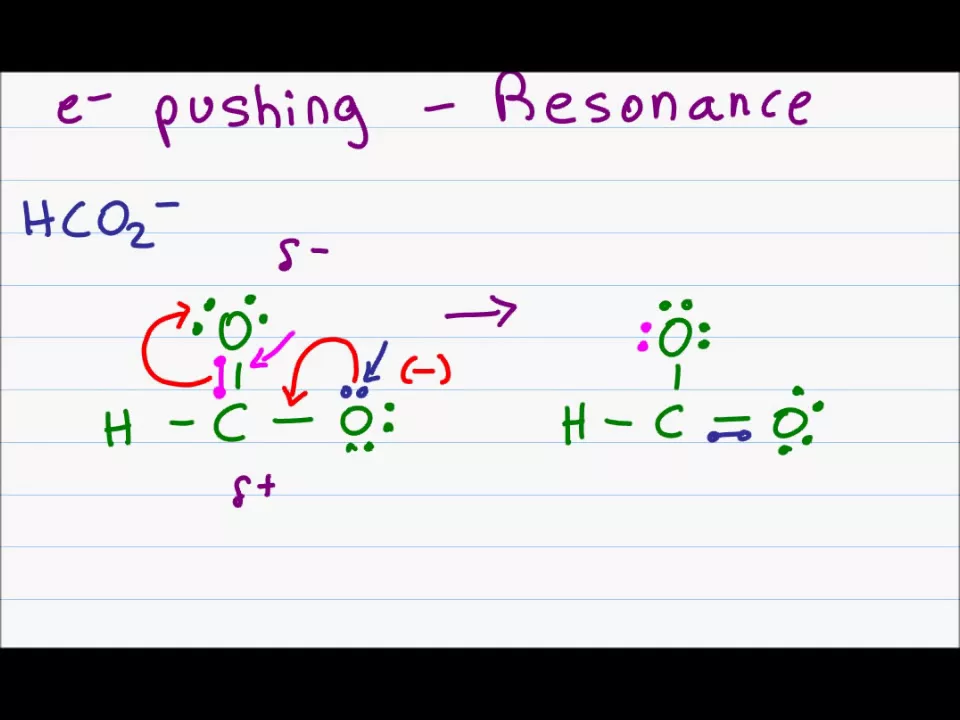
Electron Pushing Arrows in Resonance and Organic Mechanisms
199.7K
Resonance involves electron delocalization between atoms. Electrons always start at the most negative site and move toward positive sites. In carboxylate ions, electrons move from oxygen to carbon, causing adjacent bonds to shift. In conjugated systems with pi bonds, electrons from oxygen form new bonds with double-bonded carbons, shifting pi bonds to adjacent positions. Resonance structures are connected by double-headed arrows in brackets. Formal charge calculations verify electron conservation: count valence electrons minus non-bonding electrons minus half-bonding electrons.
Click to watch →
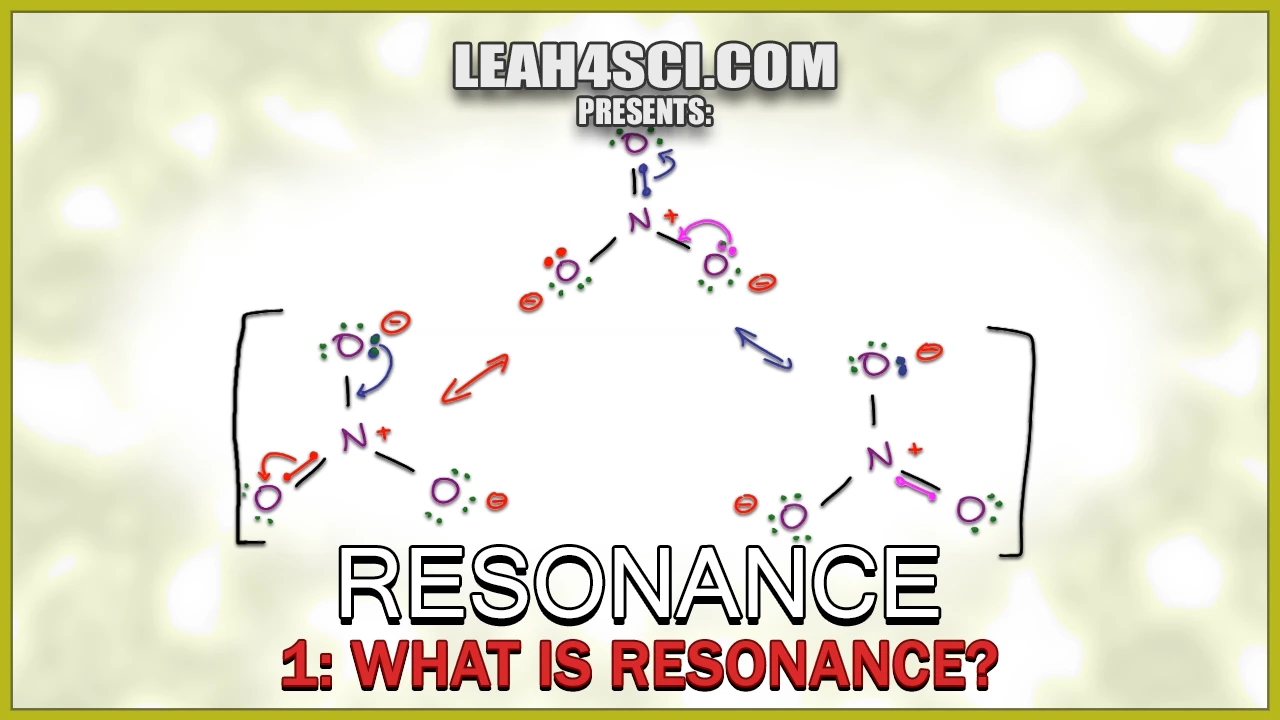
What is Resonance -Understanding Orgo Resonance Structures Vid 1 by Leah Fisch
159.8K
Curve arrows (pushing arrows) are essential tools for depicting electron movement in resonance. The arrow tail always originates from where electrons are located, while the arrow head indicates their destination. These arrows represent two-electron movements, distinguishing them from radical fishhook arrows that move single electrons. Proper resonance conversion requires starting with the most negative electrons (lone pairs) and moving them toward positive charges due to electrostatic attraction. When atoms would exceed their octet, they must release two electrons to maintain stability. Multiple resonance structures are connected using double-headed arrows and enclosed in brackets to indicate they form a resonance hybrid system.
Click to watch →

Introduction: Part - 2
19.3K
Resonance is electron delocalization where electrons spread over multiple atoms rather than being localized. The video uses benzene as an example with six delocalized pi electrons. Rules for drawing resonance structures: only electrons move, not atoms; total electrons and charge remain constant; electrons move from atoms to bonds or bonds to atoms. The curved arrow notation shows electron movement: full arrows (two electrons) for normal reactions, half-arrows (one electron) for radicals. Resonance structures are different Lewis representations of the same molecule, with the actual structure being a hybrid.
Click to watch →

How To Use Curved Arrows for Resonance Structures
48.1K
In organic chemistry, curved arrows are used to show electron movement in resonance structures through three fundamental moves: (1) moving a lone pair to form a pi bond, (2) breaking a pi bond to form a lone pair, and (3) shifting a pi bond from one position to another; importantly, curved arrows never break the octet rule and only involve pi bond changes, not single bond breaking or forming.
Click to watch →
Deep Dive
Writing out step-by-step mechanisms for fundamental organic reactions such as SN1, SN2, E1, and E2.
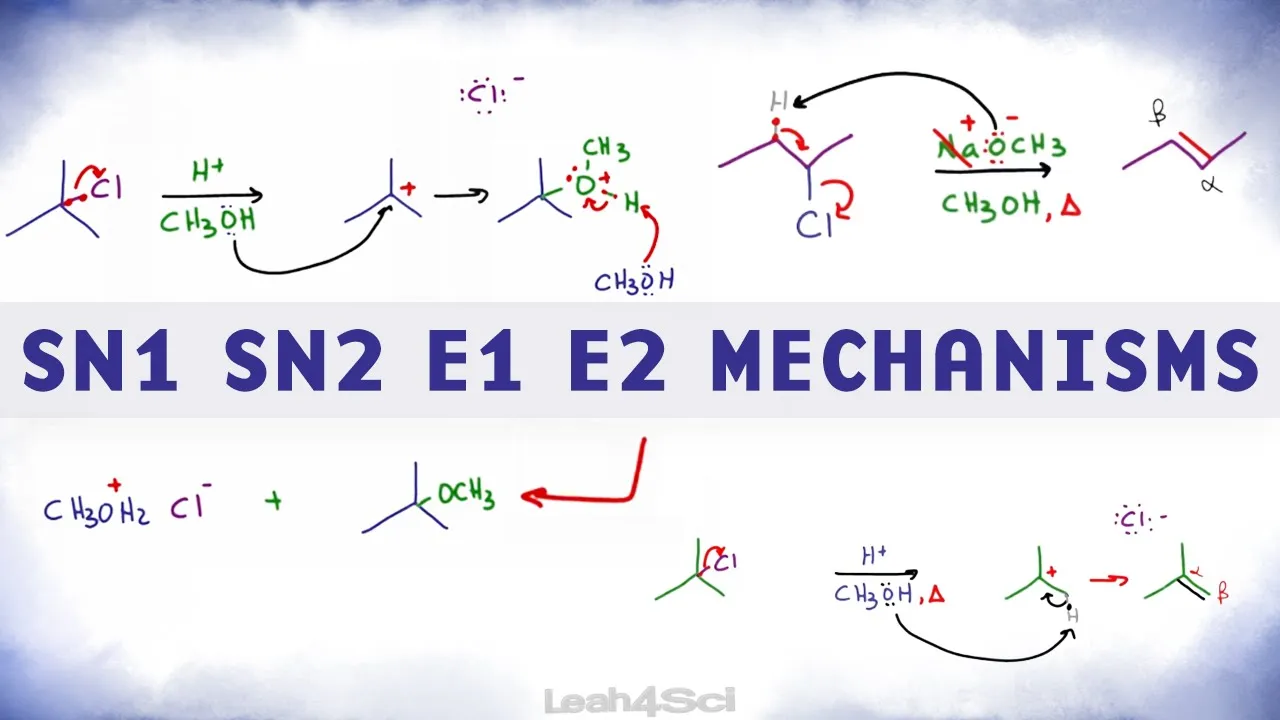
SN1 SN2 E1 E2 Reaction Mechanism Overview
561.9K
This video provides a comprehensive overview of four fundamental organic chemistry reaction mechanisms: SN1 (Unimolecular Nucleophilic Substitution) features a carbocation intermediate as the rate-determining step with solvent nucleophile attack; SN2 (Bimolecular Nucleophilic Substitution) is a concerted one-step mechanism with no intermediate and nucleophile inversion; E1 (Unimolecular Beta Elimination) shares the carbocation intermediate with SN1 but forms pi-bonds through beta-hydrogen abstraction; and E2 (Bimolecular Beta Elimination) is a concerted one-step elimination producing more substituted alkenes. The choice between these reactions depends on analyzing the alkyl chain, incoming nucleophile/base, solvent, and leaving group characteristics.
Click to watch →

Choosing Between SN2, SN1, E2 and E1 Reactions
127K
To determine whether a reaction follows SN1, SN2, E1, or E2 mechanism, examine three key factors: (1) the nucleophile/base strength (strong nucleophile/base favors SN2/E2, weak favors SN1/E1), (2) the substrate structure (primary/secondary favors SN2/E2, tertiary favors SN1/E1), and (3) the solvent type (polar aprotic solvents favor SN2, polar protic solvents favor SN1). Additionally, stereochemistry provides evidence: SN2 produces inversion of configuration while SN1 produces racemization, and E2 reactions follow Zaitsev's rule producing the more stable alkene.
Click to watch →

SN1 SN2 E1 E2 Reaction Mechanism - Test Review
237K
This video provides a comprehensive review of SN1, SN2, E1, and E2 reaction mechanisms, covering key concepts including substrate structure effects (tertiary substrates favor SN1/E1, primary/methyl favor SN2), solvent effects (polar protic solvents favor SN1/E1, polar aprotic favor SN2/E2), nucleophile/base strength differences, rate laws (first-order for SN1/E1, second-order for SN2/E2), and carbocation stability (tertiary > secondary > primary, with resonance stabilization increasing stability further).
Click to watch →

SN1, SN2, E1, E2 How to Identify Correct Mechanism | #jee2025 #jeechemistry | Monica Bedi
32.8K
The four fundamental organic reaction mechanisms can be identified by analyzing substrate structure, nucleophile/base strength, solvent type, and temperature: SN2 requires strong nucleophiles and unhindered substrates (1° or 2° alkyl halides) with polar aprotic solvents; SN1 involves weak nucleophiles, stable carbocation formation (3°, allyl, or benzyl halides), and polar protic solvents; E2 requires strong bases and higher temperatures for elimination; E1 involves weak bases and higher temperatures with stable carbocation intermediates. Temperature is a key differentiator—higher temperatures favor elimination (E1/E2) while lower temperatures favor substitution (SN1/SN2).
Click to watch →

32. LES DÉRIVÉS HALOGÉNÉS PARTIE 3/3: SN2, E1 et E2
56.5K
This video explains three fundamental reaction mechanisms in organic chemistry: (1) SN2 (nucleophilic substitution bimolecular) involves backside attack with inversion of stereochemistry (Walden reversal), requiring polar aprotic solvents like DMF or acetone; (2) E1 (elimination unimolecular) forms carbocation intermediates and follows Zaitsev's rule for product stability; (3) E2 (elimination bimolecular) is a concerted mechanism requiring anti-periplanar alignment of the leaving group and beta-hydrogen. The competition between substitution and elimination depends on factors like temperature, base strength, and solvent polarity.
Click to watch →
Deep Dive
Understanding Lewis acid-base reaction mechanisms using electron-pushing formalism.

Organic Chemistry Mechanism Challenge 3
8.9K
This video presents a mechanism challenge where students must write every single electron-pushing arrow to understand how a reaction proceeds. The starting material contains two five-membered rings, while the product shows one five-membered ring becoming a six-membered ring with an additional six-membered ring containing nitrogen. The key insight is recognizing that the azide functional group (N₃) will participate in the chemistry. Understanding the azide structure is essential: the central nitrogen has a positive charge, only two bonds, and two lone pairs, making it a strong nucleophile ready to attack electrophilic carbonyls. The first step involves the azide nitrogen attacking the carbonyl carbon, breaking the carbonyl double bond and forming a new sigma bond, which creates a seven-membered ring intermediate.
Click to watch →

Lewis concept about acids and bases || A generalized concept || G.N.Lewis 1923 @NASIBZADASSS
8.1K
In Lewis acid-base reactions, the Lewis base donates its lone pair of electrons to the Lewis acid, forming a coordinate bond. In the reaction between ammonia (NH3) and aluminum chloride (AlCl3), the nitrogen atom of ammonia donates its lone pair to the aluminum atom of AlCl3. The aluminum atom in AlCl3 is electron-deficient because it has only 6 valence electrons and can accept electron pairs. The chlorine atoms in AlCl3 donate their electrons to aluminum, creating electron-deficient species that can accept electron pairs from Lewis bases.
Click to watch →

Acids & Bases Concepts Part~1 | Arrhenius & Lewis Concepts | Pharmaceutical Analysis | BP102T | L~19
37K
This section explains the Lewis acid-base reaction mechanism with detailed examples. In Lewis reactions, acids accept electron pairs while bases donate electron pairs, forming coordinate covalent bonds. Examples include ammonia (NH3) donating its lone pair to H+ to form ammonium ion (NH4+), and boron trifluoride (BF3) accepting electron pairs from bases. The reaction creates a complex or adduct where both species share the electron pair. This mechanism demonstrates how Lewis theory explains acid-base behavior through electron pair sharing rather than proton transfer.
Click to watch →

লুইস এসিড ক্ষার | Lewis acid and lewis base | লুইস এসিড ও ক্ষার চেনার উপায়
150
In Lewis acid-base reactions, the acid accepts electrons while the base donates them. For example, in the reaction between BF3 and NH3: BF3 has an incomplete octet (6 electrons) and accepts a lone pair from NH3. NH3 has a lone pair that it donates to BF3, forming a coordinate covalent bond. This demonstrates how Lewis acids and bases interact through electron pair transfer.
Click to watch →

ACID -BASE REACTION ||REACTION MECHANISM || LECTURE -2|| NET ||GATE || IIT JAM
31.9K
Lewis acids are electron pair acceptors, while Lewis bases are electron pair donors. This definition is broader than Brønsted-Lowry (proton donors/acceptors). In Lewis acid-base reactions, the base donates an electron pair to the acid, forming a coordinate covalent bond. Back donation can stabilize Lewis acid-base complexes. This concept is fundamental for understanding reactions like Friedel-Crafts.
Click to watch →
Deep Dive
Analyzing reaction coordinate diagrams to relate curved-arrow steps to transition states and intermediates.

Enzymes - fundamentals of what they are, how they catalyze reactions, & how to interpret diagrams
1.1K
To analyze reaction coordinate diagrams: identify intermediates as valleys and transition states as peaks with double dagger notation; determine overall thermodynamic favorability by comparing substrate and product energies; identify rate-limiting step as the peak with highest activation barrier. Each intermediate has transition states on both sides. The enzyme's active site is shaped to stabilize the transition state most effectively, lowering the activation barrier for that specific step.
Click to watch →

LIVE NEET 2026 | CHEMISTRY PAPER DISCUSSION | All India FULL SYLLABUS TEST (FST-31) | NEW LIGHT NEET
2.8K
In a reaction coordinate diagram: (1) Reactants are at the left, products at the right. (2) Transition states are the peaks (highest energy points). (3) Intermediates are valleys (local minima between peaks). (4) Endothermic step: Products higher than reactants. (5) Exothermic step: Products lower than reactants. (6) Rate-determining step has the highest activation energy. For a two-step reaction with first step endothermic and second exothermic, the first step is rate-determining if it has higher activation energy.
Click to watch →

Carbocation DPP Solution (1--30 Qu.)
2.1K
In reaction coordinate diagrams, the number of transition states equals the number of intermediates plus one. Each new intermediate formation requires overcoming a new transition state. For example, three intermediates correspond to four transition states. This relationship helps analyze reaction mechanisms and energy profiles, providing insight into reaction rates and pathways.
Click to watch →
Reaction Mechanisms, Catalysts & Reaction Coordinate Diagrams
89.7K
Multi-step reactions show multiple hills on reaction coordinate diagrams, each corresponding to a separate step. Each hill has its own activation energy and transition state. Local minima between hills represent intermediates—species formed in one step and consumed in another. A two-step reaction has one intermediate, a three-step reaction has two intermediates, and so on. The step with the highest activation energy is the rate-determining (slowest) step because fewer molecules have enough energy to overcome this larger barrier.
Click to watch →

6.3 The Kinetics of Organic Reactions | Organic Chemistry
33.9K
A reaction coordinate diagram shows the energy profile of a reaction, with hills representing activation barriers and valleys representing intermediates. Each step in a multi-step reaction has its own transition state (the peak of each hill). Local minima between steps are called intermediates, and the number of intermediates is always one fewer than the number of transition states.
Click to watch →
Deep Dive
Predicting major and minor products of reactions based on the stability of intermediates (like carbocations) formed during electron flow.

NEET की नींव || Basic Idea & Script of Organic Chemistry
14.8K
Reaction intermediates are classified as electron-deficient (like carbocations) or electron-rich (like free radicals). Electron-deficient intermediates seek to gain electrons for stability, while electron-rich intermediates seek to lose electrons. The stability of the intermediate directly determines the major product formed in organic reactions. More stable intermediates lead to major products, while less stable intermediates lead to minor products.
Click to watch →

Markovnikov's rule trick & mechanism | IIT JEE & NEET | Vineet Khatri Sir | ATP STAR Kota
104.4K
The major product in electrophilic addition reactions is determined by the stability of the carbocation intermediate formed. The reaction pathway that leads to the more stable carbocation intermediate will be favored, resulting in the major product. This is because the formation of a more stable carbocation requires less activation energy.
Click to watch →

Preparation of Haloalkanes Hydrocarbons Haloalkanes & Haloarenes Class 12 Chemistry Ch 10 (2022-23)
108.6K
Markovnikov's rule states that in electrophilic addition of HX to unsymmetrical alkenes, the hydrogen adds to the carbon with more hydrogen atoms, while the halogen adds to the carbon with fewer hydrogen atoms. This rule is based on carbocation stability: tertiary > secondary > primary > methyl. The more stable carbocation forms preferentially, leading to the major product. For example, propene with HCl gives 2-chloropropane as the major product because the secondary carbocation is more stable than the primary carbocation. The reaction proceeds through a carbocation intermediate, and the stability of this intermediate determines the product distribution.
Click to watch →

1,3-dipolar cycloaddition reaction|examples|Mechanism|1,3-dipolar addition reaction CSIR-NET GATE
119.4K
Regioselectivity determines which product forms preferentially. In dipole cycloaddition, stability of intermediates governs outcome. More stable intermediates predominate. Carbocation stability follows hybridization: sp2 > sp3 > sp due to increased s-character providing better charge stabilization. Electron-withdrawing groups and aromatic systems enhance stability through resonance delocalization. These principles apply broadly to predict reaction outcomes.
Click to watch →

Electrophilic Addition Reaction - Organic Chemistry in 15 Days NEET 2023.
94K
Carbocation stability depends on the number of alkyl groups attached to the positively charged carbon. More substituted carbocations are more stable due to hyperconjugation and inductive effects. When a less stable carbocation can rearrange to form a more stable carbocation, rearrangement will occur through hydride shift or alkyl shift. This principle is crucial for predicting products in electrophilic addition reactions where carbocation intermediates are formed.
Click to watch →
Arrow Rules
Charge & Octet
Arrow Rules
0:00- 1
Electrons flow from rich to poor sites, attacking electrophiles.
- 2
Arrows start from lone pairs, negative charges, or bond centers.
- 3
Nucleophiles attack; electrophiles are the targets of attack.
Molecular Orbital Theory and Quantum Delocalization
While the curved-arrow formalism is an indispensable heuristic for tracking localized electron pairs, it simplifies the quantum mechanical reality of chemical reactions. Molecular Orbital (MO) Theory and computational quantum chemistry provide a more accurate alternative perspective. According to MO theory, electrons are not localized pairs hopping from a nucleophile to an electrophile; rather, they occupy delocalized wavefunctions spread across the entire molecular system. In pericyclic reactions, for instance, transformation is driven by the symmetry and overlap of frontier molecular orbitals (HOMO and LUMO) rather than discrete, localized electron-pushing. Furthermore, modern quantum chemical topology shows that actual physical shifts in electron density during a reaction often do not align with where curved arrows suggest electrons 'flow,' as polarization, nuclei movement, and electrostatic forces dominate the reaction coordinate in ways the Lewis-based arrow model cannot represent.
Understanding Lewis structures, including how to represent valence electrons, bonding pairs, and lone pairs.
The concept of formal charge and how to calculate it for individual atoms within a molecule.
Fundamental definitions of nucleophiles (electron-rich species) and electrophiles (electron-poor species).
The octet rule and its implications for the stability of second-row elements like carbon, nitrogen, and oxygen.
Electronegativity trends and polar covalent bonds, which dictate where electron density is concentrated.
Applying curved arrows to depict resonance structures and electron delocalization.
Writing out step-by-step mechanisms for fundamental organic reactions such as SN1, SN2, E1, and E2.
Understanding Lewis acid-base reaction mechanisms using electron-pushing formalism.
Analyzing reaction coordinate diagrams to relate curved-arrow steps to transition states and intermediates.
Predicting major and minor products of reactions based on the stability of intermediates (like carbocations) formed during electron flow.
209.7K views40likes3:21@cheggOriginal Release: 2024-02-15
[Music] Professor Dave and CH here we now know what these curved arrows mean in the context of organic reaction mechanisms but since it is so important to be able to draw these correctly let's go over some more rules and examples showing how they are used so that things will be less confusing when we learn specific mechanisms later the first thing we want to make abundantly clear is that arrows always go from electron Rich to electron poor they start at some region of excess electron density and point toward the region of electron deficiency that those electrons are attacking this is absolutely without exception you will never see an electron pushing Arrow starting at a cation or partially positive atom other words we can use to describe this are nucleophile and electrophile nucleophiles are electron rich and they do the attacking electrophiles are electron deficient and they get attacked so arrows go from nucleophile to electrophile this means arrows can start either from a lone pair a negative charge or the center of a calent bond and they always end at some atom which often has a partial positive charge or a formal positive charge next to become more familiar with nucleophiles and electrophiles let's understand that nucleophiles are always either negatively charged or of neutral charge if the atom that is attacking has a negative charge once coordinated to the electrophile it will be neutral and if it's started out neutral it will end up with a positive charge conversely the electrophile can either have a positive charge or be of neutral charge if it was positive it will end up neutralized if neutral it will end up with a negative charge when we put these two facts together we will see that charge is conserved in a chemical reaction plus and minus charges are either generated or neutralized in such a way as to conserve the overall charge of all the species involved finally we want to understand that the octet rule will guide many reactions the most important aspect of this is that elements in the ne equals 2 shell can't exceed their octet carbon can only make four bonds so if it is to accept a bond from an incoming nucleophile it must also lose a bond this way it can maintain its octed also when charges are generated or neutralized this also follows the octet rule if a base picks up a proton from hydronium the electrons in the oxygen hydrogen bond stay with oxygen and neutralize it oxygen had an octet before and after either three Bonds in a lone pair or two Bonds in two lone pairs so the neutralization did not change this we are going to get plenty of practice writing out mechanisms for a variety of organic reactions for now let's simply be aware of what nucleophiles and electrophiles are and how to represent their interactions using electron pushing arrows Professor Dave for CH see you next time
Up Next

31:13
Drawing Organic Chemistry Structures: Bond-Line & Condensed Formulas
@TheOrganicChemistryTutor
1.1M views•2016-07-27

83:56
Biocatalysis and Catalysis in Islatravir Synthesis | Merck Webinar
@SCIwheresciencemeetsbusiness
675 views•2020-10-08
10:06
1H NMR: Determining Number of Peaks from Structure
@MSJChem
59.2K views•2017-04-06

17:31
Edible Water Bottles: A DIY Guide to Sodium Alginate Spherification
@ryan
10.5M views•2019-06-21
Related Study Plans & Knowledge Roadmaps
Structured learning paths in Chemistry
chemistry
Nuclear Chemistry: Decay, Meds & Fuel Cycle
01Introduction to Nuclear Structure and Radioactivity
02Decay Dynamics and Kinetics
03Radiation Interaction and Detection
+ 2 more learning modules
24h5 modules
Explore Roadmap
chemistry
Supramolecular Chemistry: Forces & Machines
01Foundations of Chemical Bonding and Intermolecular Forces
02Introduction to Host-Guest Chemistry
03Thermodynamics and Dynamics of Self-Assembly
+ 2 more learning modules
16h5 modules
Explore Roadmap
chemistry
Photochemistry: Excited States & Reactions
01Foundations of Light-Matter Interactions
02Molecular Orbitals and Electronic States
03Photophysical Processes and Jablonski Diagrams
+ 2 more learning modules
18h5 modules
Explore Roadmap
chemistry
Coordination Chemistry: Bonding & Properties
01Introduction to Transition Metals and Ligands
02Crystal Field Theory (CFT) and Geometry
03Magnetic Behavior and Spin States
+ 2 more learning modules
14h5 modules
Explore Roadmap