





![Criminal Law: Introduction (Burdens of Production & Persuasion) [LEAP Preview]](https://i.ytimg.com/vi_webp/qpthxkNQmbc/maxresdefault.webp)







![Ohio's Bold Move: Strongest Self-Defense Immunity in the US! [NOT!]](https://i.ytimg.com/vi/3Jyj_ue_qnw/maxresdefault.jpg)





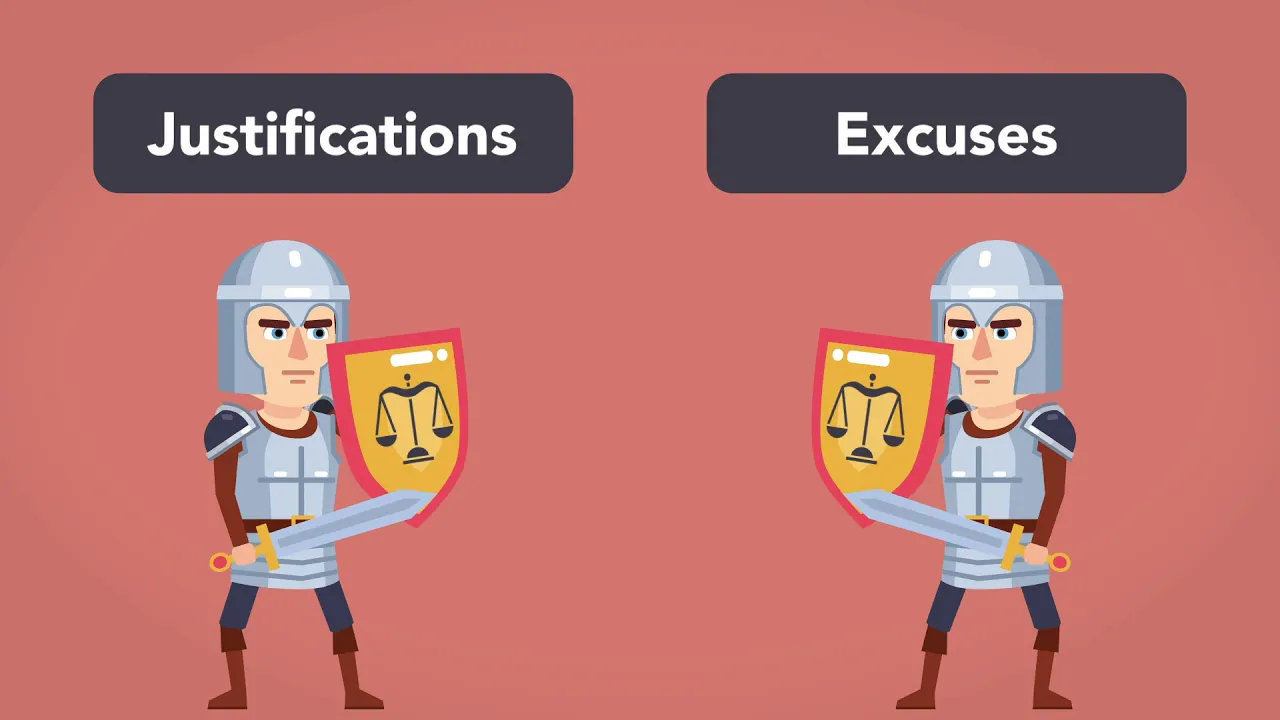
Criminal liability can be defended through two main categories: justification defenses, where the law permits the conduct (e.g., self-defense, lesser evils, public authority), and excuse defenses, where the defendant is not blameworthy due to conditions like insanity, intoxication, or minority; justification defenses require a triggering condition and proportional response, while excuse defenses involve disabilities that prevent the defendant from being a fully responsible agent.
Defences to Criminal Liability: Justification and Excuse
Added:Understanding the basic elements of a crime, specifically 'actus reus' (the physical act) and 'mens rea' (the mental state).
Familiarity with the concept of criminal liability and how the prosecution establishes a prima facie case against a defendant.
Knowledge of the burden of proof in criminal trials, including the distinction between the prosecution's burden and the defense's burden for affirmative defenses.
An in-depth study of specific excuse-based defenses such as insanity, duress, infancy, and intoxication.
Exploration of the legal boundaries of self-defense, particularly the concepts of duty to retreat, 'stand your ground' laws, and the use of deadly force.
Analysis of how modern jurisprudence adapts defenses to psychological contexts, such as the application of Battered Woman Syndrome to self-defense.
Examination of the necessity defense in modern scenarios, such as its controversial application in environmental activism and civil disobedience.
6.2K views244likes54:15Original Release: 2023-12-03
you're welcome to this presentation on criminal law uh the topic of our presentation is defenses to criminal liability part one uh in the course of the semester we have began to look at uh the legal elements of an offense we looked at the physical element of an offense we looked at the mental elements of an offense and we said that it's a combination of the two that will be sufficient to ground liability for an offense but despite the presence of the physical element of an offense and mental elements of an offense there is still the very important issue of criminal responsibility the gerine question is the defendant who has committed the act with the requisite mental element is he criminally responsible for the offense in other words is the defender at fault for the offense to such an extent as to be blameworthy the question of criminal responsibility goes to blame worthiness does this defendant deserve to be punished under the rules of criminal law the criminal law has outlined certain rules and principles which govern the question of criminal responsibility in other words even where the offender has done the prohibited act or made the prohibited Omission with a requisite mental element the question is still relevant as to whether the defendant is criminally responsible as to whether the defendant is blame worthy now we'll be looking at the general defenses to criminal responsibility these are defenses that applies to all offenses are subject to some limitation and restrictions that makes some of the defenses to be applicable to specific uh offenses so we'll be looking at those defenses to criminal responsibility but today we will start by looking at some of the governing principles that runs through several of these defenses and those goverment principles can be found on the concept of justification or excuse and we'll start with that today and we look at a couple of the uh preliminary uh a couple of the general defenses uh to criminal liability so just give me about two or three seconds as I share my slide so that you can also follow as we go along okay I believe you can all see my slides now defenses to criminal liability my name isim Bel I'm of the Department of Public Law faculty of law University ofos so uh briefly the lecture will cover general principles such as justification excuse and other grounds of impunity and then then begin to look at some uh specific defenses and we see whether they are defenses founded on justification or founded on excuse what are the learning objectives for this class there are basically two learning objectives the first one is that at the end of the lesson the students should be able to understand the general principles governing defenses to criminal liability founded on justification excuse and other grounds of impunity the second learning objective is that at the end of the lesson we expect that the students should understand the rules governing the application of specific defenses such as self-defense minority insanity and so on and so forth and for the learning outcomes we expect at that at the end of the lesson students should be able to do the following number one explain the general principles governing defenses to criminal liability founded on justification excuse and other grounds of impunity and explain and apply the rules governing the application of specific defenses we're going to be looking at some specific defenses consequently and so we expect that the student after the class should be able to explain and apply the rules governing the application of specific defense these rules are of course founded on statut provisions and uh judicial decisions now we want to look closely at the general principles which runs through several of the defenses and we start by looking at justification so what are the general principles a defendant whose conduct is within any of the grounds of justification excuse or other grounds of impunity provided by the law May Escape criminal liability in defenses based on justification the law takes the position that the defendant's conduct is not wrong because the law permits it the defendant has done a conduct that is wrongful within the definition of offenses under the criminal law but the law takes the position that the defendant's conduct is not wrong the defendant's conduct is not wrong because the law permits it now in justificatory defenses the harm caused by the Justified Behavior remains a legally recognized harm which is to be avoided whenever possible in justificatory defenses the defendant is allowed to cause some harm now the harm caused by the defendant is a legally recognized how for instance a defendant who is relying on The Plea of self-defense and takes an action which results in the death of the assant the death of the asant remains a legally recognized H but under the circumstances of the defendant trying to protect his own life from unjustifiable and illegal attack or assault the law allows that defensive conduct now under the justifying circumstances however that arm is outweighed by the need to avoid an even greater har or to avoid a greater or or or to further a greater societal interest now like we said earlier harm is caused by the uh victim who is exercising a plea of self-defense H is caused no doubt it is a legally recognized arm the asant has been killed in the case of uh a plea of self-defense but the H of killing the assant is outweighed by an even greater har and that greater har is the H of the asant who has unlawfully and unjust justifiably threatened to attack or is attacking or has attacked the victim so there are two arms here the arm done by defensive conduct is one arm the other is the arm that the asant is trying to inflict on an innocent victim so the har under the justifying circumstances out outweighs the the Great half of the law allowing an assant to threaten or take the life of the victim without any legal basis now a writer Paul Robinson identified three types of justification based defenses three types of justification based defenses the first is what he called lesser evils or choice of evil justification lesser evil or choice or choice of evil justification now in this type of uh justification based defenses the clant had a choice the clant had a choice between two evils and chooses the Lesser evil now let me give an example to illustrate this point you are driving your vehicle along the Road at a reasonable speed having regard to the level of traffic and pedestrians on the road so your driving was reasonable within the circumstances and a toddler suddenly walking by the side of the road suddenly tries to run across the road now you had a choice between two evil a lesser evil and the greater evil there are packed on the on the on the side of the road are cartons of soft drinks so you had a you had two two evils one is to run over the child who suddenly runs across you because because of the distance of the child trying to run across you and where you are at the point of driving you could not match your break uh sufficiently enough to avoid hitting the child so you had two choices one was to run into the child or to sve off the road and damage the carton of soft drinks by the side of the road now that was a situation of emergency that was a situ situation of of necessity and you had to act on The Spar of the moment so the Lesser evil is the evil of sving off the road and damaging the Caton of subject drinks of course that ordinarily would have amounted to the offense of damage to property but in the circumstances of the case you you you took a Justified C of action although your action of sving up the road and damaging the carton of uh soft drinks is something that constitutes an offense but because of the circumstances the law allows you to pick between two evils and to take a lesser evil now in that kind of a situation a charge of damaging or destroying those Kon of sub drinks cannot be successfully laid against you because you had a justification based defense now the second type of uh justification based defense is is the defensive Force justification where the law allows harm to be done for the purpose of Defending self of property now in the second scenario the law allows you to use what is called Defensive Force to Def for the purpose of Defending yourself or for the purpose of Defending property now this also involves weighing har to be done by the defensive Force against H to be done by not allowing the defensive Force where threaten H outweighs defensive H defensive arm is allowed somebody brings out a gun and shoots at you and because you you had under gone military training you are able to evade the bullet the first time the second time and the guy thean kept on trying to kill you and then you also had a gun nearby and you because of your military training you brought you able to quickly bring out your gun shoot at the asant and kills it now here the Lord allows you to use defensive Force against the arm that is threatening to you and if if the arm that is threatened against you outweighs defensive arm because if you do not kill the guy or do something drastic to him the guy is likely to end up killing you so in this circumstance defensive arm is allowed now the law allows different degrees of defensive Force depending on what is threatened if it is a life that is threatened there's a degree of defensive force that is allowed if it is a movable property that is threatened there's a degree of defensive force that is allowed if it is immovable property that is threatened there is a degree of defensive arm that is allowed for instance somebody who is threatening to assault you ordinary assault common assault maybe try to throw water on you cold water on you okay that is an ordinary assault that kind of assault you not allowed to respond with the kind of of assault or violence that is likely to threaten his life okay if he throws cold water at you and you give him a Dey slap that may be uh uh uh within the permissible degree now if it isov movable property generally the level of defensive force that the law allows for you to use when you are Defending Your movable property is not as high as the level of as high as the the degree of defensive force that the law allows you to use when you are Defending Your immovable property movable property maybe like a phone or like uh a vehicle or like uh you know other valuable movable property ordinarily the Lord does not allow you to use such Force as is likely to take human life when you are defending movable property but when you get to the level of immovable property somebody's is trying to set your house a place now the law allows you to use a higher degree of defensive force and in certain uh circumstance es the law may even allow you to use such degree of defensive force that may result in the Deb of theant so different degrees of defensive force is allowed depending on what is threatened whether it is life whether it is movable property or whether it is immovable property now the third category of justification defenses is what is called public Authority defense now in this category there is no requirement that the defense be triggered by a threat all that is sufficient is that the actor is protecting or furthering a legally recognized interest now in public Authority defense there there may be no requirement that there is a a a threat sought to be you know applied against the clim out what is important is that the person claiming Public Authority defense is protecting or fing a legally recognized interest is acting in pursuance of a legally recognized interest now the people who may come under this umbrella include Law Enforcement Officers executing the law now a law enforcement officer who is executing the law can rely on Public Authority defense ordinarily what law enforcement authorities do when they enforcing the law May constitute a crime a police officer acting under the rules of criminal procedur law administation of Criminal Justice law who wants to arrest an offender who has committed an offense in his presence is allowed to use such degree of force as may be necessary to apprehend the offender if the offender is trying to escape he is entitled to grab him or run after him or apprehend him using Force to restrain him now that use of force orar if the officer was not acting in pursuance of the law under Public Authority could constitute an assault so law enforcement officers uh uh can can come under the umbrella uh of Public Authority defense then parents under the law parents have some level of authority to discipline their wordss uh so you have the authority to discipline your child who has done something wrong now that is a a a a a a a legally recognized interest because Society recognizes the fact that children can you know often misbehave and we need to correct them but again they level of correction that the parents can can can impose has to be reasonable you can physically chastise a child or use a c you know or or other devices minimally you know to discipline a child but you are not allowed to use such Force as is likely to cause Grievous arm to the child similarly Masters or educationally Institution caring for a child allowed to use reasonable Force to correct a such child those are examples of justification based defenses uh under uh the general rubrics of Public Authority defense now one unique feature to all justification defenses is that they have the same internal structure they have the same internal structure involving a trigging condition which permits a necessary and proportional response so usually in justificatory defenses there is a trigger and that trigger you know allows for a necessary and proportional response in cases of self-defense the trigger is the threatened harm or H inflicted on the climat in public Authority defense the trigger is that the person is acting under a legally recognized interest is is fing a legally uh uh recognized interest for instance is's acting under the uh uh under Duty you know required by law in defensive Force justification the the acellent must have must have attempted to apply unlawful Force to the interest protected by law he must have attempted to apply unlawful Force to the interest protected by law before the CL claim will be at Liberty to use necessary and proportional defensive Force if disproportionate and unnecessary force is used then the defense will fail the defense will fail in in in justification based defenses the force use must be proportional if it is disproportionate or is unnecessary having regard to the circumstances then the defense will fail uh a police officer who is fing illegally protected interest of arresting of arresting an offender or a suspect who uses more Force as is reasonably necessary or who uses disproportionate Force to affect the arrest will be liable for assault because that defense will fail if the uh suspect is not resisting arrest the policeman tells him you are under arrest and he surrenders him himself to be arrested and yet the policeman still beats him up knocks him pushed him down kicks him then the police officer will no longer be entitled to the defense because the force that he's using uh is unnecessary and disproportionate now based on the above analysis of justif of the essential features of justification based defenses the following defenses may be classified as justificatory nature of course we've already mentioned self-defense I've already given the example of necessity when you are driving on on the road and a toddler suddenly runs across the road I given the example of H uh I've given the example of uh Public Authority I've also given the example of uh disciplining of children and uh some other uh example now we want to look at ex ex excusatory uh defenses want to look at defenses based on excuse and to look at their essential features now in excusatory defenses the deed is wrong the offender or or the claimant has done something the the law says should not be done but the defendant is relieved from Criminal liability because conditions suggest that he is not responsible for his deed so in excuse defenses one important feature of of excusatory defenses is that the claimant is laboring under certain conditions and those conditions affected him in such a manner as not to make him to be responsible for his deed as not to make him to be accountable for his deed as not to make him to be blameworthy for his deed as not to make him to be at fault for his deed and because of of of those conditions which has created uh his inability you know to be responsible to be accountable to be blameworthy to be at fault the law frees him from Criminal liability the law excuses him from Criminal liability in excusatory defenses just a minute I think the slide just jumped okay in ex excusatory defenses have one internal structure and that internal structure is that there is a disability causing an existing condition the offender or the claimant is laboring under a disability and that disability causes a condition which makes the defendant not a fully free and responsible agent as to be fairly held accountable the claimant is has a disability and that disability causes a condition that makes him not to be a free agent you in other words he's not fully in control of his of himself he's not fully in control of his action and because he's not fully in control of the action the Lord takes the position that he we should not hold him responsible we should not punish him because he was not fully responsible now what are the examples of some of the disabilities which causes abnormal condition examples uh come from Insanity a defendant who is mentally instable who is not mentally able who is suffering from some uh mental condition that impairs his ability to control his action or to know what he's doing the law will not hold such a defendant liable for any offense he commit he has committed in that state that is essentially the basis of The Plea of his sanity there is also intoxication although the law ordinarily concerns itself here with involuntary intoxication where a defendant is involuntarily intoxicated maybe it's unknown to him somebody uh spiked his drink or put something in his water that intoxicates him or puts a drug in his drink that intoxicates him the by making him not to be in a condition as to be able to control his action whatever offense offenses he commits in that state the Lord will excuse him will free him from Criminal liability then we also have uh some situation in which the offender is subnormal is not is not uh is laboring under a condition that does not make him to behave the way an ordinary person will behave or uh a situation where the defendant is is immature in terms of age for instance there are certain categories of age under the criminal law if you are below the age of seven the law says you cannot be responsible for an offense and in States in Nigeria that still operates the criminal code in southern Nigeria uh the law uh the criminal code says a person under the age of 12 is in capable of having unlawful uh uh Canal knowledge so a a male child under the age of 12 cannot commit the offense of rape so those are situation in which the the uh offender is uh is immature is not fully mature he's a minor under the law and why and because he a minor is that the his level of De development is a form of disability which makes him not fully responsible we all know that children are not fully uh responsible in terms of development of their intellect in terms of their development of their uh mental capacity to be able to rationalize and reason and do certain things so the law affords them uh the uh the defense of IM majority based on the grounds of excuse now most excusatory defenses completely escalates what that means is that most excusatory defenses will completely you know free the defendant from Criminal responsibility for instance the defense uh provocation as a defense for assault under Section 84 of the criminal code that is a defense that completely escalates if some somebody provokes you as a result of which you are Sal in then the law will allow you to raise a plea of provocation and if your plea succeeds then you are free from liability SE section 84 of the criminal code of course we also have the defense of insanity where a defendant is able to successfully make a plea of insanity then the court will enter even if it is found that he did the act or made the Omission but for as long as he did it while he was still insane then the court will enter a verdict of Not Guilty by reason of insanity although there are some other procedural consequences that will follow after that when we look at the defense of insanity we examine that fully and like I've said earlier that is also the defense of immaturity whatever the offender does when he's under the age of uh uh seven then is not uh responsible but between the age of seven and 12 under the criminal code then the law allows evidence to be brought in that the defendant was sufficiently mature enough to to know uh that what he was doing was wrong and if that can be established then the defendant can be liable uh in that regard but once if it is a a plea of immaturity made by a person under the age of seven or in States in southern Nigeria that still applies uh the criminal code a person who is under the age of 12 is incapable of having Canan knowledge so it provides for a complete uh excuse now the following are offenses where the excuse will only be partial the criminal law also allows for certain situation where a successful plea of excuse uh will only lead to a reduction in the punishment a reduction in the gravity of the offense and consequently a reduction in the punishment that the offender uh would receive for instance if a defendant who is charged with the offense of Mur successfully raises a plea of provocation in other words he claims that well it was the victim that you know provoked him by grave and sudden uh provocation and he did not have time for his passion to cool and in the ca of of that he MERS uh the victim the law if the plea succeeds then the law would find the court will find him guilty of the Lesser offense of manslaughter and the consequence of that is that he will be sentenced to a term of years depending on the circumstances of the the case we also have uh the excusatory defense of diminish responsibility because of the technical nature of the offense of insanity as we'll see when we get there uh a defendant who is not able to successfully raise the defense of insanity may be able to raise the defense of diminished responsibility which is a defense that is now Incorporated in section 228 of the criminal of Lagos that defense contemplates that although the defendants may not be legally insane but the uh the defendant was suffering from such other emotional or psychological state that leads to leads to the impairment of his responsibility to such an extent that he cannot uh he should not be found liable for the offense of mother so the law allows uh for the defense of diminished responsibility so we have looked at the general principles and the general features of just justification based defenses and excusatory defenses defenses based on excuse so we now want to look at some of the uh justification based defenses remember we said that one is that uh where the defendant is acting under a public duty or ERS of the authority Nigerian criminal law justifies what will otherwise be a crime when the act or the Omission constituting the crime is carried out in discharge of a public duty in execution of the law or under Superior orders so uh where the claimant is discharging a public duty uh is executing the law or is executing uh the orders of the Superior Court then he cannot be held liable for any uh offense uh people who executes the order of a court uh may you know take certain steps that will constitute an offense but the LA provides them with uh uh protection from that now uh judicial officers we know the role of judicial officers in our criminal uh justice system they interpret the law they they apply the law and determine the law and because of the nature of their responsibilities sometimes they make orders or give orders which may result in certain actions which ordinarily may open them up to criminal liability so because of the need to protect them in the discharge of their functions and to create an atmosphere that will make them free from any unnecessary TR threat of uh criminal action against them arising from the discharge of their Duty the law provides immunity for judicial officers from Criminal liability the law provides immunity for judicial officers from Criminal liability uh so the law affords them criminal uh immunity from Criminal liability under Section 46 of the PAC Cod and under Section 1 of the criminal code and this protection extends to act or Omission done in the exercise of judicial functions so whatever they do in the excise of their judicial functions you know in the course of of the Jud of their judicial functions they make orders they can uh find a person guilty of an offense they can make an order that property should be demolished they can make an order that somebody's propert party should be forcefully taken in execution of the orders of a court they may make an order that a defendant who has been found guilty should be uh sentenced to imprisonment or they may make another uh directing uh the offender to go and render community service so all these are acts done in the exercise of of their judicial function or maybe in the course of of of exercising their judicial function the offender or either of the parties before them may constitute himself into a nuisance in the court uh you know in the course of the proceedings of the Court by trying to distur the proceedings of the Court the court may you know cite him for content and Order him to be in prison so these are all you know exercises uh done in the course of their uh judicial function the criminal code Provisions in section 31 covers judicial Acts or omissions in exercise of judicial functions judicial acts Omission in exercise of judicial functions and in excess of his authority so the law covers whatever they do in excess of authority now why why should the law cover them when they do anything in excess of judicial Authority you know courts interpret the law they apply the law and they apply the law to make decisions which they believe is within their judicial Authority and they need to be given the freedom and the protection to do what they believe is within their judicial powers but in doing that they may also do something that is in excess of their judicial Authority innocently mistakenly and that is why we have the Appellate Court System you may find a situation in which the high court will say the answer to this legal question is a the litigant not happy with that decision may go to the court of appeal and the court of will say no the tri court is wrong the answer is B and the party who loses at the court of appe may also say no I I I don't agree I'm going to the Supreme Court and the Supreme Court will say that both A and B are wrong and the actual is actually a c now if you now allow litigants to be able to pursue actions against the trial cour who had initially said the answer to the legal question is a Judicial officers will not be able to discharge their functions you know freely and and uh uh fairly because they will be anxious not to do what is wrong honly they should be anxious not to do what is wrong but when it comes to judicial Authority sometimes they make innocent mistakes and that is why the law covers anything they do in excess of their judicial Authority although that is not a liberty for them to deliberately go out outside uh uh the Ambit of their judicial Authority now a a Judicial officer who acted in excess of authority will also be covered under the provisions of the penal code or although the penal code provision does not explicitly cover excess of judicial Authority but I believe that a Judicial officer who acted in excess of authority will also be covered under the PE the pinac if he believes in good faith that the Lord gives him such Powers now does judicial immunity in Nigeria cover acts done by judicial officers maliciously now when they do something maliciously what that implies is that they they are doing they've done that thing for an improper purpose or maybe for a purpose that is not connected with the exercise of their judicial functions so the question is does judicial immunity in Nigeria cover acts done by judicial officials maliciously the use of the word good faith by the penal code arguably exclude malicious acts from the scope of the immunity I mean if you look at the provisions of section 41 of of the penal code that I uh sorry section 46 of the penal code that I referred to earlier uh it uses the word that provided that whatever they do they believe in good faith that the law allows them uh to do it so the use of the words good faith by the penal code arguably exclude malicious acts from the scope of the immunity now in the English case of Anderson and gory 18951 QB page 668 it was held that no action civil or criminal lies against a judge of a superior court in respect of any act done by him in his judicial capacity although he acted maliciously that is a position in England the position is that well for as long as uh the action is done by a judge of a superior court uh in respect of anything done in his judicial capacity even if he acted maliciously uh no civil or Criminal action can lie against him but I agree with the view expressed by Cho by Professor chuko that the decision will not apply under the provisions of the criminal code the decision will not apply because the criminal code has already circumscribed the scope of what they can do in exercise of their judicial Authority so whatever they do must be done in the exercise of their judicial Authority if they acted maliciously for an improper purpose that cannot be said to be done in the exercise of their judicial Authority so I agree with him that a Nigerian Court should not follow the the decision in Anderson and gory now acts in execution of the Law act in execution of the law a person is not criminally responsible for an act or Mission if he does Orit to do an act in execution of the law if he does an act in execution of the law so if what the offender has done is in pursuance of executing the pro uh the processes of law I gave the example of the police officer arresting an offender and even under the uh rules of criminal proed or add of Criminal Justice even a private citizen is empowered in certain circumstances to arrest an offender so whatever is done within reasonable limits in pursuance of that duty to arrest an offender is an act done in the execution of the law and uh the person will not be criminally responsible for that a person is not crimin respons for an act to Omission if he does omiss to do an act in Obedience of the order of a competent Authority for which is bound by law to obey unless the order is manifestly unlawful so if you are a police officer you are on duty in a courtroom and uh one of the litigants or the defendant becomes unruly and wants to begin to disturb the proceedings of the court and the court orders the police officer duty to arrest him and take him out of the courtroom the conduct of the police officer in arresting that unruly person and taking him out of the courtroom is in Obedience of the order of a competent Authority and is bound by law to obey it unless the order is manifestly unlawful of course in this instance the order is not manifestly un love in the same ve a superior officer a superior police officer who gives a directive to a junior officer to arrest an offender and the junior officer arrests the offender the junior officer will not be liable for anything done within reasonable limit in carrying out that order of course it's also important that the order must not be manifestly unlawful section 47 of the penal code specifically includes the requirement that the protection applies not withstanding that the court may have had no jurisdiction to pass such judgment or order now how will the person enforcing the order know that the court had no jurisdiction to pass such judgment to order there was no way he would know so he will be protected so the protection I mean applies not withstanding that the court may have had no jurisdiction to pass such judgment or order Pro provided the person doing the act in good faith believes that the court had jurisdiction as far as he's concerned he's in a courtroom the court ask him to arrest somebody who is behaving unre or un or disturbing proceedings of the court and take him out of the Court through that is a proper order and in good faith he believes he can not now be liable for any criminal action with respect to that the same position will also apply under the criminal code even in the express of express provision yes even under the criminal code if if you are enforcing the order of the uh of a court of competent jurisdiction how is the person enforcing the order like I said earlier how is it to know that the court made the order properly or the court made the the court that made the order add jurisdiction to uh to make the order a person is is not criminally responsible for an act of mission if he does or Miss to do the act in if he does or Miss to do the ACT if his action is justified by law so if you can otherwise show that what you have done is justified by law the law allows you to do it the law permits you to do it then you cannot uh be responsible see see section section 45 of the penal code now Superior orders let's look a bit Superior a person who has no criminal responsibility under SE 322 of the criminal code for an act or mission in Disobedience sorry for an act Omission in Obedience of the order of a competent Authority which the person is bound by law to be unless the order is manifestly unlawful I've said something about that earlier now let's look at the aspect of uh the requirement that the uh that the order must not be manifestly unlawful yes you are if you are under Authority you are bound to obey ERS of a competent Authority if you are in the military or you are in any of the Armed Forces or you are in any position that you have a competent Authority presiding over you the law requires you to obey their orders the law requires you to to obey their orders provided that the order is not manifestly unlawful what that means is that the order is not and order that you know that I'm not bound by law to obey this order for instance if your you are working in the armed forces and your Superior orders you to arrest and another person who has uh violated the provisions of a law that is a manifestly lawful order if you carry out the arrest you cannot be responsible for any offense but if you're Superior you are you are going on the road and you are the the uh security officer attached to your Superior Commander and in the course of you know driving on the road uh anada man hit the official car of your commanding officer and your commanding officer was so annoyed he got that he he he he all lighted from the vehicle and orders you to shoot the okada rider that is a manifestly unlawful order because there is nothing that the man has done that justifies you killing or shooting thead so if you obey such an order you do not have any legal protection under the law the law will not protect uh anybody who obeys a manifestly unlawful order both the person who gave the order and the one to whom the order was addressed who carried out the order both of them will be liable depending on the circumstances if in the example that I have given you manifestly I mean you you you obeyed the order of your commander and you gone down theam man the only offense he has committed is that he used his okada you know he he he to damage the official vehicle of your commanding officer that is not sufficient enough to justify uh the order made by your Superior to shoot and kill the okada so both the uh the commanding officer and the person who carried out such an order will be liable for whatever offense has been committed you can see the case of I and the state now uh that is the the presentation uh for defenses to criminal liability part one uh so I want to thank you uh for your attention now uh there'll be opportunities for you to ask questions uh if there is any aspect of the class that is not clear to you uh you can uh you know ask your questions or request for clarification uh thank you for listening to it I hope you you'll find time to listen to it so that you can come to class prepared for questions and I will be available uh in the course of the lecture to explain any area uh that needs clarification any area that needs uh any additional input uh do not forget to subscribe uh to to click the Subscribe button so that when I post uh subsequent lectures you'll be able to to access them thank you very much God bless
Up Next

240:50
DummyVision Explained: Legal Analysis of Charlie Kirk Assassination Case
@RekietaLaw
4.1K views•2026-07-21

4:27
US Secondary Sanctions Impact on EU Businesses and Blocking Legislation
@Bureauvandijk
1.6K views•2019-03-20

5:27
Forensic Phonetics: Speaker Identification in Legal Cases
@nptel-nociitm9240
539 views•2025-03-19

24:42
Police Interrogation Tactics: False Confessions & Legal Reform
@LastWeekTonight
7M views•2022-04-18
Related Study Plans & Knowledge Roadmaps
Structured learning paths in Law
law
Self-Defense Law: Imminence & Castle Doctrine
01Foundations of Self-Defense Law
02Imminent Threat & Reasonable Belief
03The Principle of Proportionality
+ 3 more learning modules
12h6 modules
Explore Roadmap
law
Defamation Law: First Amendment & Actual Malice
01Introduction to civil torts and the First Amendment
02Elements of Defamation: Libel and Slander
03Public Figures vs. Private Individuals
+ 2 more learning modules
8h5 modules
Explore Roadmap
law
Hearsay Rule: Trial Evidence & Exceptions
01Introduction to Trial Evidence & Courtroom Basics
02Demystifying Hearsay: The Core Definition
03Non-Hearsay: Exclusions Under FRE 801(d)
+ 3 more learning modules
14h6 modules
Explore Roadmap
law
Medical Malpractice: Law, Liability & Care
01Foundations of Tort Law and Civil Liability
02The Four Elements of Medical Malpractice
03Defining and Proving the Standard of Care
+ 2 more learning modules
12h5 modules
Explore Roadmap