
















Personal identity concerns what makes a person the same over time, distinguishing between qualitative similarity (having similar properties) and numerical identity (being one and the same entity). Philosophers debate whether personal identity is constituted by physical constitution, immaterial substance (like a soul), or psychological continuity. Apparent contradictions arise when applying Leibniz's Law to changing properties, but these can be resolved by specifying time-indexed properties rather than treating change as incompatible with identity. Change is actually essential to personhood, as breathing, eating, and thinking all require temporal transformation.
Personal Identity: Philosophy of Self & Mind
Added:The distinction between qualitative identity (sharing identical properties) and numerical identity (being one and the very same entity).
The core concepts of the mind-body problem, specifically Cartesian Dualism (mind as separate from body) versus Physicalism (mind as physical).
How philosophers use hypothetical scenarios and thought experiments to test the boundaries of definitions and intuitive concepts.
A basic familiarity with empiricism and rationalism, particularly the works of René Descartes and John Locke on consciousness.
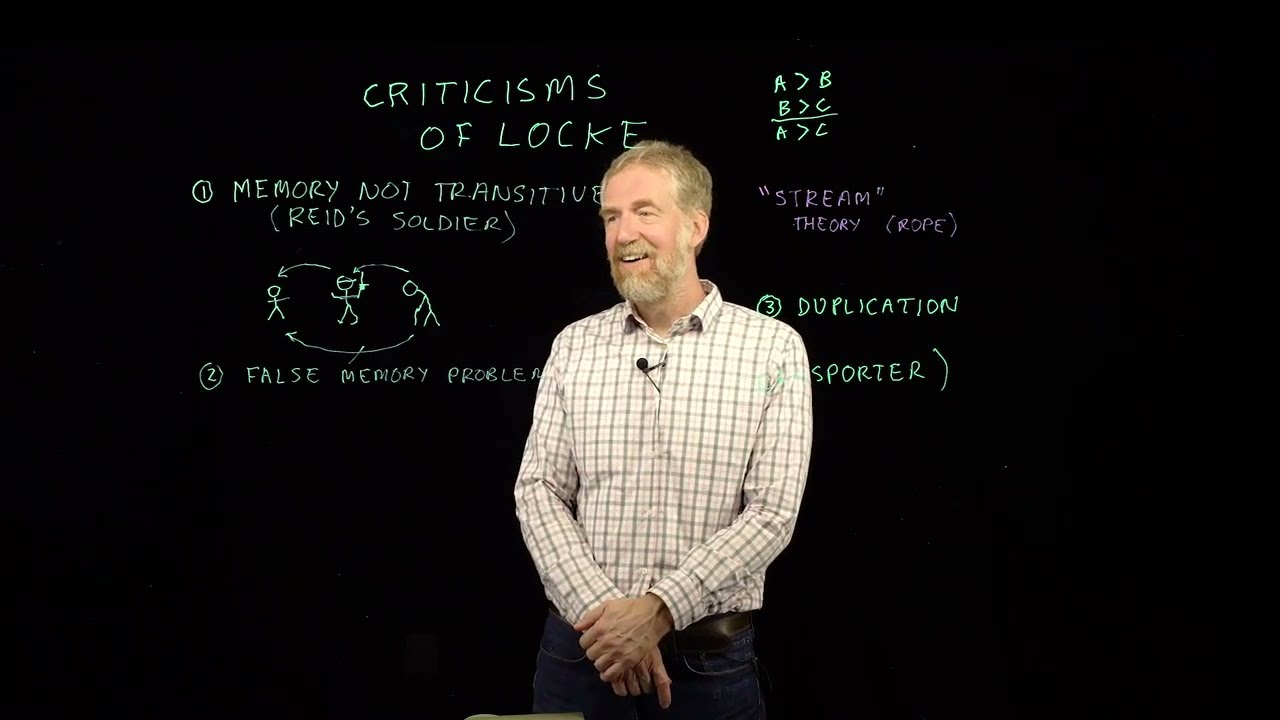
Thomas Reid's 'Brave Officer' paradox and Joseph Butler's circularity objection to John Locke's memory-based theory of identity.
Derek Parfit's reductionist 'Bundle Theory' and the philosophical implications of his teletransportation thought experiment.
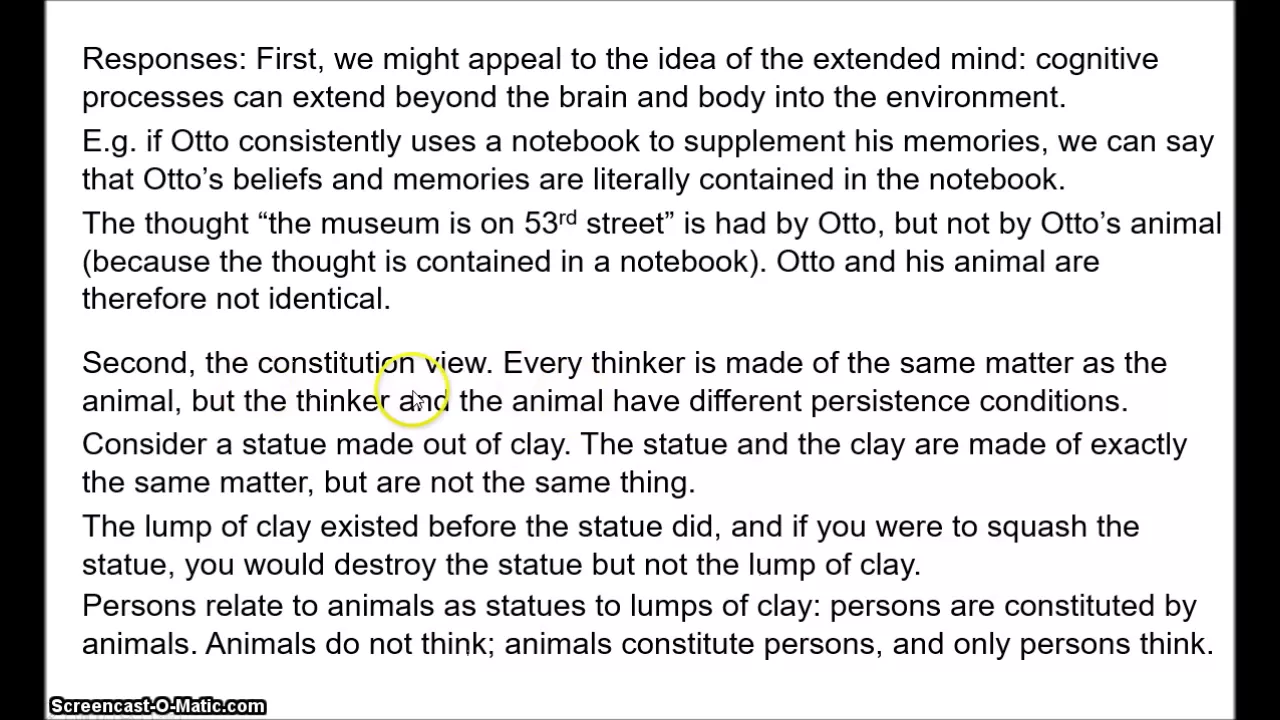
The 'Animalist' theory of personal identity, championed by thinkers like Eric Olson, which argues that we are primarily biological organisms.
The real-world ethical and legal applications of personal identity, such as determining moral responsibility in cases of severe dementia, brain injury, or advanced age.
45.6K views312likes8:54Original Release: 2011-04-14
okay so we're going to finish today with personal identity and uh as usual we've got various luminaries there John Lock David Hume Bernard Williams and Derek parit three of them with the exception of Hume all closely associated with Oxford okay so we start by distinguishing two different questions first what is it to be a person and that could invite a discussion of Mind Body uh the link between them what it is that constitutes the mind and so forth a different question what is it for a and b to be the same person that is the issue of personal identity and it's obviously typically raised over time what is it for a person at one time to be the same person as someone at a later time what is it for example uh for me to be the same as I was as a baby that we think of as the same person is that justified and if so why and how and let me start also by drawing another distinction two different meanings of the word same when you say two things are the same you can mean that they're qualitatively similar or you can mean that they're numerically identical and my advice would be in all these discussions avoid use of the word same just by itself because it is systematically ambiguous so I I would suggest that you use the word similar to mean qualitative identity when you want to say that two things have similar qualities they look this they look more or less the same uh they have various things in common talk of them as similar not as the same and if you want to say things that two things are numerically identical say that they are one and the same so the claim about personal identity is that I am one and the same person as that baby rather too many years ago now the problem arises because of liet's law again we've seen this before um back in I think the fourth lecture but here we are again with lit's law it seems to be a matter of logic that if a and b are one and the same thing then any property of a must also be a property of B so let's call the property F if it's true that F of a and a equals B then it follows logically that F of B so take these examples let a be me as a baby let B Be me today and let the property F be weighs less than a stone we have an apparent contradiction here because I as a baby certainly weighed less than a stone today I certainly weigh rather more so it seems to follow that I as a baby cannot be numerically the same as me today doesn't it well actually these sorts of problems are quite easily dealt with you simply specify F more precisely so instead of of just saying weighs less than a stone let's put a Time index in weighs less than a stone in 1958 which was the year I was born as opposed to weighs less than a stone in 2009 the fact is that I this very person had the property of weighing less than a stone in 1958 and you can say if you like that I timelessly have that property of weighing less than a stone well maybe a particular date in in 1958 and that baby has the property of weighing more than a stone in 2009 because that very baby is me at least if the claim of personal identity is true so you can see that we can at least avoid overt contradiction uh we don't have to say that there's some kind of serious problem in things having different properties at different times now some philosophers have had difficulty seeing this um David Hume for one uh most of hume's treatise is actually uh logically very acute but on this particular issue he seems to have had a bit of a blind spot he took the view that strict identity um really required exact similarity there was a major problem with saying that something that changes over time is nevertheless one and the same in his later work he seems to have uh avoided the issue and it may be that he came to see the error of his ways but at any rate there in the treaties you will find I think this mistake made okay so that is a mistake we don't have to say that if something changes over time that therefore means that it's not one and the same thing over time indeed if you think about it we want to say the reverse I mean a person who did not change at all would not be a person right I mean part of being a person is thinking for example breathing eating metabolizing all the various things we do all of those actually require change over time it's quite impossible to breathe without changing over time it's quite impossible to eat or talk or think without changing over time so so far from change being incompatible with personal identity actually personal identity seems to require change over time nevertheless there are limits some changes are fine some aren't so we're still left with the question what is it that constitutes personal identity over time what is it that makes me the same person as that baby and the various intermediate stages in between is it physical Constitution or is it having the same immaterial substance is it that when I was born God or before I was born indeed God implanted a soul made of immaterial substance and somehow it's the continuity of that soul that makes me the same person or is it a matter of the organic life of the the animal that I am um in the same way that we identify the identity of a tree as it grows over time maybe we are just physical organisms and that's how our identity is constituted Ed or should it perhaps be psychological continuity is what makes me the same person as I was then that there is a continuous line of psychological life now notice that this question the question I've highlighted there what constitutes personal identity over time is not the same question as asking how we judge personal identity in practice they're likely to be closely related but they don't have to be the same suppose for example that you did think that personal identity was constituted by an immaterial Soul well since immaterial souls are inaccessible to us you might nevertheless have to say that our way of judging personal identity in practice is through the physical organism we believe that the same Soul goes along with the same body from birth until death therefore the way we actually judge personal identity in practice is using the physical body body even though really personal identity is constituted by the soul and that way you could quite happily say that the body is the preeminent Criterion of personal identity during life whilst continuing to believe that there you can make sense of personal identity in the Hereafter through the survival of the Soul
Up Next
9:09
Philosophy of Identity: Essential and Accidental Properties
@crashcourse
1.6M views•2016-06-20

164:01
John of Damascus on Holy Images: A Theological Defense
@BannedBooks
139 views•2026-04-25

15:06
John Locke on Personal Identity: Philosophy Lecture
@oxforduniversity
59.1K views•2011-04-14
4:57
The Myth of Sisyphus: A Greek Legend of Eternal Punishment
@TEDEd
8.6M views•2018-11-13
Related Study Plans & Knowledge Roadmaps
Structured learning paths in Philosophy
philosophy
Frankfurt School: Critical Theory & Culture
01Foundations of the Frankfurt School and Critical Theory
02Horkheimer & Adorno: The Critique of Instrumental Reason
03The Culture Industry and Mass Deception
+ 2 more learning modules
12h5 modules
Explore Roadmap
philosophy
Philosophy of Language: From Frege to Austin
01The Linguistic Turn: An Introduction to Language in Philosophy
02Gottlob Frege: Sense and Reference
03Early Wittgenstein: The Picture Theory of Meaning
+ 3 more learning modules
15h6 modules
Explore Roadmap
philosophy
Feminist Epistemology: Standpoint & Injustice
01Introduction to Epistemology and Feminist Critiques
02Sandra Harding and Standpoint Theory
03Donna Haraway and Situated Knowledges
+ 2 more learning modules
12h5 modules
Explore Roadmap
philosophy
Environmental Philosophy: Ethics & Deep Ecology
01Foundations of Environmental Ethics & Anthropocentrism
02Biocentric Individualism and Animal Liberation
03Ecocentric Holism and Deep Ecology
+ 1 more learning modules
10h4 modules
Explore Roadmap