





![[니체, 삶을 묻다] 1강. 현대성으로의 전환점 (백승영 교수)](https://i.ytimg.com/vi_webp/vbyx_830q3k/maxresdefault.webp)


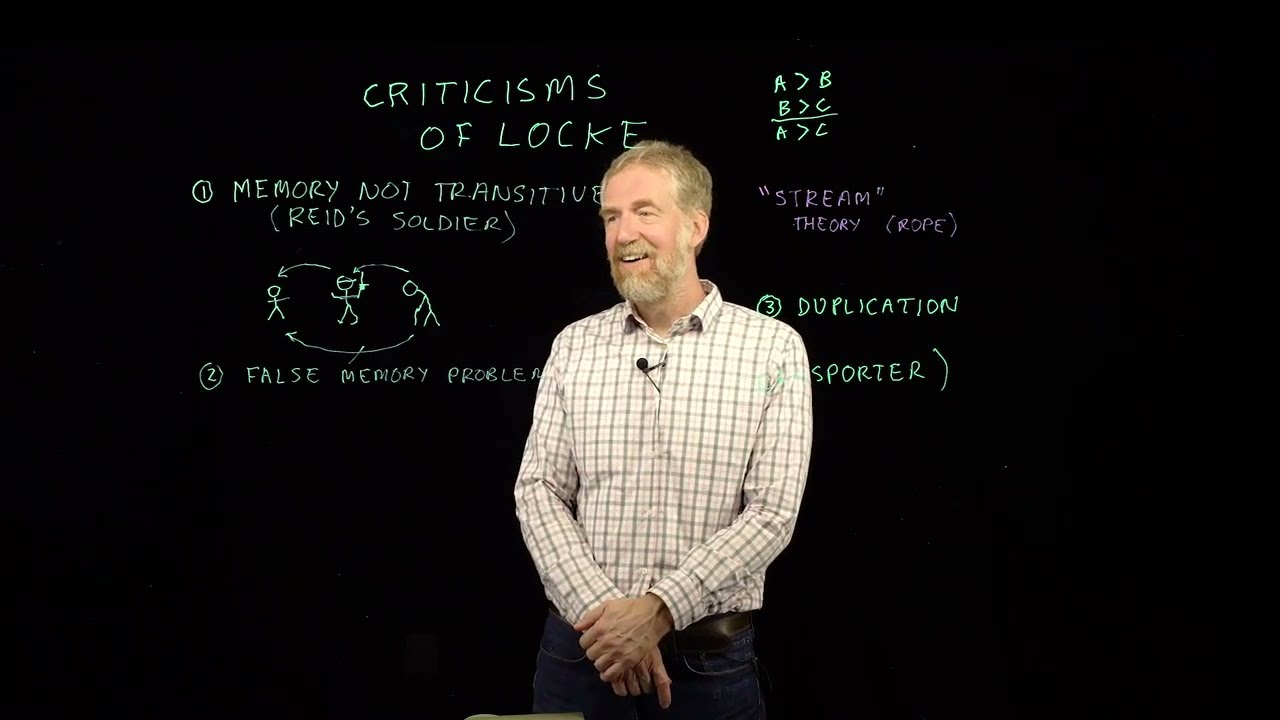

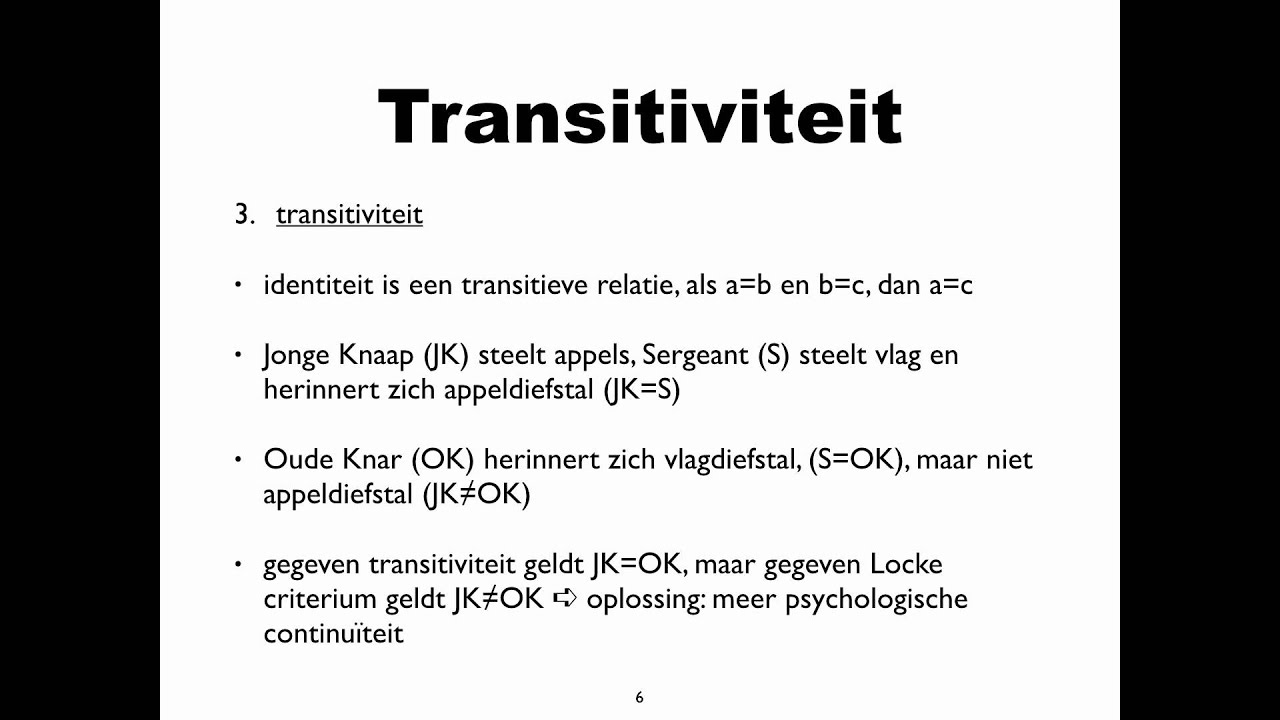





John Locke argued that personal identity over time is constituted by continuity of consciousness rather than physical or psychological continuity, distinguishing persons (thinking, intelligent beings with reason and reflection) from mere human organisms; he proposed that what makes us the same person across time is our ability to remember past experiences, which provides the basis for our sense of self-continuity and has significant implications for questions of moral responsibility and the afterlife.
John Locke on Personal Identity: Philosophy Lecture
Added:The distinction between qualitative identity (sharing identical properties) and numerical identity (being one and the same unique entity).
René Descartes' Substance Dualism, specifically the division between the immaterial mind (res cogitans) and the physical body (res extensa).
The core tenets of British Empiricism, particularly the idea that human knowledge and concept formation derive from sensory experience.
The traditional philosophical concepts of 'soul' and 'substance' as they were understood in the medieval and early modern periods.
Classic objections to Locke's memory criterion, notably Joseph Butler's circularity charge and Thomas Reid's 'Brave Officer' paradox.
Derek Parfit's modern psychological continuity theory, the 'Bundle Theory' of self, and his view on 'what matters' in survival.
The rival 'Animalism' theory (e.g., Eric Olson), which argues that human beings are fundamentally biological organisms, not merely streams of consciousness.
The ethical and legal implications of Locke's view, such as how personal identity affects moral responsibility, punishment, and the treatment of patients with advanced dementia.
59.1K views437likes15:06Original Release: 2011-04-14
okay so let's come and look at Lock's views on this Lo more more or less invented this topic and he came up with a discussion that was really impressively sophisticated given that he was more or less starting from scratch he took the view and it's a very reasonable view that the appropriate Criterion of identity that is what it is that constitutes sameness over time depends on the kind of thing you're talking about so suppose you've got a single particle of matter think of an atom if you like but think of an atom not constituted in the way that we think of it now as made up of protons and neutrons and electrons think of a a single indivisible corpal the kind of thing that lock or boil might have thought or speculated that matter was composed of well the identity of that at any rate seems a relatively straightforward matter as long as it continues in existence it remains self-identical so A and B are the same particle of matter if there's a continuous history connecting them so imagine a particle here at this at one part of time and a particle here at a different time they are the same particle if and only if there's a continuous trajectory leading from one to the other okay so that seems nice and straightforward what about the identity of a body of matter suppose for example we have a lump of clay what is it that constitutes the identity of that well that depends on the identity of the particles that constitute it it's the same body if and only if it's the same collection of particles even if they're differently arranged so if you take a lump of clay and you squash it and move it around That Remains the Same lump of clay even though the particles are differently organized as long as the same particles are there it's the same lump now that you could raise a query here what if you take that lump of clay and divide it up and the different parts of the lump have completely different histories for quite a long time and then they come back together and the lump is reconstituted would you still want to say that's the same lump of clay I think one isn't so clear on that you might think that's indeterminate but at any rate in the standard case where the lump all remains together that's the Criterion that Lo thinks we should apply now there's a problem here and the problem will emerge if you think about what happens as you mold this clay you mold this clay and having done so what do you find on your hands you find that your hands are dirty some of the clay has come off in your hands is that still the same lump then well strictly no strictly no because it no longer consists of exactly the same particles and I think here we can see the influence of what's called a CI argument I suspect that this is in the back of Lock's mind these arguments are very famous the uh Paradox of the Heap for example how many heaps does it how many grains of sand does it take to make a heap or the Paradox of the bold man okay a man with just one hair is bold agreed Just One Hair on his head that's all he's bald now suppose you take a man who has n hairs on on his head and suppose surgically or somehow you added one hair would that be enough to stop him being baled no of course not one hair can't make the difference if a man with n hairs is bald then a man with n plus1 hairs must be Bal too okay apply that argument iteratively you get the conclusion that a man with a million hairs is Bal so we get the Paradox of the bold man if a man with just one hair is Bal then a man with two hairs is Bal if a man with two hairs is Bal then a man with three hairs is Bal and so on there's nowhere to stop and this is a major problem with the issue of vagueness vague predicates uh Bal is clearly a vague predicate we've got a vague boundary between being bald and not being Bal and it leads to all sorts of interesting paradoxes and a lot of philosophers notably for example Timothy Williamson who's a professor here at new College uh have devoted a lot of energy and a lot of debate to trying to sort these things out all I want to say here is that I think we can see that issue in the locks Criterion for the sameness of a lump of matter if you allow just one particle to come off that lump and yet it remain the same lump then you can see again you can iterate take another particle off take another one off another and another and another and so on or maybe while while you're molding this particular piece of clay maybe you're molding another piece of clay as well and part little particles from that piece get mixed with this piece where do you stop the obvious way to stop is right at the beginning to say actually strictly even losing one particle of clay makes it a different lump but that can seem overly strict okay what about the identity of physical organisms living things well a plant or an animal isn't just a collection of matter we clearly do not want to apply the strict Criterion that applies to lumps of matter to organisms Lo describes these as an organiz organization of parts in one coherent body partaking of one common life so he wants to say that the identity of a living organism over time is constituted by a continuous history of such an organized life and as I've said already it's actually part of the essence of being a living thing that you are changing over time in systematic ways you're eating and excreting and drinking and breathing and all the other things so it's actually essential to being a living thing that you are at some points acquiring new matter and at other points losing matter but as long as that's part of a continuous life history we can say correctly that there is a single organism and likewise the identity of a man or or woman right we are living organisms or at least it seems that we are that's a question we might want to raise when we come to consider the identity of persons but at least it seems that as men and women we have an identity of the same kind as a tree or a dog or maybe an amoeba H not so clear well let's put that aside for the moment and come to what lock has to say about personal identity well a person is a thinking intelligent being that has reason and reflection and can consider itself the same thinking thing in different times which it does only by that Consciousness which is inseparable from thinking and essential to it so notice that lock is drawing a distinction a very important distinction between a human organism and a person a human organism is a living organism like others but a person is a thinking intelligent being and lo is here saying that Consciousness which is inseparable from thinking is the crucial issue so personal identity over time is going to be something like continuity of Consciousness and that's clearly going to depend on memory what makes me the same person as myself years ago will be some kind of consciousness of continu of Consciousness mediated by memory now one important point to make here concerns Lock's forensic perspective on this forensic just means related to law and legal matters and things like dessert and Punishment remember that for people of this time in 17th and 18th centuries the big concern about personal identity was life after death but also during life our concept of personal identity is very intimately linked up with these sorts of Notions so it is very natural irresistible indeed to be concerned about one's own future what makes me more concerned about the future in 10 years time say of this organism as a opposed to other organisms or most other organisms is that that's me I'm concerned about my future in a particularly intimate way so the notion of personal identity is not just a theoretical notion it carries very important practical concerns likewise if you believe that there's a punishment in the afterlife for people who've been bad or rewards for those who've been good then you're going to see personal identity over the gap between life and death as crucial from the forensic point of view now put yourself in lock shoes personal identity you see as being a very important notion for this reason most previous philosophers have speculated on personal identity as being constituted by a soul in fact they've pretty much taken that for granted there's an immaterial soul implanted by God and it's the identity of the Soul which matters but the trouble with appealing to an immaterial Soul or immaterial substance is first of all we have no access to it it's very unclear that there is any such stuff or if there were how we would know what there is but also if you think that souls are constituted by immaterial substance it's not clear that that really solves the problem because think about physical substance and how that plays a role in our life again we ex we eat we excrete the physical substance of our bodies is constantly turning over well let's suppose that we do have souls that are constituted by immaterial substance how do we know the same isn't true of them maybe the immaterial substance gets turned over and metabolized in some way who knows so if you you end up with personal identity depending on immaterial substance it looks like the result is just going to be complete obscurity complete ignorance you may be able to appeal to religion to get you out of that but it's going to be an appeal to Authority not to any sort of rational understanding an interesting thought experiment which brings home the forensic nature of personal identity nice thought experiment that burn Bernard Williams came up with imagine that um I fall into the hands of a mad scientist again the Mad scientists play a large role in philosophical thought experiments as you see so you and I are taken into uh this laboratory by the mad scientist and we're told that our brains are going to be switched so my brain is going to be put into your body and your brain is going to be put into my body well I hope that being a decent human individual you will be concerned about the future of both of the persons who will result so would I of course but you might be more intimately concerned about one of them than the other so which would you be concerned about the more my body your brain your body my brain well I think it's natural to identify with the continuity of the brain would you agree when I wake up after the operation which person will I identify myself with I think when I wake up go different body better than the old one might be quite happy but I think it'll be the continuity of the brain is going to be what afterwards seems to matter and I think also it will be what previously seems to matter I think when I think forward to which of those two individuals I'm going to be more intimately concerned about it's going to be the continuity of the brain that does does it now again if we're thinking of things like an afterlife you can see that there's nothing so simple to hang on to it's very difficult to see how you can make sense of this continuity of concern over a complete absence of body lock doesn't want to have to appeal to some kind of immaterial substance to do the job so he brings in consciousness um as the solution
Up Next

12:32
Kang the Conqueror: Narrative Identity Theory in the MCU's Future
@WisecrackEDU
155.9K views•2020-10-23

164:01
John of Damascus on Holy Images: A Theological Defense
@BannedBooks
139 views•2026-04-25

8:54
Personal Identity: Philosophy of Self & Mind
@oxforduniversity
45.6K views•2011-04-14
4:57
The Myth of Sisyphus: A Greek Legend of Eternal Punishment
@TEDEd
8.6M views•2018-11-13
Related Study Plans & Knowledge Roadmaps
Structured learning paths in Philosophy
philosophy
Frankfurt School: Critical Theory & Culture
01Foundations of the Frankfurt School and Critical Theory
02Horkheimer & Adorno: The Critique of Instrumental Reason
03The Culture Industry and Mass Deception
+ 2 more learning modules
12h5 modules
Explore Roadmap
philosophy
Philosophy of Language: From Frege to Austin
01The Linguistic Turn: An Introduction to Language in Philosophy
02Gottlob Frege: Sense and Reference
03Early Wittgenstein: The Picture Theory of Meaning
+ 3 more learning modules
15h6 modules
Explore Roadmap
philosophy
Feminist Epistemology: Standpoint & Injustice
01Introduction to Epistemology and Feminist Critiques
02Sandra Harding and Standpoint Theory
03Donna Haraway and Situated Knowledges
+ 2 more learning modules
12h5 modules
Explore Roadmap
philosophy
Environmental Philosophy: Ethics & Deep Ecology
01Foundations of Environmental Ethics & Anthropocentrism
02Biocentric Individualism and Animal Liberation
03Ecocentric Holism and Deep Ecology
+ 1 more learning modules
10h4 modules
Explore Roadmap