

















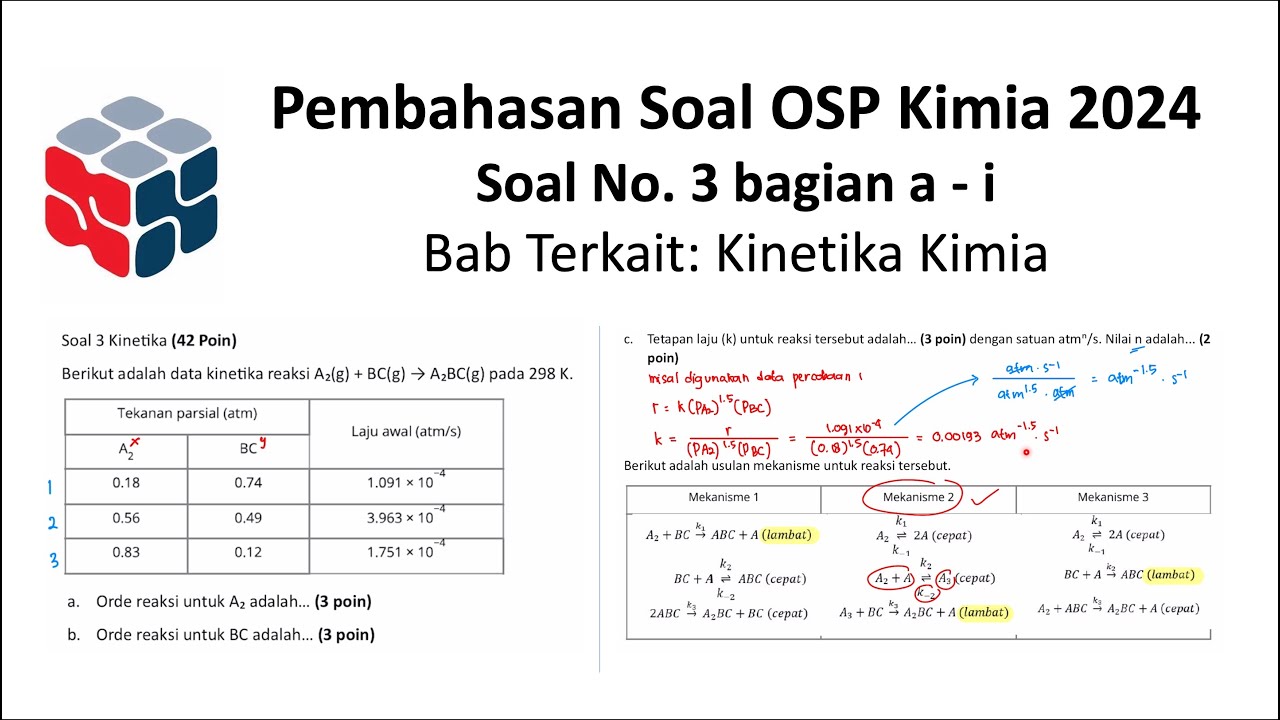
When the slow (rate-determining) step in a reaction mechanism is not the first elementary step, the pre-equilibrium/steady-state approximation method is used to determine the rate law. This involves drawing a box around the reactants of the slow step and all elementary steps above it, then canceling out any intermediates that appear as products in one step and reactants in another. The rate law is written based on what remains after cancellation, using a new rate constant K' instead of the individual elementary rate constants. This method differs from standard approaches where the slow step is first, and it can occasionally result in products appearing in the denominator of the rate law, which would act as an inhibitor causing the reaction rate to decrease with increased product concentration.
Pre-Equilibrium Approximation (Steady-State) - AP Chemistry Rate Law
Added:Hello everybody welcome back today we're going to be looking at subunit 5.9 which is called pre-equilibrium approximation some textbooks call it a steady state approximation so they're they mean the same thing so let's get started okay so just to review from the last subunit 5.8 this should look very similar we were given reaction mechanisms that will typically have two or more Elementary steps uh one of the things that is very often asked of you is to come up with the overall balanced reaction and typically to determine the rate law now what's presented in front of you probably looks similar but there's an important difference all of the examples that we did in the last subunit the slow or what we call the rate determining step was always the first Elementary step and you can see that in this example in front of you that is not the case and you might say does that even make a difference and yes it does not only do I see that the slow step is not first but that first step that is it says that it is fast very often you'll see the word equilibrium there and I can also see that in that first Elementary step there is a double-headed Arrow right there that also indicates that this reaction is at equilibrium I realize we haven't gotten to that unit yet but equilibrium just means that the reaction is going in the forward and reverse Direction that's really not going to affect how we handled this problem but there's two different rate constants K1 and K2 if you'll notice what we're asked to do here it says determine the overall balanced reaction that does not make a difference whether the slow step is first second third that doesn't matter the overall balanced reaction that method of determining that is the same as we've been doing determining the rate law however is different I'm going to show you a method I call the box out method and it was shown to me I think it's a really helpful method but let me just make sure this is clear you only have to use this method if the slow step is not first so let me show you what I'm going to do if the slow step is not first like in this example what I do is I draw a box around the reactants of that slow step and anything above it so let me show you I'm going to draw a shaded box around the reactants of the slow step and anything above it meaning any Elementary step in its entirety I'm going to include in that shaded box okay now what well now that I've boxed out what I want I'm going to look in that shaded region and see is there anything that I can cancel out and I can see that there is NO2 is an intermediate it's found on the product side of the first Elementary step the reactant side of the next one I can cancel it out to determine the rate law in this situation here's what I'm going to do I'm going to write rate equals K Prime it's not just I'm not going to write just K I'm writing K Prime to make sure that I let the greaters know that I understand that the rate constant in my rate law is not K1 it's not K2 it's a new rate constant that I'm getting from both Elementary steps but then I'm going to write it kind of like we have in the past I'm going to look at this shaded region and I'm going to write the rate law based on what remains for example nitrogen monoxide in that shaded region I can see that there's two of them so I'm going to give an exponent or a power of two whereas the bromine there's just one so I'm going to leave that with an exponent of a one so I have written the rate law based on that shaded box region whatever was left after I canceled out anything that I could okay but let me just make sure this is clear you only have to use this box out method if the slow step is not first if it's first you can just use our our regular way that we did in the past last thing I want to do here is determine the overall balanced reaction as I said that's no different whether the slow step is first second third doesn't matter so I've canceled out that intermediate so here here is my overall balanced reaction plus br2 to n o okay so that's no different but this box out method I think is really helpful when the slow step is not first so let's just look at another example okay right away I can see in this reaction mechanism that the slow step is not first and that should send up a little flag in your brain I should probably try that that box out method so I'm going to shade in again let's make sure we know what to shade in the reactance of the slow step and anything above it the entire Elementary Step Above It reactants products everything within that shaded region is there anything that I can cancel out and yes I see that there is something that we can cancel out okay there's an intermediate and so we're going to write the rate law based on everything that remains okay so I would write rate equals K Prime I can see that ozone that O3 there's two of them now there's something in this example though that's a little different let me show you okay so right here that should not be a surprise to you there's two ozone molecules on the reactant side so it gets a power of two however what is going on here we typically don't have things in the denominator in our rate laws but the reason for that guys is because we typically whoops don't have products included in our rate law that's a little bit unusual but it wasn't cancelled out so it needs to be included and if there is a product left in your shaded region it ends up in the denominator of a rate law okay so that's that's unusual that does not come up very often on the AP exam but it's possible that you could see it but I want you also to think about what it means for something to be in the denominator of a rate law that means if you were to increase the marity of that O2 gas that would actually cause the rate the overall speed of this entire reaction to slow down it would cause the rate to decrease and if we were in a biology class like AP biology um or level biology that would likely be called an inhibitor something that when you increase it it causes the reaction to slow down it's kind of the opposite of a catalyst so I just wanted you all to be aware that that does exist however pretty rare to be seen on the AP exam so um that again with something called pre-equilibrium approximation or again some textbooks call it steady state approximation just to recap you only need to use that box out method if the slow step is not first okay so I hope you guys have learned a little something today and I look forward to seeing you next time
Up Next
Activation Energy Diagrams (Endothermic & Exothermic Reactions)
@OldSchoolChemistry
5.5K views•2019-12-03

Biocatalysis and Catalysis in Islatravir Synthesis | Merck Webinar
@SCIwheresciencemeetsbusiness
675 views•2020-10-08
1H NMR: Determining Number of Peaks from Structure
@MSJChem
59.2K views•2017-04-06

Edible Water Bottles: A DIY Guide to Sodium Alginate Spherification
@ryan
10.5M views•2019-06-21
Related Study Plans & Knowledge Roadmaps
Structured learning paths in Chemistry