



![Lógica clássica [1] - Introdução (1/3)](https://i.ytimg.com/vi_webp/eA-Zv5JBCyI/maxresdefault.webp)





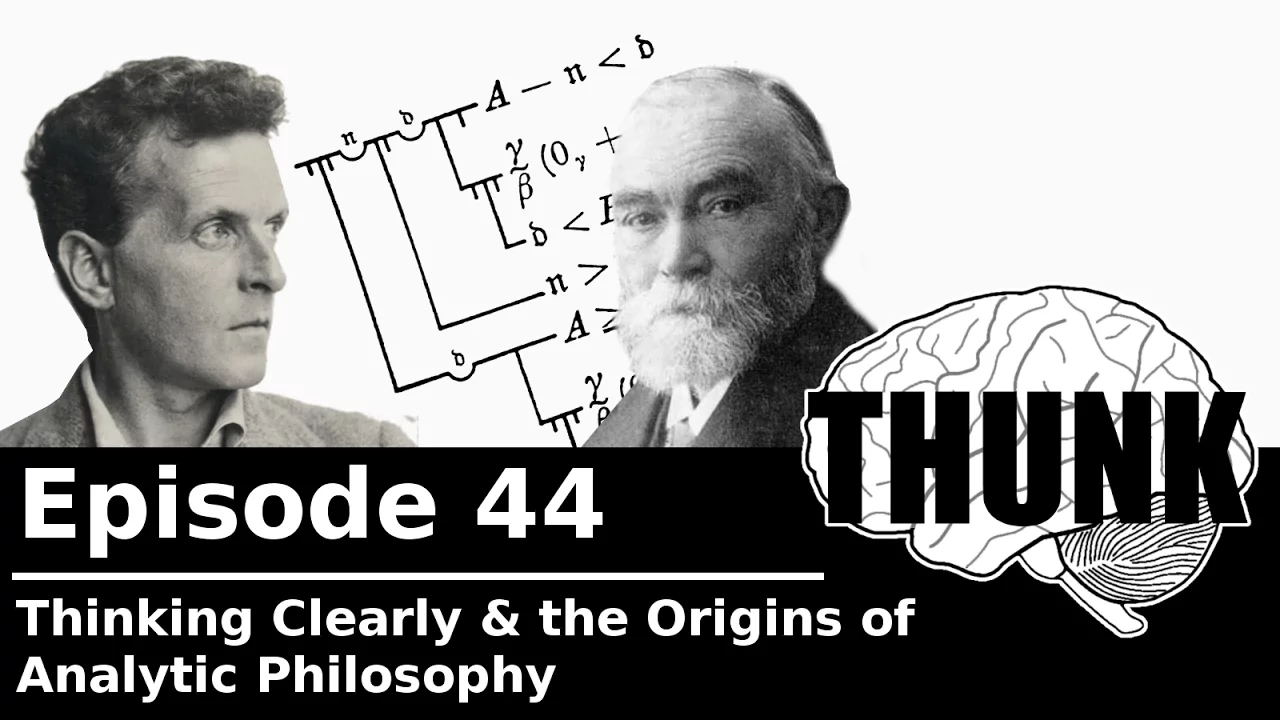

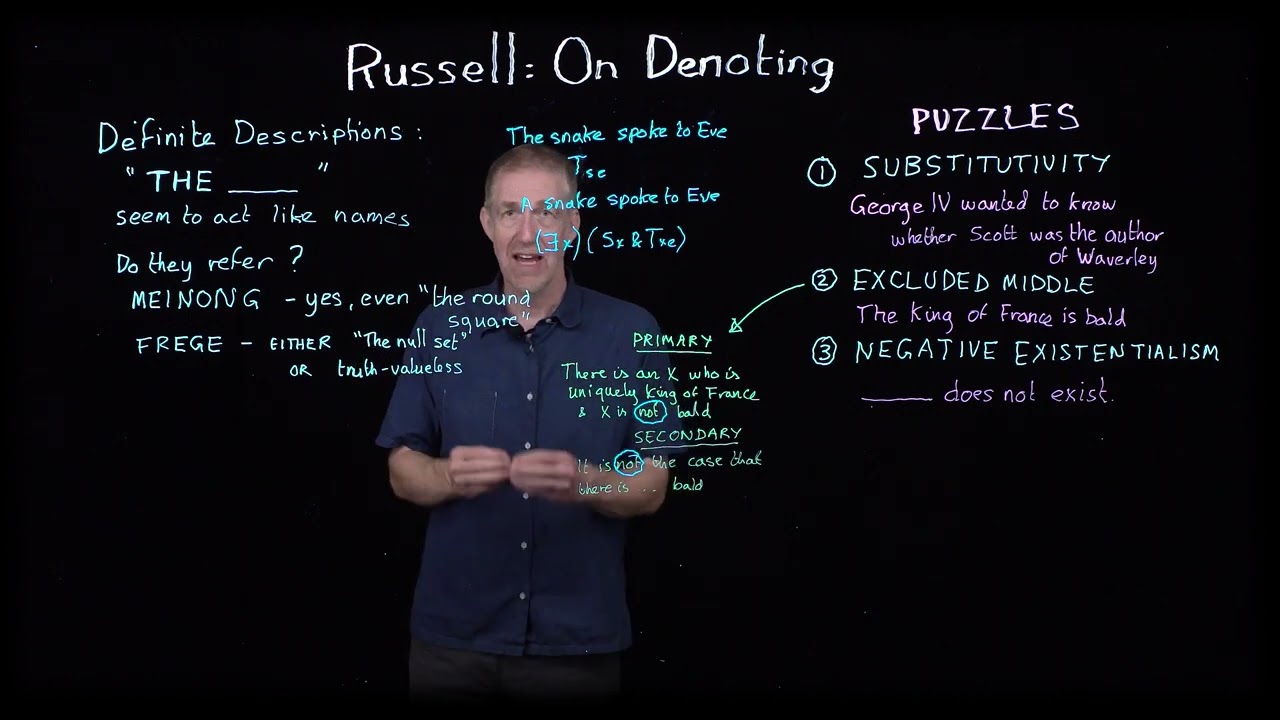





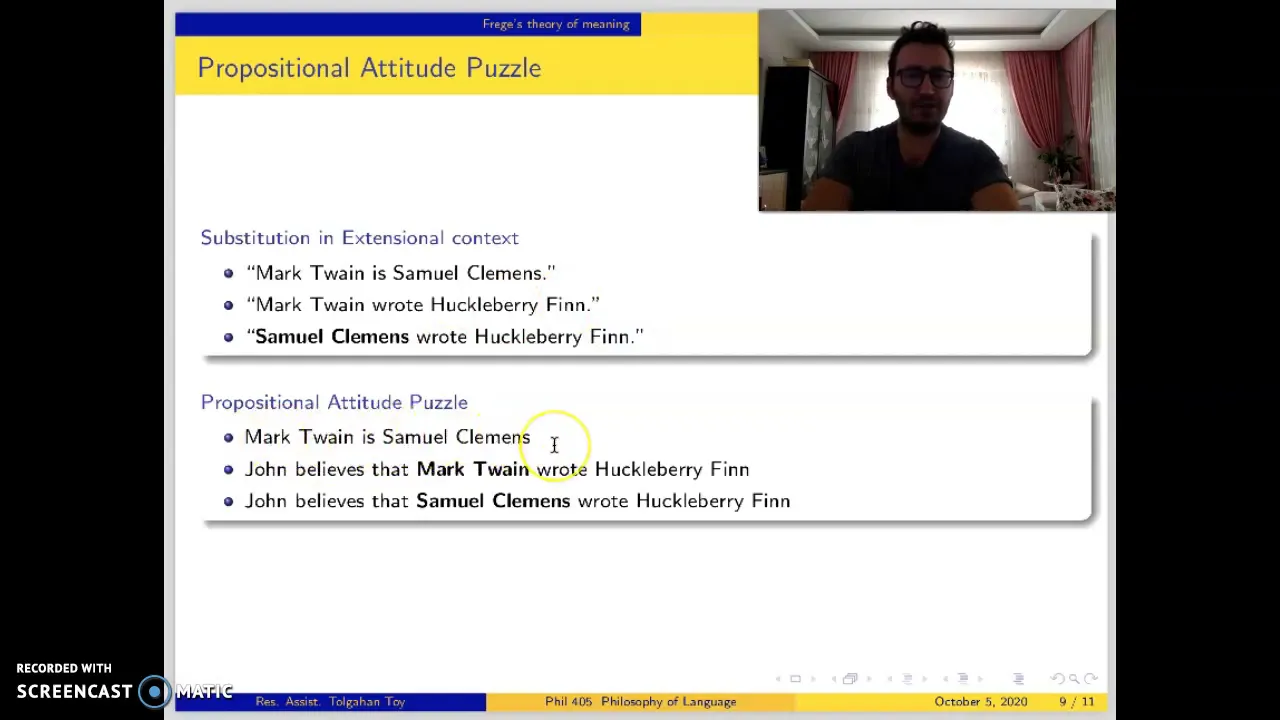
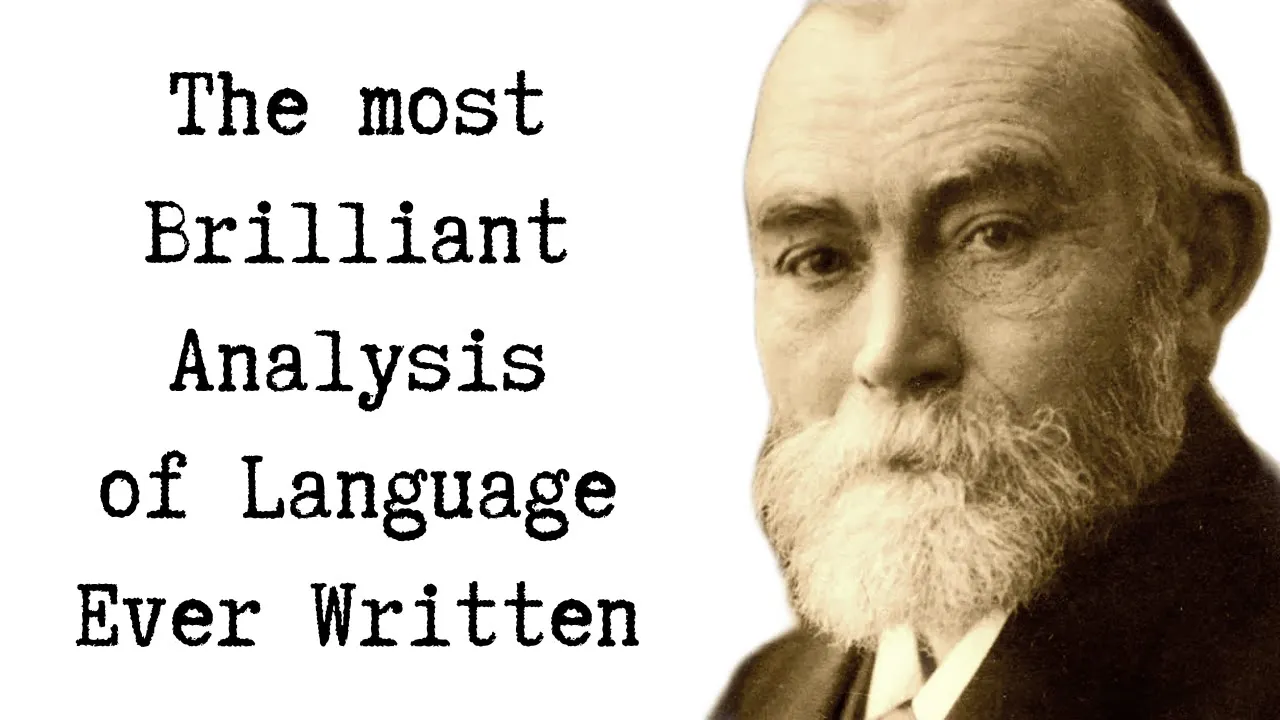



Gottlob Frege's seminal work on identity statements revealed a fundamental puzzle: while 'a = a' appears trivial and uninformative, statements like 'Bruce Wayne is Batman' or 'Water is H2O' convey significant new information. Frege resolved this by distinguishing between 'sense' (the mode of presentation or conceptual content) and 'reference' (the actual object denoted), arguing that identity statements are informative because they reveal different senses corresponding to the same referent, thereby solving the problem of how co-referential names can have different cognitive values.
Analytic Philosophy: Frege on Sense and Reference
Added:The naive referential theory of meaning, which posits that the meaning of a name or term is simply the object in the physical world it refers to.
The basic concepts of formal logic, particularly how symbols represent constants and variables, which Frege revolutionized.
The philosophical concept of identity (e.g., the difference between the trivial truth 'A = A' and the informative truth 'A = B').
A general introduction to the origins of Analytic Philosophy and its linguistic turn in the late 19th and early 20th centuries.
Bertrand Russell's Theory of Definite Descriptions, which provides an alternative approach to solving puzzles of identity and non-referring terms.
Saul Kripke's 'Naming and Necessity' and his concept of 'rigid designators', which directly challenges Fregean descriptivism.
The broader debate in the philosophy of language between Descriptivism (meaning-first) and Direct Reference theories (referent-first).
How Frege's distinction applies to propositional attitudes and intensional contexts in the Philosophy of Mind (e.g., beliefs about identity).
The foundational role of Frege's principle of compositionality in modern formal semantics and computer science.
100.1K views2Klikes50:35Original Release: 2017-01-23
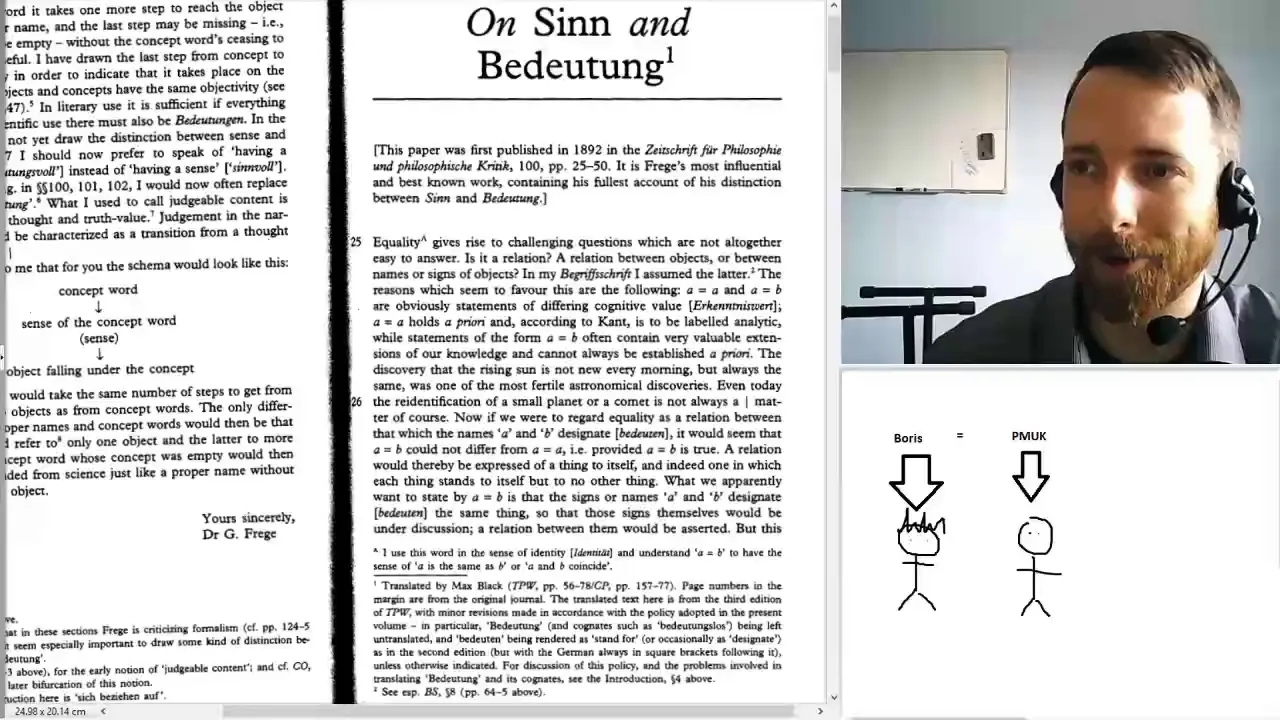
start this is of course an analytic philosophy last time I gave you this wild overview of the entire history of philosophy and by the end you might think wow we've got this very very strange idea of what philosophy is all about because it turned out that starting from fairly simple thoughts about what it is to think about something ended up leading to this conclusion that the world consists of one mind and that everything is mental okay and that seems at first glance Preposterous right if somebody say okay the basic question of philosophy metaphysics what there is what is there the world mind that's like bizarre right at least I hope you think that's bizarre and so how did we get there and what is analytic philosophy as in part at least a reaction against this sort of view well it is a course in analytic philosophy and so the first thing to ask is what on Earth is that if you look for definitions uh especially at an early stage you find things that are tied to very specific modes of philosophical thinking specific philosophical thesis and almost all of those were abandoned by right around 1950 and so on one picture of analytic philosophy it was born in the works of fga and Russell and it died in 1950 and really now those of us who think of ourselves as considering the tradition of analytic philosophy are doing something else um and so I think it's say to tie this to any specific philosophical thesis this isn't just the view of Russell or of fra um or of the logical uist or other kind types of things it's something different so let me just start by asking you since you signed up for this course you must have some idea of what the analytic tradition is all about what is analytic philosophy yeah I always thought about that as like just asking like what should I do or like what is you know like what is there out there or you know how how many different how many different ways can I think about what I am stuff like that like like like kind of the Day card kind of like armchair philosophy type like you just sit there and think sort of okay all right good now part of it is then this is philosophy right so it does connect to basic questions of metaphysics like what is there and basic question question of epistemology like how do I know and basic questions of Ethics like what do I do and so that's the philosophy part in a sense we've already been talking about that um and it is a form of philosophy now by the way it's important to say that because a lot of people thought in the initial stages of analytic philosophy that it was really a rebellion against philosophy itself and so it was an attempt to to replace philosophy with linguistic analysis roughly Linguistics or something else like that um that's certainly not the way contemporary analytic philosophers think about what they're doing and if you look at the history these people are concerned with questions like what is there how do I know what do I do and so it is a kind of philosophy it is not an anti-philosophy in the way that some of its practitioners have have held now it is important to recognize there will be a strain that we encounter that really is like that um Rudolph car in his early world really does think um philosophy is just full of pseudo problems and vien Stein thinks the same thing that in the end once you get clear about everything all the philosophical questions go away and so we will see some people who think what is there how do I know what do I do give me a break um there's no way to answer these questions in fact these questions don't even have any real sense but that's surely not the mainstream that's one particular variant so I think it is fair to say it is a kind of philosophy but now what does the analytic contribute yeah it seemed like it was kind of uh Sid sweeping all the really abstract philosophy and focusing on like empiricism and like you're saying Linguistics and the structure of what we know but um ah good okay yes the analytic part is going to be connected to some sort of methodology and you've mentioned a couple of key elements one is uh some analytic philosophers are empiricists and indeed the early datas were empiricists through and through so a lot of people think of analytic philosophy as a kind of empiricism on the other hand there on the Contemporary scene lots of people who fall under analytic philosophy who are not empiricists but let's just say there's a great deal of attention to empirical methods whether in the end you think that's the full story or not yes um there is a great concern with for example philosophy of science and also with language as you pointed out a great concern with linguistics structure indeed a lot of analytic philosophers have held the thesis that all philosophical questions are in the end questions of language vien Stein again a good example and so there are whether you think that or not um there's at least a methodology that takes language very seriously that takes empirical science very seriously what else is there anything else you can say about it yeah I was understood analytic philosophy as mostly differing stylistically from Continental philosophy so Continental philosophy writing in a way that's more uh literary opaque stylistic analytic philosophy trying to lay out very clear proofs of things ah good there is a definite difference in methodology and you can call it style if you want um but yes Clarity is a supreme virtue in fact in this respect Nal philosophy and by that I don't mean what everybody's doing in Europe I really mean specifically a certain strain of friendship German philosophy um has other values okay Clarity is not usually high on the list um that's not to say there aren't other virtues um there is a strong literary sense to a lot of people working in Continental philosophy um there is an attempt to try to how can I say it connect things with a lot of other things broadly speaking the methodology of Continental thinkers in that tradition is holistic uh and analytic philosophers tend with a few EX not to be primarily holistic the goal is not to just draw connections to lots and lots of other things it's to break down things and indeed if you think about what this term really means where it comes from analytic comes from analysis and what is analysis what is it what do you do when you analyze something take good take it apart into smaller problems exactly exactly D har in his work on method um the discourse on method actually talks about the analytic method and what does he mean he means breaking things down to their parts understanding holes in terms of parts so there's going to be an attempt to analyze things to use analysis as a method and that means understanding holes in terms of on now again that's not something that in the end every analytic philosopher is going to adhere to we will see especially in the 1950s and later a movement toward a kind of holism but it begins with that attempt and even once you get down to those thinkers who in some sense defend a sort of holism their methodology is still analytic and feel the style is very much one of analysis uh even if in some sense they deny the thesis that holds always to be understood in terms of Parts sometimes they'll think it goes the other direction but that doesn't mean they abandon the entire sort of method and approach that takes that as CRI so think about what dayart does when he defines analytic geometry for example he's breaking things down into parts and and actually what is he doing he's taking geometry and giving you uh an arithmetical model of it he's identifying points with ordered pairs for example in a plane and he talks about a line in terms of an equation and so there is a sense in which we're talking about holes in terms of parts and also a sense I think fair to say in which we're interested in constructing models of things where we say all right here's a way of trying to understand blah blah blah um what if we had a model of it that looked like this now to some extent I think that's what we do when we try to understand anything but in analytic philosophy you'll often especially in later stages of analytic philosophy find people doing precisely that you want to understand language Let me give you a model and often it's a logical model or a mathematical model though not always sometimes times there'll be a different kind of model well it's like this um now that tendency goes back and in fact all of these go back a long way um analytic philosophy is something that usually is thought of as beginning with Fraga but actually if we think in terms of breaking down holes in terms of Parts stressing language and Clarity stressing empirical methods developing models of things you can find Echoes of this throughout the entire history of philosophy I mean in retrospect who are some philosophers you might think of as analytic in spirit even long before the 20th century yeah Aristotle good so there going to be certain Heroes here and if we think just of identifying Heroes well Aristotle is going to be one of them a model of empirical investigation logical analysis Clarity um analyzing holes in terms of parts and so on so Aristotle will be one of the philosophical Heroes who else yeah all the social contract theorists tring to figure out how government works and the pieces that people people work in that okay good good yes especially in ethics and political philosophy contract theory and so you're going to find a variety of people there um Hobs lock um Hume Hume ends up being a very important hero for all sorts of reasons not just politically and morally um he seems to break holes down in terms of Parts as does lo right think about complex ideas as resolving into ultimately simple ideas that idea of analyzing the complex and of the simple is something you find in the empiricist and inspires analytic philosophers in fact for a long time Hume is really the chief hero of the analytic philosophers um and then let's see who else might be yeah deart and livenet okay good deart partly because he does identify that method and also liet why Li liment he's an interesting case I think you're totally right but what is it about liment that would appeal to somebody having this sort of approach does anybody here know enough liit to I mean one thing is liit I mean he's the co-inventor of the calculus right so he's clearly somebody interested in modeling and mathematical analysis and that sort of thing he's also a logician he develops uh a kind of complicated logic of Concepts that's actually extremely interesting um so there are a variety of things like that about livets but also what is he doing he's breaking things down into Parts um he livets never really produced a massive philosophical work uh you have to read sort of small chunks and often his views vary among those which is why it took a long time for Li to be really recognized as a major philosopher but guess who the first person was to really write uh a book on the philosophy of livet and to see him as somebody who's a progenitor of this Berard Russell and so Russell took livets as one of his main Heroes partly as a logician but partly as a philosopher who's breaking down holes into parts and indeed in one of his Works called the monadology the whole world resolves into these basic elements that are windowless monads that reflect every other monad and so imagine the world is this complicated network of these little windowless atoms as it were uh and that atomism you find in live inspired Russell and many other analytic philosophers okay good well that's something of a picture and by the way once you see this you can start seeing in all sorts of other people too in utilitarians like Bentham and Mill for example in fact in one of his essays benam talks about the analytic method and Mill considers that one of his main uh contributions so we can really start adding lots of other people here if we keep going on but now I want to think some about the thought of gut fra One Time by the way a student came into my office and said I'm really interested in the philosophy of PR and I said who I never heard of this guy he say well he's this guy and eventually I was Oh you mean fragga okay there are certain terms in and especially names in philosophy that you have to pronounce correctly or you sound dumb okay like deart um I had students who say well you know desaris um that that makes you sound stupid and I understand it if you've just read it you've never heard it but one thing that's important is learn how to pronounce it correctly the students who amaze me are the ones who all semester long will hear me talk about decart or in this case Fraga and at the end still say free or Des Cardis so don't be one of those students I never understand that they evidently think I'm wrong that I just have this strange verbal tick uh well in any case who is Fraga Fraga was born in 1848 the year of the great revolutions he died in 1925 he was a German mathematician logician and philosopher uh primarily known during his life for his mathematical work which was very important in itself um from our point of view since we're not really going to focus much on the philosophy of mathematics here we're going to look at other aspects of his thought we'll have to start with some idea of his approach to logic because in 1879 he did something quite dramatic published a work known as the gri Shri which means well the Griff is concept or conception it's often rendered in the translation we're looking at uh and shrift writing so it's a system of concept writing and really what it is in contemporary terms is the first example of first order logic now as it happens that very same year 1879 Charles Sanders purse also published a system of logic um in which he defines more or less the same thing they're pretty much equivalent and today they're just considered classical first order law but the way in which we formalize them is very different from the way that fra or Pur did then U it was really jph piano and bertron Russell um that put logic in the form that's more or less when uh today in any case this is important because it really develops a new logical language there are times in the history of philosophy where people suddenly have a new conceptual framework within which to cast philosophical problems and fraga's discovery of first orderic was one of those think about Aristotle and his contribution to logic um Aristotle by the way with many other works starts with the opinions of other people uh in the metaphysics he says for example the first thing to do is examine the common opinions see what they say before you start reflecting on this examine the common opinions as well as the opinions of the wise in logic he says actually I had no one to consider because there was no nobody before me who did did any of this so he really invented logic and in some ways you can see a great deal of philosophy is just springing from that conceptual development something similar happens with Freya it revolutionizes philosophy partly because it gives you a new way of thinking about philosophical questions so to some extent this is well if you taken any logic now it's easy to think oh this is classical first order logic and you read those parts of prga and think wow this is a really awkward way of saying something that's now cliche but it was happen happening in the first time so to think of it as cliche he's a bit like looking at Shakespeare and saying oh I don't like Shakespeare much they're all these cliches he's the one who you know come up comes up with them in the first place now it is an awkward notation he has all these little things that look like this and so on it's very notationally painful however it does give uh an important framework and there are a couple of aspects of it that we need to think about because as soon as we get into on sense and denotation um or on sense and reference we see uh this in a sense as the background so actually maybe we should develop it out that let's start with this article on sense and reference in German Zin and um and let's see how how it goes very first sentence identity and by the way you might think first sentences of important philosophical papers important philosophical books are often big and explos um like gosh what are some examples of great first lines in philosophy there actually this was a Jeopardy category one time famous first lines and uh yeah so I'll I'll give you a few Jeopardy questions um all men by Nature desire to know metaphysics good Aristotle's metaphysics um every art every action every inquiry is aimed at some good ethics good benan ethics uh let's see man is Born Free yet everywhere he is in Chains so social contract social contract good here we get identity gives rise to challenging questions which are not altogether easy to answer it's a little less dramatic right and often analytic philosophy is like that um it begins with a problem it does not begin with grand sweeping statements it does not begin with um the kind of thing that too many students WR at the beginning oh people have thought about identity for centuries or something no it gets right to the point okay identity gives rise to certain questions and he immediately starts out with a puzzle is it a relation a relation between objects or between names or signs of objects in my G shrift I assume the latter the reasons which seem to favor this are the follow now aals A and aals B are obviously statements of different cognitive Val so we begin with something that's often referred to as fr's puzzle actually there are two puzzles here I think but let's start with the first puzzle AAL a and AAL B seem really different right as he puts it they different in cognitive value and so they now what in what way well he goes on to explain he says a equals a holds a priority and according to K is to be labeled analytic while statements of the form a equals B often contain very valuable extensions of our knowledge so this is something that looks op priori you don't need experience to know whether a is a it just is right even if you don't know what a is also it appears to be analytic if you just understand the meaning of the identity term you know that it's true true what else might you say about just a equals a less less fancy philosophical terms yeah supposed some he said who really is Donald Trump I say he's Donald Trump actually in his case that might be a good answer but but that that I mean actually my saying that right indicates okay there's kind of uniqueness here right I can't can't talk about that in terms of anything else and here you might think look um yeah let's put it let it's obvious right it is uninformative ordinarily who's the professor in that course oh the professor yeah thanks a lot um it's a bit like John L he's talking about trifling propositions at one point he says Ah what is a soul suppose the answer is a soul is a soul that tells me nothing right um or someone saying doing a chemical investigation oh lead what is lead the answer is it's lead right that tells me nothing but a equals B is quite different it doesn't seem to be a priori at least in many cases I mean it might be in mathematics it doesn't look analytic in a lot of cases it's often unobvious and so in short this is something that is often informative now what are some examples of informative identity stats you learn something by finding out that a is b Bruce Wayne is Batman good Bruce Wayne is Batman that's an informative statement if you don't know who Batman Batman is and indeed most of the people in in the in that Universe don't then there's an important bit of information you're missing and if somebody reveals to you that Bruce Wayne is back man that's hardly a priori or analytic or obvious it's highly inform other examples of this sort of identity state or you learn something from it water is H2O good water is H2O that's something that seems to convey a great deal of important scientific information other examples question 2 = 4 good 2 + 2 = 4 that conveys important information now that's one that might be a prior it might be analytic depending on our theory of mathematics and in fact fra in the end defends the claim that it is both of those things but it isn't necessarily obvious and it isn't uninformative now we sort of take it for granted because it's an elementary bit of mathematics but if we made this much more complicated it would look highly informative so that's something that uh is a good example of this much of arithmetic and the rest of mathematics consists of such identity statements can you think of other examples well let's take the one that appears so far you've got sort of names or mass terms or this type of thing um an example he considers is the Morning Star is the evening star you see that star in the morning and later it appears in the evening it's the same thing the planet Venus in the example he's considering um and it's an astronomical Discovery to realize that the thing you see in the heavens in the morning is the same as the thing you're seeing in the heavens in the evening it's the same well Planet really not star at all so we can go on and on but now why is this important well here here here's what is bothering there's a picture of how we understand these things according to which it's hard to understand how these can be informative and how things involving Bruce Wayne and things involving Batman can actually therefore have a different cognitive value so let's think about well actually let's look at the way he lays it out um the discovery that the Rising Sun is not new every morning but always the same was a very great consequence to astronomy even today the identification of a small planet or a commet is not always a matter of course now if we were to regard identity as a relation between that which the names A and B designate it would seem that a equals B could not differ from a equals a provided that a equals B is true a relation would thereby be expressed of a thing to itself and indeed one in which each thing stands to itself but no other thing what is in intended to be said by a equals B seems to be that the signs or names aals B designate the the same thing so those signs themselves would be under discussion so in short we've got this problem suppose you've got something like oh well Batman and here we've got the name Batman and now we've got well Batman right can I drop that's just awful gosh well you you know what I mean here we've got I'll draw another one of my stick figures well he can gosh that's much worse if my art teachers Could See Me Now Okay so we've got now actual Batman here and so the problem becomes really this um if we're talking about well we can do the same thing with Bruce Wayne right here's the name Bruce Wayne but now who does it refer to well the same God and so if we're talking about identity as a relation between a thing and itself it looks like well really in the end it's just saying that guy is that guy and then it's hard to see how it can be informative if I say hey that guy is that guy so as we they're walking to class and there's somebody just just outside the classroom just passed out unconscious just lying there psychologists occasionally do this experiment they have somebody at class change time like fall down and collapse and like nobody stops it's very depressing about human nature but anyway this guy collapses just Li there we say who is that guy um if you just say he is he is who he is he is self-identical like all other objects of the universe we're not learning anything right so if we stay at this level it's very hard to see how this could be informative well if we think though that we're talking about the names then actually there's something different and odd going on suppose we say well really what we're talking about in an identity statement are the names we're saying that Bruce Wayne and Batman are co-referential they refer to the same thing and so it can be informative to know that Bruce Wayne the name is co-referential with Batman that water is co-referential with H2O Etc even though it's not informative to be told that that Bruce Wayne is co-referential with Bruce Wayne right of course it is but now what would be wrong then with saying this is really about the names that's what he says in the G but how is that as a theory does that work is there a problem with saying identity statements are really about the names what do you mean well suppose we translate these and we say ah Bruce way Go's Batman that's really a way of saying the name Bruce Wayne and the name Batman refer to the same thing and the same is true here right water is H2O we say that and so on and so for is there any way in which that will be approach well obviously the names in themselves I mean not what they signify but the actual little names are not the same because in one plane we perceive them differently so in that case they're not the same right okay good notice we can't say ah this is saying the name Bruce Wayne is the name bman it's not right those are different linguistic Expressions similarly the name or the master term water is not the same as the master term H2O and so they're different terms which is why we have to not only think gosh Bruce Wayne here doesn't you know we're not talking about the person we're talking with the name that means identity has to become something different right we have to interpret the identity statement here as meaning our co-referential refer to the same thing and so already you notice wait we're having to do something weird here we're saying Bruce Wayne refers to that guy right oh except when we're talking about identity and then all of a sudden the name Bruce Wayne sort of well it functions in the statement as if as if it were naming itself or something like that yeah isn't Bruce Wayne equaling Batman isn't this particular puzzle different from water equals H2O because water is necessarily H2O whereas Bruce Wayne isn't necessarily there could be other Bruce wayes there could be other Batman oo good good good yeah yeah we can ask and indeed kryy uh in naming and necessity says I'm going to be talking about the connection between naming and necessity I hope you see that there is some connection and a lot of people in his audience at the time would not have seen that there's any such connection but good you're raising an important question here it's not just that water is H2O we think or let me put it this way it's not just the water happens to be HT H2O right in this world um we really have a sense no that's what water really is right it's somehow expressing its identity in a way that suggests this is unnecessary truth suddenly 2 plus 2 is four it's not like well the way we do arithmetic 2 plus 2 just happens to be four you know that's an oddity of Texas I mean in Oklahoma it's different no it's it's it's really necessarily true but now the Morning Star is the evening star that doesn't feel the same way right why not yeah um I guess it's just kind of figuring out what the corresponden is like um like if we're talking about identity like what makes up the component of the identity and like the looser the correspondence sometimes the smaller the connecting unit um between the two okay now I agree with you there's something looser about the correspondence what's looser about um well I guess there's like a much larger body of information like evidential kind of like to gather to come up with that um oh part of to to see this of course think about this there's a big body of information lying behind that too it's not always been known I guess it's been known since about 1750 that water is H2O but before that you might think you know this was unknown and there was a huge amount of chemical information that had to be accumulated so if we start thinking in terms of Bodies of Evidence similarly what would you have to know to realize Bruce Wayne is Batman uh maybe there's a lot of stuff so I I agree with you that's one difference but we should be careful about thinking that's the essential one yeah the difference is that we can easily imagine another world where it's not the case o good yes so in a way here's the connection the more complicated the evidentiary basis for this would be the easier it is you might think to imagine that it comes out differently and so we could think yes the Morning Star could we envision a world where the Morning Star is not the evening star sure let's say where it just is it as a matter of the the planetary geometry uh in the morning it's always Venus in the evening it's always Saturn or something like that uh in that case the Morning Star would not be the same as the evening star um can we imagine a world where Bruce Wayne is not Batman sure it's a world where Bruce Wayne you know let's say meets with a terrible business Misfortune loses all his money and is now barely scraping by uh driving a bus in goam city and uh you know B maybe there is no Batman or maybe Batman that roll gets taken over by somebody else and so these don't seem necessary and these do so there can be contingent identity statements yeah what about is this an identity statement say saying something like why don't you like why don't you like country music because I don't like it that the reason is is the can the reason uh you don't I'm not saying this is a tell all example but would that be an would that be a similar statement to the morning St the evening star like I don't like something the reason I don't like it is because I simply do not like it well yeah that's an interesting question talk of reasons is um is tricky and something philosophers have only been investigating in the past say 20 years um it's remarkable but that's true actually given the importance of the notion but there is no received logic of reasons like does a matter that there's a reason Waters H2O well yeah here's the sense in which I guess you could say there's something similar going on um if you say why don't I like country music I just don't like it the reason is I don't I mean what I'm in effect saying from one point of view is look I can't give you a reason for that there's no disputing tastes Etc but I might think certain reasons are just self justifying in much the way that people have thought something like a Isa is self-justifying self-evident um why is AA is a equal a um there was a geometry class I took in high school where there was a student who just no matter what the the teacher would say Coach Jones was our geometry teacher he was a track coach by day and a well a geometry teacher from 11 to 11:45 um and he would you know he would try to explain something and no matter what he said this particular person F which why well look a is equal to b b is equal to C so a is equal to C why and you know at a certain point if somebody says and well look a is equal to a right why you might just say it's because it is um and so yeah there is this sense in which there's something loopy something you know uh a relation something holds to itself that's why I don't think a equals B is necessarily inform is necessarily informative though cuz those loopy ways of thinking think aren't that informative well okay good it might not be um so we were thinking of informative examples of ails be where there are different things on the two sides um but there might be some that are not very informing can you think of some examples yeah I'm sorry mine's informative oh well give me an informative I say in a hypothetical where we didn't change the types of meals that we throughout the day uh breakfast would be the same thing as dinner because it's and that because the morning star versus the evening star it's the same object but it's in time and space for for the Observer you know so so it seems like it's kind of a necessary difference for us at least oh okay right yeah notice the morning star that's the star that appears to us in the morning evening star star that appears to us in the evening there's a different relation to the Observer and you might think the same thing is true of he of this sort of thing you know you relate to that person in One Way by way of the description or the name Bruce Wayne and a different way as Batman um this is closely related to what fra refers to as modes of presentation of these objects the modes of presentation are different even though in a sense it's the same object in the end yeah I guess like kind of going off that like I see like the difference with all of these is there's kind of like a different association with each part of the equal sign like with Bruce Wayne and I associate that with the billionaire and Batman as a superhero like 2 plus 2+ 4 is like Parts versus a whole so I don't know it just seems kind of like in the same thing with a equals B like it seems like you kind of associate them with two different things right okay good so in these cases we do have some differences we obviously have different linguistic Expressions but we also have different um relations you might say to the object we have different um well modes of presentation um as frga puts it uh we have different associations because indeed I think Morning Star ah see it at dawn right Evening Star see it in the evening or I think um Batman that crime fighter um with cape and and so on the cool car and Bruce Wayne that guy living in the mansion and so there are different images I have well at this point let's do a little bit of a little bit of uh backing up and seeing what fro wants to to try to contribute to a solution to this problem I think once we do that it'll be clear why he goes the way he does I want to start with a traditional idea of what's going on with language and its relation to the world so think of this as sort of a word to mind to world picture there is an account something like this developed in Aristotle in the diona and there is an account in aquinus it's found later in Loch it is if you want to think of it this way the common currency of philosophers more or less all the way from Aristotle through Loch and even Beyond and Frank is doing something important so here is how it appears in a Quin according to the philosopher that is Aristotle words in in Latin vocals are signs of ideas and ideas the likenesses of things evidently words refer to things signified through the medium of an intellectual conception there is something similar well really I guess what I want to say is this passage can be read in two ways either he's talking about words referring to things or he's talking about sentences referring to well what um but the VOC case that's just sort of things said and so it can refer to sentences as well as words are signs of ideas um ideas the likenesses of things but rarum is used in Latin for both objects and also states of Affairs so there are different ways of reading this but in any case here's the way you might think of it remember our little picture of the triangle so let's take this as the object the triangle and now I'm going to forget the actual body and just go with the Mind here here's this mind and the mind has a thought about the object and then that thought is like Ah that's a triangle and so there's a concept we might say that is involved in that thought let's call this the concept of triangle and the person says triangle let's start with them actually doing this purely vable words they're not even articulating a sentence at this point there's saying a triangle well what is the position here aquinus is basically saying okay the word there triangle let's put it in fact this way in quote Syndicate we're talking about the word there that's a sign of an idea so we could say that signifies this concept or idea as it's expressed here or in lock let's say really take heart the whole new way of ideas comes from that and then what well ideas are the likenesses of things so this is somehow connected to that he says is UN likeness in some sense of the object yeah I was on a plane recently and I was thinking about how there are certain things you can't say in the airport you can't say on planes bomb you know explo explosive I don't know they're just you probably couldn't yell allaho whatever you couldn't yell things I mean you can't scare people right yeah my brother when he was a little kid in the 60s did this um they were we were going to fly to Pittsburgh to visit my relatives and they start you know go and there was something that was setting off the machine they start going over him with a wand saying step over here we're going to search you and he's young I I don't know how old he was exactly but you he's eight or nine or something he says what do you think I have a machine gun and all of a sudden there he says he has a machine gun he's taken off question by the FBI we miss our flight he probably is still an FBI record that you know possible terrorist suspect anyway so if you can't say bomb or they don't say crash they'll say emergency water landing oh yeah yeah so emergency water landing can't be a good thing I mean that's a crash we all know we're probably crashing if that's I'm oh okay good good yes there is something here that frga is concerned to point out and that people within the tradition did recognize which is that these Concepts come with Al an entanglement with a variety of other things including other words but also feelings okay so there is an emotive Aura now in the case of triangle if I just say triangle you're unlikely to have any emotional response but if I say tra crash or terrorist or machine gun or something you do have an emotional response right and so I'm going to draw this as a Spooky Little around this thing let's say that's not really part of the concept this is something that sometimes been called the tone um the connotation in some people's usage means this but you're right there's going to be in fraga's thought and really throughout much of the 20th century the idea that we can somehow separate out the concept of what's really being said from this emotional language and a huge amount of euphemism is a matter of talking about the same thing and having basically the same concept with a different tone continental breakfast right fruit or whatever yeah exactly means nothing healthy worthwhile yeah exactly yeah what are some other examples of things like that I mean it's obvious in political discourse and so forth but what about just ordinary life there euphemisms like that all the time yeah like passed away versus di good passed away versus die yeah I mean die seems harsher than passed away oh there's a lot of stuff like I'm 90 years Young oh yes right I me give me a break I I that one really bothers me because actually I think it emphasizes the old part right you're trying to do it to to make it less you know oh you're only 90 years young if I were 90 years old I'd be thinking oh what a jackass you don't only think I'm old you think I'm so old that you have to give me a eism because it's embarrassing to admit how old I am so yeah I would really a lot of medical language uh PTSD for shell shock oh good yes exactly in fact yeah used to be I think I went I had a history class last semester shell shock meaning shells it has a visceral image when you hear he has shell shock versus PTSD sounds like Mera or like staff infection or something right right exactly like skin thing you know yes hospitals are full of this and some of them convey scientific content and some of them are really just attempts to get rid of the tone around this um and it's sort of interesting because if you live as long as I have you start seeing this change in all sorts of ways where people euphemize this and then after a while that starts taking on these connotations and so you have to have a euphemism with that and so and so forth it can be kind of crazy after a while but anyway yeah um that's an important thing to notice well here's the idea then we've got the this word triangle signifying an idea a concept and that concept Bears a certain relation to the object so we could say that in a sense triangle refers to the object but does it by way of well this idea standing for in fact often this is just in the that literature referred to as standing for the concept or the idea and the idea is the thing that bears the primary relation to the other well notice that and frus stresses this this is something that is inside the head right this concept is something inside the mind and therefore it is individual it is subjective it is the sort of thing that I have my idea you have your idea they may or may not be the same yeah so are you this that it's inside the mind in an individual subjective is that of the toner of the thought well both actually um so it's yes the tone is very very definitely subjective but actually says so is the concept um suppose well for example I say what is a triangle what is your concept of a triangle 180° 180° that's his concept of a triangle three sides sides having three sides okay three points three lines three points connected by three lines any other concepts of a triangle Mak a TR angle three angles you might worry about oh well I mean a plain figure um I anyway you could go there might be somewhat different conceptions right and if you know a lot of geometry your concept of a triangle might be quite Rich um and if you don't it could be pretty sparse and so in fact it might in the end be something like that you know I mean I couldn't give you a definition of mango I know what a mango is I think I have a concept of a mango but if you said let's say I was talking to a biologist a Bist and he said so you know all about mangoes I said well I know they're very good in a smoothie and really and they make a good base for a salsa surprisingly but he no no no I don't mean that right and he's going to give me this biological concept of a mango that is not my concept at all I didn't take high school biology I could to admit I did it in order to take two maths at the same time because you can never have enough math that was my view well anyway um that kind of thing even just the cognitive part of it as opposed to this emotive part can vary from person to person and so frankus says well look when we're talking about something like Bruce Wayne is Batman water is H2O Etc I don't want to just say oh the concept in your mind is different from that we're not talking about Concepts here on the other hand because we're not talking about something particularly individual it's not like o Bruce Wayne is Batman that just means something different every person or 2 plus 2 is four no uh on the other hand we can't just talk about the referent either because then none of them would be informative so he introduces the concept of a sense the sense is something that is outside my mind outside your mind it is playing the role in fragga theory that the forms play in pl's theory so if you're over here you're far away which is why you're small here don't feel bad um but you've got your own concept of of a triangle and it has its emotive associations and you're having this thought and how are you able to actually think the same thought that I think he says if we're thinking in terms of ideas or concepts you can't that's something inside my head and there's actually no way to know whether there are concepts are the same because we can't have the same Consciousness with both of those Concepts but we can both connect to the same s and so actually I need to draw this to your word you also say triangle and the sense is something that is like a mod of presentation it is something that explains how it is possible for these to be informative because although Bruce Wayne and Batman have the same referent they do not have the same sense water H2O they do not have the same sense even though they do he says have the same refence the same thing with 2 plus2 is four Morning Star and evening star and so on for out of time next time what we'll do is draw that distinction between sense and reference and concept and then see how he uses it to solve this puzzle and a variety of other related puzles
Up Next

42:06
Frege, Russell, and the Birth of Modern Logic | A.J. Ayer & Bryan Magee (1987) - Full Discussion
@Philosophy_Overdose
37.9K views•2023-08-26

164:01
John of Damascus on Holy Images: A Theological Defense
@BannedBooks
139 views•2026-04-25

49:55
Wittgenstein's Tractatus Logico-Philosophicus | Analytic Tradition Lecture
@PhiloofAlexandria
103K views•2017-02-11
4:57
The Myth of Sisyphus: A Greek Legend of Eternal Punishment
@TEDEd
8.6M views•2018-11-13
Related Study Plans & Knowledge Roadmaps
Structured learning paths in Philosophy
philosophy
Frankfurt School: Critical Theory & Culture
01Foundations of the Frankfurt School and Critical Theory
02Horkheimer & Adorno: The Critique of Instrumental Reason
03The Culture Industry and Mass Deception
+ 2 more learning modules
12h5 modules
Explore Roadmap
philosophy
Philosophy of Language: From Frege to Austin
01The Linguistic Turn: An Introduction to Language in Philosophy
02Gottlob Frege: Sense and Reference
03Early Wittgenstein: The Picture Theory of Meaning
+ 3 more learning modules
15h6 modules
Explore Roadmap
philosophy
Feminist Epistemology: Standpoint & Injustice
01Introduction to Epistemology and Feminist Critiques
02Sandra Harding and Standpoint Theory
03Donna Haraway and Situated Knowledges
+ 2 more learning modules
12h5 modules
Explore Roadmap
philosophy
Environmental Philosophy: Ethics & Deep Ecology
01Foundations of Environmental Ethics & Anthropocentrism
02Biocentric Individualism and Animal Liberation
03Ecocentric Holism and Deep Ecology
+ 1 more learning modules
10h4 modules
Explore Roadmap