




















Algebraic connectivity (the second smallest eigenvalue of the Laplacian matrix) measures how well-connected a graph is, where a higher value indicates better connectivity; the corresponding eigenvector, called the Fiedler vector, has the property that the vertex sets with positive and negative entries each induce connected subgraphs in any connected graph.
Algebraic Connectivity and Fiedler Vector Explained
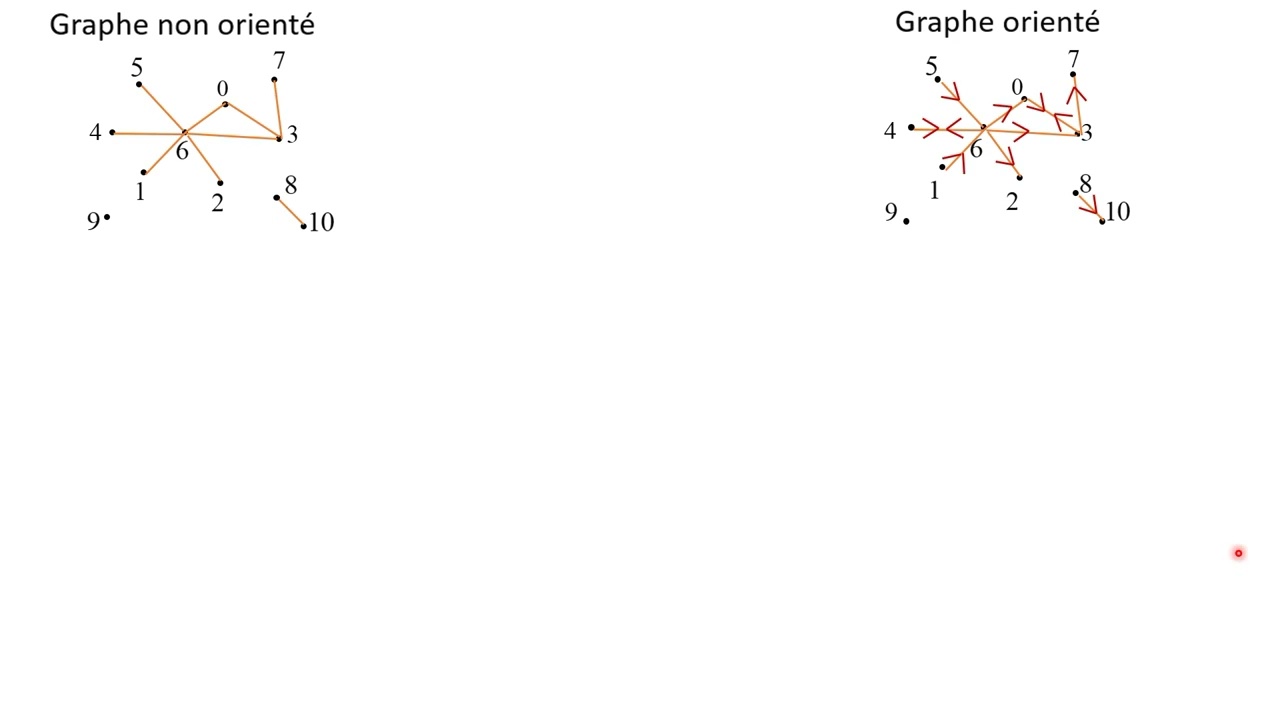
Added:Basic Graph Theory concepts, including vertices, edges, degree matrices, and adjacency matrices.
Fundamental Linear Algebra, specifically eigenvalues, eigenvectors, and symmetric matrices.
The Graph Laplacian Matrix (L = D - A) and its fundamental properties, such as being positive semi-definite.
Introductory Spectral Graph Theory, connecting graph topology with matrix representations.
Spectral Clustering algorithms and their applications in image segmentation and data machine learning.
Graph Partitioning and Cheeger's Inequality, which relates the bottleneck of a graph to the second smallest eigenvalue.
Consensus Protocols and synchronization in multi-agent systems, where algebraic connectivity dictates convergence speed.
Community Detection in social networks and complex biological network analysis.
Expander Graphs and network robustness, evaluating how well-connected a network remains under node or edge failures.
163 views3likes23:49Original Release: 2025-11-13
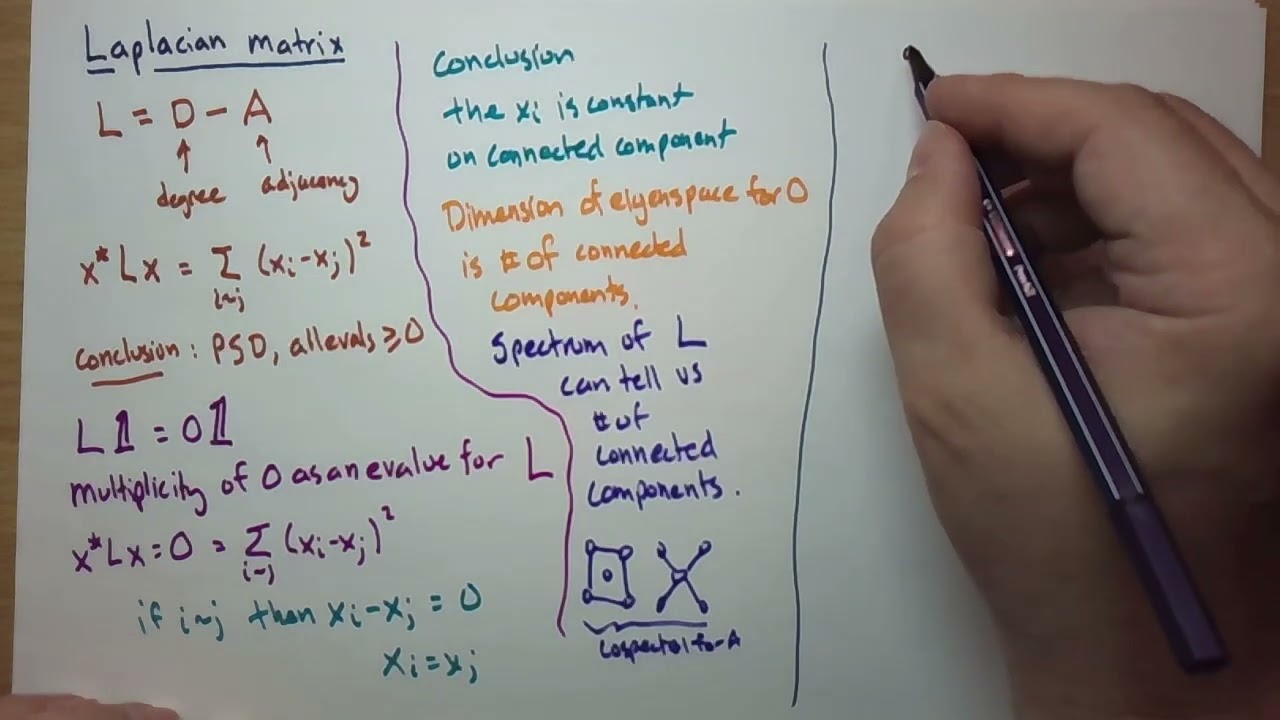
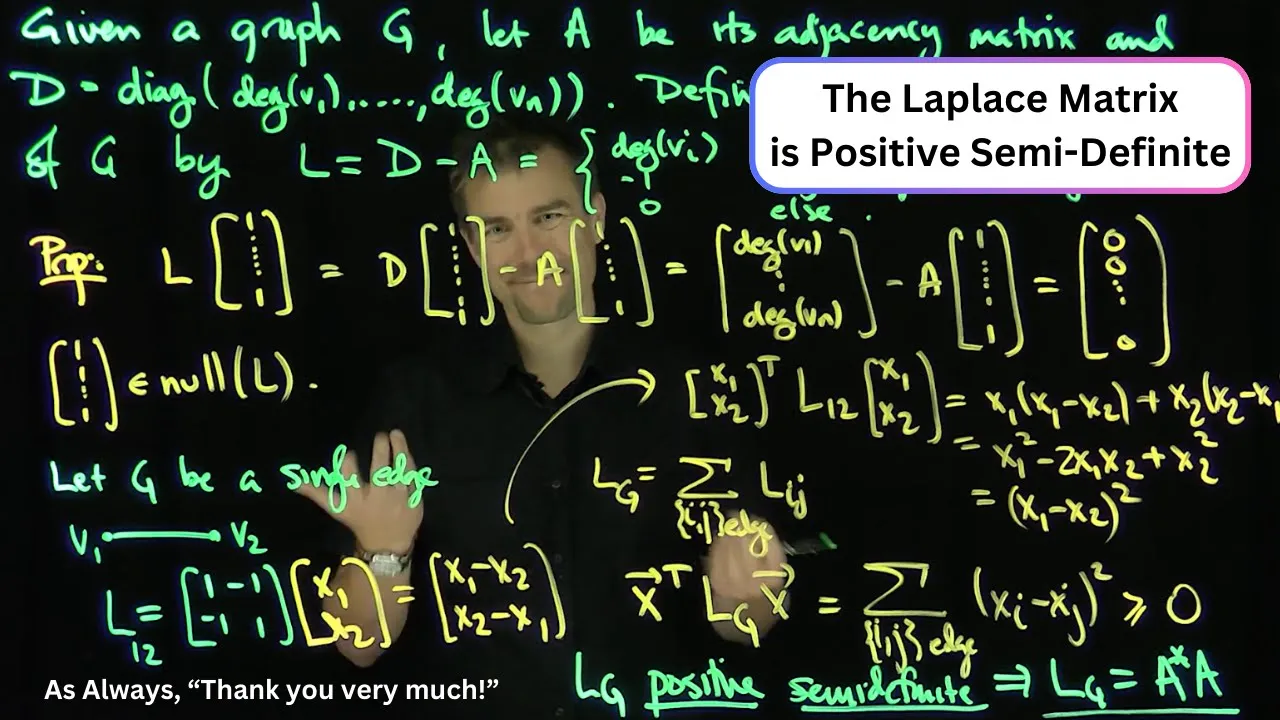
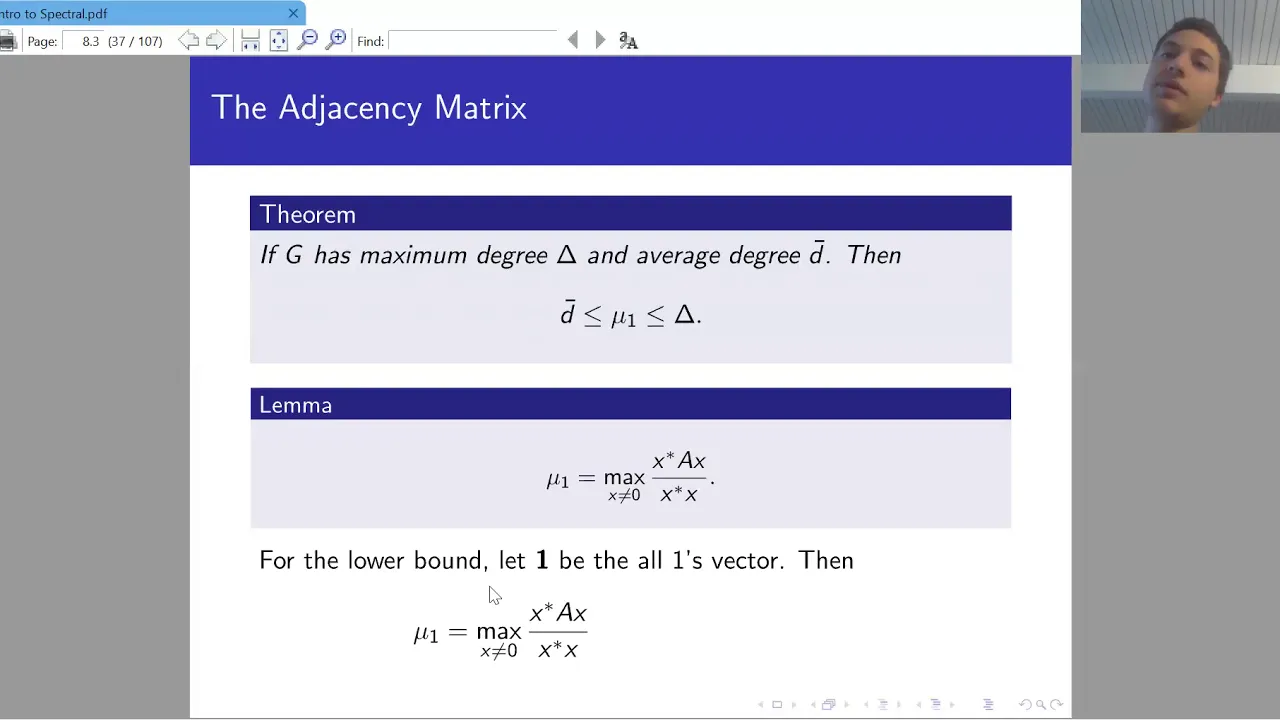
[Music] Hello everyone and welcome to this lecture. In this lecture we will start a new topic and this new topic is algebraic connectivity. A very very famous topic. Okay. In order to define what algebraic connectivity we have to go back to our famous matrix and this matrix is lelassian matrix. Okay. So what was a lelassian matrix? So remember if a uh we have a graph G okay the lelassian matrix is nothing but we denote it by LG. Okay was nothing but degree matrix minus our adjacency matrix. And we have seen many many beautiful properties of this lelassin matrix. The one one thing that was very very crucial is this matrix is actually so I will denote it by simply by L okay simply by L is positive semidefinite matrix that means all the on values of L are always non- negative okay and there was one more important thing is that zero will always be an igon value and why it is so if you see the structure of L okay okay on the dina there are degrees and of dino are minus one.
Whenever there is two vertices I and J have an edge between them then it will be minus one otherwise zero. So if you add all the entries of a row it will give you zero. Okay. So that means all one vector is an igon vector corresponding to zero on value. Okay.
Now what about the second smallest value? The first smallest value is by default zero. What about the second smallest value? Let us denote the second smallest igon value by mu. Okay. So second is smallest smallest on value of l. Okay remember if this mu is also zero that means what the graph is disconnected. G is disconnected. And why it happens? Why it happens? We have already proven that the multiplicity of zero as an igon value tells that the same number of connected components are there. Okay. So if the multiplicity is k that means there are k connected components are there. So if mu is also zero that mean there are more than one connected component as the graph is disconnected. And by the way what about the uh the mu of k? Okay. The what about for suppose complete graph on n vertices complete graph what will be its mu? If you check this the mu is nothing but n the best possible the best possible.
Okay. So in a way this mu tells how well connected a graph is and it was introduced by fiddler. Okay. And due to it the igon vector or on vector corresponding to mu okay is known as a fiddler vector. Okay. So fiddler vector is actually so let me now write it fiddler vector uh uh an igon vector anon vector uh corresponding to corresponding to mu.
Okay corresponding to to mu. Okay, we will see very very beautiful results uh just by looking at mu. Okay, in this lecture, okay, but there is one more important thing. Okay, uh I mean if you see that this suppose X is an F vector. Suppose X is a F vector.
Okay, this has to be orthogonal to all one vector. This is coming from just a spectral theorem or just a really quotient. Okay, uh because this all the vector because it's a symmetry matrix.
So we can always take the igon vectors to be orthogonal. One is already there.
So x is has to be perpendicular to or orthogonal to one. That means in x there will be some positive entries. There will be some negative entries and maybe some zero entries. Okay. So now let us move forward for one beautiful um uh theorem based on the structure of x. Okay. So suppose so I told you that there will be some positive entries, some negative entries, some zero entries. So let me define u two vortex at using x. Okay. So using x. Okay. So suppose I denote a vortex at v plus. Now I'm talking about the vortex of the graph g is actually all the indices.
Okay. All the indices such that or all the vertex i such that vortex i such that uh the corresponding entry in your part vector is positive or greater. So such that x i is greater or equal to zero. Okay. And similarly suppose V minus a set of vertices I where all these I are less or equal to zero. Okay.
So these are basically I very very simple uh notations and definitions of this V plus and V minus. And by the way both of these will be suppose if graph is connected. If the graph is connected uh then the both has to be non- empty.
Okay. So if uh g is connected if g is let me write is connected then then v plus and v minus uh both uh both are both are non- empty or why it is so why it is so non empty yeah it's due to this it's due to this fact okay very very good so now let me introduce or give a very very nice uh theorem on uh test structure of basically the fid vector.
Okay. So let g be a connected graph.
Then the theorem is then the theorem is v + and I will write similarly v minus v minus similarly v minus okay so this is a vortex set right this is a subset of a vortex set okay induced induced induce rather than so maybe I will this spelling induce induce a connected connected subgraph. Okay. So basically what you do okay if you pick all the vortex vertices in V plus okay and think about the induced subgraph on it. This will be connected subgraph. This will be connected. Similarly if you pick vertices in V minus and see the induced subgraph on V minus this will be again uh connected subgraph. Okay. So how to prove this? How to prove this beautiful fact? Okay. So but before that I need I need oh theorem okay theorem this is theorem okay I need to prove uh actually I have to make use of a very very small result very very a crisp result okay so let me first write that result and then we will uh head towards proving this beautiful theorem okay so the result is this okay so I need let me call it actually because I will be using it for proving this uh nice result okay so suppose B is a symmetry positive semi suppose let B B positive semidefinite matrix okay of order n cross n of order n cross n okay then then our claim is then xrpose for any vector x okay so maybe I go for any vector x for any vector x okay xrpose bx equal to zero zero if and only if if and only if bx is equal to zero. How to prove this? This is very very simple one. So we know that prove let us first prove it. Okay, we know that if b is positive seminent as b is uh positive semideent matrix that means there exists a matrix c there exists a matrix such that b equal to c transpose. This also we have seen many times. Okay. Now you see that what will be this if you do xrpose bx. Okay. So this is nothing but xrpose cpose uh cx right. This is this is this. So that means this is nothing but uh this you can write actually as cx transpose cx.
Now this is xrpose bx imply uh zero implies that c transpose x is actually zero right this is coming from here. So now so cx is zero that means what if you do this this further implies that crpose cs is equal to zero. Okay so we have actually proven that one part that this will imply that bx is equal to zero and the converse part is actually very very obvious. So converse part is obvious. So if bx is equal to zero that means this is uh x transform bx. So converse part is straightforward. Okay converse uh converse is obvious. Okay, very good of this. Very good. So we will make use of this result uh to prove uh our uh the main theorem for today. Okay, so the theorem is V plus induce a connected subgraph. Remember what was B plus? B plus were all the uh the vertices in G uh such that corresponding entries in your fular vectors are non negative.
Okay. So let us prove the proof of theorem. Uh so let me write it here. the proof of the proof of the theorem. Okay. Okay.
Very good. Okay. Since v plus is non- negative. Okay. So v plus is non- negative. We have seen that because x vector has to be perpendicular to so it's a sorry non- empty non-mpt.
Okay. Actually uh what you can do is so suppose suppose v plus for the contradiction purpose uh assume that assume that v plus is not connected.
Okay so this is plus assume that uh v plus is actually disconnected. Okay. So we will prove it using contradiction disconnected disconnected uh subgraph subgraph.
Okay. Induce or maybe uh maybe induces induce.
Okay. Great. So let us by default let us uh choose that out of v plus. Okay. So there are vertices suppose uh you can write from 1 to up to s. Right. So these are forming one connected component and then there are the vertices s plus so maybe write is this uh smaller one s + one up to r here. So basically your v plus is actually this okay so let me write v plus is equal to all the vertices from 1 to up to r. Okay. And out of this uh this these are suppose uh so this is a connected component uh a component component. Okay. And this is actually subgraph on uh rest of the vertices.
Okay. Okay. So now uh a component uh in in v plus a component in v plus. Okay.
Okay. So now let us see the uh the structure of the lelassian matrix. Okay.
So it will be like something this. Okay.
So llian matrix can be written as okay as this L11 this may be corresponding to uh this component okay then this uh component has not any with the rest of the graph in B plus I will write it zero okay and then it will have connection with uh the rest of the vertices or maybe this V minus okay V minus is there okay very good so now similarly here you can write L22 this will be L 23 and this will be L uh 31 L 32 and L 33. Okay. Now do what?
Okay. So suppose uh you have a filter vector X. Okay. Now this break this filter vector in actually three parts which will I mean the size will be actually uh corresponding to the size of L11, L22 and L3. So let me write it as x1 x2 okay and x3 here. Okay. So these are actually the basically chunks of chunks I have taken from the filler vector x. Okay. So this is suppose this I call it x. x is filler vector. Okay.
Fiddler uh vector. Very good. Now you see that okay so from here to here. So this constitute of what? V plus. Okay.
And this you can just think about the remaining vertices. Okay. Now that means what? So x3 will be what? So all the entries in x3 will be negative. Okay.
All the three will be negative because all the zeros or plus are consumed in in this part v plus. Okay. Now now what? So let us write the equation from here that uh uh this so this will be what? L11 * x1 and then uh this is zero. Okay. plus L13 * X3. Okay, this is actually giving you what? This will be giving you because this will be equal to mu * the same vector, right? Mu * the same vector.
Okay, because your algebraic connectivity is mu here. So, this will be giving you this. Okay, so this is indeed equal to mu * x1. Okay, now what are the implications of it? What are the implications of it? If you see that this L13 L13 is always less or equal to zero right every entry is either 0 or minus1 okay and you know that and X3 is less than zero so this implies what this implies this right this implies let me write in the next page so this implies maybe maybe here I can write this this implies that L13 * L cq is always greater or equal to zero okay now the important thing is important thing is known where L1 has at least one non-zero entry. Why it is so?
L13 has at least one non-zero entry. Why it is so? If you see that because this graph is connected. So this chunk this chunk will have some uh basically so this part must be have one edge with this right. Similarly this part I mean uh no need to take care of L L2 to write now. Okay. So you know that this component must have an edge with L13 because the graph is connected right?
The graph is connected. So as the graph is edge edge G is connected as G is maybe I write down here connected okay L3 has nonzero entry non zero entry okay so that means this L13 is not equal to zero okay very good okay now how can we make use of these uh uh these observations so that from here okay so you can first thing is is This you can immediately write that L11 minus mu okay time x1 is less or equal to zero this coming from uh this fact okay now what now what and also due to this fact that this l11 minus mu x1 is not equal to zero okay due to this very very good okay uh these observations are super super easy now how to uh make use of this to prove that V+ actually induces a connected subgraph. Okay, what I need what I need.
Okay, so up to the here the things are pretty much clear. Okay. Now let us uh claim that let us claim that uh and by the way suppose if you if you uh okay so yeah maybe if you if you do this uh this this operation what will be the quantity what will be the what we can say about this number remember x1 is always uh due to our definition is is uh always uh non- negative okay and this part is again uh uh less or equal to zero. So this will again give you uh less or equal to zero.
Okay. Due to this, okay, because x1 is what? This is non- negative vector.
Okay. And this is lesser or equal to zero. So that mean this this has to be less or equal to zero. Very good. Now we claim that let us make one claim. Claim is this. Okay. Claim is this L11. So this uh this matrix L11 minus mu uh is maybe I will write this. Okay. So now mu is a mu * identity matrix. In fact I have to actually make here identity wherever. So sorry about this identity matrix here. Okay. So maybe above also and yeah very good. So this very uh is not a not a uh positive semi-definite matrix. So let us uh let us actually prove it not a positive semi-definite matrix. Okay. So maybe we are claiming that this is not equal to zero. Not equal to zero. Okay. So is not a positive symmetry matrix. So suppose it's a positive semi-definite matrix.
That means for every vector x. So uh so suppose suppose suppose uh uh l11 minus mu is is is positive semidefinite. This implies then then what will happen? Then we can write this right x1. So maybe actually I write this as one here. X1 transpose oh sorry this is transpose I'm making some mistakes here. Okay. So this will be transpose X1 transpose time L11 uh yeah minus mu identity uh matrix and times again x1 this has to be greater or equal to zero because we have assumed that it's a positive 7 matrix. Okay this implies uh by this let me call one.
Okay. So by one so by one this implies that uh uh basically x1 transpose okay * l11 minus mu * identity matrix this will give you this will give you yeah x1 equal to zero okay this will be equal to z but remember remember if it is uh zero and l1 mu i is positive semi matrix we have just 2.1 lab in that case in that case what will So let me go to the lema.
Okay. In that case what will happen? Uh in that case we will prove that this bx actually we have proven that this bx is equal to zero. Right. So that implies here is this. Let me scroll it bit faster. Okay. So this implies that so this further implies that l11 - mu * identity matrix * x1 is indeed zero which is a contradiction. This is a contradiction due to this. Okay. So contra so let me call it now two. I'm doing the reverse side uh reverse direction but anyway so using two this is a contradiction. Okay. So by two by two it is it is a contradiction. Okay.
Contraction.
Okay. This implies that basically this implies that L1 minus H is not a positive semideft matrix.
This is not a positive seminar matrix.
This implies further that there will be at least one on value negative. Okay, that in fact that means that which means that uh and this further means that uh an igon value an value an value of l11 okay is less than is is less than mu okay and now the similar thing we can say about l22 similarly similarly okay similarly similarly uh The an igon value similarly let me write with smaller a okay so an igon value on value of l22 is less than is less than okay so less than uh mu okay okay so that means what that means what if you talk about this matrix L 1 0 0 remember this is a principal submatrix right principal submatrix of bigger L. Okay. So there will be the second smallest value. So uh so this implies that uh so so suppose the second smallest value of this matrix is mu dash. Okay. So let uh let so let me call let the let the second uh smallest on value on value on value of this matrix is of is mu dash. Okay. So that means what this mu will be uh so mu dash will be always less than uh always less than this right because uh it has an igon value which is less than mu okay it has an value which is less than mu so the second smallest value of uh basically this matrix is actually so suppose this is mu dash mu dash is less than mu okay but by koi theorem But by cowi interace theorem. Okay, remember this is a principal submatrix of L.
Okay, so this is a principle by KI uh interace. Okay, interace we know that the second smallest on value of the larger matrix okay which is in fact do must be less or equal to second smallest value of this. So there by Intel theorem mu is actually lesser or equal to mu dash. Okay. Which is again a contradiction. Which is again a contradiction. Okay. So is which is a contradiction. Which is a contradiction.
Okay. Hence hence we claim that okay our our assumption was what? V + H are disconnected. Okay. So this claim is wrong. Hence V plus has to be connected.
Hence, hence V+ is giving an an connected connected induced subgraph.
induced subgraph. Okay. And similarly we can say about V minus. And similarly about and similarly L uh it holds for it holds for for V minus. Okay. So V plus is giving a connected induc subgraph. V minus is also connect giving an induced subgraph.
This we can see just by looking at the structure of fiddler on vector. Okay. We will see some examples in our tutorial session or in assignment. Okay. So I hope you enjoyed this lecture uh the power of algebraic connectivity and uh the corresponding fiddler vector. Okay.
So I'm stopping this lecture here. See you next time. Thank you very much.
Yeah.
[Music]
Up Next

3:27
Defining the Graph Laplacian: Advanced Lecture 32
@ArtificialIntelligenceAllinOne
38.4K views•2016-04-13

4:43
Elliptic Curve Cryptography Explained: ECC, ECDSA, ECDH
@PracticalNetworking
28.5K views•2024-10-21
10:44
Fourier Series Introduction: The Big Idea Explained
@DrTrefor
387K views•2021-05-03

6:00
The Mathematical Impossibility of Accurate World Maps
@Vox
23.3M views•2016-12-02
Related Study Plans & Knowledge Roadmaps
Structured learning paths in Mathematics
mathematics
Tensor Calculus: Vectors to Riemann Curvature
01Mathematical Foundations: Linear Algebra & Calculus
02Covectors, Dual Spaces, and Tensor Basics
03The Metric Tensor and Index Gymnastics
+ 2 more learning modules
40h5 modules
Explore Roadmap
mathematics
Gödel's Incompleteness: Logic, Proofs & Limits
01Introduction to Formal Systems & Hilbert's Dream
02Set Theory, Cardinality, and Cantor's Diagonal Argument
03Arithmetization and Gödel Numbering
+ 2 more learning modules
14h5 modules
Explore Roadmap
mathematics
Galois Theory: Fields, Groups & Solvability
01Foundations of Abstract Algebra: Groups & Fields
02Polynomials & Field Extensions
03Splitting Fields & Symmetries
+ 2 more learning modules
24h5 modules
Explore Roadmap
mathematics
Non-Euclidean Geometry: Models & Geodesics
01Euclid's Fifth Postulate and the Birth of New Geometries
02Hyperbolic Space and the Poincaré Disk Model
03Geodesics: Defining Straight Lines in Curved Spaces
+ 2 more learning modules
15h5 modules
Explore Roadmap